

Mining equipment · Buyer guide
Forged Steel Parts for Mining: Grades, Specs and Costs
Mines forge shafts, pins, hooks, links, gears and grinding balls because forging closes voids and aligns grain for fatigue strength. US forging prices are up about 36% since 2019 (BLS).
Key takeaways
- Forge parts that fail by fatigue or cracking: shafts, pins, hooks, chain links, gears, rings and grinding balls.
- AISI 4140 (Cr-Mo) is the default grade for pins and shafts; 4340 for thick sections; manganese steel wear parts are mostly cast to ASTM A128.
- Order to ASTM A668 / A788 with hardness range, case depth, impact tests and ultrasonic testing.
- The BLS iron and steel forging price index rose from 151.0 (2019) to about 205 (Jan-Sep 2026).
- US Section 232 tariffs on steel articles and listed derivatives rose to 50% on 4 June 2025.
In this article
- What forged steel parts for mining are
- Forged vs cast mining parts: which to choose
- Steel grades for mining forgings
- Hardening and heat treatment
- Standards to write into the order
- How to choose a mining forgings manufacturer or distributor
- Forged steel parts prices and cost drivers
- Lead times, stock and breakdown planning
- Where the steel for mining forgings comes from
- Making forged parts last longer
- Forgings, electrical systems and the wider mine budget
- Frequently asked questions
Forged steel parts for mining are the shafts, pins, bushings, crusher components, gears, hooks, chain links and grinding balls that are shaped from hot steel under hammer or press force instead of being poured into a mould. Mines buy them for parts that take repeated shock and abrasion, because forging closes internal voids and lines the steel’s grain up with the part’s shape. Prices have risen: the US producer price index for iron and steel forging averaged about 205 in January to September 2026, against 151 in 2019 (US Bureau of Labor Statistics, PPI series PCU332111332111).
This guide is for mine owners, maintenance managers and buyers who need to specify, source and price mining forgings. It covers which parts are usually forged, the steel grades and hardening methods that matter, the standards to write into a purchase order, how to judge a forging manufacturer or distributor, what drives cost, and a calculator that turns a quote into cost per operating hour.
What forged steel parts for mining are
Forging means shaping metal with compressive force, usually after heating it above the temperature where its crystals reform. The common forging processes are open-die forging (the steel is hammered or pressed between flat or simple dies and turned by the operator), closed-die or impression-die forging (the steel fills a shaped cavity), ring rolling and upsetting. Open-die work suits very large or one-off parts such as mill shafts and large rings. Closed-die work suits repeat parts such as bucket teeth adaptors, track links and pins.
Casting pours molten steel into a mould. It can make complex shapes in one piece, but the metal cools with a random grain structure and can hold shrinkage pores. Machining from bar cuts across the rolled grain. Forging instead pushes the grain to follow the outline of the part, which raises fatigue strength and impact toughness in the directions the part is loaded, and reduces the chance of voids. That is why a dragline chain link, a hoist hook or a crusher shaft is usually forged, while a crusher liner with a complex profile is often cast.
Mining parts that are usually forged
- Shafts: crusher main shafts, eccentric shafts, mill pinion shafts, conveyor drive and pulley shafts.
- Pins and bushings: excavator, shovel and loader boom and bucket pins, track pins, dragline pins.
- Ground engaging tools: bucket teeth adaptors, ripper shanks and some tooth points (many tooth points are cast).
- Gears and rings: girth gear blanks, pinions, slewing rings and bearing races, made by ring rolling.
- Lifting and haulage: crane and hoist hooks, shackles, dragline and mining chain links, drawbar components.
- Drilling: drill rod couplings, shanks and bit bodies for top-hammer and down-the-hole drilling.
- Grinding media: forged steel balls for SAG and ball mills, one of the largest consumables by tonnage in a concentrator.
Forged vs cast mining parts: which to choose
The choice is not “forged always wins”. It depends on shape, load and volume. The table sets out the trade-offs buyers weigh.
| Factor | Forged steel | Cast steel |
|---|---|---|
| Internal soundness | Voids closed by working; fewer hidden defects | Risk of shrinkage pores and inclusions; needs inspection |
| Grain structure | Grain follows the part outline | Random grain |
| Fatigue and impact | Higher in the loaded direction | Lower for the same alloy and hardness |
| Shape complexity | Simpler shapes; extra machining for detail | Complex shapes and internal cavities in one piece |
| Tooling cost | High for closed dies; low for open-die | Pattern and mould cost, usually lower |
| Best for | Shafts, pins, hooks, links, gears, rings, grinding balls | Crusher liners, mantles, large housings, complex wear parts |
One common exception is austenitic manganese steel. Crusher jaws, cone mantles, concaves and many shovel parts are cast in this steel because it is hard to forge and very hard to machine, and its toughness comes from the alloy rather than from forging. The rule of thumb: if a part fails by fatigue or cracking under repeated load, ask for a forging; if it fails by wear on a complex surface, a casting in the right alloy may give better value.
Steel grades for mining forgings
A grade is a named chemical composition. Mining forgings mostly use medium-carbon low-alloy steels, which can be through-hardened by quenching and tempering, plus a few special wear steels.
AISI 4140 and 4340
AISI 4140 is a chromium-molybdenum steel with about 0.38-0.43% carbon, 0.80-1.10% chromium, 0.75-1.0% manganese and 0.15-0.25% molybdenum. Annealed it is about 197 Brinell hardness (HB) and 655 MPa tensile strength; quenched and tempered it can be made much stronger, with strength set by the tempering temperature. It is the default grade for pins, shafts, couplings and hooks. 4340 adds nickel for better hardenability in thick sections, so it is chosen for large-diameter shafts and heavy pins where 4140 would not harden through. Both belong to the 41xx and 43xx chromium-molybdenum family.
Carbon steels such as 1045
Plain medium-carbon steels such as 1045 cost less and forge easily. They suit lightly loaded shafts, rollers and brackets, and they respond well to induction hardening of the surface while the core stays tough.
Manganese (Hadfield) steel
Hadfield steel, created by Robert Hadfield in 1882, contains 11-15% manganese and 0.8-1.25% carbon. It starts at around 200-220 HB but its surface work-hardens under impact to over 550 HB while the core stays tough. Most parts are cast to ASTM A128, the specification for austenitic manganese steel castings, rather than forged.
Grinding ball steels
Forged grinding balls are usually high-carbon steels with manganese and chromium, hot forged or rolled and then quenched for high surface and through hardness. Buyers compare them by hardness profile from surface to core, breakage rate in drop tests and wear rate in their own mill, since ore hardness and mill conditions change the result.
Hardening and heat treatment
The forging gives shape and soundness; heat treatment sets the hardness and toughness. The main routes are:
- Quench and temper: heat, quench in water, oil or polymer, then reheat to a lower temperature to trade some hardness for toughness. Used for most 4140 and 4340 pins and shafts.
- Induction hardening: induction hardening heats only the surface layer with an alternating magnetic field and quenches it, giving a hard case (often 37-58 HRC on steels with about 0.40-0.45% carbon equivalent) over a tough core. Used on pin and shaft wear surfaces.
- Carburizing: adds carbon to the surface of a low-carbon steel before hardening; common for gears and pinions.
- Nitriding: diffuses nitrogen into the surface at lower temperature, giving a thin hard case with little distortion; used on some shafts and hydraulic parts.
Write the hardness you need as a range, the case depth for surface-hardened parts and where on the part it is measured. A drawing that says only “hardened” invites argument when a part fails early.
Standards to write into the order
Most mining forgings in North America are ordered to ASTM specifications. ASTM A668/A668M covers carbon and alloy steel forgings for general industrial use, with classes that set heat treatment and mechanical properties. ASTM A788/A788M sets the general requirements for steel forgings, such as melting practice, testing and certification. A purchase order or drawing should state:
Infographic
From quote to fitted part in 5 steps
- 1SpecifyGrade, forging standard, hardness and tests on the drawing.
- 2QualifyCheck forge capacity, heat treatment, testing and references.
- 3Forge and treatForging, quench and temper, surface hardening.
- 4TestMechanical tests, ultrasonic and magnetic particle checks, certificates.
- 5TrackRecord hours to failure to compare suppliers next time.
- The grade (for example 4140 or 4340) and the forging specification and class.
- Heat treatment and the hardness range, with case depth for surface hardening.
- Mechanical tests: tensile, yield, elongation and Charpy impact at the lowest site temperature.
- Non-destructive testing: ultrasonic testing for internal defects, magnetic particle testing for surface cracks.
- Grain flow or macro-etch evidence on a sample where fatigue matters.
- Mill test certificates traceable to the heat (the steel batch) and dimensional reports.
How to choose a mining forgings manufacturer or distributor
Buyers search for both “mining forgings manufacturer” and “steel forged parts distributor”, and the two do different jobs. A manufacturer runs the presses, hammers and heat treatment and is the right partner for custom parts, large shafts and long production runs. A distributor or stockist holds common pins, bushings and adaptors, often from several forges, and wins on lead time for breakdown orders.
Check these points whichever route you use:
- Press or hammer capacity and the largest part weight and diameter the forge can make.
- In-house heat treatment and testing, or a named subcontractor; ultrasonic and magnetic particle testing on site.
- Quality certification such as ISO 9001, plus a written inspection and test plan for your parts.
- Mining references: similar parts already in service in comparable equipment.
- Machining capacity, so the part arrives ready to fit rather than as a rough forging.
- Lead time and stock: open-die shafts can take weeks to months; a stocked pin can ship in days.
- Country of melt and forge, because it drives tariffs and the paperwork your customs broker needs.
The Forging Industry Association lists North American member forges and runs technical training, and is a reasonable place to start a supplier list.
Forged steel parts prices and cost drivers
There is no public price list for mining forgings: each part is quoted on weight, grade, complexity, machining, testing and quantity. What public data does show is the direction of prices. The BLS producer price index for iron and steel forging (December 1983 = 100) averaged 151.0 in 2019, 190.1 in 2022, 194.4 in 2025 and about 205 in January to September 2026, a rise of about 36% since 2019 (BLS). The sub-index for hot impression-die carbon steel forgings rose from 157.9 in January 2021 to 217.1 in January 2026; the alloy steel sub-index rose from 144.6 to 190.2 over the same months.
Chart
Impression-die forging price index, then and now
Index value, January 2021 vs January 2026
Chart
US iron and steel forging producer price index
Annual average, December 1983 = 100; 2026 = January-September
The main cost drivers are:
- Steel bar or ingot price, often half or more of a simple forging’s cost. The USGS producer price index for US steel mill products fell from 382 in 2022 to about 290 in 2025 (USGS Mineral Commodity Summaries 2026, iron and steel), yet forging prices kept rising, which points to labour, energy and capacity costs.
- Alloy content: chromium, molybdenum and nickel add cost per tonne.
- Tooling: closed dies are costly and only pay back over volume.
- Heat treatment, machining and testing, which on a precision shaft can exceed the forging cost itself.
- Tariffs: the US raised Section 232 tariffs on steel articles and listed derivative steel articles from 25% to 50%, effective 4 June 2025 (Presidential proclamation, June 2025). Check with a customs broker whether your imported part falls under the steel tariff lines before comparing a foreign quote with a domestic one.
- Freight and urgency: air-freighting a breakdown part can cost more than the part.
Judge price by cost per operating hour
The cheapest quote is often not the cheapest part. A pin that costs 30% more but lasts twice as long halves the cost per hour and also halves the downtime for changeouts. Use the calculator below with your own quotes and service-life records.
Calculator
Which quote costs less per operating hour?
Enter two quotes for the same part and the service life you expect from each.
- Quote A cost per hour (US$): 2.17
- Quote B cost per hour (US$): 1.28
- Quote A yearly cost (US$): $13,000
- Quote B yearly cost (US$): $7,700
Example values only, not a benchmark or market price. Part prices are inputs: example, use today’s price from your own quotes. Life in hours should come from your own maintenance records.
Lead times, stock and breakdown planning
Forging lead time is often the real cost of a failed part. A stocked standard pin or adaptor from a distributor can ship within days, while a large open-die shaft that needs forging, heat treatment, testing and finish machining is commonly quoted in weeks or months. Plan for that gap before the part breaks.
- Critical spares list: rank parts by how long the machine stands if each one fails, and hold the long-lead forgings (crusher main shafts, mill pinions, large pins) on site or under a consignment deal.
- Drawings on file: keep current drawings with grade, heat treatment and test requirements, so a second forge can quote quickly if the usual supplier is full.
- Frame agreements: fixed prices or index-linked prices for repeat parts over a year, tied to a published index such as the BLS forging index, reduce argument when steel prices move.
- Second source: qualify at least two forges for each critical part, ideally in different regions, to limit the effect of tariffs, freight delays and plant outages.
- Rough forgings in stock: some mines hold rough-forged, heat-treated blanks and machine them to size when needed, which cuts lead time without tying up money in many finished variants.
Review the list once a year with your maintenance records: a part that has failed twice is a candidate for a better grade, a deeper case or a different supplier.
Where the steel for mining forgings comes from
World raw steel output was about 1,900 million tonnes in 2025, with China producing about 980 million tonnes; the US produced about 82 million tonnes from 102 electric arc furnace minimills and a small number of integrated mills, and imported about 24 million tonnes of steel mill products (USGS, 2026). Forging-quality bar for mining parts is produced in all major steel regions, so buyers can usually choose between domestic, nearby and overseas forges and weigh price against lead time and tariffs.
Chart
Raw steel production by country
Million tonnes, 2025 estimate, selected producers
Making forged parts last longer
- Lubrication: most pin and bushing failures start with missed greasing. Automatic lubrication systems on shovels and loaders repay their cost in pin life.
- Inspection: schedule magnetic particle checks on hooks, links and shafts at fixed hours, and measure pin and bore wear at each service.
- Record life by part and supplier, so the next order is based on cost per hour, not on unit price.
- Weld repair rules: many quenched and tempered forgings lose strength if welded without the right preheat and post-weld heat treatment. Follow the maker’s procedure or replace the part.
- Failure analysis: send broken parts for analysis. A fatigue crack, a forging lap and a heat treatment fault each need a different fix.
▶ Remote sensing for mining explained in plain words. · 2:01
Forgings, electrical systems and the wider mine budget
Forged wear parts sit alongside electrical equipment such as switchgear, transformers and drives as the main repeat spending on a mine’s fixed and mobile plant. Our guide to electrical systems for the minerals industry covers that side. Both budgets depend on how long the mine runs and how much rock it moves, which is set by the deposit itself. See our overview of types of ore deposits and what a mine development company does between discovery and production.
Earlier in the chain, licence owners use satellite-based mineral detection to map alteration and target ground before any equipment is bought. Farmonaut provides that screening from a licence boundary in KML or KMZ form; to discuss a project, use the mining query form or contact us.
▶ How mine operating and sustaining costs build up into a cost per ounce. · 14:58
Frequently asked questions
What are forged steel parts for mining?
They are parts shaped from hot steel by hammer, press or rolling force, such as shafts, pins, hooks, chain links, gears, rings and grinding balls, used where equipment takes heavy shock and repeated loads.
Are forged parts stronger than cast parts?
For the same alloy and hardness, forged parts usually have better fatigue strength and impact toughness because voids are closed and the grain follows the part outline. Castings can make more complex shapes.
Which steel grade is used most for mining pins and shafts?
AISI 4140 chromium-molybdenum steel, quenched and tempered, is the common choice. 4340 is used for larger sections that need deeper hardening.
Why are crusher jaws usually cast, not forged?
Most jaws and mantles are made of manganese (Hadfield) steel, which is hard to forge and machine and gets its wear resistance by work-hardening in service, so casting to ASTM A128 is the usual route.
What standard covers steel forgings for industrial use?
ASTM A668/A668M covers carbon and alloy steel forgings for general industrial use, and ASTM A788/A788M sets general requirements for steel forgings.
Should I buy from a forging manufacturer or a distributor?
Use a manufacturer for custom, large or high-volume parts and a distributor for stocked standard parts needed quickly. Many mines use both.
How much have forging prices risen?
The US producer price index for iron and steel forging rose from 151.0 in 2019 to about 205 in January to September 2026, about 36%, according to BLS data.
Do US steel tariffs apply to imported forged parts?
Steel articles and listed steel derivatives have faced a 50% Section 232 tariff since 4 June 2025 (UK steel stayed at 25% under the same proclamation). Whether a given part is covered depends on its tariff classification, so confirm with a customs broker.
How hard should a mining pin be?
It depends on the design. Many pins are through-hardened for toughness and induction-hardened on the wear surface; follow the equipment maker’s drawing and state the hardness range and case depth on the order.
What tests should a mining forging have?
Ask for tensile and impact tests, hardness checks, ultrasonic testing for internal defects, magnetic particle testing for surface cracks, and mill certificates traceable to the steel heat.
This page is for information only. Prices and tariffs change; confirm current quotes and tariff treatment with your suppliers and customs broker.
Farmonaut mining
Get a quote for satellite screening of your licence
Before you spend on plant and parts, map alteration and target ground across your licence area from satellite data.
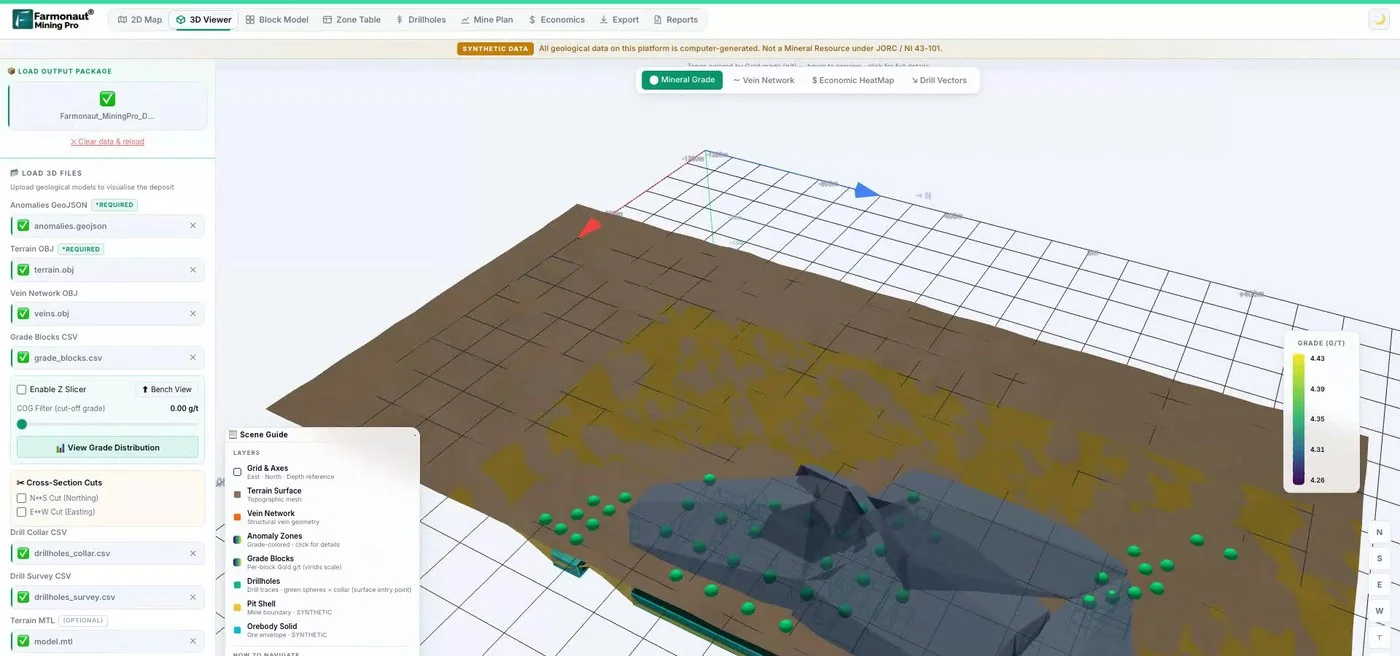
Mining Pro sample view, synthetic data
Keep reading
Sources
- US Bureau of Labor Statistics, PPI Iron and steel forging (PCU332111332111): data.bls.gov
- USGS, Mineral Commodity Summaries 2026: Iron and steel: pubs.usgs.gov
- Proclamation adjusting imports of aluminum and steel (June 2025), GovInfo: govinfo.gov
- ASTM A668/A668M-23, Steel forgings, carbon and alloy, for general industrial use: astm.org
- ASTM A788/A788M-23, Steel forgings, general requirements: astm.org
- ASTM A128/A128M-19, Steel castings, austenitic manganese: astm.org
- AZoM, AISI 4140 alloy steel datasheet: azom.com
- Forging, reference article (processes, open and closed die): en.wikipedia.org
- Mangalloy (Hadfield manganese steel), reference article: en.wikipedia.org
- 41xx steel, reference article: en.wikipedia.org
- Induction hardening, reference article: en.wikipedia.org
- Forging Industry Association: forging.org
Discussion
Questions, corrections or field experience? Share them below. First-time comments are reviewed before they appear, and your email is never published.
No comments yet. Be the first to add a question or your experience.

 GemSprout Metals Limited
 Qader Group
 Ileys General Trading
 SG Gold Mining LLC
 VRV Global Pte Ltd
 Omsri International FZE
 G.I.T.T.
 Jaunita Erss Ltd
 Almosi SARL
 SRK Consulting
 Berks Gold Limited
 Mwerezi Minerals Company Limited
 Mining SARL
 SenGold Invest SAS
 Sean Mining Limited
 NTS Group (Pty) Ltd
 Mine4Africa
 Lithspo Minerals Limited

 Client · Oregon, USA · Gold










