

Mining data · Use-case guide
Predictive Analytics in Mining: Use Cases and Results
Predictive analytics in mining forecasts faults, mill behaviour and drill targets from data. Named sites report gains of about 1% to 5% on throughput, recovery and water use, and one vendor case reports far larger maintenance savings. This guide sets out the sourced results, the data needed and a pilot payback calculator.
Key takeaways
- Freeport-McMoRan’s Bagdad machine-learning system (TROI) paired a plant digital twin with recommendations; the company targeted 100 million lb of extra copper in 2021 and 200 million lb in 2022 (Freeport investor presentation, January 2020).
- Antofagasta cut reactive maintenance from 41% of maintenance time before 2017 to 13% by mid-2025; haul truck availability rose from 78.8% to 82.7% (Annual Report, 2025).
- At Centinela, a recommendation system added 1% throughput and 0.75 percentage points of recovery; at Antucoya a leaching platform added 0.8 points and cut water use 5% (Antofagasta, 2025).
- Komatsu reports nearly 71% less unscheduled engine electrical-system maintenance at one mine over six months, a vendor case from one site (Komatsu, February 2024).
- In exploration, models learn from very few known deposits, so ranked targets need field checks (Daruna et al., arXiv, 2024).
In this article
- What predictive analytics means in a mine
- Predictive analytics in mining: where it is used, stage by stage
- Predicting where to drill: exploration targeting
- Predictive maintenance for haul trucks and fixed plant
- Mill and leach pad control: the largest reported gains
- Reported results from named sites
- What reactive-to-predictive maintenance looks like in one group's numbers
- Energy and water forecasting
- What a recovery or throughput gain is worth
- How to scope a pilot in six steps
- Where mining data analytics is heading
- Risks, limits and security
- Frequently asked questions
What predictive analytics means in a mine
Predictive analytics in mining means using past and live data to forecast what happens next: when a haul-truck engine will fail, how a mill will react to harder ore, or which part of a licence is most likely to hold mineralised rock. It is not one product. Named sites report gains of roughly 1% to 5% on measures such as throughput, recovery and water use (see the results chart below), with one vendor case reporting a far larger maintenance saving, and the best-documented gains come from plant control and maintenance, not from exploration.
A few terms first. Throughput is the tonnes of ore a plant processes in a set time. Recovery is the share of the metal in the ore that ends up in the saleable product. A SAG mill (semi-autogenous grinding mill) is the large rotating drum that crushes ore with the ore itself and steel balls. Flotation separates metal-bearing particles using air bubbles and reagents. A digital twin is a computer model of a plant or machine that is fed by live sensor data so that people can test changes on the model first. Model predictive control is a control method that predicts how a process will respond and adjusts settings ahead of the change.
This guide is written for consultants and technical managers who have to decide where a data project is likely to pay. It sets out the use cases that have named, sourced results, what each needs in data, where the evidence is thin, and how to size a pilot. It also answers a common mix-up: in computing, “data mining” means finding patterns in large datasets, while here the data comes from a mine. For the wider technology picture, our earlier overview on how technology is reshaping mining data covers the basics.
Predictive analytics in mining: where it is used, stage by stage
The table lists each use case in the order a mine meets it, from the first map to water and energy. The result column quotes only what the cited source states, and says when the source gives no figure. Almost all results are reported by the miner or a vendor, for one site and one period, so treat them as examples of the size of the effect, not as averages.
| Stage | What is predicted | Data used | Reported result |
|---|---|---|---|
| Exploration | Chance that a map cell hosts a deposit | Geology, geophysics, satellite bands, known deposits | No public hit rate; few known deposits to learn from (arXiv, 2024) |
| Haul trucks | Component faults before failure | Engine and temperature sensors | Unscheduled engine electrical-system maintenance down nearly 71% at one mine over six months (Komatsu, 2024) |
| Blasting | Ore and waste zones to blast separately | Geological models, ore characterisation | Less ore dilution at Los Pelambres; about 5% better fragmentation indicators (Antofagasta, 2025) |
| Grinding | Mill constraints and feed response | Mill speed, feed rate, water flow, slurry density | About 4% more unconstrained SAG hours than the year before at Los Pelambres (Antofagasta, 2025) |
| Flotation and concentrator | Recovery response to settings | Cell sensors, online analysers, ore type | Centinela: 1% more throughput and 0.75 percentage points more recovery (Antofagasta, 2025) |
| Heap leach | Recovery curves, irrigation effects | Solution flows, ore characterisation | Antucoya: 0.8 percentage points more copper recovery and 5% less water (Antofagasta, 2025) |
| Water and energy | Favourable sea conditions, mill energy peaks | Sea-condition and plant scheduling data | 2% more desalination plant utilisation at Los Pelambres (Antofagasta, 2025) |
One caution before the detail. A Rockwell Automation regional commercial manager told Mining Technology that the best approach is to understand the miner’s problem first and then pick the technology, and that artificial intelligence is only one option next to mature methods such as model predictive control (Mining Technology). That fits the table: several of the gains came from well-established control methods, with machine learning as one part.
Predicting where to drill: exploration targeting
Exploration is the stage with the least public evidence, because a model needs examples to learn from and there are few. Researchers building mineral prospectivity maps describe the task as linking large multi-source geospatial data to very few historical deposit observations, which makes complex models prone to overfitting, meaning they memorise the known deposits instead of learning a transferable pattern (Daruna et al., arXiv, 2024). In practice, the output is a ranked set of targets to check on the ground, not a discovery.
Satellite data is one of the inputs. The Copernicus Sentinel-2 pair of satellites carries a 13-band multispectral imager with 10 m resolution on the finest bands and a 5-day revisit (ESA). Bands that respond to iron oxides and clay minerals help map alteration, the chemical change that hot fluids leave in rock around some deposits. They do not see gold or copper directly, which is why a model output must be checked in the field. Our own satellite-based mineral detection service screens a licence area this way and delivers exploration targets in 5 to 20 business days; we report that early-stage exploration costs can fall by up to 80-85% . The results are exploration targets, ahead of any resource estimate. For two worked examples of the method on single commodities, see remote sensing in copper prospecting and AI tools for diamond exploration compared.
What to ask of any targeting model: how many known deposits it learned from, how it was tested on deposits it had not seen, and what share of its top-ranked targets held mineralisation when drilled.

▶ A plain-language look at what AI does in mineral exploration, where it fails and how to check a claim. · 4:37
Predictive maintenance for haul trucks and fixed plant
Predictive maintenance watches sensor data for the early signs of a fault, so that repairs happen at a planned stop instead of after a breakdown. Komatsu describes a case in which its MineCare system flagged repeated low exhaust-temperature events on one cylinder of a haul truck. An analyst traced the alerts to a likely faulty temperature sensor, judged it a lesser alarm, and had it replaced at the next scheduled service, before it damaged other engine parts. Komatsu says unscheduled maintenance can cost 3 to 10 times more than scheduled work, and reports that unscheduled maintenance on the engine electrical systems it monitored at that mine fell by nearly 71% between September 2019 and February 2020 (Komatsu case study, February 2024). It is a vendor case from one mine, so it shows what is possible, not what to expect.
Chart
Share of maintenance time spent on predictive work
Per cent of time, Antofagasta group maintenance activity
Antofagasta, the Chilean copper group, reports a broader move. Reactive work, meaning repairs after a failure, took 41% of maintenance time before 2017 and 13% by mid-2025; the group’s own best-practice level is 10%. Time spent on predictive work rose from 5% to 9% over the same period, against a best-practice level of 30% (Antofagasta Annual Report, 2025). In 2025 it put a predictive maintenance tool on the haul fleets at Los Pelambres and Antucoya. The tool uses statistical analysis and real-time engine monitoring to raise early alerts, and the group says it reduced critical engine failures at Los Pelambres; at Antucoya the effect was still being measured (Antofagasta Annual Report).
The same logic applies to crushers, conveyors, pumps and mill drives, where vibration, temperature and motor current are the usual inputs. The video below explains in plain language what an “AI mining app” does across these jobs.

▶ Explains the three jobs an AI mining app does: finding places to look, planning the mine and running it. · 3:52
Mill and leach pad control: the largest reported gains
Processing plants produce the most detailed public results, for a simple reason: a plant has hundreds of sensors, a steady flow of material and a clear output to measure.
Freeport-McMoRan’s Bagdad mine
Freeport-McMoRan piloted a machine-learning system at its Bagdad copper mine in Arizona and described it in its fourth-quarter 2019 investor presentation as Throughput and Recovery Optimization Intelligence (TROI). It pairs a digital twin of the processing plant with an algorithm that analyses historical data to predict results and give quality recommendations for real-time decisions, with the stated aim of more consistent operations. The company set targets of 100 million pounds of incremental copper production in 2021 and 200 million pounds in 2022 from the programme, with minimal capital (Freeport-McMoRan, January 2020). Those are company targets, not results, and the presentation gives no site-level throughput or recovery percentages. The detail worth copying is not the algorithm but the loop of data, prediction, recommendation and a human decision.
Model predictive control at Cadia and Lihir
Newcrest, now part of Newmont since the deal completed on 6 November 2023 (Global Mining Review), applied model predictive control at two sites with Rockwell Automation and Kalypso. At Cadia in New South Wales the team studied 12 months of circuit history, and the grinding application was designed, implemented and validated in nine months. At the Lihir plant in Papua New Guinea the flotation application took 12 months. Rockwell says both beat targets set at project launch, but it does not publish the targets or the gains (Rockwell Automation, December 2023). The useful numbers here are the time scales: about a year of history in, and nine to twelve months to a working controller.
Antofagasta’s plant systems
Antofagasta reports four plant systems in its 2025 results. At Centinela, a recommendation system for grinding and flotation raised throughput by 1% and recovery by 0.75 percentage points. At Los Pelambres, a machine-learning system added about 4% to unconstrained SAG mill operating hours compared with 2024, and SAG mill availability reached 94.4%. At Antucoya, a leaching platform lifted copper recovery by 0.8 percentage points, saved more than 1,000 tonnes of sulphuric acid and cut water use by 5% against 2024. A separate heap-leach monitoring system tracks recovery curves and flags underperforming modules (Antofagasta Annual Report, 2025). Group-wide, more than 50 projects approved in 2025 were reported to generate efficiency savings above US$80 million; the report does not say how much came from analytics.
Reported results from named sites
The chart puts the figures above on one scale. The measures differ (a drop in unplanned work, a rise in throughput, points of recovery), so read each bar on its own terms and do not add them up.
Chart
Reported gains from analytics projects at named sites
Per cent change, or percentage points where stated; measures differ and bases differ
What reactive-to-predictive maintenance looks like in one group’s numbers
Antofagasta publishes a before-and-after view of its maintenance system, which is rare. The group’s Maintenance Management System combines preventive, predictive and proactive work, so the gains in availability reflect the whole system and not predictive tools alone. Haul truck availability rose from 78.8% to 82.7% after the system was deployed, and reactive time fell from 41% to 13% of maintenance activity (Antofagasta Annual Report, 2025). The predictive share is still small at 9%, which shows how early most mines are on this path.
Chart
Antofagasta maintenance results, before and after
Per cent: reactive share, before 2017 to mid-2025; haul truck availability, before and after the maintenance system
Energy and water forecasting
Crushing and grinding can use up to half of a mine’s energy, according to ABB specialists quoted by Mining Technology, and a review of machine learning in mining energy puts the whole mining industry at over 10% of global industrial energy use (Frontiers in Energy Research, 2025). That makes grinding energy a natural target for forecasting. The same review lists the common methods: supervised models for failure prediction, long short-term memory networks for energy peaks, and reinforcement learning for ventilation and scheduling. It collects many published case studies; if you plan to rely on one of its percentages, follow the reference to the original paper first.
Water works the same way. Antofagasta uses predictive models of sea conditions to plan its Los Pelambres desalination plant and reports a 2% rise in plant utilisation and lower operating cost in 2025.
What a recovery or throughput gain is worth
A pilot is worth running only if the plausible gain pays for it. A one-point recovery gain sounds small, but on a large copper plant it is thousands of tonnes of metal. The calculator below turns your plant’s numbers into extra metal and a payback time. It uses copper as the example; for another metal, change the grade unit and the price.
Calculator
What is a recovery gain worth to your plant?
Enter your own plant numbers to see extra metal, its value and the pilot payback.
- Copper produced now (t per year): 42,500
- Value of extra copper per year (US$): $4,750,000
- Years to repay the cost: 0.21
Example values only, not a benchmark or a forecast. Prices are inputs: example, use today’s price (US$ per tonne of copper). The result is gross metal value before costs, royalties and treatment charges.
How to scope a pilot in six steps
- Pick one measurable loss. Unplanned truck hours, mill stops, recovery swings or acid use all work. Avoid “improve everything”.
- Check the data before the model. The Cadia project started with 12 months of circuit history. List the sensor tags, the logging interval, gaps and how lab results are matched to plant time.
- Fix the baseline and the metric in writing. Agree how recovery or availability is measured, over which period, and who signs off the result.
- Give operators the final say. Treat model output as a recommendation that experienced metallurgists and operators accept or reject, and log what happens.
- Run alongside current practice for a full cycle. Cover different ore types, shifts and seasons so that the gain is not a lucky month.
- Scale only on a measured result. Antofagasta’s own report says the Antucoya haul-truck effect was still being measured; treat unmeasured benefits as unproven.
Infographic
A pilot in 5 stages
- 1Pick a lossChoose one measurable cost such as unplanned hours or recovery swings.
- 2Check dataList sensors, history length and gaps.
- 3Set the baselineAgree the metric and the period in writing.
- 4Run with operatorsLet people decide on each recommendation.
- 5Measure and scaleScale only on a measured result.
The video below shows what organising maps, samples and targets in one system involves, which is the data groundwork behind steps 2 and 3.

▶ Shows what a mineral management system does with maps, samples and targets in one place. · 3:21
Where mining data analytics is heading
Three developments have support in the sources. First, tools are moving from alerts to recommendations: the systems at Centinela, Los Pelambres and Antucoya are called operational recommendation systems and suggest settings, with people deciding. Second, measurement is moving to the point of loading: Centinela piloted a shovel-mounted X-ray fluorescence analyser in 2025 that identifies copper and gold grades during loading so that trucks can be redirected, which aims to cut ore dilution. Third, companies are testing language models for operational support, with Antofagasta stating it is considering generative AI for this purpose (Antofagasta Annual Report, 2025). The sources give no independently audited result for any of these.
Risks, limits and security
- Few labels in exploration. With few known deposits, models overfit and ranked targets can mislead; insist on tests on unseen deposits.
- Vendor figures. Most published results come from the miner or the supplier. Ask for the baseline, the period and whether the site changed anything else.
- Process models drift. A model trained on one ore type can fail when the ore changes, so models need updating from plant feedback.
- Connected plants widen the attack surface. NIST’s guide to operational technology (OT) security covers how to secure industrial systems while meeting their reliability and safety needs (NIST SP 800-82 Rev. 3), and CISA and partners published guidance in August 2025 on building an OT asset inventory so owners know what is connected (CISA).
- Skills. Every successful case above paired metallurgists or maintenance planners with data staff. Budget for training and for time from the people who know the plant.
If this topic matters to you, read Harmony Gold Mining Stock: Tickers, Results, Dividends next.
Frequently asked questions
What is predictive analytics in mining?
It is the use of historical and real-time data to forecast events such as equipment failures, mill performance and the location of mineralisation, so that decisions are made before a problem or a cost occurs. The best-documented uses are predictive maintenance and plant optimisation.
What are examples of predictive analytics in the mining industry?
Antofagasta reports a predictive maintenance tool on haul trucks, a recommendation system that lifted throughput at Centinela, and a leaching platform that raised recovery at Antucoya. Freeport-McMoRan piloted its TROI machine-learning system at Bagdad, and Newmont’s Newcrest sites used model predictive control.
How does predictive maintenance work on mining trucks?
Sensors on the engine and drive record temperatures, pressures and other signals. Software compares them with normal patterns and raises an alert when a trend suggests a coming fault, so the part is replaced at a planned stop. Komatsu says unscheduled work can cost 3 to 10 times more than scheduled work.
How much can analytics improve mine recovery?
Antofagasta reports recovery changes of under one percentage point: 0.75 at Centinela and 0.8 at Antucoya. On a large plant that can be a lot of metal, which the calculator above lets you test with your own numbers.
What data do I need to start?
Start with sensor history and a clean link to lab or production results. The Cadia project used 12 months of circuit data. For maintenance you need equipment hours, fault records and sensor logs; for exploration you need geology, geophysics, sample results and the locations of known deposits.
What is a digital twin in mining?
A digital twin is a model of a machine, plant or circuit that is updated with live data. ABB experts quoted by Mining Technology say twins of grinding circuits let operators test different scenarios before changing the real plant.
Can predictive analytics find new mineral deposits?
It can rank areas for follow-up, but it cannot confirm a deposit. Research describes a shortage of known deposits to learn from, so results need field checks and drilling before any resource claim.
Is data mining the same as predictive analytics in a mine?
No. Data mining is the general computing practice of finding patterns in large datasets. Predictive analytics is one use of it, applied here to mine sensor, geology and production data.
Is it worth it for a small mine or a licence holder?
Often the first step is not a model but clean data and a measured baseline. Use the calculator to see whether a plausible gain covers the cost, and start with one problem. For a licence at the exploration stage, satellite screening of the area comes before any plant analytics.
What are the main risks of predictive analytics in mining?
The main ones are small training sets in exploration, model drift when ore changes, unaudited vendor claims, and cybersecurity on connected equipment. The risks section above lists them with sources.
This page is for information only. It is not investment advice. Results quoted come from the miners and suppliers named, for one site and one period, and are not averages or guarantees.
Farmonaut mining
Map your mining site from space
Consultants can screen a licence area with satellite data and receive exploration targets, ahead of any resource estimate.
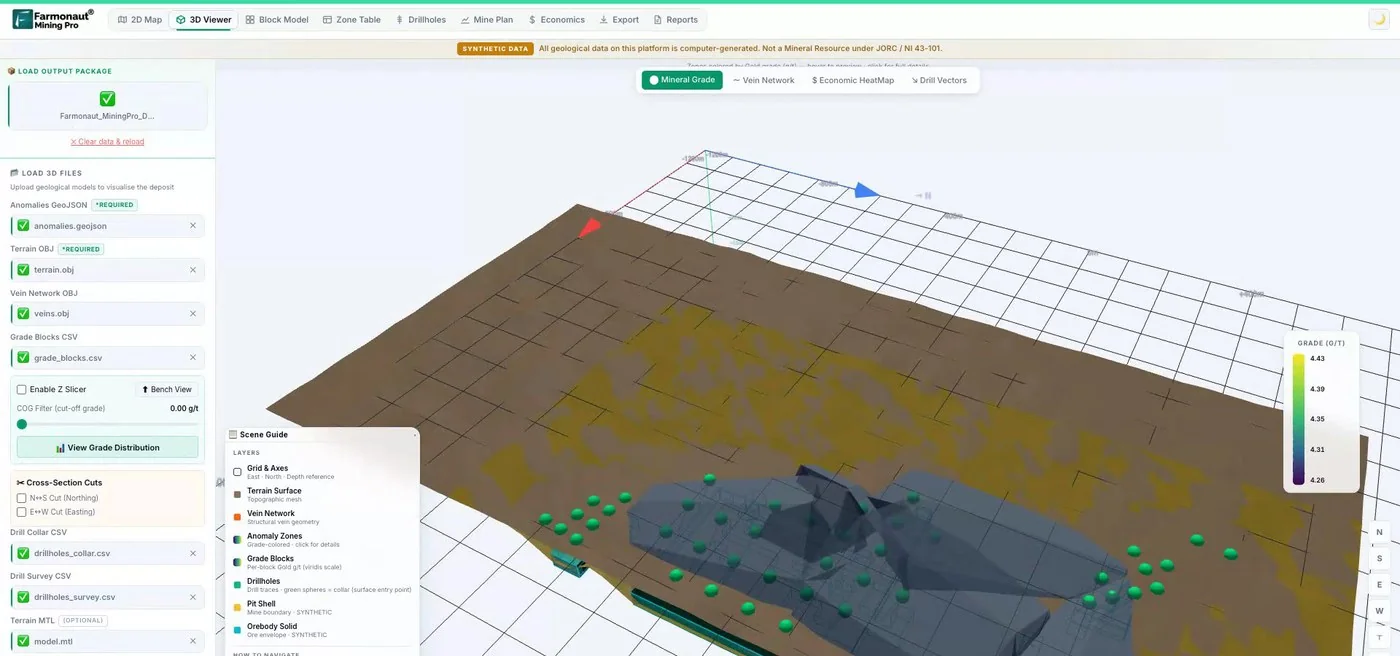
Mining Pro sample view, synthetic data
Keep reading
Sources
- Antofagasta plc, Annual Report and Financial Statements 2025: antofagasta.co.uk
- Komatsu, Early detection reduces unplanned maintenance (February 2024): komatsu.com
- Freeport-McMoRan, Fourth-quarter 2019 results presentation (January 2020): s22.q4cdn.com
- Rockwell Automation, Newcrest Mining exceeds project targets with MPC (December 2023): rockwellautomation.com
- Global Mining Review, Newmont completes acquisition of Newcrest (November 2023): globalminingreview.com
- Mining Technology, Assessing AI’s growing role in crushing and grinding: mining-technology.com
- Frontiers in Energy Research, Transforming mining energy optimization: a review of machine learning techniques and challenges (2025): frontiersin.org
- Daruna et al., GFM4MPM: Towards Geospatial Foundation Models for Mineral Prospectivity Mapping, arXiv (2024): arxiv.org
- ESA, Copernicus Sentinel-2 mission: esa.int
- NIST, SP 800-82 Rev. 3, Guide to Operational Technology (OT) Security (2023): csrc.nist.gov
- CISA, Asset inventory guidance for operational technology owners and operators (August 2025): cisa.gov
Discussion
Questions, corrections or field experience? Share them below. First-time comments are reviewed before they appear, and your email is never published.
No comments yet. Be the first to add a question or your experience.

 Dalgety Minerals Pty Ltd
 Vortex Minerals Pty Ltd
 Faith At Work (Pty) Ltd
 Geotech Mining Solutions plc
 Vulcan International Limited
 Kidepo Associates
 GKY Mining
 Alkimy SARL
 Double A Trading
 GemSprout Metals Limited
 Qader Group
 Ileys General Trading
 SG Gold Mining LLC
 VRV Global Pte Ltd
 Omsri International FZE
 G.I.T.T.
 Jaunita Erss Ltd
 Almosi SARL
 SRK Consulting
 Berks Gold Limited
 Mwerezi Minerals Company Limited
 Mining SARL
 SenGold Invest SAS
 Exploration consultancy · South Africa · Gold










