

Underground blasting · Buyer guide
Gassed Emulsions for Mining: Emulsifiers and Suppliers
A gassed emulsion is an ammonium nitrate water-in-oil explosive that is pumped into the hole and then sensitised with nitrogen bubbles made in place. Patent data put the emulsifier at 0.5-3% of the emulsion (1-2% preferred) and the gassing solution at about 0.4-0.6%.
Key takeaways
- Emulsifier dose: 0.5-3% of the emulsion by weight, 1-2% preferred (US Patent 6855219B2, granted 2005).
- Gassing solution: about 0.1-1% of the gassed product, 0.4-0.6% preferred (same patent).
- Zinc nitrate in the gassing solution made gassing about 18 times faster at +20°C and 36 times faster at +28°C in the patent’s lab runs, and lowered the solution’s freezing point from about -6°C to -20°C.
- US explosives use was 1.73 million metric tons in 2019; metal mining took 9% and coal 56% (USGS Minerals Yearbook 2019).
- Large suppliers include Orica (ASX: ORI), Dyno Nobel (ASX: DNL), Austin Powder and Maxam; ask each for a technical data sheet and water-resistance data.
In this article
- Introduction
- Market Scale: How Big Is This Segment
- Core Concept & Composition of Gassed Emulsions for Mining
- What Explosive Emulsifiers Actually Do
- Gassing Chemistry: Speed, Dosage, and Cold-Weather Handling
- Advantages of Gassed Emulsions for Underground Applications
- Underground Mining Explosive Suppliers: What to Screen For
- Key Performance Considerations for Underground Explosive Emulsifiers
- Operational Considerations for Gassed Emulsions Underground
- Comparative Table: Emulsifier Classes for Underground Use
- Emulsifier Dosage & Gassing Cost Calculator
- Farmonaut: Smarter Targeting Before You Blast
- Frequently Asked Questions: Gassed Emulsions for Mining
- Conclusion: Gassed Emulsions and What to Check Next
A gassed emulsion is an explosive built from an ammonium-nitrate-in-oil matrix, held together by an emulsifier at 1-2% of formulation weight, then aerated on-site with a gassing agent to drop density and set sensitivity. The bubbles are what make the matrix detonable: an ungassed emulsion is hard to initiate, and the gassed column is still fired with a primer or booster. That in-hole sensitising, plus water resistance, is why gassed emulsions are widely used in wet underground headings where ANFO struggles. Below: the chemistry, the dosage ranges, what the emulsifier actually does, and a cost tool you can run against your own bench numbers.
Introduction
Gassed emulsions for mining, built around purpose-formulated underground explosive emulsifiers, are the reason most metal and non-coal underground mines have moved away from ANFO for wet or deep headings. The emulsifier is a small fraction of the formula by weight, but it is the single ingredient that decides whether the ammonium-nitrate droplets stay suspended in the oil phase for the weeks a blast pattern sits loaded, or separate and fail. This guide covers the composition, the specific dosage and performance ranges published in patent literature, the market this sits inside, and how it connects to underground blast safety practice more broadly.
Every one of the underground mining explosive supplier searches that lead to this page — gassed emulsions, emulsifiers for emulsion explosive production, specialty emulsifiers, packaged and bulk explosive emulsifiers — points at the same technical question: how does the emulsifier chemistry and the gassing method change what a blast crew can safely load underground. That’s what this article answers, with sourced figures rather than generic marketing claims.
Gassing agents built on zinc nitrate cut gassing time by 18-fold at +20°C and 36-fold at +28°C versus uncatalyzed control formulations, per lab testing described in US Patent 6855219B2.
Market Scale: How Big Is This Segment
US commercial explosives consumption stood at 1.73 million metric tons in 2019, the most recent year the USGS Minerals Yearbook has published complete state- and industry-level figures for — later USGS explosives reports do not give the same state and industry detail. Of that total, coal mining accounted for 56% of US explosives sales, and a single state — Wyoming, at 25% of total US sales — dominated volume, reflecting Powder River Basin surface coal operations rather than underground hard-rock mining. Source: USGS Minerals Yearbook 2019, Explosives chapter.
Chart
US explosives sold for consumption
Million metric tons, 2015-2019
Chart
Where US explosives go
Share of US explosives sales by use, 2019 (%)
None of these figures answer a question every underground procurement team eventually asks: current-year US hard-rock and underground metal-mining-specific explosives consumption. That breakout is not published — the 2019 USGS figures are the most recent with state/industry detail, and 2024-2026 volumes broken out by underground versus surface use are not in any publicly accessible source at the time of writing. If you need that number for budgeting, the path is the same one that produced the 2019 figure: the USGS Minerals Yearbook, Volume 1, Explosives chapter, published roughly 18 months after year-end at pubs.usgs.gov/myb.
How US explosives use splits by sector
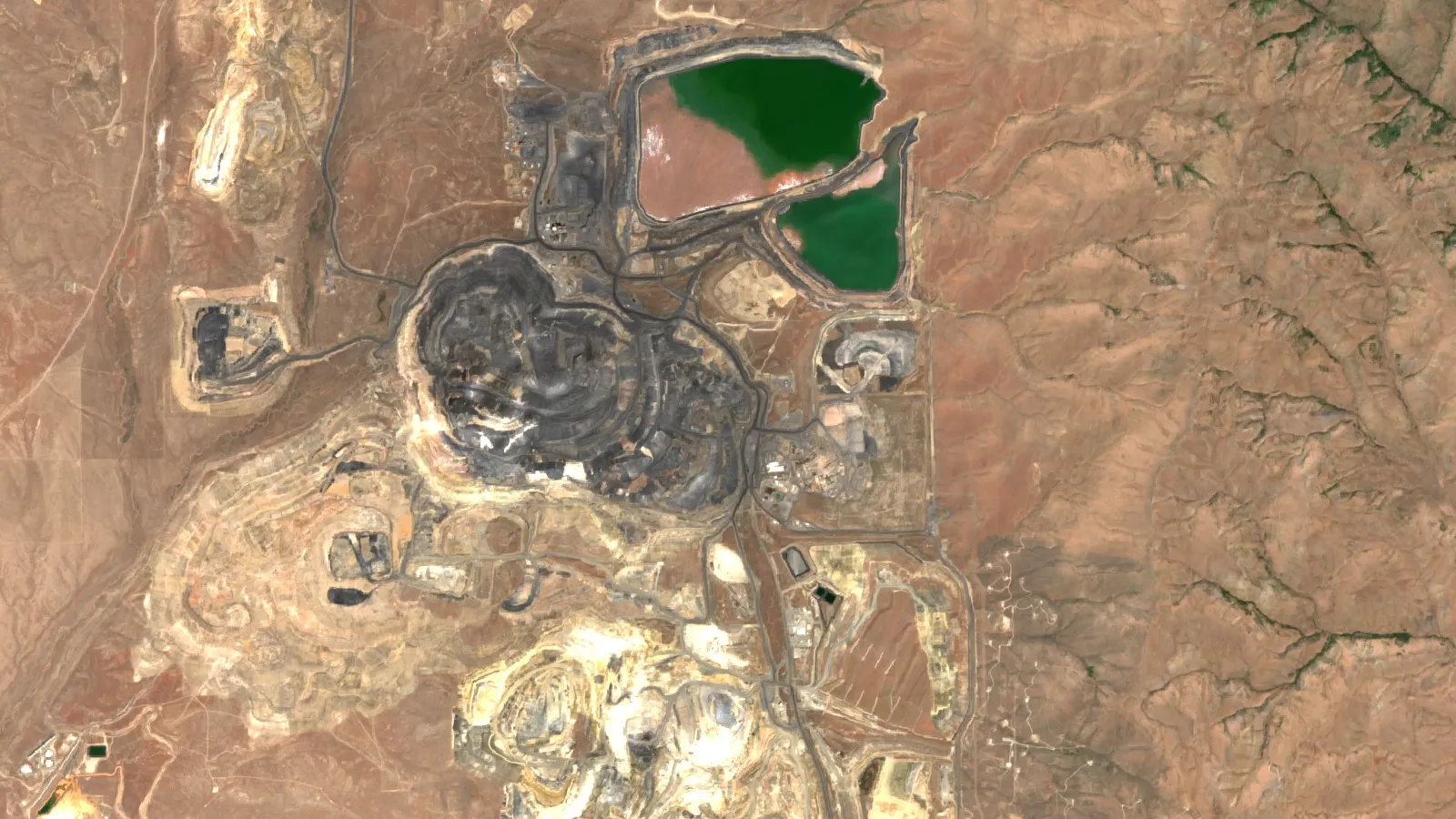
The USGS Minerals Yearbook for 2019 gives the most recent split by use. Coal mining took 56% of US explosives sales, construction 18%, quarrying and nonmetal mining 15%, metal mining 9% and other uses 3%. Wyoming led with 25% of sales; Nevada, West Virginia and Indiana together took another 20%. Nevada’s share comes mostly from metal mines, including the underground gold mines on the Carlin Trend shown in the image at the top of this page.
The same table shows the total moving between 1.65 and 2.04 million metric tons a year from 2015 to 2019, with blasting agents and oxidizers (the class that includes ANFO and bulk emulsions) making up about 98% of it. The USGS data source is the Institute of Makers of Explosives. The USGS Mineral Commodity Summaries 2026 adds that ammonium nitrate is one of the main US ammonia products and that no practical substitutes for nitrogen explosives and blasting agents are known.
Core Concept & Composition of Gassed Emulsions for Mining
Gassed emulsions for mining are water-in-oil explosive matrices manufactured for underground blasting where charge stability, water resistance, and controlled sensitivity all matter more than raw energy density.
1. Emulsion Matrix: The Foundation Layer
- Core composition: a continuous oil (hydrocarbon fuel) phase with a dispersed aqueous oxidizer-salt phase, held as a viscous water-in-oil emulsion.
- Emulsifier function: the emulsifier sits at the oil-water interface and prevents the two phases from separating over the shelf life of the product — this is the layer most of the target search terms on this page are asking about directly.
- Water resistance: because the oxidizer is locked inside water droplets surrounded by oil, gassed emulsions resist water ingress far better than ANFO, which is why they’re the default choice for damp or actively seeping underground headings.
2. Oxidizers and Sensitizers: Ignition & Energy Control
- Oxidizer system: ammonium nitrate is the primary oxidizer, frequently blended with sodium nitrate or calcium nitrate to hold performance across a wider temperature and water-content range.
- Sensitizer system: gas bubbles (see below) are the primary sensitizing mechanism in a gassed emulsion — this is what separates “gassed” emulsions from chemically sensitized or solid-sensitized (microballoon) emulsion variants.
3. Gassing: Deliberate Introduction of Gas Bubbles
- What is gassing: the deliberate introduction of gas bubbles — generated in-hole by a chemical gassing agent reacting with the emulsion, most commonly a nitrite-based agent activated by an accelerator such as zinc nitrate — into the emulsion after it is pumped into the borehole.
- How it works: the gas bubbles lower bulk density, reduce frictional and impact sensitivity relative to an ungassed matrix, and create the hot spots the column needs to detonate reliably from its primer.
- Why it matters: gassing lets a blast crew tune density, and therefore energy per hole, at the loading stage rather than at the manufacturing plant — critical when borehole diameter, rock competency, and water conditions change hole to hole in the same heading.
Uniform microbubble distribution is the single biggest lever on blast predictability. Uneven gassing produces uneven density along the column, which shows up downstream as misfires or fragmentation gaps — validate bubble uniformity at the QC bench, not just finished-hole density.
What Explosive Emulsifiers Actually Do
This is the term at the center of most of the searches this page targets — emulsifiers for emulsion explosive production, specialty emulsifiers for explosives, emulsifier for emulsion explosives manufacturer. The emulsifier is a surfactant, typically a polyisobutylene succinic anhydride (PIBSA)-derivative or sorbitan-ester chemistry, dosed to hold the water-in-oil structure together against heat, pressure, and time.
Chart
Inside one emulsion recipe
Run 1 of US Patent 6855219B2, % by weight
Two dosage ranges recur across explosive-emulsifier patent literature: a broad working range of 0.5-3% of formulation weight, and a preferred, tighter range of 1-2% for most commercial packaged and bulk formulations, per US Patent 6855219B2. Underdosing risks phase separation before the charge is even loaded; overdosing adds cost without a proportional stability gain, and can interfere with the gassing reaction itself. Commercial emulsifier chemistries such as Clariant’s ARKOMON® line are formulated specifically around PIBSA-based structures to hit water-resistance and shelf-stability targets while staying inside that dosage band — International Mining coverage of ARKOMON emulsifiers covers the commercial formulation side in more detail than patent filings typically do.
“Specialty” emulsifiers — the term behind one of this page’s target queries — generally refers to formulations engineered for a specific failure mode: extended shelf life at high ambient temperature, compatibility with a particular gassing chemistry, or performance in high-water-content ore bodies. There’s no single industry-standard specialty-emulsifier spec; what changes between suppliers is the surfactant backbone and the co-additive package, and that’s a formulation detail suppliers publish in technical data sheets rather than public research, so the right move for procurement is to request the TDS and third-party water-resistance test data directly from the supplier rather than relying on marketing copy.
What a real emulsion recipe looks like
The test runs in US Patent 6855219B2 (filed 2002 by ETI Holdings, granted 2005, now expired) list full recipes. Run 1, for example, used 76.3% ammonium nitrate, 16.9% water, 5.2% diesel and 1.4% PIBSA-based emulsifier. Lower-water runs used about 82.8% ammonium nitrate, 10.5% water, 5.5% oil and 0.9% emulsifier. The oxidizer is almost the whole mass; the emulsifier is about one part in a hundred, yet it decides how long the product stays stable after loading (its “sleep time”).
Clariant described its ARKOMON emulsifiers as PIBSA (polyisobutylene succinic anhydride) derivatives and sorbitan esters, and noted that the choice of emulsifier changes the rate of chemical gassing and the emulsion’s viscosity during storage (International Mining, 2012). That is why the emulsifier and the gassing solution should be tested together, not bought as separate parts.
Gassing Chemistry: Speed, Dosage, and Cold-Weather Handling
The gassing solution — the chemical agent that generates bubbles once pumped into the emulsion matrix — has its own dosage and performance envelope, distinct from the emulsifier’s. Per US Patent 6855219B2, the optimal gassing solution application rate sits at 0.4-0.6% of formulation weight. Below that range, gassing is incomplete or slow; above it, excess gassing agent can over-sensitize the column or waste material without a further density benefit.
Gassing speed is temperature-dependent, which is the main reason underground sites in different climates run different accelerator packages. Using a zinc-nitrate-based accelerator against an uncatalyzed control, the same patent’s lab testing recorded an 18-fold improvement in gassing speed at +20°C and a 36-fold improvement at +28°C. The two figures come from different test pairs, so they show that zinc nitrate speeds gassing at both temperatures, not an exact trend with heat. On the cold end, adding zinc nitrate (15% w/w, with 15% sodium nitrite) lowered the gassing solution’s freezing point from about -6°C to about -20°C, so the solution can be used in colder conditions without heating the gassing system. Note that this is the gassing solution, not the finished emulsion.
This is the technical core behind the “gassed emulsions for mining” and “gassed emulsion explosive suppliers” queries this page targets: gassing chemistry, not the base emulsion recipe, is what a supplier is actually differentiating on when they claim faster loading cycles or better hot-hole performance.
Advantages of Gassed Emulsions for Underground Applications
Gassed emulsions are the standard choice underground because they solve five problems ANFO and dry-loaded products don’t:
- Water resistance: the water-in-oil matrix physically isolates the oxidizer from ambient water, unlike ANFO which dissolves and loses performance in wet holes.
- Density control at the point of loading: gassing lets a crew set density in-hole, matching energy output to rock competency hole by hole rather than committing to one plant-set formulation.
- Reduced accidental-initiation risk: the matrix is not sensitised until it is gassed in the hole, which keeps it less sensitive to shock, friction and impact during transport, mixing and pumping.
- Column stability in confined, irregular boreholes: the emulsion holds its structure in narrow or off-axis holes where a dry product can bridge or segregate.
- Lower overbreak and flyrock: controlled gas volume tunes energy distribution to the rock rather than over-delivering brisance everywhere.
More Benefits:
- Faster mucking and backfill cycles from more predictable fragmentation
- Reduced dust and vibration relative to legacy dry-blasting agents
- Bulk-pumpable formats reduce manual handling versus packaged cartridge product on long rounds
Running a single emulsifier/gassing recipe across every rock type and hole temperature. The 18-fold to 36-fold gassing-speed swing across a modest 8°C range above shows how sensitive these systems are to face temperature — match the accelerator package to actual heading conditions, not a plant-average assumption.
Underground Mining Explosive Suppliers: What to Screen For
Anyone searching for an underground mining explosive supplier or a gassed emulsion explosive supplier is usually evaluating one of three purchase types: bulk emulsion delivered and pumped on-site, packaged/cartridge emulsion for smaller or specialty headings, or the emulsifier and gassing-agent additive package sold separately to a mine that blends its own emulsion. The right supplier depends on which of these you’re buying.
| Purchase type | What to request from the supplier | Typical fit |
|---|---|---|
| Bulk pumped emulsion | On-site MMU (mobile manufacturing unit) capability, gassing agent compatibility, water-resistance TDS | High-volume underground metal/non-metal mines with dedicated loading crews |
| Packaged/cartridge emulsion | Shelf-life data at your storage temperature, cartridge diameter range, detonator compatibility | Smaller headings, development drives, sites without bulk trucks |
| Emulsifier + gassing agent (self-blend) | Dosage range data (see 0.5-3% band above), accelerator chemistry, batch consistency QC data | Larger operations blending emulsion in-house at a surface plant |
Whichever category applies, ask for the same three things every time: a current technical data sheet with emulsifier dosage and gassing-solution application rate, third-party or in-house water-resistance and cold-weather performance data (freezing point, gassing time at your site’s ambient range), and batch traceability documentation — this last one is a US regulatory expectation for explosives handling generally, not a supplier nicety.
Gassed emulsion explosive suppliers to know
These are large commercial explosives makers that sell bulk and packaged emulsions to mines. The list uses public company pages and the USGS 2019 list of US explosives producers; it is not a ranking and not an endorsement.
- Orica Limited (ASX: ORI): Melbourne-based, formerly ICI Australia, and one of the world’s largest makers of commercial explosives and blasting systems (company profile). Orica USA Inc. is on the USGS list of US producers.
- Dyno Nobel (ASX: DNL): the company formerly called Incitec Pivot, now trading under the Dyno Nobel name; its site describes bulk emulsion systems for metals, coal and quarry customers (Dyno Nobel).
- Austin Powder Co.: a privately held US explosives maker on the USGS producer list (Austin Powder).
- Maxam North America, Inc.: the US arm of Spain’s Maxam, also on the USGS producer list.
For a self-blend plant, the emulsifier itself usually comes from specialty chemical makers (PIBSA chemistry), and the gassing solution is often made on site from sodium nitrite and an accelerator. Whoever you buy from, compare offers on the same basis: emulsifier type and dose, gassing-solution rate, gassing time at your rock temperature, water resistance and sleep time.
Key Performance Considerations for Underground Explosive Emulsifiers
- Gas volume & bubble size: fine, uniform microbubbles produce repeatable detonation and even energy distribution; the 0.4-0.6% gassing-solution application rate cited above is the starting point for tuning this, not a fixed universal setting.
- Sensitivity & initiation: the gassed column must detonate reliably from its primer or booster without becoming sensitive to incidental shock or friction during mixing and pumping.
- Fragmentation vs. burden: explosive weight and borehole burden must match rock-mass strength and bedding to hit target fragmentation without excess flyrock.
- Temperature stability: the emulsifier dosage (1-2% preferred) and gassing-agent chemistry both need validation across the actual temperature range the product will see, from cold surface storage to a hot underground face — the gassing-solution freezing point and the gassing-time figures above are the kind of spec sheet numbers to request from any supplier bidding your site.
The global mining explosives consumables market was estimated at $12,479.64 million for 2025, with a forecast reaching $24,053.79 million by 2035 — a projected 6.78% CAGR over 2025-2035. That’s an industry-wide growth forecast, not a site-specific budget figure; use it to gauge supplier investment trends, not to price your own contract.
Operational Considerations for Gassed Emulsions Underground
A. Mixing and Loading
- Emulsion formulations must be compatible with the mine’s mixing trucks or fixed underground loading systems — confirm this against the supplier’s TDS before the first bulk delivery, not after a failed load.
- Equipment calibration prevents bubble collapse or microbubble coalescence during high-pressure pumping.
- Consistent gas distribution during mixing is what keeps a low-density, high-energy column stable inside each blast hole.
B. Safety and Handling Protocols
- Storage temperature must stay inside the tolerance range for the chosen formulation — the -20°C freezing-point figure above is one documented reference point, and every supplier TDS should state its own product’s range.
- Crew training must cover instability recognition, correct initiation sequencing, and emergency shutdown procedures.
C. Environmental & Rock Mass Effects
- Fragmentation pattern governs mucking efficiency, backfill compaction, and stope cycle time.
- Selecting gassing rate to match rock mass reduces secondary blasting needs and controls dust and vibration near sensitive infrastructure.
D. Quality Control & Regulatory Compliance
- Routine on-site sampling for density, viscosity, and gas content verifies batch-to-batch consistency.
- Documentation of formulation details and blast logs is required for traceability under US explosives-handling regulation. Specific technical dosage or performance standards for emulsifiers under ATF or MSHA rules are not consolidated in a single public web source — the applicable requirements sit inside Title 27 CFR and MSHA guidance documents, and a compliance officer or your explosives supplier’s regulatory contact is the right first call to confirm current requirements for your site.
Which US rules apply underground
In US metal and nonmetal mines, explosives storage, transport and use fall under 30 CFR Part 57, Subpart E (sections 57.6000 to 57.6960). It covers magazine and underground storage, blasthole checks, primer protection, misfire waiting periods and site security during loading (eCFR, 30 CFR Part 57). Licensing, magazine construction and record keeping for explosive materials are set by ATF under 27 CFR Part 555 (eCFR, 27 CFR Part 555). The US Bureau of Reclamation field manual notes that in wet holes an emulsion, water gel, slurry or gelatin dynamite should be used instead of ANFO (USBR Engineering Geology Field Manual, ch. 19).
Routine non-destructive monitoring — density, viscosity, and gassing-time checks at the bench before a batch goes underground — is the practical way to catch the phase-separation and over/under-gassing failure modes described above before they reach a loaded hole.
Comparative Table: Emulsifier Classes for Underground Use
This compares emulsifier and gassing-agent parameters by function rather than by brand name — the specific dosage and rate figures come from published patent literature (US 6855219B2) rather than manufacturer marketing claims, so treat this as a screening reference for supplier TDS conversations rather than a finished product spec.
| Parameter | Broad working range | Preferred/optimal range | Why it matters underground |
|---|---|---|---|
| Emulsifier dosage | 0.5-3% of formulation weight | 1-2% of formulation weight | Below range risks phase separation in-hole; above range adds cost with no added stability |
| Gassing solution application rate | Not specified below 0.4% or above 0.6% as optimal | 0.4-0.6% of formulation weight | Sets in-hole density and sensitivity |
| Gassing speed at +20°C (zinc nitrate accelerated vs. control) | Baseline: control formulation | 18-fold faster with zinc nitrate | Determines loading-to-fire cycle time in warm headings |
| Gassing speed at +28°C (zinc nitrate accelerated vs. control) | Baseline: control formulation | 36-fold faster with zinc nitrate | Deep, hot faces gassed even faster relative to control |
| Freezing point (zinc nitrate gassed emulsion) | — | -20°C | Sets cold-climate storage and handling limits |
Emulsifier Dosage & Gassing Cost Calculator
Enter your batch size and target dosage percentages to estimate emulsifier and gassing-agent quantity and material cost per batch, using the 0.5-3% and 0.4-0.6% ranges cited above as your starting guide.
Assumes flat per-kg pricing you enter yourself and does not include labor, plant overhead, or ANFO/other explosive components — it estimates additive material cost only. Emulsifier and gassing-agent unit prices vary by supplier and are not published in market research summaries; enter your own quoted rates for an accurate figure.
Calculator
How much emulsifier and gassing solution does a batch need?
Enter your batch size, doses and quoted prices.
- Gassing solution needed (kg): 50
- Emulsifier cost (US$): $600
- Gassing solution cost (US$): $75
- Additive cost per tonne of emulsion (US$): $68
Example values only, not a benchmark. Dose ranges from US Patent 6855219B2 (emulsifier 0.5-3%, gassing solution 0.4-0.6% preferred). Prices are inputs: example, use today’s price from your supplier quote. Additive cost only; excludes oxidizer, fuel, labour and equipment.
Farmonaut: Smarter Targeting Before You Blast
Explosive formulation decides how safely and efficiently a blast performs once a hole is loaded. What decides whether that hole should be drilled at all is exploration targeting — and that’s where Farmonaut‘s satellite-based mineral intelligence fits, ahead of the emulsion and the emulsifier entirely.
- 🌎 Satellite-based mineral detection: multispectral and hyperspectral satellite data identifies mineral-rich zones, alteration halos, and structural targets across large terrains without ground disturbance. Learn more about satellite-based mineral detection
- 🚀 AI-driven 3D prospectivity mapping: for deep, complex orebodies, satellite-driven 3D mineral prospectivity mapping predicts vein structures, host-rock associations, and drilling angles. Explore satellite-driven 3D prospectivity mapping (PDF)
- 📈 Fewer wasted holes: better pre-drill targeting means fewer exploratory holes drilled and blasted on ground that turns out barren.
- ♻ ESG-aligned exploration: remote-sensing methods reduce ground disturbance, water use, and carbon footprint relative to blanket drill programs.
- 💼 Simple client workflow: supply an area of interest and mineral targets; results return in days. Get a personalized mining quote
Pinpoint new prospects, evaluate known deposits, or verify license areas — directly from your browser.

▶ What an AI mining app does: finding places to look, planning the mine and running it. · 3:52
Combine sharper exploration targeting with the blast-chemistry data above. Contact Us to discuss your site.
Frequently Asked Questions: Gassed Emulsions for Mining
Q1: What is the typical emulsifier dosage in emulsion explosives?
Published patent literature gives a broad working range of 0.5-3% of formulation weight, with a preferred range of 1-2% for most commercial gassed-emulsion products (US Patent 6855219B2). Actual dosage depends on the specific surfactant chemistry and required shelf life — confirm against your supplier’s technical data sheet.
Q2: How much faster does an accelerated gassing agent work?
Using zinc nitrate as an accelerator, lab testing recorded gassing speeds 18 times faster at +20°C and 36 times faster at +28°C compared to an uncatalyzed control formulation (US Patent 6855219B2). The optimal gassing-solution application rate in that same testing was 0.4-0.6% of formulation weight.
Q3: Can gassed emulsions handle water-saturated or flooded underground stopes?
Yes. The water-in-oil matrix physically isolates the ammonium-nitrate oxidizer from ambient water, giving gassed emulsions materially better water resistance than ANFO. Formulations with hydrophobic surfactant layers, such as Clariant’s ARKOMON® emulsifiers, are specifically engineered for this. See International Mining’s coverage of ARKOMON emulsifiers.
Q4: How big is the underground mining explosives market in the US?
US commercial explosives consumption was 1.73 million metric tons in 2019 (most recent published USGS data), with coal mining at 56% of sales and Wyoming alone at 25% of total US volume. Metal mining took 9% of that total.. Newer volumes broken out by underground versus surface use are not yet published — check the USGS Minerals Yearbook Explosives chapter for the latest release.
Q5: What role does Farmonaut play in the context of underground explosives?
Farmonaut does not manufacture or supply explosives. We provide satellite-based mineral detection and AI-driven prospectivity analysis for early-stage exploration, so mining teams target their blasting programs with more confidence and less unnecessary ground disturbance. Learn more about Farmonaut’s mineral detection services.
Q6: Where can stakeholders get technical assistance or mining site mapping support?
Miners, engineers, and investors can map their mining site using Farmonaut’s web-based GIS dashboard, or contact us at Farmonaut Contact for customized analytics and site recommendations. For underground explosive emulsifier equipment sourcing specifically, see our related coverage of emulsifiers for underground explosives mining equipment.
Who supplies gassed emulsion explosives?
Large suppliers include Orica (ASX: ORI), Dyno Nobel (ASX: DNL), Austin Powder and Maxam. The 2019 USGS yearbook lists their US units among domestic explosives producers. Most supply bulk emulsion through mobile manufacturing units and packaged product for smaller headings.
Which emulsifier is used in emulsion explosives?
Most commercial emulsifiers are PIBSA (polyisobutylene succinic anhydride) derivatives, often blended with sorbitan esters such as sorbitan monooleate (SMO). The patent test recipes used PIBSA-based emulsifier at about 0.9-1.4% of the emulsion.
What is the difference between bulk and packaged emulsion?
Bulk emulsion is pumped from a truck or underground loader and gassed in the hole. Packaged emulsion comes in cartridges, already sensitised, and suits small headings, development drives and sites without bulk equipment.
Does zinc nitrate change the freezing point of the gassing solution?
Yes. In US Patent 6855219B2, a solution of 15% sodium nitrite froze at about -6°C; adding 15% zinc nitrate lowered that to about -20°C.
Conclusion: Gassed Emulsions and What to Check Next
Gassed emulsions for mining, built on properly dosed underground explosive emulsifiers, remain the standard for wet, deep, or irregular underground headings because the emulsifier-plus-gassing-agent system delivers water resistance, in-hole density control, and in-hole sensitising in one product. The numbers worth carrying forward: 1-2% preferred emulsifier dosage, 0.4-0.6% gassing-solution rate, and gassing-speed gains as large as 36-fold with an accelerated formulation at +28°C — all sourced to US Patent 6855219B2 above.
- Durable checklist: request dosage data, water-resistance TDS, and batch traceability documentation from any supplier before committing to bulk or self-blend supply.
- Refresh path: US-specific consumption volumes update via the USGS Minerals Yearbook Explosives chapter roughly 18 months after year-end; market-size figures update via the industry reports cited throughout this piece.
- Pair blast chemistry decisions with better pre-drill targeting to cut the number of holes drilled on ground that doesn’t pay off.
Ready to pair sharper mineral targeting with your blasting program?
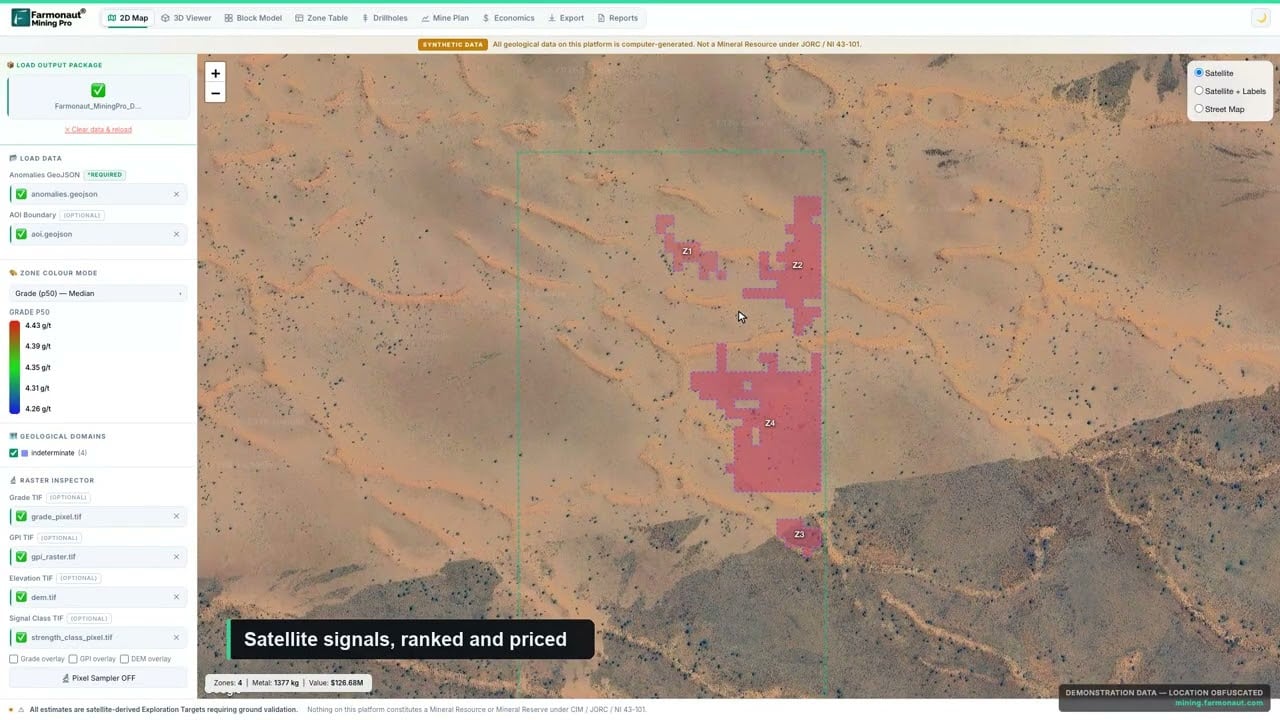
▶ A short tour of Farmonaut Mining Pro, which turns a licence boundary into a geological and economic picture. · 4:56
This page is for information only. It is not engineering, legal or investment advice. Explosives must be stored, handled and fired only by licensed people under the rules of your regulator and your supplier’s instructions.
Farmonaut mining
Map your mining site from space
Consultants can compare dated satellite views of a mine or licence area before planning drilling and blasting work.

Mining Pro sample view, synthetic data
Keep reading

Sources
- US Patent 6855219B2, Method of gassing emulsion explosives (ETI Holdings, 2005): patents.google.com
- USGS Minerals Yearbook 2019, Explosives: pubs.usgs.gov
- USGS Mineral Commodity Summaries 2026, Nitrogen (fixed)-ammonia: pubs.usgs.gov
- eCFR, 30 CFR Part 57 (Underground Metal and Nonmetal Mines): ecfr.gov
- eCFR, 27 CFR Part 555 (Commerce in Explosives): ecfr.gov
- US Bureau of Reclamation, Engineering Geology Field Manual, ch. 19: usbr.gov
- International Mining, New Clariant emulsifiers for explosives (2012): im-mining.com
- Orica Limited company profile: en.wikipedia.org
- Dyno Nobel, company site: dynonobel.com
- Austin Powder, company site: austinpowder.com
Discussion
Questions, corrections or field experience? Share them below. First-time comments are reviewed before they appear, and your email is never published.
No comments yet. Be the first to add a question or your experience.

 Sahara Mining
 Sean Mining Limited
 NTS Group (Pty) Ltd
 Mine4Africa
 Lithspo Minerals Limited
 Tintina Mining Group
 Dalgety Minerals Pty Ltd
 Vortex Minerals Pty Ltd
 Faith At Work (Pty) Ltd
 Geotech Mining Solutions plc
 Vulcan International Limited
 Kidepo Associates
 GKY Mining
 Alkimy SARL
 Double A Trading
 GemSprout Metals Limited
 Qader Group
 Ileys General Trading
 SG Gold Mining LLC
 VRV Global Pte Ltd
 Omsri International FZE
 G.I.T.T.
 Jaunita Erss Ltd
 SRK Consulting
 Berks Gold Limited

 Client · Tanzania · Gold










