

Reviewed September 2026 against MSHA (Mine Safety and Health Administration) fatality and blasting-safety data, and OSMRE (Office of Surface Mining Reclamation and Enforcement) blasting regulations.
Try it: Run your own numbers →
Table of Contents
- Mine Risk Management: The Short Answer
- The Human Toll: What MSHA’s Numbers Show
- Building a Mine Safety Management System
- Key Risks in Mine Blasting
- Blasting and Vibration Risk Management: The PPV Standard
- Blast Zones, Flyrock Distance, and Damage Risk Assessment
- Critical Safety Protocols for Every Blast
- Calculator: Estimate Your Minimum Blast Exclusion Zone
- Technology for Blasting Safety and Monitoring
- Comparative Table: Blasting Safety Technologies
- Regulatory Landscape: MSHA and OSMRE Requirements
- Satellite Monitoring for Mine Risk Management
- Training and Safety Culture
- What Changes Next in Mine Blasting Safety
- FAQ: Mine Blasting Safety and Risk Management
- Try it: Run your own numbers
Mine Risk Management for Blasting: What Actually Reduces Injuries
Mine risk management for blasting comes down to three controls that MSHA’s own incident data shows work: enforce a blast perimeter set at 1.5 times the largest flyrock distance ever recorded at that site, keep ground vibration under the 2.0 inch/second peak particle velocity (PPV) threshold near structures, and build a documented mine safety management system that ties pre-blast planning to post-blast review. Between 2010 and 2025, MSHA recorded 1,112 blasting-related injuries across US surface and underground mines, and 281 of those — 25.3% — trace directly to flyrock and blast-area security failures. That single number is the case for why blast-radius discipline matters more than any other control on this list.
This article covers the full scope of blasting risk management: the current fatality trend, how to size a mine safety management system, the vibration and flyrock thresholds that regulators actually check, and a calculator you can use to test your own exclusion-zone math against MSHA’s 1.5x rule. Every figure below carries its source and its date, plus how to pull a fresher number when this one ages out.

The Human Toll: What MSHA’s Numbers Show
MSHA’s preliminary count puts total US mining deaths at 33 for 2025, up from 26 in 2024 — both figures from MSHA’s fatality reports search tool, which is the authoritative source and is updated as investigations close (MSHA Fatality Reports Search). Of the 33 deaths recorded for 2025, 25 occurred at metal/nonmetal operations and 8 at coal operations, according to MSHA’s 2025 fatalities safety alert (MSHA 2025 Fatalities Alert). The same alert flags a sharp early-year spike: between January 3 and March 5, 2025, MSHA recorded 10 fatalities, a rate the agency describes as three times the prior year’s pace over the same window, including one death involving explosives.
Blasting-specific fatalities are a smaller slice of the total but disproportionately violent in mechanism. MSHA and CDC data covering 2010 to 2025 attribute 7 miner deaths specifically to flyrock, misfires, and toxic fumes from blasting operations (MSHA Blasting Safety). Over that same 15-year window, the agency logged 1,112 blasting-related injuries in total, with 281 (25.3%) caused specifically by flyrock and failures in blast-area security — not misfires, not toxic fumes, but rock leaving the intended blast zone or people being inside a perimeter that wasn’t held.
None of MSHA’s published tables normalize these injury counts against the number of production blasts fired or active blasting operations per year, so there is no published “injury rate per blast” figure to cite here. If you need that ratio for your own site or region, the method is to divide your own logged blast count (from shot records or a blast-log register) by injuries reported to MSHA for the same period — the raw injury and fatality counts are refreshed continuously at the two MSHA links above.
Building a Mine Safety Management System
A mine safety management system is the documented framework that connects blast planning, explosive handling, perimeter control, monitoring, and post-incident review into one auditable process — rather than treating each blast as a standalone event. MSHA does not publish a single named certification for “mine safety management systems” the way ISO administers ISO 45001, and no adoption-rate or compliance-percentage figure for MSMS uptake among US operations is published in the sources reviewed for this article. If your organization needs that benchmark, the method is to check your state mining agency’s inspection database alongside your own internal audit records, since MSHA’s own top-10 citation list is compiled per standard, not per management-system framework (MSHA Top 10 Citations, 2024).
What MSHA does publish is which standards get cited most, and that list is a practical proxy for where safety-management systems break down operationally. The 2024 top-10 list includes MSHA’s April 18, 2024 rule lowering miners’ exposure limits to respirable crystalline silica — a rule that reshaped ventilation and dust-control requirements across both coal and metal/nonmetal operations industry-wide. A working mine safety management system should treat that rule the same way it treats blasting standards: as a control with a compliance deadline, an inspection checkpoint, and a named owner, not a policy binder that sits untouched between audits.
At minimum, a functioning system should document: (1) pre-blast geological and structural surveys, (2) the calculated and as-fired blast design for every shot, (3) perimeter and evacuation confirmation logged before each detonation, (4) post-blast vibration and flyrock-distance records, and (5) a corrective-action log tied to any deviation. Every one of these five elements maps to a citation category MSHA already inspects for, which is why building the system around MSHA’s own published categories — rather than a generic ISO 45001 template — keeps the paperwork load pointed at what inspectors actually check.
Key Risks in Mine Blasting
- Flyrock: Miscalculated charges or defective initiation systems propel rock fragments beyond the planned blast radius. This is the single largest documented cause category in MSHA’s blasting injury data — 281 of 1,112 incidents (25.3%) from 2010–2025.
- Ground vibration: Excessive seismic energy transmitted through rock can crack foundations and weaken structures outside the blast zone; this is the exact hazard the PPV standard below exists to control.
- Airblast (overpressure): Air-transmitted shock waves from a blast can rattle or damage nearby structures and cause hearing risk to unprotected personnel.
- Misfires and unintentional detonations: Equipment malfunction, wiring errors, or handling mistakes during loading can trigger unplanned initiation.
- Toxic fumes: Incomplete detonation of explosives can release nitrogen oxide gases into confined underground workings, one of the three named causes in MSHA’s 7-fatality blasting figure above.
- Equipment damage: Mobile and fixed assets within the blast radius are exposed to flyrock impact and vibration-induced stress.
- Human error and blast-area security failure: Incomplete perimeter checks, premature area re-entry, or skipped evacuation confirmation are procedural failures, not equipment failures, and sit inside that same 281-incident flyrock/security category.

Blasting and Vibration Risk Management: The PPV Standard
The peak particle velocity standard is the single most load-bearing number in blasting and vibration risk management. The US Bureau of Mines established 2.0 inches per second as the safe PPV limit for residential structures near blasting operations in Report of Investigations RI-8507 (1989), and that threshold remains the basis for the regulatory limits OSMRE enforces at active coal mines today (OSMRE: Regulating Active Coal Mines — Blasting). PPV is measured at the nearest structure using a seismograph, not at the blast face, because the standard exists to protect what vibration reaches — foundations, walls, and utilities — not to describe the energy of the shot itself.
Practically, this means a mine’s vibration monitoring program needs a seismograph reading logged at the closest protected structure for every blast within range, with an automatic hold if the predicted or measured PPV approaches 2.0 in/sec. Charge weight per delay, distance to the nearest structure, and local geology all move the actual PPV a given blast produces, which is why blast designers scale charge weight per delay downward as distance to a protected structure shrinks, rather than relying on a single fixed charge size across a site.
Blast Zones, Flyrock Distance, and Damage Risk Assessment
MSHA’s current blasting-safety standard requires that the minimum blast exclusion perimeter be set at 1.5 times the maximum flyrock distance ever recorded at that specific site (MSHA Blasting Safety). This is a site-specific, historically-derived number, not a fixed industry distance — a site with a documented 400-foot flyrock event must hold a minimum 600-foot perimeter on every subsequent blast until a new maximum is recorded, at which point the perimeter recalculates upward again.
This is also the core of damage risk assessment for blasting: the assessment isn’t a one-time document, it’s the running maximum flyrock distance on file for a site, cross-checked against the PPV readings taken at the nearest structures every time a shot is fired. A site that has never logged a flyrock event beyond its permitted boundary still needs to base its 1.5x calculation on the largest distance in its actual shot record, not on a design assumption — the standard is written around what has happened at the site, not what the blast design predicts should happen.
Where this breaks down operationally is blast-area security: MSHA’s data shows flyrock and blast-area security failures together account for 281 of 1,112 injuries (25.3%) over 2010–2025, meaning a meaningful share of these incidents happen not because a perimeter was miscalculated, but because it wasn’t held — vehicles or personnel entered or remained inside a correctly-set boundary before or during detonation.
Critical Safety Protocols for Every Blast
-
Pre-Blast Planning and Design
- Geological surveys and blast-design modeling to calculate spacing, burden, and charge weight per delay against the site’s PPV and flyrock history.
- 3D geological models help predict rock behavior and reduce the odds of an unplanned flyrock event that would reset the 1.5x perimeter calculation upward.
-
Explosive Handling and Storage
- Documented procedures for secure storage and handling, reducing the risk of unintentional initiation from static, heat, or impact.
- Electronic detonators allow precise timing and sequencing, which lowers misfire risk versus older non-electric initiation systems.
-
Safety Zones and Evacuation Procedures
- Perimeter set at a minimum of 1.5x the site’s largest recorded flyrock distance, with real-time communication to confirm the zone is clear before every detonation.
-
Real-Time Monitoring
- Seismographs logging PPV at the nearest protected structure for every blast, with an automatic hold if readings approach the 2.0 in/sec threshold.
- Drone or satellite imagery to verify blast-zone clearance and post-blast ground conditions.
-
Continuous Training and Safety Culture
- Role-specific training for blasters and supervisors, with documented refreshers tied to any change in MSHA standards, such as the April 2024 respirable silica rule.

Calculator: Estimate Your Minimum Blast Exclusion Zone
Enter your site’s largest recorded flyrock distance and current PPV reading to check both against MSHA’s 1.5x perimeter rule and the 2.0 in/sec USBM vibration limit.
Run your own numbers
Assumptions: exclusion perimeter is calculated strictly as 1.5x your largest logged flyrock distance, per MSHA’s blasting-safety standard. PPV threshold is the 1989 USBM RI-8507 limit of 2.0 in/sec for residential structures, as referenced in OSMRE’s coal blasting regulations. This tool does not replace a licensed blast designer’s site-specific plan, local geology, charge-weight-per-delay calculations, or state/federal permit conditions — it only checks your inputs against these two published thresholds.
Technology for Blasting Safety and Monitoring
Beyond the regulatory minimums, several technology categories now support mine risk management for blasting operations:
- AI and machine learning: Ingests site data to model predicted flyrock trajectories and PPV outcomes before a blast design is finalized, letting engineers adjust charge weight or timing ahead of detonation rather than reacting after a threshold is breached.
- Remote (wireless) initiation: Electronic detonators allow crews to trigger blasts from a distance well beyond the calculated exclusion perimeter, removing manual detonation as a point of exposure.
- Drone monitoring and 3D modeling: Post-blast drone surveys measure actual flyrock distance against the design prediction, feeding the running maximum that the 1.5x perimeter rule depends on.
- Seismographs and vibration sensors: Continuous PPV logging at protected structures, with automated alerts as readings approach the 2.0 in/sec threshold.
- Satellite-based environmental monitoring: Tracks air quality, ground disturbance, and emissions after blasts to support both safety review and environmental compliance. Farmonaut’s monitoring tools are one option in this category — carbon footprint monitoring for mining covers how emissions tracking ties into a broader compliance record.




Get satellite-based site insights on web or mobile — track ground conditions and environmental compliance alongside your blasting safety program with Farmonaut Apps.
Comparative Table: Blasting Safety Technologies
| Technology/Method | Primary Risk Addressed | Implementation Complexity | Typical Cost Range (USD) | Key Safety Function |
|---|---|---|---|---|
| Manual Blasting Procedures | Baseline; highest exposure to human error | Low | $5,000–$15,000 | Manual perimeter marking, manual ignition |
| Remote Detonation Systems | Misfires; direct worker exposure at ignition | Medium | $30,000–$70,000 | Electronic detonators, remote initiation beyond exclusion perimeter |
| Drone Post-Blast Survey | Flyrock distance verification | Medium | $25,000–$55,000 | Measures actual flyrock distance to update the 1.5x perimeter record |
| Seismograph / Vibration Monitoring | Ground vibration exceeding PPV limit | Medium | $35,000–$100,000 | Continuous PPV logging against the 2.0 in/sec USBM threshold |
| AI-Based Blast Design Modeling | Flyrock and vibration prediction pre-blast | High | $60,000–$250,000 | Predictive modeling before charge is loaded, integrated with monitoring systems |
Cost ranges above are typical market estimates for equipment and integration and are not sourced to a single MSHA or OSMRE figure; treat them as planning bands, not quoted prices.

Regulatory Landscape: MSHA and OSMRE Requirements
Two federal frameworks govern most US blasting risk management. MSHA sets blasting-safety standards for all mining operations, publishing the flyrock-perimeter rule (1.5x the largest recorded distance) and tracking blasting injuries and fatalities on an ongoing basis (MSHA Blasting Safety). OSMRE separately regulates blasting vibration and airblast limits specifically at active coal mining operations, anchored on the 2.0 in/sec PPV threshold from USBM RI-8507 (OSMRE Blasting Regulations).
Notably, MSHA’s own top-10 most-cited-standards list for 2024 does not list a blasting-specific standard among the ten most common citations — the list is dominated by broader categories including the April 18, 2024 respirable crystalline silica exposure rule (MSHA Top 10 Citations, 2024). That absence doesn’t confirm blasting compliance is uniformly strong; it may equally mean blasting-specific violations get bundled into broader citation codes rather than tracked as their own category in the public top-10 rollup. If you need the actual blasting-citation count for a specific state or district, MSHA’s full citation database (linked from the same top-10 page) breaks citations down by standard number, and that full dataset is refreshed on a rolling basis.
No published range for the dollar penalty attached specifically to blasting violations or to non-compliance with the silica rule was found in the sources reviewed here. MSHA’s penalty schedule is generally tied to violation severity, negligence, and company size rather than a flat per-hazard-type fee, so the reliable way to get an actual number is to pull penalty assessments for your specific violation type from MSHA’s citation and penalty database directly, rather than relying on an industry-wide average.
Integrate Satellite Monitoring With Your Safety Systems
Farmonaut’s API delivers satellite-based site data that can feed into a mine safety management system’s environmental and ground-condition monitoring layer.
Access the API here or view
Farmonaut’s API developer documentation for technical integration.
Satellite Monitoring for Mine Risk Management
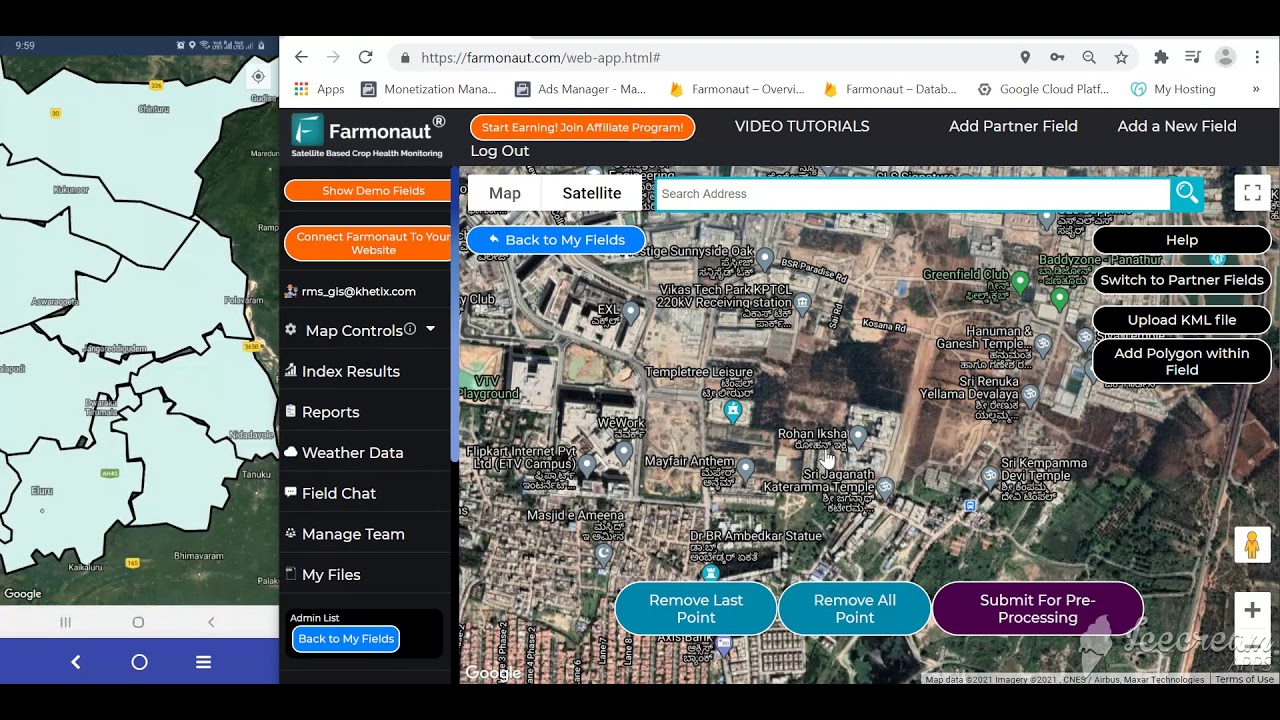
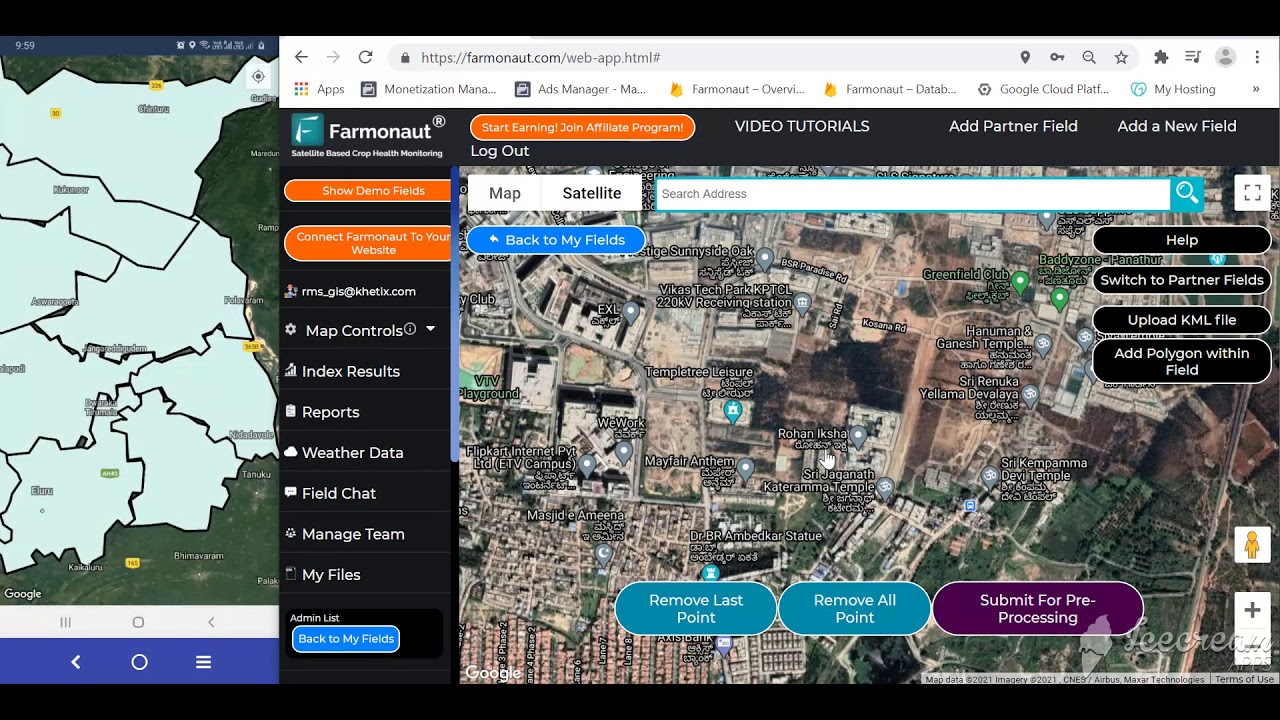
Satellite and remote-sensing tools support mine risk management as a complement to — not a replacement for — MSHA-mandated blasting protocols and seismograph monitoring. Farmonaut’s tools are relevant to the parts of a mine safety management system that sit outside the blast itself:
- Site-wide monitoring: Multispectral satellite imaging covers extraction areas and can flag structural anomalies or ground-condition changes ahead of a scheduled blast.
- Traceability: Blockchain-based traceability for mining supply chains supports the documentation trail a mine safety management system needs for regulatory audits. See traceability solutions for mining.
- Fleet and equipment tracking: Real-time resource tracking keeps mobile assets logged and out of exclusion zones during scheduled blasts. Explore fleet & equipment management technology.
- Environmental compliance: Carbon footprint and emissions tracking supports the environmental side of blasting compliance reporting. Discover carbon footprinting for your operations.
Farmonaut Subscription Plans – Get Satellite, AI & Safety Insights for Mining

Training and Safety Culture
No amount of monitoring technology substitutes for trained personnel who hold a perimeter and stop an unsafe blast. MSHA does not publish a single universal training-hour requirement for blasters that applies uniformly across every state and commodity — certification and renewal cycles for blasters are set partly at the federal level and partly by state mining boards, so the current requirement for a specific role and state is best confirmed directly against your state mining agency’s blaster-certification rules rather than assumed from a national average.
-
Modern training approaches:
- VR-based scenario training for pre-blast checks, perimeter confirmation, and emergency response.
- Refresher modules tied to specific regulatory changes, such as MSHA’s April 2024 respirable silica rule.
-
Operational safety culture:
- Personnel empowered to halt a blast if perimeter clearance or PPV monitoring can’t be confirmed.
- Documented near-miss reporting that feeds the site’s running flyrock-distance record used in the 1.5x perimeter calculation.
For mines managing safety oversight across multiple sites, centralized monitoring and reporting tools support cross-site benchmarking and compliance documentation. Learn about large-scale management solutions.
What Changes Next in Mine Blasting Safety
Mine risk management for blasting is an ongoing regulatory and operational story, not a single event. The trend line to watch is MSHA’s fatality count itself — 26 deaths in 2024 versus a preliminary 33 in 2025 is a meaningful year-over-year increase, and MSHA’s fatality reports search tool updates as new incidents are investigated and closed, making it the single best source to check before citing a fatality figure from this article a year from now (MSHA Fatality Reports Search).
What would change the picture materially: a revision to the 2.0 in/sec PPV standard itself (unchanged since 1989), a new MSHA rule specifically targeting blast-area security failures given their 25.3% share of injuries, or expanded state-level blaster certification requirements. None of those changes is confirmed as in progress in the sources reviewed here — this section describes what to watch, not what has already happened.
The durable parts of this framework won’t expire: the 1.5x flyrock-perimeter rule, the 2.0 in/sec PPV threshold, and the practice of logging every blast’s actual flyrock distance and vibration reading against those two numbers. Whatever the fatality count reads next year, that method for setting a defensible exclusion zone stays the same.




Further reading:
FAQ: Mine Blasting Safety and Risk Management
-
Q: What is the minimum safe blast exclusion zone?
A: MSHA’s standard requires a perimeter of at least 1.5 times the largest flyrock distance ever recorded at that specific site — not a fixed industry-wide distance. See MSHA Blasting Safety. -
Q: What ground vibration level is considered safe for nearby structures?
A: 2.0 inches per second peak particle velocity (PPV), established by the US Bureau of Mines in 1989 (RI-8507) and still the basis for OSMRE’s coal blasting vibration limits. -
Q: How many mining deaths occurred in the US recently?
A: MSHA recorded 26 fatalities in 2024 and a preliminary 33 in 2025, per MSHA’s fatality reports search, which updates as investigations close. -
Q: What causes the most blasting injuries?
A: Flyrock and blast-area security failures, accounting for 281 of 1,112 blasting injuries (25.3%) recorded by MSHA between 2010 and 2025. -
Q: Is there a certified “mine safety management system” standard like ISO 45001 for blasting?
A: No single MSHA-administered MSMS certification was found; MSHA regulates blasting through specific safety standards and citations rather than a unified management-system certification. Build your system around MSHA’s published standards categories directly. -
Q: Which Farmonaut products support mining risk management?
A: Carbon footprinting (read more), traceability (read more), and fleet management (read more) each address distinct operational and compliance needs.
Mine risk management for blasting rests on numbers that don’t change with the calendar: a 1.5x flyrock perimeter, a 2.0 in/sec PPV limit, and a documented safety system that logs both after every shot. Check MSHA’s fatality and blasting-safety pages directly before relying on any figure in this article beyond its stated date.
Discussion
Questions, corrections or field experience? Share them below. First-time comments are reviewed before they appear, and your email is never published.
No comments yet. Be the first to add a question or your experience.

 Qader Group
 Ileys General Trading
 SG Gold Mining LLC
 VRV Global Pte Ltd
 Omsri International FZE
 G.I.T.T.
 Jaunita Erss Ltd
 Almosi SARL
 SRK Consulting
 Berks Gold Limited
 Mwerezi Minerals Company Limited
 Mining SARL
 SenGold Invest SAS
 Sean Mining Limited
 NTS Group (Pty) Ltd
 Mine4Africa
 Lithspo Minerals Limited
 Tintina Mining Group
 Licence holder · Nigeria · Gold + lithium










