

New Zealand gold · Buyer's guide
Gold Claims for Sale in NZ: Permits, Costs, West Coast
New Zealand has no private gold claims. Sellers offer Crown minerals permits, and a buyer needs ministerial consent plus a landowner access arrangement. NZP&M charges NZ$5,750 to apply for a Tier 2 mining permit and NZ$2,530 to consent to a transfer.
Key takeaways
- Gold is owned by the Crown, so a New Zealand ‘claim’ is a minerals permit from NZ Petroleum and Minerals, not land (NZP&M).
- A Tier 3 hobby permit began on 25 September 2025: gold only, river bed or beach, under 50 hectares, up to 10 years, NZ$2,783 to apply (NZP&M).
- Consent to transfer a Tier 1 or Tier 2 permit costs NZ$2,530; a permit also needs a landowner access arrangement before work starts (NZP&M fee page and permit guide).
- Nine of the 19 public fossicking areas, where no permit is needed for hand tools, are on the West Coast (NZP&M).
- Macraes and Waihi produced 84% of New Zealand’s 213,000 ounces in 2024, so few producing mines are ever for sale (NZP&M, November 2025).
In this article
- Gold claims for sale in NZ: what you are really buying
- Permit types and tiers: which one a seller holds
- How much does a gold claim cost in New Zealand?
- Gold claims for sale on the West Coast
- Gold mines for sale in New Zealand
- Gold mining leases: why the word misleads
- Buyer checks before you pay a deposit
- How a permit transfer works, step by step
- Hobby gold mining: Tier 3 and the December deadline
- Fossicking without buying anything
- Screening ground from space before you buy
- Frequently asked questions
In New Zealand you cannot stake a gold claim the way you can in Nevada or the Yukon. All gold belongs to the Crown, so what a seller really offers is a minerals permit issued by NZ Petroleum and Minerals (NZP&M), often with a land access arrangement and a resource consent attached. Buying one means asking the Minister to consent to the transfer, and the permit’s tier, remaining years and access terms decide what it is worth. This guide explains each of those pieces for licence owners, consultants and investors, with the 2025 changes, fees, West Coast context and a buyer checklist.
Prices and listings change, so every figure below carries its source and date. This is general information, not legal advice. A New Zealand lawyer should read any sale agreement.
Gold claims for sale in NZ: what you are really buying
When a New Zealand listing says “gold claim”, it usually means an alluvial gold mining permit (alluvial gold is gold carried and left by water in river gravel): the right to work gold in a river bed or on a beach within a mapped area. Searching for gold by hand with a pan or detector is called fossicking, and it follows separate rules covered below. The regulator says gold is owned by the Crown, even where it lies under your own land, so a permit is needed to mine it outside the public fossicking areas (NZP&M, gold fossicking).
A permit is not land. The regulator’s guide for alluvial permit holders says getting a permit is only the first step: you also need a land access arrangement with the owner, which may be a private owner or the Crown (for Crown land, often the Department of Conservation or Land Information New Zealand), and possibly a resource consent and WorkSafe approval (NZ Petroleum and Minerals, Complying with your alluvial gold mining permit). A seller who offers a permit without an access arrangement is offering a right you may not be able to use.
Three questions sort most listings quickly. Which permit is it, and which tier? How many years are left on it? And what does the seller hold that lets you actually reach the ground? The sections below take each in turn.
Permit types and tiers: which one a seller holds
The regulator issues three kinds of minerals permit. A prospecting permit covers very low impact work such as mapping and hand sampling. An exploration permit gives the exclusive right to explore, including drilling and bulk sampling. A mining permit gives the exclusive right to mine known deposits (NZP&M, types of minerals permits).
Chart
Area rules in NZ minerals permits (hectares)
Tier 3 is under 50 ha; exploration permits have a 150 ha minimum; Tier 2 mining permits are ordinarily up to 200 ha
Permits are also sorted into tiers, which set how closely they are overseen. The table summarises what the regulator publishes.
| Tier | What it covers | Size and term |
|---|---|---|
| Tier 1 | Underground operations, most exploration permits (unless expected spend over the final five years is under NZ$1,250,000), and gold, silver or platinum group metal mining permits with an expected annual royalty of NZ$50,000 or more | Area reflects the discovery and work programme |
| Tier 2 | Smaller industrial and small-business operations that are neither Tier 1 nor Tier 3 | Mining permits ordinarily no more than 200 hectares; the term depends on the resource |
| Tier 3 | Small-scale, non-commercial gold mining in river beds or beach sand, previously done under Tier 2 | One unbroken area under 50 hectares; maximum 10 years |
Tier 3 started on 25 September 2025 under the Crown Minerals Amendment Act 2025 (NZ Petroleum and Minerals, regulators update). That matters for buyers because many small “hobby claims” were Tier 2 permits and are being moved across, as the section on Tier 3 below explains.
Terms differ by permit type. A prospecting permit usually starts at 2 years and can reach 4. An exploration permit usually starts at 5 years and can reach 10 from commencement, with the area cut back at extension. A mining permit’s term depends on the tier and the resource (Regulator guidance, types of minerals permits).
How much does a gold claim cost in New Zealand?
There are two costs: what the seller asks, and what the regulator charges to hold or move the permit. The regulator’s side is published. A new Tier 2 mining permit application costs NZ$5,750 including GST, and a Tier 3 application costs NZ$2,783 including GST. Annual fees are NZ$1,150 for Tier 3, and for an onshore Tier 2 permit NZ$2,058.50 per square kilometre or part of one, or NZ$1,150, whichever is greater (NZP&M, minerals permit fees).
Chart
What the regulator charges (NZ$ incl. GST)
NZP&M published fees, selected: applications, transfer consent and one annual fee
Consent to a transfer has its own fee. NZ Petroleum and Minerals lists NZ$2,530 for Tier 1 and Tier 2 applications under sections 41 or 41C of the Crown Minerals Act, and NZ$1,223.60 for Tier 3 (same page). The chart shows how these sit side by side.
The asking price is a private matter between buyer and seller, and no official register of sale prices exists. One dated public example: in January 2019 a Marlborough mining licence with a hut and 5 km of river was listed on Trade Me from NZ$75,000, with a smaller river section listed separately from NZ$40,000; the licence was due to expire in January 2026 (NZ Herald, January 2019). That is one listing from before the 2025 law change, not a market average. Treat any asking price as a starting point for negotiation and test it against remaining term, access and the gold the ground has actually produced.
Royalties are separate. Under the regulator’s fee page, Tier 3 holders pay royalties only if the gold mined meets a threshold set in regulations, and the alluvial permit guide says other holders pay royalties if they earn above a certain amount from gold sales. Read the current royalty regulations before you model returns. The calculator below works out how many ounces a year a permit must yield just to cover what you pay, before any operating costs or royalty.
Calculator
How many ounces a year does a permit need to cover its cost?
Enter your own price, legal costs, years and area. Operating costs and royalty are not included.
- Price, legal costs and consent fee: $47,530
- Annual permit fee: $2,058
- Fees and price per year: $11,564
Example values only, not a forecast or valuation. The gold price default of NZ$7,300/oz is a rounded conversion of the Kitco spot of US$4,122.50 (5 November 2026, 1:43 a.m. New York) at 1.771 NZD per USD (x-rates.com, 5 November 2026, 06:44 UTC); it is an input, so enter today’s price. Gold price is an input: example, use today’s price in NZ$. The NZ$2,530 transfer consent fee (Tier 1 and 2) and the Tier 2 annual fee (NZ$2,058.50 per square kilometre or part of one, or NZ$1,150, whichever is greater, so at least NZ$2,058.50 for any area up to 1 square kilometre) come from the NZP&M fee page. Tier 3 fees differ. Fees can change.
Gold claims for sale on the West Coast
The West Coast of the South Island is where most buyers look first. Public fossicking, which needs no permit, is concentrated here: nine of the 19 designated gold fossicking areas are on the West Coast, including Jones Creek, Lyell Creek, Britannia Stream, Nelson Creek, Slab Hut Creek, Shamrock Creek, Moonlight Creek and the Waiho River (Regulator guidance, gold fossicking). Those areas are open to the public, so a seller cannot sell exclusive rights over them.
Ground outside those areas that a seller offers is covered by a mining permit, and some West Coast ground is public conservation land. For Crown land the access arrangement may be with the Department of Conservation, according to the NZP&M alluvial permit guide. DOC itself says fossicking outside designated sites needs NZP&M permission and, on public conservation land, possibly a DOC permit as well (Department of Conservation, gold fossicking). For a buyer this means the access paperwork can matter as much as the permit itself.
Use the regulator’s Minerals Permit Webmaps, which show all current minerals permits and applications, to check that the seller’s permit number, area and status match the listing (NZ Petroleum and Minerals, minerals permits). Ask for the permit certificate, the last annual summary report and any access arrangement. The regulator also warns that a permit gives no rights to pounamu (greenstone); removing it without agreement from Ngāi Tahu is unlawful, and holders in a pounamu management area are advised to talk to Ngāi Tahu.
The West Coast is also where a major new mine in the region sits. Endura’s Snowy River mine at Ikamatua, behind Reefton, is on the site of the old Blackwater mine and is aiming for first gold in December 2026, with development costs above NZ$400 million (1News, 13 August 2026). That is a company target, not a result. It is worth knowing because a large operator nearby affects labour, road access and neighbour relations for any small permit in the same district.
Gold mines for sale in New Zealand
New Zealand’s gold output is concentrated in very few mines. The regulator reports national production of 213,000 ounces in 2024, down from 220,000 ounces in 2023, with OceanaGold’s Macraes and Waihi mines providing 84% of the 2024 total. Gold royalties paid to the Crown rose 26% to NZ$11.6 million in 2024 (NZP&M, mining industry statistics for 2024; NZ Petroleum and Minerals, 2023 statistics).
| Year | Gold produced (thousand ounces) | Gold royalties |
|---|---|---|
| 2023 | 220 | NZ$9.23 million |
| 2024 | 213 | NZ$11.6 million |
The 2023 royalty figure is reported against the 2022-23 comparison year in the regulator’s release, so compare the two rows as a rough guide only. Macraes, in Otago, is described by its operator as the country’s largest gold mine (OceanaGold, September 2020).
That leaves few producing mines on the market. For the Australian side, see our Australia mining map by state. Most “mines for sale” listings are therefore one of three things: a small permit with historic workings, an exploration permit held by a junior company, or a project awaiting consents. The second and third are usually sold with the company or through a transfer of interest, which brings in the ministerial consent steps below.
One project shows how long consents can take. Santana Minerals’ Bendigo-Ophir project near Cromwell in Central Otago holds a 30-year mining permit (MMP 61326) but still needs fast-track approval. The company’s 2026 annual report says the expert panel’s draft decision is due in November and its final decision on 20 January 2027, with first gold targeted in 2028. RNZ reported in February 2026 that the panel was first due to decide by 29 October 2026, so the dates have moved more than once. Check the fast-track register for the current timetable. Nothing here indicates value, and this is not investment advice.

▶ Follows one gold nugget from rock to ring: drilling, crushing, leaching, refining. · 5:27
Gold mining leases: why the word misleads
Searchers often type “lease” or “licence”, and some sellers use the terms, as the 2019 Marlborough advertisement did (“mining licence”). Under the current system the instrument is a minerals permit. The two parts a buyer must not confuse are the permit from the regulator, which covers the minerals, and the access arrangement or lease-type agreement with the landowner, which covers the surface.
If a landowner offers you a lease alone, you still have no right to the gold. If a seller offers a permit alone, you still have no right to cross the land. A complete package has both, plus any consents the work needs. Ask the seller to show each document, with dates and expiry.
The 2025 law changes also moved the purpose of the Act. NZP&M says “manage” was replaced with “promote” for prospecting, exploration and mining, and the Minister’s role now includes attracting permit applications (NZ Petroleum and Minerals, Crown Minerals Act law changes). For buyers the practical effect is a regulator set up to receive applications, but each application is still assessed on its own terms.
Buyer checks before you pay a deposit
Run these checks in this order, because the early ones can end the deal cheaply.
- Permit identity. Match the permit number, holder name, minerals, area and expiry date against the regulator’s Minerals Permit Webmaps and the certificate.
- Tier. Confirm whether it is Tier 1, 2 or 3. A Tier 3 permit is limited to gold in river beds or beach sand and to unpowered hand tools, riffle boxes and no more than 10 horsepower of powered equipment at any one time (Regulator guidance, hobby or recreational gold mining permits). Check that the way you plan to work fits.
- Years left. A permit with two years to run is a different asset from one with eight. Ask what the seller will do about renewal or extension.
- Compliance record. Holders must file an annual summary report by 31 March each year, even if no work was done, pay annual fees by 31 July, and send technical reports within 40 working days of the start of each permit year. NZP&M says non-compliance can affect future applications, so ask for proof of each filing.
- Conditions. Permits can carry conditions such as a start date for mining, a minimum production rate or a limit on equipment. Ask whether the seller has met each one.
- Access arrangement. Ask for the signed arrangement with each landowner and occupier, and whether it is registered against the title. Check whether any ground is conservation land or Māori land, where extra consent may apply.
- Consents. Ask for the resource consent from the regional or district council and any WorkSafe approvals. Check conditions on discharge, water and rehabilitation.
- Production history. Ask for the gold actually recovered, by month, with weights and sale receipts. A seller’s estimate is not evidence.
- Liens and debts. Ask your lawyer to search for security interests and any unpaid fees.
- Neighbours and iwi. Ask who has been consulted. Conflict with neighbours can end a project long after the sale.
For a wider checklist that applies in any country, see our gold mine for sale due diligence guide; the same exercise for North America is in our guide to British Columbia gold claims for sale.
The regulator states that guidance is not a guarantee and that it keeps discretion to decline an application that does not meet the legal requirements (NZ Petroleum and Minerals, alluvial gold permit guide). Buyers should not treat a seller’s confidence as consent.
A claim is not land, and in New Zealand it is not even a claim. The short Farmonaut explainer below covers the United States rule that owning a gold claim is not owning the land, a useful contrast with New Zealand, where the gold belongs to the Crown and a permit is a different instrument.
▶ Explains in clay why owning a gold claim in the United States is not owning the land. · 3:19
How a permit transfer works, step by step
The regulator states plainly that you must apply for and be granted consent before you can sell your permit or give it to someone else. If a company holds the permit and the company is sold, the holder must notify the regulator of a change of control (NZP&M, alluvial gold permit guide). The forms are numbered: APP-04 covers consent to a change of operator or transfer of interests, APP-05 consent to a dealing and APP-06 a change of control (NZ Petroleum and Minerals, minerals permits).
Infographic
Buying a permit in five steps
- 1Conditional agreementMake the sale subject to ministerial consent and access.
- 2Apply for consentSend APP-04 and the fee to NZP&M.
- 3Agree accessSign an arrangement with each landowner.
- 4Wait for the MinisterDo not treat the sale as complete before consent.
- 5Record the transferConfirm NZP&M records it and update consents.
Chart
Standard permit terms in years
Prospecting and exploration permits, NZP&M
If you are the seller, our guide on how to sell a mine covers valuation and deal structures. A sensible order for a private buyer is below. The regulator also publishes a minerals sale and purchase agreement template, which a lawyer can adapt.
First, sign a conditional agreement that makes the sale subject to ministerial consent and to access arrangements being transferred or renewed. Second, send the APP-04 application with the fee. Third, agree the access arrangement with the landowner in your name. Fourth, wait for the Minister’s decision; no sale should be treated as complete before it. Fifth, make sure the regulator records the transfer, and update your resource consents. Ask your lawyer about the deadline for lodging the application after signing and about conditions the Minister may attach.
Because the permit’s remaining term is part of what you buy, the chart below compares the standard terms NZP&M publishes. A longer term gives more time to recover the price you paid, but only if conditions are met each year.
Hobby gold mining: Tier 3 and the December deadline
If you want to work a river or beach by hand rather than buy a commercial operation, Tier 3 is designed for you. It covers gold only, in a river bed (from bank to bank) or beach sand, in one unbroken area under 50 hectares, for up to 10 years. You may not hold two Tier 3 permits side by side. An application costs NZ$2,783 including GST and the annual fee is NZ$1,150. A permit does not let you start work on its own: you may still need resource consent and an access arrangement, and the annual report on Tier 3 activity is filed on Form 14C (NZ Petroleum and Minerals, hobby or recreational gold mining permits).
Existing Tier 2 holders can propose a move to Tier 3 at no cost. The regulator’s page gives 12 December 2026 as the date to submit the proposal; the regulator may accept or decline it, and a declined proposal can be amended and resubmitted at no cost. If you are buying a Tier 2 hobby permit, ask the seller whether a transition proposal has been lodged and what the regulator said. A permit that cannot move to Tier 3 and does not fit Tier 2 rules is a risk.
The same page does not say whether a Tier 3 permit can be sold or transferred. The fee schedule does list a Tier 3 fee of NZ$1,223.60 for section 41 and 41C applications, so ask NZP&M directly before you agree a price for one.
Fossicking without buying anything
Many people searching for a claim only want to try. The regulator lists 19 public gold fossicking areas: five in the Tasman region, nine on the West Coast and five in Otago. You need no permit if you are in one of those areas in the South Island and use only hand tools or non-motorised equipment such as pans, shovels, picks, metal detectors and sluice boxes. You must stay within the mapped boundaries (NZ Petroleum and Minerals, gold fossicking).
The Department of Conservation adds practical rules: never use explosives, stay within the active creek bed, restore the ground, avoid historic and culturally significant sites, ask the landowner before crossing private land, and watch for sudden river rises after heavy rain or hydro dam releases (Department of Conservation, gold fossicking). Mercury must never be used to recover gold; it is dangerous to you and to the river.
A weekend in a designated area is a cheap way to learn what the ground is like before you pay for a permit. It does not prove an area will work commercially.
Screening ground from space before you buy
Before you commit money, satellite imagery can show things a listing will not: rock exposure, vegetation cover, iron-stained or clay-altered rock, and the pattern of faults and river channels. It cannot see gold itself, and it is not a resource estimate or an environmental clearance. Used early, it helps a buyer decide whether a permit area deserves a site visit and sampling.
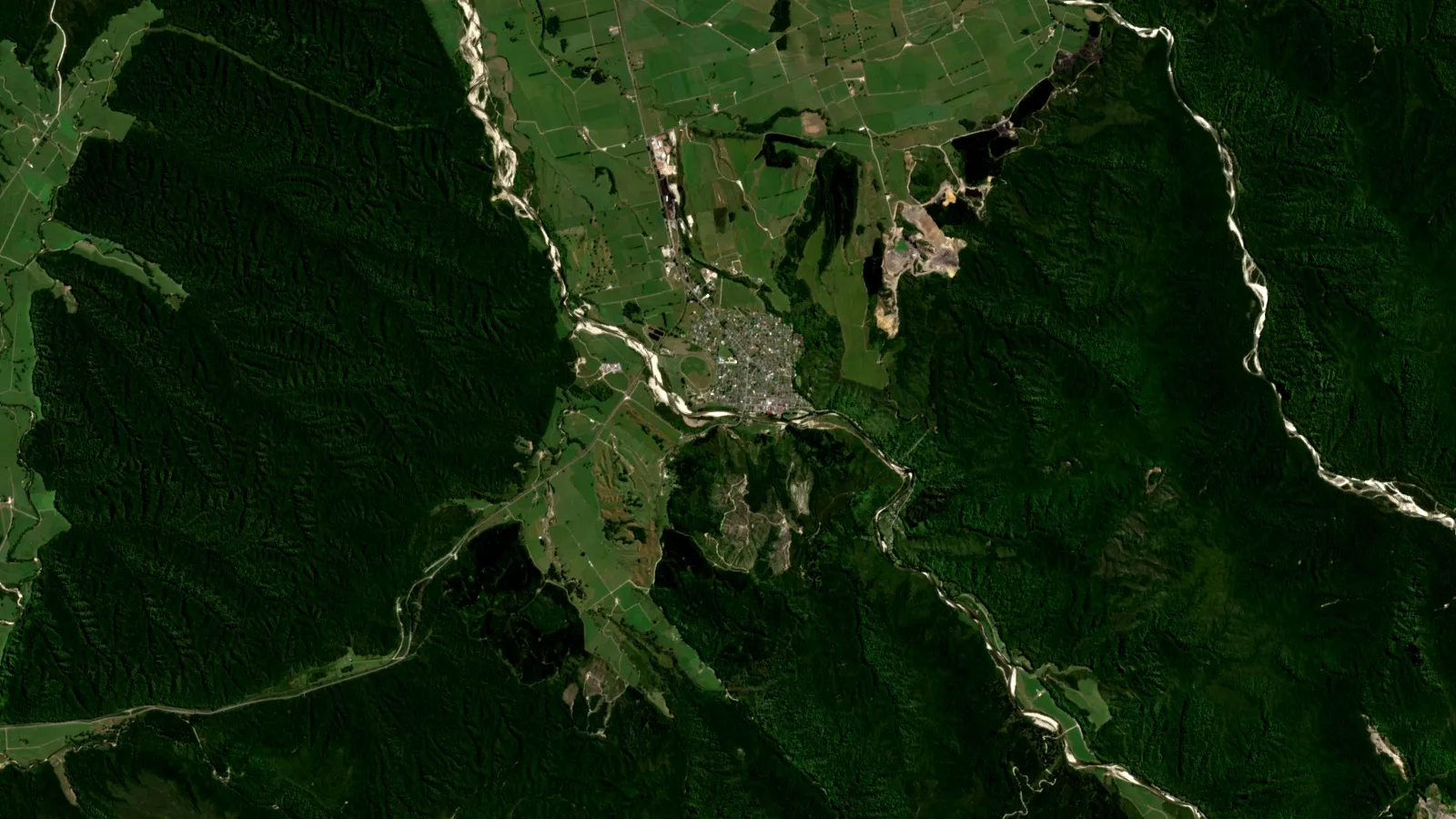
Farmonaut can screen a permit area from satellite data if you send a boundary file. The hero image on this page is a Sentinel-2 view of the Reefton goldfield on the West Coast; it shows land cover, not a prospectivity result. Treat any satellite screening as a way to rank places to check on the ground, then confirm with sampling.

▶ Explains how satellites map the rock around gold rather than gold itself. · 4:25
Frequently asked questions
Can you buy a gold claim in New Zealand?
You can buy a minerals permit, usually an alluvial gold mining permit, but you need the Minister’s consent to the transfer. Gold is owned by the Crown, so there is no private claim to buy in the sense used in North America (Regulator guidance, gold fossicking).
Where can I find gold claims for sale in NZ?
Permits are sold privately and sometimes through online auction sites; the 2019 Marlborough licence was listed on Trade Me. There is no official sales register, so verify every permit against NZP&M’s Minerals Permit Webmaps and certificate before you pay.
How much does a gold mining permit cost in New Zealand?
The regulator charges NZ$5,750 to apply for a Tier 2 mining permit and NZ$2,783 for Tier 3, both including GST, with annual fees from NZ$1,150. Buying an existing permit costs whatever the seller asks plus a NZ$2,530 transfer consent fee for Tier 1 and 2 (NZ Petroleum and Minerals, minerals permit fees).
Are there gold claims for sale on the West Coast?
Permits there do change hands, but the public fossicking creeks are open to everyone and cannot be sold. Some of the ground may be conservation land, so confirm the access arrangement and any DOC consent before you pay.
Are there gold mines for sale in New Zealand?
Few producing mines are offered. Macraes and Waihi supplied 84% of 2024 gold output, so most listings are small permits, exploration permits or projects awaiting consents (Regulator guidance, 2024 statistics).
Is a gold mining lease the same as a permit?
No. The permit from NZP&M covers the minerals. A lease or access arrangement with the landowner covers the surface. You need both to work the ground.
Do I need a permit to pan for gold in New Zealand?
Not in the 19 designated public fossicking areas, if you use hand tools or non-motorised equipment. Elsewhere you need permission from the regulator, even on your own land, and possibly a DOC permit on conservation land.
What is a Tier 3 gold mining permit?
A permit for small-scale, non-commercial gold mining in river beds or beach sand, in one area under 50 hectares, for up to 10 years. It began on 25 September 2025 (NZ Petroleum and Minerals).
Can foreigners buy a New Zealand gold permit?
The permit pages set no nationality rule, but the Overseas Investment Act can apply to overseas buyers of sensitive land. Santana Minerals, an overseas person, needed Overseas Investment Office consent in May 2026 to buy about 3,680 hectares of farmland for its project (Santana annual report, ASX). Ask a New Zealand lawyer which rules cover your purchase.
What happens if the seller has not filed annual reports?
Annual summary reports are due by 31 March each year even when no work was done. The regulator says non-compliance can lead to a penalty or revocation, and can affect future applications, so a missing filing is a reason to pause or reprice.
Does a permit let me take pounamu?
No. A minerals permit gives no rights to pounamu, and removing it without agreement from Ngāi Tahu is unlawful (NZP&M, alluvial gold permit guide).
This page is for information only. It is not legal or investment advice. Confirm the rules with NZ Petroleum and Minerals and a New Zealand lawyer before you sign. Prospect only with the landowner’s permission and any permit required, and never use mercury.
Farmonaut mining
Screen a permit area from space before you buy
Request a quote to have your permit area screened with satellite data, so you know which ground to check on site.

Mining Pro sample view, synthetic data
Sources
- types of minerals permits (regulator): nzpam.govt.nz
- hobby or recreational gold mining permits (Tier 3) (regulator): nzpam.govt.nz
- gold fossicking (regulator): nzpam.govt.nz
- minerals permit fees, royalties and levies (regulator): nzpam.govt.nz
- apply for a Tier 1 or Tier 2 mining permit (regulator): nzpam.govt.nz
- Complying with your alluvial gold mining permit (regulator): nzpam.govt.nz
- mining industry statistics for 2024 (regulator): nzpam.govt.nz
- mining industry statistics for 2023 (regulator): nzpam.govt.nz
- regulators update December 2025 (regulator): nzpam.govt.nz
- Crown Minerals Act law changes (regulator): nzpam.govt.nz
- minerals permits (regulator): nzpam.govt.nz
- Department of Conservation, gold fossicking: doc.govt.nz
- NZ Herald, Marlborough mining claim with hut up for grabs (January 2019): nzherald.co.nz
- 1News, West Coast gold mine recruiting after $400m development (13 August 2026): 1news.co.nz
- RNZ, Treaty concerns push out Santana mine decision (February 2026): rnz.co.nz
- OceanaGold, Waihi district update (September 2020): oceanagold.com
- Santana Minerals, Annual Report 2026 (ASX, 29 September 2026): announcements.asx.com.au
- Kitco, gold spot price chart (5 November 2026): kitco.com
- x-rates, USD to NZD (5 November 2026): x-rates.com
Discussion
Questions, corrections or field experience? Share them below. First-time comments are reviewed before they appear, and your email is never published.
No comments yet. Be the first to add a question or your experience.

 Denkyira Nkoranza Concession
 Mwerezi Minerals Company Limited
 Congo Mining Solutions
 Mining SARL
 SenGold Invest SAS
 Sania Corporation
 Sean Mining Limited
 NTS Group (Pty) Ltd
 Mine4Africa
 Lithspo Minerals Limited
 Tintina Mining Group
 Dalgety Minerals Pty Ltd
 Vortex Minerals Pty Ltd
 Faith At Work (Pty) Ltd
 Geotech Mining Solutions plc
 Vulcan International Limited
 Kidepo Associates
 GKY Mining
 Alkimy SARL
 Double A Trading

 Licence holder · Nigeria · Gold + lithium










