

Gold exploration · Nova Scotia
A gold mine in Nova Scotia starts as a 16-hectare claim: licences, holding costs, Touquoy and the Meguma districts
Key takeaways
- Claims are picked on a map in NovaROC, not staked on the ground. Each is 16 ha, and a licence holds 1 to 80 of them for two years.
- Holding cost is mostly work: $400 per claim per term for the first two terms, then $600, $800 and $1,600 as the licence ages.
- A licence does not let you enter land. You need the landowner’s consent, or a permit on Crown land, and notices before drilling, digging or flying.
- Touquoy (St Barbara) targets reopening in November 2026 to process about 3 million tonnes of stockpiles; Goldboro (NexGold) began early works in September 2026.
- Gold sits in the folded Meguma Group, mostly the Goldenville Formation, under forest and glacial till. Satellites help with structure and access more than with direct alteration mapping.
In this article
- Gold fields of Nova Scotia: the Meguma districts behind every gold mine in Nova Scotia
- Is there a gold mine in Nova Scotia operating now? Touquoy, 15-Mile and Goldboro
- Gold claims in Nova Scotia: how NovaROC exploration licences work
- What gold claims in Nova Scotia cost to hold: a calculator
- Gold prospecting in Nova Scotia: landowners, Mi'kmaq consultation and safety
- Finding gold in Nova Scotia: what satellites and lidar can and cannot see
- Nova Scotia gold prospecting with Farmonaut: a screen before the fieldwork
- Gold mine in Nova Scotia: frequently asked questions
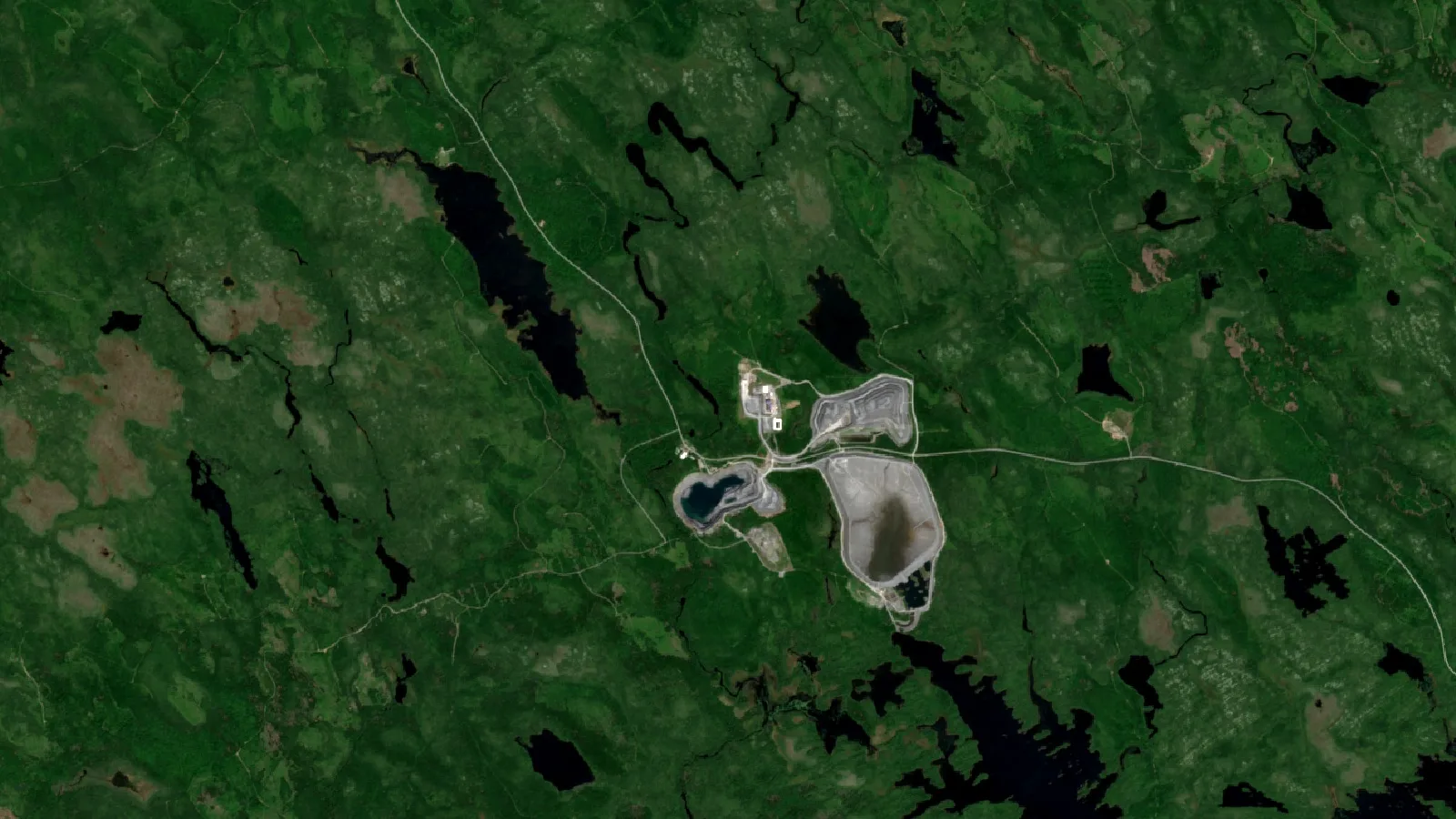
The only gold mine in Nova Scotia to produce at scale in recent years is Touquoy at Moose River, owned by St Barbara’s subsidiary Atlantic Mining NS, which is restarting to process stockpiles by the end of 2026, while NexGold’s Goldboro project began early works in September 2026.
Ask who runs a gold mine in Nova Scotia today and the honest answer is short: Touquoy was the province’s only operating gold mine from 2021 to 2023 and is restarting on stockpiles, a second project is clearing ground, and a third group of pits is in federal permitting. Behind them sit hundreds of exploration licences, and most of the people holding them are individuals, not companies. This page is written for those holders, and for the juniors and investors who buy from them. It goes deeper than our overview of gold exploration across Canada: one province, its licence arithmetic, its mines and its terrain.
Nova Scotia’s historical gold came almost entirely from narrow quartz veins, about 1.2 million ounces, mined no deeper than 300 metres.
Gold fields of Nova Scotia: the Meguma districts behind every gold mine in Nova Scotia
Almost every historical gold mine in Nova Scotia shares one geological address. A provincial geoscience summary on Meguma gold deposits describes the Cambrian to Ordovician Meguma Group, which dominates southern Nova Scotia, as a lower sandy flysch, the Goldenville Formation, under a shaly flysch, the Halifax Formation. These rocks were folded into upright, northeast-trending folds and intruded by granites around 370 million years ago. Gold occurs throughout the group but is most common in the Goldenville Formation, usually in laterally continuous veins on the limbs of domal folds.
The same summary sorts the deposits into three styles. First, high-grade, narrow quartz veins under a metre wide. Second, low-grade disseminated gold of a few grams per tonne in altered sandstone and shale, where carbonate, sulphide and sericite alteration marks the host. Third, a combination of the two. Disseminated gold had been found in 19 former gold districts when that summary was written, and it noted that the geology resembles the Bendigo and Ballarat goldfields of Victoria, Australia. That comparison still frames how explorers think about these folds: the hinge zones and limbs of anticlines are where the gold collects.
From the 1858 discovery to 64 gold districts
The Nova Scotia Archives record the first find in 1858 at Mooseland on the Tangier River, made by a British army officer hunting with a Mi’kmaq guide, Joe Paul. Two years later Paul returned with prospector John Pulsifer, who reported it in Halifax and staked a claim. A rush to Tangier followed, and the government declared it a formal district to keep order. A Royal Society of Canada summary of historical gold mining and lake sediments counts 64 historical gold districts worked between the 1860s and 1940s.
Why does history matter to a modern licence holder? Because the old districts are where the drill records, shafts and tailings are, and where a new gold mine in Nova Scotia has the most data to start from. Touquoy itself was first described as a shale-hosted zone of the old Moose River gold district. A district name on the claim map is a strong hint about the structure underneath.

▶ A documentary on the global race for gold, the market behind every junior's licence budget. · 10:44
Is there a gold mine in Nova Scotia operating now? Touquoy, 15-Mile and Goldboro
We checked each project against the owner’s own filings this month, because names and owners have changed. The province’s mineral production report (Information Circular ME 84, February 2026) says Touquoy is operated by Atlantic Mining NS Inc., a subsidiary of St Barbara Limited, which bought it in 2019 through its purchase of Atlantic Gold Corporation. Production mining ended in early 2023, stockpiled ore was processed until September 2023, and the site moved into reclamation in 2024. Clean-up of the mill recovered 2,903 ounces in 2024.
Chart
Gold shipped from Nova Scotia mines
Troy ounces per year, 2017 to 2024 (Touquoy was the main producer)
That is not the end of the story for this gold mine in Nova Scotia. On 10 April 2026 the Natural Resources minister announced industrial approval for new work at the Touquoy site in Moose River, Halifax County, allowing Atlantic Mining Nova Scotia to process about three million tonnes of stockpiled ore. St Barbara’s ASX release of 13 April 2026 puts the plan at 38,000 ounces from 3.0 million tonnes of stockpiles grading 0.4 g/t over about 13 months, with initial capital of about C$11.4 million. Its June 2026 quarterly report says the board approved the final investment decision, the mining contractor began mobilising in June, and official reopening is targeted for November 2026.
Reporting by The Canadian Press, carried by BNN Bloomberg, adds that the mine is about 70 km northeast of Halifax, that tailings will go into the mined-out pit (a first for the province), and that the province holds a $79.9 million reclamation bond. So the one recent gold mine in Nova Scotia is a short restart on existing stockpiles, not new mining.
The 15-Mile hub and two renamed deposits
St Barbara’s plan does not stop at Touquoy. The same quarterly report describes a 15-Mile Processing Hub.
Under that plan, the Touquoy plant would be moved to the 15-Mile Mine site after the stockpiles run out in early 2028, and fed from four open pits at 15-Mile plus two satellite pits. Those satellites carry new names. The Old Austen Mine was formerly Beaver Dam, and the Old Mitchell Mine was formerly Cochrane Hill. Search the old names in news archives, but use the new ones when you read St Barbara’s filings. The company submitted an initial project description to the Impact Assessment Agency of Canada in June 2026 and is targeting a final investment decision in mid-2027.
Goldboro: the next gold mine in Nova Scotia?
NexGold Mining Corp. holds the Goldboro Gold Project in Guysborough County, about 1.6 km north of the village of Goldboro, according to its project portal, which also lists a provincial Crown land lease in May 2025 and an Industrial Approval in August 2025.
On 17 September 2026 the company announced early works: sediment and erosion controls, tree clearing and a bypass road, carried out with the Mi’kma’ki-Municipal Limited Partnership. A board construction decision is expected in the fourth quarter of 2026, with full construction targeted for the first quarter of 2027 if approved. The company’s NI 43-101 feasibility study of 11 January 2022 describes an 11-year open pit producing about 100,000 ounces a year, figures it says the updated study may revise.
The table lists each gold mine in Nova Scotia and each advanced gold project whose owner and status we could confirm from owner or government filings this month.
| Project (current name) | Owner | Location | Status as published | Source, date |
|---|---|---|---|---|
| Touquoy | Atlantic Mining NS Inc. (St Barbara Ltd, ASX: SBM) | Moose River, Halifax County | Restart to process ~3.0 Mt of stockpiles; reopening targeted Nov 2026 | St Barbara quarterly, July 2026 |
| 15-Mile Mine (Processing Hub) | St Barbara | Nova Scotia | Federal permitting started June 2026; FID targeted mid-2027 | St Barbara quarterly, July 2026 |
| Old Austen Mine (formerly Beaver Dam) | St Barbara | Nova Scotia | Planned satellite pit, mining from year four of the hub | St Barbara quarterly, July 2026 |
| Old Mitchell Mine (formerly Cochrane Hill) | St Barbara | Nova Scotia | Planned satellite pit, mining from year three of the hub | St Barbara quarterly, July 2026 |
| Goldboro Gold Project | NexGold Mining Corp. (TSXV: NEXG) | Guysborough County | Early works since Sept 2026; construction decision expected Q4 2026 | NexGold release, 17 Sept 2026 |
Gold claims in Nova Scotia: how NovaROC exploration licences work
Nova Scotia does not use posts in the ground. The Crown owns the minerals, and the province’s Guide to Mineral Exploration Legislation (Information Circular ME 086, July 2026) explains that rights are located on a map grid built from the National Topographic System. Each claim reference map holds 108 tracts of 16 claims, and each claim is a 0.4 km square, which the NovaMINE portal gives as 16 hectares, about 39.5 acres. A licence holds 1 to 80 adjoining claims, so the largest single licence covers 1,280 ha, roughly 3,160 acres.
A licence is the first legal step toward any gold mine in Nova Scotia, but not for every commodity. Gypsum, non-Crown limestone, stone, sand and gravel are not minerals under the Act, so a licence will not give you those. Gold, silver and the metals are covered.
Prospecting before you apply
Individuals aged 19 or older, and registered companies, can register as prospectors through NovaROC and do non-disturbance work on open ground: outcrop mapping, soil sampling and most geophysics, with the landowner’s permission. The guide says this lets you assess ground before committing to a licence, and the regulations set a $10 registration fee and a 10-year term. Work done this way can later be credited to a licence on the same ground if you report it properly.
Applying, competing and timing
Applications go through NovaROC and the provincial permits directory gives a 10 business day service standard. A few timing rules decide who gets contested ground. Under the Mineral Resources Regulations, if two people apply for the same claim, the Registrar asks both for tenders or work proposals within 30 days. Ground from an expired licence cannot be applied for before 10 a.m. on the day after expiry, and the former licensee and associates are barred for 90 days. Anyone hoping to pick up lapsed ground near a gold mine in Nova Scotia should diarise those dates.
Infographic
From open ground to a renewed licence in Nova Scotia
- 1RegisterOpen a NovaROC account; a prospector ID is not required.
- 2Check the mapFind open claims on the NovaROC reference map.
- 3ApplyApply for 1 to 80 claims at $10 per claim.
- 4Get permissionObtain landowner consent or a Crown land permit.
- 5Notify workGive 7 days’ notice before drilling, excavation or aerial work.
- 6Report and renewFile work credits and a report, and renew every 2 years.
Permission and notices before any work
An exploration licence lets you explore, take test samples (not for sale) and apply for a mineral lease. It does not let you walk onto the land. Non-disturbance work on private land needs at least verbal permission; on Crown land it needs a permit. Trenching, excavation and drilling need written permission on both. Excavation registrations, drilling notifications and aerial survey notices (drone, fixed wing or helicopter) must all be filed through NovaROC at least seven days before work starts, and drill data must be tabulated within 30 days of finishing.
Mining itself needs more. NovaMINE states that every mine requires an Environmental Assessment, and a bulk sample of more than 100 tonnes needs an Industrial Approval. Moving from a licence to a gold mine in Nova Scotia therefore means a mineral lease, environmental assessment and industrial approval, each with its own file.
Chart
New exploration licences issued in Nova Scotia
Licences issued per year, 2015 to 2025
The licence rush is visible in the numbers. Information Circular ME 84 reports 961 new licences in 2025, more than double the 422 issued in 2024 and the most since mineral rights moved online in 2013. The area covered by newly issued licences grew from 88,262 ha to 466,631 ha, and 297 holders held interests, 75 companies and 222 individuals. Preliminary exploration spending was projected at $34.7 million for 2025, up from $21.1 million.

▶ Satellite screening in another forested, glaciated northern gold region. · 11:35
What gold claims in Nova Scotia cost to hold: a calculator
The fees are small. The work is not. Section 79 of the regulations sets the licence fee at $10 per claim for the first two-year term, then $20 per claim for renewals one to four, $40 for renewals five to seven, $160 for renewals eight to twelve and $320 after that. The permits directory page lists $80 rather than $160 for renewals eight to twelve, so check the current regulation before you budget a long hold. Assessment work is the real cost: section 30 requires $400 of work credit per claim per term for the first two terms, $600 for terms three to five, $800 for terms six to eight and $1,600 from term nine.
Chart
Assessment work needed to renew, per claim
Canadian dollars (C$) of work credit per two-year term, per 16-ha claim
The calculator below applies those published amounts to your own claim count, whether you hold a single prospect or ground beside a past gold mine in Nova Scotia. It also shows what dropping the weakest claims after a screen would save. The 961 licences issued in 2025 averaged about 486 ha each (466,631 ha divided by 961), or roughly 30 claims.
Calculator
What does it cost to hold Nova Scotia gold claims?
Enter how many claims you hold, for how long, and the share you expect to drop after screening.
- Area held: 320 ha
- Licences needed (at least): 1
- Two-year terms: 3
- Licence and renewal fees (C$): $1,000
- Assessment work to stay in good standing (C$): $28,000
- Claims kept after dropping: 15
- Total for the kept claims (C$): $21,750
- Saving from dropping claims (C$): $7,250
Example values only, not a quote. Amounts in Canadian dollars (C$). Assumptions: claims of 16 ha (39.5 acres), up to 80 per licence; two-year terms, with years rounded up to whole terms; fees from section 79 of the Mineral Resources Regulations (N.S. Reg. 196/2018): C$10 per claim at issue, C$20 per claim for renewals 1 to 4, C$40 for renewals 5 to 7, C$160 for renewals 8 to 12, C$320 from renewal 13; required work credit per claim per term from section 30 (C$400, C$600, C$800, C$1,600), counted for every term held because it is needed to renew at the end of each term. Excludes payment in lieu of work, carried-forward credits, surface access costs, lease rental and taxes. Confirm with the Registry of Mineral and Petroleum Titles.
A worked example
At the defaults, 20 claims is 320 ha, or about 791 acres, in one licence. Holding it for six years means three terms. Fees come to 20 × ($10 + $20 + $20), or $1,000. Work comes to 20 × ($400 + $400 + $600), or $28,000. Drop a quarter of the claims after a desk screen and the six-year bill falls to $21,750. Nearly all of that saving is fieldwork you no longer have to fund on ground you do not believe in.
Three rules soften the bill. Work above the minimum carries forward for up to five terms. A bona fide prospector can renew twice using a prospector’s statement, with each eight-hour day credited at $130. And a payment in lieu of work is allowed, but only if none was made in the previous five terms, and never for a late renewal. Reports are held confidential for two years from submission, then released.
From licence to lease, and the royalty
If a discovery becomes a gold mine in Nova Scotia, a mineral lease costs $120 per claim per year in rental under the same fee table, and gold carries a royalty of 1% of the net value received by the producer. Transferring a licence costs $20, and any option agreement must be summarised to the Registrar or it is ineffective for its purpose. For buyers of a licence, those filings are the paper trail to check. Listing sites are not.
Gold prospecting in Nova Scotia: landowners, Mi’kmaq consultation and safety
Finding gold in Nova Scotia happens on somebody’s land. The licence holder needs the owner’s or occupier’s consent, and if consent cannot be obtained the regulations set out a separate process to request surface access rights from the Minister. Since 2018 the regulations have also required licensees to prepare a stakeholder engagement plan proportionate to the work and to file it within 24 hours if the Minister asks.
Mi’kmaq rights shape every proposed gold mine in Nova Scotia. On 31 August 2010 the thirteen Mi’kmaq communities, through the Assembly of Nova Scotia Mi’kmaq Chiefs, signed the Mi’kmaq-Nova Scotia-Canada Consultation Terms of Reference with both governments, according to the Office of L’nu Affairs, which also publishes a Proponents’ Guide. The province’s mining consultation page describes a Mining Consultation Table where Mi’kmaq representatives meet regularly with regulators, and where proponents are sometimes invited to present their projects. Exploration on reserve lands is administered federally.
Mercury is not a theoretical warning here. The Royal Society of Canada summary notes that ore was mostly crushed and the gold recovered by mercury amalgamation, and that the 64 districts produced more than 3 million tonnes of tailings dumped without treatment, rich in arsenic from arsenopyrite and in mercury. Lake sediments downstream have not fully recovered. For recreational panners, our older Nova Scotia panning guide covers the hobby side; this page sticks to licences.
Nova Scotia’s 64 historical gold districts left more than 3 million tonnes of untreated tailings behind.
Finding gold in Nova Scotia: what satellites and lidar can and cannot see
Meguma country is forest, wetland and glacial till with scattered outcrop. That fact sets the limits of any remote method for finding the next gold mine in Nova Scotia. St Barbara’s own regional programme in its quarterly report is a fair picture of how professionals explore here: up to 2,075 till and rock chip samples across six areas, a 1,069.7 line-km drone magnetic survey at West Caledonia, then reverse-circulation drilling of the best targets. Satellite work fits in front of that sequence, not in place of it.
Where satellite and elevation data help
- ✔ Fold and fault structure. The northeast-trending anticlines and domes that host veins show up in lidar hillshades and terrain models as ridges, strike-parallel lakes and offset streams.
- ✔ Old workings. Shafts, trenches, waste dumps and tailings fans mark mineralised trends, and many are easier to see in a lidar elevation model than on the ground.
- ✔ Exposed rock. Quarries, road cuts, burns, clear-cuts and coastal outcrop let multispectral and hyperspectral data map carbonate and sericite alteration where it reaches the surface.
- 📊 Access and constraints. Roads, wetlands, watercourses, wilderness areas and private parcels decide where a programme can actually go.
Where they cannot
- ⚠ Through till and canopy. Optical sensors read leaves and soil, not bedrock. Under thick till, a screen ranks structure, not alteration.
- ⚠ Grade and depth. No orbital sensor measures g/t. The 0.4 g/t Touquoy stockpile grade and the narrow high-grade veins of the old districts would look alike from space.
- ⚠ Season. Snow and leaf-on conditions narrow the useful imagery windows each year.
One local rule makes a screen better value. Section 31 of the regulations lists “photogeological and remote imagery interpretations” and technical data compilations among the work credited at full cost, subject to the Registrar’s approval and the reporting rules. A properly reported interpretation of your licence can therefore count toward the $400 per claim you must spend anyway. Confirm eligibility with the Registrar before you rely on it.

▶ Satellite mineral mapping on Canadian ground, including what changes when the rock is covered. · 3:11
Public data you should pull first
- 📊 NovaROC map: current licences, open claims and the claim reference grid for the whole province.
- 📊 NovaMINE: status tracking for licences, Crown land permits, drilling notifications, excavation registrations and approvals.
- 📊 NovaScan and the Natural Sciences Library: past assessment reports, geological reports and maps, searchable online, plus the Drill Core Library in Stellarton.
- ✔ Provincial lidar: the DataLocator Elevation Explorer serves lidar point clouds and derived elevation models, hillshades and canopy height tiles for download.
- ✔ National statistics: the Natural Resources Canada and Statistics Canada 2024 mineral production table reports 185,555 kg of Canadian gold but does not publish a Nova Scotia figure, so use the province’s own report for local output.
For how the province fits into the national picture, see our guide to Canada gold deposits by province, and for other countries’ registers, the mining cadastre portal guide by country.

▶ What happens after a target becomes a mine: the processing steps behind a restart like Touquoy's. · 10:34
Nova Scotia gold prospecting with Farmonaut: a screen before the fieldwork
Our place in this workflow is the desk step between the NovaROC map and the till sampling crew, long before anyone talks about a gold mine in Nova Scotia. Our satellite-based mineral detection takes your licence boundary as a KML, KMZ, polygon or coordinates plus the target mineral, analyses multispectral or hyperspectral imagery for alteration zones, faults and structural patterns, and returns a report with prospectivity heatmaps, ranked high-potential zones with estimated location and depth ranges, and georeferenced GIS files, in 5 to 20 business days.
The Premium+ report adds TargetMax drilling intelligence and 3D subsurface models. We have scanned 100,000+ hectares for 20+ minerals in 25+ countries, and early screening can cut early-exploration cost by up to 80 to 85% and timelines from months to days.
On Meguma ground we will tell you plainly where till and forest limit the result, and where structure and old workings carry the ranking instead. The output is a set of exploration targets ahead of any resource estimate. It is not an NI 43-101 resource, it does not guarantee a discovery, and it is not an environmental clearance. Draw your claims at mining.farmonaut.com, Map Your Mining Site, see a typical 3D mineral prospectivity deliverable, or get a quote.
Gold mine in Nova Scotia: frequently asked questions
Is there an active gold mine in Nova Scotia?
No mine was mining new ore as of October 2026. Touquoy at Moose River stopped mining in 2023, but St Barbara has approval to process about 3 million tonnes of stockpiles and targets reopening in November 2026. NexGold began early works at Goldboro in September 2026.
Who owns the Touquoy gold mine in Nova Scotia?
Atlantic Mining NS Inc., a subsidiary of Australia’s St Barbara Limited, which acquired it in 2019 when it bought Atlantic Gold Corporation, according to the province and St Barbara’s filings.
How do you stake a gold claim in Nova Scotia?
You do not stake on the ground. You register in NovaROC, pick open 16-ha claims on the online reference map and apply for an exploration licence of 1 to 80 claims at $10 per claim. The licence runs for two years and renews if you file the required work.
How much does an exploration licence cost in Nova Scotia?
The fee is $10 per claim for the first term, then $20 per claim per renewal for renewals one to four. The bigger cost is $400 of assessment work per claim per term for the first two terms, rising to $600, $800 and $1,600 as the licence ages.
Where is gold found in Nova Scotia?
Mainly in the Meguma Group of southern Nova Scotia, especially the Goldenville Formation, in quartz veins on the limbs and hinges of northeast-trending folds, and as disseminated gold in altered sandstone and shale. Historic districts include Mooseland, Tangier, Moose River and Goldenville.
Is there still gold in Nova Scotia?
Yes. Nova Scotia produced 112,266 ounces in 2020, the high point of the province’s 2014 to 2024 series, and companies are still drilling the old districts. Historical vein mining never went deeper than about 300 m, so the deeper parts of many old vein systems were never mined.
Do I need a licence to prospect for gold in Nova Scotia?
For non-disturbance prospecting on open ground you can register as a prospector in NovaROC instead, with landowner permission. Any digging, trenching or drilling needs an exploration licence, written permission and a notice filed seven days ahead.
Can I explore on private land in Nova Scotia?
Only with the owner’s or occupier’s permission. If you cannot get consent, the regulations allow a licence holder to ask the Minister for surface access rights through a statutory declaration.
What royalty does a gold mine in Nova Scotia pay?
The Mineral Resources Regulations set the gold royalty at 1% of the net value received by the producer, with no rebate. Mineral lease rental is $120 per claim per year.
How long does it take to build a gold mine in Nova Scotia?
Goldboro gives a recent example. NexGold received its Crown land lease in May 2025 and Industrial Approval in August 2025, started early works in September 2026, expects a construction decision in late 2026, and estimates about 26 months of construction and commissioning after that.
Can satellites find gold in Nova Scotia?
Not directly. They map fold structure, old workings, access and alteration where rock is exposed, which helps rank claims before till sampling, geophysics and drilling. Remote imagery interpretation can count as assessment work if it is reported as the regulations require.
Authored by: Farmonaut Research & Content Team · Reviewed by: Farmonaut Mining & Mineral Exploration Team · Updated October 2026
General information only, not legal or investment advice. Fees, rules, project status and ownership change; confirm with the Registry of Mineral and Petroleum Titles and with company filings. Farmonaut is not a licensing agent, broker, legal adviser or investment adviser, and satellite targets are exploration targets, not resources or reserves.
Farmonaut mineral detection
Map your mining site from space
Send your claim or licence boundary as KML, KMZ or a polygon. Farmonaut returns ranked satellite exploration targets for it, usually in 5 to 20 business days.

Keep reading
Sources
- Nova Scotia Department of Natural Resources, A Guide to Mineral Exploration Legislation in Nova Scotia, Information Circular ME 086 (2026): novascotia.ca
- Nova Scotia Department of Natural Resources, Mineral Production in 2024 and Exploration in 2025, Information Circular ME 84 (2026): novascotia.ca
- Government of Nova Scotia, Mineral Resources Regulations, N.S. Reg. 196/2018 (consolidated, 2018): novascotia.ca
- Government of Nova Scotia, NS Permits Directory: Mineral Exploration Licence (2026): novascotia.ca
- Government of Nova Scotia, NovaMINE portal (2026): mining.novascotia.ca
- Nova Scotia Department of Natural Resources, Meguma gold deposits, Information Circular 51 (Smith and Kontak): novascotia.ca
- Nova Scotia Archives, Men in the Mines: Gold history: archives.novascotia.ca
- Royal Society of Canada, Historical gold mining increased metal(loid) concentrations in lake sediments from Nova Scotia: rsc-src.ca
- Government of Nova Scotia, Statement from Minister on Industrial Approval of Touquoy Mine (2026): news.novascotia.ca
- St Barbara Limited, ASX release on the Touquoy restart (13 April 2026): announcements.asx.com.au
- St Barbara Limited, Quarterly report for the June quarter FY26 (30 July 2026): announcements.asx.com.au
- The Canadian Press via BNN Bloomberg, Nova Scotia approves plan to process leftover ore at idled mine (2026): bnnbloomberg.ca
- NexGold Mining Corp., Commencement of early works at the Goldboro Gold Project (2026): nexgold.com
- NexGold Mining Corp., Goldboro project portal (2026): nexgold.com
- Office of L'nu Affairs, Nova Scotia, Consultation (Terms of Reference, 2010): novascotia.ca
- Nova Scotia Department of Natural Resources, Mi'kmaq consultation for mining: novascotia.ca
- Nova Scotia Environment, Wilderness areas FAQ: novascotia.ca
- Nova Scotia Geomatics, DataLocator Elevation Explorer (lidar): nsgi.novascotia.ca
- Natural Resources Canada and Statistics Canada, Mineral production of Canada, Table G01 (2024): sead.nrcan-rncan.gc.ca
Discussion
Questions, corrections or field experience? Share them below. First-time comments are reviewed before they appear, and your email is never published.
No comments yet. Be the first to add a question or your experience.

 Berks Gold Limited
 Mwerezi Minerals Company Limited
 Congo Mining Solutions
 Mining SARL
 SenGold Invest SAS
 Sania Corporation
 Sean Mining Limited
 NTS Group (Pty) Ltd
 Mine4Africa
 Lithspo Minerals Limited
 Tintina Mining Group
 Dalgety Minerals Pty Ltd
 Vortex Minerals Pty Ltd
 Faith At Work (Pty) Ltd
 Geotech Mining Solutions plc
 Vulcan International Limited
 Kidepo Associates
