

Gold exploration · Quebec
Gold mine in Quebec: who owns Canadian Malartic, which mines produce, and how to hold ground beside them
Key takeaways
- Canadian Malartic, the largest gold mine in Quebec, plus LaRonde and Goldex (all Agnico Eagle), Lamaque (Eldorado Gold) and Westwood (IAMGOLD) reported about 1.41 million ounces between them in 2025.
- Éléonore in Eeyou Istchee James Bay changed hands in early 2025: Newmont sold it to Dhilmar, a UK-based private company.
- A Quebec claim is now called an exclusive exploration right. You designate it on the GESTIM map; there is no staking on the ground.
- Since the 2024 amendments, most private land outside towns and every urbanization perimeter are closed to new rights.
- Satellite screening works best on the structures that carry Quebec gold. Glacial clay, till and forest hide much of the bedrock, so treat results as targets to sample.
In this article
- Every major gold mine in Quebec, with its owner and status
- How much gold Quebec produces, year by year
- The geology behind a gold mine in Quebec
- What satellites can see over Quebec gold ground
- Gold prospecting in Quebec: exclusive exploration rights and the new rules
- Buying into a gold mine in Quebec, or the ground around one
- How we screen Quebec gold ground
- Frequently asked questions
The largest gold mine in Quebec is Canadian Malartic, owned 100% by Agnico Eagle since March 2023, which produced 642,612 ounces in 2025 from its Barnat open pit and the Odyssey underground mine.
If you are weighing a gold mine in Quebec, as a buyer, a junior with ground nearby or a consultant writing a property review, start with who mines what and where. Most of the producing mines named below sit in the Abitibi region between Rouyn-Noranda and Val-d’Or, with one large underground mine far to the north in Eeyou Istchee James Bay. The rules for holding exploration ground changed in 2024, in 2025 and again in 2026. Our national guide to gold exploration in Canada compares the provinces side by side; this page stays inside Quebec and goes further on its mines, its law and its terrain.
Canadian Malartic produced 642,612 ounces of gold in 2025, more than LaRonde and Goldex combined.
Every major gold mine in Quebec, with its owner and status
Five operations reported gold production in Quebec in 2025 in company filings we could open, and three of them belong to one company. The table lists owner, type, status and the latest reported output for each gold mine in Quebec that we could confirm this month. Reserve figures come only from the owner’s NI 43-101 disclosure, with proven and probable reserves kept apart from resources. Where a figure is preliminary, the table says so.
| Operation | Owner (as filed) | Where | Status | 2025 gold output | Proven + probable reserves |
|---|---|---|---|---|---|
| Canadian Malartic complex (Barnat open pit, Odyssey underground) | Agnico Eagle, 100% since 31 March 2023 | Town of Malartic, 25 km west of Val-d’Or | Operating; Barnat pit expected to run to 2029 | 642,612 oz payable | 9.05 Moz in 169.9 Mt at 1.66 g/t (incl. Marban) |
| LaRonde complex (incl. LaRonde Zone 5) | Agnico Eagle | Preissac and Cadillac, between Rouyn-Noranda and Val-d’Or | Operating, underground | 344,555 oz payable | 2.85 Moz in 23.8 Mt at 3.72 g/t |
| Lamaque Complex (Triangle mine, Ormaque) | Eldorado Gold | Quebec | Operating; Ormaque bulk samples processed | 187,208 oz | See owner’s filing |
| Goldex complex (incl. Akasaba West) | Agnico Eagle | Quebec; Akasaba West 30 km east-southeast of Goldex | Operating | 125,501 oz payable | 0.90 Moz in 19.1 Mt at 1.46 g/t |
| Westwood complex | IAMGOLD, 100% | About 40 km east of Rouyn-Noranda | Operating | 113,900 oz (preliminary) | See owner’s filing |
| Éléonore | Dhilmar (bought from Newmont, closed early 2025) | Eeyou Istchee James Bay | Underground mine; commercial production since 2015 | Not published by owner | Not published by owner |
| Wasamac (project) | Agnico Eagle | Abitibi | Development project | None | 1.38 Moz probable, 14.8 Mt at 2.90 g/t |
Sources: Agnico Eagle annual information form for 2025 (Canadian Malartic, LaRonde, Goldex, Wasamac), Eldorado Gold 2025 results, IAMGOLD preliminary 2025 operating results and its Westwood page, and, for Éléonore, Mining Technology on the Dhilmar sale plus a Quebec environment ministry authorization issued to Dhilmar Éléonore in May 2025.
Chart
Gold output by Quebec operation, 2025
Troy ounces of gold produced in the year, as reported by each owner
Malartic mine Quebec: the Canadian Malartic gold mine today
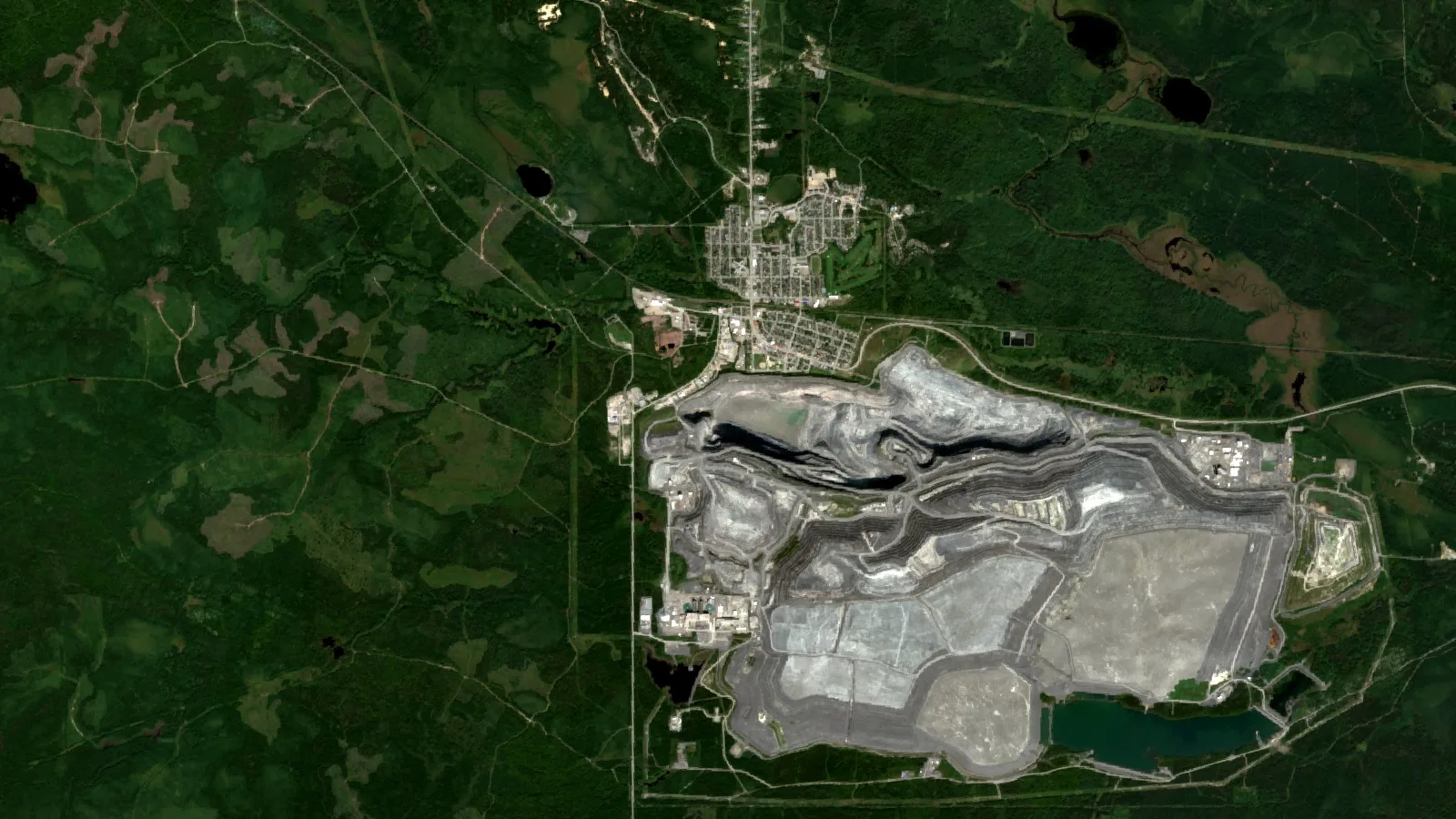
Search for “malartic mine quebec” and you will find two mines in one complex, together the largest gold mine in Quebec by output. Agnico Eagle’s annual information form describes Canadian Malartic as the large open-pit mine and processing plant inside the town of Malartic, about 25 kilometres west of Val-d’Or and 80 kilometres east of Rouyn-Noranda, plus the Odyssey underground mine. The original Canadian Malartic pit was depleted in 2023 and now takes tailings and waste rock. The Barnat pit is expected to produce until 2029, while the Odyssey underground mine, including the East Gouldie zone, is developed alongside it.
Ownership has moved twice. Agnico Eagle and Yamana Gold bought Osisko jointly in 2014 and each held 50% of the Canadian Malartic gold mine through a partnership. On 31 March 2023 Agnico Eagle bought Yamana’s Canadian assets, taking Malartic to 100% and adding the Wasamac project. Commercial production at the open pit was first achieved in May 2011. In 2025 the mill averaged 55,132 tonnes a day and recovered 91.6% of the gold from ore grading 1.08 g/t, for 642,612 payable ounces. The company guides 575,000 to 605,000 ounces for 2026.
History matters for anyone holding ground nearby. The filing records that the Gouldie brothers found gold in the Malartic area in 1923, and that the Canadian Malartic, Barnat/Sladen and East Malartic mines produced about 5.5 million ounces between 1935 and 1983, mostly underground. Old shafts, old drill holes and old assessment files sit all over this camp. A modern gold mine in Quebec’s Abitibi is usually a new way of mining a known system, not a fresh discovery.

▶ How ore becomes gold bars: a useful primer on the crushing, grinding and recovery steps a mill like Canadian Malartic runs at scale. · 10:34
LaRonde, Goldex and the Cadillac corridor
LaRonde sits roughly halfway between Rouyn-Noranda and Val-d’Or, in the municipalities of Preissac and Cadillac, about 470 kilometres northwest of Montreal. It is a deep underground gold mine in Quebec that also ships copper and zinc concentrate. In 2025 it produced 344,555 payable ounces from ore with a 4.08 g/t head grade. The Cadillac-Larder Lake fault zone, which the filing describes as the contact between the Abitibi and Pontiac subprovinces, runs about two kilometres south of the property, and the Malartic deposits lie along the same contact. That fault is the single most important line on a Quebec gold map.
Goldex produced 125,501 ounces in 2025 from 3.3 million tonnes at 1.40 g/t, and since February 2024 it has also processed ore from the satellite Akasaba West open pit, about 30 kilometres away. The company expects 115,000 to 125,000 ounces from Goldex in 2026.
Lamaque, Westwood and the other producers
Eldorado Gold reported 187,208 ounces from the Lamaque Complex in 2025, down 5% on 2024 because of lower grades and recoveries, and it marked the complex’s one millionth ounce since commercial production began in 2019. It also processed a second bulk sample from the Ormaque deposit. IAMGOLD’s Westwood complex, the smallest producing gold mine in Quebec in our table, 100% owned and about 40 kilometres east of Rouyn-Noranda, produced 113,900 ounces on a preliminary basis, below its own 125,000 to 140,000 ounce guidance. IAMGOLD also names a Nelligan Mining Complex in the Chibougamau-Chapais region as an exploration focus for 2026.
Éléonore and the James Bay north
The one large gold mine in Quebec far from the Abitibi is Éléonore, an underground mine in Eeyou Istchee James Bay that began commercial production in 2015. Newmont agreed in November 2024 to sell it to Dhilmar, described as a UK-based private mining company, for US$795 million in cash, and industry reporting records the sale as completed in early 2025. The Quebec environment ministry’s May 2025 authorization for a new tailings cell is addressed to Dhilmar Éléonore, which confirms the new owner on a government document. Dhilmar has not published production figures that we could find, so we give none.
Chart
Reserve grade at Agnico Eagle’s Quebec deposits
Proven and probable mineral reserves, grams of gold per tonne, at 31 December 2025
How much gold Quebec produces, year by year
The Mineral production in Canada table for 2024, compiled by Natural Resources Canada from Statistics Canada data, puts Quebec’s gold production at 58,259 kilograms, about 58.3 tonnes, against 185,555 kilograms for Canada. Quebec’s gold shipments were worth C$5.64 billion that year. Ontario produced 69,687 kilograms. The gap between the two provinces has narrowed: in the 2020 table Quebec produced 51.0 tonnes to Ontario’s 70.7.
Chart
Quebec and Ontario gold production
Tonnes of gold produced, 2020 to 2024 (converted from kilograms)
For the national picture by province, including the territories and British Columbia, see our Canada gold deposits by province page. The reason the Quebec number matters to an explorer is practical: the province has the mills, contractors, assay labs and trained crews that a new gold mine in Quebec would need, and the operating mines are actively buying and drilling around their own camps. Agnico Eagle’s filing lists 2025 regional exploration around Canadian Malartic, Goldex, west of LaRonde and at Wasamac and Marban.

▶ A Canadian example of satellite screening on gold and copper ground, the same first step we apply in Quebec's Abitibi. · 3:11
The geology behind a gold mine in Quebec
Quebec’s main gold camps follow the southern edge of the Abitibi subprovince. Agnico Eagle’s technical descriptions place the Malartic deposits on the contact between the Larder Lake-Cadillac fault zone and metasedimentary rocks of the Pontiac Group, and LaRonde about two kilometres north of the same fault. In plain terms, most of the big Quebec gold mines are strung along one long, deep crustal break and the smaller faults that branch off it.
That gives a gold explorer in Quebec three things to look for: the main fault corridor, second-order splays and folds near it, and intrusive bodies such as porphyries that focused fluids. Around Malartic, the filing links gold to stockworks and disseminations in or near dioritic and felsic porphyry intrusions; at LaRonde it comes with copper and zinc in a sulphide system. Different styles, same corridor. Open-pit reserves in this camp grade under 1 g/t, while underground reserves run from about 1.6 to 5.7 g/t, as the chart above shows.
Two public sources do most of the desk work. SIGÉOM, the Quebec government’s geomining information system, holds geoscience and mining data collected since 1875, free to download as shapefiles or geodatabases. It includes bedrock and Quaternary geology, geophysics, geochemistry, mineral occurrence records, diamond drill hole locations and the EXAMINE library of filed exploration reports. GESTIM, the title system, shows who holds what. Using both before you spend money on any target is the cheapest due diligence available in Canada.
Quebec’s SIGÉOM database holds geoscience records back to 1875, free to download.
What satellites can see over Quebec gold ground
Much of the Abitibi is flat, forested and covered by glacial sediment. The Geological Survey of Canada has worked on this problem for decades; its Open File 945 reports gold content in overburden samples across the Abitibi Clay Belt, from a till and bedrock survey between Timmins and Val-d’Or. When the bedrock is under clay and till, a satellite looking at the surface sees soil, peat, trees and water, not altered rock.
So what does work? Sentinel-2, the European Copernicus mission, carries an imager with 13 spectral bands at up to 10 metre resolution across a 290 kilometre swath, with a five-day revisit from its two-satellite constellation. Over Quebec gold ground that is enough to map linear features that follow faults and shear zones, drainage offsets, contrasts in vegetation stress over different substrates, outcrop ridges and old workings. Combined with elevation models and public magnetic data, it is a good way to rank ground before a field crew goes in.

▶ Northern gold terrain with forest, snow and short field seasons, conditions Quebec explorers also plan around. · 11:35
What satellites cannot do in Quebec matters as much. They do not see gold. They see little through more than a thin skin of cover, and snow hides the ground for several months of the year, so useful scenes come from the snow-free season. They also cannot tell you whether a fault carries grade: only sampling and drilling can. Glacial ice moved material from where it formed, so a surface anomaly in till may sit some distance from its source. A screening result is a ranked list of places to sample, not a deposit; before any target becomes a gold mine in Quebec it needs drilling, a resource estimate and permits.
Gold prospecting in Quebec: exclusive exploration rights and the new rules
Gold prospecting in Quebec, whether on open ground or beside a producing gold mine in Quebec, starts on a map, not with posts. The province is divided into grid polygons, and you obtain an exclusive exploration right, formerly called a claim, by filing a notice of map designation through GESTIM. Prospecting itself needs no permit, but it still has to respect land access law. The first term is three years; renewals are for two years at a time and depend on doing the exploration work the regulation sets. For other provinces and countries, our mining cadastre portal guide shows how map-designation systems compare.
What changed with Act 36
Bill 63, assented to on 29 November 2024 as chapter 36, replaced the word “claim” with “exclusive exploration right” and changed how rights are granted and renewed. Three changes matter most for gold explorers. First, state-owned minerals under private land outside an urbanization perimeter are withdrawn from prospecting, exploration and mining, unless the parcel already carried a right or a designation notice received before 28 May 2024. Second, urbanization perimeters are withdrawn as well, though a regional county municipality can ask for a lifting. Third, the Act lets the government sign agreements with Indigenous nations, including the Cree Nation Government, Makivik Corporation and the Kativik Regional Government, to reserve or withdraw land.
Regional county municipalities can also ask for land to be declared a territory incompatible with mining activity, or TIAM. According to the Quebec government page on TIAMs, the withdrawal takes effect when it appears on the GESTIM title map and blocks any new exploration right for state-owned minerals. Existing holders under a TIAM must do work on each right to renew it. At 2 April 2026, 19 MRCs had TIAMs in force and 29 had temporary six-month suspensions while they drew theirs.
Chart
Where TIAM withdrawals cover the most ground
Share of each regional county municipality (MRC) under a TIAM, at 2 April 2026, % (selected MRCs)
The obligations that now come with a right
Since 6 May 2024, all so-called impact-causing exploration work must be authorized before it starts, and the application must include a report of exchanges with local municipalities and Indigenous communities. Separately, the annual exploration work planning rule requires the holder to send a plan to the local municipality and any Indigenous nation or community concerned at least 30 days before work, including airborne geophysical surveys, to hold an information session on request, and to post the plan on its website. The government’s directives and notices page also says that from 29 November 2025 a right can only be transferred during its first term with the Minister’s authorization, and that since 6 May 2026 work reports are uploaded directly into GESTIM.
Infographic
From open ground to a renewed exploration right in Quebec
- 1Check the map and designateOpen ground only (TIAMs, urbanization perimeters and most private land are withdrawn); file a notice of map designation in GESTIM, with a fee set by polygon size and latitude.
- 2First term: three yearsThe right is registered and the Minister notifies the parties concerned.
- 3Send the annual work planningTo the municipality and Indigenous communities 30+ days before work starts.
- 4Get authorization for impact-causing workRequired since 6 May 2024, with a report of exchanges attached.
- 5Declare the work in GESTIMReports above $5,000 per right are signed by a geologist or engineer.
- 6Renew for two years at a timeMeet the minimum work cost, or at 90%+ pay twice the shortfall.
Work reports follow their own rules. The holder obligations page says a simplified exploration report covers outcrop and erratic boulder examination, and that once the reported amount for such work on one right exceeds $5,000 it must be signed by the supervising geologist or engineer, a member of the Ordre des géologues du Québec or the Ordre des ingénieurs du Québec.
What a right costs to designate and renew
Fees changed on 15 July 2026. The rates and indexation page sets fees by polygon size and by whether the land lies north or south of the 52nd parallel, and it charges much more per right when one holder designates large blocks on the same day: above 40 rights south of the 52nd parallel, or above 150 rights north of it. South of the line, a right over 100 hectares costs $158.60 in a small filing but $793.00 in a bulk filing. Recording a transfer in the public register costs $23 per right, capped at $1,868 per deed. Rates are indexed each 1 January, by 2.05% for 2026.
The work requirement is the bigger cost. Under section 73 as amended by Act 36, a holder who has reported at least 90% of the minimum work cost may renew by paying the Minister twice the difference. Below 90%, that route is closed. The minimum work amounts per right are set in the Mining Regulation and printed on each title in GESTIM; we do not reproduce them here because we could not open the current consolidated table this month. Enter yours in the calculator below.
Calculator
What will it cost to renew your Quebec exploration rights?
Enter the number of rights, the renewal fee for your band and the work figures from your titles (C$).
- Renewal fees (C$): $3,149
- Work reported, share of the minimum: 95.0%
- Payment in place of the shortfall, twice the gap (C$): $3,000
- Work still missing if below 90%, not payable (C$): $0
Renewal fee per right in C$ from the Quebec rates and indexation page, fees in force from 15 July 2026: south of the 52nd parallel C$53.95 (under 25 ha), C$104.98 (25 to 100 ha), C$158.60 (over 100 ha); north of the 52nd C$53.95 (under 25 ha), C$193.70 (25 to 45 ha), C$218.40 (over 45 to 50 ha), C$244.40 (over 50 ha). The 90% rule and the twice-the-difference payment come from section 73 of the Mining Act as amended by Act 36 (2024): if reported work is below 90% of the minimum, the payment option is not available and more work is needed before renewal. The minimum work cost and the default values are examples only: take the real amount from each title in GESTIM. Excludes work already performed, excess credits from neighbouring rights, taxes and professional fees. All amounts in Canadian dollars (C$). Confirm with the MRNF.
Exploring in Eeyou Istchee James Bay
North of the Abitibi, most gold exploration in Quebec takes place in Eeyou Istchee, the territory of the James Bay Cree, governed by the James Bay and Northern Quebec Agreement (JBNQA). The Cree Nation Government states that it supports mineral development within the JBNQA’s principles, provided its social and environmental regime is respected, and its Cree Nation Mining Policy rests on three pillars: support for mining, sustainable practice using tools such as social and economic agreements and environmental assessment, and transparency and collaboration.
For a junior, that translates into early contact with the community whose traplines and land users your program will touch, an annual work planning that actually reaches them, and a report of exchanges that records real questions and answers rather than a form letter. The Éléonore mine shows that a large modern gold mine in Quebec can be built and operated in the territory. It also shows the scale of permitting involved: the mine’s main environmental certificate has been amended more than twenty times since 2011, according to the ministry’s 2025 authorization letter.
Buying into a gold mine in Quebec, or the ground around one
Most readers who search for a gold mine in Quebec for sale are really looking at one of three things: shares in a listed producer, a joint venture with a junior, or a block of exploration rights next to a producing camp. Each needs different checks. For listed companies, the NI 43-101 technical report and the annual information form are the documents that count. For exploration rights, the GESTIM register, the work credits on each title and the filed reports in SIGÉOM count.
Three Quebec-specific points come up again and again. A right still in its first term cannot be transferred without the Minister’s authorization since November 2025. A right under a TIAM can be renewed only if work is done on it. And private land designated before 28 May 2024 keeps its right, but new designations on private land outside towns are no longer possible, so any title on private land deserves a closer look at its history.
The formula behind every resource headline is simple: tonnes times grade in grams per tonne, divided by 31.1035 grams per troy ounce. Run it on Canadian Malartic’s reserve, 169.9 million tonnes at 1.66 g/t, and you get about 9.07 million ounces, close to the 9.05 million the company reports after rounding. Gold traded at a Kitco bid of US$4,153.60 an ounce on 15 October 2026; the calculator uses a round US$4,150 as an example only.
Calculator
How many ounces could a Quebec gold target contain?
Enter tonnes, grade, recovery and a gold price to see contained and recoverable ounces and their gross value in US dollars.
- Contained gold: 48,226 oz
- Recoverable gold: 43,403 oz
Assumptions: 31.1035 grams per troy ounce; recovery (capped at 100%) applied to contained ounces; gross value in US dollars (US$), rounded to the nearest US$1,000, before mining, processing, royalty, tax and capital costs. The gold price is an example, check today’s price (Kitco spot gold, 15 October 2026, was about US$4,150/oz). Default values are illustrative examples, not a Farmonaut estimate or a resource. A satellite target has no tonnes or grade until it is drilled and estimated by a Qualified Person under NI 43-101. Not investment advice.

▶ Why majors and juniors keep spending on gold exploration, and how that money moves through camps like the Abitibi. · 10:44
How we screen Quebec gold ground
We are a satellite data company. Our satellite-based mineral detection work analyses multispectral and, where suitable, hyperspectral data for alteration signatures, faults, fractures and deposit-related patterns, and turns them into ranked target zones. You send the area as coordinates, a KML or KMZ file or a polygon, with the mineral of interest. We choose the data, run the analysis and deliver in 5 to 20 business days depending on size and complexity. Across our work we have scanned more than 100,000 hectares for 20+ mineral types in 25+ countries.
For a right holder near a gold mine in Quebec, the value is in ranking: deciding which polygons to keep, which to drop before renewal, and where to send a till-sampling or geophysics crew first. That can shorten early exploration from months to days and cut early-stage costs by up to 80 to 85%. The premium report includes prospectivity heatmaps, estimated location and depth ranges and GIS files; the Premium+ report adds TargetMax drilling intelligence and 3D prospectivity models. Results are exploration targets that sit ahead of any resource estimate. They are not NI 43-101 resources, and we are not a broker, legal adviser or investment adviser.
Frequently asked questions
What is the biggest gold mine in Quebec?
By 2025 output, Canadian Malartic is the biggest gold mine in Quebec. Agnico Eagle reported 642,612 payable ounces from the complex, which combines the Barnat open pit and the Odyssey underground mine at Malartic in the Abitibi.
Who owns the Canadian Malartic gold mine?
Agnico Eagle owns 100%. It bought 50% with Yamana Gold through the 2014 Osisko acquisition and the remaining 50% on 31 March 2023.
Is the Malartic mine in Quebec still open?
Yes. The original pit was depleted in 2023, but the Barnat pit is expected to produce until 2029, and the Odyssey underground mine, including East Gouldie, is being developed to take over. Agnico Eagle guides 575,000 to 605,000 ounces for 2026.
How many gold mines are there in Quebec?
Five operations reported 2025 gold production in owner filings: Canadian Malartic, LaRonde, Goldex, Lamaque and Westwood. Éléonore has produced since 2015, though its new owner has not published figures. Projects, such as Wasamac and Marban, carry reserves but are not yet in production.
Which companies mine gold in Quebec?
The main Quebec gold mining companies by 2025 output are Agnico Eagle (Canadian Malartic, LaRonde, Goldex), Eldorado Gold (Lamaque) and IAMGOLD (Westwood). Dhilmar, a UK-based private company, has owned Éléonore since early 2025.
Is there a gold mine in Quebec’s James Bay region?
Yes. Éléonore is an underground gold mine in Quebec’s Eeyou Istchee James Bay territory, in commercial production since 2015 and owned by Dhilmar since early 2025.
Where is gold found in Quebec?
Mostly along the southern Abitibi, between Rouyn-Noranda and Val-d’Or, close to the Cadillac-Larder Lake fault. Gold is also mined in Eeyou Istchee James Bay, home of Éléonore, and explored in the Chibougamau-Chapais area.
How do you stake a gold claim in Quebec?
You do not stake on the ground. You designate grid polygons on the GESTIM map as an exclusive exploration right. The first term is three years, then two-year renewals that depend on work. Fees depend on polygon size and latitude.
Can I prospect for gold on private land in Quebec?
Generally no new right can be designated. Since the 2024 amendments, minerals under private land outside urbanization perimeters are withdrawn unless a right or designation notice existed before 28 May 2024. Prospecting also needs the owner’s permission.
Is there still gold in Quebec?
Yes. Quebec produced 58.3 tonnes in 2024, and Agnico Eagle alone reports 14.2 million ounces of proven and probable reserves across its Quebec operations and projects at the end of 2025.
Can you buy a gold mine in Quebec?
Buying a producing gold mine in Quebec usually means buying shares in its listed owner. Buying exploration rights is more common: check the GESTIM register, the work credits on each title and, during a first term, the Minister’s authorization. Not investment advice.
Can satellites find gold in Quebec?
Not directly. Satellites map faults, linear features, vegetation and outcrop patterns that help rank ground. Glacial clay, till, forest and snow limit what they see, so ground sampling and drilling decide whether a target holds gold.
Farmonaut mineral detection
Map your mining site from space
Send your claim or licence boundary as KML, KMZ or a polygon. Farmonaut returns ranked satellite exploration targets for it, usually in 5 to 20 business days.

Keep reading
Sources
- Agnico Eagle, Annual Information Form for the year ended 31 December 2025 (SEC filing, 2026): sec.gov
- Eldorado Gold, 2025 year-end results (SEC filing, 2026): sec.gov
- IAMGOLD, Q4 2025 operating results and 2026 guidance (2026): s202.q4cdn.com
- IAMGOLD, Westwood complex operations page (2026): iamgold.com
- Natural Resources Canada, Mineral production in Canada, Table G01 (2024): sead.nrcan-rncan.gc.ca
- Natural Resources Canada, Mineral production in Canada, Table G01 (2023): sead.nrcan-rncan.gc.ca
- Natural Resources Canada, Mineral production in Canada, Table G01 (2022): sead.nrcan-rncan.gc.ca
- Natural Resources Canada, Mineral production in Canada, Table G01 (2021): sead.nrcan-rncan.gc.ca
- Natural Resources Canada, Mineral production in Canada, Table G01 (2020): sead.nrcan-rncan.gc.ca
- Mining Technology, Newmont agrees sale of Éléonore to Dhilmar (2025): mining-technology.com
- Mining Technology, Newmont completes sale of three non-core operations (2025): mining-technology.com
- Ministère de l'Environnement du Québec, Éléonore tailings cell 5 authorization (2025): environnement.gouv.qc.ca
- Gouvernement du Québec, Exclusive exploration right: rates and indexation (2026): quebec.ca
- Gouvernement du Québec, Procedure to obtain an exclusive exploration right (2026): quebec.ca
- Gouvernement du Québec, Annual exploration work planning (2026): quebec.ca
- Gouvernement du Québec, Obligations of the exclusive exploration right holder (2026): quebec.ca
- Gouvernement du Québec, Mining directives and notices (2026): quebec.ca
- Publications du Québec, Act 36 (Bill 63) amending the Mining Act (2024): publicationsduquebec.gouv.qc.ca
- Gouvernement du Québec, Territoires incompatibles avec l'activité minière (2026): quebec.ca
- Gouvernement du Québec, SIGEOM geoscience database (2026): quebec.ca
- Cree Nation Government, Mining (Cree Nation Mining Policy): cngov.ca
- Geological Survey of Canada, Open File 945: gold in overburden, Abitibi Clay Belt (1983): geochem.nrcan.gc.ca
- European Space Agency, Sentinel-2 mission overview: esa.int
- Kitco, Live gold price chart (accessed 15 October 2026): kitco.com
Discussion
Questions, corrections or field experience? Share them below. First-time comments are reviewed before they appear, and your email is never published.
No comments yet. Be the first to add a question or your experience.

 Ramani Investments Ltd
 Congo Mining Solutions
 Mining SARL
 SenGold Invest SAS
 Sania Corporation
 Sean Mining Limited
 NTS Group (Pty) Ltd
 Mine4Africa
 Lithspo Minerals Limited
 Tintina Mining Group
 Dalgety Minerals Pty Ltd
 Vortex Minerals Pty Ltd
 Faith At Work (Pty) Ltd
 Geotech Mining Solutions plc
 Vulcan International Limited
 Kidepo Associates
 GKY Mining
 Alkimy SARL
 Double A Trading
 GemSprout Metals Limited
