

Gemstones · Auction price guide
How Much Is Jadeite Worth? Auction Prices Per Carat
Fine jadeite sells by the piece and the carat. Sotheby’s sold Imperial Green cabochon earrings at US$35,101 per carat in April 2021, and a jadeite necklace reached US$27.4 million in 2014. Stone without top colour and a lab report sells for less.
Key takeaways
- Sotheby’s Hong Kong reported US$35,101 per carat for Imperial Green cabochon earrings (April 2021); a 277.673-carat bangle made US$3,917,830, about US$14,100 per carat by our division.
- The Hutton-Mdivani jadeite necklace sold for HK$214.04 million (US$27.4 million) in April 2014, the auction record for jadeite jewellery.
- One carat is 0.2 g, so multiply a per-carat price by five for a per-gram price; GIA ranks colour, then transparency, then texture as the main value drivers.
- China’s jade market fell from RMB 150 billion in 2023 to RMB 98 billion in 2024 (GAC data via Solitaire), and Myanmar’s 61st emporium offers 3,073 jade lots against 6,973 in March 2019.
- The US Treasury sanctioned Myanma Gems Enterprise on 8 April 2021, so check sanctions and chain of custody before any Myanmar jadeite deal.
In this article
- Jadeite auction prices: what the top pieces sold for
- Jadeite value per gram and per carat: why one number is misleading
- What sets jadeite's price: colour, translucency, texture and size
- Treated or natural: A, B and C jade and what a lab report adds
- Where jadeite comes from: Hpakant, Guatemala and other sources
- How Myanmar sells rough jadeite: the gems emporium
- From boulder to bangle: how rough jadeite becomes a finished piece
- Demand and price risk: what changed in China's jade market
- Sanctions, import rules and ethical sourcing for buyers
- Estimate a piece's value from its weight and price per carat
- A six-step check before paying for a jadeite piece
- What satellite screening can and cannot show for a jadeite project
- Land, safety and community risks at jadeite mines
- Frequently asked questions
Fine jadeite is priced by the piece and by the carat, not by a standard price per gram, and the top end is very high. A pair of “Imperial Green” jadeite cabochon earrings sold at Sotheby’s Hong Kong for US$35,101 per carat in April 2021, and the Hutton-Mdivani necklace of 27 jadeite beads reached US$27.4 million in April 2014, a record for any jadeite jewel. Pieces without top colour and a lab report sell for less, though this guide has no dated price for them; what separates the two is quality, treatment and paper trail.
Jadeite is a tough rock made of tiny interlocking crystals. GIA, the gem laboratory, describes it as one of the two materials gemologists call jade, the other being nephrite. A carat is the gem trade’s weight unit: one carat equals 0.2 grams, so five carats make a gram. This page is written for investors who want to read auction results, spot weak claims in a price table and understand the supply chain behind the stone. It gives dated auction data, a conversion to price per gram, a quality checklist, a note on sanctions and a calculator.
Jadeite auction prices: what the top pieces sold for
Auction results are the main public, dated prices for fine jadeite, and they come from a narrow top slice of the market. The table lists the best-documented Sotheby’s Hong Kong results found for this page. Prices are as reported by Sotheby’s or the trade press, in Hong Kong dollars (HK$) and US dollars (US$) as given. The per-carat column is only filled where the weight or the per-carat price was published.
Chart
Selected Sotheby’s Hong Kong jadeite results
Reported sale price, HK$ million (selected lots, not a price index)
| Lot | Sale | Weight or size | Reported result | US$ per carat |
|---|---|---|---|---|
| Hutton-Mdivani necklace, 27 beads | Sotheby’s Hong Kong, April 2014 | Beads 15.40 to 19.20 mm | HK$214.04 million (US$27.4 million) | Not published |
| Green jadeite bangle (SSEF report) | Sotheby’s Hong Kong, April 2021 | 277.673 carats | HK$30,425,000 (US$3,917,830) | About 14,100 (our division) |
| Pair of “Imperial Green” cabochon earrings | Sotheby’s Hong Kong, April 2021 | About 25.5 carats (implied) | HK$6,951,000 (US$895,080) | 35,101 (reported) |
| Jadeite Tianchi demi-parure | Sotheby’s Hong Kong, October 2023 | Not published | HK$31,910,000 | Not published |
| 47-bead jadeite, diamond and ruby necklace | Sotheby’s Hong Kong, April 2021 | Not published | HK$23,407,000 (US$3,014,119) | Not published |
| “Circle of Heaven” bangle | Sotheby’s Hong Kong, April 2018 | Not published | Did not sell; estimate US$10.2 to 12.8 million | Not applicable |
| Smaller jewellery (bracelet, pendant necklace, earrings) | Sotheby’s, dates not stated | Not published | HK$241,300 to HK$393,700 per lot | Not published |
The sources behind the table are the Sotheby’s press release of April 2021 (bangle, earrings and the 47-bead necklace), a Sotheby’s market article (the HK$214.04 million necklace result and the smaller lots), and National Jeweler’s report on the 2018 sale, where the top bangle failed to reach its reserve. A Sotheby’s spokesperson said at the time that the jadeite market remained price sensitive.
Two points matter for anyone using these numbers. First, they are results for exceptional pieces that were offered by a major house, so they say little about a typical stone. Second, an unsold top lot shows that even the best material can fail when the estimate runs ahead of buyers. Our own division of the 2021 bangle price by its weight gives about US$14,100 per carat; that figure is our arithmetic, not a Sotheby’s number.
Jadeite value per gram and per carat: why one number is misleading
The trade does not quote one price per gram for jadeite. GIA says size is commonly expressed in millimetres, and that with top-quality Imperial jadeite, small differences in size can make large differences in value. For that reason a single “price per gram” for a whole grade hides the spread. Price lists that give one range per gram for a grade, without naming a sale date, a lab report or a weight, do not match the dated auction record above.
You can still convert. Because one carat is 0.2 grams, multiply a per-carat price by five to get a price per gram. The 277.673-carat bangle weighs about 55.5 grams, so its US$3.92 million result works out to roughly US$70,500 per gram. The earrings’ reported US$35,101 per carat equals about US$175,500 per gram. These are top-of-market figures for mounted or finished pieces, and they include everything the buyer paid for polish, cut, proportion and rarity. They are not a guide to what a small commercial cabochon or an untreated bead costs.
For rough stone the picture is different again, because rough is sold by tender in Myanmar and the buyer carries the risk that the boulder is flawed inside. The section on the Myanmar emporium below explains how that sale works. If you are comparing a finished piece with a price you saw online, ask for the weight in carats, the dimensions and the lab report number first, then compute the carat price yourself with the calculator further down this page.
What sets jadeite’s price: colour, translucency, texture and size
GIA ranks the quality factors by their effect on value: colour first, then transparency, then texture. The list below follows that order and adds the other factors that buyers and auction houses stress.
- Colour. The most desirable colour is a very specific green that is pure and intense, with no hint of grey, and that reads strongly even from a distance. GIA names the top material “Imperial jade” and notes that the green runs from pure green to slightly bluish or slightly yellowish green. Other prized types include kingfisher jade (slightly less vivid than Imperial), apple jade (intense yellowish green) and moss-in-snow jade (translucent white with bright green veins). Lavender comes next in value, and intense colours earn a premium over pale ones.
- Transparency. The best jadeite is semi-transparent: text read through it looks slightly blurred. Good transparency can partly make up for uneven colour. Opaque stones and stones with cloudy patches are the least desirable.
- Texture. Texture is the grain size of the interlocking crystals, and can be fine, medium or coarse. Fine-grained jadeite looks smooth and has high lustre. The trade sometimes calls the three grades old mine, relatively old mine and new mine.
- Size and weight. For cabochons, beads and bangles, value rises with size when other factors are equal. GIA adds that larger size does not raise the value of nephrite dramatically in most cases.
- Cut and form. Bangles are carved from one piece (called hololiths), so a great deal of rough is lost. Sotheby’s catalogue note for a 2016 bangle says bangles and bead necklaces command the highest values mainly because of this waste, and that a bangle needs a boulder with almost no fissures or inclusions. GIA says one-piece bangles cost more than bangles joined by metal hinges.
- Treatment status and proof. Bleached, impregnated or dyed stone is a different product from natural stone, and the seller must say which one it is. The next section covers this.
Value is also tied to market taste. GIA writes that the price for fine jadeite rose dramatically along with China’s economic rise and that, historically, the Chinese court once held a standing order for all the Imperial material available. That demand history is why the market follows Chinese consumer conditions so closely, as the demand section below shows.
Treated or natural: A, B and C jade and what a lab report adds
The trade uses letters for treatment. In the classification used in China, “A” jade is natural or polished with wax only, “B” jade is bleached with acid and then impregnated with polymer resin, and “C” jade is dyed. B and C material can look attractive, and GIA warns that when treatment is not disclosed a buyer may believe a stone is worth more than it really is.
Disclosure is not optional in the gem trade. GIA’s overview says that anyone selling a treated gem is legally required to disclose the treatment, and points to the United States Federal Trade Commission guidelines and to trade bodies such as AGTA, ICA and CIBJO. Testing is not trivial: GIA research cited in its jade guidance says polymer impregnation is not always visible under magnification. A GIA Gems and Gemology note on a 244.29-carat bangle shows why. A clearer patch looked like polymer filling, but Raman spectroscopy showed it was natural nepheline, a mineral that occurs with the jadeite.
For high-value lots, auction houses publish the lab result. Sotheby’s catalogue entry for a 2016 bangle cites a Hong Kong Jade & Stone Laboratory certificate stating the jadeite is natural, “A jade”. Before paying for any significant piece, ask for an independent report that names the treatments in the lab’s own words, and keep the report number with the invoice.
Look-alikes add another risk. A China-based analyst writing in 2025 notes that a quartzite sold as Feizhou Cui, or “African jadeite”, can imitate high-grade jadeite and costs only a few thousand yuan where a genuine high-grade bangle costs more than RMB 100,000. That gap is a sign of how much the genuine stone is worth, and of how much mislabelling a buyer can face.
If this topic matters to you, read How Much Copper Does a Data Center Use? Calculator next.
Related reading on this site: Kunzite Stone Value: Price per Carat by Quality.
Where jadeite comes from: Hpakant, Guatemala and other sources
Jadeite is rare in the ground. A review by Tsujimori and Harlow in the European Journal of Mineralogy describes jadeitite-bearing serpentinite mélange in the Caribbean (Guatemala, Cuba, Dominican Republic), the circum-Pacific (Japan, Western USA, Papua New Guinea), the Alpine-Himalayan belt (Italy, Greece, Myanmar) and the Caledonian belt (Russia, Kazakhstan). Serpentinite is a rock formed when mantle rock takes up water, and a mélange is a jumbled body of blocks in such a matrix. The review says most major occurrences are fluid precipitates from subduction zones, the places where one tectonic plate sinks beneath another, and that the rocks always sit with other high-pressure, low-temperature metamorphic rocks.
The review is about geology, not gem grade, so it does not tell you which occurrences yield gem-quality stone. Global Witness says the most valuable jade in the world is found in the Kachin hills of northern Myanmar, and Hpakant township in Kachin State is the best-known mining area. GIA notes that rough often comes as boulders, with one Myanmar example weighing 23 metric tons. Guatemala is a second source: Harlow and co-authors describe jadeitite blocks in serpentinite along the Motagua fault, formed at roughly 6 to 12 kilobars and 300 to 400 °C for the northern occurrences. An analyst writing in Solitaire reports that Guatemala now supplies around 30% of China’s jadeite imports, though its material generally lacks the colour saturation and translucency of Burmese stone.
Do not read this as a ranking of countries by value. Origin matters to buyers because Imperial jade has been tied to Burma since its discovery, according to GIA, but a stone’s price is set by its own colour, transparency and texture, not by its passport. A low-grade Burmese piece is still a low-grade piece.
How Myanmar sells rough jadeite: the gems emporium
Myanmar’s state sells jade by open tender at the Myanmar Gems Emporium, held in Naypyidaw; the US Treasury says the state gems enterprise organises emporiums and special sales three times a year. The announcement for the 61st emporium (8 to 17 October 2026) lists 3,073 jade lots, split into 350 Grade A, 1,255 Grade B and 1,468 Grade C lots, plus 160 gemstone lots and 700 pearl lots. Merchants may pay deposits and lot values in US dollars, in foreign currencies accepted by Myanmar’s central bank, or in kyats, depending on the type of lot.
Chart
Lots offered at the Myanmar Gems Emporium
Lots put up for tender, not lots sold; two sales only, not a trend
The scale of supply has changed. At the 56th emporium in March 2019, 6,973 jade lots were offered among 7,747 lots in all, and about US$541.5 million came from 5,601 lots sold, according to a Xinhua report. For the 61st sale fewer than half as many jade lots are on offer. The chart shows lots offered, not lots sold or money raised, and pearl lots went up while jade and gemstone lots went down.
Supply swings matter to prices. An analyst writing for Solitaire says Myanmar’s 2024 tender resumed normal operation with supply volumes 51% higher than a year earlier, though premium rough stayed scarce. A Hong Kong jadeite specialist quoted in JNA calls Myanmar the world’s main source of high-quality jadeite and says its political instability has disrupted supply and raised costs, which has made premium jadeite scarce.
From boulder to bangle: how rough jadeite becomes a finished piece
The route from pit to showcase explains why finished prices are so much higher than rough prices, and why waste is a recurring theme in the sources. Each step below adds cost or loses weight.
Infographic
From rough boulder to finished jadeite in 5 steps
- 1Mine the roughJadeite rough often comes as boulders; GIA shows a 23-tonne Myanmar example.
- 2Sell by tenderMyanmar sells jade lots by open tender at its gems emporium.
- 3Cut and polishGIA names China as the main polishing centre for jadeite.
- 4Shape the formCabochons, beads and one-piece bangles lose much rough in cutting.
- 5Test and sellA lab report states natural or treated; pieces sell at auction or through dealers.
Demand and price risk: what changed in China’s jade market
China is the largest buyer, so its market sets the mood. The Gems and Jewelry Trade Association of China (GAC) data, compiled and charted by HubWis in an article by analyst Liang Weizhang in Solitaire, shows that the jade market grew from RMB 128 billion in 2021 to RMB 150 billion in 2023, then fell to RMB 98 billion in 2024, a 35% drop, bringing jade’s share of China’s jewellery market down to 13%. Jadeite alone was RMB 115.7 billion in 2023, about 14% of the jewellery market. The chart uses the years the analysis reports.
Chart
China’s jade market value in the years reported
RMB billion; the source gives 2021, 2023 and 2024
Trade voices describe a split rather than a collapse. JNA, citing the GAC’s 2024 China Jewellery Industry Development Report, reports jade jewellery retail sales of RMB 98 billion in 2024 (about US$13.6 billion), still the second-largest jewellery category after gold. A Hong Kong jadeite dealer told JNA that prices of top-quality jadeite rose about 20% on average over the last few years; that is one dealer’s view of his own segment, not a price index. Together the two sources suggest that value held up best at the top, while the broad market and cheaper substitutes shifted.
For an investor, the practical points are narrow. There is no exchange price, no futures contract and no continuous quote for jadeite. Resale happens through auction houses, dealers and private sale, and the Sotheby’s spokesperson’s 2018 comment about price sensitivity is a reminder that a piece can fail to sell at the reserve. This page does not rate jadeite as an investment and gives no price forecast.
Sanctions, import rules and ethical sourcing for buyers
Myanmar jadeite has had a changing legal status in the United States. GIA’s buyer’s guide says the Tom Lantos Block Burmese JADE Act prohibited US imports of jadeite and ruby from Myanmar from 2008 to 2016, and that the ban ended in 2016. Since then the position has tightened for state-linked sellers. On 8 April 2021 the US Treasury designated Myanma Gems Enterprise, the state body responsible for gemstone activities, under Executive Order 14014, and said all its property in the United States or in the control of US persons was blocked. Treasury describes the enterprise as handling permits, licences, royalties and the marketing of jade.
That means a US buyer or investor cannot assume that jadeite from Myanmar is simply a commodity. Ask for the chain of custody and the date the rough left Myanmar, and take legal advice on sanctions screening before dealing with any company linked to the state enterprise. Rules also differ in the EU, UK and Asia, and they change. This page reports the April 2021 designation only, so check OFAC’s current sanctions list.
The ethical question is part of the price. Global Witness estimated in 2015 that jade production was worth as much as US$31 billion in 2014, up to 48% of Myanmar’s official GDP at the time, and argued that little of that reached ordinary people or the state. That is an upper-bound estimate from an advocacy investigation, and it is not comparable with the US$541.5 million raised at the March 2019 emporium, which is a different year and covers official tender sales only. For a buyer, the lesson is that provenance documents are a risk control as much as a premium.
Estimate a piece’s value from its weight and price per carat
Use the calculator below to turn a weight in grams and a quoted price per carat into a total, a price per gram and a total with a buyer’s fee. The inputs are examples, not benchmarks. Enter the quote you have actually been given, and use the weight on the lab report.
Calculator
What is a jadeite piece worth at your quoted carat price?
Enter the weight and the price per carat you were quoted.
- Weight in carats: 250.0
- Value per gram (US$): $5,000
- Total with buyer fee (US$): $300,000
Example values only, not a benchmark or a quote. The price per carat is an input: example, use the quote you have. Fixed in the formula: 1 carat = 0.2 g (GIA). The discount and fee are your own assumptions, for treatment, flaws or an auction buyer fee; check the fee on the sale terms.
A six-step check before paying for a jadeite piece
- Get the weight and size. Ask for carats or grams and the dimensions in millimetres, and convert with 1 carat = 0.2 g.
- Ask for an independent lab report. It should name the material as jadeite and state any bleaching, polymer or dye in the lab’s own wording.
- Judge colour, transparency and texture in two lights. GIA says buyers check colour under both fluorescent and incandescent light.
- Compare with dated sale results. Use auction records for similar weight and quality, and note the sale date, currency and whether fees are included.
- Check the paper trail. Ask for provenance, the date the rough left the country and proof the seller can legally sell it.
- Run the sanctions screen. Confirm with a lawyer that no party is on a sanctions list that applies to you.
What satellite screening can and cannot show for a jadeite project
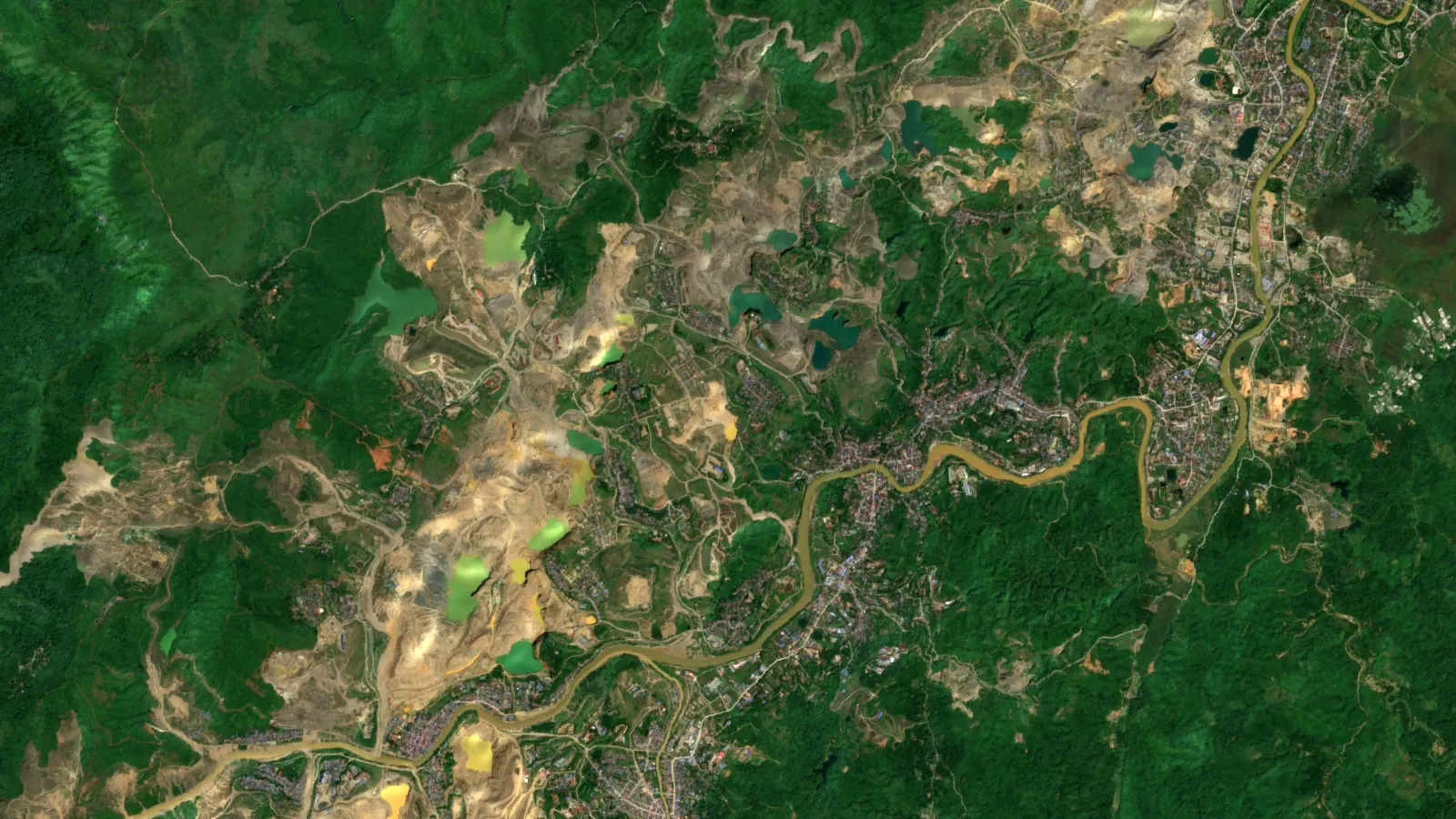
Satellite data cannot tell you how a boulder will cut, and jadeite is not among the minerals that Farmonaut’s satellite-based mineral detection lists. For a licence holder or investor looking at a serpentinite belt, what remote sensing can add is context before field work: mapped faults, alteration patterns and host rock across a wide area, delivered in 5 to 20 business days. Farmonaut states that this early stage can cost up to 80 to 85% less than conventional early exploration. The finding of gem-quality jadeite still needs sampling and cutting tests on the ground.
If you hold a licence and want to talk through a screen of your area, you can request a quote or contact the team. For another gem-value page on this site, see the guide to malachite price and value, and for how gem districts are explored, the diamond exploration guide.
▶ Remote sensing for mining in three minutes: how satellites measure ground from a distance. · 2:01
Land, safety and community risks at jadeite mines
Large pits, waste heaps and water make jadeite mining dangerous as well as disruptive. In early July 2020 a collapse at a jade mining site in Hpakant killed 170 people and injured 54, according to the ASEAN Disaster Information Network. The record says the bank of Laku Creek collapsed after heavy rain and sent mud and water onto a mine where dozens were working. The Myanmar authorities reported the number of dead rising from 126 on 2 July to 166 on 3 July.
For investors, safety and community conditions are a business risk: they can stop a mine, raise insurance and legal costs and block a sale to buyers who screen suppliers. Responsible operators plan waste dumps, drainage and slope control before they dig, and they report on both. The video below gives a short, plain-language overview of the main environmental effects of mining in general.
▶ The seven environmental impacts of mining, explained as a short claymation. · 2:31
Frequently asked questions
How much is a jadeite stone worth?
It depends on colour, transparency, texture, size, treatment and proof of origin. At the top, Sotheby’s sold “Imperial Green” cabochon earrings at US$35,101 per carat in April 2021 and a 277.673-carat bangle for US$3,917,830. Smaller pieces at the same house sold for HK$241,300 to HK$393,700. There is no standard price list.
How much is jadeite worth per gram?
There is no single figure. Multiply a per-carat price by five to convert, since a carat is 0.2 g. The 2021 bangle result works out to roughly US$70,500 per gram, and the earrings to roughly US$175,500 per gram. Commercial and treated material sells for much less.
What is the most expensive jadeite ever sold?
The Hutton-Mdivani necklace of 27 beads sold at Sotheby’s Hong Kong in April 2014 for HK$214.04 million, about US$27.4 million. Sotheby’s says it still holds the auction record for jadeite jewellery as of its April 2025 article.
Which colour of jadeite is most valuable?
GIA says the most desirable colour is a very specific green, pure and intense with no grey, known in the finest examples as Imperial jade. Lavender is the next most valuable colour, and intense colour earns a premium over pale colour.
Is jadeite worth more than nephrite?
Fine jadeite commands some of the highest prices among gems, according to GIA, while GIA notes that bigger size does not raise the price of nephrite dramatically in most cases. No source used here gives a nephrite price, so this guide cannot compare the two in dollars; compare by quality rather than by name.
What is B jade and does it lower the value?
B jade is jadeite bleached with acid and then impregnated with polymer resin, according to GIA. It is treated material, and GIA warns that undisclosed treatment can make a gem look worth more than it is. Treatment must be disclosed when a piece is sold.
How can I tell real jadeite from a look-alike?
Not by eye alone. Quartzite sold as Feizhou Cui can imitate high-grade jadeite, and treated jadeite can be hard to spot even with magnification. Ask for a report from an independent gem laboratory that identifies the material and any treatment.
Where is the best jadeite mined?
Myanmar is the main source of high-quality jadeite according to trade analysts, and Hpakant township in Kachin State is its best-known mining area. Guatemala is a second source and supplies around 30% of China’s jadeite imports, but its material generally has less colour saturation and translucency, according to an industry analyst writing in 2025.
Can I buy Burmese jadeite in the United States?
The 2008 to 2016 import ban has ended, according to GIA, but in April 2021 the US Treasury sanctioned Myanma Gems Enterprise. Take legal advice and check sanctions screening and chain of custody before any purchase.
Is jadeite a good investment?
This page cannot say. China’s jade market fell 35% to RMB 98 billion in 2024 after rising for two years, one dealer says top-quality prices rose about 20% over several years, and an unsold Sotheby’s top lot shows that sales can fail. There is no exchange price, so valuation and resale are harder than for gold or shares.
How is jadeite formed?
Jadeitite forms in subduction zones, where one plate sinks under another, mostly as a fluid precipitate in serpentinite that sits above the sinking plate. It is found with other high-pressure, low-temperature metamorphic rocks, according to a review in the European Journal of Mineralogy. The review is about geology and does not say which occurrences yield gem-quality stone.
This page is for information only. It is not investment advice, and it does not recommend buying or selling any gemstone. It is not legal advice: confirm sanctions, import and disclosure rules with the regulator or a lawyer. Auction results are for selected lots and use different dates and bases. Prospecting needs the landowner’s permission and a licence, and mercury must never be used.
Farmonaut mining
Screen a licence area from space
Request a quote for satellite-based screening of your licence area for faults, alteration and host rock before you commit to field work.
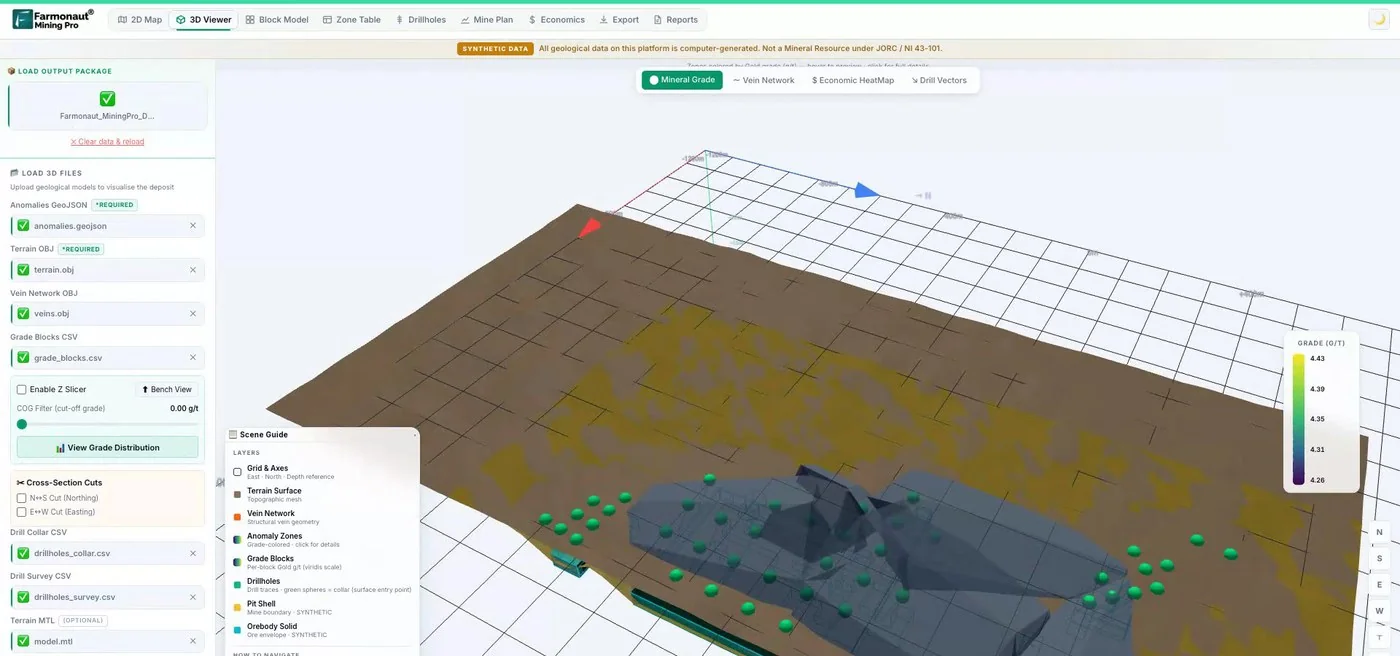
Mining Pro sample view, synthetic data
Keep reading
Sources
- GIA, Jadeite Jade Quality Factors: gia.edu
- GIA, Jade Description: gia.edu
- GIA, Jade buyer’s guide and questions and answers: gia.edu
- GIA, What is B jade?: gia.edu
- GIA, An Introduction to Gem Treatments: gia.edu
- GIA Gems & Gemology, Jadeite bangle with the appearance of polymer treatment (Summer 2014): gia.edu
- GIA, 4Cs carat weight: gia.edu
- Sotheby’s, Two ultra-rare bangles steal the show at Sotheby’s Hong Kong (20 April 2021): sothebys.com
- Sotheby’s, The Renaissance of Jadeite (16 April 2025): sothebys.com
- Sotheby’s, Highly Important Jadeite Bangle, lot 1790 (2016): sothebys.com
- National Jeweler, Jadeite necklace sets 2 world auction records (7 April 2014): nationaljeweler.com
- National Jeweler, Circle of Heaven jadeite bangle fails to sell at Sotheby’s (4 April 2018): nationaljeweler.com
- Tsujimori and Harlow, Petrogenetic relationships between jadeitite and associated high-pressure and low-temperature metamorphic rocks, European Journal of Mineralogy (2012): schweizerbart.de
- Harlow, Sisson and Sorensen, Jadeitite from Guatemala: new observations and distinctions among multiple occurrences: research.amnh.org
- Global Witness, Jade: Myanmar’s big state secret (23 October 2015): globalwitness.org
- US Department of the Treasury, Treasury Sanctions Key Gems Enterprise in Burma (8 April 2021): home.treasury.gov
- ASEAN Disaster Information Network (AHA Centre), Landslide in Hpakant Township, Kachin State (July 2020): adinet.ahacentre.org
- Solitaire (GJEPC), Jade in Flux: Reassessing the Dynamics of China’s Enduring Gemstone Market (13 August 2025): gjepc.org
- JNA (Informa Markets), Jadeite retains edge in a changing world (27 August 2025): news.jewellerynet.com
- Eleven Media via The Star, 61st Myanmar Gems Emporium to be held in Naypyidaw (1 October 2026): thestar.com.my
- Xinhua via Burma News International, Almost 541.5 million US dollars earned during gem emporium (21 March 2019): bnionline.net
- Sotheby’s, The Jadeite Tianchi (catalogue, 5 Oct 2023): sothebys.com
Discussion
Questions, corrections or field experience? Share them below. First-time comments are reviewed before they appear, and your email is never published.
No comments yet. Be the first to add a question or your experience.

 Ramani Investments Ltd
 Congo Mining Solutions
 Mining SARL
 SenGold Invest SAS
 Sania Corporation
 Sean Mining Limited
 NTS Group (Pty) Ltd
 Mine4Africa
 Lithspo Minerals Limited
 Tintina Mining Group
 Dalgety Minerals Pty Ltd
 Vortex Minerals Pty Ltd
 Faith At Work (Pty) Ltd
 Geotech Mining Solutions plc
 Vulcan International Limited
 Kidepo Associates
 GKY Mining
 Alkimy SARL
 Double A Trading
 GemSprout Metals Limited










