

Western Australia · Prospecting guide
Gold and Diamond Prospecting in Western Australia: Rules
In Western Australia you need a Miner’s Right (A$30) to prospect for gold or diamonds on Crown land, and it never covers mining. WA made 209 tonnes of gold in 2024-25 but only 24,870 carats of diamonds. Includes a licence cost calculator.
Key takeaways
- A Miner’s Right costs A$30 and lets you keep samples up to 20 kg; mining needs a title (DMPE, June 2026; fee schedule from 1 July 2026).
- WA produced 209 tonnes of gold in 2024-25, worth about A$29 billion and 72 per cent of Australian output (DMPE Statistics Digest 2024-25).
- A prospecting licence under 200 ha costs A$478 to apply for, needs A$5,000 security and must be marked out (DMPE).
- Fossicking excludes gold and diamonds in the WA Act, so searching for either is prospecting.
- Argyle was a lamproite pipe that yielded more than 865 million carats over its life; mining stopped in November 2020, and WA recorded 24,870 carats in 2024-25.
In this article
- Gold and diamond prospecting in Western Australia: the short answer
- Who is Jeff Williams, and what this page covers
- What a Miner's Right lets you do
- Seven rules to follow before you dig
- Why gold and diamonds are not "fossicking" in WA
- What a prospecting licence costs in Western Australia
- Where Western Australian gold comes from
- How much is being spent searching for gold
- How Western Australia compares with other gold producers
- Diamonds in Western Australia after Argyle
- Using satellite data before you walk the ground
- Safety, land and heritage on WA prospecting trips
- Frequently asked questions
Gold and diamond prospecting in Western Australia: the short answer
To prospect for gold or diamonds on Crown land in Western Australia (WA), each person needs a Miner’s Right, which costs A$30 on the 2026-27 fee schedule. The permit lets you pass over land to reach Crown land and keep samples of ore or material up to 20 kilograms. It does not let you mine; that needs a mining title, according to the state’s Miner’s Rights page (updated 19 June 2026).
The two minerals sit very differently in the state’s numbers. Gold is a big business: WA produced 209 tonnes (6.7 million troy ounces) in 2024-25, worth about A$29 billion in sales, and that was 72 per cent of Australian output (DMPE Statistics Digest 2024-25). Diamonds are a rounding error by comparison. The same digest records 24,870 carats worth A$5.12 million for the year, after the Argyle mine closed in November 2020.
This page is for people who want to know the permit rules, the costs, the real production picture and what to check before they walk onto a block of ground. It is written for hobby prospectors, small-scale operators and the consultants who advise them. Units are metric (tonnes, hectares, kilograms) with troy ounces where gold is priced, and money is in Australian dollars (A$) unless stated.
Two terms first. A tenement is the legal title to explore or mine a piece of ground in WA. Crown land is state-owned land, and in WA it includes pastoral leases, which are large grazing properties leased from the state.
Who is Jeff Williams, and what this page covers
Jeff Williams is a very common name, and searches for it lead to many different people. This page is about the places, rules and costs of prospecting in Western Australia, so it does not profile any individual.
Readers who arrive from a video search may be looking for one specific channel. A gold-prospecting site called Ask Jeff Williams describes its host as a certified geologist who guides people in gold prospecting. The site does not mention Australia, so nothing here should be read as his advice on WA rules. If you want his view on a method, ask him; if you want to know what the law says in WA, read the sections below and the regulator’s own pages.
What a Miner’s Right lets you do
The Mining Act 1978 treats prospecting and fossicking as two separate activities, and both need a Miner’s Right. The state’s guidance sets out what the permit covers:
- It is held per person, so a couple prospecting together need two.
- It allows prospecting on Crown land, including pastoral leases, with hand-held tools such as a metal detector.
- It allows you to take and keep samples of ore or material up to 20 kilograms.
- It does not cover mining operations, which need a mining title.
- It does not cover land under a mining tenement unless the holder consents, and it does not cover reserved land except for common, mining or public-utility purposes.
The permit is issued by a Mining Registrar’s office for a set fee per person, as the Department of Mines, Petroleum and Exploration (DMPE) brochure Seven Golden Rules for Prospecting explains. The brochure carries a July 2025 reference. The department has changed name more than once, so older guides and some web addresses still show the earlier names DMIRS and DEMIRS.
Seven rules to follow before you dig
DMPE condenses the rules into seven steps in the brochure above. Here they are in plain words, with the numbers it gives.
- Put safety first. Carry enough water, fuel, maps and first-aid supplies, and take a registered Personal Locator Beacon (PLB).
- Get a Miner’s Right when you prospect on available Crown land.
- Get a section 40E permit before prospecting inside an exploration tenement if you do not have the holder’s written permission. The 2026-27 schedule lists it at A$119.
- Get written permission from the tenement holder on a mining lease, a prospecting licence, or an exploration licence where you have no 40E permit.
- Follow the pastoral lease rules. You may not prospect within 100 metres of an occupied building or within 400 metres of livestock water without the pastoralist’s consent.
- Show respect on Crown land, because other people use it and it is set aside for many purposes.
- Fill any holes you dig and repair disturbed ground.
The brochure also warns that the maximum penalty for an individual who prospects illegally is A$150,000. Check land status before you travel. The state’s GeoVIEW.WA service lets you search geoscience and tenement information, and our guide to gold prospecting maps for Western Australia shows how to read the layers.

▶ A Farmonaut video on the official maps to read before prospecting in Western Australia, and what a Miner’s Right is. · 4:13
Why gold and diamonds are not “fossicking” in WA
Many visitors use the words prospecting and fossicking as if they meant the same thing. In WA the Act defines fossicking as searching for and removing rock, ore or minerals other than gold or diamonds, in small quantities, as samples or for a hobby, a mineral collection or lapidary work (DMPE, 2026). So looking for gold or diamonds is prospecting, and the rules for prospecting apply. Both still need a Miner’s Right.
The practical difference shows up on conservation land. For fossicking on Crown land or conservation land, holders need prior written consent from the land occupier. If your plan is a weekend with a metal detector, read the permission rules for the exact block rather than assuming one permit covers everything.
What a prospecting licence costs in Western Australia
A Miner’s Right suits a person with a detector. If you want exclusive rights over a small patch, you apply for a prospecting licence. The state’s page on prospecting licences (updated 9 April 2025) says the licence covers an area under 200 hectares that must be marked out, and lets the holder extract or disturb up to 500 tonnes of material, including overburden. The term is four years, with one further four-year extension. A security of A$5,000 is required for each licence, and there is no limit on how many a person can hold.
Fees on the DMPE schedule effective 1 July 2026 are below. Rent is charged per hectare or part of a hectare, and the minimum annual spend is the amount you must show you spent on the ground each year.
| Title | Maximum area | Application fee | Annual rent | Minimum annual spend |
|---|---|---|---|---|
| Miner’s Right | Not applicable | A$30 | None | None |
| Section 40E permit | Not applicable | A$119 | None | None |
| Prospecting licence | 200 ha | A$478 | A$4.40 per ha (minimum A$40.70) | A$40 per ha (minimum A$2,000) |
| Special prospecting licence for gold | 10 ha | A$478 | A$4.40 per ha (minimum A$40.70) | A$2,000 |
| Exploration licence, one block | 1 block | A$503 | Set by block and year | A$1,000 per block in years 1-3 (minimum A$10,000 for one block) |
| Mining lease | Not set | A$703 | A$30.10 per ha | A$100 per ha (minimum A$5,000 if 5 ha or less) |
These are government fees only. They leave out the cost of marking out the ground, surveys, a Programme of Work for mechanised disturbance, insurance and your own travel. Use the calculator below to see what a prospecting licence commits you to over its term. It covers the prospecting licence line only, so for other titles read the schedule directly.
Calculator
What does a WA prospecting licence commit you to?
Enter the area and term to see rent and the minimum spend you must show.
- Rent per year (A$): $440.00
- Minimum spend per year (A$): $4,000.00
- Rent over the term (A$): $1,760.00
Example values only. Fee constants are from the DMPE Fees and Charges 2026-27 schedule (effective 1 July 2026): application A$478, rent A$4.40 per ha (minimum A$40.70), minimum spend A$40 per ha (minimum A$2,000). Fees change each 1 July; the A$5,000 security is separate and not included.
Where Western Australian gold comes from
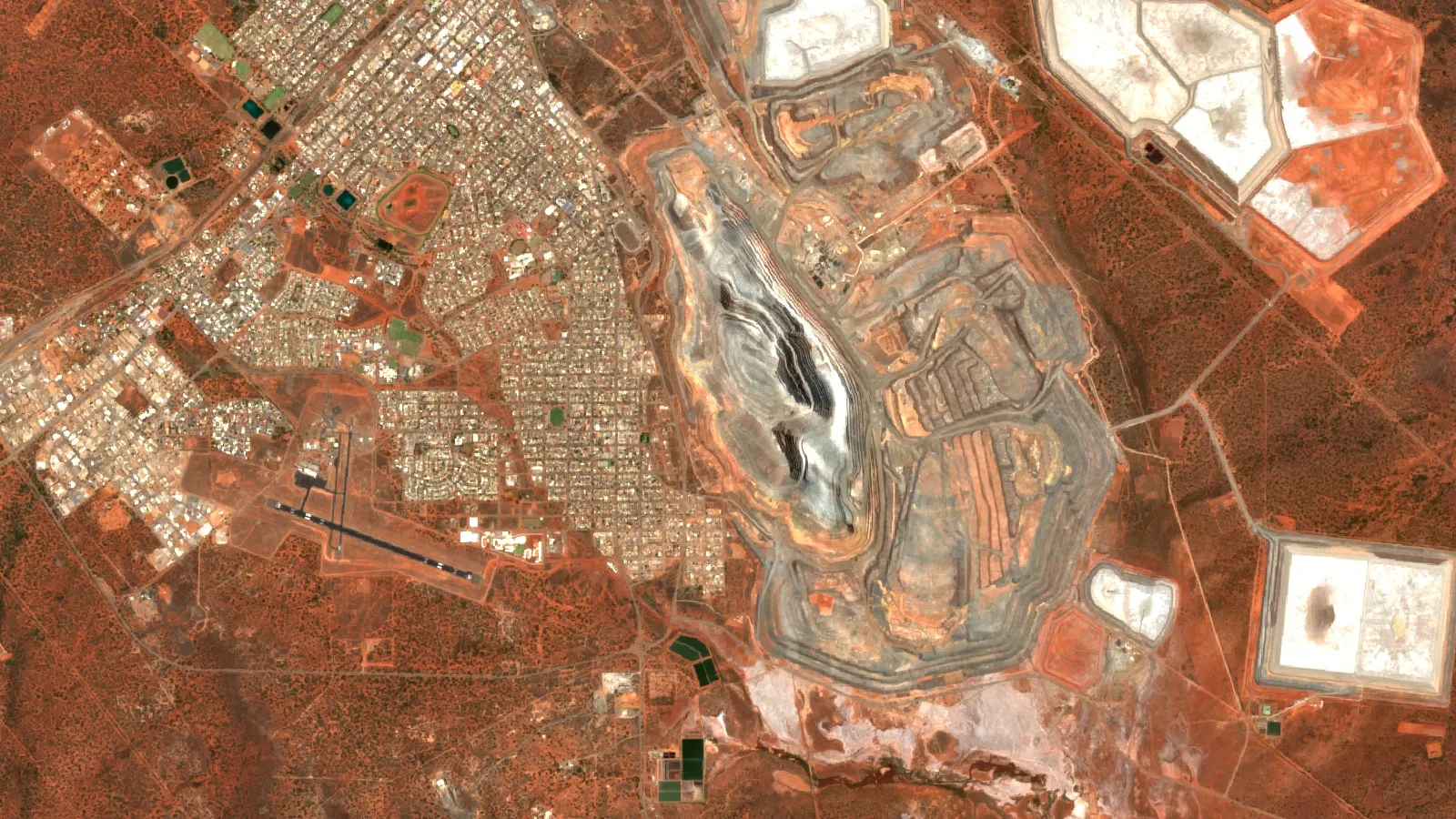
WA’s gold is mostly produced by mid-sized and large companies running open-pit and underground mines, not by individual prospectors. The Super Pit open-cut mine at Kalgoorlie-Boulder is the best-known one. It is run by KCGM, part of Northern Star Resources, and its public lookout is open from 7am to 7pm daily (Super Pit).
Chart
Gold sales rose while lithium and nickel fell
WA sales value on production, A$ billion
The state’s 2024-25 digest shows gold stood out in a weak year for other metals. Total WA mineral and petroleum sales fell from A$240 billion to A$220 billion, and gold sales rose 41 per cent to a record A$29 billion, on an average price of US$2,820 per ounce for the year. The chart compares gold with other commodities in the digest’s table of sales values.
New supply is coming too. The digest lists gold projects that started or restarted in the year, among them Black Cat Syndicate’s Kal East and Paulsens, Meeka Metals’ Murchison and Horizon Minerals’ Boorara, and notes expansions such as Capricorn Metals’ Karlawinda, which is planned to reach 150,000 ounces a year. It also records mines placed on care and maintenance, such as Ramelius Resources’ Edna May, Symes and Tampia projects, so the picture is not all growth.
How much is being spent searching for gold
Exploration is where small prospectors and consultants usually enter the picture. The digest, quoting Australian Bureau of Statistics data, puts WA mineral exploration spending at A$2.57 billion in 2024-25, almost level with the year before and just under the A$2.60 billion record set in 2023. Gold took A$1.03 billion, the most since 2022 but below its record, and iron ore took A$806 million.
Chart
Gold led WA exploration spending
Mineral exploration expenditure, 2024-25, A$ million
How Western Australia compares with other gold producers
The US Geological Survey estimates world mine production of gold at 3,300 tonnes in 2025, and puts Australia’s output at 280 tonnes (USGS Mineral Commodity Summaries 2026). Treated as if it were a country, WA ranks third in the world for 2024 with 6.26 per cent of world gold output, according to the DMPE digest. The chart shows the leading producers in the USGS table.
Chart
Selected gold-mining countries
Mine production, tonnes of gold, 2025 estimate

▶ A Farmonaut video following gold from rock to refined bar. · 5:27
Diamonds in Western Australia after Argyle
WA’s diamond story is a lamproite story, not a kimberlite one. The Argyle mine in the Kimberley was the world’s largest source of natural diamonds, with more than 835 million carats produced since mining began in 1983 (Rayner and others, Society of Economic Geologists, 2018). Its host rock was an olivine lamproite pipe. Lamproite and kimberlite are two different diamond-bearing volcanic rocks.
Rio Tinto says mining at Argyle ceased in November 2020 after 37 years, and that the site is being closed and rehabilitated for return to its Traditional Owners (Rio Tinto). Since then WA’s diamond output is tiny: 24,870 carats and A$5.12 million in 2024-25 in the state digest, against A$29 billion for gold.
The legal route for diamonds is the same as for gold: a Miner’s Right for hand-held work, or a tenement for anything larger. Our guide to where people look for diamonds covers other places to compare.
Using satellite data before you walk the ground
A satellite cannot see a gold nugget or a diamond. What it can map is the rock around them: rusty iron stains, clay minerals and long straight faults, which are clues that hot fluids once moved through a rock. Teams use these maps to decide where to spend field days. Sentinel-2 images are openly published, but turning them into a ranked target map takes processing and geological judgement.
Farmonaut produces satellite mineral reports from a licence boundary in KML, KMZ or polygon form, typically in 5-20 business days. A report is a ranked list of exploration targets to check on the ground, not a resource estimate. See our page on satellite-based mineral detection for the detail.
▶ A Farmonaut video on what a satellite can and cannot detect when looking for gold. · 2:00
Safety, land and heritage on WA prospecting trips
Most of WA’s goldfields are remote. DMPE’s first rule is to carry a registered PLB, and its brochure sets out the phone numbers of regional Mining Registrar offices in Kalgoorlie, Leonora, Geraldton and Karratha among others. Tell someone your route and return time before you go.
- Permission: know whose land you are on. Pastoral leases, tenements and reserved land each have different rules, as set out above.
- Heritage: Crown land is used by many people and is set aside for many purposes. Leave any site of cultural significance you come across undisturbed.
- Ground disturbance: fill any hole you dig and repair disturbed ground.
- No mercury: never use mercury to recover gold. It is toxic and the practice is a hazard to you and to waterways.
If this topic matters to you, read Gold Prospecting in Arizona: Kit, Rules and Costs next.
Frequently asked questions
Do I need a licence to prospect for gold in Western Australia?
You need a Miner’s Right for each person who prospects on Crown land. It costs A$30 on the 2026-27 fee schedule. If the ground is inside a mining tenement you also need the holder’s consent, or a section 40E permit for exploration tenements.
How much gold can I keep with a Miner’s Right?
The state says the permit lets you take and keep samples of ore or material up to 20 kilograms. It does not allow mining.
Can I use a metal detector in WA?
Yes, on Crown land with a Miner’s Right. DMPE’s brochure describes hand-held tools such as a metal detector as covered by the permit. You still need permission on tenements and you cannot detect in reserved land.
Where can I not prospect with a Miner’s Right?
Not on reserved land, and not on tenements without consent. On pastoral leases you cannot work within 100 metres of an occupied building or within 400 metres of livestock water without the pastoralist’s consent.
What is the difference between prospecting and fossicking in WA?
Under the Mining Act fossicking excludes gold and diamonds. Searching for either is prospecting. Both need a Miner’s Right.
How much does a prospecting licence cost?
The application fee is A$478, rent is A$4.40 per hectare each year (minimum A$40.70), and a security of A$5,000 is required. The minimum annual spend is A$40 per hectare, with a minimum of A$2,000 (DMPE fee schedule, effective 1 July 2026).
How big can a prospecting licence be?
Less than 200 hectares, and it must be marked out. The holder may extract or disturb up to 500 tonnes of material unless the Minister approves more.
How much gold does Western Australia produce?
The 2024-25 DMPE digest records 209 tonnes (6.7 million troy ounces) and A$29 billion in sales, or 72 per cent of Australian production.
Are there still diamond mines in Western Australia?
Argyle, once the world’s largest diamond source by volume, stopped mining in November 2020. The 2024-25 state digest records only 24,870 carats of diamonds for the year.
What is the penalty for prospecting without permission?
DMPE’s brochure states a maximum penalty of A$150,000 for an individual who prospects illegally.
Who is Jeff Williams?
The name is shared by many people. The Ask Jeff Williams website describes its host as a certified geologist who guides people in gold prospecting; his site does not link him to WA, and this page does not cover him.
This page is for information only. It is not legal advice. Confirm the rules with the regulator. Prospecting needs permission from the land holder, a registered personal locator beacon, filled holes, and no mercury. Fees change each 1 July.
Farmonaut mining
Map your own project area from space
Send a licence boundary and get a satellite screen of exploration targets to check on the ground.

Mining Pro sample view, synthetic data
Keep reading
Sources
- WA Government, Miner’s Rights (updated 19 June 2026): wa.gov.au
- DMPE, Seven Golden Rules for Prospecting (July 2025): wa.gov.au
- DMPE, Fees and Charges 2026-27 (effective 1 July 2026): wa.gov.au
- WA Government, Prospecting licences (updated 9 April 2025): wa.gov.au
- DMPE, Western Australian Mineral and Petroleum Statistics Digest 2024-25: wa.gov.au
- USGS, Mineral Commodity Summaries 2026: Gold: pubs.usgs.gov
- Rayner and others, Geology of the Argyle (AK1) Diamond Deposit (2018): researchportalplus.anu.edu.au
- Rio Tinto, Argyle: riotinto.com
- Super Pit (KCGM, Northern Star Resources), Super Pit Lookout: superpit.com.au
- WA Government, GeoVIEW.WA: dmirs.wa.gov.au
- Ask Jeff Williams, official website: askjeffwilliams.com
Discussion
Questions, corrections or field experience? Share them below. First-time comments are reviewed before they appear, and your email is never published.
No comments yet. Be the first to add a question or your experience.

 Sania Corporation
 Sean Mining Limited
 NTS Group (Pty) Ltd
 Mine4Africa
 Lithspo Minerals Limited
 Tintina Mining Group
 Dalgety Minerals Pty Ltd
 Vortex Minerals Pty Ltd
 Faith At Work (Pty) Ltd
 Geotech Mining Solutions plc
 Vulcan International Limited
 Kidepo Associates
 GKY Mining
 Alkimy SARL
 Double A Trading
 GemSprout Metals Limited
 Qader Group
 Ileys General Trading
 SG Gold Mining LLC
 VRV Global Pte Ltd
 Omsri International FZE
 G.I.T.T.
 Jaunita Erss Ltd
 SRK Consulting











