

Uranium · Namibia mine guide
Namibia Uranium Mines: Husab, Rössing, Langer Heinrich
Namibia has three producing uranium mines: Husab, Rössing and Langer Heinrich. They mined 7,333 tU in 2024, about 12% of world supply (WNA). See owners, locations, output, Langer Heinrich costs and a margin calculator.
Key takeaways
- Namibia mined 7,333 tU in 2024, about 12% of world supply and third after Kazakhstan and Canada (WNA, updated 9 October 2026).
- Husab (Swakop Uranium) mined 4,437 tU, Rössing 2,205 tU and Langer Heinrich 691 tU in 2024; Husab was the world’s third-largest uranium mine (WNA).
- Langer Heinrich restarted in March 2024 and finished ramp-up in the June 2026 quarter: 4.82 million lb U3O8 at US$43.3/lb cost of production in the year to June 2026 (Paladin, 22 July 2026).
- The Etango joint venture took its construction decision on 23 October 2026: 3.5 million lb U3O8 a year, about US$353 million capital, first production targeted for 2028 (World Nuclear News).
- Spot uranium was US$89.63/lb and the long-term price US$96.50/lb at 30 September 2026 (Cameco, UxC and TradeTech averages); Paladin’s realised price for the year to June 2026 was US$70.0/lb.
In this article
- Namibia uranium mines compared: owners, locations and output
- How much uranium does Namibia produce
- Langer Heinrich uranium mine: location, owner and restart
- Swakop Uranium and the Husab mine location
- Rössing mine: Namibia's oldest uranium operation
- Paladin mines and projects
- Namibian uranium projects that are not producing yet
- Why Namibian uranium ore is low grade: calcrete and alaskite
- African uranium beyond Namibia
- Water, land and licences
- Uranium price and what a mine earns per pound
- How satellite imagery helps screen Namibian ground
- Frequently asked questions
Namibia has three producing uranium mines: Husab (run by Swakop Uranium), Rössing and Langer Heinrich. Together they mined 7,333 tonnes of uranium (tU) in 2024, about 12% of world supply and third place behind Kazakhstan and Canada (World Nuclear Association, updated 9 October 2026). Husab is the biggest at 4,437 tU, Rössing is the oldest, and Langer Heinrich is the restart: Paladin Energy’s mine went on care and maintenance in 2018, resumed output in March 2024 and finished its ramp-up in the June 2026 quarter.
This page lists the producing Namibian uranium mines and the main advanced projects with owner, location and output, shows the numbers behind the Langer Heinrich restart, covers the projects still to be built (the Etango joint venture took its construction decision on 23 October 2026) and ends with a margin calculator and answers to the questions people search most. A few units first. A tU is a tonne of uranium metal. U3O8 is the oxide concentrate called yellowcake, which sells by the pound: one tonne of uranium makes about 1.18 tonnes of U3O8, and one tonne is 2,204.62 lb. Grade is the share of uranium in the rock, often written in ppm (parts per million; 1,000 ppm is 0.1%).
Namibia uranium mines compared: owners, locations and output
How this list is built: producers come first, ranked by 2024 output in tU from the World Nuclear Association (WNA) Namibia profile, updated 27 October 2026. Projects with a mining licence or a construction decision follow, ordered by how close they are to production. Ownership and status are as the profile and company filings state them.
| Mine | Owner and operator | Location | Status | 2024 output (tU) |
|---|---|---|---|---|
| Husab | Swakop Uranium: 90% Taurus Minerals (CGN-URC 60%, China-Africa Development Fund 40%), 10% Epangelo Mining | About 5 km south of Rössing, 45 km north-east of Walvis Bay | Producing since end-2016; 5,430 t U3O8 (about 4,600 tU) drummed in 2025 | 4,437 |
| Rössing | Rössing Uranium: 68.6% China National Uranium Corporation; minority holders include South Africa’s Industrial Development Corporation (about 10%, which it is trying to sell) and the Namibian government (3%) | 65 km inland from Swakopmund | Producing since 1976; board-approved life extension to 2036 | 2,205 |
| Langer Heinrich | Langer Heinrich Uranium (Pty) Ltd: Paladin Energy 75%, CNNC Overseas Limited 25% | About 80 km east of Swakopmund, 85 km north-east of Walvis Bay, 50 km south-south-east of Rössing | Restarted March 2024; ramp-up completed in the June 2026 quarter | 691 |
| Etango | Etango joint venture (Bannerman 55%, CNNC Overseas 45%) holds 95%; One Economy Foundation holds 5% | 30 km south-east of Swakopmund | Construction decision 23 October 2026; production targeted for 2028 | 0 |
| Tumas | Deep Yellow (through Reptile Mineral Resources) | Palaeochannel in the central Namib, south of the Omahola granites | Mining licence issued late 2023; investment decision deferred in October 2026 | 0 |
| Trekkopje | Orano | 80 km north-east of Swakopmund | Care and maintenance since October 2012; restart under study since 2024 | 0 |
| Norasa (Valencia) | Forsys Metals | 25 km north-east of Rössing | 25-year mining licence granted August 2008; not built | 0 |
Husab’s design capacity is about 5,100 tU a year, so it still has room above its 2024 output (WNA, Uranium in Namibia). Rössing’s nominal capacity is 4,000 tU a year.
How much uranium does Namibia produce
Namibia mined 7,333 tU in 2024, up 5% on 6,986 tU in 2023 and almost two and a half times the 2,993 tU of 2015. Husab alone, at 4,437 tU, was the third-largest uranium mine in the world that year, behind McArthur River/Key Lake (7,808 tU) and Cigar Lake (6,501 tU), both in Canada. In oxide terms the 2024 total is about 8,650 tonnes of U3O8, or roughly 19 million pounds; some Namibian sources quote the oxide figure, which is why two totals circulate for the same year.
Chart
Uranium mined by country
Tonnes of uranium (tU) from mines in 2024, seven largest producing countries
Namibia also holds 504,500 tU of identified resources recoverable at up to US$130 per kg of uranium, 6% of the world total (WNA, World Uranium Mining Production, citing the OECD-NEA/IAEA 2026 Red Book, data for 1 January 2025).
Company reports point higher for the latest periods. Rössing reported 3,185 tonnes of U3O8 (about 2,700 tU) for 2025, up from 2,600 tonnes in 2024 (Windhoek Express, reporting Rössing’s Sustainability and Performance Report). Swakop Uranium reports that Husab drummed 5,430 tonnes of U3O8 in 2025, about 4,600 tU (Namibian Uranium Association, Husab Mine), which matches WNA’s ‘about 4,600 tU’. Paladin’s financial year to 30 June 2026 produced 4.82 million pounds of U3O8 at Langer Heinrich, about 1,850 tU.
Langer Heinrich uranium mine: location, owner and restart
Langer Heinrich lies in the Namib Desert about 80 km from the coast, 50 km south-south-east of Rössing, inside the Namib Park. Gencor found the deposit in 1973 and Paladin bought it in 2002. The pit opened in late 2006 at 1,000 tU a year, and the Stage 3 expansion lifted capacity to 2,000 tU a year from late 2011 for US$100 million. The ore is carnotite, a yellow uranium vanadate, in a palaeochannel system (an ancient buried river valley) that runs about 15 km and sits some 50 m deep. A conventional mill with an alkaline leach circuit treats it (WNA). Reserves are 32,300 tU at 0.038% U, using a 0.021% cut-off (the lowest grade that still pays to mine).
Chart
Langer Heinrich: cost of production and realised price
US$ per lb U3O8, by quarter, July 2025 to September 2026
Output peaked at 2,098 tU in 2013, fell to 394 tU in 2018 as stockpiled medium-grade ore ran out, and stopped when Paladin put the mine on care and maintenance in August 2018. Nothing was produced from 2019 to 2023. Production restarted in March 2024 and reached 691 tU that year.
Paladin’s quarterly report of 22 July 2026 shows the mine at full rate (all figures on a 100% basis; Paladin owns 75%). In the financial year to 30 June 2026 it processed 4.76 million tonnes of ore at 498 ppm U3O8 with 90% recovery and produced 4.82 million pounds of U3O8, the top of the 4.5 to 4.8 million pound guidance range. It sold 4.35 million pounds at an average realised price of US$70.0 per lb and reported a cost of production of US$43.3 per lb (Paladin Energy, Quarterly Report, 22 July 2026). The June quarter cost rose to US$51.6 per lb because mining moved into the J pit and the earlier stockpile was used up.
Guidance for the financial year to June 2027 is 5.1 to 5.6 million pounds produced, 4.8 to 5.3 million pounds sold, a cost of US$44 to US$48 per lb and capital spending of US$29 to US$35 million. Planned maintenance in September and December 2026 weighs on the first half, with stronger output expected in the second half as higher-grade ore is processed (Paladin Energy, Langer Heinrich Mine FY2027 Guidance, ASX announcement, 22 July 2026). The realised price is not the spot price: Paladin’s forecast average realised price for the year runs from US$51 to US$103 per lb for spot prices of US$40 to US$140 per lb, because its contracts mix fixed, escalated and market-linked pricing.
Paladin’s September 2026 quarterly report (14 October 2026) covers the first quarter of FY2027. Langer Heinrich produced 1.00 million pounds of U3O8, sold 1.16 million pounds at an average realised price of US$79.4 per lb and reported a cost of production of US$61.6 per lb. Paladin said the planned maintenance shutdown, lower plant recovery and the move between pits hit the quarter, and that FY2027 guidance is unchanged (Paladin Energy, Quarterly Report, 14 October 2026).
Swakop Uranium and the Husab mine location
People searching for the Swakop Uranium mine location are looking for Husab. It is about 5 km south of Rössing and 45 km north-east of Walvis Bay, on the former Rössing South orebody, under roughly 50 m of alluvial sand. WNA calls it the highest-grade granite-hosted uranium deposit in Namibia. Development began in February 2013, first production came at the end of 2016, and its engineering, procurement and construction contract was the largest for any African mine (WNA).
Chart
Namibian uranium output by mine
Tonnes of uranium (tU) per year
Swakop Uranium is 90% owned by Taurus Minerals and 10% by Namibia’s state-owned Epangelo Mining. Taurus is 60% China General Nuclear’s uranium arm (CGN-URC) and 40% the China-Africa Development Fund. Most Husab uranium goes to China, and up to 20% is marketed internationally by CGN Global Uranium, a UK-registered company. A heap leach pilot plant started in July 2024, and in late 2025 Namibia Water finalised a joint venture with Swakop Uranium for a new desalination plant of 20 million m³ a year.
The chart shows why Husab matters: Namibia’s output more than doubled between 2015 and 2024 mainly because Husab ramped up while Langer Heinrich stopped and restarted.
Rössing mine: Namibia’s oldest uranium operation
Rio Tinto took the rights to the low-grade Rössing deposit in 1966, and the open pit in hard granite (alaskite) began producing in 1976, making it Namibia’s first commercial uranium mine. China National Uranium Corporation bought Rio Tinto’s 68.6% in a sale completed in July 2019. The board approved the Phase 4 pushback and a life extension to 2036 in February 2023, a 15 MWe solar plant is under construction, and Beifang Mining holds a 13-year contract for mining services from 2024 to 2036. Reserves at the end of 2018 were 23,810 tU, probable category, at 0.033% U (WNA).
In 2025 Rössing processed 10.07 million tonnes of ore (8.49 million in 2024), produced 3,185 tonnes of U3O8, took in N$8.22 billion in revenue and made N$1.022 billion in net profit from normal operations, almost level with N$1.028 billion a year earlier because costs rose with volume (Windhoek Express). Its uranium is sold to utilities in central Europe, North America and south-east Asia, including China.
Paladin mines and projects
Paladin Energy is a Perth-based uranium company listed on the ASX and the Toronto Stock Exchange under the ticker PDN. Its operating mine is Langer Heinrich; its main growth project is in Canada. The quarterly report of 22 July 2026 lists three assets:
| Paladin asset | Country | Stage |
|---|---|---|
| Langer Heinrich (75% Paladin) | Namibia | Producing; ramp-up completed in the June 2026 quarter |
| Patterson Lake South, including the Triple R deposit | Canada (Athabasca Basin, Saskatchewan) | Development; construction licence application accepted as sufficient for review by the Canadian Nuclear Safety Commission, hearings targeted for the end of 2027 |
| Michelin | Canada | Exploration; desktop studies and target generation |
Paladin gained Patterson Lake South by acquiring Fission Uranium, a deal completed on 23 December 2024 (Paladin and Fission joint announcement). On 25 June 2026 Paladin announced that its winter drilling had found a new high-grade body, Atlas, 3.5 km south of Triple R; the discovery hole cut 17.5 m of composite mineralisation, including 8.0 m averaging 1.75% U3O8. At 30 September 2026 Paladin held US$209 million in cash and investments with an undrawn US$70 million credit facility (Paladin Energy, Quarterly Report, 14 October 2026). This describes company activity and is not investment advice.
Namibian uranium projects that are not producing yet
- Etango (Bannerman and CNNC Overseas). The joint venture took a positive final investment decision on 23 October 2026 for the Etango-8 design, 3.5 million pounds of U3O8 a year (about 1,350 tU). Pre-production capital is about US$353 million, of which about US$64 million is spent, and the JV’s cash covers the rest. The resource is 207 million pounds of U3O8 (79,622 tU) at a 100 ppm cut-off. Bulk earthworks were 99% complete at the end of September, and first production is targeted for 2028 (World Nuclear News, 23 October 2026). A 2024 scoping study showed a route to 6.7 million pounds a year.
- Tumas (Deep Yellow). A calcrete and palaeochannel deposit with a planned capacity of 1,385 tU a year and a mining licence since late 2023. Deep Yellow deferred its final investment decision beyond the end of the year in October 2026, citing weak equity markets, while civil works continue.
- Trekkopje (Orano). A very low-grade palaeochannel deposit (0.012 to 0.015% U) with a mining licence from 2008. Pilot production ran in 2011 to 2013, and the project went into care and maintenance in October 2012. Orano has been studying a restart since 2024.
- Norasa (Forsys Metals). Valencia and Namibplaas alaskite deposits with 17,467 tU of measured and indicated resources at 136 ppm U3O8 and 16,401 tU inferred (NI 43-101 technical report, effective 14 May 2024, Forsys Metals); a 2015 feasibility study assumed about 2,000 tU a year over 15 years.
- Marenica (Elevate Uranium). A low-grade palaeochannel project built around the U-pgrade process, which scrubs and screens about 350 ppm calcrete ore to a product of 1 to 1.5% U3O8 holding 85% of the original uranium.
Source for the project facts above unless linked otherwise: WNA, Uranium in Namibia, updated 27 October 2026. For a global comparison of the biggest mines and countries, see our map of uranium deposits and the top producing countries.
Why Namibian uranium ore is low grade: calcrete and alaskite
Namibia hosts two deposit families. Granite-hosted (alaskite) deposits at Rössing, Husab and Etango are bodies of pale, uranium-bearing granite that are mined in large open pits. Surficial deposits at Langer Heinrich, Tumas, Trekkopje and Marenica are young, near-surface uranium in sediments cemented by calcium and magnesium carbonate, usually as carnotite, in valley fills left by ancient rivers; calcrete deposits are the largest of the surficial type, and WNA names the central Namib Desert as one of the places they occur (WNA, Geology of Uranium Deposits).
Chart
Resource grade of Namibian deposits
Measured and indicated resource grade, ppm uranium, selected deposits
Both are low-grade by world standards. WNA’s grade table lists Namibia’s “very low-grade” ore at 0.01% U (100 ppm), against 0.1% U (1,000 ppm) for ordinary low-grade ore. Volume makes up for grade: Langer Heinrich moved 24.41 million tonnes of rock in the 2026 financial year, 6.09 million tonnes of it ore, to produce 4.82 million pounds of U3O8. Low grade also means small price moves hit margins hard, which is why unit cost is the number to watch.
Grades quoted in company reports are usually ppm U3O8, while the WNA resource table uses percent uranium; 1 ppm of uranium equals about 1.18 ppm of U3O8.
African uranium beyond Namibia
Namibia’s 12% of world supply dwarfs the rest of Africa, but exploration is moving into countries that have never supplied uranium. Tanzania’s Mkuju River project (Uranium One) was planned for 1,400 tU a year and was suspended between 2017 and 2019 on low prices; the 2026 Red Book counts 72,200 tU of identified in-situ resources in Tanzania. Malawi’s Kayelekera project holds 14,400 tU, and Zimbabwe has 2,000 tU of reasonably assured resources recoverable to US$260 per kg plus 25,000 tU of speculative resources (WNA, Uranium in Africa, updated 23 October 2026).

▶ A short explainer on whether Zimbabwe has uranium and what is known about Kanyemba. · 4:27
Water, land and licences
Water shapes every Namib mine. A coastal desalination plant 20 km north of Swakopmund has supplied the Erongo uranium belt since 2010 with about 20 million m³ a year, and WNA reports that the water costs the mines at least US$4 per m³. Between 2007 and 2010 Namibia ran a strategic environmental assessment of the whole uranium province inland from Swakopmund and Walvis Bay, which led to a Strategic Environmental Management Plan in 2011.
Licensing has a state layer. In April 2011 the government said its state-owned explorer Epangelo Mining would have exclusive control of new strategic mineral developments, including uranium, without nationalising existing mines or leases. The government has also kept a moratorium on new mining and petroleum licence applications while it reviews how existing licence holders have performed, the minister said in March 2026 (Namibia Mining & Energy). The WNA profile does not set out the application route, so confirm the current rules with the Ministry of Industries, Mines and Energy and Epangelo before you plan a licence purchase or farm-in. Our guide to mining cadastre portals by country shows how to search a cadastre before you buy.
Uranium mines also carry heavy duties for radioactive waste, dust and groundwater, which is why the Namibian projects were assessed as a province and not one by one. Do not prospect, sample or handle uranium ore without permission, a licence and radiation-safety training.

▶ A plain-language claymation on the seven environmental impacts of mining. · 2:31
Uranium price and what a mine earns per pound
Cameco’s industry averages, built from UxC and TradeTech month-end prices, put the spot price at US$89.63 per pound of U3O8 and the long-term (term) price at US$96.50 on 30 September 2026 (Cameco). Trading Economics’ benchmark quote, a contract for difference that tracks the market, was US$89.90 on 26 October 2026, up 15.78% on a year earlier (Trading Economics). Spot is the price for immediate delivery. Most uranium sells under term contracts, and term prices can sit above or below spot (US$96.50 against US$89.63 at 30 September 2026). Langer Heinrich’s realised price of US$70.0 per lb for the year to June 2026 was below both because Paladin’s contracts mix fixed, escalated and market-linked pricing; Paladin’s FY2027 forecast is a realised US$72 per lb at a spot price of US$80 and US$83 per lb at US$100. Our uranium price guide covers spot and term in detail.
WNA reports that mines supplied 74% of utility requirements in 2022, with stockpiles and other secondary sources covering the rest (WNA, Uranium Markets, updated August 2024). Namibian output goes mainly to China from Husab and to utilities in Europe, North America and Asia from Rössing.
The calculator below turns ore tonnage, grade, recovery, price and unit cost into pounds, revenue and operating margin. The defaults echo Langer Heinrich’s 2026 financial year, but the price and cost are your inputs.
Calculator
What does a uranium mine earn per year?
Enter your own tonnage, grade, recovery, price and cost.
- Revenue at your price (US$): $428,578,128
- On-site cost at your unit cost (US$): $214,289,064
- Margin before royalties, capital, tax (US$): $214,289,064
- Margin per lb (US$): 45.0
Example values only, not a forecast. Defaults echo Langer Heinrich’s year to June 2026 (4.76 Mt at 498 ppm U3O8, 90% recovery; Paladin, 22 July 2026, on a 100% basis; Paladin owns 75%). 1 tonne = 2,204.62 lb. Price is an input: example, use today’s price (US$ per lb U3O8). Unit cost is an input; Paladin’s cost of production covers on-site mining and processing only. The result is before royalties, stripping, overheads, capital and tax.
How satellite imagery helps screen Namibian ground
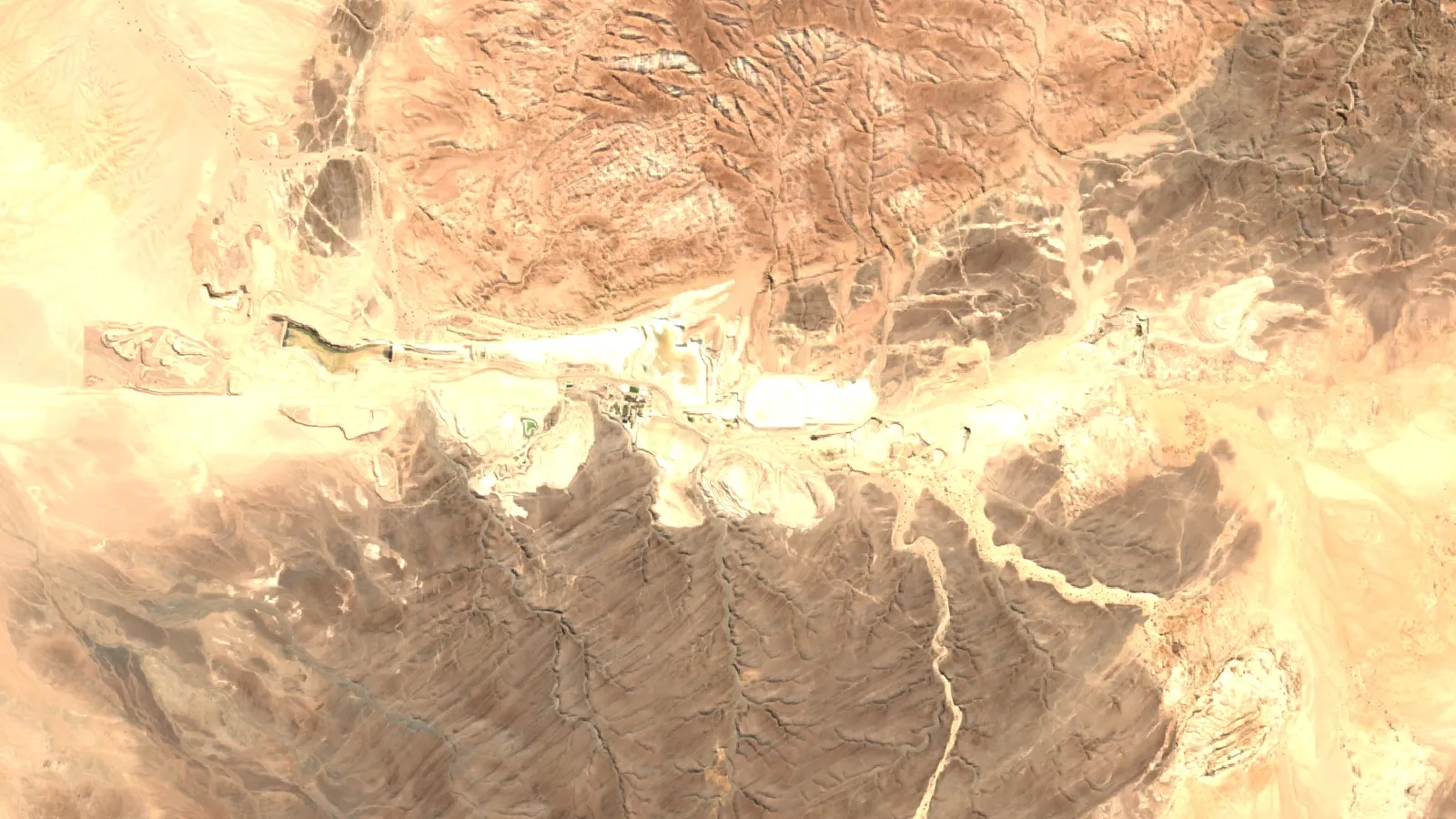
The Namib is bare desert, so surface geology is visible from space. Alaskite bodies show against darker host rock, and calcrete palaeochannels appear as pale carbonate-rich drainage traces. A consultant or licence owner can map these from imagery to rank ground before spending on radiometric surveys and drilling. Imagery is a screen, not proof: the 36 km Hirabeb palaeochannel was identified from geophysics and drilling with no radiometric anomaly (WNA, Uranium in Namibia), so the methods work best together.
Farmonaut’s satellite-based mineral detection covers uranium among 20+ minerals: you send a boundary as KML, KMZ or a polygon and receive exploration targets in 5 to 20 business days. Results are targets ahead of any resource estimate, not a resource under JORC or NI 43-101. Farmonaut also offers fleet management, carbon footprinting and product traceability products.
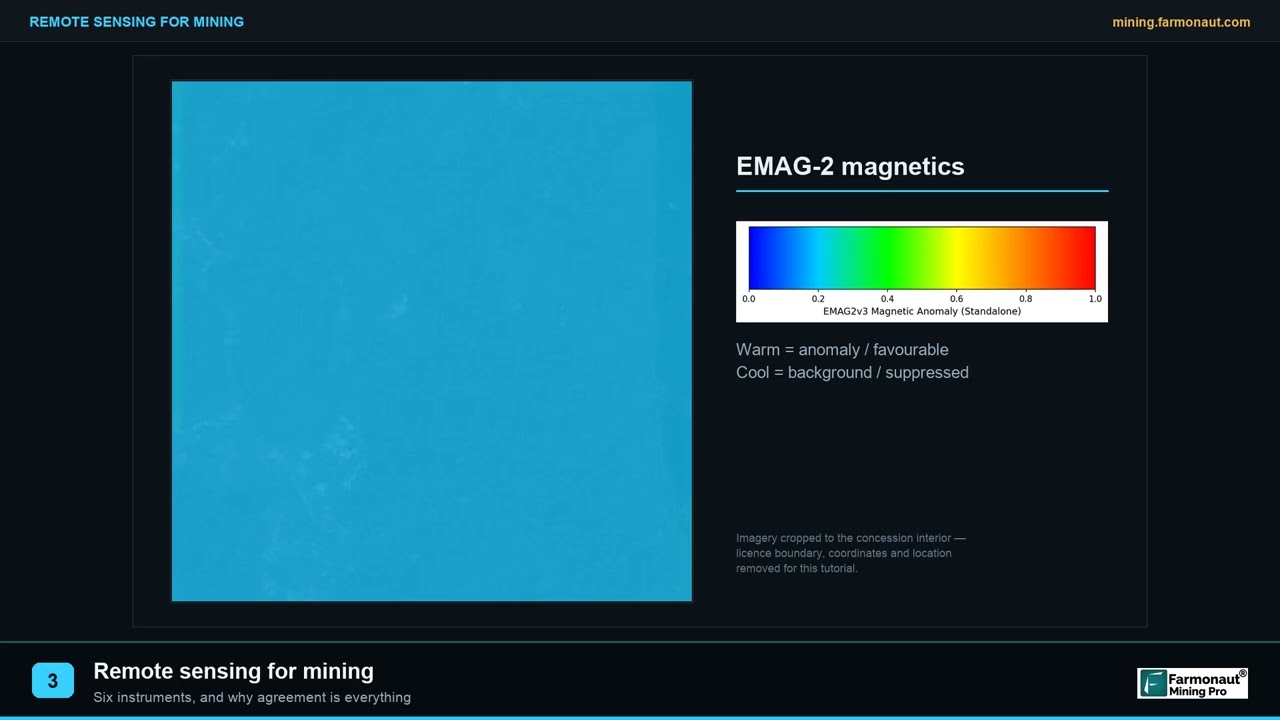
▶ A three-minute explanation of remote sensing for mining and the six instrument families. · 2:01
Frequently asked questions
How many uranium mines are there in Namibia?
Three mines produce uranium: Husab, Rössing and Langer Heinrich. Trekkopje is on care and maintenance, and Etango, Tumas and Norasa are projects. Etango reached a construction decision on 23 October 2026 and is targeting first production in 2028.
Which is the biggest uranium mine in Namibia?
Husab, run by Swakop Uranium, mined 4,437 tU in 2024. That made it the third-largest uranium mine in the world, behind McArthur River/Key Lake and Cigar Lake in Canada (WNA).
Where is the Langer Heinrich uranium mine located?
It is in the Namib Desert in Namibia’s Erongo Region, about 80 km east of Swakopmund, 85 km north-east of Walvis Bay and 50 km south-south-east of the Rössing mine, inside the Namib Park (Paladin Annual Report 2026; WNA).
Where is the Swakop Uranium mine located?
Swakop Uranium operates Husab, about 5 km south of Rössing and 45 km north-east of the port of Walvis Bay, in the Erongo Region. It is under roughly 50 m of alluvial sand.
How much uranium does Namibia produce?
Namibia mined 7,333 tU in 2024, about 12% of world supply. That equals roughly 8,650 tonnes of U3O8 or 19 million pounds. Company reports for 2025 point higher, with Rössing at 3,185 tonnes of U3O8 and Husab near 4,600 tU.
Who owns the Langer Heinrich mine?
Paladin Energy owns 75% and operates the mine through Langer Heinrich Uranium (Pty) Ltd, the Namibian operating company. CNNC Overseas Limited, part of China National Nuclear Corporation, owns the other 25% and takes that share of output (Paladin Annual Report 2026; WNA).
Is Langer Heinrich operating again?
Yes. The mine went on care and maintenance in August 2018, restarted production in March 2024 and completed its ramp-up in the June 2026 quarter. It produced 4.82 million pounds of U3O8 in the financial year to June 2026 and guides to 5.1 to 5.6 million pounds for the next one.
Which mines does Paladin own?
Paladin owns 75% of Langer Heinrich in Namibia, the Patterson Lake South development project in Saskatchewan, Canada, which it gained by buying Fission Uranium in December 2024, and the Michelin exploration project in Canada.
Who owns Namibia’s uranium mines? Are they Chinese-owned?
Chinese state-linked companies hold the majority of Husab (through Taurus Minerals) and Rössing (China National Uranium Corporation), 25% of Langer Heinrich (CNNC Overseas) and 45% of the Etango joint venture. Paladin, an Australian-listed company, owns 75% of Langer Heinrich, and Namibia’s state explorer Epangelo holds 10% of Swakop Uranium.
Is Rössing still operating?
Yes. Rössing has mined since 1976, produced 3,185 tonnes of U3O8 in 2025, and has a board-approved life extension to 2036.
What is the difference between tonnes of uranium and pounds of U3O8?
Production tables usually give tonnes of uranium metal (tU), while prices and company reports use pounds of the oxide concentrate (U3O8). One tU equals about 1.18 tonnes of U3O8, and one tonne is 2,204.62 lb, so 1,000 tU is about 2.6 million pounds of U3O8.
What is the uranium spot price?
The industry-average spot price was US$89.63 per lb of U3O8 at the end of September 2026 and the long-term price was US$96.50 (Cameco, from UxC and TradeTech). Trading Economics’ contract-for-difference quote was US$89.90 on 26 October 2026. Prices change daily, so check a current source before you use them.
Can I get a uranium exploration licence in Namibia?
Since 2011 the state explorer Epangelo Mining has held exclusive control of new strategic mineral developments, including uranium (WNA). In March 2026 the minister said the moratorium on new mining and petroleum licence applications would stay while existing licences are reviewed. Confirm the current rules with the Ministry of Industries, Mines and Energy and Epangelo before you commit money.
This page is for information only. It is not investment advice or legal advice. Confirm licence and exploration rules with Namibia’s Ministry of Industries, Mines and Energy and Epangelo Mining. Uranium is radioactive: do not prospect or sample without permission, a licence and radiation-safety training. Output, ownership and price figures are as dated above.
Farmonaut mining
Screen your own ground from space
Investors and consultants can send a licence boundary and receive satellite-based exploration targets for uranium, ahead of any resource estimate.

Mining Pro sample view, synthetic data
Keep reading
Sources
- World Nuclear Association, Uranium in Namibia (updated 27 October 2026): world-nuclear.org
- World Nuclear Association, World Uranium Mining Production (updated 9 October 2026): world-nuclear.org
- World Nuclear Association, Supply of Uranium (updated 29 September 2026): world-nuclear.org
- World Nuclear Association, Geology of Uranium Deposits: world-nuclear.org
- World Nuclear Association, Uranium in Africa (updated 23 October 2026): world-nuclear.org
- World Nuclear Association, Uranium Markets (updated August 2024): world-nuclear.org
- Paladin Energy, Quarterly Report for the period ending 30 June 2026 (ASX, 22 July 2026): announcements.asx.com.au
- Paladin Energy, Langer Heinrich Mine FY2027 Guidance (ASX announcement, 22 July 2026): paladinenergy.com
- Paladin and Fission Uranium, completion of the acquisition (23 December 2024): newswire.ca
- World Nuclear News, FID sees Etango enter full-scale construction (23 October 2026): world-nuclear-news.org
- Windhoek Express, Rössing records its strongest performance in 2025: we.com.na
- Trading Economics, Uranium price (contract-for-difference quote, 26 October 2026): tradingeconomics.com
- Cameco, Uranium Price (UxC and TradeTech month-end averages): cameco.com
- Paladin Energy, Quarterly Report for the period ending 30 September 2026 (ASX, 14 October 2026): paladinenergy.com
- Paladin Energy, Annual Report 2026: paladinenergy.com
- Forsys Metals, Norasa Project NI 43-101 Technical Report (effective 14 May 2024): minedocs.com
- Namibian Uranium Association, Husab mine: namibianuranium.org
- Namibia Mining & Energy, Namibia keeps freeze on new mining and petroleum licences pending review of existing rights: miningandenergy.com.na
Discussion
Questions, corrections or field experience? Share them below. First-time comments are reviewed before they appear, and your email is never published.
No comments yet. Be the first to add a question or your experience.

 African Venture Partners Holding
 Congo Mining Solutions
 Mining SARL
 SenGold Invest SAS
 Sania Corporation
 Sean Mining Limited
 NTS Group (Pty) Ltd
 Mine4Africa
 Lithspo Minerals Limited
 Tintina Mining Group
 Dalgety Minerals Pty Ltd
 Vortex Minerals Pty Ltd
 Faith At Work (Pty) Ltd
 Geotech Mining Solutions plc
 Vulcan International Limited
 Kidepo Associates
 GKY Mining
 Alkimy SARL
 Double A Trading
 GemSprout Metals Limited











