

High-purity quartz · Status and owners
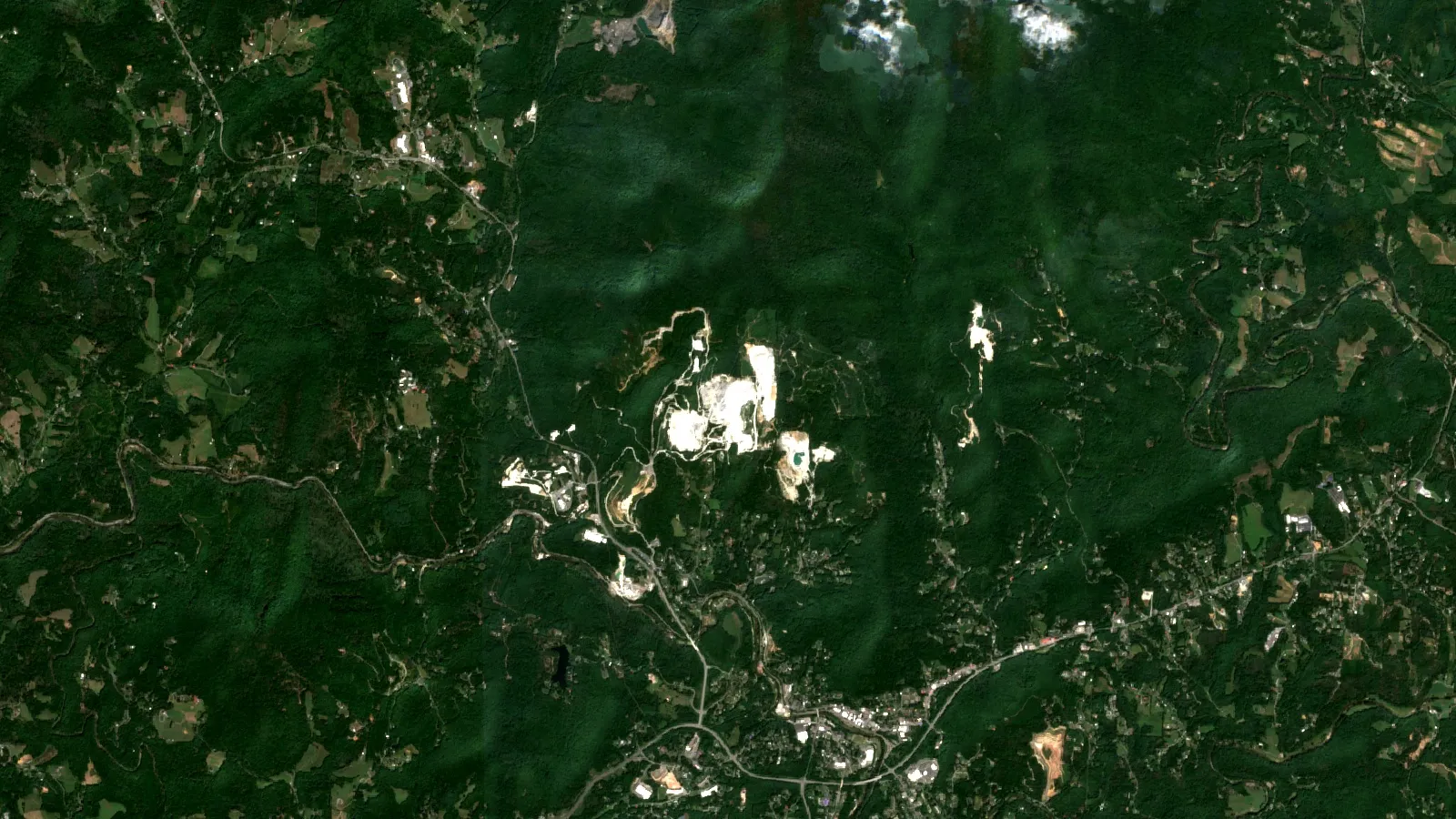
Spruce Pine Quartz Mine: Operational Status, Who Owns It
Yes. USGS counts two high-purity quartz producers around Spruce Pine, North Carolina in 2025 (USGS, 2026). Company sites name them: Sibelco and The Quartz Corp. There is no single owner and no pure-play stock.
Key takeaways
- Two companies produced US high-purity quartz in 2025, both around Spruce Pine (USGS, 2026).
- Owners: Belgian group Sibelco, and The Quartz Corp, a private Norwegian company linked to family-owned Norsk Mineral.
- USGS estimates about 100,000 t sold or used in 2025, rounded to the nearest 100,000 t.
- USGS puts ground HPQ at US$500 to US$12,000 per tonne in 2025; there is no exchange price.
- On 22 October 2026 Sibelco signed a letter of intent for up to US$56 million of CHIPS Act research funding, not yet a final award.
In this article
- Operational Status: Is Spruce Pine Quartz Mining Right Now?
- Who Owns the Spruce Pine Quartz Mine?
- Spruce Pine quartz at a glance: USGS figures
- What USGS Actually Publishes on High-Purity Quartz
- Geological Origin: Why This District, Not Somewhere Else
- Quartz Pricing and Market Size: The Real Numbers
- How to Invest in Spruce Pine Quartz
- Pineapple Quartz: A Different Product Entirely
- Industrial Applications Driving Demand
- Quartz Grades Compared
- Calculator: Contract Quartz Cost
- What to Check Yourself
- Satellite-Based Mineral Intelligence: Farmonaut's Approach
- Frequently asked questions
Yes, Spruce Pine quartz is still being mined. Two companies, Sibelco and The Quartz Corp, produce high-purity quartz around Spruce Pine, North Carolina, and the USGS Mineral Commodity Summaries 2026 estimates the United States leads world output of this material. There is no single mine to buy into: each producer runs its own sites, and neither has a US stock ticker.
High-purity quartz (HPQ) is natural quartz with less than 100 parts per million (ppm) of impurities, which equals 99.99% pure. A key use is the crucibles in which silicon is melted and grown into ingots for chips and solar cells. This page covers the current status, the owners, the USGS numbers, the geology, prices, the indirect investment routes, and what you can check yourself.
Operational Status: Is Spruce Pine Quartz Mining Right Now?
The operations were active on the latest public evidence. USGS reports that both US producers continued capacity expansion plans in 2025. Sibelco’s first-half 2026 results describe a weak market for HPQ sold to solar makers, not a shutdown, and on 22 October 2026 the company announced a CHIPS Act letter of intent for US research on HPQ processing.
Hurricane Helene hit western North Carolina in late September 2024 and disrupted work in the district, including at Sibelco. Sibelco later announced a restart of production and shipments, with both ramping up towards full capacity. Neither company publishes weekly output, so there is no public live production figure for any Spruce Pine mine.
What USGS confirms and what it does not
- Confirmed: two companies produced HPQ around Spruce Pine in 2025.
- Confirmed: the ore is pegmatite, a very coarse-grained igneous rock, mined together with feldspar and mica.
- Confirmed: at least one company sent product overseas for further processing.
- Not published: output by mine or by company. USGS gives one national estimate, rounded to the nearest 100,000 tonnes.
- Not published: a world production or world reserve table for HPQ.
Recent events at a glance
| Date | Event | Source |
|---|---|---|
| April 2023 | Sibelco announces a US$200 million expansion to double HPQ installed capacity | Sibelco |
| September 2024 | Hurricane Helene disrupts the district | Sibelco |
| 2025 | Both producers continue expansion plans; HPQ sold or used is estimated at about 100,000 t | USGS |
| First half of 2026 | Sibelco reports challenging conditions in HPQ for solar | Sibelco |
| 22 October 2026 | Sibelco signs a letter of intent for up to US$56 million of CHIPS Act research funding; not yet a final award | Sibelco |
Who Owns the Spruce Pine Quartz Mine?
Two separate groups own the HPQ operations. The name “Spruce Pine quartz mine” covers several sites run by two competitors, not one mine with one owner. The district is also mined for feldspar, mica and kaolin, so a truck or sign in town may belong to a different business.
| Producer | Who stands behind it | Spruce Pine footprint | Product or history |
|---|---|---|---|
| Sibelco | Sibelco Group, a Belgian industrial minerals company founded in 1872, with its own shareholders and a board | Quartz and Schoolhouse (mining and separation), Crystal and Red Hill (HPQ) | Sold under the IOTA brand; in North Carolina since the 1970s |
| The Quartz Corp (TQC) | The Quartz Corp AS, a private Norwegian company in Drag; family-owned Norsk Mineral lists it among its wholly and partly owned mineral companies | US office in Spruce Pine, with refining also in Drag | US operations date from 1957; the company was established in 2011 |
Sibelco’s site list gives each location and what it does, including a Bakersville address for Red Hill. For TQC, the Norwegian company register records a private limited company in Drag, and Norsk Mineral’s minerals page shows its link to TQC, and its about page calls Norsk Mineral family-owned. Neither source gives a full shareholder split.
Ownership of the rock is also different from ownership of the method. TQC describes its route as crushing, isolating quartz from other minerals, then several purification steps with quality controls. USGS likewise lists physical, chemical and thermal processing. Anyone assessing the district should treat ore and process know-how as two separate assets.
What mining company is in Spruce Pine, North Carolina?
For high-purity quartz, the answer is Sibelco and The Quartz Corp. USGS does not name the companies, but it counts two US HPQ producers, both around Spruce Pine. A company that sells feldspar or mica from the same district is not automatically an HPQ producer.
Spruce Pine quartz at a glance: USGS figures
These are the latest official figures, from the 2026 edition of the USGS quartz chapter. Tonnes are metric tons; one tonne is about 1.1 short tons.
| Item | USGS figure |
|---|---|
| US producers | Two companies, both around Spruce Pine (2025) |
| HPQ sold or used | About 100,000 t in 2025; 200,000 t in 2023 and 2024 (estimates) |
| Price range | US$500 to US$12,000 per tonne in 2025; US$500 to US$17,000 in 2024 |
| Purity of Spruce Pine HPQ | Greater than 99.999% |
| Source rock | Pegmatite, mined together with feldspar and mica |
| Demand driver named | Fused quartz crucibles for silicon ingots |
What USGS Actually Publishes on High-Purity Quartz
The USGS chapter is the main US government source on this material. It tracks sold-or-used volume, a price range, trade notes and market events. Import and export columns for ground HPQ read “not available”, because trade codes combine it with other quartz.
Chart
US high-purity quartz sold or used
Tonnes, USGS estimates rounded to the nearest 100,000 t
The rounding matters. A move from 200,000 t to 100,000 t looks like a halving, but both figures are estimates rounded to the nearest 100,000 t, so the true change could be much smaller or larger. Read it as direction, not as a measured fall. USGS links weaker demand in 2024 and 2025 to photovoltaic cells.
Global production context
USGS estimates that global HPQ reserves are limited to a few locations. It lists the United States as the leader, with other sources in Australia, Brazil, Canada, China, and Russia among the producers it names. On 10 April 2025, China’s Ministry of Natural Resources announced more than 35 million tons of HPQ reserves in Henan and Xinjiang, with reported early test grades of 99.995% to 99.998%. That is a real development to watch, but test grades are not the same as sustained commercial output.
Geological Origin: Why This District, Not Somewhere Else
The quartz comes from the Spruce Pine plutonic suite, a group of small igneous bodies plus hundreds of dikes and sills of coarse garnet-muscovite granodiorite and pegmatite. A dike or sill is a sheet of once-molten rock that pushed into older rock. For more on this rock family, see our guide to pegmatite deposits, and for context on other deposit classes, types of ore deposits.
On age, published summaries differ by what they date. A summary of the dating work gives about 336 million years for micas in the pegmatites and 470 to 450 million years for the older district rocks. TQC’s geology page gives about 350 million years for the forming of the Appalachians and links the melt to the collision of North America and Africa. Quote the mineral and method along with any age.
The finding most useful to explorers comes from a 2010 Geological Society of America abstract. Only some bodies in the suite yield ultra-high-purity quartz, and the authors say suitable ore is identified by mining up to 100 tons and running it through the processing lines. None of the mineral measurements they tested separated the quartz-mine rock from other Spruce Pine rock, so those measurements offered no exploration guide.
- For license owners: a pegmatite that looks similar is not proof of HPQ. Bulk processing tests decide it.
- For consultants: report trace elements in ppm plus results after processing, not only a silica percentage.
- For investors: treat a “new Spruce Pine” claim as unproven until process test results are shown.
Quartz Pricing and Market Size: The Real Numbers
USGS estimates ground HPQ at US$500 to US$12,000 per tonne in 2025, down at the top from US$17,000 in 2024 and US$20,000 in 2023. It is a wide range of values rather than a market price, and the low end did not move across the five years. Quartz content, impurity limits and end use all affect what one buyer pays, so one figure cannot describe the whole market.
Chart
Ground HPQ price range by year
US$ per tonne, low and high of the USGS range
There is no exchange price for HPQ like the ones for gold or copper. Sibelco describes long-term sales agreements with customers, some with prepayments, and it has outlined about US$700 million of planned expansion at Spruce Pine: US$200 million for the first phase and a preliminary figure of about US$500 million for the second. That plan predates the recent solar weakness, so check the latest company reports for its current timing.
Demand is pulling in two directions. Sibelco’s first-half 2026 revenue was EUR 1,088 million across all its minerals, down 4% organically, which it put down mostly to a strong solar HPQ comparison in early 2025. USGS expects semiconductors, electronics, fiber optics and specialty glass to keep supporting global demand. Tariff talks between the United States and China also affected the trade in 2025.
How to Invest in Spruce Pine Quartz
You cannot buy a pure Spruce Pine quartz stock, because neither producer has a US-listed share and no public security tracks these mines alone. The routes below give only partial exposure. They are facts about structure, not recommendations.
| Route | What you would actually own | Main limit |
|---|---|---|
| Parent or group shares | A stake in a wider minerals group. Sibelco publishes reports for its shareholders | Quartz is one line among many, and access depends on how and where shares can be traded |
| Crucible, wafer, chip or solar companies | Businesses that use HPQ further down the chain | Quartz is a small input; their results depend on other things |
| Thematic funds | A basket of companies | Few may hold any quartz exposure, so read the holdings list |
Treat any seller offering shares in “the Spruce Pine mine” with care, and ask for the legal entity, the register entry and the mineral rights documents. Before you commit money, compare what the page names with the two producers above. This section is not investment advice.
Spruce Pine quartz for sale: industrial or specimen?
Two different markets use the same words. Industrial HPQ is sold in bulk through direct supply contracts with the producers. Specimens and rough pieces sold online are collector items, and a place name on a listing says nothing about purity. Ask for a current certificate of analysis if purity matters.
Pineapple Quartz: A Different Product Entirely
Pineapple quartz is a trade name sellers use for clustered quartz crystals bought for appearance. It is not a grade of Spruce Pine industrial quartz, and the USGS chapter does not track it. The name does not tell you where a piece was mined, so ask the seller for the locality. Collectors value shape and clarity, while HPQ buyers pay for low trace-element content after processing.
Industrial Applications Driving Demand
USGS ties recent demand growth to the fused quartz crucible. Silicon metal is melted in the crucible and grown into an ingot, and the ingot is sliced into wafers. The quartz holds the silicon during that step; it is not described by USGS as the raw material of the silicon itself.
- Semiconductors: crucibles for wafers, and quartz components used in chip manufacturing.
- Solar cells: the same crucible step, and the market USGS reports as weaker in 2024 and 2025.
- Fiber optics and lamp tubing: other uses named by USGS.
- Specialty glass and electronics: also named by USGS as continuing sources of demand.
USGS states that no economic substitute exists for most HPQ applications. Cultured quartz can substitute, though rarely, because it costs more. For the wider mineral’s other everyday and industrial uses, see our guide to quartz mineral uses.
Quartz Grades Compared
Purity percentages are easier to compare as impurities. Each step below cuts the allowed impurities sharply, which is the reason the same mineral can sell at very different values.
Chart
Maximum impurities at each purity level
Parts per million, converted from the purity percentages USGS reports
| Grade or material | Purity | Total impurities | Source |
|---|---|---|---|
| HPQ threshold | 99.99% | Under 100 ppm | USGS |
| China test results (lower end) | 99.995% | About 50 ppm | USGS, converted |
| China test results (upper end) | 99.998% | About 20 ppm | USGS, converted |
| Ultra-high-purity products and Spruce Pine HPQ | Over 99.999% | Under 10 ppm | USGS |
Calculator: Contract Quartz Cost
Use this to size a supply budget from your own quote and see where it sits against the USGS range. Real contracts vary by specification and volume, so use it for a first comparison only.
Calculator
What would your quartz order cost?
Enter your tonnage, your quote and your freight in US$.
- Same order at USGS low end, US$: $70,000
- Same order at USGS high end, US$: $1,220,000
- Your quote as a share of the USGS high end (%) (%): 41.7
Example values only, not a benchmark. The price is an input: example, use today’s price or your own quote. The comparison lines use the USGS 2025 range of US$500 to US$12,000 per tonne (USGS, Mineral Commodity Summaries 2026), fixed in the formula, and include your freight.
What to Check Yourself
- Open the newest USGS quartz chapter and compare the producer count, volume and price range with this page.
- Read the latest company releases for restarts, expansions and award status.
- Check the North Carolina DEQ Mining Program for state mining permits; permit applications have moved to its AccessDEQ portal.
- Match any company offering a stake against a company register and its mineral rights papers.
- For a sample or product, ask for a dated lab certificate showing trace elements in ppm.
▶ The main environmental impacts of mining, explained in plain words · 2:31
Satellite-Based Mineral Intelligence: Farmonaut’s Approach
Satellite imagery can help a license owner see how ground, workings and access have changed, and screen an area before spending on fieldwork. It cannot certify quartz purity: at Spruce Pine that takes processing tests. Farmonaut’s satellite-based mineral detection produces exploration targets that sit ahead of any resource estimate. Our exploration targeting guide explains how such targets get ranked. For a project quote use the mining query form or contact us.
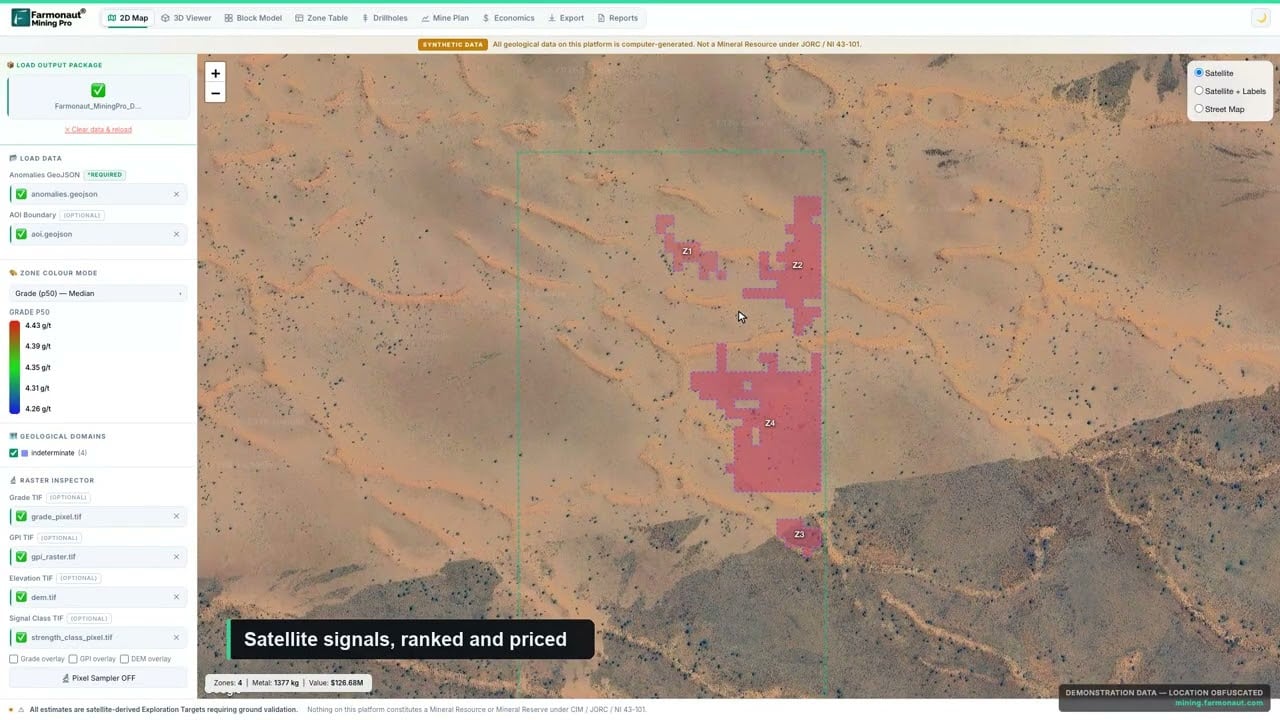
▶ What Farmonaut Mining Pro does with a license boundary · 4:56
Frequently asked questions
Is the Spruce Pine quartz mine currently operational?
Yes, on the latest public evidence. USGS reports both producers continued expansion plans in 2025, and Sibelco reported on its solar HPQ market and signed a US research letter of intent in 2026. Neither publishes weekly output.
Who owns the Spruce Pine quartz mine?
There is no single owner. Belgian group Sibelco and The Quartz Corp, a private Norwegian company linked to family-owned Norsk Mineral, run the HPQ operations.
Is there a stock for Spruce Pine quartz mines?
No. No security tracks these mines alone, and neither producer has a US ticker.
How can I invest in Spruce Pine quartz?
Only indirectly, through a wider group, companies further down the supply chain, or a fund that holds them. Each gives partial exposure at most. This is not investment advice.
What mining company is in Spruce Pine, NC?
Sibelco and The Quartz Corp produce the high-purity quartz. The district is also known for feldspar, mica and kaolin mining.
What does USGS say about Spruce Pine high-purity quartz?
It reports two producers in 2025, purity above 99.999%, about 100,000 t of US HPQ sold or used, and US$500 to US$12,000 per tonne.
How much does high-purity quartz cost?
USGS gives a 2025 range of US$500 to US$12,000 per tonne for ground HPQ. Actual prices depend on specification and contract, and there is no exchange price.
Why is this quartz used for semiconductors?
Its very low impurity level suits the crucibles used to grow silicon ingots for wafers. USGS says no economic substitute exists for most HPQ uses.
Did Hurricane Helene shut down the Spruce Pine mines?
It disrupted the district in September 2024. Sibelco later announced a restart of production and shipments, and USGS reports both producers continuing expansion plans in 2025.
Is pineapple quartz from Spruce Pine?
The name does not establish that. It is a collector trade name, not an industrial grade, so ask the seller for the locality.
Can I buy quartz from Spruce Pine?
Industrial buyers deal directly with the producers on specification. Collector pieces are sold separately, and a certificate of analysis is the way to check any purity claim.
More from Farmonaut: quartz mineral stone key uses in agriculture mining.
This page is for information only. It is not investment advice.
Farmonaut mining
Map your own project area from space
Request a quote for satellite screening of your own license area.

Mining Pro sample view, synthetic data
Keep reading
Sources
- USGS, Mineral Commodity Summaries 2026: Quartz: pubs.usgs.gov
- Sibelco, Restart of production and shipments at Spruce Pine after Hurricane Helene: sibelco.com
- Sibelco, Spruce Pine locations: sibelco.com
- Sibelco, Update on the expansion of Spruce Pine HPQ operations: sibelco.com
- Sibelco, First-half 2026 results: sibelco.com
- Sibelco, CHIPS Act letter of intent (22 October 2026): sibelco.com
- Sibelco, About us: sibelco.com
- Sibelco, Investors: sibelco.com
- The Quartz Corp, History: thequartzcorp.com
- The Quartz Corp, Geology: thequartzcorp.com
- The Quartz Corp, High purity quartz: thequartzcorp.com
- Bronnoysund Register Centre, The Quartz Corp AS (976 144 163): data.brreg.no
- Norsk Mineral, Minerals: norskmineral.no
- Susina, Swanson and Christiansen, GSA Abstracts with Programs (2010): gsa.confex.com
- NC DEQ, Mining Program: deq.nc.gov
- Wikipedia, Spruce Pine Mining District: en.wikipedia.org
- its about page: norskmineral.no
Discussion
Questions, corrections or field experience? Share them below. First-time comments are reviewed before they appear, and your email is never published.
No comments yet. Be the first to add a question or your experience.

 Ramani Investments Ltd
 Congo Mining Solutions
 Mining SARL
 SenGold Invest SAS
 Sania Corporation
 Sean Mining Limited
 NTS Group (Pty) Ltd
 Mine4Africa
 Lithspo Minerals Limited
 Tintina Mining Group
 Dalgety Minerals Pty Ltd
 Vortex Minerals Pty Ltd
 Faith At Work (Pty) Ltd
 Geotech Mining Solutions plc
 Vulcan International Limited
 Kidepo Associates
 GKY Mining
 Alkimy SARL
 Double A Trading
 GemSprout Metals Limited

 Client · Somalia · Gold
 Client & affiliate partner · Ghana · Gold










