

Mining geometry · Explainer
Strike Length, True Width and Thickness in Mining
Strike length is how far a vein runs along its strike; true width is its thickness at right angles to the walls. Drilled length is longer, so reports must say which one they give.
Key takeaways
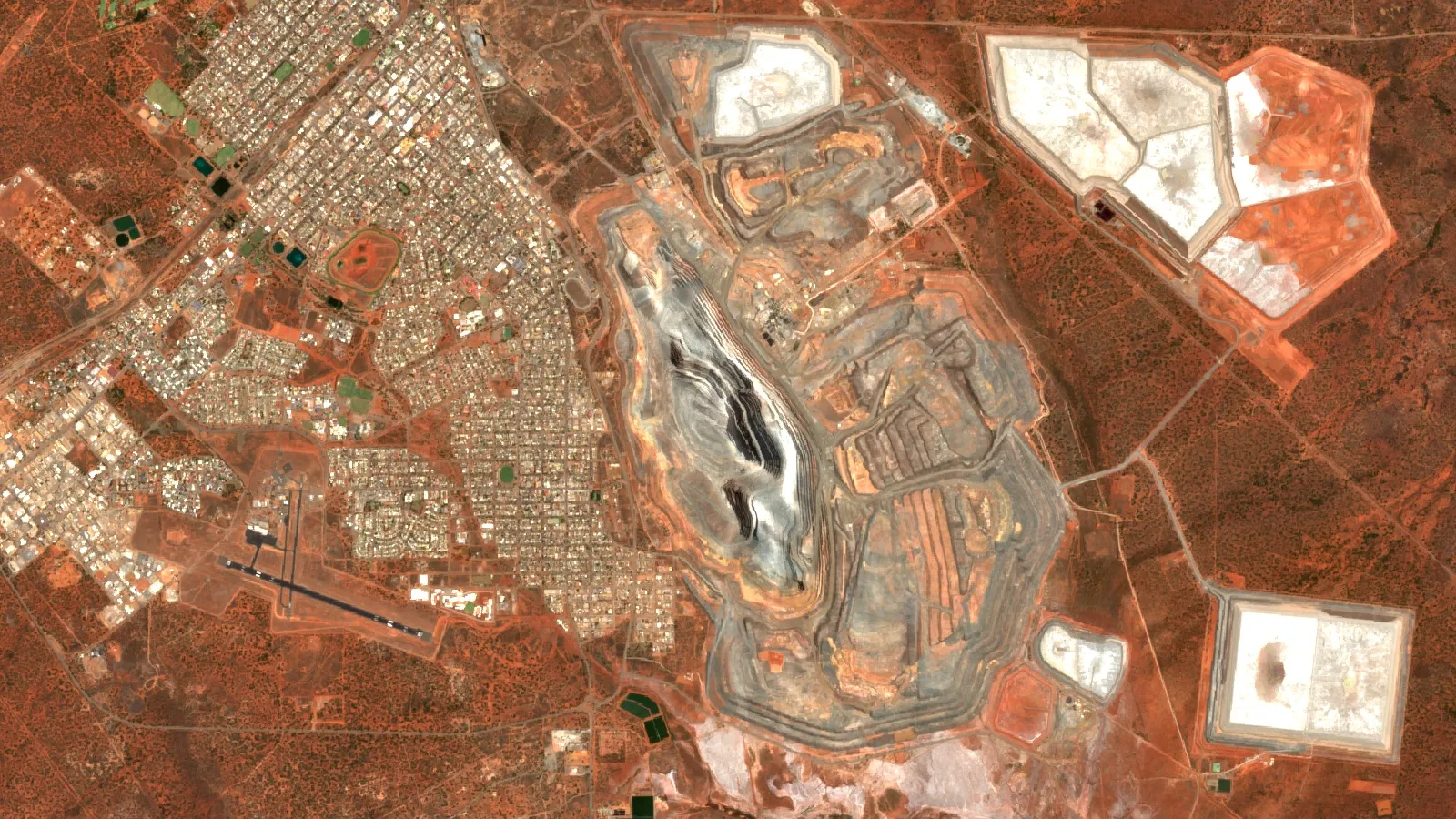
- Strike length is the horizontal run of a vein or lode. Some Golden Mile lodes run up to 1,800 m long but are only up to 10 m wide (Northern Star, KCGM Operations).
- True width = drilled length x sin(angle between hole and vein). At 30 degrees only half of the drilled length is true width (sine rule).
- JORC Table 1 asks reporters to say when only downhole lengths are given; NI 43-101 s.3.3(2)(c) asks the same for true width (OSC).
- Orla Mining quoted true widths of 30-100% of downhole length at Musselwhite (9 April 2026); West Point Gold reported 30 m true width in a 62.5 m intercept (29 July 2026).
- A block 100 m along strike and 100 m down dip holds about 27,000 t per metre of true width at 2.7 t/m3 (calculation).
In this article
- What is strike length in mining
- Strike and dip: the two angles that place a vein in space
- Thickness, true width and apparent width compared
- How to calculate true width from a drilled length
- Why drill results quote downhole length and true width
- What is strike width in mineral exploration
- How strike length and true width set tonnes
- From strike length to a block model
- Real strike lengths and thicknesses compared
- How to read a drill intercept in a news release
- Mapping strike from space and from the ground
- Frequently asked questions
Strike length is how far a vein, lode or mineralised zone runs along its strike, which is the horizontal direction of the structure at the surface. It is measured in metres or kilometres, and it is only one of three sizes that decide whether a deposit can be mined. The other two are the thickness across the body and the extent down its dip. At the Golden Mile in Western Australia, for example, some ore lodes run up to 1,800 m long and 1,200 m deep but only 10 m wide (Northern Star, KCGM Operations). This guide explains strike length, true width, true thickness and apparent width in plain words, shows how to turn a drilled length into a true width, and gives a worked calculator that carries the result through to tonnes.
What is strike length in mining
Every flat or tabular body in the ground, such as a quartz vein, a fault, a coal seam or a mineralised shear, has an orientation. Geologists describe that orientation with two angles. The first is strike: the compass bearing of the line where the body meets a horizontal plane. The second is dip: how steeply the body tilts down from horizontal, measured at right angles to strike. Strike length is the distance the body can be followed along that horizontal line.
Think of a sheet of plywood leaning against a wall. The bottom edge on the floor is the strike line. The length of that edge is the strike length. How far the sheet climbs up the wall, measured along its face, is the dip extent. The thickness of the plywood is the true thickness. A vein is the same shape on a much bigger and messier scale.
Strike length matters because it is the cheapest dimension to prove and the one that sells a project. A soil line, a trench or a surface mapping traverse can follow a structure for kilometres. Only drilling can show how far it goes down and how thick it really is. A long strike length with no thickness data is a target, not a deposit.
A few related terms appear in reports and press releases:
- Strike length: the horizontal run of the body along strike.
- Dip length or down-dip extent: how far the body continues down its dip, measured along the plane.
- Plunge length: the distance along the line of highest grade inside the body, used for ore shoots that plunge across the plane.
- True thickness or true width: the shortest distance between the two walls of the body, measured at right angles to them.
- Apparent width or downhole length: any other measured distance across the body, such as the length of core along a drill hole.
Strike and dip: the two angles that place a vein in space
A geologist measures strike with a compass held flat against the structure and dip with a clinometer set at right angles to strike. Maps show the pair as a small T-shaped symbol: the long bar follows the strike and the short tick points down-dip. Dip is always taken at right angles to strike. If you tilt a clinometer in any other direction you read an apparent dip, and an apparent dip is always flatter than the true dip. The US Geological Survey gives the relation as tan(apparent dip) = tan(true dip) × cos(angle between the two directions) (Walsh, USGS Techniques and Methods 7-C28, 2022).
The same logic applies to width. A true width is a measurement taken at right angles to the walls of the body. Any measurement taken at another angle is an apparent width, and it is always equal to or larger than the true width. This is the whole reason the topic exists: drill holes rarely cross a vein at 90 degrees, so the number in the drill log is almost always longer than the real thickness.
Two more facts help when you read a section or plan. First, the strike line stays the same at every elevation for a plane. If a vein strikes north-south at the surface, it strikes north-south at 300 m depth. Second, dip can change with depth. Many veins flatten or steepen, which is why one dip measurement from the outcrop is a starting point and not a final answer. Dip often varies along a vein; our guide to gold vein mining, grades and lode claims covers gold veins, grades and lode claims.
Thickness, true width and apparent width compared
The words thickness and width are used loosely, so the table below sets out what each one usually means in a mining report.
| Term | What it measures | Where you see it |
|---|---|---|
| True thickness | Distance between the two walls, measured at right angles to them | Resource estimates, geological models, cross-sections |
| True width | Same thing as true thickness for a vein or lode | Drill results, technical reports |
| Apparent width | Any width measured at another angle to the walls | Surface sampling, drill core, mapping |
| Downhole length or core length | Distance along the drill hole through the mineralisation | Drill intercept tables |
| Horizontal width | Width measured on a level plan, at right angles to strike | Level plans, stope design, underground mapping |
| Mining width | The width actually excavated, including waste the miners must take | Mine plans and dilution calculations |
Horizontal width and true width are linked by the dip. For a vein of true width T and dip d, the horizontal width is T divided by sin(d). A 5 m thick vein dipping at 60 degrees looks 5.8 m wide on a level plan. A vein dipping at 30 degrees looks 10 m wide on the same plan, although it is still 5 m thick. Plans therefore overstate the thickness of flat veins, and drill intercepts overstate it even more when the hole runs along the structure.
Thickness also steers the way a mine is built. A mining-method table in a 2017 technical memo for the Resolution Copper environmental review lists stulled stopes for narrow veins, usually less than 12 ft (about 3.7 m) wide, while other methods suit wide or massive bodies (Kliche, SWCA memo, 2017). A true width that is one metre less than expected can move a project from one method to another, which changes cost per tonne and the cut-off grade.
How to calculate true width from a drilled length
The working rule is short. Let L be the length of the intercept along the hole and let g be the angle between the hole and the plane of the vein. Then true width = L × sin(g). If the hole crosses the vein at 90 degrees the true width equals the drilled length. At lower angles it shrinks. A structural geology text gives the same rule for beds as true thickness = apparent thickness × cos(q), where q is the angle between the line of the measurement and the pole to the bedding (Waldron and Snyder, Geological Structures, LibreTexts). Because q = 90 degrees minus g, cos(q) and sin(g) are the same number.
Chart
True width as a share of drilled length
Percent of the downhole length that is true width, by crossing angle between hole and vein
To find g for a hole drilled at right angles to strike, you only need the dip of the vein and the plunge of the hole below horizontal:
- Hole runs against the dip direction. The hole starts on the side the vein dips toward and heads the other way. Then g = dip + plunge. If the sum passes 90 degrees, use 180 degrees minus the sum.
- Hole runs with the dip direction. The hole heads the same way as the vein dips. Then g = the difference between dip and plunge, taken as a positive number.
- Take the sine of g and multiply by the drilled length.
Two examples show how big the gap can be. Take a 12.0 m intercept in a vein dipping 60 degrees. Drilled at 50 degrees below horizontal against the dip, the angle to the vein is 110 degrees, which is the same as 70 degrees, and the true width is 12.0 × sin(70 degrees) = 11.3 m. Drilled at 45 degrees below horizontal with the dip, the angle is only 15 degrees and the true width is 12.0 × sin(15 degrees) = 3.1 m. Same vein, same drilled length, and the true width differs by a factor of more than three.
Holes are not always drilled at right angles to strike, and veins bend. When the hole azimuth is oblique to the dip direction, the angle g has to be worked out in three dimensions, normally with software that uses the surveyed hole path and a modelled vein surface. The simple rule above is a good field check; the geological model is what goes into a resource estimate. The same geometry is why drill planning software and the model for exploration targeting try to place holes as close to perpendicular to the target as the terrain allows.
The chart below shows the share of the drilled length that is true width at different crossing angles. It is a calculation from the sine rule, not a measurement. At 30 degrees only half the drilled length is real thickness. Below about 20 degrees a hole is nearly useless for width, because a small error in dip causes a large error in true width.
Why drill results quote downhole length and true width
Companies report what the drill produced: a length of core with a grade. That number is a fact. The true width is an interpretation, because it depends on the dip and strike of the vein, and early in a programme the geometry is often not known. Rules therefore ask the reporter to say which one they are giving.
Chart
Core length versus true width, selected intercepts
Eight intercepts from one release, metres
- JORC Code (Australasia). Table 1 asks for the relationship between mineralisation widths and intercept lengths. If the geometry with respect to the hole angle is known, report it. If it is not known and only downhole lengths are given, say so clearly, with a wording such as “down hole length, true width not known” (JORC Code 2012, Table 1).
- NI 43-101 (Canada). A case-study answer sheet from the Ontario Securities Commission cites section 3.3(2)(c) of the instrument for the same point: if the intervals are not true widths, state that true width is unknown (Ontario Securities Commission). A 2025 law-firm review lists failing to distinguish true width from apparent width as a common disclosure problem (Cassels).
Real releases show the spread. In April 2026 Orla Mining reported drill results from the Musselwhite mine in Ontario and noted that its true width estimates range from 30% to 100% of the downhole interval, with widths left out where geological control was not good enough (Orla Mining news release, 9 April 2026). A 30% factor corresponds to a crossing angle of about 17.5 degrees, and 100% to a right-angle crossing. The chart below plots eight of the intercepts in that release, core length against estimated true width, and the gap runs from nearly nothing to nearly two-thirds.
A second example is West Point Gold. In July 2026 it reported hole GC26-166, a reverse-circulation hole that cut 62.5 m at 3.12 g/t gold, with an estimated true width of 30 m. The zone is a planar structure dipping 70 degrees (West Point Gold news release via Kalkine Media, 29 July 2026). Here the true width is about 48% of the downhole length. The same release gives a 12 m true width for a footwall vein breccia inside a 54.9 m intercept, so the length of the headline interval and the width of the high-grade part can differ a lot.
Why do headlines lead with downhole length? Because it is the larger and more eye-catching number, and because it is what the assay table holds. It is not misleading when the release explains it. It becomes misleading when a long intercept at a shallow angle is the only number a reader sees, and the grade is then compared with true-width intercepts from another project. Compare like with like: true width to true width, and downhole to downhole only when both holes cross at the same angle.
What is strike width in mineral exploration
People searching for strike width usually mean one of two things. The first meaning is simply how long the body is along strike, which is the strike length covered above. The second meaning is the width of the body measured across the strike direction on a level plan, which geologists call horizontal width. Neither is a formal term in the JORC wording quoted above, which speaks about mineralisation widths and intercept lengths, so check how a report defines it before you use the number.
Why does it matter? Because a project is a three-dimensional shape and every report picks one slice of it. A press release that talks about a “strike width” of 40 m may be describing a horizontal width, which includes the effect of a flat dip. The true thickness might be half that. For a licence owner or investor the rule is simple: ask which direction the number was measured in, and ask for the true width and the dip that go with it.
For mine planning the useful trio is strike length, down-dip extent and true thickness. Multiply them and you have the volume of a tabular body. The next section does exactly that.
How strike length and true width set tonnes
For a simple tabular body, volume is the plan area of the plane (strike length times down-dip extent) times the true thickness. Tonnes are volume times density. Density depends on the rock; many hard-rock veins sit near 2.7 tonnes per cubic metre, but a heavy sulphide body is denser, so use a measured value when you have one. In the calculator and the chart we use 2.7 as an example input.
Chart
Tonnes in a 100 m by 100 m block by true width
Thousand tonnes at an example density of 2.7 t/m3
The chart shows how much rock a block of 100 m along strike and 100 m down dip holds at different true widths. Doubling the true width doubles the tonnes, and a hole that overstates the width by 50% overstates the tonnes by 50% in the same way. This is why careful reporters reduce the drilled length to true width before they build a resource model.
The calculator below turns a drill intercept into a true width and then into a block of tonnes. It assumes the hole is drilled at right angles to strike and that the vein is a flat plane. Enter your own numbers. The sine is calculated with a close approximation that stays within 0.2 percentage points of the exact value, so the result stays within about 0.2% of the drilled length of the exact value (for example 0.2 m on a 100 m intercept). Treat the output as a field check, not a resource estimate.
Tonnes in a block are not the same as an ore reserve. Mining takes a minimum width, dilutes the vein with waste, loses some ore, and applies a cut-off grade. Our guide to mineral resource estimation explains how the geology becomes an inferred, indicated or measured resource, and why exploration results such as strike length and true width stay as exploration information until that work is done.
Calculator
What is the true width and how many tonnes does the block hold?
Enter your own intercept, vein dip, hole plunge and block size. The hole is assumed to run at right angles to strike.
- True width as share of drilled length: 93.9%
- Angle between hole and vein (degrees): 70.0
- Horizontal width on a level plan (m): 13.0
- Tonnes in the block: 1,369,098
Example values only, not a benchmark and not a resource estimate. Sine is computed with a close approximation (within 0.2 percentage points; angles under 10 degrees are least exact). The block is a flat plane: strike length x down-dip extent x true width x density.
From strike length to a block model
A resource model does not store a vein as a plane. It divides the ground into blocks, and each block gets a grade, a density and a confidence class. True thickness is built into the model because the solid that holds the blocks follows the walls of the vein. If the interpretation of dip is wrong, the block model inherits the error.
That is also why geologists model the vein walls from every hole and cross-check the thickness hole by hole. Thickness that changes smoothly along strike and down dip is a good sign. Sudden jumps often mean a hole crossed the vein at a different angle, or a fault has moved a piece of the body. The video below shows what a block model is and how it is read.
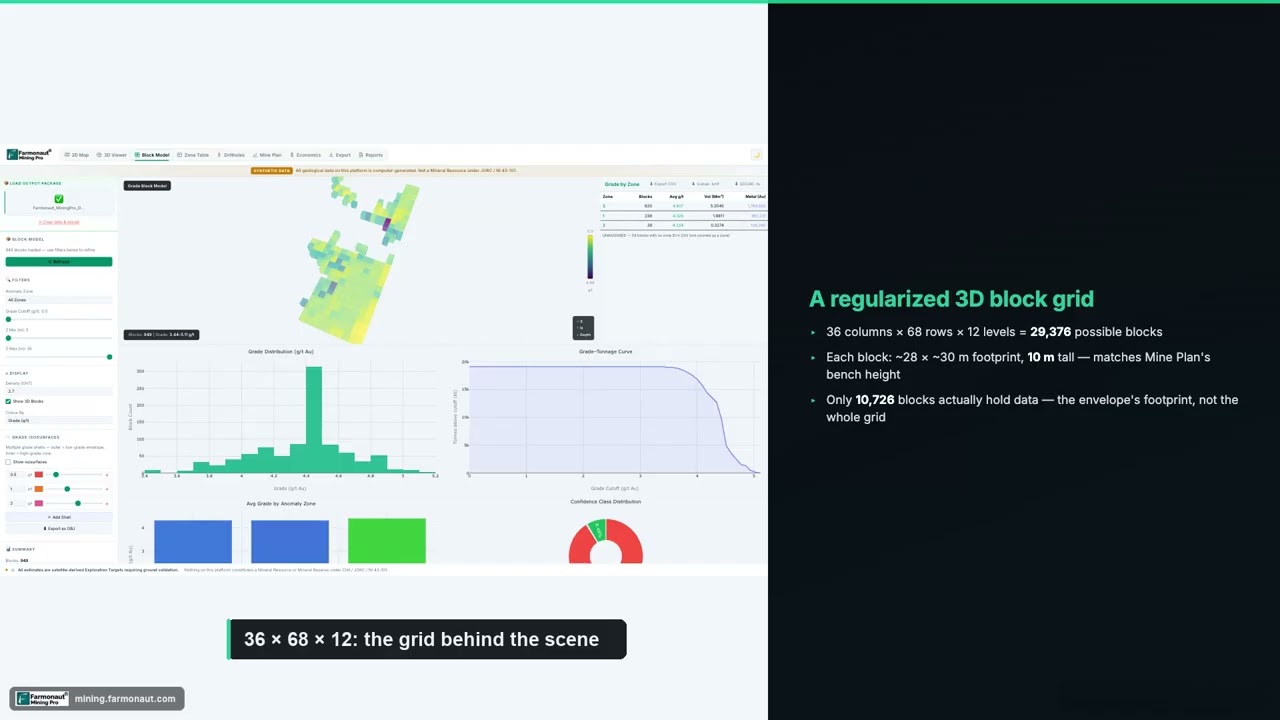
▶ What a block model is and how it is read. · 5:23
Real strike lengths and thicknesses compared
Real deposits have very different shapes, and the ratio of strike length to thickness is a useful way to see them. It is not a measure of quality.
| Deposit | Length along strike (as reported) | Depth or dip extent | Thickness | Source and date |
|---|---|---|---|---|
| Golden Mile lodes, Western Australia | Up to 1,800 m | Up to 1,200 m deep | Up to 10 m wide | Northern Star, KCGM Operations page |
| Santoy 8, Saskatchewan | 600 m confirmed | 350 m dip length | 1.5 to 30 m true thickness (Santoy 8 and 8E) | Canadian Mining Journal, April 2008 |
| Santoy 8E, Saskatchewan | 200 m intercepted | 250 m dip length | Within the same 1.5 to 30 m range | Canadian Mining Journal, April 2008 |
The Golden Mile figures describe individual lodes, not the whole camp: the operator says more than 1,000 separate lodes sit within the Golden Mile, with the largest reaching the dimensions above (Northern Star). Northern Star gives these as upper limits for individual lodes, so the longest and the widest lode may not be the same one; even so, these lodes are far longer than they are thick. The Santoy 8 figures come from a 2008 report on drilling at the Seabee gold property, and they show that one body can range from a narrow 1.5 m to 30 m thick depending on where you cut it (Canadian Mining Journal, 23 April 2008). These are historical figures from 2008.
Three lessons follow. First, a long strike length does not guarantee width: many gold lodes are kilometres long and metres thick. Second, thickness varies along the body, so one hole is not enough to quote an average. Third, the numbers describe what was drilled and mapped when the report was written. Drilling more holes changes them.
How to read a drill intercept in a news release
Use this checklist when a company reports an intercept such as 25.0 m at 2.1 g/t gold. For grade units and what a gram per tonne means, see our guide to grams per tonne in gold grades.
- Find the label. Does the release say downhole, core length, apparent width or true width? If it says nothing, treat the number as downhole.
- Look for the dip and hole angle. The collar table lists azimuth and dip of the hole. The release or a section should give the dip of the vein. With both you can estimate the true width with the rule above.
- Look for the conversion statement. Many releases say that true widths are a stated percentage of downhole lengths. Orla gives 30% to 100%, which is a wide range that still has to be checked hole by hole.
- Check the strike length claim. Ask whether a strike length is the distance between the farthest holes or a continuous body proven by drilling. Look at the hole spacing. If holes are 200 m apart, a 1 km strike length rests on only a handful of points.
- Check that low-grade gaps are shown. Balanced reporting shows low and high results, not only the best holes. The JORC table says so directly.
- Remember the stage. These are exploration results. They are not a resource, and a resource is not a reserve.
When a company gives the same intercept in both downhole and true width, you can calculate the implied crossing angle. If the true width is 48% of the downhole length, the crossing angle is about 29 degrees, because the sine of 29 degrees is close to 0.48. A low angle can be a clue that the hole was drilled in a poor direction for the vein, and that a better-planned hole would give a cleaner result. Our guides to exploration drilling methods and core sampling and logging cover how oriented core and downhole surveys give the angles you need.
Mapping strike from space and from the ground
Strike can be seen well before a drill arrives. Faults, gold-bearing shear zones and quartz veins often show as straight or gently curved lines in satellite and aerial images, and a line that holds a straight bearing for kilometres is the sort of target that makes a strike length claim believable. Field teams then confirm the bearing and dip with a compass, sample it, and trench it. Satellites map surface and near-surface signatures; sampling and drilling confirm what lies below.
Farmonaut produces satellite mineral reports that screen a licence for alteration and structural patterns, which can help a licence owner decide where to place a first line of sampling. These are exploration targets and not a resource estimate. If you want to see the methods side by side, our guide to satellite-based mineral detection explains what multispectral and radar data show; the short video below summarises how remote sensing works.
For a practical order of work on a new licence, start with mapping and structure interpretation, then follow with soil or rock sampling along the strike line, then trenching, and only then drill at an angle that crosses the structure as close to 90 degrees as the access allows. This keeps true width close to downhole length and makes your first intercepts easier to read. For a wider view of the process see our mineral exploration guide.
▶ Remote sensing for mining explained in about two minutes. · 2:01
Frequently asked questions
What is strike length in mining?
Strike length is the horizontal distance over which a vein, lode, seam or shear can be followed along its strike direction. It is one of three dimensions that define a tabular body, together with the extent down the dip and the true thickness.
What is the difference between strike and dip?
Strike is the compass direction of the horizontal line in the plane of the body. Dip is the angle at which the plane tilts down from horizontal, measured at right angles to strike. For example, a vein that strikes north-south and dips 60 degrees east tilts down toward the east.
What is true width in mining?
True width, also called true thickness, is the shortest distance between the two walls of a vein or ore zone, measured at right angles to those walls. A drill intercept is only a true width when the hole crosses the zone at 90 degrees.
How do you calculate true width from a drill intercept?
Multiply the drilled length by the sine of the angle between the hole and the vein. A 12 m intercept that crosses the vein at 70 degrees has a true width of about 11.3 m; at 15 degrees it is about 3.1 m. The calculator on this page does the sum from the dip and the hole plunge.
What is apparent width?
Apparent width is any width measured at an angle other than 90 degrees to the walls of the body. Core length in a drill hole is the usual example. Apparent width is always equal to or longer than true width.
What is strike width in mineral exploration?
It is not a fixed technical term. Most people use it either for the length of a body along strike or for its horizontal width on a level plan. Check how the report defines it, and ask for the true width and dip to compare projects fairly.
Why do companies report downhole length and not true width?
Downhole length is measured directly, while true width needs the dip and strike of the vein, which are often unknown early on. Reporting rules such as the JORC Code ask companies to say clearly when only downhole lengths are given and the true width is not known.
What is a normal ratio of true width to drilled length?
There is no standard figure. Companies state their own, and published releases range widely. Orla Mining quoted 30% to 100% for one set of results, and West Point Gold reported about 48% for one reverse-circulation hole. The ratio depends on how the holes cross the structure.
How wide does a vein need to be to mine?
It depends on the method, the grade, the metal price and the cost of dilution. Narrow-vein methods such as stulled stopes are listed for veins usually under about 12 ft (3.7 m) wide in one mining-method table, but a very high-grade narrow vein can pay while a wide low-grade one may not. Confirm with a mining engineer.
Can satellite images show strike length?
They can show the surface trace of faults, shear zones and veins, and with it a first estimate of strike. They cannot show true thickness at depth. Ground mapping, sampling and drilling give that.
Is strike length the same as the size of the deposit?
No. A deposit is a three-dimensional shape. Strike length tells you one dimension; you also need the extent down dip, the true thickness and the grade before you can say anything about tonnes or value. Reported figures are exploration information until a qualified person publishes a resource estimate.
This page is for information only. It is not investment advice. Drill results and strike lengths are exploration information, not a mineral resource or reserve under JORC, NI 43-101 or SAMREC.
Farmonaut mining
Screen your licence from space
Send your licence boundary and ask for a quote on a satellite mineral report to help place the first sampling lines.

Mining Pro sample view, synthetic data
Sources
- JORC Code 2012, Table 1 report template: jorc.org
- Ontario Securities Commission, NI 43-101 case-study answer sheet: osc.gov.on.ca
- Cassels, NI 43-101: the requirement to disclose complete and transparent exploration results: cassels.com
- USGS, An apparent dip calculator for spreadsheets (Walsh, Techniques and Methods 7-C28, 2022): pubs.usgs.gov
- Waldron and Snyder, Geological Structures: Primary structures (LibreTexts): geo.libretexts.org
- Orla Mining, Musselwhite deep directional and underground drill results (9 April 2026): newswire.ca
- West Point Gold, NE Tyro zone drill results (29 July 2026, via Kalkine Media): kalkinemedia.com
- Northern Star, KCGM Operations (Golden Mile lodes): nsrltd.com
- Canadian Mining Journal, Claude tallies numbers at Santoy 8 deposit (23 April 2008): canadianminingjournal.com
- Kliche, Mining method memo for the Resolution Copper project (SWCA, 2017): resolutionmineeis.us
Discussion
Questions, corrections or field experience? Share them below. First-time comments are reviewed before they appear, and your email is never published.
No comments yet. Be the first to add a question or your experience.

 Critica Metals Limited
 Congo Mining Solutions
 Mining SARL
 SenGold Invest SAS
 Sania Corporation
 Sean Mining Limited
 NTS Group (Pty) Ltd
 Mine4Africa
 Lithspo Minerals Limited
 Tintina Mining Group
 Dalgety Minerals Pty Ltd
 Vortex Minerals Pty Ltd
 Faith At Work (Pty) Ltd
 Geotech Mining Solutions plc
 Vulcan International Limited
 Kidepo Associates
 GKY Mining
 Alkimy SARL
 Double A Trading
 GemSprout Metals Limited
 Qader Group
 Ileys General Trading

 Client & affiliate partner · Ghana · Gold










