

Exploration risk · Drilling guide
Dry Holes in Mineral Exploration: Why Drill Holes Miss
A dry hole is a drill hole that finds nothing worth following up. Natural Resources Canada says fewer than 1 in 10,000 mineral showings become a mine. Many misses come from target, angle, depth or sampling choices that can be checked before the rig moves.
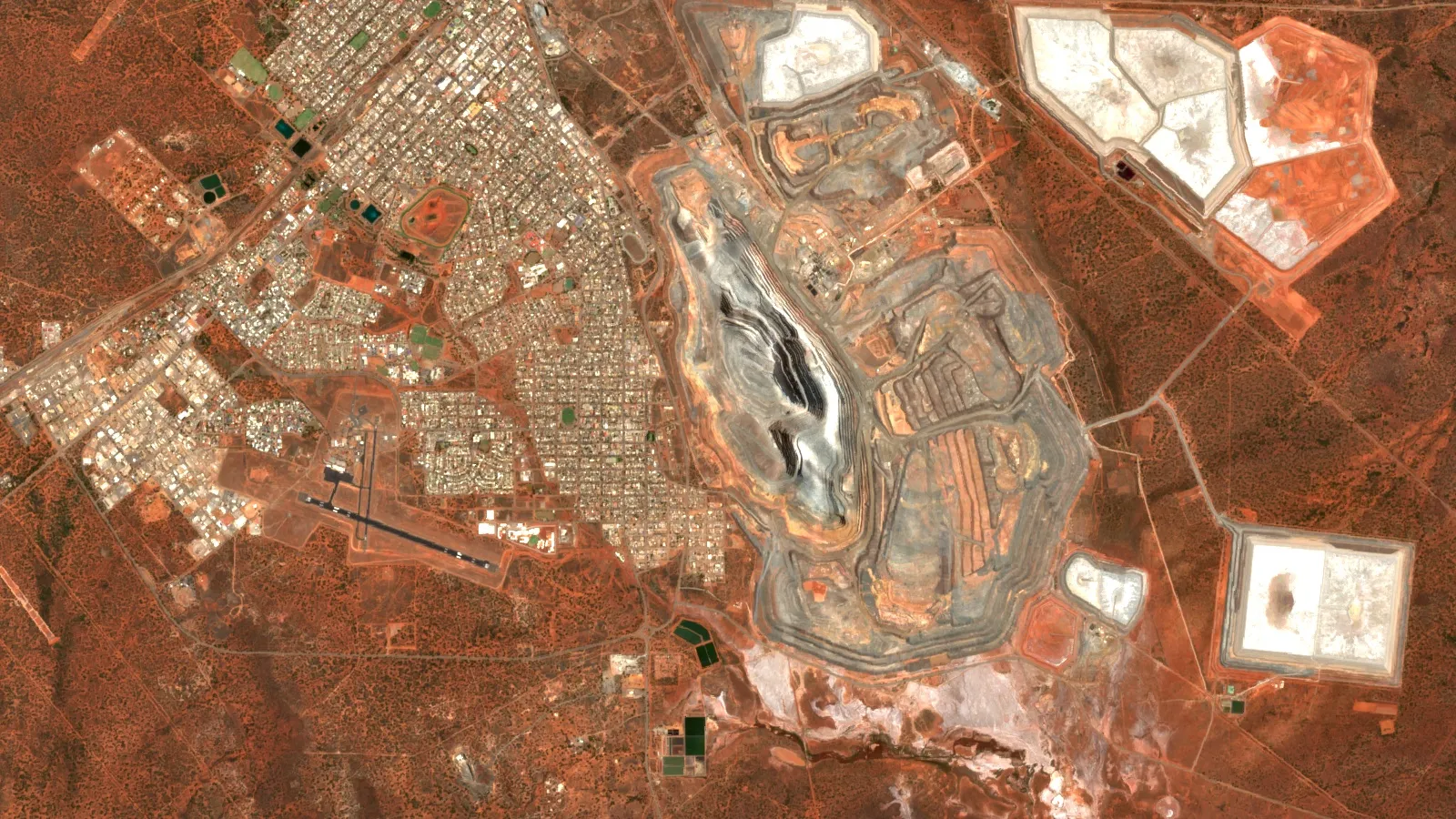
Key takeaways
- Fewer than 1 in 10,000 mineral showings become a mine, and a promising showing takes at least 7 to 10 years to reach one (Natural Resources Canada, 2013 guide).
- Less than half of all discoveries turn into mines, with a 15 to 20 year delay for those that do (MinEx Consulting, 2025).
- The average cost of one moderate-or-larger discovery rose from about US$65 million (1975 to 2005) to US$218 million (2011 to 2020) (MinEx Consulting, 2023).
- Hole angle changes what a hole reports: at 30 degrees to a vein, down-hole length is twice the true width (standard geometry; JORC 2012 Table 1).
- Base drilling rates run from 12 to 20 per metre for RAB to 110 to 250 for diamond core, and all-in costs often reach double the base (Novo Resources).
In this article
- Dry hole meaning in mineral exploration
- How often drill holes miss: the odds
- Exploration risk: why more spending has not meant more discoveries
- Why mining companies drill several dry holes before finding gold
- Hole angle and true width: the geometry that hides a good target
- The nugget effect: when a hole crosses gold and still returns little
- What a barren hole costs: diamond drilling cost per metre and other rates
- Why a hole in the wrong place is the costliest mistake
- Program cost per hit: a calculator
- Six gold exploration mistakes that cost money
- Drill hole planning: how to choose drilling locations
- A staged exploration drilling program
- Is your exploration plan based on data or guesswork?
- How to reduce drilling risk before the rig arrives
A dry hole is a drill hole that finds no mineralisation worth following up. In mining the phrase is informal, and it covers several different outcomes: the hole missed the target, it crossed the target but returned low grades, or it hit mineralisation that was too thin or too small to matter. In oil and gas the term is formal: the US Energy Information Administration defines a dry hole as an exploratory or development well that cannot produce enough oil or gas to justify completing it. This page is about mineral drilling only.
Natural Resources Canada says the odds are long: in its 2013 guide for communities, fewer than 1 in 10,000 mineral showings discovered actually become a mine. That is a statement about whole projects, not single holes, but it explains why a barren hole is a normal event in exploration and not always a sign of poor work. What separates a careful program from a wasteful one is how many of its misses could have been avoided with better data, a better hole angle or a better sampling plan. The rest of this page covers why holes miss, what a miss costs, and how to cut the odds before the rig moves.
Dry hole meaning in mineral exploration
A drill hole is a narrow cylinder cut into the ground to bring up rock or rock chips. Geologists log what comes up and send samples to a laboratory for assay, the chemical test that gives the grade. Grade is the amount of metal in the rock. For gold it is usually written in grams per tonne (g/t). An intercept is the stretch of a hole that crosses mineralisation, for example “8 m at 2.1 g/t”. A hole with no intercepts above the company’s cut-off grade is what people call dry.
Three kinds of miss are worth separating, because each has a different cause and a different fix.
- The hole was in the wrong place. The target model was wrong, or the target was right but the hole started in the wrong spot. The ground there holds no mineralisation.
- The hole was in the right place but built wrong. The angle, depth or sample size was wrong for the style of mineralisation. Rock with gold was in or near the hole, and the hole failed to record it.
- The hole did its job and the answer was no. The target was a fair test and was empty. This is the one miss that cannot be avoided, and it still has value, because it removes ground from the search.
Most of the cost savings sit in the first two. The third is the price of exploring.
How often drill holes miss: the odds
No public source gives one success rate for gold drilling, and any single percentage would depend on how “success” is defined. A hole that hits any gold is far more common than one that hits ore-grade gold over a minable width, and that is more common again than a hole on a deposit that is later built into a mine. The sources below measure different steps of that ladder, so read each number for what it measures.
Chart
Average cost of one world discovery
US$ million per moderate-or-larger deposit, 2023 dollars
| What is counted | Figure | Source |
|---|---|---|
| Mineral showings that become a mine | Fewer than 1 in 10,000 | Natural Resources Canada (2013 guide) |
| Time from a promising showing to a new mine | At least 7 to 10 years | Natural Resources Canada (2013 guide) |
| Discoveries that turn into mines | Less than half on average, with a 15 to 20 year delay for those that do | MinEx Consulting (2025 presentation) |
| Moderate-or-larger deposits found worldwide | About 50 a year at the 2023 run-rate (not the 2012 to 2021 average, about 74 a year), down from a peak of 149 in 2007 | MinEx Consulting (2023 and 2017 presentations) |
The first row comes from the Natural Resources Canada guide, which describes the success rate as extremely low for prospecting and early exploration. The second and third rows come from Richard Schodde of MinEx Consulting, who tracks discoveries worldwide. His 2025 conference note says that on average less than half of all discoveries turn into mines, and that the conversion rate is getting lower and slower. In his 2023 presentation, a “moderate” deposit means roughly 100,000 ounces of gold or more, or 100,000 tonnes of copper or more, so these counts leave out small finds.
The cost of finding such a deposit has climbed. MinEx divides total exploration spending by the number of discoveries and gets an average that more than tripled between two periods.

▶ A short mockumentary on why exploration is a long-odds game and how satellite data changes the choice of the next hole · 2:17
Exploration risk: why more spending has not meant more discoveries
Exploration risk is the chance that money spent on searching produces nothing that can be developed. It has three layers: geological risk (the deposit is not there, or not where the model says), technical risk (the hole or the sampling fails to detect it), and economic risk (it is there, but too small, too deep or too low in grade to pay). Dry holes belong to the first two layers, and a sound program tries to push both down before drilling starts.
Chart
World exploration spending in selected years
US$ billion, June 2023 dollars; years labelled by MinEx
The numbers show how hard the first layer is. In the MinEx 2023 presentation, world exploration spending rose from about US$3.8 billion in 2002 to US$42.1 billion in 2012 (June 2023 dollars), then fell to US$13.3 billion in 2016 and US$16.1 billion in 2022. Over 2012 to 2021, 737 new deposits of moderate size or larger were found worldwide, 126 of them in Australia. MinEx puts the world average cost of one such discovery at about US$65 million for 1975 to 2005 and US$218 million for 2011 to 2020 (2023 dollars). Those are industry-wide averages that include every cost of exploring, not the price of a single hole.
Why did costs rise? MinEx’s 2017 analysis shows the industry looking progressively under deeper cover since 1900, which makes deposits harder to find, though it describes this as a slow trend that does not explain the whole drop in recent performance. Easy outcrops have mostly been drilled. What is left is under sand, gravel, younger rock or deep weathering, where a hole is a blind test.
Why mining companies drill several dry holes before finding gold
A company that reports a discovery hole has often drilled many before it. The usual causes are below. Several can act on the same hole, which is why one miss rarely proves that a target is empty.
1. The target model was wrong
Targets are chosen from maps, geochemistry, geophysics and earlier holes. If the model of where gold sits is wrong, for example a vein system that turns out to be fault-offset, every hole based on it misses. Our guide to exploration targeting shows how drill targets get ranked, and why a ranked list is more useful than a single bullseye.
2. The hole angle did not suit the structure
Gold in veins and shear zones sits in tabular bodies that dip. A hole that runs close to parallel to the body can stay in barren wall rock beside it, or sit inside it for a short stretch and then leave. The JORC Code (2012), the Australasian reporting standard, asks reporters to say whether the drilling orientation may have introduced a sampling bias. The next section shows the geometry.
3. The hole stopped too early, or started in the wrong place
Where mineralisation lies under transported cover, such as sand or gravel, the hole must pass through that cover before it can test the rock. A geologist writing in Coring Magazine notes that about 80% of Australia lies under post-mineralisation cover and regolith (weathered ground), and that discoveries under more than 50 m of cover are rare. A shallow hole in such ground can end in cover without ever reaching bedrock. Our guide to how deep gold is found covers the depth question in detail. Collar position matters too: the CIM guidelines advise that collar surveys be accurate enough for the stage of the property, and that deviation surveys be taken at regular intervals down the hole.
4. The sample did not represent the gold
Some gold is coarse and rare in the rock. A small core sample can miss the nuggets by chance, and a lab test on a small portion can do the same. This is the nugget effect, covered in its own section below.
5. The data behind the plan were thin or wrong
Old maps with a different grid, soil samples with no quality checks, and old holes with no survey data all lead to targets that were never in the place the model said. The CIM exploration guidelines list quality assurance and quality control (QA/QC) steps that catch many such faults.
6. The target was a fair test, and it was empty
Some holes miss because there is nothing there. That is the cost of exploring and it is not avoidable. A well-logged barren hole still tells the next geologist where not to look.
Hole angle and true width: the geometry that hides a good target
A drill hole measures length along the hole. The thickness of the body it crosses is something else, and the two are equal only when the hole meets the body at a right angle. For a flat-sided vein of even thickness, true width equals the down-hole length multiplied by the sine of the angle between the hole and the vein. At 30 degrees, a 10 m true-width vein shows as 20 m down the hole. At 5 degrees it shows as about 115 m. A hole that runs along the vein can give a long intercept that says little about real thickness, and a hole that is a few degrees out in the other direction can pass beside it.
Chart
True width as a share of down-hole length
Flat vein of even thickness, by angle between hole and vein
Miners and investors who read press releases should look for the hole’s dip and azimuth next to the dip and strike of the body. JORC Table 1 asks for a statement when only down-hole lengths are known, for example “down hole length, true width not known”. Our guide to strike length and true width explains the terms and the reporting rules.
The nugget effect: when a hole crosses gold and still returns little
The nugget effect is the extra variation in assay results that comes from gold sitting in scattered coarse particles. Two samples taken a few centimetres apart can give very different assays. A paper by Simon Dominy, presented at the 2017 World Conference on Sampling and Blending, says the share of coarse gold in a sample has a major effect on how it should be prepared and assayed, and that traditional fire assays on small charges often understate the results given by larger-charge methods such as screen fire assay and LeachWELL (AusIMM abstract). In the Ballarat case study in that paper, the current protocol uses whole drill core.
The JORC Code makes the same point from the reporting side: where there is coarse gold, the sampling method may need more explanation, and the report should say whether sample bias might have arisen from loss of fine or coarse material. In practice this means a dry result from a coarse-gold system is weaker evidence than a dry result from a fine-grained, evenly spread system. Before calling the ground barren, check the sample size, the assay method and the recovery of the core.
What a barren hole costs: diamond drilling cost per metre and other rates
The cost of a barren hole is the cost of the hole plus the time and information lost. The direct part is easy to estimate once you know the method and depth. Drilling rates are quoted per metre (US readers search for the same figure as cost per meter). Novo Resources, a gold explorer, publishes average base rates by method, and notes that all-in costs often reach double the base rate once standby, moves, consumables and water are added.
Chart
Base drilling rate per metre by method
Average base rates, dollars per metre, currency not stated by the source
| Method | Base rate per metre | Used for |
|---|---|---|
| Rotary air blast (RAB) | 12 to 20 | Cheap, shallow sampling of weathered ground |
| Aircore | 18 to 30 | Sampling bedrock under soft cover |
| Reverse circulation (RC) | 30 to 55 | Fast testing of targets in hard rock, chips only |
| Diamond core | 110 to 250 | Intact core for structure and grade, the slowest method |
Those ranges come from the Novo Resources glossary, which does not state the currency on the page. A public cap gives a second reference point: the Newfoundland and Labrador government’s schedule of maximum allowable costs for its exploration incentive allows C$200 per metre for diamond drilling, all-in including standby, moves and consumables. That is a cap for rebate claims, not a market price, and the schedule shows no date, so the figure may have changed since it was published. Our guide to exploration drilling methods and costs goes through each method and what drives its price.
Worked examples
The arithmetic below uses the figures above. Treat the results as illustrations, not quotes.
- One 300 m diamond hole at C$200 per metre all-in costs C$60,000.
- One 150 m RC hole at a base rate of 30 to 55 costs 4,500 to 8,250 at base rate, and about 9,000 to 16,500 if all-in costs double the base, as Novo says is common.
- A program of ten 300 m diamond holes costs C$600,000. As a hypothetical only, if one hole in ten found mineralisation worth following up, nine holes, or C$540,000, would go on holes that found nothing. With one hit, the program cost for that hit would be the full C$600,000, which shows why hole success rate can matter more to the budget than the rate per metre.
Why a hole in the wrong place is the costliest mistake
A rig does not charge less for a hole in the wrong place. The metre rate is the same, and so are the standby, the move, the assays and the geologist’s time. The loss that does not show on the invoice is time. NRCan says at least 7 to 10 years pass between a promising showing and a new mine. MinEx adds that 15 to 20 years can pass from discovery to development for the deposits that do get built. A season spent on empty ground is a season of that clock, and for a junior company it can also be the season in which the money runs out.
There is an information cost too. A barren hole in a poor location tells you little about the target next door. A barren hole drilled on a good geological test can narrow the search. Wrong-place holes are expensive because they teach less than they cost.
Program cost per hit: a calculator
The calculator below turns a program budget and a hit rate you choose into the cost of each hit. The hit rate is an example input, not a benchmark. It shows how fast the cost per hit climbs as the hit rate falls, which is the figure to put next to any plan to drill “just a few more holes”.
Calculator
What does each hit cost in your program?
Enter your own holes, depth, rate and hit rate.
- Cost of one hole: $60,000
- Total program cost: $600,000
- Expected hits: 1.0
- Spend on holes with no hit: $540,000
Example values only, not a benchmark or forecast. The cost per metre is an example in US$, use a current contractor quote. A hit is whatever you define it to be, for example an intercept above your cut-off grade. Costs exclude assays, access and staff unless you include them in the rate.
Six gold exploration mistakes that cost money
These are the faults that show up again and again in the sources above and in how programs are reviewed. Each one can be checked on paper before a rig is booked.
- Drilling before the target has been compared with alternatives. One anomaly looks convincing alone. Ranked beside several others it may not. See our guide to exploration targeting for a method.
- Setting the hole angle without the structural data. A hole planned from a map alone can run parallel to the vein. Geometry should be settled using measured dips and strikes.
- Ignoring cover. Planning a 100 m hole where the bedrock lies deeper than that. Cover depth should come from nearby holes, geophysics or water bores before the first metre is drilled.
- Using a sample method that cannot see the gold. A small-charge fire assay on coarse-gold rock may read low even when gold is present.
- Skipping QA/QC. The CIM guidelines call for blanks, certified reference materials and duplicates as part of the program, not as an extra. Without them a surprising result cannot be trusted either way.
- Treating a single miss as the end, or a single hit as proof. One barren hole in a coarse-gold or steep-structure setting does not close the target, and one rich intercept does not make a deposit. Plan follow-up holes before the first one starts.
Drill hole planning: how to choose drilling locations
Good drill hole planning is a sequence of checks that ends in a hole design. The CIM Mineral Exploration Best Practice Guidelines (2018) say the drilling method should suit the rock, the commodity and the aim of the program, that hole diameter should give enough sample for description and analysis, and that geologists should prepare a working cross section showing the expected target for every hole. The steps below follow that logic.
Infographic
Seven checks between data and a hole
- 1Clean the dataPut maps, assays and old logs on one grid.
- 2Model the systemFind the likely source, channels and surface signs.
- 3Rank targetsScore each target on the same criteria.
- 4Design the holeSet dip, azimuth and depth from the geometry and cover.
- 5Match the methodUse cheap holes first and core to confirm.
- 6Plan QA/QCAdd blanks, standards and duplicates from hole one.
- 7Update after each holeLet each result change the next hole.
- Collect and clean the data. Put old maps, assays, geophysics and drill logs on one grid, and check that their coordinate systems agree.
- Build a simple model of the system. Where is the source of the fluids, what channels them (faults, contacts), and where do they leave a signature at surface?
- List and rank targets. Score each against the same criteria. Our guide to exploration targeting lists the evidence layers.
- Design the hole from the geometry. Choose dip and azimuth so the hole crosses the structure at a high angle, and set the depth to pass through cover and reach the target with room to spare.
- Match the method to the question. Cheap holes such as aircore or RC test many targets, and core confirms structure and grade where the early holes are positive.
- Write the QA/QC plan before drilling. Blanks, standards and duplicates go into the sample stream from the first hole.
- Update the model after each hole. A result changes the next hole. Do not run a fixed grid whatever the early holes say.
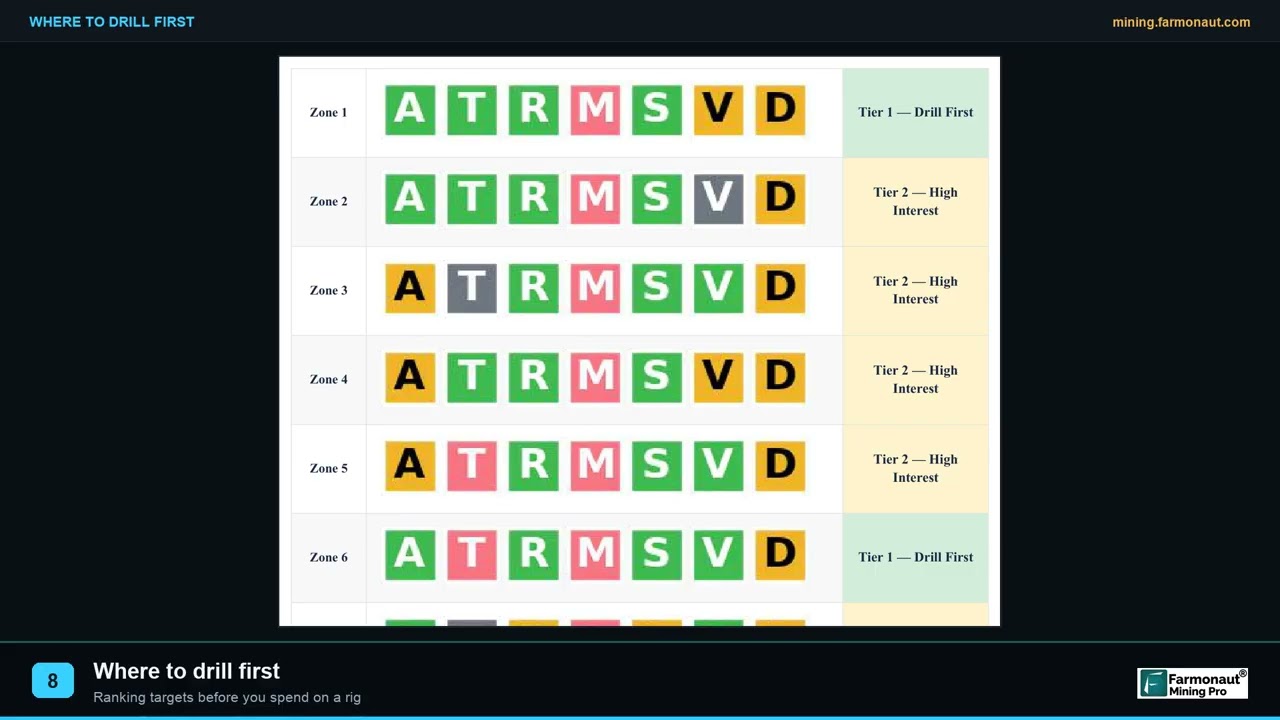
▶ How targets are ranked into a drill order · 2:19
A staged exploration drilling program
A typical exploration drilling program moves from cheap and broad to costly and narrow. Early holes with RAB or aircore sample the weathered profile across a wide area and cost a fraction of core. Where a pattern appears, RC holes test it at depth. Diamond core comes last, once the target is real enough to justify intact rock, for structure and for a better grade sample. This staging follows from the per-metre rates in the table above: spending core money on an untested target is how a season’s budget ends up in a handful of holes. For a first-year budget on a small licence, see our guide to a first-year exploration budget.
Is your exploration plan based on data or guesswork?
Instinct has a place. Experienced geologists often spot patterns before the numbers do. The problem comes when the plan cannot show its working. A plan built on data can answer each question below with a map, a table or a number. A plan built on guesswork answers with “we have always drilled there”.
| Question to ask | Data-led answer | Guesswork answer |
|---|---|---|
| Why this target and not the next one? | It ranks first on stated criteria beside alternatives | It is near an old pit or a promising result |
| Why this angle? | Measured dip and strike of the structure | It is the angle used on the last program |
| How deep is the cover? | Estimated from nearby holes or geophysics | Assumed to be shallow |
| Can the sample see the gold? | Sample size and assay method match the gold grain size | Standard method used, without checking |
| What will you do after a miss? | A set of follow-up rules agreed in advance | Decide later |
The point is not to remove judgement. It is to make the judgement visible, so that a second geologist can disagree with it before the money is spent.
How to reduce drilling risk before the rig arrives
You cannot remove exploration risk, but you can lower the share of holes that fail for avoidable reasons. These steps cost far less than a hole.
- Check the target against at least two independent datasets, such as surface alteration and a geophysical response, before ranking it highly.
- Fix the hole orientation from structural measurements, and design at least one hole that crosses the structure in the opposite direction as a check.
- Estimate cover depth and plan the hole to pass through it with a margin.
- Pick sample size and assay method to suit the gold, and add blanks, standards and duplicates.
- Keep a log of why each hole was placed where it was, so that results can be traced back to the decision.
- Agree stop and go rules before drilling: what result leads to a follow-up hole, and what result retires a target.
Our guide to satellite, geochemistry and geophysics compares the early methods that feed these checks.
Can satellite data help reduce the risk of dry holes?
Satellites do not see gold and they do not see deep. They record the sunlight reflected and the heat given off by the ground surface, and from that geologists map rock types, iron staining, clay minerals and fault lines. A 2014 review of ASTER, ALI and Hyperion sensors found that this spectral data helps geologists map exposed rock units, especially in the reconnaissance stages of hydrothermal copper and gold exploration. What this does for drilling risk is narrow the list of places to test and show where alteration and faults line up, before the first hole is booked.
It has limits. Satellites map surface and near-surface signatures, and sampling and drilling confirm what is below. Under thick cover the surface signal can be weak or absent. A satellite result is an exploration target, not a mineral resource, and it works best as one layer next to geology, geochemistry and geophysics. We covered the wider picture in our guide to satellite-based mineral detection.
A Farmonaut satellite mineral report screens a licence for target zones ahead of drilling, delivered in 5 to 20 business days. It supplies one layer of evidence for the ranking step above, not a replacement for field checks.

▶ Mineral exploration from space and why a hole in the wrong place costs as much as one in the right place · 4:26
Frequently asked questions
What is a dry hole in mining?
It is an informal name for a drill hole that finds no mineralisation worth following up. It may have missed the target, crossed it without reaching the cut-off grade, or hit mineralisation too thin to matter. In oil and gas the EIA gives a formal definition of a well that cannot produce enough to justify completion.
What percentage of drill holes find gold?
No published source gives one figure for all gold drilling. The share depends on whether “find” means any gold, ore-grade gold or an economic deposit. Natural Resources Canada says fewer than 1 in 10,000 showings become a mine, and MinEx says less than half of discoveries do.
What is a good drilling success rate in gold exploration?
A good rate depends on the stage. Early holes on untested ground should expect many misses, and holes that follow up a known intercept should do better. Judge a program against its own stated aim and compare holes to the plan, not to a single industry percentage.
How much does a dry hole cost?
It costs the same as a hole that finds ore. A 300 m diamond hole at C$200 per metre all-in costs C$60,000, using the Newfoundland and Labrador cap. A 150 m RC hole costs 4,500 to 8,250 at Novo Resources’ base rates (currency not stated by Novo), and up to double that all-in. That is a fraction of the diamond figure.
What is the diamond drilling cost per metre?
Novo Resources lists a base rate of 110 to 250 per metre for diamond core, and says all-in costs often double that. Newfoundland and Labrador caps all-in diamond drilling at C$200 per metre for its incentive program. Rates rise with depth and with core diameter, so get current quotes.
Why do holes miss gold that is clearly nearby?
The usual reasons are hole angle, depth and sample size. A hole parallel to a vein can run beside it. A hole that is too short can stop in cover. Coarse gold can be missed by a small sample even when the hole passes through it.
How many holes are drilled before a discovery?
There is no standard count. Programs vary from a handful of holes to hundreds, and the discovery hole is often not the first. MinEx data show the world cost of a discovery rose to about US$218 million for 2011 to 2020, which reflects many holes and many projects behind each find.
Is a dry hole a failure?
Not always. A well-placed hole that tests a clear idea and finds nothing removes ground from the search and improves the model. A hole that was in the wrong place for reasons that could have been checked is the costly kind.
How do you reduce the risk of a failed drilling campaign?
Rank targets against alternatives, set hole angle from structure, plan depth through cover, match the sample method to the gold, run QA/QC, and agree follow-up rules before the first hole. The checklist above lists each step.
Can satellite data predict where gold is?
No. It maps surface and near-surface signs such as alteration and faults that help narrow where to look. Sampling and drilling confirm what is in the ground.
This page is for information only. It is not investment advice. Drilling costs are published benchmarks and caps, not quotes. Satellite and desk-study results are exploration targets, not a JORC, NI 43-101 or SAMREC mineral resource. Check licence and drilling permit rules with the regulator before you drill. Drilling and field work carry safety risks: use qualified contractors and follow local safety rules.
Farmonaut mining
Screen your ground before the rig moves
Send your licence boundary and target mineral to request a quote for a satellite mineral report.

Mining Pro sample view, synthetic data
Sources
- US Energy Information Administration, Glossary: dry hole: eia.gov
- Natural Resources Canada, Exploration and Mining Guide for Aboriginal Communities (2013): natural-resources.canada.ca
- MinEx Consulting, Exploration: Australia vs The World, IMARC (October 2023): minexconsulting.com
- MinEx Consulting, The fingerprint of a successful discovery (AMIRA, September 2025): minexconsulting.com
- MinEx Consulting, Challenges of Exploring Under Deep Cover (March 2017): minexconsulting.com
- Coring Magazine, The challenge of mineral discovery under cover: coringmagazine.com
- JORC Code, 2012 Edition, Table 1: jorc.org
- CIM, Mineral Exploration Best Practice Guidelines (2018): mrmr.cim.org
- Novo Resources, Drilling Techniques and Costs glossary: novoresources.com
- Government of Newfoundland and Labrador, maximum allowable costs for exploration incentive: gov.nl.ca
- AusIMM, Dominy (2017), Sampling coarse gold-bearing mineralisation, abstract: ausimm.com
- Beiranvand Pour and Hashim, ASTER, ALI and Hyperion data for ore minerals exploration (2014): pmc.ncbi.nlm.nih.gov
Discussion
Questions, corrections or field experience? Share them below. First-time comments are reviewed before they appear, and your email is never published.
No comments yet. Be the first to add a question or your experience.

 Mineral Gulf Transhipment DMCC
 G.I.T.T.
 Jaunita Erss Ltd
 Almosi SARL
 SRK Consulting
 Berks Gold Limited
 Mwerezi Minerals Company Limited
 Mining SARL
 SenGold Invest SAS
 Sean Mining Limited
 NTS Group (Pty) Ltd
 Mine4Africa
 Lithspo Minerals Limited
 Tintina Mining Group
 Dalgety Minerals Pty Ltd
 Vortex Minerals Pty Ltd

 Licence holder · Nigeria · Gold + lithium
 Client · Somalia · Gold










