

Underground mining · Methods explained
Animation for Mining Methods: 9 Methods With Costs
Underground mining methods range from about US$9 per tonne (block caving) to about US$68 per tonne (cut and fill) in a published cost model. Here is what an animation of each method should show, including the ventilation fans.
Key takeaways
- Three families: supported (room and pillar), stoping (sublevel, cut and fill, shrinkage, VCR) and caving (sublevel, block, longwall).
- Cost model in a 2017 US Forest Service review: block caving about US$9/t, sublevel longhole US$19/t, cut and fill US$68/t.
- US coal, 2024: longwall 112.8 and continuous mining 92.8 million short tons underground (EIA).
- 30 CFR 75.325 sets at least 3,000 cfm at each coal face and 30,000 cfm at each longwall face.
- A good animation shows access, development, the production cycle, ground support and ventilation, checked by an engineer.
In this article
- What an underground mining animation should show
- Types of underground mining methods, with animation notes
- Underground mining methods compared by cost and output
- How method choice changes cut-off grade
- Underground vs surface mining: what the numbers show
- Underground mining fan animation and ventilation
- Animation for safety training and emergencies
- How to brief a 3D mining animation in 6 steps
- Common mistakes in mining method animations
- Frequently asked questions
An animation for mining methods shows, step by step, how ore is reached and removed underground: the access tunnels, the drilling and blasting, how the ground is held up or allowed to cave, and how fresh air is pushed through by fans. The nine methods below are the ones most training and planning animations cover, and they differ enormously in cost: a 2017 review for the US Forest Service put operating costs at about US$9 per tonne for block caving and about US$68 per tonne for cut-and-fill (Kliche for SWCA, 2017). That gap is the main reason a mine picks one method over another, and it is the thing a good animation should make obvious.
This guide walks through what each method looks like when animated, which details an engineer will check, how ventilation fans are shown, and how to brief an animation studio. It finishes with a cut-off grade calculator, because the method you choose decides how much of an orebody is worth mining.
What an underground mining animation should show
Most people who search for mining method animations are students, new miners, investors or mine staff who need to explain a plan to someone else. A still diagram shows a mine at one moment. An animation shows the sequence: which tunnel is driven first, where the ore is blasted, where it falls, how it is hauled out and what is left behind. That sequence is the hard part to explain in words.
Infographic
The underground production cycle in 6 steps
- 1AccessShaft, decline or adit reaches the orebody.
- 2DevelopmentDrifts, crosscuts and raises open the stope.
- 3Drill and chargeHoles are drilled and loaded with explosives.
- 4Blast and ventilateFans clear fumes before anyone returns.
- 5Load and haulLoaders and trucks or hoists move the ore out.
- 6Support or fillBolts, pillars, backfill or controlled caving.
A useful animation of any underground method shows five layers:
- Access: the shaft (a vertical opening), decline (a sloping ramp for trucks) or adit (a horizontal tunnel from a hillside) that connects the surface to the orebody.
- Development: the drifts and crosscuts (horizontal tunnels along and across the orebody) and raises (vertical or steep openings between levels) that are dug before any ore is produced.
- Production cycle: drill, charge with explosives, blast, ventilate the fumes, then load and haul, repeated many times a day.
- Ground support: what holds the rock up (pillars, rock bolts, mesh, backfill) or, in caving methods, how the rock is allowed to collapse in a controlled way.
- Ventilation: where fresh air enters, which fans move it, and where used air leaves.
An animation that skips ventilation or ground support looks tidy but teaches the wrong lesson, because those two systems decide whether a stope (the underground opening where ore is mined) can be worked safely at all. Our earlier overview of 3D animation trends for underground mining methods covers the software side; this page focuses on the mining methods themselves.
Types of underground mining methods, with animation notes
Mining engineers group underground methods into three families. Supported methods leave natural pillars of rock to hold the roof. Unsupported or filled stoping methods open a large void and either leave it open briefly or fill it with waste rock or cemented tailings. Caving methods let the ore, the rock above it, or both collapse under their own weight. Which family fits depends on the shape, depth, strength and grade of the orebody, which is why it helps to know the main types of ore deposits before choosing.
1. Room and pillar
Room and pillar mining removes material across a flat layer, leaving a grid of rooms with pillars of untouched rock that support the roof, as described in the room and pillar mining entry. It suits flat, fairly thin deposits: coal, salt, potash, limestone, trona and some lead-zinc ores. In US coal, the continuous miner (a machine with a rotating cutting drum) does the cutting, and roof bolters install bolts behind it.
Animation focus: show the checkerboard plan view first, then cut into section to show the pillar size relative to the room width. A good room and pillar animation also shows retreat mining at the end of a panel, where pillars are partly removed and the roof is allowed to fall behind the miners. Viewers often miss that step, and it is the most hazardous one.
2. Longwall
Longwall mining cuts a single long face of coal, called a panel, with a shearer that runs back and forth under a row of powered hydraulic roof supports. Panels are typically 3,000 to 4,600 m long and 300 to 460 m wide, in seams about 1.2 to 6.1 m thick, according to the longwall mining entry. As the supports step forward, the roof behind them collapses into the mined space (the “gob”).
Animation focus: the shearer pass, the shields advancing one by one, the armoured face conveyor carrying coal to the headgate, and the gob caving behind. Showing the gate roads (the tunnels on each side of the panel) and their ventilation makes the method much easier to understand.
3. Sublevel stoping (sublevel longhole)
Sublevel stoping drills long holes from tunnels at several levels, blasts slices of ore into the open stope, and collects the broken ore from drawpoints at the bottom. It suits steep, strong orebodies with competent walls. The 2017 Kliche review gave it an operating cost of about US$19 per tonne at 4,000 tonnes a day.
Animation focus: the ring or fan pattern of drill holes seen from a sublevel, the blast sequence from a slot raise outward, and the loader at the drawpoint. Viewers should see that nobody enters the open stope.
4. Cut and fill
Cut and fill mines an orebody in horizontal slices, usually working upward. After each slice is blasted and removed, the space is filled with waste rock, sand or cemented paste, and the next slice is mined from the top of that fill. It is selective, follows irregular high-grade veins well and leaves little ore behind, but it is slow and costly: the 2017 review estimated about US$68 per tonne for conventional cut and fill and US$52 per tonne for the mechanized version, both at 1,000 tonnes a day.
Animation focus: the repeating cycle of drill, blast, muck, fill. A cutaway that rises slice by slice with the fill level following behind shows why the method is selective and why it is slow.
5. Shrinkage stoping
Shrinkage stoping also works upward, but miners stand on the broken ore itself. Because broken rock takes up more space than solid rock, only part of each blast is drawn off (about 40% according to the stoping entry), enough to make room for the next slice, and the rest stays in the stope as a working floor and wall support. When the stope reaches the top, it is emptied. The 2017 review put it at about US$51 per tonne.
Animation focus: the swell of broken rock, the partial draw from chutes below, and the final emptying. The method is now uncommon in larger mines, so an animation is often the only way trainees see it.
6. Vertical crater retreat (VCR)
VCR uses large-diameter holes drilled down from an upper level. Charges are placed near the bottom of the holes and blasted in horizontal layers, so the stope retreats upward toward the drilling level, and the ore drops to drawpoints below. The 2017 review estimated about US$40 per tonne at 2,000 tonnes a day.
Animation focus: the charging of holes from above and each crater-shaped layer breaking upward.
7. Sublevel caving
In sublevel caving, ore is drilled and blasted in rings from closely spaced sublevels, and the waste rock above caves in as ore is drawn. It works in steep orebodies where the hanging wall (the rock above the ore) will cave. Some waste mixes with the ore, which is called dilution. The sublevel caving entry describes it alongside the other stoping methods. The 2017 review estimated about US$22 per tonne at 8,000 tonnes a day.
Animation focus: ring blasting from the drift, the flow of broken ore and caved waste toward the drawpoint, and the moment the loader operator stops drawing when too much waste appears.
8. Block caving and panel caving
Block caving undercuts a large block of ore so that it collapses under its own weight; the broken ore funnels through drawbells (cone-shaped openings) to a production level below, where loaders remove it. Rio Tinto describes the method at Oyu Tolgoi in Mongolia as technically complex but one of the safest and most cost-effective ways to mine deep ore because it uses gravity. Panel caving is a variant that mines the block in strips; it is the method proposed for the Resolution Copper deposit in Arizona, which lies about 1,400 to 2,100 m (4,500 to 7,000 ft) below surface. The 2017 review put block caving at about US$9 per tonne at 30,000 tonnes a day, but with the highest capital cost in its table, about US$164 million.
Animation focus: the undercut, the cave front moving upward, the drawbells and extraction drifts, and the subsidence zone at the surface. Block caving is the method where animation helps most, because the caving itself cannot be seen or filmed.
9. Longwall top coal caving and other hybrids
Many real mines combine methods: a longwall that also lets thick top coal cave behind the shields, a room and pillar mine that later recovers pillars, or a sublevel stoping mine that uses paste fill to recover pillars between stopes. A good animation states which variant it shows, because the hybrid details change the safety rules and the costs.
▶ How gold is mined and refined, from rock to ring, in claymation. · 5:27
Underground mining methods compared by cost and output
The table summarizes the cost model quoted in the 2017 Kliche review, which drew on published US cost-estimating data for shaft-access mines. Read it as a comparison between methods, not as a price for any real mine today: costs have risen since, and every orebody differs.
Chart
Operating cost per tonne by underground method
US$ per tonne of ore, selected methods, 2017 shaft-access cost model
| Method | Family | Production rate (t/day) | Operating cost (US$/t) | Capital cost (US$ million) |
|---|---|---|---|---|
| Cut and fill | Filled stoping | 1,000 | 68.03 | 32.7 |
| Mechanized cut and fill | Filled stoping | 1,000 | 52.48 | 68.4 |
| Shrinkage | Open stoping | 1,000 | 51.49 | 31.5 |
| Vertical crater retreat | Open stoping | 2,000 | 40.36 | 66.8 |
| End slice | Open stoping | 2,000 | 25.58 | 45.0 |
| Sublevel caving | Caving | 8,000 | 21.99 | 142.6 |
| Room and pillar | Supported | 8,000 | 20.83 | 118.2 |
| Sublevel longhole | Open stoping | 4,000 | 19.02 | 63.7 |
| Block caving | Caving | 30,000 | 9.10 | 163.7 |
Two patterns stand out. First, bulk methods that move huge tonnages (block caving, room and pillar, sublevel caving) are cheap per tonne but need large up-front spending on development. Second, selective methods such as cut and fill cost several times more per tonne, so they only make sense for high-grade or irregular ore. The review notes that cut and fill can be 20 or more times as expensive per tonne as block caving when comparing relative costs.
How method choice changes cut-off grade
Cut-off grade is the lowest grade at which a tonne of rock pays for its own mining and processing. If you switch from a US$9 per tonne caving method to a US$52 per tonne stoping method, the cut-off grade rises, and some ore that was profitable becomes waste. The 2017 review makes exactly this point for the Resolution deposit: a costlier method raises the cut-off grade and lowers the amount of mineable material. For gold, grade is usually given in grams per tonne (g/t); our guide to grams per tonne in gold mining explains how those numbers are read.
Chart
Bigger output, lower cost per tonne
Production rate (t/day) vs operating cost (US$/t)
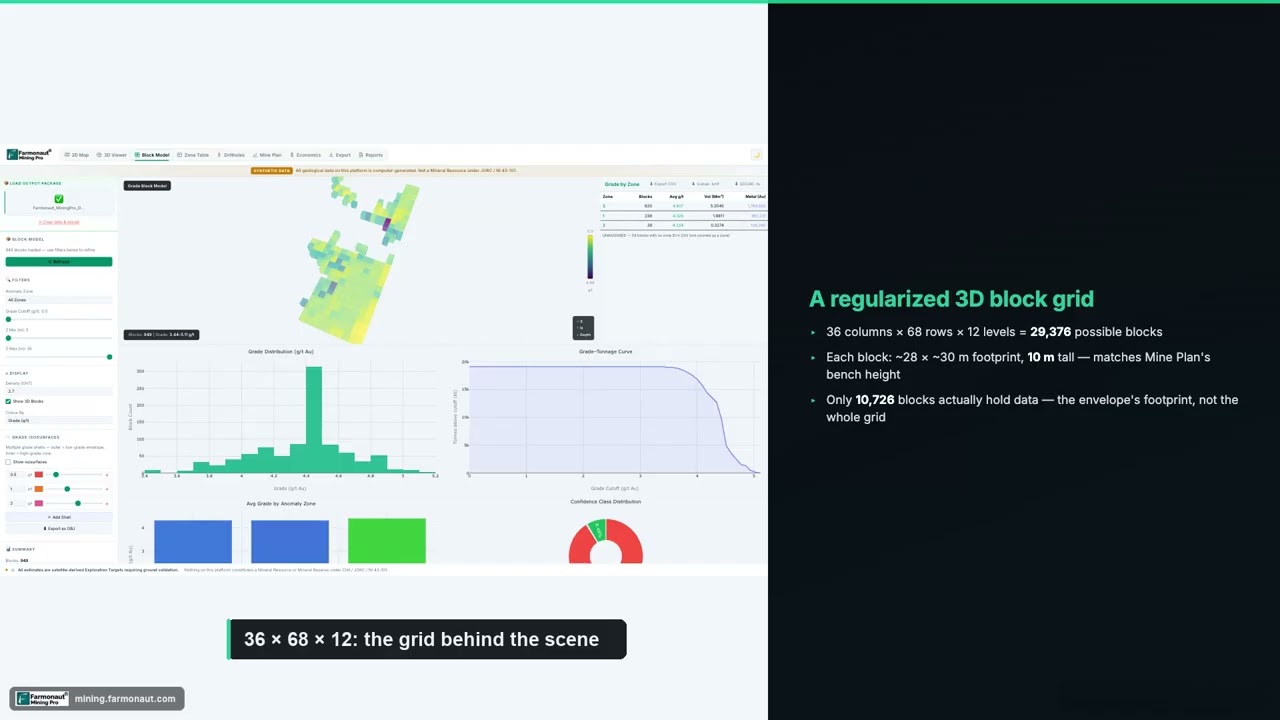
That is also why an animation for investors or a mine plan review should show the method alongside the grade shells (3D outlines of ore above a given grade). Seeing the block model in colour makes it clear which parts of a deposit each method can reach at a profit. Use the calculator below to test the effect with your own numbers.
Calculator
How does the mining method change your copper cut-off grade?
Enter the mining cost for your method, processing cost, recovery and today’s copper price.
- Recovered copper value per tonne at your grade (US$): $87
- Margin per tonne at your grade (US$): $52
Example values only, not benchmarks. Method costs for comparison (2017 cost model, Kliche for SWCA): block caving US$9/t, sublevel longhole US$19/t, mechanized cut and fill US$52/t. 2,204.62 lb per tonne. Excludes royalties, smelting terms and tax.
▶ What a block model is, the 3D grid behind every mine plan and mining animation. · 5:23
Underground vs surface mining: what the numbers show
Surface mining (open pits and strip mines) moves more rock per worker. Underground mining is chosen when ore is too deep, or the overburden (rock above the ore) too thick, for a pit to pay. US coal gives the clearest public data. In 2024, 177 underground coal mines produced 206.2 million short tons and 339 surface mines produced 305.8 million short tons, according to the US Energy Information Administration’s Annual Coal Report.
Chart
US coal productivity by mining method
Short tons per employee hour, 2024
Within underground coal, longwall mining produced 112.8 million short tons and continuous mining (the room and pillar method) produced 92.8 million short tons in 2024, with less than 1 million from conventional and other methods. Productivity tells the same story: longwall mines produced 4.54 short tons per employee hour, continuous mining 2.79, and surface mines 8.94 (EIA, 2024 data). Underground coal also sold for more, an average of US$85.88 per short ton against US$29.61 from surface mines.
An animation that compares surface and underground mining should show the strip ratio (tonnes of waste removed per tonne of ore) rising as a pit deepens, until going underground costs less per tonne of ore. Our article on how deep gold is found shows how depth changes that decision for gold.
Underground mining fan animation and ventilation
Ventilation is the system an animation most often leaves out, and it is one of the most regulated. Underground mine ventilation supplies enough air to dilute and remove dust and gases such as methane, carbon monoxide and blasting fumes, and to control heat. The electricity to run the main fans can account for about one third of a typical underground mine’s power bill, according to the underground mine ventilation entry.
Chart
Minimum air quantities in US coal mines
Thousand cubic feet per minute, 30 CFR 75.325
Two kinds of fan should appear in a mine ventilation animation:
- Main fans at the surface, on an intake or exhaust shaft, drive the flow-through circuit for the whole mine. Doors, stoppings (walls that block air) and regulators steer that air into each working area.
- Auxiliary fans underground, with flexible or steel ducting, take air from the main circuit and push it into dead-end headings (forcing systems) or pull fumes out (exhausting systems).
US rules set minimum air quantities that an accurate animation can show as labelled arrows. Under 30 CFR 75.325, bituminous and lignite coal mines must deliver at least 3,000 cubic feet per minute (cfm) to each working face where coal is cut or loaded, 9,000 cfm to the last open crosscut of each set of entries, and 30,000 cfm to the working face of each longwall. The approved ventilation plan can require more air; only the longwall figure can be lowered, and only if the operator shows a smaller quantity still meets the methane and dust standards. Anthracite mines have lower minimums: 1,500 cfm at the face and 5,000 cfm at the last open crosscut.
Animation focus: colour intake air and return air differently, show the fan on the surface and the auxiliary fans and ducts at the headings, and show what happens when a door is left open: air short-circuits and the face loses its supply. Showing blasting fumes being cleared before the crew returns is a simple scene that improves safety training.
Animation for safety training and emergencies
Safety is where mining animations earn their cost. In the US, a new underground miner must receive no less than 40 hours of training before being assigned to work, and every miner must receive at least 8 hours of annual refresher training, under 30 CFR Part 48. Animations fit naturally into those hours because they show hazards nobody should see for real.
Scenes that work well in training include:
- Escape routes from a working section to the surface or a refuge chamber, with the primary and secondary escapeways marked.
- Roof and rib falls: why miners never go under unsupported roof, and how bolting patterns hold the ground.
- Gas build-up: how methane layers at the roof when airflow drops, and why the face must be re-examined after any ventilation change.
- Mobile equipment: loader and truck blind spots in a narrow drift.
- Fire: how smoke travels along the air current, which decides the safe direction to walk.
Animations do not replace hands-on training or a mine’s approved plans. They make the plans easier to remember. Our roundup of mining safety solutions covers the monitoring systems that sit alongside this training.
How to brief a 3D mining animation in 6 steps
Mine owners, consultants and equipment makers commission animations for investor decks, permitting hearings, community meetings and training. A clear brief saves rework.
- Name the audience and the decision. An investor wants to see scale, sequence and timing; a regulator wants to see subsidence, water and ventilation; a new miner wants to see hazards and escape routes.
- Supply real geometry. Give the studio the mine design (shafts, declines, levels, stopes) and the orebody model as exported 3D files. Software such as Deswik, Datamine, Vulcan and Surpac all export formats animation tools can read.
- Fix the method and the sequence. State the mining method, the stope order and the backfill or caving sequence. This is where most errors creep in.
- Include ventilation and ground support. Ask for intake and return air, the main and auxiliary fans, and the support type for each area.
- Keep scale honest. Equipment, tunnel sizes and depths should be true to scale. Exaggerated vertical scale is acceptable only if labelled.
- Have an engineer sign off. A mining engineer or the mine’s technical team should review the storyboard before rendering and the final cut before release.
For early-stage projects, the orebody model may not exist yet. In that case the animation can show the exploration path: surface mapping, sampling, drilling and the first resource model. Satellite imagery is often the first layer in that story; Farmonaut, for example, maps alteration and structure on a licence from satellite data so a team can decide where to sample first. Our page on satellite-based mineral detection explains how that screening works, and the mine development company guide covers the stages that follow.
Common mistakes in mining method animations
- Wrong order: showing production before development, or backfill before the stope is emptied.
- Missing pillars or crown pillars: removing the rock that holds a mine up, or leaving it out of the model.
- Caving shown as an explosion: block caving is a slow, controlled draw over months and years, not a single collapse.
- No dilution: sublevel and block caving always mix in some waste; showing clean ore oversells the method.
- Silent ventilation: no fans, no airflow arrows, no return airway.
- Unlabelled scale: a 1,500 m deep cave looks the same as a 150 m one unless depth is marked.
▶ The seven environmental impacts of mining, including subsidence, explained in claymation. · 2:31
Frequently asked questions
What are the main types of underground mining methods?
They fall into three families: supported methods such as room and pillar, open and filled stoping methods such as sublevel stoping, cut and fill, shrinkage and vertical crater retreat, and caving methods such as sublevel caving, block caving and longwall in coal.
Which underground mining method is cheapest per tonne?
Block caving, at about US$9 per tonne at 30,000 tonnes a day in the cost model quoted by the 2017 Kliche review, but it needs the largest up-front investment and a large, fairly uniform orebody.
Which underground mining method is the most expensive?
Conventional cut and fill, at about US$68 per tonne in the same cost model, because it mines in small slices and must be backfilled after each one.
What is the difference between room and pillar and longwall mining?
Room and pillar leaves pillars of coal or ore to hold up the roof, so some material stays behind. Longwall removes a whole panel and lets the roof collapse behind hydraulic supports. In US coal in 2024, longwall produced about 112.8 million short tons and continuous (room and pillar) mining about 92.8 million (EIA).
What does a mine ventilation fan do?
Main fans at the surface push or pull air through the whole mine; auxiliary fans and ducts underground carry that air into dead-end headings. Together they dilute gases and dust, clear blasting fumes and control heat.
How much air must reach a coal mine working face in the US?
At least 3,000 cubic feet per minute at each working face in bituminous and lignite mines, and at least 30,000 cfm at each longwall face, under 30 CFR 75.325. The ventilation plan can require more; only the longwall figure can be set lower, if the operator shows that still meets methane and dust standards.
What is a stope in mining?
A stope is the underground opening from which ore is mined, as opposed to the tunnels dug only to reach it.
Is block caving safe?
Rio Tinto describes it as one of the safest and most cost-effective methods for deep ore because people work on the production level below the cave rather than inside it. It still carries risks such as mud rushes, air blasts and surface subsidence, which the mine design must control.
What software is used to make mining animations?
Mine design packages such as Deswik, Datamine, Vulcan and Surpac produce the 3D geometry, and general 3D tools render it into an animation. The geometry should always come from the mine design rather than be drawn by hand.
Why is underground coal more expensive than surface coal?
Underground mines produce fewer tons per worker hour (3.24 against 8.94 in 2024, EIA), so each ton costs more to produce. The 2024 average sales price was US$85.88 per short ton underground and US$29.61 at surface mines.
For a quote on mapping a licence area before mine planning starts, use our mining query form.
More from Farmonaut: contact us.
This page is for information only. Cost figures are a published 2017 model for comparison, not estimates for any mine. It is not investment or engineering advice.
Farmonaut mining
Map your licence before you plan the mine
Get a quote for a satellite report that maps alteration and structure on your licence, so your team knows where to sample and drill first.
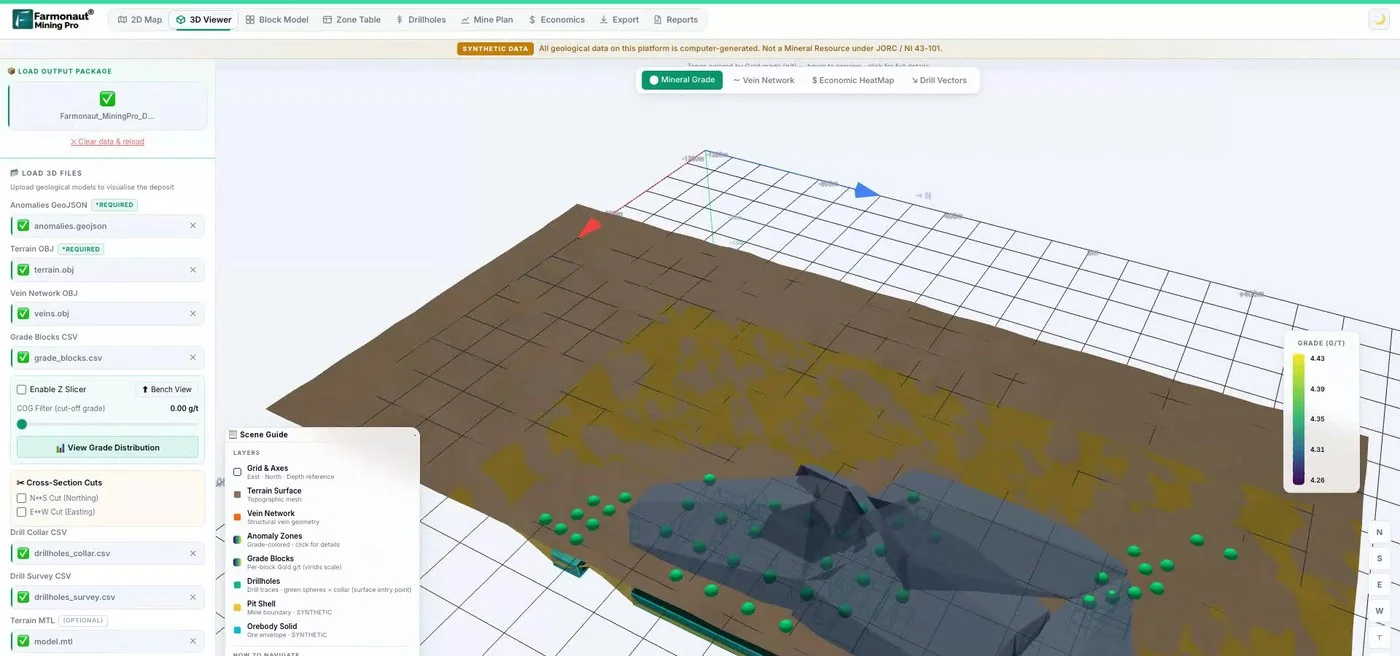
Mining Pro sample view, synthetic data
Keep reading
Sources
- Kliche for SWCA, Resolution Copper underground mining method alternatives memo (2017): resolutionmineeis.us
- Resolution Copper Project and Land Exchange, Final EIS Volume 1: resolutionmineeis.us
- US EIA, Annual Coal Report 2024: eia.gov
- eCFR, 30 CFR Part 75 Subpart D, Ventilation: ecfr.gov
- eCFR, 30 CFR Part 48 Subpart A, Training of underground miners: ecfr.gov
- Rio Tinto, Oyu Tolgoi operation: riotinto.com
- Wikipedia, Room and pillar mining: en.wikipedia.org
- Wikipedia, Longwall mining: en.wikipedia.org
- Wikipedia, Stoping: en.wikipedia.org
- Wikipedia, Underground hard-rock mining: en.wikipedia.org
- Wikipedia, Block caving: en.wikipedia.org
- Wikipedia, Underground mine ventilation: en.wikipedia.org
Discussion
Questions, corrections or field experience? Share them below. First-time comments are reviewed before they appear, and your email is never published.
No comments yet. Be the first to add a question or your experience.

 SRK Consulting
 Berks Gold Limited
 Mwerezi Minerals Company Limited
 Mining SARL
 SenGold Invest SAS
 Sania Corporation
 Sean Mining Limited
 NTS Group (Pty) Ltd
 Mine4Africa
 Lithspo Minerals Limited
 Tintina Mining Group
 Dalgety Minerals Pty Ltd
 Vortex Minerals Pty Ltd
 Faith At Work (Pty) Ltd
 Geotech Mining Solutions plc
 Vulcan International Limited

 Licence holder · Nigeria · Gold + lithium
 Client · Somalia · Gold










