

Uranium mining · How-to guide
How Is Uranium Mined? 3 Methods With Output Data
Uranium is mined by in situ leach (55% of 2024 output), open pit or underground mining, or as a by-product. Here is each method, the mill steps, output by country and a recovery calculator.
Key takeaways
- In situ leach gave 55% of world uranium in 2024; conventional mines gave 40% and by-product 5% (WNA).
- World mine output was 60,213 tU in 2024; Kazakhstan, Canada and Namibia gave about three-quarters (WNA).
- Acid ISL recovers 70-90% of uranium and alkaline ISL 60-70%; heap leach 50-80% (WNA).
- TradeTech’s long-term price indicator was US$97.00/lb U3O8 on 30 September 2026.
In this article
- How is uranium mined? The short answer
- The three ways uranium is mined
- Where uranium is mined: countries and mines
- How in situ leach works, step by step
- From ore to yellowcake: the mill steps
- How much uranium is recovered, by method
- What drives uranium mining cost and the price
- Safety, radon and land restoration
- How uranium deposits are found
- Frequently asked questions
How is uranium mined? The short answer
Uranium is mined in three main ways: in situ leach (ISL), where a liquid is pumped through the ore underground and the uranium is dissolved in place; conventional mining in open pits or underground tunnels; and as a by-product of other metals. In 2024, ISL gave 55% of world output, conventional mines 40% and by-product recovery 5%, according to the World Nuclear Association (WNA). World mine output was 60,213 tonnes of uranium (tU) that year.
Whatever the mining method, the product is the same: a dried powder called yellowcake, mostly uranium oxide (U3O8), which is packed in steel drums and sent on for conversion and enrichment. This page explains each method, how the mill turns ore into yellowcake, which countries and mines produce the most, what recovery rates look like, and what the process costs. It also has a calculator so you can test your own tonnage and grade.
Two terms first. Grade is the share of uranium in the rock, quoted as a percentage (0.1% is 1,000 parts per million). Recovery is the share of the uranium in the ground that ends up in the final product. Most uranium ore carries more than 0.10% U, some Canadian ore averages up to 20%, and mines can operate on ore as lean as about 0.02%, says the WNA mining overview. For comparison, the average crust holds only about 2.8 parts per million, so a mine needs rock that is hundreds to thousands of times richer than average.
The three ways uranium is mined
Grade convention: grades are % uranium (U) unless marked U3O8; 1% U3O8 is about 0.848% U.
Chart
Share of world uranium output by mining method, 2024
Percent of tU
Three families of method exist: ISL, conventional mining (open pit or underground, shown as two rows below) and by-product recovery. The method depends on how deep the ore is, how hard the rock is, and whether the ore sits in water-bearing sand. The table puts the options side by side.
| Method | Best suited to | Share of 2024 output | Typical recovery | Main trade-off |
|---|---|---|---|---|
| In situ leach (ISL, also called in situ recovery, ISR) | Permeable sand or sandstone below the water table, confined above and below by impermeable layers | 55% | 70-90% (acid), 60-70% (alkaline) | Little surface disturbance, but groundwater must be controlled and restored |
| Open pit | Shallow orebodies | Part of the 40% conventional share | Set by mill; heap leach 50-80% | Large pit and a lot of waste rock |
| Underground | Deep or very high-grade orebodies, up to about 600 m | Part of the 40% conventional share | Set by mill | Higher cost; radon and gamma control, remote mining in the richest ore |
| By-product | Copper, gold or phosphate operations | 5% | Depends on host process | Uranium grade can be a tenth of a uranium-only mine |
In situ leach (ISL or ISR)
ISL leaves the rock where it is. Wells are drilled into the ore-bearing sand, a leaching solution is injected, and the solution that comes back up carries dissolved uranium to a plant. The WNA ISL guide says this method creates no tailings or waste rock, but the orebody has to be permeable and placed so the solution cannot reach groundwater outside the ore zone. Its share of world output rose from 16% in 2000 to 56% in 2022.
ISL works on sandstone-hosted deposits, often “roll-front” deposits shaped like a C in cross section, where uranium was dropped out of flowing groundwater along a boundary between oxidised and reduced rock. ISL essentially reverses that natural process in a much shorter time. Sandstone-hosted deposits average 0.05% to 0.40% U3O8, per the same guide.
Open-pit mining
Where the ore is close to the surface, miners dig a pit and remove the overlying rock. Namibia’s Husab and Rössing mines are the large open pits in the 2024 top-ten list: 4,437 tU and 2,205 tU respectively. The cost is waste rock and a large footprint; the benefit is simple access and the ability to mine lower-grade ore in bulk.
Underground mining
Deeper ore needs shafts and tunnels. The world’s two largest mines in 2024, McArthur River/Key Lake (7,808 tU) and Cigar Lake (6,501 tU), are underground in Canada’s Athabasca Basin. McArthur River’s ore averages 16.5% U3O8 after dilution, sits about 600 metres down and is mined by remote-controlled raise boring, according to the WNA Canada profile. At that grade, special dust suppression and remote handling protect workers.
Heap leaching and by-product recovery
Low-grade ore, usually below 0.1% uranium, is sometimes stacked on a lined pad 5 to 30 metres high and sprayed with acid for weeks. The WNA puts heap-leach recovery at 50-80%. Elsewhere uranium comes out as a second product: at Olympic Dam in Australia (2,693 tU in 2024, copper being the main product), at South African gold operations and at phosphate deposits.
Where uranium is mined: countries and mines
Production is concentrated. Kazakhstan, Canada and Namibia supplied about three-quarters of world mine output in 2024, and the ten largest mines gave 62% of it (37,156 tU), according to the WNA data. Kazakhstan’s mines are almost all ISL, Canada’s are underground, and Namibia’s are open pit.
Chart
World uranium mine output, 2015-2024
Tonnes of uranium (tU)
Chart
Uranium mine output, eight largest producing countries, 2024
Tonnes of uranium (tU)
The United States was a minor producer in 2024 at 260 tU, but it is restarting. Most US output is ISL in Wyoming and Texas. The US Energy Information Administration reports about 2.1 million lb of U3O8 concentrate from US facilities in 2025, up from 657,000 lb in 2024, with operating ISR plants holding 13.3 million lb of annual capacity at the end of 2025. The WNA US profile reports that enCore’s Rosita and Alta Mesa plants in Texas captured about 288,589 lb of U3O8 in 2024, that Ur-Energy’s Lost Creek in Wyoming produced about 158 tU in 2025, and that the Pinyon Plain mine in Arizona, a conventional underground mine, produced ore holding about 1.53 million lb U3O8 at 1.62% in 2025, among the highest-grade US mines on record.
The company picture is just as concentrated. In 2024 Kazatomprom produced 12,463 tU (21% of the world), Cameco 10,193 tU (17%) and Orano 6,815 tU (11%). Kazatomprom’s attributable share in 2025 was 13,519 tU, per the WNA Kazakhstan profile.
World output fell from 63,207 tU in 2016 to 47,731 tU in 2020, then recovered as Canada’s McArthur River restarted and prices rose. Canada’s output went from 3,885 tU in 2020 to 14,309 tU in 2024. The 2024 world total was 60,213 tU, which the WNA says met 90% of world demand; the rest came from stocks and recycled material.
How in situ leach works, step by step
- Drill a wellfield. Injection wells and extraction wells are drilled in a pattern through the ore sand. They are built like water bores. In Australia, wells are pressure-tested to 150% of operating pressure to confirm they do not leak into other aquifers.
- Fortify the groundwater. Native groundwater is pumped out, then topped up with a complexing agent and an oxidant. US plants use an alkaline carbonate mix because the host rock holds gypsum and limestone. Australian plants use hydrogen peroxide and sulfuric acid. Kazakh plants use much stronger acid and no added oxidant.
- Circulate through the ore. The solution is injected, moves slowly through the sand, dissolves the uranium and is pumped from extraction wells to the surface.
- Capture the uranium. The solution passes through ion-exchange resin, which holds the uranium. The barren liquid is re-fortified and sent back down. About 0.5% is bled off so that groundwater flows toward the wellfield, not away from it.
- Strip and precipitate. The uranium is washed off the resin, precipitated with ammonia, peroxide, caustic soda or magnesia, then filtered and dried.
- Restore the aquifer. After mining, wells are sealed and groundwater is treated back toward baseline.
Each well pattern runs for a short time. In the United States a pattern typically produces for one to three years and most of the uranium comes out in the first six months, with overall recovery of about 80% in the best operations and about 60% at the low end (WNA). The rule of thumb on chemistry: if the ore holds more than about 2% calcium (as limestone or gypsum), alkaline leaching is needed, even though acid gives higher recovery and costs about half as much to run.
From ore to yellowcake: the mill steps
Ore from open-pit and underground mines goes to a mill. ISL operations skip the crushing and grinding but use the same recovery steps. The sequence is below.
Infographic
Ore to yellowcake in 6 steps
- 1Crush and grindFine particles expose the uranium minerals.
- 2LeachSulfuric acid or carbonate solution dissolves the uranium.
- 3SeparateBarren solids (tailings) are split from the uranium liquid.
- 4ConcentrateIon exchange or solvent extraction purifies the solution.
- 5PrecipitateThe uranium is dropped out, filtered and dried.
- 6PackYellowcake goes into sealed 200-litre steel drums.
- Crush and grind the ore to fine particles so the chemicals can reach the uranium minerals.
- Leach the ground ore in tanks, usually with sulfuric acid. Carbonate leaching is used for some ores. A pressure leach is needed for uranium recovered from some South African gold tailings.
- Separate solids from liquid. The barren solids are tailings; the uranium-rich liquid moves on.
- Concentrate and purify with ion exchange resin or solvent extraction, in which an organic liquid carries the uranium out of the solution.
- Precipitate the uranium, for example as ammonium diuranate, then filter, dry or roast it.
- Pack the yellowcake into 200-litre steel drums.
The finished product is usually khaki rather than yellow. It is about 85% uranium by mass when roasted at high temperature, and about 80% U3O8 when peroxide products are dried at low temperature. The WNA notes that the radiation level one metre from a drum of fresh U3O8 is about half the cosmic radiation on a commercial flight.
Sometimes a pre-concentration step comes first, such as radiometric sorting (used at Ranger in Australia), which raises the head grade before chemical treatment. Mines also use radiometric tools to control grade, because the decay products in the ore give off radiation that tracks the uranium content.
How much uranium is recovered, by method
Recovery is where methods differ most. A mine that recovers 90% of a deposit needs a smaller deposit than one that recovers 60%. The figures below are ranges published by the WNA, typical ranges, and each project is tested on its own ore.
Chart
Typical uranium recovery range by method
Percent of uranium recovered (low and high of range)
Acid ISL gives 70-90% and costs about half as much to operate as alkaline ISL, which gives 60-70%. Heap leaching gives 50-80%. Acid use is high: Kazakh ISL production uses about 40 kg of acid per kg of uranium, against 7.7 kg per kg at Australia’s Beverley mine in 2007. Power use is about 19 kWh per kg of uranium in Australia and about 33 kWh in Kazakhstan. Kazakhstan used 1.85 million tonnes of sulfuric acid in 2025 (Acuity Commodities, via the WNA), which is why acid supply is a standing risk for Kazakh output.
Calculator
How much yellowcake does your ore make?
Enter your own ore tonnage, grade, recovery and price.
- Uranium metal recovered (tonnes): 72.1
- Value at your price (US$): $14,991,416
Grade is % U3O8 here (1% U3O8 = 0.848% U). Example values only, not a benchmark. Uses 2,204.62 lb per tonne and 0.848 kg U per kg U3O8. Price is an example, use today’s price (see TradeTech or Cameco).
What drives uranium mining cost and the price
Uranium is sold under contract. TradeTech’s long-term price indicator stood at US$97.00 per pound of U3O8 on 30 September 2026, up US$13.00 from a year earlier and the highest in more than 18 years, according to a TradeTech release dated 2 October 2026. TradeTech says utilities are seeking supply for delivery from 2027 into the late 2030s. Spot prices move more than long-term contract prices.
Method sets cost. ISL needs lower capital than a shaft or pit because there is no mill for crushing and no tailings dam, so small deposits can pay: a satellite plant that only loads resin can feed a distant central plant. Conventional mines carry higher capital but can mine very high grades, and Canadian ore at up to 20% uranium needs far less rock milled per tonne of uranium than a 0.1% ore. Cash costs depend on acid prices, labour and wellfield design.
Producers switch mines on and off as price moves. US output fell to 6 tU in 2020 and 8 tU in 2021 before restarts lifted it to 260 tU in 2024 (WNA). Canada’s output fell from 14,039 tU in 2016 to 3,885 tU in 2020 and recovered to 14,309 tU in 2024. Idling a mine, and restarting it later, is a normal response to low and then high contract prices.
Safety, radon and land restoration
Uranium itself is only slightly radioactive. The hazards are radon gas (released when ore is mined and crushed), gamma radiation near high-grade ore, and dust that carries radioactive particles. Underground mines use strong ventilation, dust control, dose badges and routine air monitoring. In Canada’s highest-grade ore, remote-controlled mining methods are used. ISL has minimal radon release and no ore dust because the ore stays underground.
In open-pit mining, waste rock is placed near the pit and shaped for revegetation. Tailings are stored in a mined-out pit or engineered dam, kept covered with water while the mine runs and capped with about two metres of clay and soil at closure. For ISL, US law requires the aquifer to be restored to a quality that allows its pre-mining use, which is usually water below 500 ppm total dissolved solids, and the water is often treated by reverse osmosis. Disposal of the brine from that step is one of the known issues. The US EPA uranium mine brochure gives a plain-language overview of conventional mining, mill tailings and in situ leaching.
▶ The seven environmental impacts of mining, explained in clay. · 2:31
How uranium deposits are found
Exploration for uranium has one advantage: the decay products of uranium give off a signature that aircraft can map. The WNA says deposits can be identified and mapped from the air, which is why airborne radiometric surveys are a standard first step. Geologists then match the pattern to known deposit types: roll-front sandstone, unconformity deposits in basins like the Athabasca, and others.
Satellite imagery cannot measure uranium directly. It is used alongside radiometric surveys to map alteration, structure, drainage and land cover over a licence area, and to rank ground before field work. Farmonaut maps licence areas from satellite data, and uranium is among the minerals it covers; any satellite result is an exploration target to be checked against radiometric surveys and drilling, not a resource estimate. For related background, see our guides to mineral exploration spending in Canada and the Farmonaut platform at farmonaut.com.
▶ Remote sensing for mining explained in plain words. · 2:01
We cover a connected topic in Minerals Mined in Canada: Ranked by Value of Output.
Frequently asked questions
How is uranium mined and processed?
It is mined by ISL, open pit, underground or as a by-product, then leached with acid or an alkaline solution, concentrated by ion exchange or solvent extraction, precipitated and dried into yellowcake (WNA, 2026).
What is the most common way to mine uranium?
In situ leach, at 55% of world production in 2024 (WNA).
What is in situ recovery?
The same thing as in situ leach: dissolving uranium in the ground with a circulated solution and pumping it to the surface. North America uses the name ISR; elsewhere it is ISL.
Which countries mine the most uranium?
Kazakhstan (23,270 tU), Canada (14,309 tU) and Namibia (7,333 tU) in 2024, together about three-quarters of the world total (WNA).
What is yellowcake?
The dried uranium oxide concentrate that comes out of a mill or ISL plant, mostly U3O8. It is the form in which mined uranium is traded and shipped.
Why do some uranium mines use acid and others alkaline solutions?
Acid dissolves uranium better, but if the host rock has more than about 2% calcium minerals such as limestone or gypsum, acid would be used up by the rock, so an alkaline carbonate solution is used instead.
Is uranium mining dangerous?
The main risks are radon, gamma radiation and dust. Operators control them with ventilation, dust suppression, remote handling at the highest grades and dose monitoring, under national regulators. In Canada the Canadian Nuclear Safety Commission licenses all uranium mines and mills.
Does in situ leach contaminate groundwater?
It is only licensed where the ore zone is confined and drinking water is not threatened, and the solution is kept flowing inward by bleed. After mining the aquifer must be restored to its pre-mining use standard in the US. Restoration can take time and effort, and results are tracked by regulators.
How much uranium is in a tonne of ore?
At 0.1% grade, one tonne holds about 1 kg of uranium. At 20% uranium (the top of the range WNA gives for some Canadian mines), a tonne holds 200 kg. McArthur River’s 16.5% U3O8 ore holds about 140 kg of uranium per tonne.
Can uranium be recovered from other mines?
Yes. Olympic Dam in Australia recovers uranium from a copper-gold operation, and phosphate and gold-tailings operations have done the same (WNA).
Not investment advice. Production, price and company figures are dated and change.
This page is for information only. It is not investment, legal or safety advice. Uranium mining and handling are licensed activities; confirm the rules with the regulator.
Farmonaut mining
Map your own licence area from space
Request a quote for a satellite mineral detection report on your licence.
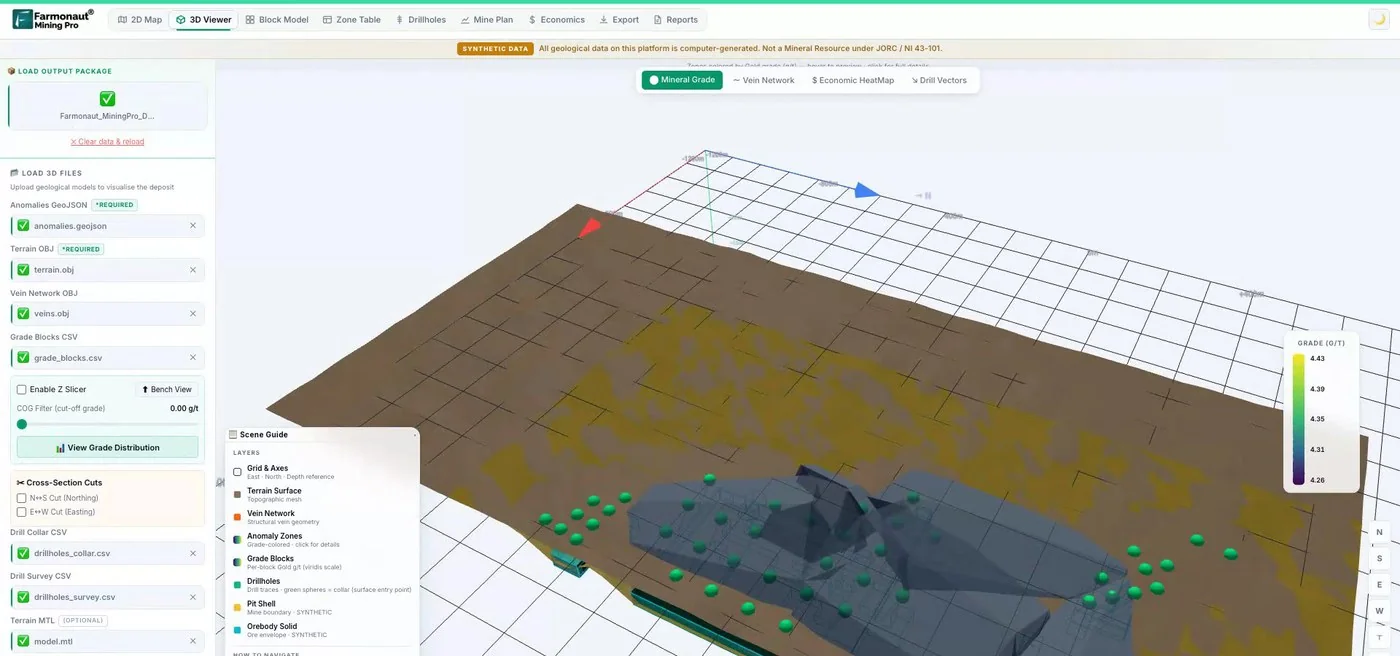
Mining Pro sample view, synthetic data
Keep reading
Sources
- World Nuclear Association, Uranium Mining Overview (2026): world-nuclear.org
- World Nuclear Association, World Uranium Mining Production (2026): world-nuclear.org
- World Nuclear Association, In-Situ Leach Mining of Uranium: world-nuclear.org
- World Nuclear Association, Uranium in Canada: world-nuclear.org
- World Nuclear Association, Uranium and Nuclear Power in Kazakhstan: world-nuclear.org
- World Nuclear Association, US Uranium Mining and Exploration: world-nuclear.org
- TradeTech, press releases (2 October 2026): uranium.info
- US EPA, uranium mine brochure: epa.gov
- World Nuclear Association, US Nuclear Fuel Cycle: world-nuclear.org
- US Energy Information Administration, Domestic Uranium Production Report: eia.gov
- Canadian Nuclear Safety Commission, Uranium mines and mills: cnsc-ccsn.gc.ca
Discussion
Questions, corrections or field experience? Share them below. First-time comments are reviewed before they appear, and your email is never published.
No comments yet. Be the first to add a question or your experience.

 Rains of Favour
 Tintina Mining Group
 Dalgety Minerals Pty Ltd
 Vortex Minerals Pty Ltd
 Faith At Work (Pty) Ltd
 Geotech Mining Solutions plc
 Vulcan International Limited
 Kidepo Associates
 GKY Mining
 Alkimy SARL
 Double A Trading
 GemSprout Metals Limited
 Qader Group
 Ileys General Trading
 SG Gold Mining LLC
 VRV Global Pte Ltd
 Omsri International FZE
 G.I.T.T.
 Jaunita Erss Ltd
 Almosi SARL
 SRK Consulting
 Berks Gold Limited
 Mwerezi Minerals Company Limited
