

Virtual Reality in Mine Planning: 5 Key 2025 Benefits
“By 2025, over 60% of mining companies are expected to adopt Virtual Reality for mine planning and training,
Virtual Reality simulations can reduce mine planning errors by up to 40%, significantly improving operational efficiency in 2025.”
Virtual Reality in Mine Planning: Revolutionizing the Mining Industry in 2025
The mining industry is experiencing a profound transformation in 2025, driven by the integration of advanced technologies like Virtual Reality in Mine Planning. As global demand for minerals intensifies and operational complexities increase, the industry seeks ways to optimize planning, improve safety, and ensure environmental sustainability. Virtual Reality (VR) has quickly emerged as one of the most influential tools, redefining how mining projects are conceptualized, designed, and executed—making mining more efficient, safer, and environmentally conscious.
This comprehensive guide will explore the five key benefits of Virtual Reality in Mine Planning for 2025 and beyond, providing actionable insights for mining companies, engineers, and planners worldwide.



Virtual Reality in Mine Planning: An Overview
For decades, mine planners relied on 2D layouts and blueprints, later shifting to 3D models on screens for improved visualization. In 2025, Virtual Reality in Mine Planning enables a radical leap—immersion into a virtual replica of a mine site, complete with underground tunnels, geological formations, and equipment layouts.
This interactive space empowers engineers and stakeholders
to walk through, evaluate designs, simulate different scenarios, and optimize extraction strategies before commencement of actual excavation. VR makes it possible to reduce planning errors, identify potential hazards, enhance safety, and ensure better resource management—all while supporting sustainability and stakeholder collaboration.

Summary Table: 5 Key VR Benefits in 2025
| Benefit | Brief Description | Estimated 2025 Impact |
|---|---|---|
| Enhanced Visualization & Design Accuracy | Immersive 3D walkthroughs enable better spatial understanding, reducing errors in layouts, haul roads, and equipment placement. | Up to 40% reduction in mine planning errors and 30% faster design iterations. |
| Boosting Safety & Reducing Risk | Simulate emergencies, hazards, and operational risks to enhance planning, safety protocols, and training. | As much as 20% fewer on-site accidents and improved regulatory compliance. |
| Environmental Impact & Sustainability | Model ecosystem interactions, optimize waste management, and minimize habitat disruption. | Up to 25% reduction in environmental impact and faster ESG approvals. |
| Improved Collaboration & Stakeholder Engagement | Unified platform for teams, communities, and regulators, improving communication and transparency. | Up to 35% faster buy-in from key stakeholders and smoother approvals. |
| Cost & Time Efficiency | Reduce the need for physical site visits, optimizing planning cycles and resource allocation. | Possible 15-20% savings in project costs and 25% reduction in lead times. |
1. Enhanced Visualization and Design Accuracy
Why Visualization Matters in Mine Planning
In the complex world of mine planning, visualization is more than just graphical representation; it’s about transforming massive data sets and geological reports into actionable, spatially precise plans. Traditional 2D maps or even 3D models on screens can miss critical underground details, leading to design errors, safety risks, and inefficiencies.
- Virtual Reality in Mine Planning allows planners and engineers to immerse themselves in a lifelike, interactive replica of the site.
- This immersion enhances spatial understanding, allowing interactive walkthroughs to assess geological formations, tunnel complexity, and potential hazards before actual excavation begins.
- VR supports the simulation of different extraction scenarios, haul road routing, ventilation systems, and optimal equipment placement, greatly reducing design errors.
According to recent estimates, this can cut mine planning errors by up to 40% in 2025!
By simulating multiple methods of resource extraction within a virtual environment, VR enables optimization of yield and minimization of waste. It’s not just about visualizing, but about achieving unmatched precision—decreasing costly redesigns and ensuring every detail is aligned before the first shovel strikes the ground.

Key Features:
- Immersive 3D Walkthroughs: Explore the space to understand geology, tunnels, and system layouts better than static 2D or 3D screens ever could.
- Realistic Scenario Simulation: Evaluate different layouts, extraction strategies, and operational methods for maximum efficiency.
- Early Detection: Identify potential hazards and costly errors before construction commences.
For seamless integration of satellite imagery insights into your mine planning, consider the Farmonaut Fleet Management solution. With robust resource and equipment management tools, our platform ensures high accuracy for large and small mining operations.
“By 2025, over 60% of mining companies are expected to adopt Virtual Reality for mine planning and training,
Virtual Reality simulations can reduce mine planning errors by up to 40%, significantly improving operational efficiency in 2025.”
2. Boosting Safety and Reducing Risk
Creating Safer Mines with Virtual Reality
Mining operations are inherently risky—with ground collapses, gas emissions, and equipment accidents continually posing significant threats to workers. Ensuring safety and effective risk management during planning is not just regulatory best practice but a moral and financial necessity.
In 2025, Virtual Reality in Mine Planning plays a vital role in proactively addressing hazards by:
- Allowing teams to simulate emergencies (e.g., collapses, gas leaks, equipment malfunctions) in a safe, virtual environment—developing and refining robust contingency plans well before operation begins.
- Providing VR-based safety training simulators to familiarize workers with underground conditions— dramatically reducing accidents tied to human error and environmental unpredictability.
- Enabling detailed ventilation system planning, appropriate emergency escape routes, and compliance with evolving regulatory standards.
This risk reduction is measurable: 2025 projections show up to 20% fewer on-site accidents and significant decreases in operational downtime. Fewer incidents mean fewer delays—helping mining projects stay safely on time and budget.

What Makes VR Training Effective?
- Immersive Scenarios: Teams “walk through” both everyday and emergency scenarios—preparing them for real-life challenges underground.
- Enhanced Preparation: Accurately plan and test ventilation, escape routes, and assess high-risk zones well in advance.
- Regulatory Readiness: VR helps ensure all designs and safety systems meet or exceed regulatory safety requirements, reducing project delays.
Amplify your mine safety with real-time satellite monitoring and AI analytics using the Farmonaut API. Automate, integrate, and optimize safety protocols using data-driven insights. Check out our API Developer Docs for seamless technical integration.
3. Environmental Impact Assessment & Sustainability
Making Sustainability Standard with Virtual Reality in Mine Planning
- As global awareness of environmental impacts rises, and regulatory standards tighten in 2025, sustainability in mine planning is imperative.
- Virtual Reality in Mine Planning supports planners with tools to visualize and model every aspect of the mine’s impact on the environment.
Key ways VR revolutionizes sustainability:
- Model Interactions with Surrounding Ecosystems: See exactly how excavation, waste management, and infrastructure affect flora, fauna, and water tables in real-time.
- Simulate Mitigation Strategies: Identify and test methods to minimize environmental disruption like habitat fragmentation and excess emissions before committing plans to action.
- Align with Regulatory Demands: Satisfy regulatory bodies by providing data-backed visualizations that prove adherence to environmental best practices.
- Plan Reclamation: Use VR to model post-mining reclamation and land restoration scenarios for transparent environmental stewardship.
Estimates suggest up to 25% reduction in negative environmental impacts for mines incorporating VR into planning and ongoing monitoring by 2025.
Pro Tip: For real-time, satellite-driven tracking of carbon emissions, land use, and reclamation progress at your mining operation, explore Farmonaut’s Carbon Footprinting feature— bringing visibility, compliance, and sustainability to modern mining.

4. Improved Collaboration and Stakeholder Engagement
Uniting Stakeholders via Virtual Collaboration
Mine planning in 2025 is a multidisciplinary endeavor—requiring input from engineers, geologists, environmental scientists, investors, regulators, and local communities. Historically, communication breakdowns led to misunderstanding, delays, or resistance.
Virtual Reality in Mine Planning solves this through:
- Shared Immersive Platforms: Enable all stakeholders to “walk” together through virtual mines, translating technical jargon into intuitive visual experiences.
- Stakeholder Trust: Regulators and communities gain transparency—observing planned operations, safety measures, and anticipated impacts hands-on in a virtual environment.
- Faster Approvals: Enhanced stakeholder understanding accelerates decision-making, reducing approval lead times by up to 35% according to 2025 predictions.
This collaborative approach is especially valuable for projects in sensitive regions or with complex environmental/ESG reporting requirements, ensuring compliance and smoother project launches.
Looking for secure supply chain validation in mining? Check out our Product Traceability solution that leverages blockchain for tamper-resistant records—helping companies demonstrate authenticity and build public trust.
Streamline large-scale mining operations or multi-site resource management with Farmonaut’s large-scale management platform. Our platform enables quick integration of satellite insights, AI advisory, and real-time environmental monitoring—empowering teams to collaborate smarter, not harder.

5. Cost and Time Efficiency
Cutting Waste and Project Costs with VR
Old methods of mine planning required repeated physical site visits, back-and-forth revisions, and costly delays whenever unexpected hurdles arose. Virtual Reality in Mine Planning transforms processes by allowing simulations of every step of the operation before breaking ground.
- Reduced Site Visits: Much of the assessment, adjustment, and troubleshooting can happen virtually—saving travel costs and time.
- Accelerated Project Timelines: Discover and solve problems virtually so fewer major changes are needed during actual excavation and construction.
- Resource Optimization: VR streamlines equipment placement, haul road design, and waste handling, reducing material waste and keeping budgets on track.
These efficiencies translate into concrete results: project lead times can drop by up to 25%, and total project costs can decrease by 15-20% in 2025 for VR-driven operations.

See how Farmonaut helps in remote mine monitoring, resource optimization, and actionable AI advisory—all without costly on-site expenses. Read more about it in our Large Scale Farm & Mining Management app.
Farmonaut: Satellite-Driven AI & Mine Management for 2025 and Beyond
At Farmonaut, we understand how vital it is for mining companies to combine Virtual Reality in Mine Planning with real-time, remote data analytics. Our platform provides a powerful range of satellite-based solutions, including multispectral monitoring, AI advisory, and blockchain traceability—enabling smarter, data-driven decision-making for mine planners.
-
Satellite-Based Mine Monitoring:
Our multispectral imaging pinpoints ground movement, vegetation health, emissions, and other environmental/operational data points for enhanced planning and safety. -
AI Advisory:
Jeevn AI system delivers tailored strategies for mine operations, weather event predictions, and emergency response—integrating seamlessly with VR planning tools for rapid, accurate responses. -
Blockchain Traceability:
Blockchain-secured data guarantees the integrity and transparency of mining product supply chains, facilitating regulatory compliance and stakeholder trust.
Explore Product Traceability -
Fleet and Resource Management:
Advanced fleet tracking reduces equipment waste, improves logistics, and enhances risk management—optimizing every phase of the mining project.
Learn about Fleet Management Tools -
Environmental Impact Monitoring:
Automatically track carbon footprint and environmental compliance with our real-time platform.
Discover Carbon Footprinting Solutions -
Crop Loan and Insurance Verification:
Streamline mining loan or insurance validation with satellite-driven verification—lowering risk for both operators and financial institutions.
Get details on Crop Loan & Insurance
All these services are available through our Android, iOS, and Web platforms—and for seamless integration into mining company dashboards via direct API access.
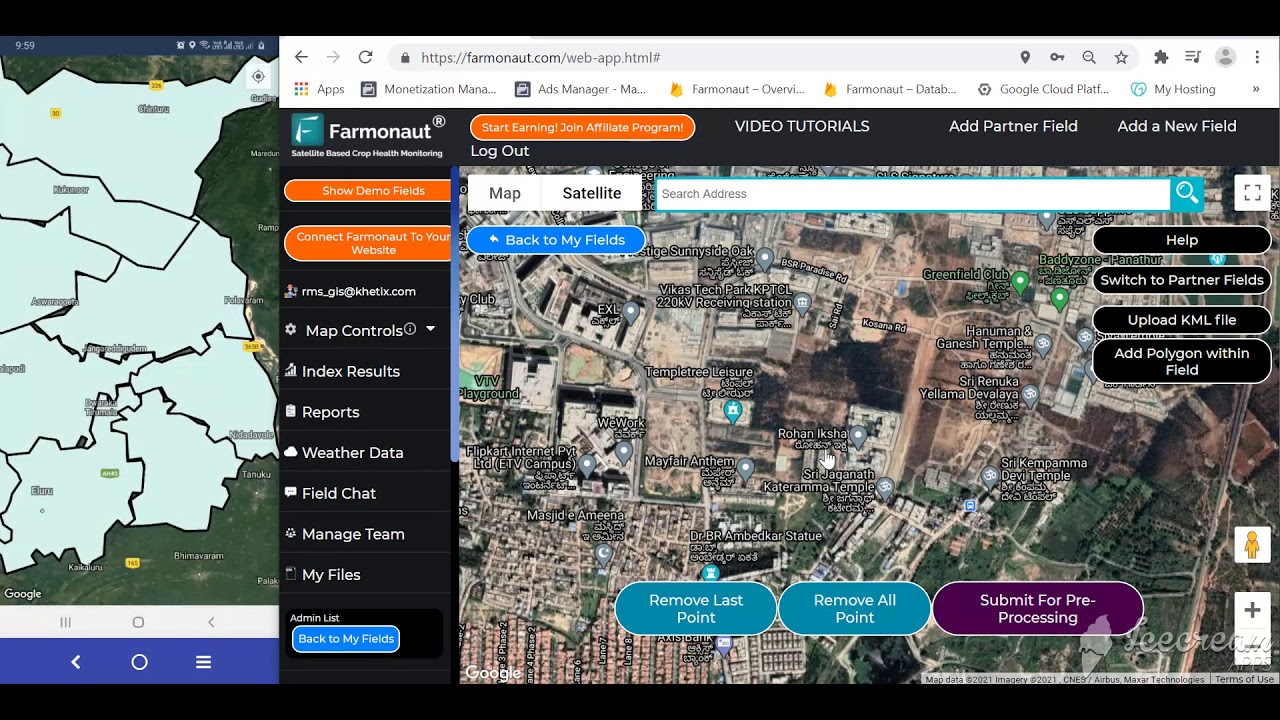

Accessible, Affordable, Scalable
We at Farmonaut make advanced satellite and AI technologies affordable and accessible to businesses, users, and governments worldwide. Our modular subscription model, robust web/mobile platforms, and seamless API connectivity empower everyone—from small mining operators to multinational enterprises—to lead in the era of data-driven mining.
Real-World Examples & More Videos: VR, Satellites, and Mining in 2025
- Rare Earth Boom 2025 ? AI, Satellites & Metagenomics Redefine Canadian Critical Minerals
- Arizona Copper Boom 2025 ? AI Drones, Hyperspectral & ESG Tech Triple Porphyry Finds
- Satellite Mineral Exploration 2025 | AI Soil Geochemistry Uncover Copper & Gold in British Columbia!
- 1.5 M-oz Gold Find 2025 ? Diamond Drilling, AI Satellite Mapping & ESG Mining in Oko, Guyana
- Farmonaut Large Scale Field Mapping & Satellite Based Farm Monitoring | How To Get Started
- Farmonaut Large Scale Farm Mapping And Satellite Based Farm Monitoring
- Farmonaut® Satellite Based Crop Health Monitoring
- Farmonaut Introduction – Large Scale Usage For Businesses and Governments
Farmonaut Subscriptions and App Access
Unlock the full power of satellite, AI, and virtual reality-driven monitoring and planning for your mining projects—all tailored to your unique needs. View subscription options below or access our app today!
Frequently Asked Questions: Virtual Reality in Mine Planning
1. What is Virtual Reality in Mine Planning?
Virtual Reality in Mine Planning involves creating a fully interactive, immersive 3D or virtual environment that represents a mine site and its underground structures, allowing planners, engineers, regulators, and communities to experience, assess, and refine every aspect of a mining project before physical excavation begins.
2. How does VR improve accuracy and reduce errors in mine planning?
VR allows stakeholders to “walk through” the mine virtually, offering greater spatial understanding than static 2D or even 3D models. This reduces planning errors, identifies potential hazards early, and enables more precise design of tunnels, roads, and equipment placement.
3. In what ways does VR boost safety for mining operations?
VR facilitates real-world scenario simulation for emergencies, hazards (such as collapses and gas emissions), and complex operational tasks. Teams can practice and validate safety protocols in a controlled digital setting, resulting in up to 20% fewer on-site accidents in 2025.
4. How is environmental impact reduced with VR?
By visualizing environmental interactions, modeling waste management, and testing mitigation strategies, planners can minimize ecological disruption and better plan land reclamation post-extraction.
5. What collaboration advantages does VR offer?
VR provides a shared platform where technical teams, executives, regulators, and local stakeholders can explore the project together, improving understanding, enabling more transparent communication, and accelerating project approvals.
6. How do Farmonaut’s satellite and AI solutions support VR-based mine planning?
We provide satellite-based monitoring, AI advisory, blockchain traceability, and fleet/resource management enhancements, offering crucial data and analytics that complement VR immersive planning. Our APIs and platforms integrate seamlessly into digital mining dashboards, supporting next-gen efficiency and compliance.
7. Is VR-based planning scalable for both large and small mining operations?
Yes! VR solutions are modular and can be scaled according to project size, making them accessible and valuable for single-site mines, multi-site operations, small exploration companies, and global corporations.
8. Can VR help with regulatory and ESG reporting?
VR environments allow clear demonstration of compliance with new safety, environmental, and ESG requirements. Stakeholders and regulators can review, comment, and approve plans faster based on detailed, interactive evidence.
Conclusion: Virtual Reality in Mine Planning—The New Industry Standard for 2025
By 2025, the integration of Virtual Reality in Mine Planning is no longer an innovation—it’s quickly becoming the industry standard. VR technologies are revolutionizing how mining projects are conceptualized, designed, and executed, delivering quantifiable advantages: improved accuracy, unmatched safety, measurable reductions in environmental impact, stronger stakeholder collaboration, and substantial cost efficiencies.
Paired with satellite-driven AI and blockchain solutions from providers like Farmonaut, mining companies now have access to a full suite of tools that make operations smarter, more sustainable, safer, and more profitable. As the mining industry enters an era defined by advanced technologies and higher stakeholder expectations, embracing Virtual Reality in Mine Planning ensures you don’t just adapt to the future—you lead it.
Transform your mine planning. Visualize more, risk less, and build a sustainable future with VR and next-gen technology.

 Berks Gold Limited
 Mwerezi Minerals Company Limited
 Congo Mining Solutions
 Mining SARL
 SenGold Invest SAS
 Sania Corporation
 Sean Mining Limited
 NTS Group (Pty) Ltd
 Mine4Africa
 Lithspo Minerals Limited
 Tintina Mining Group
 Dalgety Minerals Pty Ltd
 Vortex Minerals Pty Ltd
 Faith At Work (Pty) Ltd
 Geotech Mining Solutions plc
 Vulcan International Limited
 Kidepo Associates
 GKY Mining
 Alkimy SARL
 Double A Trading
 GemSprout Metals Limited
 Qader Group
 Ileys General Trading
 SG Gold Mining LLC
 VRV Global Pte Ltd
 Omsri International FZE
 G.I.T.T.
 Jaunita Erss Ltd
