

Water Management in Mining Operations: 5 Key Strategies
Summary:
Water Management in Mining Operations: A Critical Imperative for Sustainable Resource Extraction
Table of Contents
- Importance of Water Management in Mining Operations
- Key Challenges in Water Management for Mining in 2025
- 5 Key Strategies for Effective Water Management in Mining
- Comparison Table: Water Management Strategies & Their Impact
- Innovation, Regulation, and the Road Ahead to 2025 & Beyond
- Empowering Mining Water Management with Farmonaut
- Frequently Asked Questions (FAQ)
- Conclusion
Mining remains at the core of modern industry, supplying essential minerals and metals for our global economy. However, the sector faces growing scrutiny regarding Water Management in Mining Operations due to its significant water needs and potential environmental impact. In 2025, effective water management is not just best practice—it’s a critical imperative for the sustainability of mining operations, social responsibility, and regulatory compliance.
With stricter environmental standards, increasing climate change challenges, and heightened community expectations, it is vital for mining companies to adopt advanced strategies that protect local ecosystems, safeguard resources, and ensure continued access to one of the planet’s most precious assets: water.
Importance of Water Management in Mining Operations
Water Management in Mining Operations is a cornerstone of responsible resource extraction, acknowledging the sector’s significant usage of water across various activities such as mineral extraction, ore beneficiation, d ust suppression, slurries transportation, and tailings disposal. These activities are inherently water-intensive, and improper management poses severe environmental and social risks.
Operators wanting a yardstick for their own sites can compare water use benchmarks for mines, six of which are set out with sources.
- Resource Usage: Water is vital for processing ore, separating valuable minerals, and controlling dust during excavation.
- Environmental Protection: Responsible management prevents surface and groundwater contamination, acid mine drainage (AMD), heavy metal leaching, and sedimentation, which can damage biodiversity and local communities’ health.
- Social Responsibility: Safeguarding local water supplies and protecting ecosystems helps maintain the social license to operate.
- Regulatory Compliance: Adhering to increasingly stringent water regulations is essential to avoid fines, project shutdowns, and reputational harm.
- Sustainability: Sustainable water management supports long-term mining and community prosperity.

Key Challenges in Water Management for Mining in 2025
While significant progress has been made, effective Water Management in Mining Operations continues to face several complex challenges, especially as we move into 2025:
1. Water Scarcity and Climate Change
- Many mining regions face water stress, which is increasingly exacerbated by climate change. We now observe altered rainfall patterns, more frequent and severe droughts, and unpredictable weather, reducing the availability of freshwater sources.
- Mining operations must adapt by improving efficiency, embracing alternative water sources, and lowering dependency on limited water reserves.
2. Pollution and Wastewater Treatment
- Outflows from mining often contain heavy metals, chemicals, and suspended solids. If not managed, Contamination can spread to surface and groundwater bodies, affecting local ecosystems, communities, and agricultural lands.
- Advanced, site-specific treatment technologies are needed to reduce this pollution and comply with stringent discharge standards.
3. Regulatory Compliance and Social Expectations
- Governments worldwide are imposing tougher regulations governing water usage, discharge quality, and environmental impact assessments. This forces mining companies to implement comprehensive management plans.
- Mining operators must balance profitability with environmental and social responsibility, responding to stakeholder and community expectations.
- Failure to meet requirements risks penalties, operational shutdowns, or loss of social license to operate.
4. Tailings and Structural Failures
- Tailings storage facilities can leak or fail, posing severe risks of contamination, groundwater pollution, and destruction of habitats.
- New approaches, including dry stacking, require effective monitoring and maintenance.
5. Data Gaps and Monitoring Challenges
- Consistent and comprehensive monitoring of water usage, discharge, and quality across large, remote mining sites is challenging.
- Real-time data and predictive analytics are needed for effective, responsive management.

5 Key Strategies for Effective Water Management in Mining Operations
2025 marks a pivotal year for Water Management in Mining Operations. Let’s explore the five key strategies essential for sustainable resource extraction, reducing environmental impact, and ensuring both regulatory and community expectations are met.
1. Water Recycling and Reuse: Maximizing Closed-Loop Systems
Water recycling and reuse is now central for modern mining operations. Instead of depending solely on freshwater withdrawal, mines increasingly employ closed-loop water systems—treating and reusing process water multiple times.
- Techniques include: sedimentation tanks, membrane filtration (ultrafiltration, nanofiltration, reverse osmosis), biological treatments, and integrated water treatment circuits.
- Benefits: Substantially reducing freshwater usage, lowering costs, and cutting reliance on local water bodies vulnerable to scarcity.
- Regulatory compliance: Recycling aligns with stringent discharge standards, avoiding environmental harm and legal penalties.
How much water can be recovered varies widely with ore type, climate and tailings method, so each site needs its own measured water balance.

Advanced water reuse techniques also integrate well with Fleet Management Solutions for mining. By deploying our resource management tools, mines can track equipment usage, schedule cleaning cycles for recycled water, and ensure that water-intensive machinery operates efficiently.
2. Rainwater Harvesting and Water Storage: Resilient Approaches to Water Scarcity
To reduce dependency on local water sources, rainwater harvesting and on-site storage are increasingly essential. By collecting and storing rainfall during wet seasons via engineered reservoirs, ponds, or tanks, mines supplement water supplies and bolster operational resilience against drought and variability.
- Approach: Use graded catchments, runoff channels, and sedimentation basins to divert and store and filter rainwater for use in dust suppression, mineral processing, or irrigation of remediated areas.
- Benefits: Not only lessens pressure on local and regional freshwater resources, but also boosts water availability for critical operations during dry periods.
- Climate resilience: This method adapts well to the altered rainfall patterns driven by climate change.
By combining harvesting with sedimentation and filtration, mines can ensure water quality while meeting regulatory compliance requirements for all operational uses.

This strategy is also relevant to water-sensitive mining regions in Europe (e.g., Spain, France) where water scarcity and regulations demand innovative storage and use practices. Our Carbon Footprinting Solutions enable mining operators to measure and optimize the energy and emission impact of rainwater systems for more sustainable operations.
3. Tailings and Wastewater Management: Minimizing Contamination and Disaster Risk
Mining generates tailings (residues from ore processing) and wastewater, which often contain chemicals, heavy metals, and suspended solids. Effective tailings and wastewater management is critical to prevent seepage, groundwater contamination, and catastrophic dam failures.
- Advanced strategies: Incorporate dry stacking (dewatering tailings to create stable, low-moisture stacks), lined and covered storage ponds, and geosynthetic barriers, reducing potential for contamination and evaporation losses.
- Wastewater treatment: Employ oxidation, precipitation, filtration, and bioremediation technologies to meet national and international discharge standards.
- Compliance: These methods are essential to comply with tough regulations and community safety expectations.
Additionally, a growing number of mining companies in 2025 implement remote monitoring of tailings facilities, leveraging satellite and AI-based solutions to detect leaks, sedimentation issues, and structural instability before disasters occur.

With Farmonaut’s Blockchain Traceability, mines can record every step of wastewater and tailings handling, enhancing regulatory adherence and transparency to stakeholders.
4. Monitoring and Data-Driven Decision Making: Enabling Proactive Water Management
Proactive water monitoring is essential for effective management. Modern mining increasingly depends on real-time data, predictive analytics, and digital twins to optimize resource usage, detect leaks or contamination early, and forecast future water needs.
- Sensors and IoT: On-site and remote sensors measure flow rates, water quality, turbidity, and chemical concentrations, enabling minute-by-minute management of complex mining operations.
- Satellite monitoring: High-resolution imagery and multispectral data (such as provided by Farmonaut) quantify water bodies, mapping changes in storage and detecting potential pollution events over time.
- Digital twins and AI-driven models: Simulate entire site hydrology or tailings facility status for predictive maintenance and disaster risk reduction.
Farmonaut delivers immediate value here through our satellite-based remote monitoring and API access for mining companies. We enable integration of real-time water and infrastructure data directly into existing systems for improved compliance, operational safety, and efficient water management.

How to Improve Water Recovery: Start With a Site Water Balance
A mine cannot save water it has not measured. The International Council on Mining and Metals sets out a simple balance in its Water Reporting good practice guide: withdrawal equals discharge plus consumption plus any change in water held in storage on site. Withdrawals are split by source, such as surface water, groundwater, seawater and third-party supply.
Once the balance is in place, the losses show up. The usual places to look are:
- Tailings. Water leaves with the tailings slurry and is lost to evaporation, seepage or pore water. Thickening, paste or filtered (dry-stack) tailings send more of it back to the plant.
- Evaporation from ponds. Smaller, deeper or covered storage cuts surface losses in hot climates.
- Dust suppression. Haul-road watering is a large consumer on many sites; lower-quality or recycled water can often be used here.
- Metering gaps. Flow meters on each major circuit turn guesses into numbers and make leaks visible.
The best water management system for a given mine is the one that closes its own balance, not a single product.
5. Community and Stakeholder Engagement: Building Trust Through Transparency
Mining projects, more than ever, require transparent and proactive engagement with local communities and stakeholders about water usage, risks, and benefits.
- Transparent communication: Reporting water usage, pollution data, remediation plans, and emergency procedures fosters trust and meets rising social expectations.
- Participatory planning: Involving communities in water management choices supports sustainable resource extraction and aligns operations with shared local values.
- Conflict avoidance: Early, ongoing dialogue helps avoid disputes over water allocation, environmental quality, and health.
Through clear communication and regular updates, sustainable-minded mining companies both reinforce their social license to operate and build long-term partnerships with local regions and regulatory authorities.

Mining Water Scarcity Solutions in Practice: Chile’s Shift to Seawater
Chile’s copper belt sits in the Atacama, one of the driest places on Earth, so it shows which solutions work at scale. The main answer there has been to stop drawing on inland fresh water and use the sea instead.
- Sector level. Seawater supplied 40.7% of water used in Chilean copper mining in 2024, about 7.5 cubic metres per second. The state copper commission Cochilco expects that share to reach 67.6% by 2034 (Reuters via Kitco, March 2026).
- Mine level. BHP’s Escondida, the world’s largest copper mine, added 833 litres per second of desalination capacity in an expansion commissioned in December 2019. The project was built so the mine could meet its water needs from desalination rather than groundwater (Black & Veatch).
Desalination is not a cheap fix. Water has to be pumped from the coast up to mines that often sit thousands of metres above sea level, so energy use and brine discharge become the new issues to manage. For inland mines far from the sea, the options are narrower: recycle more process water, recover water from tailings, capture rain and runoff, and cut losses to evaporation and seepage. Most sites use several of these at once.
Comparison Table: Water Management Strategies & Their Impact
Innovation, Regulation, and the Road Ahead to 2025 & Beyond
As we move further into 2025, Water Management in Mining Operations is being transformed by new technologies and rising environmental demands.
Key Themes Influencing the Future of Water Management
- Renewable-powered desalination: Coastal mining sites are increasingly turning to solar- or wind-powered desalination plants to augment water supplies, reducing strain on local freshwater resources.
- Nature-based solutions: Constructed wetlands, biofiltration, and vegetated drainage channels naturally treat wastewater before environmental discharge, aligning with circular economy and sustainability goals.
- Regulatory frameworks: Governments are tightening water withdrawal, discharge limits, and ecosystem degradation controls. The bar for environmental compliance in mining will only rise in coming years.
- Integration of satellite, AI, and blockchain: Platforms like Farmonaut drive next-generation water management by providing transparent records, leak alerts, and predictive analytics for resource and compliance optimization.
- Corporate water stewardship: Mining companies embed water stewardship in ESG frameworks, viewing sustainable water management as both a duty and a way to secure project viability.
For innovators and responsible miners, 2025 offers unprecedented opportunities to align extraction with the protection of our finite water resources and the communities who depend on them.
Empowering Mining Water Management with Farmonaut
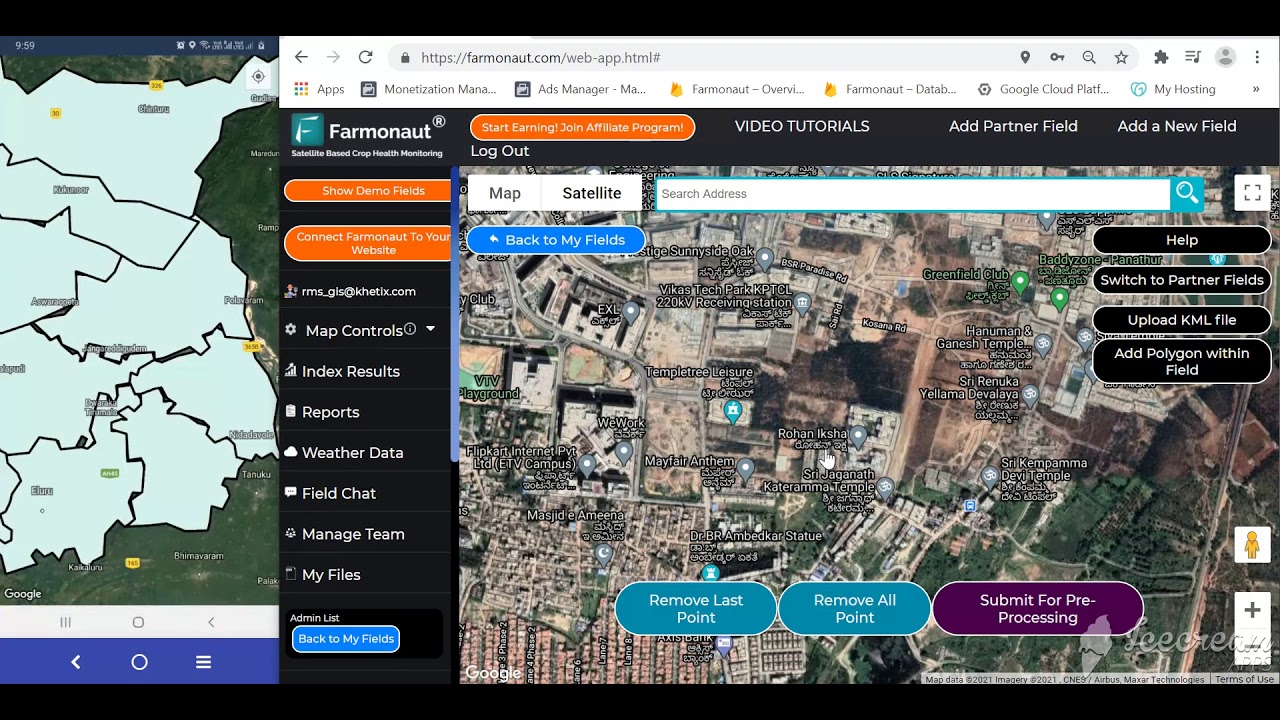
At Farmonaut, we recognize that effective water management in mining operations is crucial for the industry’s sustainable future. Our satellite-driven technologies, available via web and mobile apps (see buttons below), provide real-time monitoring, AI-based advisories, and resource management tools tailored for mining.



- Satellite-Based Water Monitoring: Access multispectral data for real-time assessment of water bodies, tailings storage, and wastewater flows, ensuring compliance and disaster prevention.
- AI-Powered Decision Support: Leverage Jeevn AI’s analytics to identify leak risks and optimize scheduling of water-intensive processes.
- Blockchain Traceability: Record every step of water and waste handling for transparent, tamper-proof reporting to regulators and stakeholders. Learn more about our Traceability Platform.
- Fleet & Resource Optimization: Manage mobile water treatment units, pumps, and transport logistics efficiently with Fleet Management Tools.
- Custom API Integration: Seamlessly integrate our insights with your existing digital infrastructure: Farmonaut API
Our modular services scale from small individual mining operations to government regulatory oversight, always supporting the transition towards sustainable, responsible extraction.
Frequently Asked Questions (FAQ)
What is Water Management in Mining Operations?
It refers to the integrated practices and technologies used by mining companies to control, monitor, and optimize water usage across all stages of extraction and processing to minimize environmental risks, ensure compliance, and support sustainable resource extraction.
Why is water management critical for mining in 2025?
Growing water scarcity, stricter regulatory requirements, visible climate change impacts, and the necessity for community involvement make effective water management more vital than ever. It’s key to operational continuity, legal compliance, and maintaining a positive social license.
What are common water-related risks in mining?
- Contamination: Leaching of heavy metals, chemicals, and sediments into local water bodies.
- Tailings dam failure: Catastrophic spills affecting entire ecosystems and communities.
- Drought-induced shutdowns: Insufficient water supply disrupting operations.
- Regulatory penalties: Fines or shutdowns for non-compliance with discharge limits or environmental protection regulations.
Which technologies can improve water management for mines?
- Membrane filtration (RO, UF, NF)
- Automated water quality monitoring sensors
- AI and digital twins for process optimization
- Blockchain for traceability and compliance
- Satellite analytics for hydrological mapping
How is Farmonaut relevant to mining water management?
Farmonaut provides affordable, scalable satellite monitoring, AI-driven advisory (Jeevn), blockchain traceability, and fleet/resource management tools to help mining operators and regulators meet regulatory, sustainability, and operational goals.
How can mining companies reduce their freshwater usage?
By deploying closed-loop recycling, advanced treatment, implementing rainwater storage, recovering water from tailings, and early leak detection through monitoring and satellite analytics, mining companies can cut their freshwater dependency substantially.
Conclusion: Defining the Future of Sustainable Mining
Water Management in Mining Operations is not only a technical or regulatory issue, but the keystone of responsible, sustainable resource extraction for the mining sector in 2025 and beyond. By implementing the five key strategies outlined here—recycling & reuse, rainwater harvesting, advanced wastewater & tailings management, comprehensive monitoring, and community engagement—mining companies can reduce impact on local water bodies, ensure enduring regulatory compliance, and secure the trust and well-being of surrounding communities.
At Farmonaut, our mission is to provide real-time, evidence-based tools that empower effective water management across the mining lifecycle. As regulatory scrutiny and climate variability intensify, adopting innovative, sustainable, and transparent approaches to water is more imperative than ever—for the protection of our planet’s limited resources, health of local ecosystems, and continued prosperity of mining communities worldwide.
Discover how Farmonaut’s API and large-scale land monitoring platform can help you manage, monitor, and optimize your mining or environmental operations for a resilient future.

 Alkimy SARL
 Double A Trading
 GemSprout Metals Limited
 Qader Group
 Ileys General Trading
 SG Gold Mining LLC
 VRV Global Pte Ltd
 Omsri International FZE
 G.I.T.T.
 Jaunita Erss Ltd
 Almosi SARL
 SRK Consulting
 Berks Gold Limited
 Mwerezi Minerals Company Limited
 Mining SARL
 SenGold Invest SAS
 Sean Mining Limited
 NTS Group (Pty) Ltd
