

Harvesting Robots: Market Size, Speed & 7 Machines
Reviewed September 2026 against USDA Economic Research Service, USDA National Agricultural Statistics Service, and Technavio market data.
Try it: Run your own numbers →
A harvesting robot is a machine that uses computer vision and robotic arms or grippers to identify ripe produce and pick it without a human hand touching the plant. Market estimates vary widely between research firms. Technavio forecasts the crop harvesting robots market to grow by USD 7.47 billion between 2024 and 2029, a 41.9% CAGR, with North America the leading region (Technavio). This article covers what’s driving that growth, how these machines actually perform in the field, and seven representative harvesting robots built for different crops.

Harvesting Robot Market: Size, Growth, and Where the Money Is
The crop harvesting robots segment specifically — the subset of agricultural robotics doing the actual picking, as opposed to spraying, weeding, or scouting — is growing faster than the broader ag-robotics category. Technavio projects a 41.9% CAGR for crop harvesting robots between 2024 and 2029 (Technavio).
North America isn’t just a large market; it’s the growth engine. Technavio names North America as the leading region for crop harvesting robots (Technavio), driven by high labor costs, large-acreage specialty crop operations in California, Washington, and Florida, and early USDA-backed field trials. That regional concentration is also why “robot harvester” and “crop harvesting robot market” queries increasingly surface US-specific coverage rather than generic global overviews — the money and the deployments are here.
Post-Harvest Robotics: A Distinct, Smaller Category
It’s worth separating “harvesting robot” (the machine that picks) from post-harvest robotics — sorting, grading, packing, and palletizing systems that take over once produce leaves the field. Market analyses from Technavio and iMARC Group bundle field-harvesting robots as their own segment because the sensing problem (finding and gripping a piece of produce on a living plant) is fundamentally different from the sorting problem (grading uniform, already-detached produce on a conveyor). If you’re specifically evaluating post-harvest automation — packhouse sorting lines, robotic palletizers — that’s a separate purchase decision from the field robots covered in this article, and vendor-specific pricing for those systems isn’t broken out in the market reports cited here.
Why Growers Are Buying: The Labor Math Behind AI Harvesting
The business case for ai harvesting isn’t hypothetical — it’s arithmetic that shows up on every US farm’s payroll. USDA wage and guest-worker data show how tight that labor supply has become.
Wages tell the rest of the story. Hired farmworkers averaged $19.52 per hour in the April 2025 reference week, per USDA NASS. Looking at the full-year picture, the USDA Economic Research Service puts the average farmworker wage at $18.12 per hour in 2024, against a nonfarm average wage of $30.13 per hour in 2024 — a persistent gap that still isn’t enough to fill open positions. Labor now accounts for 10.4% of gross farm income from 2021 to 2023, USDA ERS reports, making it one of the largest controllable cost lines on a specialty-crop operation.
Farms have leaned harder on the H-2A temporary visa program to close the gap: 385,000 H-2A positions were approved in FY 2024, up from just 48,000 in FY 2005 — a more than sevenfold increase in 19 years, per USDA ERS. The US Department of State issued 315,500 H-2A visas in FY 2024. That growth curve is itself evidence of a labor supply that mechanization is being asked to backstop.
Dairy offers the closest thing to a real-world, longitudinal case study of robotic adoption paying off. USDA ERS found that robotic milking, or use of two or more precision dairy technologies, raised dairy net returns by 13 percent on average, and that robotic milking added $3.15 per hundredweight relative to nonadopters (USDA ERS). It’s a different task than fruit or vegetable picking, but it’s the best publicly documented before-and-after economic read on ag robotics in the US, per the USDA Economic Research Service.

How a Harvesting Robot Actually Picks — and How Fast
This is the question AI Overviews tend to answer vaguely, and it’s where actual field data helps. In trials in two Michigan commercial orchards during the 2024 season, a dual-arm apple harvester built by a research team including USDA’s Agricultural Research Service recorded picking success rates of 80.7% and 79.7%, with an average cycle time of 5.97 seconds; coordinating the two arms cut harvest time by 28% versus a single-arm baseline (arXiv preprint). Other published apple-robot trials report success rates of about 77–80% and cycle times of roughly 7.3–7.5 seconds (Horticulturae, arXiv).
Grain and grape mechanization work differently — these crops don’t need per-item ripeness judgment the way tree fruit does, so throughput is measured in tons per hour rather than seconds per item.
What’s Not Yet Published
Several numbers readers searching “harvesting robot” or “ai harvester” want simply aren’t public yet. There is no USDA or NASS survey disaggregating harvesting-robot adoption by US farm size or region — market reports estimate total spend, not per-farm penetration. Manufacturers don’t publicly disclose units sold or market share by model. And there’s no comprehensive USDA cost-benefit study establishing a standard payback period by crop — case studies exist, but not a national analysis. If you need a farm-specific payback estimate, the honest path is to request a pilot quote from a manufacturer using your own acreage, crop mix, and current labor cost, then run it through the calculator below rather than relying on a published industry average that doesn’t exist yet.
Harvesting Robots Already Working on Farms
Most harvesting robots are still in pilots, but a few are picking commercial crops. Three examples show how differently they work and how their output compares with people.
- Dogtooth (strawberries, UK). The robot runs on rails between tabletop strawberry rows, clamps the stem above the fruit, cuts it with a blade and checks each berry with five cameras before packing. Future Farming reported in January 2026 that it picks about 12.5 kg an hour against roughly 24 kg for a person, but can run around the clock, with one operator overseeing up to 12 robots. The unit price quoted was £30,000 (Future Farming).
- Tevel Aerobotics (tree fruit, US and elsewhere). Tethered drones fly to the canopy, find fruit with their own vision system and pull it with suction. HMC Farms in Kingsburg, California, piloted the system on peaches, nectarines and plums (HMC Farms).
- Dual-arm apple harvester (research, Michigan). A vacuum-tube robot with two arms and a time-of-flight camera reached about 80% picking success at 5.97 seconds per apple in 2024 commercial-orchard trials (arXiv preprint).
The pattern is consistent. Robots are slower per hour than a skilled picker, so the business case rests on working longer shifts, working at night or in heat, and cutting the number of seasonal hires rather than on raw speed. Ask any vendor for kilos or fruit per hour on a crop and training system like yours, and for the share of fruit it leaves on the plant.
7 AI Harvesting Machines: What Each One Is Built For
The specs below describe representative machine classes and typical configurations in this equipment category as of late 2026 — treat model names as illustrative of what’s commercially emerging rather than a specific SKU to search for by name, and confirm exact specifications and availability directly with any manufacturer before purchasing.
1. Soft-Gripper Fruit Harvester (Strawberries, Apples, Tomatoes)
- Designed for: Delicate crops where bruising destroys market value
- Key AI features: Multispectral vision for ripeness detection, soft robotic arms, per-fruit grip-force control
- Benefit: Selective picking cuts bruising and waste versus uniform mechanical stripping
- Try it: Run your own numbers
2. Grain Combine Harvester (Wheat, Corn, Barley)
- Designed for: Row-crop grains harvested by volume, not individual ripeness
- Key AI features: Adaptive route mapping, weather-data integration, predictive maintenance alerts
- Benefit: High-throughput harvesting with minimal human supervision across large fields
3. Leafy Green Harvester (Lettuce, Spinach, Kale)
- Designed for: Fast-turnover leafy crops needing visual grading at speed
- Key AI features: Visual ripeness grading, terrain mapping, IoT field-data integration
- Benefit: Reduces the highly labor-intensive stoop-labor demand this category traditionally requires
4. Berry Harvester (Blueberries, Raspberries, Strawberries)
- Designed for: Soft fruit where even light mechanical stripping causes crushing
- Key AI features: Soft gripping technology, real-time firmness scoring, autonomous row navigation
- Benefit: Precision picking reduces harvest losses on high-value soft fruit

5. Multi-Crop Row Harvester (Wheat, Soy, Corn, Pulses)
- Designed for: Operations rotating between several row crops on the same fleet
- Key AI features: Predictive scheduling, yield forecasting, automated header calibration between crops
- Benefit: One machine covers multiple crop types instead of a dedicated harvester per crop
6. Orchard Harvester (Citrus, Apples, Pears, Nuts)
- Designed for: Uneven orchard terrain and tree-canopy navigation
- Key AI features: 360° lidar scanning, AI-based fruit clustering, path optimization around trunks and low branches
- Benefit: Handles complex orchard layouts that stymie single-pass mechanical shakers
7. Root Vegetable Harvester (Carrots, Onions, Potatoes)
- Designed for: Below-ground crops requiring depth judgment, not surface vision alone
- Key AI features: Depth vision, shape/size classification, soil-condition sensors
- Benefit: Reduces root damage from blind mechanical digging, integrates yield data with farm records

Comparison Table: Speed, Crop Fit, and Cost
Pricing varies significantly by manufacturer, region, and financing terms — always request a current quote before budgeting.
Labor Savings Calculator
Enter your current harvest labor setup to see how it compares against USDA’s national average farm wage and a range of assumed labor-cost reductions.
Run your own numbers
Assumptions: the 30/60/95% reduction tiers are illustrative brackets, not published results; your actual result depends on crop, robot model, and field conditions. This calculator excludes robot purchase price, financing, and maintenance costs — no published national dataset covers those by crop or region yet, so get a quote from your equipment vendor for full ROI.
Post-Harvest Robotics: What Happens After the Robot Picks
Once a harvesting robot fills a bin, the produce still needs sorting, grading, and packing before it reaches a buyer — and that's where post-harvest robotics takes over. This is a genuinely separate equipment category from the field harvesters above: sorting lines work with already-detached, roughly uniform produce moving on a conveyor, which is a much more constrained vision problem than finding a ripe strawberry hidden under a leaf. Because of that, adoption and pricing data for post-harvest sorting and packing robots is tracked separately in the market reports cited in this article and isn't broken out by model here. If post-harvest automation specifically — not field picking — is what you're evaluating, treat it as its own capital decision with its own vendor quotes, separate from anything in the comparison table above.
Core Technologies Behind Every Harvesting Robot
Regardless of crop, the machines in this category rely on the same stack:
- AI & machine learning algorithms: Process weather, crop health, and growth-stage data for real-time harvesting decisions.
- Computer vision: Multispectral and hyperspectral cameras identify ripeness, size, and defects on individual plants — the same sensing class used in the Michigan dual-arm apple trials.
- Sensors: Soil moisture and atmospheric sensors feed both the harvester and broader farm-data systems.
- Soft robotics and gripping mechanisms: Enable bruise-free picking of delicate fruit.
- Autonomous mobility: GPS and obstacle detection let machines navigate uneven or complex terrain without a driver.
- IoT integration: Harvesters exchange data with field sensors and farm-management platforms for coordinated automation.



Tip: Explore the Farmonaut App for real-time satellite monitoring, AI-powered advisory, and easy-to-use farm management tools.
Where Satellite Data Fits Into a Robotic Harvest
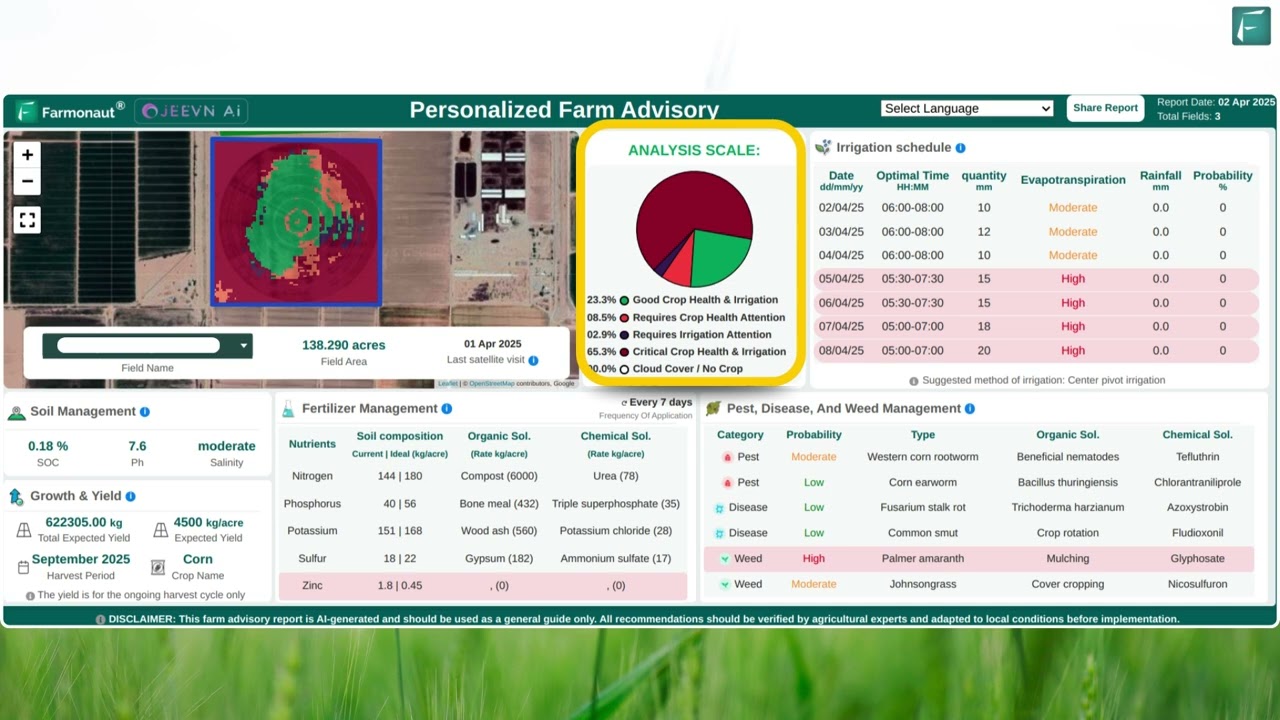
A harvesting robot only knows what's in front of its cameras. Deciding which field to send it to, and when, is a satellite-and-weather-data problem that sits upstream of the robot itself. Farmonaut supports that decision layer:
- Real-time satellite crop and soil monitoring: Continuous NDVI, soil moisture, and crop health data help growers decide when and where to deploy harvesting robots.
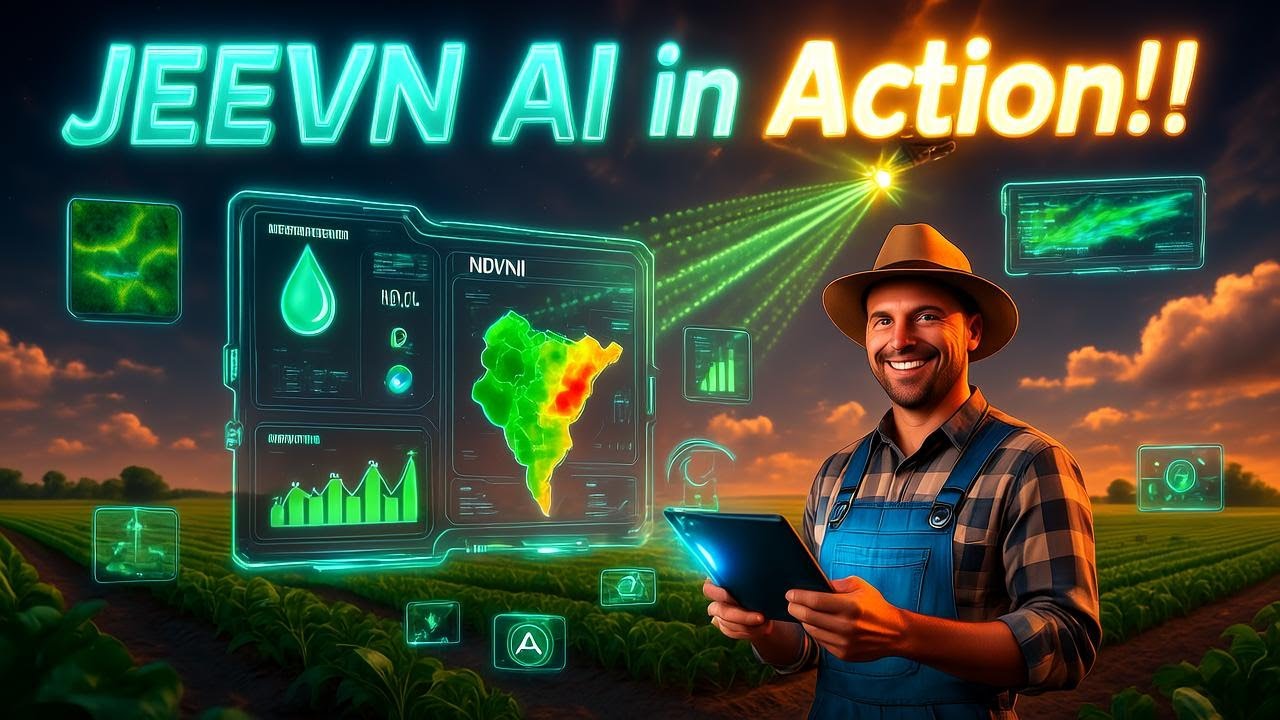
- Farmonaut Jeevn AI Advisory System: Delivers AI-driven recommendations on weather, terrain, and harvesting windows to improve timing and yield.
- Environmental monitoring: Tools for measuring the carbon footprint of farming operations support compliance with emerging sustainability standards. Learn how Farmonaut's Carbon Footprinting Solution enables sustainable, data-driven farming.
- API access and integration: Developers can connect to the Farmonaut API to automate crop health and harvest-window workflows. Integration details are in the developer docs.
- Traceability: Blockchain-based product traceability for harvested produce supports food safety and buyer trust. Learn about using blockchain for harvest traceability.
- Fleet management: Farmonaut's Fleet Management solution helps operations coordinate vehicles and machinery — relevant once a robotic harvester joins the fleet.
- Crop loans and insurance: Satellite-based field verification helps lenders and insurers assess risk faster. Read more about Farmonaut's Crop Loan & Insurance solution.

Related reading: agricultural robots beyond harvesting — covering scouting, spraying, and weeding platforms — if you're building a broader robotics fleet rather than a picking-specific one.

Get started with real-time satellite-based farm management for improved harvesting decisions. Try the Farmonaut App on web, Android, or iOS.
For large operations coordinating multiple harvesters and machinery, Farmonaut's Large Scale Farm Management solution streamlines planning, monitoring, and compliance across the fleet.
Farmonaut Subscriptions: Satellite and AI Tools for Every Farm
Access satellite monitoring, AI harvest advisory, blockchain traceability, and sustainability tools via a single subscription:
Frequently Asked Questions
Q1: How big is the harvesting robot market?
Estimates differ widely by research firm. Technavio forecasts the crop harvesting robots market to grow by USD 7.47 billion from 2024 to 2029, a 41.9% CAGR, with North America the leading region (Technavio). These figures update periodically — check the linked sources directly for the latest published estimate.
Q2: What is the difference between a harvesting robot and a conventional mechanical harvester?
Harvesting robots use computer vision and AI to judge ripeness on individual fruits or vegetables and adapt their picking method accordingly. Conventional harvesters, like grain combines or shaker-type fruit harvesters, collect crops in bulk regardless of individual ripeness — appropriate for grain but wasteful for delicate produce.
Q3: How fast do AI harvesters pick compared to human labor?
In 2024 Michigan orchard trials, a dual-arm apple harvester averaged 5.97 seconds per apple with about 80% success, and cut harvest time 28% versus a single-arm setup (arXiv preprint). Dogtooth's strawberry robot picks about 12.5 kg an hour, roughly half a person's rate, but can run around the clock (Future Farming). There's no published USDA study directly comparing that to human picker speed on the same field, so a farm-specific comparison requires timing your own crew against a demo unit.
Q4: Which crops benefit most from AI harvesting?
High-value, bruise-sensitive crops — strawberries, apples, tomatoes, blueberries — see the clearest quality benefit because selective picking avoids the waste of uniform mechanical harvesting. Grains and pulses benefit more from throughput than selectivity.
Q5: Is post-harvest robotics the same as a harvesting robot?
No. A harvesting robot picks crops in the field. Post-harvest robotics — sorting, grading, packing — operates after the crop is already off the plant, on separate equipment with its own market data and vendor pricing.
Q6: Can farms access AI and satellite-powered harvesting support from a smartphone?
Yes. The Farmonaut App for Android, iOS, and Web gives growers satellite insights, AI advisory, and field/fleet management features from a phone.




The Bottom Line on Harvesting Robots
The market data and USDA field trials agree on the same direction: harvesting robots are moving from pilot programs into early commercial use, pulled by tight US farm labor: a farm wage of $18.12 an hour against $30.13 for nonfarm work in 2024, and H-2A approvals up more than sevenfold since 2005. Research robots already reach about 80% picking success on apples.
What hasn't caught up yet is standardized, farm-level reporting: no national adoption rate by farm size, no standardized payback period by crop, no public unit-sales data by manufacturer. Until that reporting exists, the responsible way to evaluate a purchase is the same method this article used to build its own figures — cite the specific USDA, NASS, or market-report number for the claim you're checking, note its publication date, and re-pull it from the source before you budget against it. Use the calculator above with your own labor numbers as the starting point for that conversation with a vendor.

 AdBio
AdBio MISE Maroc
 Drift-Sense
 NWNS
NWNS Hydenmet
 Red August Group
 Farm Inc
 WeMe Global
 Agrotoken
 Blue BearX
 Insignito
 Croptimum
 DnCubed
 Field Capacity
 Indosistim Teknologi
 Liquify Digital
 CU Foods
 BeyondTech Global
