

Indoor growing · Buyer guide
AI Indoor Garden: Best Systems, Accuracy and Real Costs
An AI indoor garden pairs a soil-less unit with lights, a pump and software. Prices at the two brands that list them ran from US$124.95 to US$899.95 on 5 November 2026, and of the four brands here only Gardyn clearly claims cameras and AI. Here is what each brand offers, how accurate plant AI is, and how to test the cost.
Key takeaways
- Automation, app reminders and real AI are three different things; of the four brands here, only Gardyn clearly claims cameras and AI.
- Regular list prices checked on 5 November 2026: Click and Grow from US$124.95, Rise from US$349; the largest units listed near US$900.
- In one test, the top plant ID app named the species in 83.86% of leaf photos but 51.82% of bark photos (Arboriculture and Urban Forestry).
- A disease model scored 99.35% on images like its training set and about 31% on images taken under other conditions (Frontiers in Plant Science, 2016).
- Hydroponic lettuce used 20 L of water per kg against 250 L in the field, but 82 times more energy, in a modelled Arizona comparison (Barbosa, 2015).
In this article
- What makes an indoor garden "AI"
- AI indoor garden systems compared
- How we checked the numbers
- What an AI indoor garden costs up front
- How accurate is AI plant care?
- Light, water and nutrients: what AI cannot fix
- Is hydroponic growing greener?
- Does it pay for itself? Run your own numbers
- Plant care tools that need no smart garden
- How to choose an AI indoor garden
- AI plant care vs traditional methods
- Where satellites fit, and where they do not
- FAQ
An AI indoor garden is a soil-less growing unit with built-in lights and a pump, plus software that schedules care or watches the plants. List prices at the two brands that published them, Rise and Click and Grow, ran from US$124.95 to US$899.95 on 5 November 2026. Those two sell on timers and app reminders; Gardyn, the brand with the clearest camera and AI claim, showed no single unit price. Read the feature list before you pay.
This guide compares four brands, shows how far AI plant care can be trusted, and helps you work out whether a unit pays for itself. It also covers where plant care apps fit, and what changes when the “garden” is a commercial field rather than a kitchen shelf.
What makes an indoor garden “AI”
Three layers are often sold under the same label. It helps to separate them.
- Automation: a timer runs the LEDs and the pump. No learning is involved. This is what keeps a countertop unit running day to day.
- Connected reminders: a Wi-Fi app tells you when to add water or nutrients, and which stage each crop has reached.
- Real AI features: cameras or sensors feed software that reads the plants or the unit and changes its advice. Of the four brands below, only Gardyn clearly claims this.
A plant in water still needs the same basics as a plant in soil. Penn State Extension’s guide to hydroponic plant nutrition lists the essential nutrients, and in a hydroponic unit they come from what you add to the tank. Software can remind you to feed. It cannot replace the feed, the light or clean water.
AI indoor garden systems compared
Each entry below comes from the maker’s own US site on 5 November 2026. The feature descriptions are the makers’ claims. We did not grow in these units, so this is a comparison of what is offered, not a yield test.
1. Gardyn: the clearest AI claim
Best for: households that want a large vertical unit and active monitoring.
Gardyn says cameras and sensors watch the unit and that Kelby, its in-app assistant, personalizes a care plan. It sells the Home (30 plants) and the Studio (16 plants). A paid membership adds features such as Vacation Mode, which Gardyn says keeps plants going for up to two weeks. Its home page advertised financing rather than a single price, so check the current hardware and membership cost together before you decide.
2. Rise Gardens: expandable and app-guided
Best for: people who want to start small or scale to a lot of greens.
Rise lists the countertop Personal Rise Garden at US$349 (8 pods) and the Rise Garden 3 at US$899 (16 to 108 plants on one to three levels). Both have Wi-Fi, full-spectrum LEDs and an app with reminders. Rise describes the ongoing costs as water, electricity, seed pods and nutrients. It presents the app as guidance, not as an AI system.
3. Click and Grow: lowest price we recorded
Best for: a few herbs on a counter with little setup.
Click and Grow’s store showed the Smart Garden 3 at US$124.95 regular (US$99.96 on sale), the Smart Garden 9 at US$249.95 (US$174.97 on sale), the 9 PRO at US$299.95 (US$179.97 on sale) and the Smart Garden 27 at US$899.95 (US$539.97 on sale). Plant pods listed at US$14.95 for a 3-pack of herbs or lettuce (US$11.96 on sale). Here “smart” points to simple pod-based growing, so do not assume camera monitoring.
4. AeroGarden: a known name, check support
Best for: buyers who find a discounted unit and already have pods.
AeroGarden, sold by ScottsMiracle-Gro, showed gardens, seed kits and grow lights, along with a “Last Chance Clearance” category and savings of up to 60% on selected items. Before buying a clearance model, confirm that its pods and spare parts will stay available.
How we checked the numbers
We used each maker’s US site and recorded prices on one date, 5 November 2026. We chose these four brands because they sell complete home units with lights and pumps under their own names. We compared regular list prices and noted sale prices separately. Gardyn’s home page gave no single unit price and AeroGarden’s store page listed no unit prices, so the price range covers Rise and Click and Grow only. Feature claims are the makers’ own. Accuracy and water figures come from published studies, and each one is named where it appears.
What an AI indoor garden costs up front
Within each brand, price rises with plant capacity. The chart uses regular list prices so that a short sale does not distort the comparison. Sale prices change often, so treat them as a snapshot.
Chart
Regular list prices of selected indoor gardens
US$, makers’ US sites on 5 November 2026, before any sale and excluding pods or memberships
How accurate is AI plant care?
Good in clear conditions and much weaker in messy ones. That pattern shows up in the two kinds of test below, and it should shape how you use any app.
Plant identification
A study in Arboriculture and Urban Forestry tested six apps on 440 photos of leaves and bark from 55 New Jersey tree species. PictureThis scored highest. It named the genus in 97.27% of leaf photos and the species in 83.86%, but bark photos fell to 65.45% and 51.82%. The authors concluded that these apps can narrow the choices and cannot replace field identification. The test covered trees and not houseplants, and app versions have changed since, so read it as a pattern rather than a current score.
Other apps in that test included iNaturalist, which came second, and Pl@ntNet, a citizen science project on plant biodiversity. Whichever you pick, a clear photo of a leaf gives the software more to work with.
Disease diagnosis
The warning here is stronger. In a well-known study in Frontiers in Plant Science (2016), a model built from a public set of 54,306 leaf images collected under controlled conditions reached 99.35% accuracy on held-out images from the same set. On images taken under different conditions, accuracy fell to about 31%. That was well above the 2.6% expected by chance, yet far from reliable. Newer models have had years of further work, but the lesson stands: a high score on tidy photos says little about a dim kitchen.
In practice, use a diagnosis as a question to check. Look at the undersides of leaves, the roots and the tank before you treat anything. If you do use a pest or disease product, check the label and local rules, and confirm that it is approved for edible plants grown indoors. For the app side of this topic, see our guide to diagnosing plant diseases with an app.
Chart
Top plant ID app: species vs genus accuracy
PictureThis, percent of tree photos identified correctly, 440 photos of 55 species
Light, water and nutrients: what AI cannot fix
Many problems in small units come back to basic growing conditions. Three deserve attention.
- Light: Purdue Extension’s guide to daily light integral explains the measure growers use, which is the total useful light a plant receives in a day. University of Kentucky’s lettuce guidance gives an optimal range of 12 to 17 moles per square metre per day. Fruiting crops generally need more light and room than leafy greens, so start with greens and herbs.
- Water quality: University of Kentucky’s hydroponic lettuce profile calls water quality critical because plants rely on water for nutrient delivery and root health. It recommends monitoring nutrient strength and acidity. That advice is written for commercial growers, but the same logic applies to a small tank. Clean the tank between crops.
- Nutrients: follow the unit’s dosing guide. More feed is not better, and pods or nutrient refills are a real running cost.
Beginners can find more growing information in Cornell’s controlled environment agriculture site, which links to a home hydroponics guide and a lettuce handbook.
▶ Ten small agriculture ideas, starting from a shelf of microgreens. · 6:03
Is hydroponic growing greener?
On water, usually yes. On energy, not necessarily. A study of lettuce in Yuma, Arizona (Barbosa and colleagues, 2015) compared government statistics and crop budgets with modelled figures for a hypothetical hydroponic greenhouse. The hydroponic system gave about 11 times the yield and used 20 litres of water per kilogram against 250 litres. It also needed 82 times more energy: 90,000 kJ against 1,100 kJ per kilogram.
Chart
Water used per kilogram of lettuce
Litres per kg per year, Yuma, Arizona: government and crop-budget data vs modelled hydroponic greenhouse
That study modelled a commercial greenhouse, not a kitchen unit, so its figures do not transfer directly to your home. The trade-off does. A unit saves water and spares you a trip to the store, but its lights run on electricity for many hours a day. AI care is not automatically sustainable; the savings depend on what you grow and how your power is made.
Simple habits still help in any garden: compost plant waste, match water to plant need, and accurately identify a problem before you reach for a treatment.
Does it pay for itself? Run your own numbers
Gardyn says its unit quickly pays for itself. Whether that is true for you depends on your electricity rate, what you would otherwise buy, and how much you really eat. US homes paid an average of 18.16 cents per kWh in August 2026, up from 17.57 cents a year earlier, according to the US Energy Information Administration. Rates vary widely by state and country, so use the figure on your own bill.
Enter your own numbers below. The default values are examples set near break-even, not typical results. Check the actual wattage on the unit’s label, because makers do not always publish it on their sales pages.
Try the numbers for your own farm below.
Calculator
Does your indoor garden beat buying greens?
Enter your own unit, power rate and harvest to see the yearly result.
- Total yearly cost: $267
- Yearly electricity: $42
- Value of greens at store price: $275
- Break-even bunches per year: 97
All default values are examples set near break-even, not benchmarks or forecasts. Every number is your input. The default electricity rate is rounded from the US residential average of 18.16 cents per kWh for August 2026 (EIA). Lights are assumed to run every day of the year; pump power is not counted unless you add it to the wattage.
Plant care tools that need no smart garden
You do not need a hydroponic unit to use AI for plant care. A phone app covers two common jobs: naming a plant and suggesting what may be wrong with it. That costs far less than hardware and works on the pots you already own.
The limits are the ones shown above. An app sees a photo. It does not know how often you water, how far the pot sits from a window, or what is happening at the roots. Give it a sharp, well-lit picture of one leaf. Then take a second photo from another angle and compare the answers. If two photos give two different results, inspect the plant before you act.
A simple water meter and a light meter app can add facts that a photo cannot show. Keep a short note of each change you make, so you can tell what helped.
How to choose an AI indoor garden
- Ask what the “AI” does. Does a camera or sensor read the plants, or does the app only send timed reminders? Both can grow good lettuce, but only one matches the marketing.
- Add up three years of cost. Include pods, nutrients, power and any membership. A low hardware price can hide high refill costs.
- Check what still works offline. Find out whether the lights and pump run on their own if the app, Wi-Fi or subscription stops.
- Check seed flexibility. Some systems let you grow your own seeds, which reduces your reliance on one brand’s pods.
- Measure the space. Note the height at full growth, the distance to an outlet, and the noise of the pump if the unit will sit near a bedroom.
- Read the return terms. Rise, for example, listed a 90-day return period and a two-year limited warranty on hardware and electronics.
- Review the privacy policy. A unit with a camera in your home should state what it stores and who can see it.
AI plant care vs traditional methods
| Task | Traditional | AI-assisted | Watch out for |
|---|---|---|---|
| Naming a plant | Field guide or local expert | Photo app suggests a match | Weaker to species level and on bark |
| Diagnosis | Close inspection, lab sample | Photo suggests a likely problem | Accuracy can drop under new conditions |
| Watering | Check by hand | Pump and reminders | Tank must still be filled and cleaned |
| Light | Window, manual lamp | LED schedule | Power use, and fixed lamp height on some units |
| Records | Notebook | App history | Records may depend on an account |
Where satellites fit, and where they do not
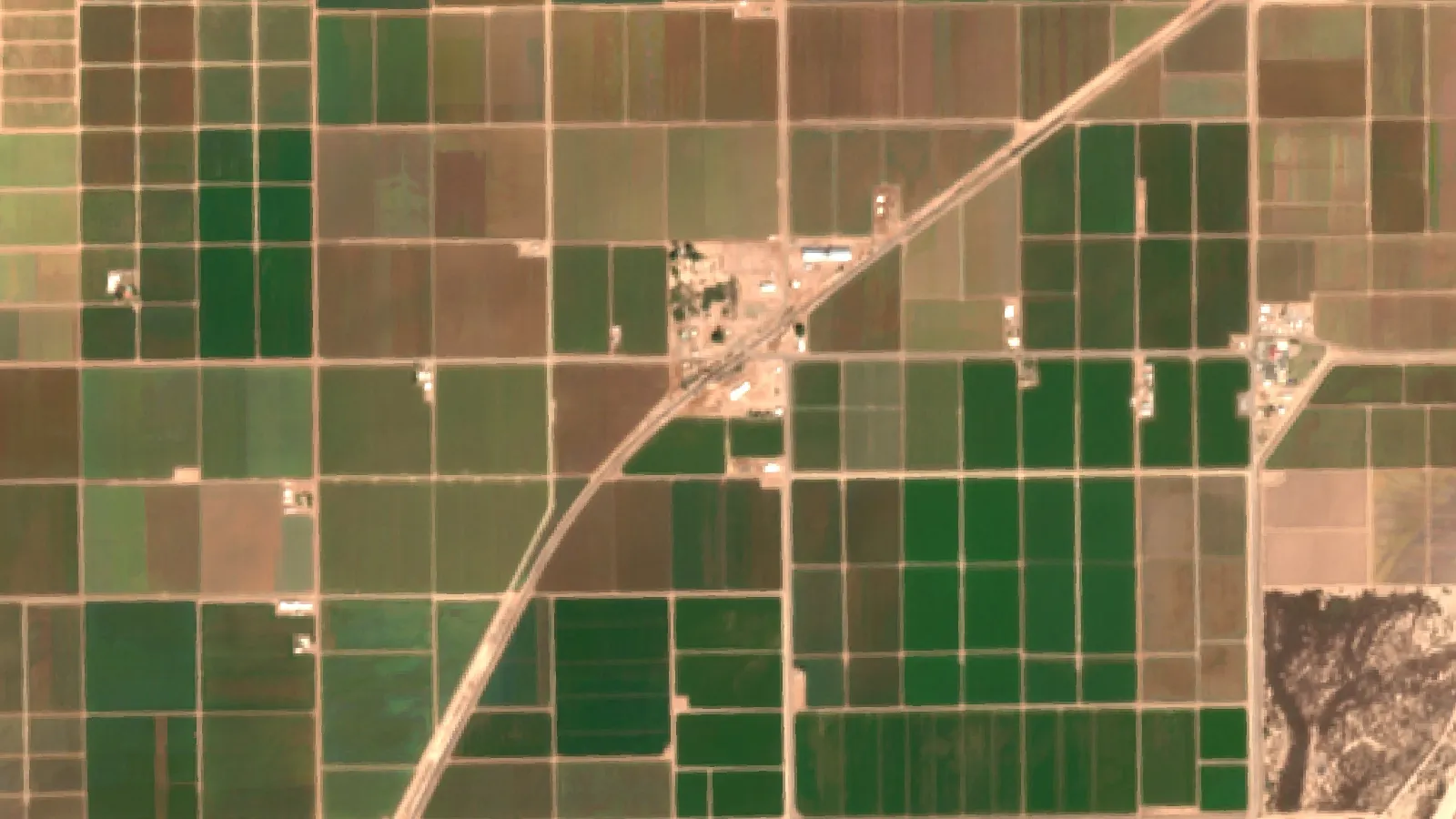
Satellites do not help with a houseplant or a backyard bed. The Sentinel-2 mission has its finest bands at 10 metres, so one pixel covers 100 square metres, larger than many home gardens. Its value appears at field scale: it shows how plant cover changes across a large block, with a design revisit of five days at the Equator.
▶ How satellite NDVI maps show crop stress across a large farm. · 4:09
For growers, this is the same idea as an indoor camera on a much larger scale. A vegetation map shows where a crop differs from the rest of the field, and someone then walks to that spot to find the cause. The map does not name the pest or disease. Farmonaut applies this approach to agricultural land, not to indoor units, and its web and mobile apps show those maps for a field you draw.
Developers can see the satellite and weather API documentation and the API access page.
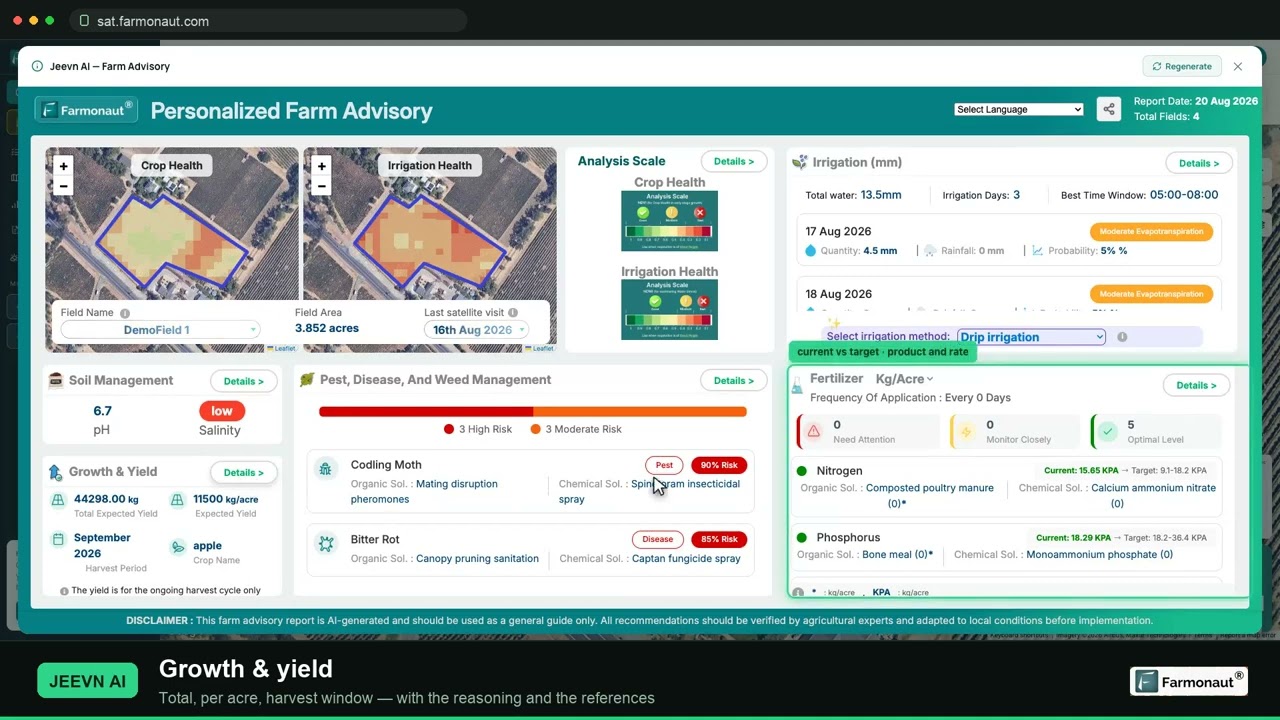
▶ A full walkthrough of satellite crop monitoring and reading NDVI for a field. · 19:36
FAQ
What is the best AI indoor garden?
No single model wins for every home. Among the four brands here, Gardyn makes the most direct AI claim, with cameras, sensors and an assistant. Rise and Click and Grow offer simpler routes at listed prices from US$349 and US$124.95. Choose by the features you will use and your total running cost.
Can AI really detect plant problems?
It can suggest likely problems, but treat the result as a lead to check. One study saw a disease model fall from 99.35% on images like its training set to about 31% on images taken under different conditions.
Which plants are easiest in a smart garden?
Leafy greens and herbs are the usual starting point. Rise says leafy greens such as lettuce and arugula are ready in about four weeks, while fruiting plants take longer.
Do I need a subscription?
It depends on the brand. Gardyn sells a membership with premium features such as Vacation Mode, while Rise includes its app with its gardens and lists a separate Rise Plus option tied to supply shipping. Ask what still works if you stop paying.
Are plant care apps worth using without a smart garden?
Yes, for naming plants and narrowing down a problem. A clear leaf photo gave the best results in the tree study above. Confirm anything important, especially before eating a plant or applying a treatment.
Can satellites monitor my home garden?
Not in useful detail. At a 10 metre pixel, Sentinel-2 suits fields rather than beds or houseplants.
Related pages on our site: plant disease apps.
Farmonaut crop monitoring
Growing at field scale?
Draw your fields once and see satellite vegetation maps for them through the season, on web, Android or iOS.




Keep reading

Sources
- Gardyn, home page: hydroponic indoor garden system (retrieved 5 November 2026): mygardyn.com
- Rise Gardens, home page and prices (retrieved 5 November 2026): risegardens.com
- Click and Grow, store prices (retrieved 5 November 2026): clickandgrow.com
- AeroGarden by ScottsMiracle-Gro, store page (retrieved 5 November 2026): aerogarden.com
- Schmidt et al., Accuracy of photo-based plant identification applications on 55 tree species, Arboriculture and Urban Forestry (2022): auf.isa-arbor.com
- Mohanty, Hughes and Salathé, Using deep learning for image-based plant disease detection, Frontiers in Plant Science (2016): frontiersin.org
- Barbosa et al., Comparison of land, water and energy requirements of lettuce, Int. J. Environ. Res. Public Health (2015): ncbi.nlm.nih.gov
- US EIA, Electric Power Monthly Table 5.6.A, August 2026: eia.gov
- Purdue Extension, Measuring Daily Light Integral in a Greenhouse (HO-238-W): extension.purdue.edu
- Penn State Extension, Hydroponics systems and principles of plant nutrition (updated February 2026): extension.psu.edu
- University of Kentucky CCD, Hydroponic lettuce crop profile (2026): ccd.uky.edu
- Cornell University, Controlled Environment Agriculture: cea.cals.cornell.edu
- Copernicus SentiWiki, Sentinel-2 mission: sentiwiki.copernicus.eu
- Pl@ntNet, project home page (retrieved 5 November 2026): plantnet.org
Discussion
Questions, corrections or field experience? Share them below. First-time comments are reviewed before they appear, and your email is never published.
No comments yet. Be the first to add a question or your experience.

 Hydenmet
 Dirks Bros Farms
 Red August Group
 Farm Inc
 WeMe Global
 Agrotoken
 Blue BearX
 Insignito
 Croptimum
 DnCubed
 Field Capacity
 Indosistim Teknologi
 Liquify Digital
 CU Foods
 BeyondTech Global
 Rouge VC
 AgroGreen Dynamics

 Licence holder · Niger · Gold
 Client · Tanzania · Gold
 Client · Somalia · Gold










