

AI-Powered Tools for Agriculture: 7 Precision Solutions Revolutionizing Farming Practices in 2025 and Beyond
The future of farming has arrived—with AI-powered tools for agriculture at the forefront. Explore how seven precision solutions are marking a pivotal shift towards sustainable, efficient crop production in 2025 and beyond.
Table of Contents
- Introduction: Evolving Agriculture in 2025 and Beyond
- What is AI-Powered Precision Agriculture?
- 7 AI-Powered Tools Revolutionizing Agriculture
- Feature Comparison Table
- Farmonaut: Leading AI-Powered Satellite Agriculture Solutions
- Key Benefits, Pro Tips & Callout Boxes
- The Future of AI in Precision Agriculture: Challenges & Opportunities
- Getting Started: Tools, Apps, APIs, & Subscriptions
- Frequently Asked Questions
Introduction: Evolving Agriculture in 2025 and Beyond
AI-powered tools for agriculture are revolutionizing the way we grow food, optimize resources, and protect the environment. In 2025, the increasing demand for sustainable and productive farming practices is driving a fundamental shift towards smarter, data-driven solutions. As global populations rise and climate challenges intensify, traditional agriculture methods often struggle to meet the world’s food needs while conserving natural resources. Enter the new era: ai-powered precision agriculture. Rather than relying solely on experience and guesswork, farmers now have access to intelligent algorithms—powered by vast amounts of data, weather forecasts, drone and satellite imagery, and even real-time soil sensors—which enables granular decision-making right at the root zone.
Growth in these tools is tracked commercially too, and figures on the precision farming market size show where crop scouting fits.
This blog explores seven transformative, AI-driven solutions—each marking a pivotal shift towards efficient, sustainable farming. We also provide actionable comparisons, practical tips, and detailed guidance for adopting these technologies in 2025 and beyond.

AI-powered precision agriculture isn’t just about yield optimization—it enables sustainable, transparent, and resilient farming practices for a changing planet.
What Is AI-Powered Precision Agriculture?
At its core, ai-powered precision agriculture deploys intelligent algorithms and machine learning models that analyze vast amounts of data from diverse sources. These inputs include:
- 🌍 Satellite imagery – monitoring crop health, drought stress, and nutrient status
- 🚁 Drone surveillance – giving a bird’s-eye view of fields for pest infestations and lodging
- 🌱 Soil sensors – providing real-time soil moisture, temperature, and fertility measurements
- ☀️ Weather forecasts – anticipating rainfall, heat stress, and extreme weather conditions
- 🧬 Genetic information – adjusting crop management to varieties, growth stages, and performance potential
By continuously processing these data streams, ai-powered agricultural solutions provide farmers and stakeholders with actionable insights: where to irrigate, apply fertilizers or pesticides, schedule harvesting, rotate crops, and even plan logistics—all with new levels of efficiency and sustainability.
7 AI-Powered Tools Revolutionizing Agriculture in 2025
Below, we detail the seven most significant advancements in ai-powered tools for agriculture, each driving the pivotal shift towards precision, sustainability, and higher productivity.
-
1. AI-Driven Crop Health Monitoring
AI-powered crop health monitoring harnesses satellite imagery, drones, and in-field IoT sensors to track field-to-plant level indicators like NDVI (Normalized Difference Vegetation Index), LAI, and chlorophyll content in real time. Machine learning algorithms analyze these images and data points, alerting farmers to early-stage pest infestations, disease outbreaks, drought stress, or nutrient deficiencies.
- 📊 Data insight: Enables intervention before visible symptoms occur, reducing yield loss by up to 15%.
- ✔ Key benefit: Lower pesticide costs and input waste while enhancing crop quality.
- ⚠ Risk: Relies on high-quality, up-to-date imagery and robust networks for remote fields.
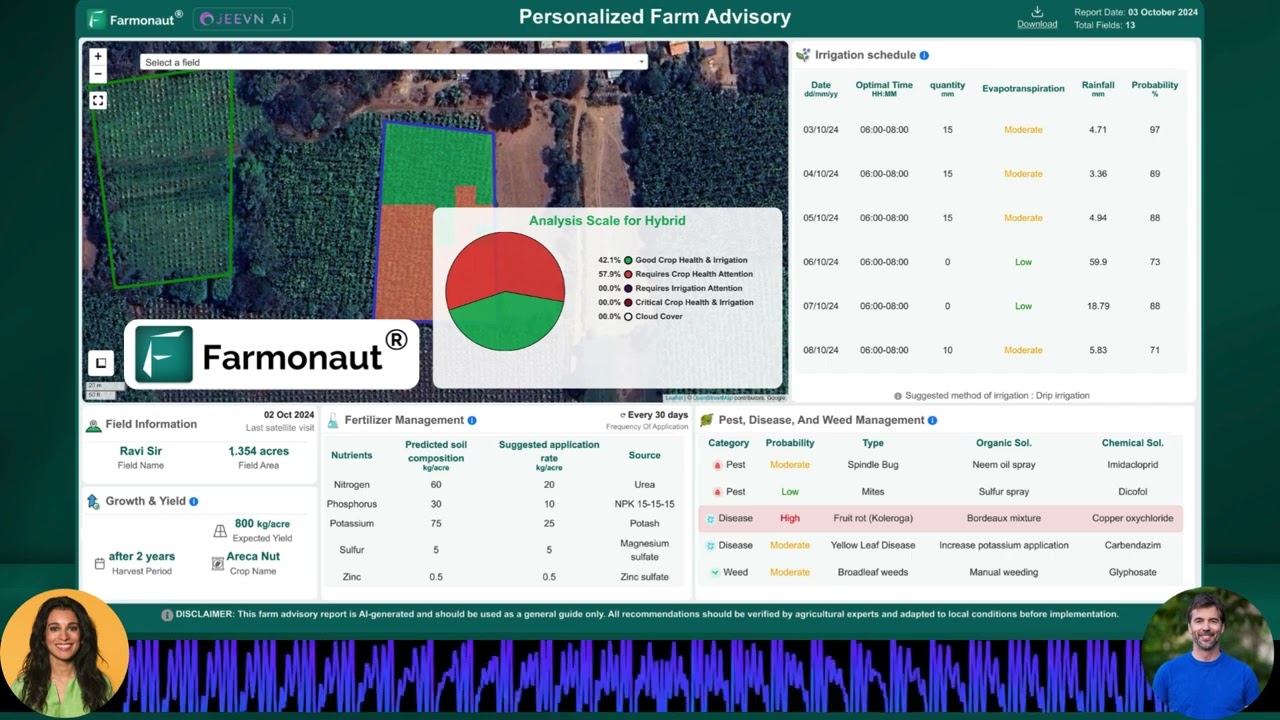

Try Farmonaut’s AI-powered crop and soil monitoring today! Our satellite-driven platform provides real-time insights, enhancing farm efficiency and sustainability.
-
2. Precision Irrigation Systems
AI-powered precision irrigation solutions integrate soil moisture sensors, weather forecasts, and field mapping to determine exactly when and where to apply water for optimal crop development.
- ✔ Key benefit: Dramatically reduces water waste—saving up to 30% in high-evaporation regions.
- 📊 Data insight: Combines satellite moisture mapping with forecast modeling for “just-in-time” irrigation.
- ⚠ Limitation: Precision requires investment in sensors and data connectivity.

-
3. Autonomous Machinery & Robots
Modern AI-equipped autonomous tractors, robotic planters, and harvesters use computer vision and deep learning to perfectly navigate fields, plant seeds at optimal depths, and harvest at peak quality—often without human intervention.
Robots also perform precision weeding, micro-dosing pesticides, and targeted nutrient applications, increasing speed and accuracy beyond manual labor.- ✔ Key benefit: Reduces reliance on seasonal labor, maximizing efficiency in remote or difficult terrains.
- 📊 Data insight: Increase in productivity by 10–20%, with lower input and operational costs.
- ⚠ Limitation: Higher initial capital investment.

-
4. AI-Based Pest & Disease Detection
Through high-resolution drone and satellite imagery—analyzed by deep learning—AI systems identify visual signatures of pest infestations or disease outbreaks long before symptoms are clear to the naked eye. Precision alerts allow targeted, minimal chemical use, reducing environmental impact and operational costs.
- ✔ Key benefit: Minimizes pesticide use by 20–40%, promotes residue-free crops.
- 📊 Data insight: Real-time alerts enable rapid, localized interventions.

Farmonaut’s Jeevn AI delivers actionable disease and pest alerts derived from satellite and AI insights—helping you protect your crops and save on agrochemical costs. -
5. AI-Powered Yield Prediction & Crop Modeling
Forecasting crop yields is now achievable with remarkable accuracy. Machine learning models ingest historical weather, soil data, genetic information, and current satellite imagery to estimate future performance.
This transforms:- 📅 Harvest planning
- 🚚 Supply chain management
- 💸 Pricing and market negotiations
- 📈 Financial risk assessment
- ✔ Key benefit: Minimizes post-harvest losses, supports contract farming and helps secure better pricing.

-
6. Blockchain-Based Traceability Platforms
Modern food systems demand not only productivity but also traceability—from seed to shelf. AI-driven traceability solutions leverage blockchain and automated data collection, ensuring farm-to-market transparency and reducing fraud. These systems give buyers, certifiers, and consumers access to field-level data, input records, crop variety, and sustainable practices—all securely recorded.
- ✔ Key benefit: Strengthens farmer bargaining power and consumer trust.
- 📊 Data insight: Blockchain verifies every input and event across the whole food value chain.
-
7. Environmental Impact & Carbon Footprint Monitoring
As climate challenges intensify, sustainable agriculture practices are paramount. AI-powered environmental monitoring platforms now track farm-level carbon emissions, identify resource inefficiencies, and recommend climate-smart solutions such as crop rotation, organic amendment strategies, or cover cropping.

- ✔ Key benefit: Helps meet global regulatory standards and tap into carbon credit markets, boosting farm profitability while preserving land for future generations.
Feature Comparison Table: Top 7 AI-Powered Tools for Agriculture in 2025
| Tool Name | Main Functionality | Estimated Yield Improvement (%) in 2025 | Sustainability Impact | Ease of Implementation (1-5) | Typical Use Case |
|---|---|---|---|---|---|
| AI-Driven Crop Health Monitoring | Real-time NDVI/biomass, disease & stress detection | 15–20% | High | 4 | Spotting crop issues early for timely intervention |
| Precision Irrigation Systems | SMART irrigation scheduling and zone management | 8–15% | High | 3 | Reducing irrigation water waste |
| Autonomous Machinery/Robots | Self-driving planting, harvesting, & precision weeding | 10–20% | Medium | 2 | Labor savings, remote farm operations |
| AI-Based Pest & Disease Detection | Visual identification, rapid response alerts | 8–12% | High | 4 | Pest/disease minimization, chemical reduction |
| Yield Prediction & Crop Modeling | Forecasting yields, planning logistics | 10–15% | Medium | 5 | Harvest scheduling, supply chain optimization |
| Blockchain Traceability Platforms | Secure farm-to-market recordkeeping | 5–8% | High | 3 | Certification, anti-fraud, export compliance |
| Environmental Impact Monitoring | Carbon footprint & emission tracking | 5–10% | High | 4 | Sustainability reporting, climate-smart eligibility |
The adoption of AI-powered agriculture solutions is projected to be a $27 billion market by 2026. The convergence of sustainability and technology is driving investment in digital agri-intelligence worldwide.
Farmonaut: Leading AI-Powered Satellite Agriculture Solutions
At Farmonaut, our mission is to democratize AI and satellite-driven insights, making these transformative technologies accessible and affordable to everyone—farmers, agribusinesses, and governments around the globe. Our unique platform seamlessly integrates multi-source satellite imagery, AI-based advisory systems, and blockchain traceability to deliver real-time solutions for agriculture.
- 🌱 Crop health and soil monitoring: Real-time NDVI, soil moisture, and field condition insights, accessible via Android, iOS, web, or API.
- 🤖 Jeevn AI Advisory System: AI-driven analytics and tailored recommendations, including weather forecasts and risk mitigation for farms of any scale.
- 🔗 Blockchain-enabled traceability: From seeding to harvest, we ensure every step is tracked for transparency across agricultural supply chains.
- 🚚 Fleet and resource management: Streamlined logistics for large-scale farm machinery and vehicles.
- 🌏 Environmental Impact Monitoring: Carbon footprint tracking to support regenerative agriculture and meet compliance goals.
AI, Satellite, Blockchain
Integrated stack for actionable, real-time insights
Multi-platform Access
Available on web, iOS, Android, and via API
Affordable, Scalable
For individual small farms to government institutions
Open & Secure
Blockchain traceability for maximum transparency


Fleet management for agriculture: Track, schedule, and optimize your farm equipment via AI insights.
Crop loan and insurance: Use satellite-based verification for easier financing and reduced fraud in 2025.
Pair AI-powered remote-sensing tools with in-field soil moisture sensors for the highest accuracy in water and fertilizer savings!
Water-Smart Farming
Monitor field, optimize irrigation, reduce cost
Yield Forecasting
Plan confidently with AI modeling
Disease Detection
Spot outbreaks early for savings
Carbon Credits
Track emissions to join global climate initiatives
Ignoring data validation! Always verify sensor calibration and satellite data accuracy to ensure AI recommendations match field realities.
Key Benefits, Pro Tips & Highlighted AI Insights
-
✔
Sustainability: Reduce water, energy, and agrochemical use, cutting costs and environmental impact. -
⚡
Efficiency: Optimize every operation, from seeding to harvest, with AI-powered automation and modeling. -
📈
Yield: Boost output—sometimes by double digits—by timely interventions and accurate forecasting. -
🔒
Transparency & Trust: Blockchain traceability builds supply chain credibility with consumers, buyers, and authorities. -
🌍
Climate Resilience: Adapt to extreme weather, conserve natural resources, and secure your farm’s future.
AI-powered solutions don’t just serve mega-farms—cloud-based platforms bring real-time satellite insights to even the most remote or fragmented lands.
Frequently Asked Questions About AI-Powered Precision Agriculture
-
How does AI-powered precision agriculture benefit smallholder farms?
AI-powered agricultural solutions are more accessible than ever, thanks to mobile apps, cloud systems, and low-cost sensors. Even small farms can monitor crop health, soil moisture, and receive AI-based advisories affordably. -
What are the challenges of adopting AI-powered tools for agriculture?
Common challenges include initial costs of devices, the need for reliable connectivity, data privacy considerations, and user training. However, new AI-as-a-Service models, government initiatives, and open APIs are steadily lowering these barriers. -
Are these AI-powered systems secure and private?
Leading platforms, such as Farmonaut, use blockchain and proven cybersecurity measures to keep user data safe, secure, and accessible only to authorized users. -
How do I get started with Farmonaut’s AI-powered solutions?
You can access Farmonaut’s monitoring, advisory, and traceability tools via web, Android, or iOS app, or integrate our API into your system. -
Will precision agriculture be relevant after 2026?
Absolutely. As climate variability and food security concerns grow, AI-powered precision agriculture will become the backbone of resilient, sustainable farm management worldwide.
Carbon credit trading and climate compliance are fast becoming major revenue streams for digitally advanced farms.
Getting Started: Tools, Apps, APIs, & Subscriptions
Ready to adopt AI-powered tools for agriculture? With Farmonaut, you can leverage satellite-driven insights and advisory services at your fingertips—whether you’re in the field, in the office, or on the move.
- 🔗 Try Farmonaut on your browser:
Monitor crops, analyze soil, and manage farm operations online. - 📱 Download the Farmonaut App:
- 🖥 Want to integrate Farmonaut’s API?
Access the API
|
See API Developer Docs - 🔖 Launch blockchain-enabled traceability:
Learn about Farmonaut’s traceability platform
Embracing ai-powered tools for agriculture is not just a rising trend—it’s the very foundation of farming’s bright, resilient future throughout 2026 and beyond.

Conclusion: AI-Powered Precision Agriculture—The Future Is Now
AI-powered tools for agriculture have transcended hype to become the new essential infrastructure for global food systems. With intelligent models, real-time monitoring, sustainability reporting, and robust traceability, precision agriculture in 2025 and beyond means not only feeding a growing world but also conserving water, soil, and biodiversity for the next generation. The adoption of these technologies is set to accelerate, marking a pivotal shift in how we grow, market, and manage food production under ever-evolving climate and economic pressures. Join the revolution—and help ensure a secure, sustainable agricultural future.

 Raintree Computing
 Agricultural Credit Policy Council
 BayWa
BayWa MCSOD
MCSOD Marei Nursery
 eKGIS
eKGIS Mostas Tech
 Native Seeds
 Andex
Andex FCF India
 Unifrutti Gulf
 Deluxe Conseil
 TVS Electronics
 WICO
WICO Chimera Innovation
 SkyHarvest
