

Herbicides · Small grains label guide
Pixxaro Herbicide: Rates, Weeds, Timing and Rotation
Pixxaro is a Group 4 mix of halauxifen-methyl and fluroxypyr for wheat, barley and triticale. The US label allows 6.0 fl oz per acre once a year, up to flag leaf emergence. It controls emerged broadleaf weeds, not grasses, and does not control weeds that emerge after spraying.
Key takeaways
- US rate: 6.0 fl oz per acre, one application a year, with a 60-day preharvest interval (EPA-accepted label, December 2023).
- Great Britain: 0.5 L/ha from GS13 to GS45, or 0.25 L/ha in winter oats (Corteva UK).
- Targets include cleavers, kochia, chickweed, lambsquarters and marestail. Only emerged weeds are controlled.
- US rotation runs from 0 months for wheat, barley and triticale to 15 months for crops not listed. Canada’s package needs 10 months for many crops and 22 for lentils.
- Both main actives are Group 4, and fluroxypyr-resistant kochia has been reported in Kansas and Alberta.
In this article
- What Pixxaro herbicide is and what it contains
- How it works in the weed
- Weeds Pixxaro herbicide controls
- Timing and rate by crop stage
- Rotation, drift and environmental limits
- Pixxaro compared with other cereal broadleaf options
- Resistance: why kochia needs a plan
- What weeds cost, and when a spray pays
- How to scout before and after spraying
- FAQ
Pixxaro herbicide is a Corteva broadleaf weed product for small grains. It is a Group 4 (synthetic auxin) mix of halauxifen-methyl, sold as Arylex active, and fluroxypyr. The US label accepted by EPA in December 2023 sets one rate of 6.0 fl oz per acre, one application a year, in wheat, durum, barley and triticale.
It kills emerged broadleaf weeds such as cleavers, kochia, chickweed and lambsquarters. It does not control grasses on the US list, and it is not a corn or soybean herbicide. This guide compares the label by country, shows European trial results, sets out rotation limits and gives you a break-even calculator.
What Pixxaro herbicide is and what it contains
The name covers several products, so read the label for your country. They share Arylex active, but the partners, crops and rotation rules differ.
| Market | Product and actives | Crops | Rate or timing |
|---|---|---|---|
| United States | Pixxaro, EPA Reg. 62719-735: halauxifen-methyl 1.21% + fluroxypyr-meptyl 38.94% | Wheat, durum, barley, triticale | 6.0 fl oz/acre, preplant to flag leaf emergence |
| Great Britain | Pixxaro EC, MAPP 17545: 280 g/L fluroxypyr + 12.5 g/L halauxifen-methyl | Winter and spring wheat, barley, rye, triticale, durum, spelt; winter oats | 0.5 L/ha (winter oats 0.25 L/ha), GS13 to GS45 |
| Canada | Pixxaro: Arylex 2 g + fluroxypyr 31 g + MCPA ester 142 g per acre | Wheat, durum, winter wheat, barley | 40 acres per case, 3-leaf to flag leaf emergence |
| Australia | Pixxaro with Arylex active, Group 4 | Wheat, barley, oats, triticale; fallow with glyphosate | See the Australian label |
| South Africa | Pixxaro 266 EC, Reg. L11191 | Wheat, barley; fallow burndown | See the local label |
Details come from Corteva’s pages for Great Britain, Canada, Australia and South Africa. The Hertfordshire Pesticide Formulations Catalogue also lists the formulation with a safener, cloquintocet-mexyl, and shows registration codes for France, Ireland and Luxembourg.
In the US, 6.0 fl oz per acre delivers 0.0046 lb acid equivalent of halauxifen-methyl and 0.109 lb of fluroxypyr. That is close to the British dose: 6 fl oz per acre equals about 0.44 L/ha.
How it works in the weed
Both actives are growth regulators. They act like the plant hormone auxin and disrupt growth in susceptible broadleaf plants. Halauxifen-methyl was a first member of the arylpicolinate class, as described by its developers in a 2016 conference paper.
Three practical points follow from the US label:
- Growth stops fast, but death is slow. Discoloration may not show for 1 to 2 weeks. Do not judge a spray too early.
- No control of later flushes. The label says that only weeds emerged at treatment will be controlled. Plan for later flushes.
- Rainfast in 1 hour. Wet foliage can reduce control, and the label also advises avoiding sprays when rain or irrigation is expected within 48 hours, to reduce runoff.
Warm, moist conditions help uptake. Weeds hardened by cold or drought may not be fully controlled and can regrow.
Weeds Pixxaro herbicide controls
The US label lists these as controlled, among others: catchweed bedstraw (cleavers), common chickweed, cocklebur, flixweed, fumitory, henbit, horseweed (marestail), kochia, common lambsquarters, common mallow, nightshades, redroot pigweed, prickly lettuce, puncturevine, purple deadnettle, common and giant ragweed, velvetleaf, volunteer alfalfa and flax, and wild buckwheat.
Canada thistle, field bindweed, field horsetail, field pennycress and knotweed are listed for suppression, not control. Expect them to slow down, then possibly come back. In Britain, Corteva names cleavers, poppy, fumitory, fat hen, cranesbill and chickweed as key targets.
The published trial numbers come from the product’s developers, so read them as a company data set. The 2016 paper reports spring sprays at 0.5 L/ha, applied in cereals, in Germany, the UK, Belgium and the Netherlands between 2010 and 2014. Efficacy was rated 6 to 10 weeks after treatment.
Chart
Developer trial efficacy of Pixxaro EC at 0.5 L/ha
% control, selected weeds, 6-10 weeks after spring spraying at BBCH 25-32, Germany, UK, Belgium, Netherlands, 2010-2014
Timing and rate by crop stage
- Preplant or preemergence (US). Apply 6.0 fl oz per acre before seeding, up to crop emergence. If you tank mix with glyphosate, do not apply after planting.
- Postemergence (US). Apply 6.0 fl oz per acre from crop emergence up to flag leaf emergence (Zadoks 39).
- Weed size. For best results, spray actively growing seedlings under 4 inches tall.
- Harvest, grazing and re-entry. The US preharvest interval is 60 days. Livestock may graze treated crops 7 days after application, and hay may be cut 21 days after. Workers must stay out for 12 hours unless the label’s early-entry rules are met.
- Water volume. The US minimum is 8 gal per acre by ground and 5 by air. The label prefers 10 or more by ground.
Britain works differently: the earliest date is 1 February for winter cereals and 1 March for spring cereals, with a last date of 30 June. For crop staging help, see our guide to wheat growth stages. Rates here are a summary. Always check the current product label and local rules, and ask your agronomist before you spray.

▶ Six plain steps to start precision agriculture on a farm, without buying a robot. · 4:18
Rotation, drift and environmental limits
Rotation is where the country labels differ most. In the US, the label says:
| Next crop | US minimum interval |
|---|---|
| Wheat, barley, triticale | 0 months |
| Field and sweet corn | 3 days |
| Oats, sorghum, grass | 14 days |
| Soybean, canola, alfalfa | 4 months; alfalfa needs over 6 in of rain plus irrigation, otherwise 9 |
| Sunflower, cotton, rye | 4 months |
| Peas, dry bean, flax | 9 months |
| Sugar beet, chickpea | 9 months |
| Potato, not for seed | 10 months with over 8 in of rain plus irrigation, otherwise 15 |
| Crops not listed | 15 months |
Canada’s package adds MCPA ester and has longer intervals for many crops, though not all. Corteva lists 3 months for fall rye and winter wheat, 10 months for spring wheat, spring barley, oats, canola, corn, soybeans, sunflowers, flax, field peas and others, and 22 months for lentils. In Britain, Corteva states no rotational restrictions for the EC product.
Do not assume low water risk. The product is toxic to fish, and the US label carries both a groundwater and a surface-water advisory, and warns about permeable soils with a shallow water table. Take these limits seriously:
- For aerial application, the label says not to spray in wind over 15 mph or under 2 mph, and that drift potential is lowest at 2 to 10 mph. By ground or air, avoid gusty wind and temperature inversions.
- Keep drift off canola, peas, lentils, soybeans, sunflowers, sugar beets, potatoes, tomatoes and other sensitive plants.
- Do not use on crops underseeded with legumes.
- Do not compost plant material from treated areas. Do not use manure from animals fed on treated forage for compost, mulch or mushroom spawn until 30 days after application.
- Feed animals forage without fluroxypyr for at least 3 days before moving them off the treated property, if they ate treated forage.
- Count all products toward the yearly cap: 0.0178 lb ae of halauxifen-methyl and 0.243 lb ae of fluroxypyr per acre.

▶ Our video on herbicide injury symptoms in crops and plants, useful if drift or carryover is a concern. · 17:24
Pixxaro compared with other cereal broadleaf options
Choosing a product starts with the weeds you have, then the group history of the field. The same developer paper describes a sister product, Zypar, which pairs Arylex with florasulam. At its 1 L/ha maximum, it delivers 6 g ae/ha of Arylex and 5 g/ha of florasulam. Pixxaro EC at 0.5 L/ha delivers the same 6 g ae/ha of Arylex, with 140 g ae/ha of fluroxypyr instead.
That difference matters for resistance. Florasulam is an ALS inhibitor (Group 2), while Pixxaro EC has no ALS partner. In Britain, Corteva says Pixxaro EC beats sulfonyl-urea products on cleavers, dead nettles, fumitory, fat hen, volunteer beans, and ALS-resistant chickweed and poppy. That is a company comparison, so test it on your own farm with strips where you can.
Tank mixes can widen the range. Corteva UK lists mixing with some grass herbicides, plant growth regulators, fungicides and trace elements. Check that each partner is allowed on your label, and use the most restrictive rule. In the US, do not tank mix with a product containing the same active unless either label gives the maximum dose for that mix.
Resistance: why kochia needs a plan
A non-ALS option helps where Group 2 herbicides have failed, and the developers designed it for that use. It is not a fix for every resistant weed. Both actives are Group 4, so using this product does not give you a second mode of action.
Kochia shows the risk. Kansas State scientists confirmed kochia cross-resistant to dicamba and fluroxypyr in western Kansas in 2018. In a 2017 Alberta survey, 13% of kochia populations were resistant to fluroxypyr, and 4% were resistant to both fluroxypyr and dicamba. A later Prairie survey summary found dicamba-resistant kochia at 1% of Manitoba (2018), 45% of Saskatchewan (2019) and 28% of Alberta (2021) sites. In Alberta in 2021, 44% of samples were also resistant to fluroxypyr.
The US label names Chouteau, Fergus, Liberty, Toole and Treasure counties in Montana as areas with extensive dicamba-tolerant kochia, and says to rotate with products that do not contain dicamba there. The PNW weed management handbook also notes that some kochia populations have resistance to fluroxypyr’s mode of action. A simple plan:
- Never cut the rate. The label warns that rates under 6.0 fl oz per acre can shift a field toward tolerant kochia.
- Rotate or mix in other effective groups, as the label’s resistance section advises, and check the other label first.
- Spray small weeds, then scout for survivors once symptoms have had time to show. Report suspected failures to your adviser.
- Use crop rotation and cultivation where they fit, and stop survivors from setting seed.
What weeds cost, and when a spray pays
Public figures for North America come from the Weed Science Society of America loss report (Flessner and colleagues, 2021). It compared wheat with no weed control against clean plots, using replicated trials from 2007 to 2017. Those are potential losses with no control at all, not gains from any one product.
Chart
Potential wheat yield loss with no weed control
Production-weighted average, % of yield, trials 2007-2017
No fixed yield gain applies to every field, so do not budget on a headline figure. A spray pays if the yield it protects is worth more than the product and pass. Your answer depends on weed pressure, so use your own trial strips or history.
No public list price appears on Corteva’s product pages. Ask your dealer for a current quote, and enter it below as a per-gallon figure.
Chart
Range of potential wheat loss across locations
% of yield with no weed control, US states and Canadian provinces with data
Try the numbers for your own farm below.
Calculator
Does a Pixxaro pass pay on your acres?
Enter your own acres, protected yield and costs. The result starts close to break-even.
- Product cost per acre: 6.00 US$
- Total cost per acre: 9.00 US$
- Yield needed to break even: 1.50 bu/acre
Example values only, not a benchmark, quote or forecast. Enter your dealer’s price and your own grain price; money is in US$. The formula fixes the rate at 6.0 fl oz per acre (128 fl oz per gallon), from the US label accepted by EPA in December 2023. The rate cannot be changed, so this fits US-label use only; other products or rates will give a wrong result. Check the label and local rules, and get professional advice before spraying.
How to scout before and after spraying
- Walk fields early. Note species, size and patches. Species decides whether this product fits at all.
- Check neighbors. Map sensitive crops and wind direction before loading.
- Record the job. Note date, rate, crop stage, weed size, weather and tank partners.
- Check back after symptoms show. The label says this may take 1 to 2 weeks. Compare treated strips with an untreated check if your farm allows one.
- Plan next season. Note survivors and which group you used.
Satellite maps can help you decide where to walk first. Farmonaut Satellite + AI Farm Monitoring System shows vegetation change across a field; it does not identify a weed species, so a field check still decides the spray.
Related pages on our site: carbon footprint tracking, product traceability, fleet management, crop loan and insurance verification, large farm management, satellite data API and API developer docs. You can also open the web app.
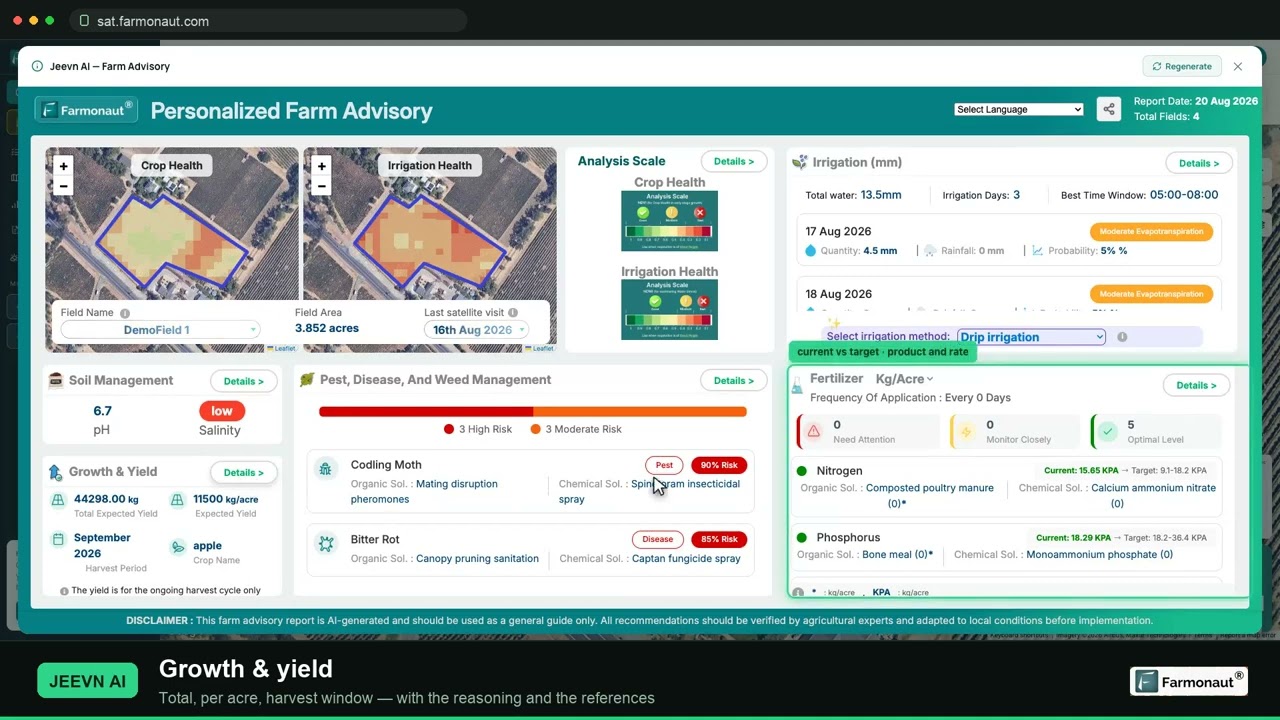
▶ Our walkthrough of satellite crop monitoring and reading NDVI on your own field. · 19:36
FAQ
What is the active ingredient in Pixxaro?
Halauxifen-methyl (Arylex active) plus fluroxypyr in the US and British products. Corteva’s Canadian program also lists MCPA ester.
Does Pixxaro control grasses?
No grass weeds appear on the US label’s controlled list. Use a labeled grass herbicide if you need one, and check tank-mix directions on both labels.
Can I use Pixxaro in corn or soybeans?
The US label covers wheat, durum, barley and triticale. Soybeans are on its list of sensitive crops. Corn and soybeans appear as rotation crops, not treated crops.
What is the Pixxaro rate per acre?
In the US, 6.0 fl oz per acre, once a year. In Britain, 0.5 L/ha, or 0.25 L/ha in winter oats. Follow your own product label.
What can I plant after Pixxaro?
In the US: wheat, barley and triticale right away, corn after 3 days, oats after 14 days, rye after 4 months, soybean and canola after 4 months, and peas after 9 months. Canada’s intervals are longer, so check the local label.
Is Pixxaro a residual herbicide?
Not for weed control. The US label says that only weeds emerged at treatment are controlled, so later flushes need another plan. It can still affect sensitive crops through treated soil, so follow the rotation intervals.
Farmonaut crop monitoring
See which parts of your fields need a walk first
Satellite maps show vegetation change across your fields, so you can plan scouting before a spray decision.




Keep reading

Sources
- US EPA, Pixxaro label amendment, Reg. 62719-735 (December 2023): www3.epa.gov
- Corteva UK, Pixxaro EC product page: corteva.com
- Corteva Canada, Pixxaro product page: corteva.com
- Corteva Australia, Pixxaro Arylex active page: corteva.com
- Corteva South Africa, Pixxaro 266 EC page: corteva.com
- University of Hertfordshire, Pesticide Formulations Catalogue: Pixxaro: sitem.herts.ac.uk
- Julius-Kühn-Archiv, Arylex active, Zypar and Pixxaro EC in cereals (2016): ojs.openagrar.de
- Flessner et al., Potential wheat yield loss due to weeds in the US and Canada, Weed Technology (2021): cambridge.org
- DTN, Kochia resistant to dicamba and fluroxypyr found in Kansas (2018): dtnpf.com
- Top Crop Manager, Fluroxypyr-resistant kochia confirmed in Alberta: topcropmanager.com
- Saskatchewan Pulse Growers, Kochia resistance update: Prairie surveys: saskpulse.com
- PNW Pest Management Handbooks, Kochia: pnwhandbooks.org
Discussion
Questions, corrections or field experience? Share them below. First-time comments are reviewed before they appear, and your email is never published.
No comments yet. Be the first to add a question or your experience.

 Deluxe Conseil
 Krishify
 TVS Electronics
 BW Pipelines
 WICO
 Gen Chayat
 Chimera Innovation
 SkyHarvest
 Polaris Digitech
 Teledarbas
 Wild Oak Farm
 SFX
 BACF Africa
 Doodlakine
 Exurbia Geospatial

 Licence holder · Niger · Gold
 Client · Tanzania · Gold
 Client · Somalia · Gold
 Client & affiliate partner · Ghana · Gold










