

Coffee · EUDR sourcing guide
How to Source EUDR Compliant Coffee: 6 Steps and Data
Trace every lot to mapped plots, check those plots were not forest cleared after 31 December 2020, confirm legal production and file a due diligence statement. The rules apply from 30 December 2026 for large and medium operators and 30 June 2027 for small ones (European Commission).
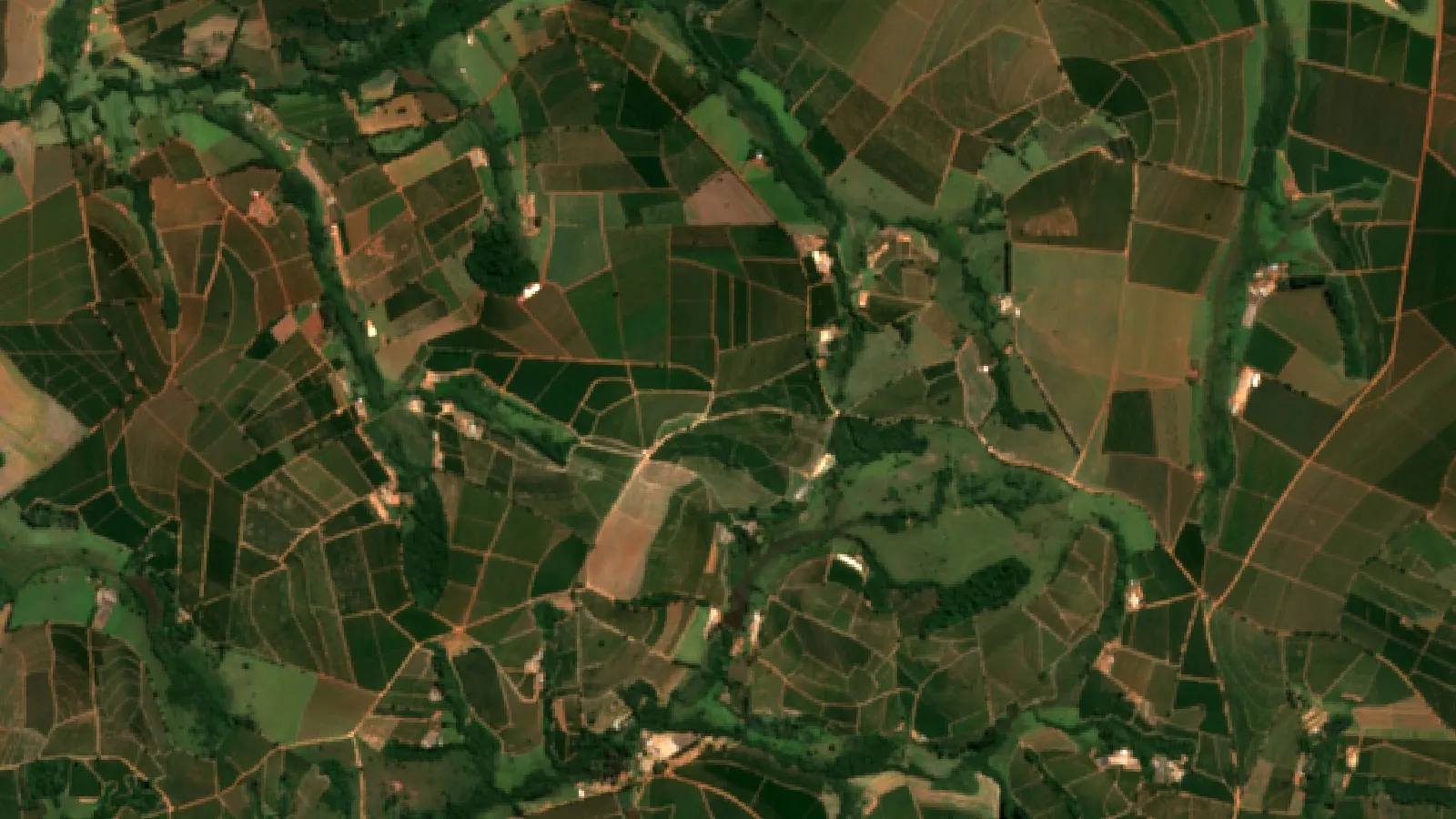
Key takeaways
- EUDR dates: 30 December 2026 for large and medium operators, 30 June 2027 for micro and small enterprises; the deforestation cut-off is 31 December 2020 (European Commission).
- Plots of 4 ha or less need one point with six decimals; larger plots need a polygon; files go to the EU Information System as GeoJSON in WGS-84 (Commission FAQ, April 2026).
- Vietnam, Costa Rica and Rwanda are low risk; Brazil, Colombia, Ethiopia, Honduras, Indonesia, Peru and Uganda are standard risk. Low risk still needs plot coordinates.
- The EU imported 46.5 million bags of green coffee in 2025/26, with 50.0 million forecast for 2026/27 (USDA FAS, July 2026).
- Field time to map plots is the main cost; the calculator on this page estimates it per 60-kg bag.
In this article
- What EUDR compliant coffee means
- Key dates and who must act
- Where EU coffee comes from and how each origin is rated
- How to source EUDR compliant coffee in 6 steps
- Plot geolocation for EUDR compliance: points, polygons and file format
- Checking plots against the cut-off date with satellites
- What it costs to map a supplier base
- Traceability across several coffee origins
- Common gaps and how to close them
- FAQ
To source EUDR compliant coffee, buy only lots you can trace to mapped plots, check that those plots were not deforested after 31 December 2020, confirm the coffee was grown legally, and pass the due diligence statement (DDS) reference down the chain. The European Commission says the rules apply to large and medium operators from 30 December 2026 and to micro and small enterprises from 30 June 2027.
This guide is for importers, roasters, exporters and farm managers. It covers the dates, what plot data you need, how origin countries are rated, a six-step sourcing plan, a cost calculator for mapping your supplier plots, and charts on where EU coffee comes from.
What EUDR compliant coffee means
The EU Deforestation Regulation (EUDR) covers seven commodities: cattle, cocoa, coffee, oil palm, rubber, soy and wood. Green coffee, roasted coffee and some coffee products are in scope. A lot of coffee meets the rules when three things are true.
- No deforestation after the cut-off. The coffee was grown on land that was not deforested after 31 December 2020.
- Legal production. It was grown in line with the laws of the country of production, such as land use, labour and tax rules.
- A statement on file. The operator filed a due diligence statement (or, for some small operators, a simplified declaration) in the EU Information System. The statement carries the geolocation of every plot.
The Commission’s EUDR overview page lists these conditions. It also notes that about 10 million hectares of forest are lost to deforestation each year, and that farm expansion is the main driver. A label or certificate can help your risk check, but it does not replace the statement or the plot data.
Key dates and who must act
The EU changed the timeline twice. A first amendment in December 2024 moved the start date. A second amendment on 19 December 2025 moved it again and changed some due diligence duties. The dates below come from the Commission page, checked on 12 November 2026.
| Date | What happens |
|---|---|
| 31 Dec 2020 | Cut-off date. Coffee from land deforested after this date cannot enter or leave the EU market. |
| 30 Dec 2026 | Rules apply to large and medium operators and traders. |
| 30 Jun 2027 | Rules apply to micro and small enterprises. |
| 30 Dec 2027 | Rules apply to products newly added to the scope list. |
The duty sits with the company that first places coffee on the EU market or exports it. In most chains that is the importer. The Commission’s EUDR FAQ (version 5, April 2026) says the regulation puts no direct duty on producers outside the EU unless they place products on the EU market themselves. In practice, though, buyers will ask farms, cooperatives and exporters for plot data. A farm without it may lose EU buyers.
Downstream buyers, such as a roaster that buys green coffee from an importer, need the DDS reference number from their supplier. The FAQ says downstream operators and traders must keep the information they collect for at least five years. Fines are set by each member state. For companies, the FAQ says the maximum fine cannot be lower than 4% of total annual EU turnover. This is general guidance, not legal advice: check the rules in the member state where you trade and get professional advice for your own case.
Where EU coffee comes from and how each origin is rated
The EU is a large buyer of green coffee. The USDA Foreign Agricultural Service puts EU green bean imports at 46.5 million 60-kg bags in 2025/26, with 50.0 million forecast for 2026/27 (Coffee: World Markets and Trade, July 2026). Brazil alone grows nearly 40% of world coffee, the same report says.
Chart
Coffee production forecast, selected origins
Million 60-kg bags, 2026/27 forecast
Each origin country has a risk class under the EU country benchmarking system. Implementing Regulation (EU) 2025/1093 sets the low-risk and high-risk country lists. Every country not listed is standard risk. The Commission’s country classification list shows the class for each country.
| Origin | EU risk class | What it means for buyers |
|---|---|---|
| Brazil | Standard | Full due diligence: collect data, assess risk, reduce risk. |
| Vietnam | Low | Simplified due diligence, but plot geolocation is still needed. |
| Colombia | Standard | Full due diligence. |
| Ethiopia | Standard | Full due diligence; many very small plots. |
| Indonesia | Standard | Full due diligence. |
| Uganda | Standard | Full due diligence; many very small plots. |
| Honduras | Standard | Full due diligence. |
| Peru | Standard | Full due diligence. |
| Costa Rica | Low | Simplified due diligence; geolocation still needed. |
| Rwanda | Low | Simplified due diligence; geolocation still needed. |
Four countries are high risk: Belarus, Myanmar, North Korea and Russia. None of them is a large coffee exporter. Low risk does not remove the need for plot coordinates. The FAQ states there is no exception from geolocation for low-risk countries, and that buyers must still check the risk of mixing with coffee of unknown origin.
Chart
EU green coffee bean imports
Million 60-kg bags, marketing years; 2026/27 is a forecast
How to source EUDR compliant coffee in 6 steps
These steps follow the order of the due diligence process in the Commission’s guidance: collect information, assess risk, reduce risk, then file. They work for an importer buying from a few large estates or from thousands of small farms through cooperatives.
Infographic
Sourcing EUDR compliant coffee in 6 steps
- 1Map the chainList suppliers and every point where lots are mixed.
- 2Collect geolocationPoints for plots up to 4 ha, polygons above.
- 3Check the cut-offCompare plots with forest maps from 2020 onward.
- 4Check legalityLand rights, permits, labour and tax evidence.
- 5Keep lots separateLot codes and segregated storage.
- 6File and pass onDDS in the EU Information System; keep records 5 years.
Step 1: Map your supply chain
List every supplier, the regions they buy from, and how lots are bulked. Find the points where coffee from different farms is mixed, such as collection centres, wet mills, dry mills and warehouses. Each mixing point is a place where traceability can break.
Step 2: Collect plot geolocation
Ask each supplier for the coordinates of every plot that grew the coffee in a lot. Set a clear data standard in your contracts: format, decimal places, plot ID, farmer ID and harvest dates. The next section covers the technical rules.
Step 3: Check each plot against the cut-off date
Compare each plot with forest maps and satellite images from before and after 31 December 2020. Flag plots where tree cover was cleared after the cut-off. Ask the supplier for evidence on every flag before you buy.
Step 4: Check legality
Collect evidence that the coffee was grown legally: land-use rights, environmental permits where they apply, labour rules and tax rules of the producing country. Cooperatives and national coffee bodies can often supply part of this.
Step 5: Keep lots separate
A lot is only as good as its weakest bag. If one bag of unknown origin is blended in, the whole lot can fail. Use segregated storage, lot codes on every bag and mass records at each mixing point.
Step 6: File and pass on the reference
The operator files the DDS in the EU Information System before the coffee clears EU customs. The reference number then travels with the coffee to downstream buyers. Keep all records for at least five years.
Plot geolocation for EUDR compliance: points, polygons and file format
This is the step most suppliers ask about. The Commission FAQ sets these rules for crops such as coffee:
- Plots of 4 hectares or less: one latitude and longitude point is enough. A polygon is also accepted.
- Plots over 4 hectares: a polygon is required. That means latitude and longitude points along the whole boundary.
- Precision: coordinates need six decimal places.
- File format: the Information System accepts manual entry or a GeoJSON file in WGS-84 coordinates (EPSG:4326). One declaration file can be up to 25 MB.
- Small operators in low-risk countries: a micro or small primary operator that places coffee on the EU market directly can give a postal address instead, if it clearly matches the plot location.
The FAQ says coordinates can be collected with mobile phones, handheld GNSS receivers and GIS apps, and that a GNSS signal is enough; no mobile network is needed in the field. A common method is to walk the boundary of larger plots with a phone app and take one point near the centre of smaller ones. Many coffee farms are small: a field team can often record a point in minutes, while a polygon takes longer because someone must walk the edge.
Common errors to check before you accept a supplier file: points that fall in a town or a river, swapped latitude and longitude, too few decimals, polygons that cross themselves, and one point used for several farms. A quick map check catches most of these.
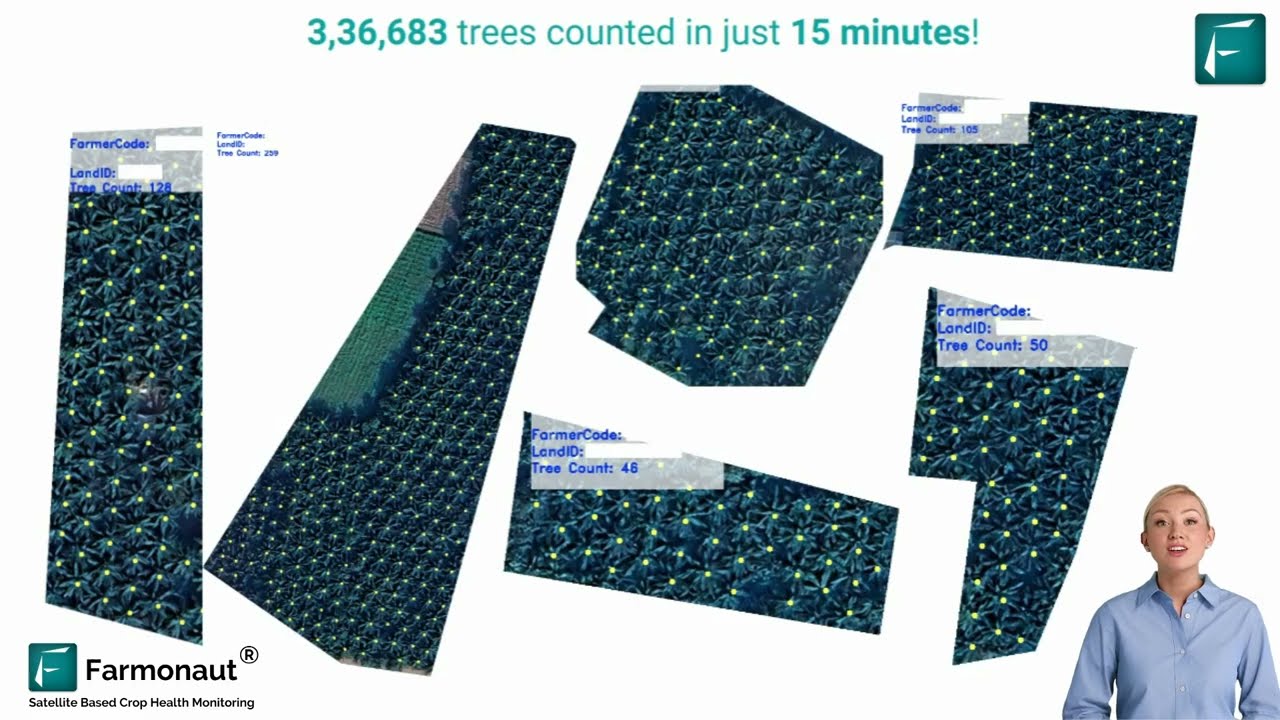
▶ How satellite and AI tree detection maps the location of each tree in a plantation · 4:05
Checking plots against the cut-off date with satellites
Once you have coordinates, you need to show that each plot was not forest cleared after the cut-off. Satellite images make this possible at scale. The EU Forest Observatory offers a global forest cover map for 2020, built to support the regulation. It is a reference, not a legal verdict, so treat a match or a mismatch as a reason to look closer.
Open Copernicus data is widely used for these checks. The Sentinel-2 mission images land at up to 10 m resolution and revisits each place every 5 days at the equator, according to the Copernicus SentiWiki. That is fine enough to see clearing on most coffee plots and frequent enough to build cloud-free views in wet regions.
Shade-grown coffee is a special case. Coffee under a tree canopy can look like forest on a map. A plot that was shaded coffee in 2020 and is still shaded coffee is not new deforestation, but a broad forest map may flag it. Keep photos, farm records and image time series ready to explain such plots.
Forest loss is still large in coffee regions. The World Resources Institute reports that 4.3 million hectares of tropical primary forest were lost in 2025, 36% less than in 2024, with farm expansion the leading cause of tree cover loss in the tropics. Brazil cut its primary forest loss by 42% in 2025 and Colombia by 17%, the same analysis says.
Farmonaut Satellite + AI Farm Monitoring System lets you draw or upload field boundaries and view satellite images and vegetation indices for each field over time. Teams that manage many plots can use this to review plot history before a purchase.
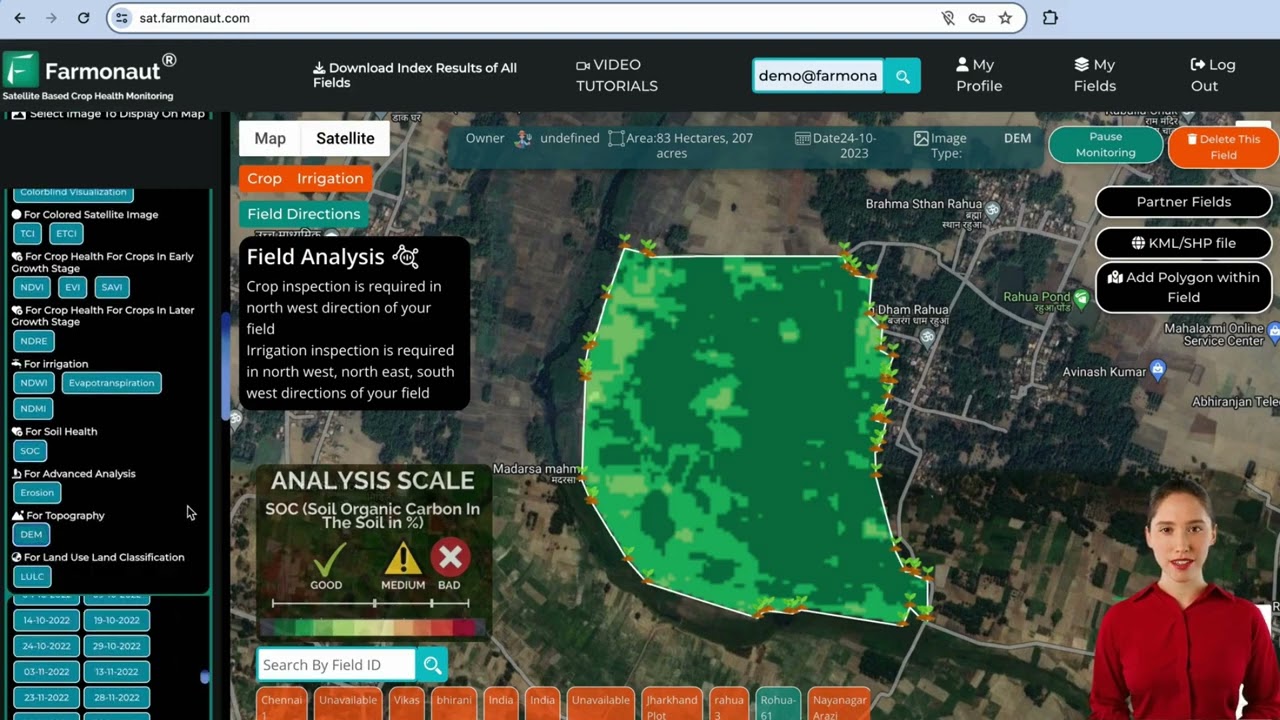
▶ Tutorial: drawing fields and viewing satellite layers in the Farmonaut web app · 8:02
What it costs to map a supplier base
The largest cost for most buyers is field time to collect coordinates. Use the calculator below with your own numbers. It splits plots into point plots (4 ha or less) and polygon plots (over 4 ha), then gives total field hours, cost and cost per 60-kg bag.
The default values are examples only. Field time per plot depends on terrain, travel, farm size and how many plots each farmer has. Ask your supplier or field team for their real times.
Try the numbers for your own farm below.
Calculator
How much will it cost to map your supplier plots?
Enter your own plot count, field times and costs.
- Total field hours: 133.3 hours
- Plots needing a polygon: 100 plots
- Mapping cost per 60-kg bag, US$: 0.53 US$/bag
Example values only, not benchmarks. The 4-hectare split between point plots and polygon plots follows the European Commission EUDR FAQ (version 5, 2026). Field times, labour cost and volume are inputs you should replace with your own.
Traceability across several coffee origins
Importers that buy from several regions face a harder task. Each origin has its own risk class, plot sizes, supplier types and data quality. A few practices help keep data consistent:
Chart
Production change by origin, 2021/22 to 2026/27
Million 60-kg bags, selected origins (2026/27 forecast)
- One data template for all origins. Use the same fields for plot ID, farmer ID, coordinates, area, harvest dates and lot codes everywhere.
- One map store. Keep all plots in one GIS layer or database, not in many supplier spreadsheets.
- Lot links. Each export lot record lists the plot IDs it came from. Do not rely on region names.
- Risk by origin. Spend more checking effort on standard-risk origins and on suppliers with mixing points you cannot see.
- Yearly refresh. Plots change. Farmers sell land, plant new areas and join new cooperatives. Update the map before each harvest.
Larger buyers often connect plot data to their own systems through an API. Field data and satellite layers then sit next to contracts and lot records, which makes the DDS faster to prepare.
Common gaps and how to close them
Most coffee chains were not built for plot-level tracing. These are the gaps buyers report most often, with a practical fix for each.
- Middlemen with no records. Local traders buy from many farms without written records. Fix: buy through cooperatives or exporters that register farms, or pay traders to record plot IDs.
- Smallholders without tools. Many farmers have no smartphone or training. Fix: send field teams, or train cooperative staff to map members. The Commission says the EU and its member states have mobilised EUR 81.5 million through Team Europe to support partner countries and smallholders in more than 26 countries.
- Data privacy. Farmers may not want their location shared widely. Fix: agree in writing who sees the data and why, and share only what the statement needs.
- Cost sharing. Mapping costs money. Fix: agree who pays, for example a per-bag fee or a premium for traceable lots.
- Mixed lots. Fix: keep traceable coffee separate from the warehouse door to the ship.
Coffee that you cannot trace to a plot cannot be placed on the EU market under the rules. It can still be sold to other markets, but many roasters supply several regions and may prefer one traceable stream.
Land use matters for plot checks too. Our guide to land use types explains how farmland, forest and other classes are defined. For the wider set of monitoring tasks, see our page on EUDR deforestation monitoring steps.
Related pages on our site: field monitoring app · satellite data API · API developer documentation
▶ Adding, editing and managing farm records through the Farmonaut API · 6:06
FAQ
How do I source EUDR compliant coffee?
Buy from suppliers that can give you plot coordinates for every lot, check those plots against the 31 December 2020 cut-off, gather proof of legal production, keep lots separate, and file or receive a due diligence statement reference. Start with your largest origins and suppliers.
When does the EUDR apply to coffee?
From 30 December 2026 for large and medium operators and traders, and from 30 June 2027 for micro and small enterprises, according to the European Commission. The cut-off date for deforestation is 31 December 2020.
How do I collect plot-level geolocation data for EUDR compliance?
Use a phone app or handheld GNSS receiver. Record one point with six decimal places for plots of 4 hectares or less, and walk the boundary to make a polygon for larger plots. Export the data as GeoJSON in WGS-84 for the EU Information System.
Do coffee farmers have to file anything themselves?
Not unless they place coffee on the EU market directly. The legal duty falls on the importer or exporter. Farmers are still asked for plot data by buyers, so having it ready helps them keep EU sales.
Does coffee from a low-risk country need geolocation?
Yes. Low-risk origins, such as Vietnam, Costa Rica and Rwanda, get simplified due diligence, but the Commission FAQ says there is no exception from the geolocation requirement.
Can certification replace EUDR due diligence?
No. A certificate can support your risk assessment, but the operator remains responsible for the statement and must still hold plot data for every lot.
Farmonaut crop monitoring
Review your coffee plots from space
Draw or upload field boundaries and view satellite images of each plot over time.




Keep reading

Sources
- European Commission, EU Deforestation Regulation (EUDR) overview and key dates (2026): environment.ec.europa.eu
- European Commission, EUDR Frequently Asked Questions, version 5 (April 2026): environment.ec.europa.eu
- European Commission, Guidance Document for the Regulation on Deforestation-Free Products (2026): green-forum.ec.europa.eu
- EUR-Lex, Commission Implementing Regulation (EU) 2025/1093, country risk lists (2025): eur-lex.europa.eu
- European Commission Green Forum, EUDR country classification list: green-forum.ec.europa.eu
- European Commission Green Forum, Deforestation Regulation implementation and Information System: green-forum.ec.europa.eu
- USDA Foreign Agricultural Service, Coffee: World Markets and Trade (July 2026): apps.fas.usda.gov
- European Commission, EU Forest Observatory (2020 global forest cover map): forest-observatory.ec.europa.eu
- Copernicus SentiWiki, Sentinel-2 mission: sentiwiki.copernicus.eu
- World Resources Institute, Global Forest Review: tropical rainforest loss in 2025 (2026): gfr.wri.org
Discussion
Questions, corrections or field experience? Share them below. First-time comments are reviewed before they appear, and your email is never published.
No comments yet. Be the first to add a question or your experience.

 Save Your Soils
 GalaxEye Space
 Grandstream Algérie
 XOS Realty
 Geospatial Lab Africa
 Agro La Gándara
 HIPSAC
 ZOL Zimbabwe
 Juligerm
 AdBio
 MISE Maroc
 NWNS
 Red August Group
 Farm Inc
 WeMe Global
 Agrotoken
 Blue BearX
 Insignito
 DnCubed
 Indosistim Teknologi
 Liquify Digital
 CU Foods
 BeyondTech Global
 Rouge VC
 AgroGreen Dynamics

 Licence holder · Niger · Gold
 Client · Somalia · Gold










