

Agriculture Loans in Mahomet & Columbia: Rates & Terms
Reviewed September 2026 against USDA Farm Service Agency and USDA National Agricultural Statistics Service data.
Try it: Run your own numbers →
Agriculture loans in Mahomet and Columbia are priced off the same national benchmarks every US farm borrower sees: the USDA Farm Service Agency’s monthly direct-lending rates, and the Farm Credit System and commercial banks that together hold the vast majority of US farm debt. As of August 2026, FSA’s Direct Farm Operating Loan rate is 5.25% and its Direct Farm Ownership Loan rate is 6.00%, while commercial and personal loans in Mahomet run on standard bank underwriting rather than a farm-specific program. This guide walks through what each loan type actually costs, how much land in these regions is worth as collateral, and where to check the numbers yourself once they move.
Overview: What “Agriculture Loans” Means for Mahomet and Columbia
“Agriculture loans” is not one product. For a borrower researching agriculture loans Mahomet or agriculture loans Columbia, the practical menu is: USDA Farm Service Agency direct and guaranteed loans, Farm Credit System financing, and commercial bank agricultural lending — plus, for non-farm borrowers in the same towns, ordinary commercial loans Mahomet and personal loans Mahomet products that carry no farm-specific underwriting at all. The FSA sets published national rates monthly; Farm Credit and commercial banks price off those benchmarks plus their own risk spread, which is not published nationally and has to be quoted per lender.
Nationally, the Farm Credit System held $456.9 billion in outstanding loans at the end of 2024 and accounted for 45.82% of US agricultural debt in 2023, according to Farm Credit System data reported via farmdocdaily and the USDA Economic Research Service. Commercial banks held $212 billion in farm loans outstanding at the end of 2025, per FDIC data reported by Capital Press. Those two figures alone explain why a Mahomet or Columbia producer typically gets quotes from both a Farm Credit association and a local bank before choosing — the two lender types are roughly the same order of magnitude in scale, but their underwriting and relationship terms differ.

Current Rates: FSA, Farm Credit and Commercial Banks
The only agricultural lending rates published nationally and updated on a fixed schedule are USDA FSA’s direct-loan rates. As of the August 2026 announcement from the USDA Farm Service Agency, three rates apply:
- 5.25% — Direct Farm Operating Loan rate
- 6.00% — Direct Farm Ownership Loan rate
- 4.00% — Joint Financing Farm Ownership Loan rate (used when FSA co-finances alongside another lender)
These are not fixed for the life of a loan program — FSA revises them monthly. A Mahomet or Columbia producer checking current pricing should go directly to USDA FSA’s news and announcements page, which posts the new rate schedule at the start of each month, or subscribe to FSA’s email updates for automatic notice.
Loan size caps are also fixed by statute rather than by region: the maximum FSA Direct Operating Loan is $400,000, and the maximum FSA Guaranteed Operating Loan (where FSA guarantees a portion of a loan made by a bank or Farm Credit lender rather than lending directly) is $2,251,000, per the USDA Farm Service Agency’s farm operating loan page. Direct Operating Loan repayment terms run 1 to 7 years depending on the purpose of the loan and the collateral pledged.
Farm Credit System and commercial bank rates for commercial loans Mahomet and ag loans big timber-scale operations are not published in a single national table — they are quoted per applicant based on credit profile, collateral, and loan purpose, and move with each institution’s own cost of funds. To get a current commercial quote, a borrower contacts a local Farm Credit association or bank directly; FSA’s published rates above are the only fixed reference point and are useful as a floor for comparison, since Farm Credit and bank pricing typically sits at a spread above or below the FSA benchmark depending on the borrower’s risk profile.
Agriculture, Commercial and Personal Loans in Mahomet
Mahomet sees search demand across three distinct loan categories — agricultural, commercial, and personal — and each is underwritten differently:
Agriculture Loans Mahomet
- FSA Direct and Guaranteed Operating Loans, priced at the national rates above, for seed, fertilizer, equipment, and livestock purchase
- FSA Direct and Guaranteed Farm Ownership Loans for land acquisition or farm real estate improvements, priced at 6.00% direct as of August 2026
- Farm Credit System financing, available through the regional Farm Credit association serving the area — one of the lenders holding a combined 45.82% national market share as of 2023
- Commercial bank agricultural lending, part of the $212 billion in bank-held farm loans nationally at the end of 2025
Commercial Loans Mahomet
For a non-farm business — a grain elevator, an equipment dealer, an agribusiness supplier — commercial loans Mahomet searches usually mean standard business lending from a local or regional bank: term loans, lines of credit, and equipment financing underwritten on business cash flow and collateral rather than on FSA farm-loan criteria. These are not part of the FSA rate schedule above; a business borrower should request a rate quote directly from prospective commercial lenders, since no national published rate applies.
Personal Loans Mahomet
Personal loans Mahomet searches typically target consumer lending — debt consolidation, home improvement, or unsecured credit — which is unrelated to agricultural underwriting entirely. Personal loan rates depend on the individual borrower’s credit score and the lender’s consumer-lending terms; local banks and credit unions serving Mahomet are the direct source for current personal loan rates, since neither FSA nor the Farm Credit System issues personal (non-agricultural) consumer credit.

Agriculture Loans in Columbia
Agriculture loans Columbia follow the same FSA/Farm Credit/commercial-bank structure described above — there is no separate Columbia-specific loan program in USDA or Farm Credit data. Producers in Columbia evaluating operating capital for crop diversification, irrigation equipment, or precision-agriculture tools should apply the same national FSA benchmarks (5.25% direct operating, 6.00% direct ownership as of August 2026) as a starting comparison point when a Farm Credit association or bank quotes a rate. For readers researching a related market, Farmonaut’s companion guide covers agriculture loans in Great Falls, Columbia Falls and O’Fallon, a distinct set of locations from the Columbia covered here.
Loan proceeds for row-crop and mixed-farming operations commonly cover crop insurance and revenue protection bundled alongside the operating loan itself — Farmonaut’s crop loan and insurance page outlines how that bundling works for producers evaluating both financing and risk coverage together.
Agricultural Land Management in Robbinsville, NJ
Searches for agricultural land management Robbinsville NJ point to a narrower need than a loan product: farmland owners and operators in Robbinsville Township, Mercer County, managing active cropland or preserved farmland want tools for monitoring soil condition, crop health, and compliance documentation — often the same documentation a lender or a state farmland preservation program requires. New Jersey’s farmland is a small fraction of national acreage, and the USDA NASS land-value data cited below reports at the national and regional level rather than isolating individual New Jersey townships; a Robbinsville landowner wanting a parcel-specific value should consult the USDA NASS state office for New Jersey or a licensed local appraiser, since township-level figures are not part of NASS’s published national aggregates.
For ongoing land management rather than a one-time appraisal, satellite-based monitoring gives an owner or lender continuous vegetation and soil-condition data instead of a single site visit — the same verification approach covered in the Farmonaut section below.
Land Values: What Lenders See as Collateral
Collateral value drives both loan approval and loan size, and USDA National Agricultural Statistics Service publishes the only national, government-sourced benchmark for US farm real estate. As of the July 2026 USDA NASS land values report:
- $6,020 per acre — US average farm cropland real estate value
- $2,000 per acre — US average farm pasture real estate value
- $8,590 per acre — Corn Belt cropland value (Illinois, Indiana, Iowa, Missouri, Ohio), reflecting the higher productivity of that region relative to the national cropland average
These figures come from the DTN/Progressive Farmer summary of the USDA NASS land values report. NASS does not isolate figures for Mahomet, Columbia, or Robbinsville specifically in this report — only national and multi-state regional averages are published at this level. A borrower or lender in any of these locations wanting a county-level or state-level figure can query USDA NASS’s annual Land Values and Cash Rents Highlights report, updated each August with the prior year’s data, or run a custom query in the NASS farm real estate value map and Quick Stats database by state and county.



Loan Payment Calculator
Use the calculator below to estimate a monthly and total payment for an FSA-rate or custom-rate agriculture, commercial, or personal loan — enter your own loan amount, rate, and term to compare scenarios rather than relying on a single example figure.
Run your own numbers
Assumes a fixed-rate, fully amortizing loan with equal monthly payments and no fees, points, or balloon payment. It excludes FSA guarantee fees, closing costs, appraisal costs, and any lender-specific spread above the published FSA rate — actual Farm Credit and commercial bank quotes will differ. FSA rates shown are the August 2026 published rates and change monthly; check USDA FSA’s news page for the current rate before applying it to a real decision.
Comparing Lender Types
The table below summarizes the three lender categories a Mahomet, Columbia, or Robbinsville borrower will encounter, using only nationally published figures — no region-specific rate exists for any of these lenders at the town level.
| Lender Type | National Scale | Published Rate (2026) | Typical Loan Cap | Repayment Term | Best Fit |
|---|---|---|---|---|---|
| USDA FSA (Direct) | Government lender of last resort for credit-underserved farmers | 5.25% operating / 6.00% ownership (Aug 2026) | $400,000 (Direct Operating) | 1–7 years (operating) | Beginning or credit-underserved farmers who can’t qualify commercially |
| USDA FSA (Guaranteed) | FSA guarantees a bank/Farm Credit loan | Set by the underlying lender, guarantee reduces lender risk | $2,251,000 | Set by underlying lender | Larger operations wanting bank service with FSA-backed risk reduction |
| Farm Credit System | 45.82% of US ag debt (2023); $456.9B outstanding (end 2024) | Quoted per applicant, not nationally published | No fixed national cap | Varies by product (operating, real estate, equipment) | Established farm operations, land purchases, member-owned cooperative structure |
| Commercial Banks | $212B in farm loans outstanding (end 2025) | Quoted per applicant, not nationally published | No fixed national cap | Varies by product | Producers with existing banking relationships; also the source for commercial and personal loans in Mahomet |
How Land and Compliance Data Get Verified
Whichever lender a borrower uses, loan underwriting for real estate or expansion loans typically requires proof of the land’s current condition and use — crop cover, soil health trend, or compliance with any conservation terms attached to the loan. This is where satellite monitoring has become a practical substitute for repeated site visits, especially for lenders covering large or geographically spread portfolios across multiple counties in Illinois or Missouri, or across scattered parcels in New Jersey.
- Vegetation and soil monitoring gives a lender a time series rather than a single inspection date, useful for verifying that funded acreage is actually in the claimed use.
- Large-scale field mapping lets an agribusiness lender or Farm Credit association check collateral boundaries against actual planted area without a site visit for every parcel.
- Traceability records support loan applications tied to specific supply-chain or sustainability requirements some lenders now attach to larger operating loans.
Farmonaut’s guide to precision agriculture technology covers the broader toolset — drones, sensors, and data platforms — that Columbia-area diversified operations use alongside financing to reduce both production risk and, indirectly, the risk profile a lender assigns to the loan. Timber and forestry operations evaluating longer-cycle real estate financing can also review Farmonaut’s coverage of forestry production trends, relevant where Mahomet-area operations blend cropland with timber acreage.

Farmonaut: Satellite Verification for Loan Underwriting
Farmonaut provides satellite-based monitoring that agricultural lenders, Farm Credit associations, and individual producers in Mahomet, Columbia, and Robbinsville can use alongside a loan application or an ongoing land-management plan:
- Real-time vegetation health, soil condition, and crop-stage data through our crop loan and insurance verification platform, which lenders can use to validate land use during underwriting.
- Blockchain-based traceability for operations documenting sustainable practices as part of a loan’s conditions.
- API access (API; developer docs) so a lender or large operation can automate monitoring across a multi-parcel portfolio via large-scale farm management tools.
- Fleet management for operations coordinating equipment across scattered acreage, relevant for Mahomet’s mixed farming-and-forestry operations.
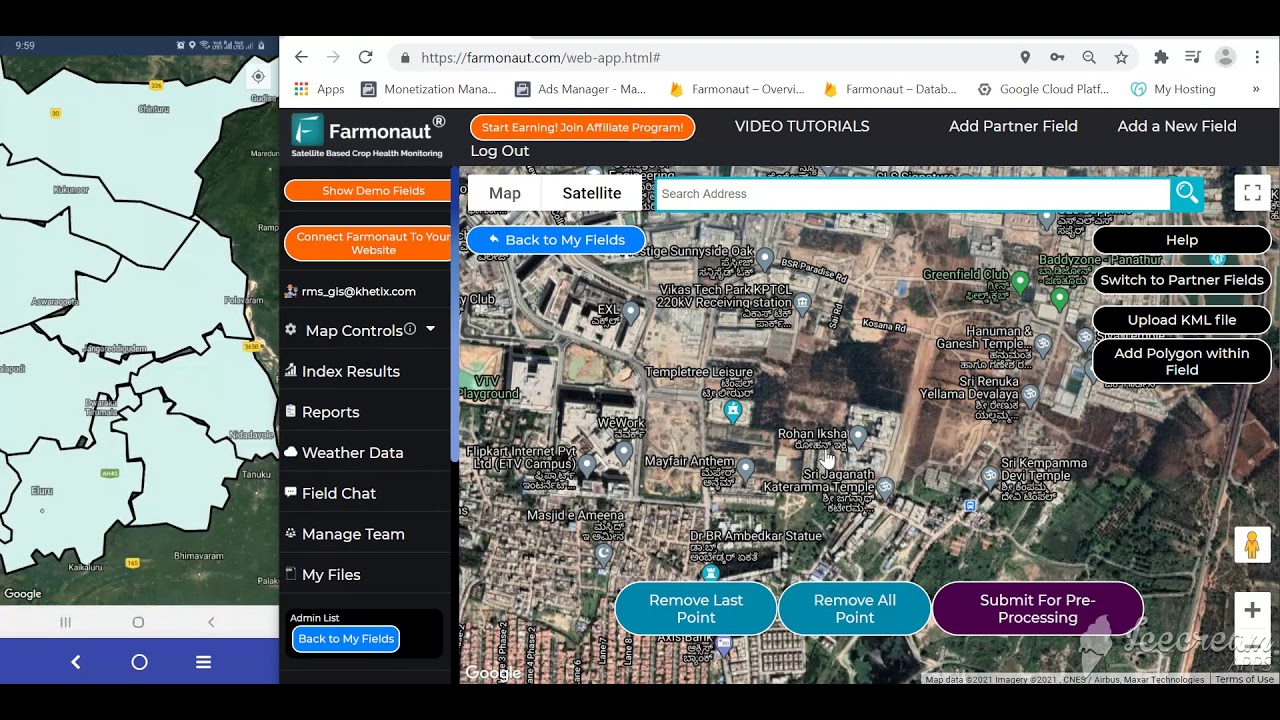
- An admin app for managers overseeing multiple farms or client accounts, useful for lenders monitoring a loan portfolio rather than a single borrower.


Get Started with Farmonaut Subscriptions
Video Resources
- 10 Low-Investment, High-Profit Agri Business Ideas: business models relevant to diversifying farm income alongside loan repayment.
- Regenerative Agriculture: Carbon Farming, Soil Health & Climate-Smart Solutions | Farmonaut: practices some lenders now factor into sustainability-linked loan terms.
- Smart Farming Future: Precision Tech & AI: Boosting Harvests, Enhancing Sustainability: technology relevant to Columbia’s diversified operations.
- Farmonaut For Admins Tutorial Video and Farmonaut Large Scale Field Mapping & Monitoring Tutorial: for lenders and managers verifying multi-parcel portfolios.
Frequently Asked Questions
What is the current USDA FSA interest rate for agriculture loans?
As of the August 2026 announcement, the FSA Direct Farm Operating Loan rate is 5.25%, the Direct Farm Ownership Loan rate is 6.00%, and the Joint Financing Farm Ownership Loan rate is 4.00%. FSA revises these monthly — check FSA’s news page for the current figures before applying them to a real loan decision.
How do commercial loans Mahomet differ from agriculture loans Mahomet?
Agriculture loans in Mahomet are underwritten against farm income, land, and equipment, and can draw on FSA’s published rates as a benchmark. Commercial loans Mahomet are standard business lending — term loans, lines of credit — underwritten on business cash flow with no FSA involvement and no nationally published rate; a business borrower requests a quote directly from a local bank.
Where do personal loans Mahomet rates come from?
Personal loans are consumer credit, priced on individual credit score and the lender’s own consumer-lending terms. Neither FSA nor the Farm Credit System issues personal loans — local banks and credit unions are the source, and rates are not part of any agricultural benchmark.
What is farmland worth per acre for loan collateral purposes?
USDA NASS reported a national average of $6,020 per acre for cropland and $2,000 per acre for pasture as of the July 2026 land values report, with Corn Belt cropland averaging $8,590 per acre. These are national and regional averages, not town-level figures for Mahomet, Columbia, or Robbinsville; a county-level estimate requires a query in USDA NASS’s farm value map and Quick Stats tool or a local licensed appraiser.
How does agricultural land management work in Robbinsville, NJ?
Robbinsville Township farmland owners typically combine state or county farmland assessment/preservation documentation with ongoing monitoring of soil and crop condition. USDA’s national land-value aggregates don’t isolate New Jersey township figures, so a Robbinsville-specific land value requires the state NASS office or a local appraiser; satellite monitoring tools can supply the continuous condition data that both lenders and preservation programs increasingly ask for.
What is the maximum loan amount available through USDA FSA?
$400,000 for a Direct Operating Loan and $2,251,000 for a Guaranteed Operating Loan, per USDA FSA’s farm operating loan program page. Amounts above the guaranteed cap require Farm Credit System or commercial bank financing outside the FSA program.
Where can I access Farmonaut’s monitoring technology?
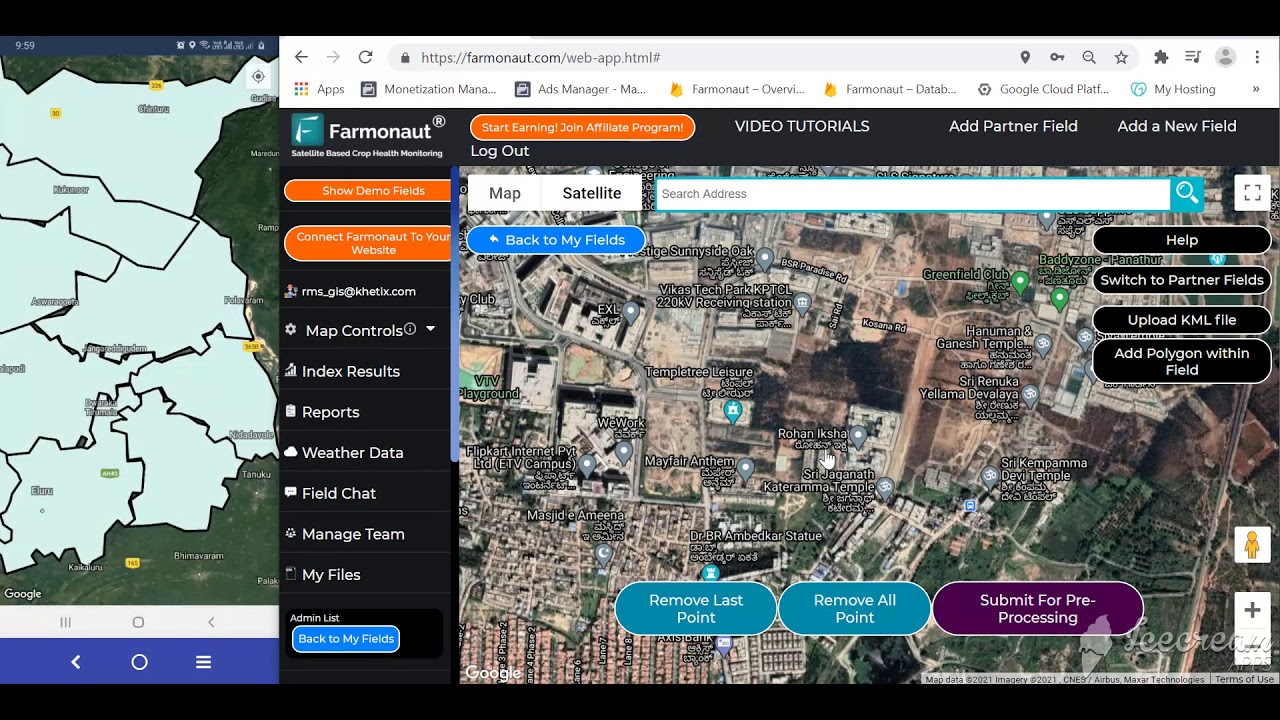
Farmonaut is available via web and mobile apps, with API and developer documentation for lenders and larger operations. Subscription options are listed above.





Conclusion
For a Mahomet or Columbia borrower, the fixed reference points are USDA FSA’s monthly rate schedule — 5.25% Direct Operating, 6.00% Direct Ownership, 4.00% Joint Financing Ownership as of August 2026 — and USDA NASS’s annual land-value report, which put national cropland at $6,020 per acre and Corn Belt cropland at $8,590 per acre in July 2026. Everything else — Farm Credit System and commercial bank rates, commercial loans Mahomet, personal loans Mahomet, and county-level land values for Mahomet, Columbia, or Robbinsville, NJ — is quoted per applicant or per county rather than published nationally, so the durable method is the same regardless of when you’re reading this: pull the current FSA rate from FSA’s news page, pull the current NASS land value for your specific county from the NASS Quick Stats tool, then request comparable quotes from a Farm Credit association and a commercial bank before choosing a lender.
Whichever lender you choose, satellite-based verification of land use and crop condition — through carbon footprinting tools, traceability applications, or large-scale management services — can support both the loan application and any ongoing compliance reporting the loan requires.
Ready to verify your land and streamline loan documentation?
Download the Farmonaut App or register online to get started.
All rates and figures in this guide are sourced from USDA FSA and USDA NASS as cited above and are current as of their publication dates; they are not financial advice. Confirm current rates and terms directly with USDA FSA, a Farm Credit association, or a commercial lender before making a borrowing decision.

 AgriSevak
 CU Foods
 BeyondTech Global
 Rouge VC
 Yutz Automation
 AgroGreen Dynamics
 AgroRisk
 Oath Inc
 Reddane Farming
 Esri North East Africa
 Cresol
 Atur Kuliner
 MDCV UK
 Zerella Group
 Etech Consulting Madagascar
 Vestlandsforsking
 Delicio
 WB Dev
 Sama Premium
 Prochecker
 Tres Valles
 LACOS Geoinformation
 Magrifly
 LatConnect 60
