

Mining · US bauxite guide
Bauxite Mines in the USA: Where They Are, What They Mine
The US still mines small amounts of bauxite in Alabama, Arkansas and Georgia, all for nonmetallurgical uses such as abrasives, cement, chemicals and refractories (USGS, 2026). Ore for aluminum is imported, mainly from Jamaica, and refined at one Louisiana plant. Here are the districts, reserves, trade numbers and the trade-offs.
Key takeaways
- In 2025 a limited amount of bauxite was mined in Alabama, Arkansas and Georgia for nonmetallurgical uses; the tonnage is withheld (USGS Mineral Commodity Summaries 2026).
- US reserves are about 20 million tons, under 0.1% of the world’s 29 billion tons; Guinea holds about 7.4 billion (USGS, 2026).
- The US imported about 3.0 million tons of bauxite in 2025; Jamaica supplied 60% of imports in 2021-2024 (USGS, 2026).
- Arkansas output peaked at more than 6 million long tons in 1943; the last public figure is about 1.24 million long tons in 1981 (Arkansas Geological Survey).
- About 4 tons of dried bauxite make 2 tons of alumina and 1 ton of aluminum, and refining leaves about 1.23 tonnes of residue per tonne of alumina (USGS; International Aluminium Institute).
In this article
- Are there bauxite mines in the USA today?
- Arkansas: the biggest bauxite field in US history
- US bauxite reserves compared with the world
- How the US gets bauxite for aluminum
- How bauxite mining works
- Benefits of bauxite mining
- Problems and challenges in bauxite mining
- Bauxite market snapshot
- Satellites and mineral exploration
- Outlook for bauxite in the United States
- Frequently asked questions
- Key takeaways
Yes, the United States still has working bauxite mines, but they are small. In 2025 a limited amount of bauxite and bauxitic clay was mined in Alabama, Arkansas and Georgia, and all of it went to nonmetallurgical uses such as abrasives, cement, chemicals, proppants and refractories, according to the USGS Mineral Commodity Summaries 2026. The tonnage is withheld to protect company data. No US mine supplies ore for making aluminum: the country imports that bauxite, mainly from Jamaica.
This guide explains where the old and current bauxite districts are, how big US reserves are next to the world’s largest holders, what the country imports and refines, and what the benefits and problems of bauxite mining look like on the ground. All figures carry their source and date. A calculator lets you test the basic bauxite-to-alumina numbers with your own prices.
Are there bauxite mines in the USA today?
There are, but only for specialty products. The USGS says the US reported consuming about 1.7 million tons of bauxite in 2025, worth an estimated $54 million. About 63% of that bauxite was refined into alumina or aluminum hydroxide by the Bayer process. The rest went into abrasives, cement, chemicals, proppants for oil and gas wells, refractory bricks and slag control in steel mills.
US mine output is marked “W” (withheld) in every year from 2021 to 2025. The USGS Minerals Yearbook for 2022 gives a sense of scale: domestic mines supplied less than 5% of the US requirement for bauxite, and the country was reliant on imports for 100% of the metallurgical-grade bauxite it consumed. That means older claims of “over 5 million tonnes” of US bauxite output a year are not supported by any government data.
The short answer to “is bauxite mined in the US” is therefore: yes, in three southern states, in small pits that feed specialty markets, not aluminum smelters.
Where the US bauxite districts are
| State | Main districts | What the record shows |
|---|---|---|
| Arkansas | Saline and Pulaski counties, near the town of Bauxite | The largest US deposits; output peaked at more than 6 million long tons in 1943 (Arkansas Geological Survey) |
| Georgia | Andersonville district and northwest Georgia | First US bauxite mined near Rome from 1888; about 1.23 million long tons mined to 1960 (USGS Bulletin 1199-A) |
| Alabama | Eufaula district and northeast Alabama | Eufaula found in 1922; about 1.23 million long tons mined to 1960 (USGS Bulletin 1199-A) |
| Mississippi | Scattered small deposits | Small historic output; not named in the USGS 2026 summary |
| Tennessee, Virginia | Chattanooga district (Tenn.) and small Virginia deposits | About 3% (Tenn.) and 1% (Va.) of Southeastern output to 1960; no current mines |
Current mining is limited to Alabama, Arkansas and Georgia, the three states the USGS names for 2025. For a state-by-state look at where aluminum is made rather than mined, see our guide to bauxite and aluminum producing states.

▶ The pros and cons of strip mining, the surface method used for most bauxite. · 4:37
Arkansas: the biggest bauxite field in US history
Arkansas holds the largest bauxite deposits ever found in the United States. The Arkansas Geological Survey brochure on the history of bauxite in Arkansas says state geologist John C. Branner identified the ore in 1887, from a sample used to surface a road near Little Rock. The first 20 tons were shipped in 1896.
Production grew fast. Arkansas mines shipped about 170,000 long tons in 1913 and more than 560,000 long tons in 1918. In 1923 the state produced about half of the world’s bauxite. Cheaper, high-grade ore from northern South America then took market share, and by 1932 output had fallen to about 90,000 tons.
World War II changed everything. The federal government built a stockpile through the Metals Reserve Company from 1942, and Arkansas output hit its all-time peak of more than 6 million long tons in 1943. The War Production Board then cut deliveries back sharply. After the war, Alcoa found it more profitable to mine overseas, as the Encyclopedia of Arkansas entry on Bauxite, Saline County notes, and the company town of Bauxite shrank.
Arkansas output still ran above 1 million long tons a year through most of the 1950s to the 1970s. The survey’s table ends in 1981, at about 1.24 million long tons, the last year with public figures. Under Arkansas law, land mined by open-cut methods after 1971 must be reclaimed: pits are partly backfilled, high walls removed, acid spoil neutralised and the land replanted; the survey lists pasture, wildlife habitat, recreation and a community airport as possible future uses.
Georgia and Alabama: the Coastal Plain districts
The first bauxite mined in the United States came from Georgia, where mining began near Rome in 1888. A USGS study of bauxite deposits of the Southeastern United States (Bulletin 1199-A) counts 15 districts across Georgia, Alabama, Tennessee, Virginia and Mississippi. It estimates total Southeastern output from 1889 through 1960 at about 2.57 million long dry tons, split almost evenly between Georgia and Alabama.
The same study put the region’s reserves of commercial bauxite at about 1.06 million long tons, less than 1.5% of total US bauxite reserves at the time. Most of the rest lay in Arkansas. The Andersonville district in southwest Georgia and the Eufaula district in southeast Alabama sit in Coastal Plain farm country, where kaolin and bauxitic clay pits lie between row-crop fields and pine plantations.
Chart
Arkansas bauxite output in selected years
Thousand long tons per year
US bauxite reserves compared with the world
The USGS puts US bauxite reserves at about 20 million tons. That is less than 0.1% of the world total of 29 billion tons. Guinea alone holds about 7.4 billion tons, Australia 3.7 billion and Vietnam 3.1 billion.
Chart
Bauxite reserves: the US next to the largest holders
Million metric dry tons, the six countries with the largest reserves plus the United States
The USGS is direct about the gap: domestic resources of bauxite are inadequate to meet long-term U.S. demand. It adds that the US, like most aluminum-producing countries, has very large subeconomic resources of aluminum in clays and other materials. Those are not competitive with bauxite at current costs.
Reserves are the part of a resource that can be mined at a profit with today’s prices and technology. Resources are much larger: the USGS estimates world bauxite resources at 55 to 75 billion tons, with 32% in Africa, 23% in Oceania and 21% in South America and the Caribbean.
Who mines the most bauxite
World mine output reached an estimated 440 million tons in 2025, not counting the US. Guinea led with about 150 million tons, ahead of Australia at 97 million and China at 87 million. Brazil mined about 33 million tons and Jamaica about 6.2 million. Guinea’s output has grown fast, while Australia’s slipped slightly from 2024.
Chart
Bauxite mine output: 2024 vs 2025
Million metric dry tons, selected producers
How the US gets bauxite for aluminum
Because domestic ore goes to specialty uses, the bauxite used for alumina is imported. US imports were about 3.0 million tons in 2025, down from 3.88 million in 2021. From 2021 to 2024, Jamaica supplied 60% of imported bauxite, Turkey 16%, Guyana 9% and Australia 8%, according to the USGS Mineral Commodity Summaries 2026.
Chart
US bauxite imports and reported use
Thousand metric dry tons per year; 2025 is an estimate
The average import value of crude dry bauxite was about $32 per ton in 2025 (free alongside ship, a USGS customs unit value, not a spot price). Metallurgical-grade alumina imports averaged about $590 per ton. Those are trade averages; contract prices between miners and refiners are not public.
Net import reliance for bauxite has stayed above 75% of apparent use in every year since 2021. For alumina it rose from 58% in 2021 to 71% in 2025, because more alumina was imported, mainly from Brazil.
The one working alumina refinery
In 2025 one US alumina refinery was running on imported bauxite: a 1.2-million-ton-per-year plant at Gramercy, Louisiana. A 500,000-ton plant at Burnside, Louisiana, has been idle since August 2020. US alumina output was an estimated 710,000 tons in 2025, and about 70% of it went to aluminum smelters.
The Gramercy plant is run by Atlantic Alumina (ATALCO). In January 2026 the company announced a $450 million deal with the US government to secure alumina output and build a gallium production circuit at the site, as reported by Aluminium Today. Gallium is recovered as a by-product of alumina refining, and ATALCO expects the plan to yield over one million tons of alumina and up to 50 tons of gallium a year.
How bauxite mining works
Bauxite is a rock, not a single mineral. It forms when heavy tropical weathering strips silica and other elements out of rock or sediment and leaves aluminum hydroxides behind, mainly gibbsite, boehmite and diaspore. That is why the largest deposits sit in warm, wet regions such as West Africa, northern Australia and the Caribbean. The US deposits formed in a warmer climate tens of millions of years ago.
Most bauxite lies near the surface, so it is dug in open pits or strip mines:
- Clear vegetation and store the topsoil for later use.
- Remove the overburden above the ore.
- Dig the bauxite with excavators, loaders or surface miners.
- Crush, wash and sometimes dry the ore.
- Ship it to an alumina refinery, where the Bayer process dissolves the alumina in hot caustic soda.
- Smelt the alumina into aluminum by electrolysis (the Hall-Héroult process).
- Backfill, reshape and replant the mined land.
You can read more about the methods in our guides on how strip mining is done and the bauxite refining process, and in our look at alumina mining and refining worldwide.
From bauxite to aluminum: the 4-2-1 rule
The USGS uses a simple rule: about 4 tons of dried bauxite make 2 tons of alumina, which in turn make 1 ton of aluminum. The exact ratio depends on how much available alumina and reactive silica the ore holds. Low-grade or high-silica ore needs more tons per ton of alumina.
The ratio explains why aluminum makers want high-grade ore close to a port or a refinery, and why small US deposits struggle to compete. It also explains the waste problem described below: half or more of the ore’s weight ends up as residue.
Try the numbers for your own farm below.
Calculator
Bauxite to alumina: tonnes and margin
Enter your own tonnage, ore ratio, prices and refining cost.
- Alumina produced: 50,000 t
- Aluminum it could make (2 t alumina per t): 25,000 t
- Bauxite cost: 3,200,000 US$
- Residue to store: 61,500 t
Example values only, set near break-even; they are not a benchmark or forecast. The default ratio of 2 t bauxite per t alumina and 2 t alumina per t aluminum follow the USGS general rule (Mineral Commodity Summaries 2026, footnote 1); real ores vary. Default prices are USGS 2025 average import unit values (free alongside ship), not spot or contract prices: use today’s prices. The refining cost is an example input that should include energy, caustic soda, labour and residue handling. Get professional advice before any investment decision.
Benefits of bauxite mining
When it is planned and run well, bauxite mining brings real gains, mostly to the region around the mine and to the industries that use aluminum and alumina.
- Jobs and local income. Mines, haul roads, refineries and ports employ people directly and support local suppliers. ATALCO says its Gramercy plan will create more than 500 jobs in Louisiana.
- Raw material for specialty products. US bauxite feeds abrasives, refractories, high-alumina cement and proppants, products where a nearby supply cuts freight costs.
- A base for aluminum. Aluminum is light, strong and resists corrosion, so it is used in vehicles, aircraft, power lines, packaging and buildings.
- Supply security. ATALCO says its alumina has served US aerospace, defense and automotive supply chains since 1959. Domestic refining reduces the risk of a sudden supply cut.
- Tax revenue. Mines pay royalties, property tax and income tax. US law gives domestic bauxite a 22% depletion allowance, against 14% for foreign bauxite (USGS).
- Land that can be reused. Arkansas law requires mined pits to be reclaimed, and the state survey lists pasture, wildlife habitat and recreation among possible future uses.
Aluminum also recycles well. The Aluminum Association says recycled aluminum needs about 5% of the energy used to make new metal, and that around 75% of all aluminum ever produced is still in use. Every ton recycled is a ton that does not need about 4 tons of fresh bauxite.
▶ How mining feeds a local and national economy, from jobs to taxes. · 5:03
Problems and challenges in bauxite mining
Bauxite mining also brings costs that miners, regulators and neighbours have to manage. Here are the main ones, with what the record shows.
1. Land disturbance
Bauxite seams are wide and shallow, so a mine clears a large area per ton of ore. Vegetation, topsoil and habitat are removed, and the land stays disturbed until it is reclaimed. Our guide to the disadvantages of open-pit mining covers the wider impacts.
2. Water and acid drainage
Exposed spoil can wash into streams as sediment. In Arkansas the survey notes that the top layer of mine spoil was acid and had to be neutralised before plants could grow. Runoff controls, settling ponds and fast replanting reduce the risk.
3. Refinery residue (red mud)
The biggest waste stream comes after mining. The International Aluminium Institute’s residue guidance gives a typical global average of 1.23 tonnes of residue per tonne of alumina produced, with a range of 0.55 to 2.21. This residue is alkaline and must be held in engineered storage facilities until it is closed and replanted. At the 710,000 tons of US alumina made in 2025, the global average ratio points to roughly 870,000 tons of residue a year.
4. Energy and emissions
Refining and smelting use large amounts of heat and electricity. The Bayer process burns fuel to heat caustic liquor, and smelting needs steady, low-cost power. High energy costs have idled US smelters in recent years, which in turn cuts demand for alumina.
5. Weak domestic economics
US deposits are small and lower in grade than those in Guinea or Australia. Imported ore at about $32 a ton sets a low bar. Prices and supply also depend on events abroad: in 2025 Guinea revoked one company’s bauxite licences, and Indonesia’s 2023 export ban cut its bauxite output, the USGS reports.
6. Communities and land use
New mines need roads, water and power, and they share land with farms, forests and homes. In Arkansas, the company town of Bauxite shrank once mining moved overseas, and is now a commuter town for Little Rock. Clear benefit sharing, dust and noise controls, and honest reporting matter for a social licence to operate.
Rules differ by state and by land type. Anyone planning a mine or buying mineral rights should check state and federal permit rules and get professional legal and technical advice.

▶ Seven environmental impacts of mining, from land clearing to water. · 2:31
Bauxite market snapshot
The table below gives the main US and world numbers side by side. All rows come from the USGS Mineral Commodity Summaries 2026.
| Measure | 2024 | 2025 (est.) |
|---|---|---|
| US mine output | Withheld | Withheld |
| US bauxite imports | 2.92 Mt | 3.0 Mt |
| US bauxite consumed | 1.64 Mt | 1.7 Mt |
| US alumina output | 700,000 t | 710,000 t |
| Bauxite import value | $31/t | $32/t |
| Alumina import value | $580/t | $590/t |
| World mine output | 428 Mt | 440 Mt |
| US reserves | About 20 Mt | |
| World reserves | About 29 billion t | |
Values are USGS customs unit values (free alongside ship), not spot or contract prices. Mt means million metric tons.
Satellites and mineral exploration
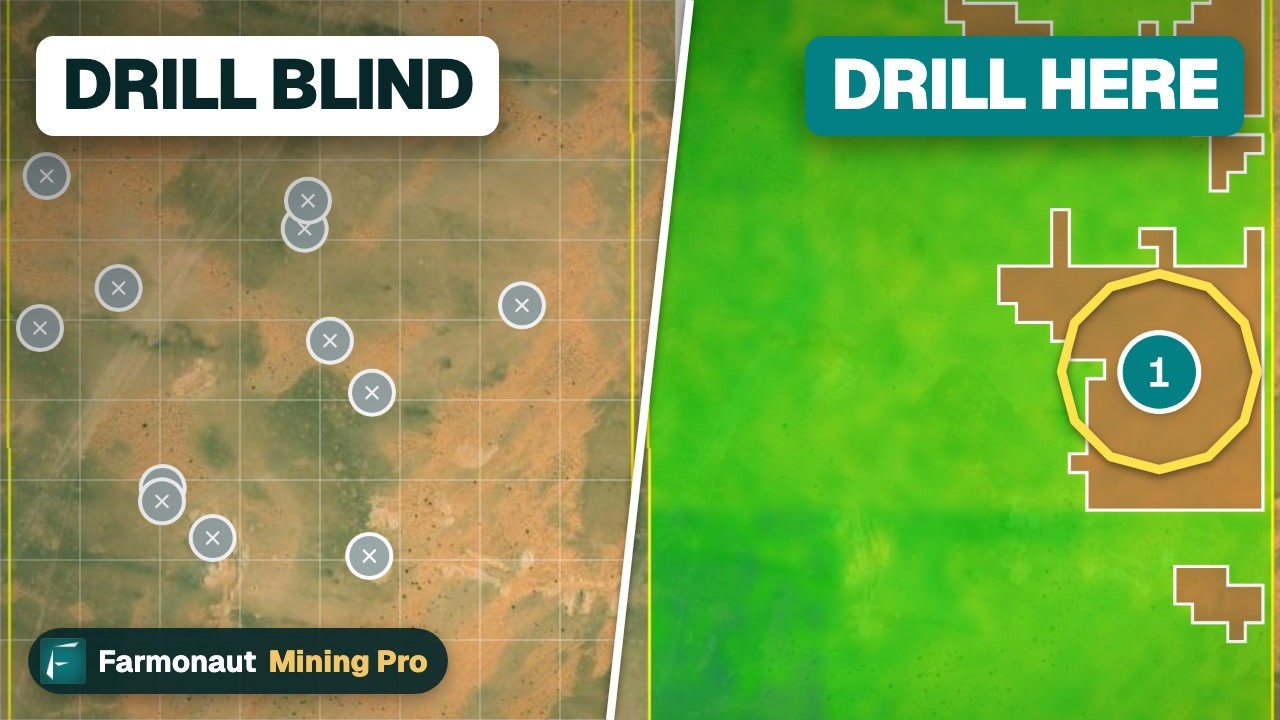
Because bauxite forms at the surface, it often leaves signs that satellites can measure: red, iron-rich soils, changes in vegetation and clay minerals in the topsoil. Explorers combine these maps with geology, drilling and assays. Satellite data can narrow down where to look and track how a mine and its reclamation change over time, but only drilling confirms a deposit.
Farmonaut, a US-based company, offers satellite mineral exploration maps that rank where surface signs of mineralisation are strongest, as a first step before field work. Our article on modern earth exploration technologies explains the wider toolset, and bauxite mining sustainability looks at cleaner methods. For a broader view of how mines and farms share land, see mining impacts on agriculture.
Outlook for bauxite in the United States
New large bauxite mines in the US look unlikely, because the deposits are small next to Guinea’s or Australia’s and imported ore is cheap. The more likely changes are in refining and recycling:
- Refining: the Gramercy refinery’s gallium plan and federal support could keep domestic alumina output steady or higher.
- Specialty bauxite: Alabama, Arkansas and Georgia pits should keep supplying refractories, abrasives and proppants.
- Other sources of alumina: the USGS says clays, alunite and anorthosite are technically possible sources but not yet economic.
- Recycling: more scrap use cuts the need for new bauxite and saves energy.
- Supply risk: with more than 75% import reliance, events in Jamaica, Guinea or Brazil will keep shaping US alumina supply.
Frequently asked questions
Does the US have bauxite deposits?
Yes. The largest are in central Arkansas, with smaller ones in Georgia, Alabama, Mississippi, Tennessee and Virginia. The USGS puts US reserves at about 20 million tons, under 0.1% of the world total.
Is bauxite mined in the US today?
Yes, in small amounts in Alabama, Arkansas and Georgia, for abrasives, cement, chemicals, proppants and refractories. The tonnage is withheld by the USGS. Bauxite for aluminum is imported.
Where does US bauxite come from?
Most imported bauxite comes from Jamaica (60% in 2021-2024), followed by Turkey, Guyana and Australia, according to the USGS.
What type of rock is bauxite?
Bauxite is a weathered rock made mainly of aluminum hydroxide minerals (gibbsite, boehmite and diaspore) with iron oxides, clay and silica. It forms by intense weathering in warm, wet climates.
How much bauxite makes a ton of aluminum?
As a general rule, the USGS says about 4 tons of dried bauxite give 2 tons of alumina, which give 1 ton of aluminum.
Key takeaways
US bauxite mining is real but small, and it serves specialty markets. Arkansas was once a world-class producer, peaking during World War II, but the country now imports the bauxite it refines into alumina at one Louisiana plant. Reserves of about 20 million tons cannot meet long-term demand, so recycling, refining and stable imports matter more than new mines. The benefits of bauxite mining (jobs, materials and supply security) come with land, water and residue costs that need careful planning and reclamation.
Related pages on our site: carbon footprint tracking · fleet and vehicle tracking · supply chain traceability · satellite data API · API developer docs · web app · Android app · iOS app
Farmonaut mineral exploration
Map surface mineral signs from space
Draw your licence area once and get satellite maps that rank where surface signs of mineralisation are strongest, as a first step before field work.




Sources
- USGS, Mineral Commodity Summaries 2026: Bauxite and Alumina (February 2026): pubs.usgs.gov
- USGS, Mineral Commodity Summaries 2026 (full volume, February 2026): pubs.usgs.gov
- USGS, Mineral Commodity Summaries 2024: Bauxite and Alumina: pubs.usgs.gov
- USGS, Mineral Commodity Summaries 2022: Bauxite and Alumina: pubs.usgs.gov
- USGS, 2022 Minerals Yearbook: Bauxite and Alumina: pubs.usgs.gov
- USGS Bulletin 1199-A, Bauxite deposits of the Southeastern United States (Overstreet): pubs.usgs.gov
- Arkansas Geological Survey, History of Bauxite in Arkansas, Brochure Series 003 (revised 2007): geology.arkansas.gov
- Encyclopedia of Arkansas, Bauxite (Saline County): encyclopediaofarkansas.net
- International Aluminium Institute, Sustainable Bauxite Residue Management Guidance (2022): international-aluminium.org
- The Aluminum Association, Recycling: aluminum.org
- Aluminium Today, ATALCO enters into $450M government deal (13 January 2026): aluminiumtoday.com
- Android app: play.google.com
- iOS app: apps.apple.com
Discussion
Questions, corrections or field experience? Share them below. First-time comments are reviewed before they appear, and your email is never published.
No comments yet. Be the first to add a question or your experience.

 Nanita Company Limited
 Mwerezi Minerals Company Limited
 Congo Mining Solutions
 Mining SARL
 SenGold Invest SAS
 Sania Corporation
 Sean Mining Limited
 NTS Group (Pty) Ltd
 Mine4Africa
 Lithspo Minerals Limited
 Tintina Mining Group
 Dalgety Minerals Pty Ltd
 Faith At Work (Pty) Ltd
 Geotech Mining Solutions plc
 Vulcan International Limited
 Kidepo Associates
 GKY Mining
 Alkimy SARL
 Double A Trading

 Licence holder · Nigeria · Gold + lithium
 Client · Somalia · Gold










