

Reviewed August 2026 against SG Land Management, Boom Brush Control, and SNS Insider.
Try it: Run your own numbers →
Table of Contents
- How Much Does Forestry Mulching Cost?
- Trivia: Forestry Mulching Savings
- Forestry Mulching Cost in North Carolina (Wake, Wake Forest)
- Forestry Mulching Cost in Georgia (Macon)
- Comparing Mulching Methods: Costs & Benefits Table
- What Actually Drives the Price Per Acre
- Forestry Mulching Cost Calculator
- Core Benefits of Cost-Effective Forestry Mulching
- How Forestry Mulching Works
- Applications: Agricultural, Forestry, and Restoration Projects
- Choosing Forestry Mulching Contractors: What to Look For
- Regional Notes: Trexlertown PA, Monroe Township NJ, Wake Forest NC
- Farmonaut: Satellite Data for Land & Mulching Management
- Trivia: Mulching and Soil Retention
- Enhancing Sustainability & Soil Health with Mulching
- On-Site, Mobile Mulching Service Delivery
- Farmonaut Products and Solutions for Land Managers
- Maintaining Restored Sites: Long-Term Success
- Frequently Asked Questions
- Try it: Run your own numbers
“Forestry mulching handles clearing, grinding, and soil protection in a single pass, which is why it usually undercuts multi-step traditional clearing on total project cost.”
How Much Does Forestry Mulching Cost?
Forestry mulching runs from $500 to $4,000 per acre in North Carolina and $1,500 to $6,500 per acre in Georgia, according to 2026 pricing published by Boom Brush Control and SG Land Management. For dense forest with large-diameter trees, expect the top of that range or higher — OWNR OPS puts heavy clearing at $900 to $1,200 per acre nationally. The spread exists because “an acre of mulching” is not one product: light brush on flat, dry ground costs a fraction of what a stand of 10-inch-diameter hardwood on a slope costs, and the quote you get depends entirely on which of those two jobs a contractor is actually walking.
This page answers the cost question directly, by state and by density, then gives you a calculator to run your own acreage against real per-acre ranges. It also covers the mechanics of the work — what a mulching head does differently from a bulldozer or a controlled burn — because the price only makes sense once you know what you’re paying for.
Forestry Mulching Cost in North Carolina (Wake, Wake Forest)
For North Carolina projects — including Wake County and Wake Forest — Boom Brush Control’s 2025-2026 pricing breakdown puts the statewide range at $500 to $4,000 per acre. Where a given job lands in that range depends on three things the quote will spell out: vegetation density (light brush vs. mixed hardwood), average tree diameter (mulching heads handle up to roughly 6-8 inches efficiently; larger stems slow the pass and raise cost), and site access (a flat open lot vs. a sloped, wooded parcel reachable only by a narrow easement).
“Leaf mulching” queries for Wake Forest, NC typically mean either residential yard-waste mulching (a much smaller-scale, much cheaper service, usually priced by the cubic yard or by the hour rather than by the acre) or light forestry mulching on a small lot. If you’re clearing more than a quarter acre of brush or saplings rather than composting fallen leaves, ask the contractor to quote it as forestry mulching, not leaf removal — the equipment and the per-acre pricing model above apply.
North Carolina cost by vegetation type
| Site condition | Typical position in NC’s $500-$4,000/acre range |
|---|---|
| Light brush, grass, saplings under 2″ | Lower end, near $500-$1,200/acre |
| Mixed brush with saplings 2″-6″ | Middle, roughly $1,200-$2,500/acre |
| Dense mixed hardwood, 6″+ stems, poor access | Upper end, $2,500-$4,000/acre |
These bands are a reading of Boom Brush Control’s published range against the density factors it names, not a separate published breakdown — get a written, itemized quote before committing, since access and stem count can shift a job between bands.
Forestry Mulching Cost in Georgia (Macon)
SG Land Management’s 2026 Georgia pricing guide lists a statewide range of $1,500 to $6,500 per acre — noticeably higher than North Carolina’s range, which reflects Georgia’s denser pine and mixed-hardwood cover on many rural and suburban parcels, including the Macon, GA area. As in North Carolina, project size and vegetation density move the price within that band: small residential lots (under an acre) tend to carry a per-acre premium since mobilization cost is spread over less ground, while multi-acre agricultural or forestry tracts can achieve a lower blended rate per acre.
If you’re comparing quotes for a Macon-area project, ask each contractor to state which end of the $1,500-$6,500/acre range your specific site falls into and why — pine thinning with minimal underbrush should land well below the top of that range, while dense hardwood clearing with large-diameter removal justifies the higher end.
Comparing Forestry Mulching Methods: Costs & Sustainability Table
| Clearing Method | Estimated Cost per Acre | Soil Protection Level (1-5) |
Habitat Restoration Impact (1-5) |
Land Clearing Efficiency (1-5) |
Sustainability Rating (1-5) |
|---|---|---|---|---|---|
| Forestry Mulching (NC, light-moderate) | $500 – $2,500 | 5 | 5 | 5 | 5 |
| Forestry Mulching (GA, or dense/large-tree) | $1,500 – $6,500 | 5 | 5 | 4 | 5 |
| Manual Clearing | $600 – $1,000 | 2 | 2 | 2 | 2 |
| Controlled Burning | $100 – $300 | 1 | 1 | 3 | 1 |
What Actually Drives the Price Per Acre
Every published guide for this service — North Carolina, Georgia, or the national OWNR OPS range — names the same handful of variables. Understanding them is the durable part of this article: prices will move year to year, but the variables that set your price will not.
- Vegetation density: stems per acre. A pasture reclaiming from light brush costs far less per acre than a fully wooded lot.
- Average stem diameter: mulching heads chew through saplings and brush fast; trees above roughly 6-8 inches diameter slow the pass and often require a second pass or a larger machine.
- Site access: can the machine drive straight in, or does it need to be walked in via a narrow trail, across a stream crossing, or around structures?
- Slope and terrain: steep or uneven ground reduces the operator’s safe working speed.
- Total acreage: mobilization (trailering the machine to site) is a fixed cost per job; it’s spread thinner across a 10-acre project than a 0.5-acre one, which is why small residential jobs often carry a higher effective per-acre rate.
- Debris disposal requirements: standard forestry mulching leaves the ground mulch in place; if a permit or HOA requires hauling material off-site, that is priced separately.
No government survey — not USDA, not NASS — tracks the share of US landowners choosing forestry mulching over traditional clearing methods, so there’s no adoption-rate figure to cite here; if that comparison matters to your decision, the way to get it for your own project is to request itemized bids for both mulching and traditional clearing (dozer + haul-off or burn) on the same acreage and compare the total, not just the headline per-acre number.
Forestry Mulching Cost Calculator
Enter your acreage, vegetation density, and state to see where your project likely falls within the published cost ranges above.
Run your own numbers
Assumes the state ranges published by Boom Brush Control (NC) and SG Land Management (GA) for 2025-2026, and the national dense/large-tree range from OWNR OPS. It excludes debris haul-off, permitting fees, stump grinding, and mobilization surcharges for sites under an acre — get an itemized written quote before committing. This is a planning estimate, not a bid.

Forestry mulching folds clearing, grinding, and soil protection into one pass, which is the mechanical reason it competes on cost with methods that need separate hauling, burning, or grading steps.
Core Benefits of Cost-Effective Forestry Mulching
- ✔ Streamlined Land Clearing: One-pass operation minimizes cost, time, and equipment use.
- 🌱 Improved Soil Protection: Mulched residue shields against erosion and retains moisture for lasting soil health.
- 🐦 Enhanced Habitat Restoration: Clearing unwanted species allows native vegetation and wildlife habitats to thrive.
- 💰 Lower Ongoing Costs: No hauling or burning required — saving fuel, labor, and post-clearing weed control expenses.
- ⚡ Immediate Results: Uniform mulch surface stabilizes the site for planting, grazing, or further restoration activities.
Common Mistakes When Budgeting for Forestry Mulching
- ⚠ Underestimating Site Complexity: Ignoring stem diameter, slope, and access adds cost that a phone-quote won't catch.
- ⚠ Comparing a national average to a local quote: a $900-$1,200/acre national dense-clearing figure and a $500-$4,000/acre North Carolina range describe different things — always compare quotes against the range for your own state and density band.
- ⚠ Missing Post-Mulching Planning: Failing to budget for re-seeding or follow-up weed control.
- ⚠ Ignoring Sustainable Practices: Burning or excessive debris hauling increases site disturbance and often costs more in the long run than a single mulching pass.
Overlooking the role of mulch residue — it is a natural soil protector and should not be cleared away or burned, except where necessary for fire risk reduction.

How Forestry Mulching Works: The Sustainable Approach
Forestry mulching streamlines land clearing, protection, and preparation in a way that aligns with cost-saving and soil-health goals, using specialized machinery — typically a mulching head attached to a skid steer or a dedicated tracked mulcher.
-
Assessment and Planning:
A contractor evaluates vegetation type, density, stem diameter, access, and desired restoration goals — the same variables that set the price per acre. -
Selecting the Right Equipment:
Single-pass machinery is chosen based on terrain and clearing objectives; larger stems may call for a higher-horsepower unit. -
On-Site Mulching Operation:
A skilled operator grinds and mixes biomass with the mineral soil, leaving a uniform, stable mulch cover. -
Immediate Soil & Habitat Benefits:
Mulch preserves soil structure, reduces exposure, and forms a seedbed for natural regeneration or planned planting. -
Follow-Up and Maintenance:
Managers monitor for unwanted species, plan seeding, and ensure mulch continues to control erosion.
- 📊 Data insight: Forestry mulching reduces exposed soil, immediately lowering erosion risk and controlling unwanted invasive species.
- 🌾 Key benefit: Mulch residue increases moisture retention by acting as an organic barrier, improving seed germination rates.
- 🛑 Risk or limitation: Excessively thick mulch layers may temporarily slow natural vegetation rebound; correct calibration is essential.
For drought-prone areas, leave 2-3 inches of mulch to maximize moisture retention and suppress invasive weed growth cost-effectively.

Applying Forestry Mulching in Agricultural, Forestry, and Restoration Projects
Forestry mulching contractors are increasingly hired to implement site-specific work for:
- Site Preparation for Developments: Quickly clear land for construction or future planting initiatives without the downsides of debris hauling or burning.
- Road Corridor Development: Low-impact trail and road creation that maintains soil integrity and reduces sediment runoff into sensitive watersheds.
- Rangeland & Grazing Areas: Farmers reclaim or convert overgrown pastures in a single operation, boosting forage availability.
- Habitat Restoration Projects: Mulching combines clearing invasive species, stabilizing the ground, and creating uniform seedbeds for native plant reestablishment.
- Forestry and Silviculture: Remove underbrush and ladder fuels, supporting managed forests and wildfire reduction efforts in line with environmental regulations.
There's no peer-reviewed study comparing forestry mulching to traditional land-clearing economics over a full project lifecycle — factoring in debris reuse, soil impact, and hauling savings together. If that lifecycle comparison matters for a specific project, the practical way to build it yourself is to track your own site's re-seeding costs and erosion-repair costs for 12-24 months after mulching versus after a traditional clear, since no published dataset does this for you yet.
Land restoration and mulching projects are increasingly eligible for carbon credit schemes and sustainability funding. Consider integrating carbon tracking tools (see Farmonaut's Carbon Footprinting solution) for enhanced returns and compliance.

Choosing Forestry Mulching Contractors: What to Look For
Selecting skilled forestry mulching contractors is pivotal for a cost-effective, safe, and ecologically responsible result, wherever you're located:
- ✔ Experience with Local Terrain: Local knowledge ensures effective navigation of the region's soils, vegetation, and topography.
- ✔ Modern, Maintained Equipment: The right skid steer or dedicated forestry mower means fewer breakdowns and consistent mulch quality.
- ✔ Transparent, Itemized Cost Estimates: Reputable contractors state pricing by acre, and explain where your site falls within a range like North Carolina's $500-$4,000/acre or Georgia's $1,500-$6,500/acre, and why.
- ✔ Detailed Post-Mulching Plan: This should cover seeding, erosion control strategies, and a re-inspection schedule.
- ✔ Safety Protocols and Insurance: Minimizing risk to workers and property, with full insurance and safety-trained operators.
Before committing, always request specifics on the mulching technique (single-pass, grinding depth, and residue management), review environmental credentials, and ask for local references. There's no published data on what share of contractors own their machines outright versus lease them, or on typical contractor profit margins on mulching equipment — those aren't publicly tracked figures, so they're not a useful basis for judging a quote; itemized pricing and references are.
Regional Notes: Trexlertown PA, Monroe Township NJ, Wake Forest NC
Neither Pennsylvania nor New Jersey has a published state-specific forestry mulching cost guide in the research gathered for this page — the two verified state ranges available are North Carolina's $500-$4,000/acre (Boom Brush Control) and Georgia's $1,500-$6,500/acre (SG Land Management). For Trexlertown, PA and Monroe Township, NJ, the most reliable planning approach is to use the national dense/large-tree benchmark of $900-$1,200/acre from OWNR OPS as a floor for heavily wooded sites, and to solicit three to five local quotes to establish the actual regional range — labor and mobilization costs in the Lehigh Valley (PA) and central New Jersey markets differ from the Southeast, and no single published number substitutes for a local bid.
For agricultural land management in Trexlertown, PA specifically, the same site-condition variables apply — vegetation density, stem diameter, access, and acreage — and a written quote should break the price down by those factors rather than quoting a flat per-acre number regardless of site condition.
For "forestry mulching wake" and "forestry mulching wake forest nc" searches, the applicable range is the North Carolina statewide figure above; contractors serving Wake County and Wake Forest price within that $500-$4,000/acre band based on the same density and access factors.



For integration with your own management platform or to automate site monitoring, explore the Farmonaut API and detailed developer documentation — ideal for contractors seeking to streamline data-driven land and mulching management.
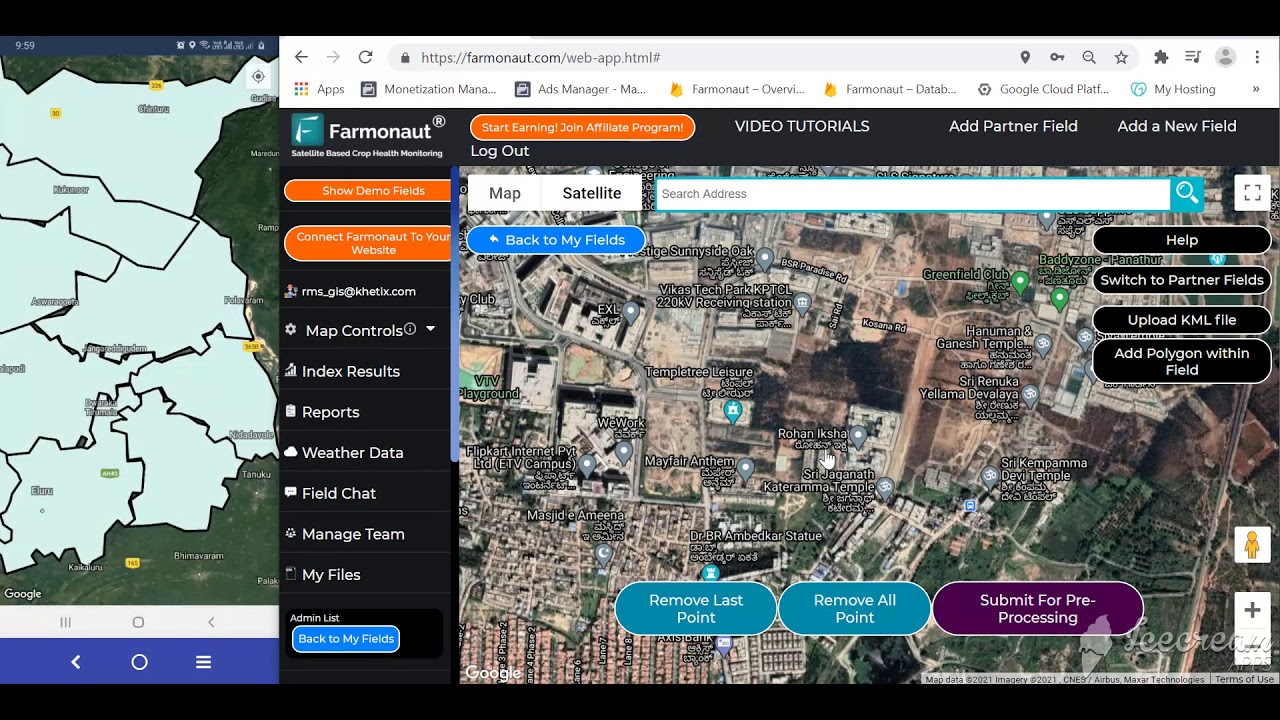
Farmonaut: Satellite-Powered Insights for Forestry and Mulching
We at Farmonaut deploy satellite-based technology to support land managers, project contractors, and local governments striving for sustainable, cost-effective land management. Our platform offers:
- ✔ Real-time vegetation health and soil monitoring to time and assess mulching activities for maximum ecological benefit and regulatory alignment.
- ✔ AI-driven advisory for weather, soil moisture, and restoration strategy tailored to every parcel.
- ✔ Carbon footprint tracking — align your projects with climate goals using our carbon footprinting tools.
- ✔ Blockchain-based traceability for managing restoration initiatives in compliance with funding and grant requirements. Learn more about agricultural traceability.
- ✔ Fleet and equipment tracking for forestry mulching contractors via our resource management solutions.
Our mobile apps and web platform enable both large and small landowners to monitor site progress, record residue depth, and track seedbed stabilization from anywhere — supporting the same cost-control goal this whole guide is built around.

"Mulch left in place after a forestry mulching pass functions as an erosion barrier, which is why every state cost guide reviewed here treats residue removal as an optional, separately priced add-on rather than a standard step."
Enhancing Sustainability & Soil Health with Forestry Mulching
Eco-friendly forestry mulching helps landowners reach sustainable management goals while controlling costs:
- ✔ Minimizing Disturbance: Only the targeted vegetation and underbrush are processed; the ground is left stabilized with no root upheaval.
- ✔ Preserving Surrounding Ecosystems: The method avoids sediment runoff, protecting waterways and wildlife corridors.
- ✔ Boosting Soil Organic Matter: Returning organic mulch to the soil supports active nutrient cycling and microbial activity.
- ✔ Moisture Retention: Reduced surface exposure lowers evaporation rates — useful for the future productivity of agricultural rangelands and cover crop sites.
- ✔ Encouraging Native Species: Lower seedbank presence of invasive or unwanted species, making future weed control simpler and less costly.
The broader wood-processing equipment market this work depends on — wood chippers and mulching heads — was sized at $450.6 million globally in 2025, with SNS Insider projecting growth to $677 million by 2035, a compound annual growth rate of 4.22%. The same report notes wood chips currently account for roughly 25% of US renewable energy consumption from biomass sources — context for why mulched and chipped woody residue increasingly has a market value beyond the clearing project itself, per SNS Insider's wood chipper machines market report.

On-Site, Mobile Mulching Service Delivery
Mobile forestry mulching solutions bring the machinery and skilled operators right to the project site, minimizing logistics, staging, and overhead. Whether the operation is on a rural tract or an urban-edge parcel, mobile mulching contractors can adapt to:
- 🚌 Remote, hard-to-reach parcels; ideal for stream buffers, urban-wildland interfaces, and utility corridors.
- ⏳ Time-sensitive projects, as setup and equipment transfer are immediate with mobile service units.
- ♻️ Reduced carbon footprint and fuel costs, as there's no need for multiple machine deployment or debris trucking.
Mobile solutions consolidate steps, enhance safety, and provide a transparent cost structure — landowners get fast, effective results for seasonal demands like planting, grazing, or fire risk reduction.

Farmonaut Products and Solutions for Land Managers
We at Farmonaut support every phase of your forestry mulching project with data-driven and scalable technology solutions:
-
Crop Plantation & Forest Advisory:
Optimize mulching timing for soil health and site restoration with real-time monitoring and AI-based recommendations. -
Large-Scale Farm Management:
Manage expansive fields, grazing, and mulching operations on a unified web/mobile dashboard for compliance and efficiency. -
Fleet Management Tools:
Track equipment, monitor operator performance, and optimize transport routes — a must for forestry mulching contractors and landowners alike. -
Crop Loan and Insurance Verification:
Access satellite-based proof for land value, recent clearing, or restoration activities — crucial for securing financing or insurance. -
Product Traceability:
Ensure restoration projects meet grant and carbon credit requirements with blockchain-backed reporting.
Maintaining Restored Mulching Sites: Ensuring Long-Term Success
After effective single-pass forestry mulching, sustained maintenance ensures lasting value and minimizes the risk of future costly interventions:
- ✔ Monitor for weed resurgence: Use satellite apps for timely scouting and implement re-mulching or selective control if needed.
- ✔ Reseed with robust native mixes: Stabilize soil, attract beneficial wildlife, and offer ongoing erosion protection.
- ✔ Inspect for erosion after rain events: Address any gully or sediment movement by adjusting mulch thickness or planting cover species.
- ✔ Leverage technology: Use Farmonaut's AI tools and satellite imagery for alerts on problematic exposure or nutrient cycling issues, so the site continues to meet sustainable management goals.
Extra Tip: Resilience is built through routine follow-up, a well-defined ground cover plan, and by leveraging cutting-edge monitoring tools.
Frequently Asked Questions: Forestry Mulching Cost
-
How much does forestry mulching cost per acre?
In North Carolina, $500 to $4,000 per acre depending on vegetation density and access, per Boom Brush Control's 2025-2026 guide. In Georgia, $1,500 to $6,500 per acre, per SG Land Management's 2026 guide. Nationally, dense forest and large-tree clearing runs $900 to $1,200 per acre, per OWNR OPS. Get a written, itemized quote for your specific site rather than relying on any single average. -
What is the cost of forestry mulching compared to traditional clearing?
Controlled burning is cheapest upfront at $100-$300/acre but scores lowest on soil protection and sustainability and can trigger permit and liability costs. Manual clearing runs $600-$1,000/acre with lower efficiency. Forestry mulching's per-acre range is wider ($500-$6,500 depending on state and density) but folds clearing, grinding, and soil protection into one pass, avoiding separate hauling or burn-permit costs. -
What drives forestry mulching cost up or down on a specific site?
Vegetation density, average stem diameter, site access, slope, total acreage, and any debris-haul-off requirement. These are the same factors every published state guide cites, and they're the questions to ask a contractor before accepting a per-acre number. -
Are there cost-effective forestry mulching solutions for small or hard-to-reach lots?
Mobile mulching units that trailer directly to the site reduce mobilization overhead versus staging multiple machines, and can access stream buffers, utility corridors, and urban-wildland interface parcels that heavier equipment cannot reach. -
How do I find reputable forestry mulching contractors near me?
Look for contractors with experience in your local terrain, up-to-date specialized equipment, clear itemized cost estimates tied to a published state range, and proven habitat restoration knowledge. Ask about safety protocols, insurance, and post-application maintenance plans. -
Can Farmonaut help monitor forestry mulching and land restoration?
Yes. We provide satellite-based soil, vegetation, and operational monitoring to help optimize mulching timing, assess seedbed stabilization, and provide actionable restoration and weed control insights year-round.
Conclusion: Budget Forestry Mulching with Real Numbers, Not Averages
Forestry mulching cost is not one number — it's $500-$4,000 per acre in North Carolina, $1,500-$6,500 per acre in Georgia, and $900-$1,200 per acre nationally for dense, large-tree clearing, with vegetation density, stem diameter, and site access doing the work of moving a specific job within those ranges. Use the calculator above to plan your own project, then confirm the estimate against a written, itemized quote from a local contractor — state and national ranges tell you what's reasonable, not what your specific acreage will cost. Whether you're an agricultural operator, a conservation manager, or a private landowner, understanding these cost drivers lets you evaluate a quote instead of just accepting it.
Ready to plan your next land management project? Download the Farmonaut app to monitor site conditions before and after mulching, or contact a local mulching contractor for an itemized quote against the ranges above.

 Godrej Agrovet
 Hayleys Agriculture
 Linx Agritech
 Adinet
 Save Your Soils
 GalaxEye Space
 Grandstream Algérie
 XOS Realty
 Geospatial Lab Africa
 Agro La Gándara
 HIPSAC
 ZOL Zimbabwe
 Juligerm
 AdBio
AdBio MISE Maroc
 NWNS
NWNS Red August Group
 Farm Inc
 WeMe Global
 Agrotoken
 Blue BearX
 Insignito
 DnCubed
 Indosistim Teknologi
 Liquify Digital
 CU Foods
 BeyondTech Global
 Rouge VC
 AgroRisk
 Oath Inc
 Esri North East Africa
 MDCV UK
 Etech Consulting Madagascar
 Vestlandsforsking
 WB Dev
 Sama Premium
 Tres Valles
 Blickwinkel
 Agricultural Credit Policy Council
 eKGIS
eKGIS Mostas Tech
 Andex
Andex Deluxe Conseil
 WICO
WICO Chimera Innovation
 SkyHarvest
 Teledarbas
 Exurbia Geospatial
 FieldZero
