

Farm machinery · Price guide
John Deere Combine Price: What a New One Costs
We found no public Deere list price, so a new combine is whatever the dealer quotes. Dated reference points run from almost $433,000 (average advertised S780, June 2025) to a $784,500 university list price for a 470 hp class combine, header extra.
Key takeaways
- Machinery Pete put the average dealer advertised price of a new S780 at almost $433,000 in June 2025; the University of Illinois lists a 470 hp class combine at $784,500 before the header (August 2025).
- The Illinois list price for a 470 hp class combine rose from $560,500 in 2021 to $784,500 in 2025, about 40%.
- US combine retail sales fell from 7,349 in 2023 to 3,579 in 2025 (AEM), yet USDA’s price index for all farm machinery was still 0.8% higher in December 2025 than a year earlier.
- The Illinois model puts combining corn at $113.00 per acre at 1,000 acres a year and $48.90 at 3,000 acres, against a 2025 Wisconsin custom average of $38.47 per acre for combining corn.
- A used S780 averaged $250,781 at auction in June 2025; a 2024 machine with 476 hours sold for $414,000 on 30 June 2026.
In this article
- What a new John Deere combine costs
- Price by model and size class
- What comes on top of the combine
- Why combine prices stay high
- New or used: what auctions show
- Buy, finance or hire the harvest
- Which features are worth paying for
- Where satellite monitoring fits
- Buyer checklist: seven steps before you sign
- How we checked the numbers
- FAQ
We found no public list price for a new John Deere combine. Dealers quote each machine, and the price moves with the model, the header and the technology packages. The best dated numbers we found: Machinery Pete put the average dealer advertised price of a new S780 at almost $433,000 in June 2025; that is the previous S700 generation, not the S7 now on sale (AgWeb), while the University of Illinois budgets a 470 hp combine at a $784,500 list price before the header (farmdoc, August 2025). This page puts those and other figures side by side, with the basis of each, plus a calculator that compares owning a combine with hiring the harvest.
What a new John Deere combine costs
Deere sells combines through its dealer network, so the price you pay is a quote, not a sticker. The launch coverage of the S7 range gives power, grain tank size and automation options, and no prices (DTN, February 2024). Any single number you read online is therefore an estimate. The table below shows what each source actually measures, so you can see why the figures differ.
| Source | What it measures | Figure | Date |
|---|---|---|---|
| Machinery Pete | Average dealer advertised price, new S780 | almost $433,000 | June 2025 |
| Machinery Pete | Average auction price, used S780 | $250,781 | June 2025 |
| Ritchie Bros. auction | One 2024 S780 with 476 hours, sold at auction | $414,000 | 30 June 2026 |
| Univ. of Illinois | List price, 470 hp combine, header extra | $784,500 | August 2025 |
| Univ. of Illinois | The purchase price it assumes (85% of list) | about $666,800 | August 2025 |
| Manitoba Agriculture | Purchase price, 421 to 500 hp class, average of base and fully optioned | C$800,000 | 2026/27 guide |
Why do the first and fourth rows sit so far apart? They answer different questions. Machinery Pete averages what dealers advertise for one model (AgWeb, 2 June 2025). The Illinois figure is a budgeting list price for a 470 hp class combine, and the university buys it at 85% of list in its cost model. Manitoba’s guide uses the average of a base price and a fully optioned price, collected from at least two manufacturers (Manitoba Agriculture, 2026/27 guide). None of the three is a Deere price list, and none includes your trade-in, your header or your dealer’s discount.
A practical way to use these numbers: expect a wide spread between sources, from about $433,000 for an advertised new S780 to about $958,000 for a 470 hp class combine and corn head at Illinois list prices, and ask the dealer for a written quote that lists the machine, header, software and delivery as separate lines. Treat any figure on this page as a starting point for that conversation, not as an offer.
Price by model and size class
For model year 2025, Deere launched the S7 range in four sizes, S7 600, 700, 800 and 900, as the successor to the S700 series (21st Century Equipment, March 2024). Auction results for earlier machines, such as the S780 above, use the older S700-series names. The specifications below are from DTN’s launch report; the last column pairs each model with the nearest Illinois size class, which is a list price for budgeting and not a Deere price.
| Model | Rated power | Grain tank | Peak unloading | Nearest Illinois class (list, Aug 2025) |
|---|---|---|---|---|
| S7 600 | 333 hp | 300 bu | 3.6 bu/s | 330 hp class: $645,700 |
| S7 700 | 402 hp | 300 bu | 4.2 bu/s | No class between 330 and 470 hp |
| S7 800 | 473 hp | 400 bu | 4.2 bu/s | 470 hp class: $784,500 |
| S7 900 | 543 hp | 400 bu | 4.2 bu/s | 540 hp class: $818,200 |
Power, tank size and unloading rate come from DTN. Bigger machines cost more in absolute terms, but not much more per horsepower at the top: the Illinois list price rises from $784,500 at 470 hp to $818,200 at 540 hp, an increase of about 4% for about 15% more power (our arithmetic from the farmdoc table).
The same university series shows how fast list prices have moved. For a 470 hp class combine it lists $478,000 in 2017, $523,000 in 2019, $560,500 in 2021, $708,000 in 2023 and $784,500 in 2025. The chart compares the 2021 and 2025 editions for three size classes.
Chart
List price of a combine by size class
US$, combine only, header extra; generic size classes, not a Deere price list
What comes on top of the combine
The combine is not the whole bill. In the Illinois tables the header is priced separately: a 12-row corn head is listed at $173,500 and a 35 ft grain platform at $79,300 for the 470 hp class, and a 16-row corn head at $228,200 for the 540 hp class (farmdoc, August 2025). A 1,000 bushel grain cart is listed at $84,250 in the same publication. For a farm that grows corn and soybeans, a 470 hp combine with a corn head therefore comes to about $958,000 at Illinois list prices, before options, tax and delivery.
Other costs to put in the quote comparison:
- Automation and guidance packages. Deere says its harvest automation can raise productivity by up to 20%, a manufacturer claim reported by DTN; ask the dealer which package the quote includes and what it costs on its own.
- Extra headers for a second crop, such as a draper for small grains.
- Software and connectivity subscriptions, if the machine needs them for the features you want.
- Delivery, set-up, and any dealer prep charges.
- Insurance and storage: the Illinois model charges 1% of the remaining value each year for insurance and housing.
Questions worth asking each dealer:
- Is the quote for the combine alone, or with the header and trailer?
- Which automation and guidance packages are included, and which cost extra?
- What is the lead time, and what happens to the price if delivery slips to next season?
- What trade-in value does the dealer offer, and on what hours and condition?
- How far is the nearest service technician, and how fast do parts arrive during harvest?
Check the terms of any warranty, service plan and financing offer in writing, and talk to your lender or accountant before you sign. This page is general information, not financial advice.
Why combine prices stay high
Fewer combines are selling. The Association of Equipment Manufacturers (AEM) counted 3,579 self-propelled combines sold at retail in the US in 2025, down 35.6% from 5,556 in 2024 (AEM, December 2025 report). Sales had peaked at 7,349 in 2023, so 2025 was about half of that (farmdoc daily, February 2026). The slide has continued: AEM’s September 2026 report shows 2,432 combines sold in the first nine months of 2026, 9.4% fewer than 2,683 a year earlier (AEM, September 2026 report). In one month, August 2026, AEM reports US combine sales down 4% and Canadian combine sales down 42.6% from a year earlier (AEM, August 2026).
Lower volume has not meant lower prices. USDA’s index of machinery prices paid by farmers was 0.8% higher in December 2025 than a year earlier (all farm machinery, not combines alone), and farmdoc notes that increases have leveled off but prices remain high compared with before the pandemic. The same article reports that Deere absorbed about $600 million of tariff costs in its 2025 fiscal year and expected about $1.2 billion in 2026 (farmdoc daily, February 2026). Earlier, new equipment prices rose by more than 20% between 2021 and 2023 (farmdoc daily, October 2025).
What does this mean for a buyer? Dealers are working with weaker demand: in a 2026 survey cited by farmdoc, 67.5% of dealers reported new equipment sales down by 2% or more in 2025. That can give you room to negotiate on terms, trade-in value and financing, even if list prices do not fall. It is a reason to ask, not a promise of a discount.
Chart
US retail sales of self-propelled combines
Units sold per calendar year (preliminary AEM member data)
New or used: what auctions show
Used prices tell a different story. In June 2025 the average auction price of a used S780 was $250,781, about 58% of the advertised price of a new one (our arithmetic from Machinery Pete’s two averages; AgWeb, 2 June 2025). Pete’s rule of thumb is that a well-kept late-model machine should sell at auction for roughly 70% to 75% of the new advertised price; at that moment the S780 was below that range. That is his own metric, and one model on one date.
Late-model machines are not always cheap. A 2024 S780 with 476 hours sold for $414,000 at a Ritchie Bros. auction in Medford, Minnesota, on 30 June 2026, the highest auction price on that model with more than 450 hours in over two years, and AgWeb’s Pete’s Pick column says farmers are buying newer used equipment because there are few five- to 12-year-old machines (AgWeb, 7 July 2026). An older S670 with 2,316 engine hours sold for $103,500 at an Illinois auction the same day, the second highest auction price that year for the model. Auction prices exclude dealer prep and any warranty, so compare like with like.
Before you buy used, ask for the engine and separator hours, the service history and the software version, and run the serial number through the dealer. Be careful with online ads that look too cheap: the American Farm Bureau Federation, repeating an FTC alert, warns that scammers pose as equipment businesses and ask for deposits by wire transfer, so check the seller before you send money (Farm Bureau News).
Buy, finance or hire the harvest
A combine is a fixed cost that you spread over the acres you cut. That is why the same machine looks expensive on 800 acres and reasonable on 3,000. Using a 470 hp combine, the University of Illinois puts the cost of combining corn at $113.00 per acre when it cuts 1,000 acres a year and $48.90 per acre at 3,000 acres, including depreciation, interest, insurance, housing, repairs, fuel and labor (farmdoc, August 2025). Its economists suggest that a farm gets the cost benefit of a new combine at around 3,000 acres or more, and that smaller farms could share a machine or hire part of the harvest (farmdoc daily, October 2025).
Chart
Cost per acre of combining corn, by acres a year
US$ per acre, new 470 hp combine with 12-row corn head, 60% of acres in corn
Sharing is the other route. The farmdoc economists give the example of two 2,000-acre farms owning one combine and harvesting 4,000 acres, which would cost far less per acre than running two machines, though it needs a clear sharing agreement. They also note that on most farms the combine is the single largest machinery investment, and that harvest often accounts for more than half of total machinery-related costs. Across central Illinois corn farms in the Farm Business Farm Management records, total machinery costs rose from $136 per acre in 2021 to $171 in 2024, a 25% increase (farmdoc daily, October 2025). Those are Illinois results; farms with different crops, soils or harvest windows should run their own numbers.
The alternative is a custom operator. Wisconsin’s 2026 survey of the 2025 season (135 responses) found an average of $38.47 per acre for combining corn (34 responses) and $38.45 for soybeans (29 responses), and $51.08 and $50.27 when the operator also supplies the grain cart and hauls locally (University of Wisconsin Extension). Manitoba’s 2026/27 guide gives an average custom rate of C$31 to C$40 per acre for a self-propelled rotary combine, a calculated rate that includes a 15% margin rather than a survey of prices paid (Manitoba Agriculture). Rates vary by region, crop and what is included, so get two local quotes.
Where does the money go once the machine is in the shed? In the Illinois model for a 470 hp combine cutting 1,500 acres of corn and 1,000 acres of soybeans, the corn cost of $54.40 per acre splits into $30.30 combine overhead (depreciation, interest, insurance, housing and repairs), $18.10 for the corn head, $3.50 for fuel and lubricants and $2.50 for labor. The model assumes 175 hours of use a year, a 10-year life (its Table 2), 5.5% interest, diesel at $3.00 per gallon and labor at $22.00 an hour (farmdoc, August 2025). Fuel and labor are small next to ownership, which is why the number of acres matters so much. If your diesel price or wage is different, change those lines in the calculator.
The calculator below turns these ideas into your own numbers. It uses a simple straight-line method: the purchase price less the resale value, spread over the years you keep the machine, plus interest and 1% for insurance and housing on the average value. Replace every example with your own quote.
One more point on timing. A combine is used for a few weeks a year, and the Illinois model assumes about 175 hours of use a year. A machine that sits waiting for a part during harvest still carries its full ownership cost. That is why service access matters as much as the price: ask where the nearest technician is, how large the dealer’s parts stock is, and whether a loaner is available at peak season.
Chart
Custom rates for combining in Wisconsin
US$ per acre, average of survey responses for the 2025 season
Try the numbers for your own farm below.
Calculator
Is it cheaper to own a combine or hire the harvest?
Enter your own quote, acres and local hire rate.
- Yearly fixed cost of owning: $89,756
- Own minus hire, per acre: -0.10 US$/acre
- Own minus hire, per year: -$244
- Break-even acres a year: 2,493 acres
Example values only, not a forecast or a quote. Straight-line method: depreciation on purchase price less resale value, interest on the average value, and a fixed 1% a year for insurance and housing as in the University of Illinois model (farmdoc, August 2025). The 85% purchase share and 5.5% interest come from the University of Illinois model and are examples. Manitoba Agriculture’s 2026/27 guide assumes a 33% salvage value at the end of a machine’s service life, which varies by machine and may not match a 10-year hold, so the 33% resale value is an example too; use today’s price and your own quote.
Which features are worth paying for
The main S7 upgrade is automation. Deere says Predictive Ground Speed Automation uses stereo cameras to read crop mass about 30 feet ahead of the cutter bar, and Harvest Settings Automation adjusts concave clearance, rotor speed, fan speed and sieve settings to the grain loss, foreign material and broken grain targets the operator sets (DTN, February 2024). The company quotes up to 20% more productivity. That is a manufacturer’s claim, so test it on your own crop: ask for a demonstration in your field, or talk to a neighbor who runs the package.
A simple way to decide is to write down what a feature must save. If a package costs $30,000 and the machine cuts 2,500 acres a year, it has to save about $1.20 per acre per year over ten years just to pay back its price, before interest. A yield monitor, grain-loss sensor and guidance can pay back through fewer passes, less fuel and less grain left behind, but only the crop you grow can show that. Also ask which functions work on older headers and whether any feature needs a subscription after the first term.
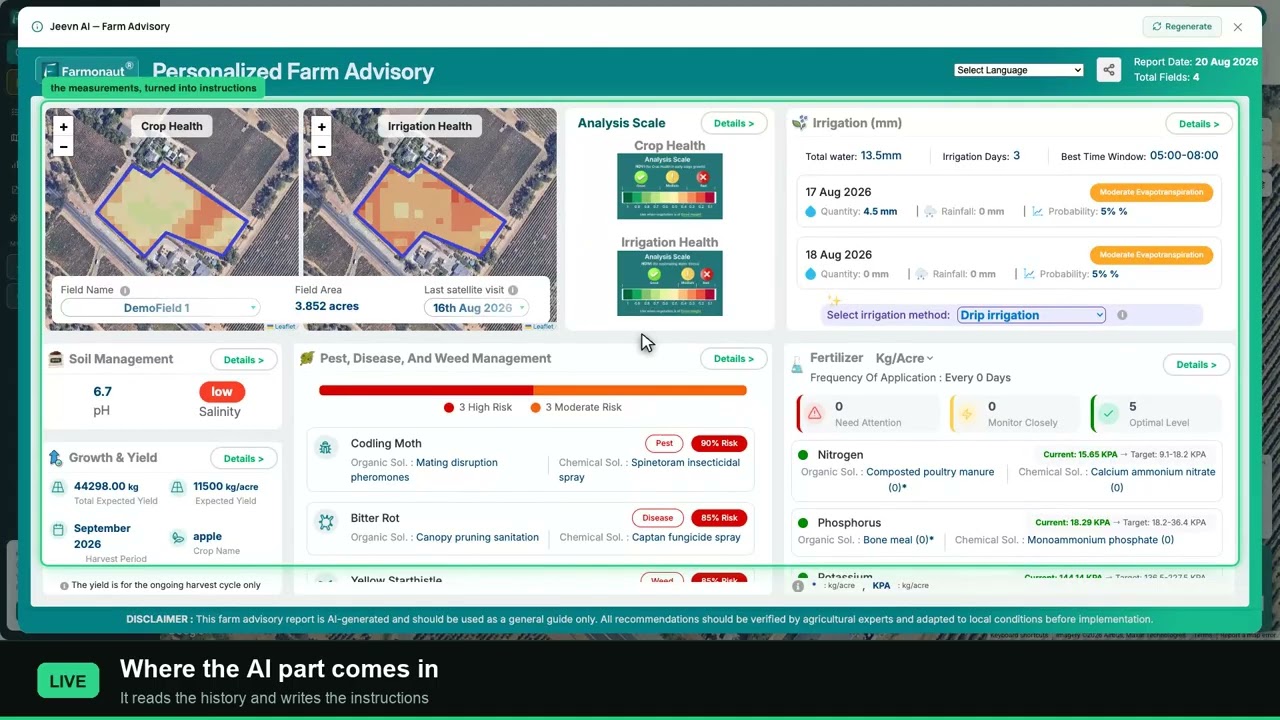
▶ The real advantages and disadvantages of precision agriculture, shown on an actual field. · 2:39
Where satellite monitoring fits
Satellite vegetation maps can be compared with a combine’s yield map after harvest to see where a field varied, though they show vegetation change rather than the cause.

▶ Six plain steps to start precision agriculture on your own farm. · 4:18
Buyer checklist: seven steps before you sign
- Count your acres and crops, then work out the cost per acre of owning against hiring, using the calculator above.
- Pick the size class from the acres and the harvest window you need, not from the largest model on the lot.
- Ask two dealers for a written quote with the machine, header, software and delivery on separate lines.
- Get a trade-in value and a used-machine quote for the same job, and compare them with the auction results above.
- Compare financing terms, the length of the warranty and what the service plan covers.
- Ask for a field demonstration of the automation you are paying for.
- Check the total with your lender or accountant, including tax treatment, before you commit.
How we checked the numbers
All figures come from pages we opened between 15 and 26 October 2026. Prices carry their date and their basis: dealer advertised price, auction result, university list price or guide assumption. The Illinois tables are generic size classes, not a Deere price list, and the Manitoba figures are in Canadian dollars. Where a source gave a percentage and we computed another number from its table, the text says so. Prices change with options and market conditions, so confirm with your dealer.
FAQ
How much does a new John Deere combine cost?
We found no published Deere list price, so it depends on the quote. Machinery Pete put the average dealer advertised price of a new S780 at almost $433,000 in June 2025, while the University of Illinois budgets $784,500 for a 470 hp class combine before the header (August 2025). Get written quotes from dealers near you.
Do combine prices fall when sales fall?
Not so far. AEM counted 3,579 US combine sales in 2025, down 35.6%, yet USDA’s price index for all farm machinery (not combines alone) was 0.8% higher in December 2025 than a year earlier. Dealer terms and trade-in value are where there may be room to negotiate; Sandhills data cited by farmdoc daily put used combine auction values 7.5% above a year earlier in December 2025.
What does a used John Deere S780 cost?
Machinery Pete’s average auction price was $250,781 in June 2025, and one 2024 machine with 476 hours sold for $414,000 on 30 June 2026. Hours, condition, header and dealer prep all change the price.
Is it cheaper to hire a custom combine operator?
For smaller acreages, often yes. Wisconsin’s 2025 average was $38.47 per acre for combining corn, or $51.08 with cart and hauling included, while the University of Illinois puts a new 470 hp combine at $113.00 per acre at 1,000 acres a year. Run your own acres through the calculator.
How many acres do I need to justify buying a combine?
The University of Illinois treats about 3,000 acres a year as a benchmark for economical use of a new combine and suggests sharing a machine or hiring the harvest below that. Your own figure depends on the price you pay, resale value and the rate a custom operator charges.
Related pages on our site: fleet management, carbon footprinting, crop loans and insurance, farm admin app, product traceability, satellite and weather API docs, satellite API and web and mobile apps.
Farmonaut crop monitoring
See your own fields from space
Draw your fields once and Farmonaut shows satellite vegetation maps for them through the season, on web, Android or iOS.




Keep reading


Sources
- AgWeb, Machinery Pete ratio and used S780 and new S780 averages (2 June 2025): agweb.com
- AgWeb, Pete’s Pick: John Deere S780 and S670 lead June auctions (7 July 2026): agweb.com
- University of Illinois, Machinery Cost Estimates: Harvesting (August 2025): farmdoc.illinois.edu
- University of Illinois, Machinery Cost Estimates: Harvesting (September 2023): farmdoc.illinois.edu
- University of Illinois, Machinery Cost Estimates: Harvesting (September 2021): farmdoc.illinois.edu
- University of Illinois, Machinery Cost Estimates: Harvesting (July 2019): farmdoc.illinois.edu
- University of Illinois, Machinery Cost Estimates: Harvesting (June 2017): farmdoc.illinois.edu
- farmdoc daily, Large Increase in Machinery Costs (14 October 2025): farmdocdaily.illinois.edu
- farmdoc daily, The U.S. Farm Machinery and Equipment Market (27 February 2026): farmdocdaily.illinois.edu
- AEM, United States Ag Tractor and Combine Report, December 2025 (13 January 2026): stocks.observer-reporter.com
- AEM, United States Ag Tractor and Combine Report, September 2026: finance.yahoo.com
- AEM, U.S. and Canadian Tractor and Combine Sales See August Decline (2026): aem.org
- University of Wisconsin Extension, Custom Rates for 2025 Wisconsin Farm Operations (2026): farms.extension.wisc.edu
- Manitoba Agriculture, Cost of Production: Farm Machinery, 2026/27 guide: manitoba.ca
- DTN Progressive Farmer, John Deere unveils 9RX series tractors, S7 combines (28 February 2024): dtnpf.com
- 21st Century Equipment, John Deere reveals S7 Series combines (11 March 2024): 21stcenturyequipment.com
- American Farm Bureau Federation, Scammers are impersonating farm equipment businesses: fb.org
Discussion
Questions, corrections or field experience? Share them below. First-time comments are reviewed before they appear, and your email is never published.
No comments yet. Be the first to add a question or your experience.

 John Deere
 Progenseed
 SkyHarvest
 Polaris Digitech
 Teledarbas
 Wild Oak Farm
 SFX
 BACF Africa
 Doodlakine
 Exurbia Geospatial
 FieldZero
 Indico Company
 Kubota

 Licence holder · Niger · Gold










