

Gardening · UK retailer check
Ericaceous Compost at Wickes, B&Q and Asda: Prices
Wickes had no ericaceous compost in its online range in November 2026. B&Q sold its own Verve acid mix at £4.50 for 20 litres and £7.50 for 50 litres, and Asda’s garden range varies by store. Prices per litre, which plants need it and how many bags you need.
Key takeaways
- Wickes listed 21 compost and topsoil products in November 2026, none of them ericaceous (Wickes range page).
- B&Q’s Verve bag for acid-loving plants was £7.50 for 50 litres (about £0.15 a litre) and its 20-litre Verve ericaceous bag was £4.50 on diy.com, list prices in November 2026.
- Azaleas and blueberries do best at pH 4.5 to 5.5 and camellias at 5.0 to 6.5 (Oregon State University Extension); the RHS suggests pH 5.0 to 6.0 for rhododendrons.
- UK retail growing media used 389,000 cubic metres of peat in 2023, down from 1.02 million in 2021 (Defra); peat was about 17% of all retail growing media that year.
- Hard tap water raises pH around acid-loving roots, so use rainwater and retest the pH once a year (RHS).
In this article
- Ericaceous compost at Wickes, B&Q and Asda: quick answer
- What B&Q, Wickes and Asda list online
- Price per litre: how the bags compare
- Which plants need ericaceous compost?
- Why soil pH matters for acid-loving plants
- What is in a bag of ericaceous compost?
- How much ericaceous compost do you need?
- How to use it: pots, beds and top-dressing
- No ericaceous compost in stock? What to do instead
- Peat, the planned ban and what is on the shelf
- How we checked the numbers
- For larger growers: watching acid-soil crops at field scale
- FAQ
Wickes does not list an ericaceous compost: its online compost and topsoil range showed 21 products in November 2026, such as multi-purpose compost, topsoil, bark, loam, manure, grow bags and soil improver, but none labelled ericaceous (Wickes compost and topsoil range). B&Q was the only one of the three where we found an own-brand acid mix online: its Verve ericaceous compost was £4.50 for 20 litres on diy.com, and a 50-litre Verve bag for acid-loving plants was £7.50 (B&Q product page for the 50-litre Verve bag). Asda sells garden products in some larger stores, but its online range is small and seasonal, so check the Asda app for your branch before you travel.
This page sets out what each retailer had in November 2026, the price per litre, which plants need an acid mix, how many bags a bed or pot needs (with a calculator), and what to do when your local store has none. Prices are online list prices on the date shown. Store stock and promotions differ by branch.
Ericaceous compost at Wickes, B&Q and Asda: quick answer
If you searched for ericaceous compost at Wickes, the short answer is that the chain sells general composts but no acid mix online. diy.com is the easier place to buy one. Asda is a gamble.
- B&Q: own-brand Verve ericaceous bags in 20 and 50 litre sizes, plus third-party bags sold through diy.com. Best for: a quick, low-cost bag for pots and new shrubs.
- Wickes: multi-purpose compost made without peat at £7 for 50 litres and Miracle-Gro all-purpose at £8.50, but no ericaceous line. Best for: general planting, raised-bed fill and bark mulch.
- Asda: a small seasonal garden range in larger stores. Best for: a top-up only if your branch has stock on the day.
- Independent garden centres: often stock branded acid mixes and loam-based ericaceous compost. Best for: larger jobs and advice on pH.
What B&Q, Wickes and Asda list online
We checked each retailer’s own website in November 2026. The table shows online list prices, not in-store offers or club discounts. The diy.com site was running Black Friday promotions at the time, so the price at the till may be lower.
| Retailer | Product | Size | Price | Per litre |
|---|---|---|---|---|
| B&Q | Verve compost for acid-loving plants (coir, wood fibre, bark) | 50 L | £7.50 | £0.15 |
| B&Q | Verve ericaceous compost | 20 L | £4.50 | £0.23 |
| B&Q | RHS Sylvagrow ericaceous (third party, Thompson & Morgan) | 40 L | Out of stock | – |
| B&Q | Ericaceous professional compost (third party) | 60 L | Out of stock | – |
| Wickes | No ericaceous compost listed | – | – | – |
| Wickes | Multi-purpose compost, no peat (not acid) | 50 L | £7 | £0.14 |
| Asda | Check the app for your branch | – | – | – |
Sources: the diy.com listings for the 20-litre Verve ericaceous bag, the RHS Sylvagrow 40-litre bag and the 60-litre professional bag, and the Wickes range page above. The Wickes multi-purpose bag is listed only as a price benchmark. It is not an acid mix and will not suit blueberries or rhododendrons on its own.
B&Q ericaceous compost
The 50-litre Verve bag for acid-loving plants is the cheapest acid mix per litre we found among the three chains. The listing says it is made from coir, wood fibre and bark, contains iron for greener leaves and feeds for up to six weeks. It is sold and shipped by the retailer itself, so it can be collected in store where stock allows.
The smaller 20-litre Verve ericaceous bag costs more per litre (about £0.23) but is easier to carry and suits one or two pots. Some other ericaceous lines on diy.com, such as the 60-litre professional bag, are sold by third-party sellers. Those ship from the seller and are not on the shelf in its stores. Check the “sold by” line before you plan a collection.
Wickes ericaceous compost
Wickes stocks compost, topsoil, bark and loam, much of it in 500-litre bulk bags for landscaping. In November 2026 the range had no product labelled ericaceous or for acid-loving plants. The nearest Wickes options are its own multi-purpose compost at £7 for 50 litres and bark chippings at £13 for 100 litres. Bark can help as a mulch on an acid bed, but neither product lowers pH enough to replace an ericaceous mix in a pot.
If you searched for “ericaceous soil Wickes” or a Wickes multi-buy deal, check the current offers on the Wickes range page; the price there is the one to trust.
Asda ericaceous compost
Asda’s garden range is seasonal and is largest in spring. Do not confuse ericaceous plant feed with ericaceous compost. A liquid ericaceous feed adds nutrients and some acidity over time, but it does not give a pot the low-pH growing medium that rhododendrons and blueberries need. If your local Asda has bagged ericaceous compost in store, check the pH or “for acid-loving plants” claim on the bag.
Price per litre: how the bags compare
Bag sizes differ, so price per litre is the fairest way to compare. diy.com shows a per-litre figure on its own listings, and Wickes shows one on most bulk bags.
The Wickes bag in the chart is a general compost included for comparison. It shows that the 50-litre Verve acid mix costs only about a penny more per litre than plain compost at the same size.
Chart
Compost price per litre, diy.com and Wickes
UK pounds per litre, online list prices, November 2026
Which plants need ericaceous compost?
Ericaceous plants are lime-haters. The Royal Horticultural Society lists rhododendrons, camellias, heathers and blueberries among them, and says a slightly acid soil of pH 6.5 is the best general-purpose pH for most gardens (RHS rhododendron growing guide). Acid-loving plants want it lower.
Chart
Suggested soil pH for garden plants
pH range, lower and upper end
Oregon State University Extension gives suggested pH ranges for common garden plants. Azaleas and blueberries do best at pH 4.5 to 5.5, camellias at 5.0 to 6.5 and blue hydrangeas at 4.5 to 6.0, while fruit trees and annual bedding plants prefer 6.0 to 7.0 (Oregon State University Extension, EC 1560). The guide says acid-loving plants need a pH below 6, and preferably below 5.5.
- Rhododendrons and azaleas: the RHS suggests pH 5.0 to 6.0 in soil rich in organic matter. Best grown in pots of ericaceous compost on alkaline ground.
- Blueberries: the RHS says pH 4.5 to 5.5 (RHS blueberry growing guide). In unsuitable soil it suggests large pots of ericaceous compost.
- Camellias: a little more tolerant, but still acid-loving.
- Heathers (Erica and Calluna): the plant family that gives “ericaceous” its name.
- Pieris, skimmia and many magnolias: often sold next to rhododendrons in garden centres and grown in the same mix.
Plants that do not need it include most vegetables, roses, lawns and fruit trees. Using an acid mix for them gives no benefit and may cause problems.
Why soil pH matters for acid-loving plants
Soil pH controls how easily roots take up some nutrients. Oregon State University Extension notes that iron and zinc become less available as pH rises above 7.5. Plants that cannot get enough iron show interveinal chlorosis: young leaves turn yellow while the veins stay green. The iron is often still in the soil. The plant just cannot reach it at high pH.
That is why an ericaceous plant can look sick in a rich, well-fed bed. Adding general fertiliser rarely fixes it. Lowering the pH, or growing the plant in an acid mix, does.
Water matters too. The RHS warns that tap water, especially in hard-water areas, carries enough calcium to reduce acidity around rhododendron roots. Collect rainwater in a butt for acid-loving pots where you can.
What is in a bag of ericaceous compost?
Most ericaceous mixes sold in UK stores today are made without peat. Makers use materials that are naturally acidic, or add sulphur to bring the pH down.
- Wood fibre: light and open, helps drainage and air at the roots.
- Composted bark: pine bark is naturally acid and breaks down slowly, so it holds structure through the season.
- Coir: coconut fibre that holds water well.
- Loam: used in John Innes style ericaceous mixes for longer-lived shrubs in pots.
- Added iron and nutrients: a starter charge, often for four to six weeks, after which you feed with an ericaceous fertiliser.
The 50-litre Verve bag lists coir, wood fibre and bark. Levington’s ericaceous compost made without peat describes a “special pH” mix with a high-iron formula for beds, borders and pots (Levington product page). When you compare bags, look for a stated pH or an “ericaceous” or “for acid-loving plants” label, the main ingredients and how long the feed lasts.
Chart
What UK retail compost was made of
Thousand cubic metres by ingredient, retail market, 2023
How much ericaceous compost do you need?
Work out the volume first, then divide by the bag size. A bed 2 m long, 1 m wide and 30 cm deep holds 600 litres. If you mix half compost and half soil, you need 300 litres, or six 50-litre bags. Pots are easier: the litre size is usually printed on the pot.
The calculator below does the sums for a bed or raised bed. Change the example values to your own measurements and today’s bag price.
Try the numbers for your own farm below.
Calculator
How many bags of ericaceous compost do you need?
Enter your bed size, mix share and bag price.
- Compost needed: 300 L
- Total bed volume: 600 L
- Cost of bags, £: 45.00
- Price per litre, £: 0.15
Example values only: a 2 m by 1 m bed, 30 cm deep, half compost and half soil, with a 50-litre bag at £7.50 (example, use today’s price). For pots use 100% and enter the pot volume as length x width x depth. Allow one extra bag for settling and top-dressing.
How to use it: pots, beds and top-dressing
A few habits keep the root zone acid for longer.
- Test first. A simple pH kit tells you whether your garden soil is already acid. If it is, you may only need ericaceous compost for pots.
- Pots: use the mix at full strength for blueberries, camellias and rhododendrons. There is no garden soil to buffer it.
- Beds on alkaline soil: the RHS suggests growing rhododendrons as container plants instead, because reducing soil pH is not simple.
- Mulch: the RHS suggests a mulch of chipped conifer bark or other acidic material around rhododendrons, kept loose rather than packed down.
- Water: use rainwater where possible, especially in hard-water areas.
- Feed: after the starter charge runs out, use an ericaceous fertiliser. Check the label for rates.
- Retest yearly: soil water slowly pushes an acid bed back up on chalky or limestone ground.
Oregon State University Extension says elemental sulphur gives the fastest drop in soil pH, and that further acidification is fairly easy when the soil is already below pH 6.5. In one trial near Wilsonville, Oregon, a single dose of 45 pounds of sulphur per 1,000 square feet took a loam soil from pH 5.7 to 5.1 after two years. That is a slow, field-scale change. Always check the product label and local guidance before applying sulphur, and get advice for large areas.

▶ How raised beds give you control over soil, drainage and plant growth, useful when building an acid bed on neutral ground. · 9:38
No ericaceous compost in stock? What to do instead
If your Wickes, B&Q or Asda branch has none, you have several options.
- Order from diy.com for delivery. Check whether the retailer or a third-party seller ships it.
- Try an independent garden centre. Many stock branded acid mixes and loam-based ericaceous compost, and staff can advise on pH.
- Buy a smaller bag. The 20-litre Verve bag costs more per litre but may be in stock when the 50-litre one is not.
- Hold off planting. A rhododendron or blueberry can wait a week or two in its nursery pot if kept watered with rainwater.
- Avoid quick fixes. The RHS warns that reducing soil pH is not simple. Oregon State University Extension does not recommend aluminium sulphate for lowering pH, because aluminium can harm plant roots.
Peat, the planned ban and what is on the shelf
The UK compost market has moved away from peat. Defra figures show retail growing media used 1.02 million cubic metres of peat in 2021, 471,000 in 2022 and 389,000 in 2023 (Defra, peat usage in growing media production). Wood fibre was the largest single ingredient in retail growing media in 2023, at 835,000 cubic metres.
Chart
Peat used in UK retail growing media
Thousand cubic metres per year, retail (amateur) market
In August 2022 the government announced a ban on peat sales to amateur gardeners in England by 2024 (Defra press blog, August 2022). The RHS policy page, updated in October 2026, refers to a lack of government legislation on peat (RHS statement on peat). Retailers have changed their ranges anyway, which is why most ericaceous bags on diy.com are now made without peat.
The RHS says it has not sold peat-based compost since 2019, and that since 1 January 2026 all plants sold at RHS garden centres and on RHS Plants online are “no new peat”. For gardeners, the practical point is that mixes without peat can dry out on top while staying wet below. Water by feel, not by habit.

▶ Seven simple ways to protect soil and water, explained in plain English. · 4:34
How we checked the numbers
We read each retailer’s own product and range pages in November 2026. Prices are online list prices before club discounts and do not include delivery. Per-litre prices are the retailer’s own where shown, or the list price divided by the bag size. Plant pH ranges come from the RHS and Oregon State University Extension. Peat volumes come from Defra’s growing media datasheets for 2021 to 2023, published in December 2025. North Carolina State Extension’s gardener handbook explains the soil chemistry behind pH and nutrient uptake if you want more depth (NC State Extension Gardener Handbook, soils chapter).
For larger growers: watching acid-soil crops at field scale
Blueberry growers, nurseries and forestry seedling producers face the same pH problem at a bigger scale. Iron chlorosis on high-pH patches shows as weaker, yellower canopy, which satellite vegetation maps can flag before a field walk. Farmonaut offers satellite crop monitoring for fields and plantations on web, Android and iOS, and you can open the app to map a block. A soil test is still the way to confirm the cause.
For trends in nursery and ornamental growing, see our piece on sustainable ornamental horticulture trends. For ways to change soil pH in either direction, see our guide to acid and alkaline soil amendments.
Related pages on our site: carbon footprint tracking, product traceability, fleet management, satellite and weather API developer docs.
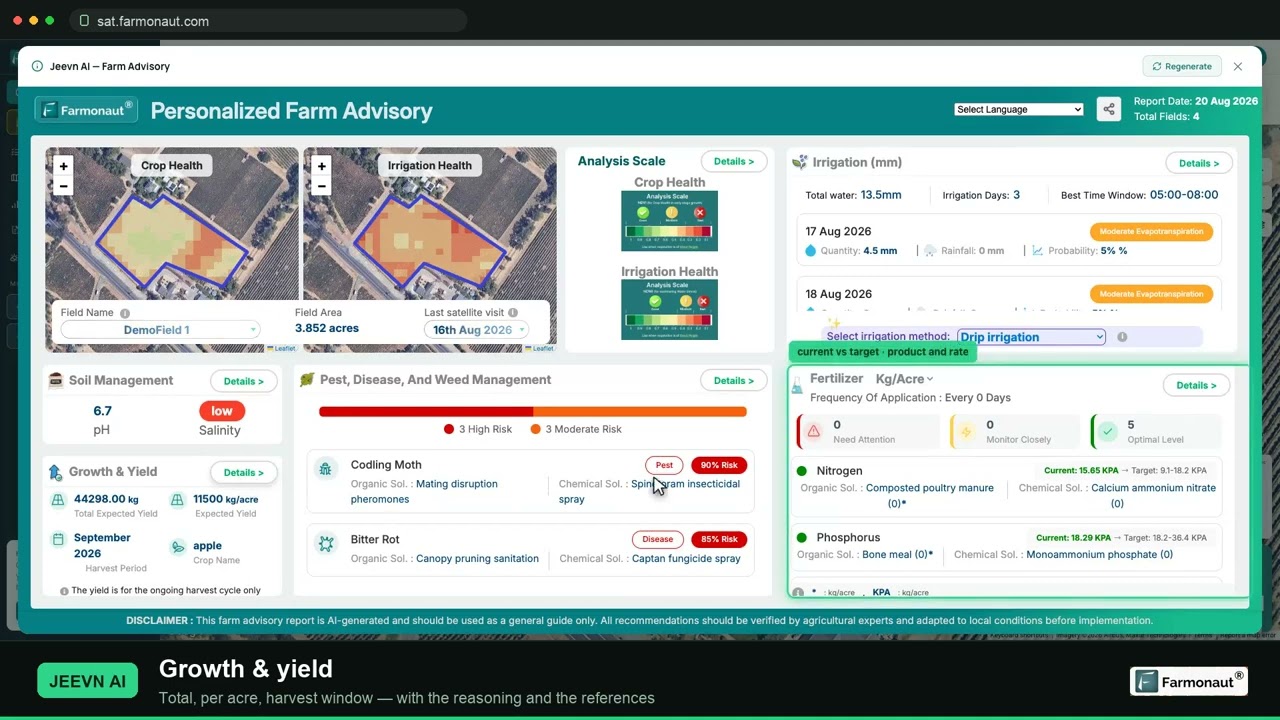
▶ A walkthrough of satellite crop monitoring: reading NDVI maps to spot crop stress early. · 19:36
FAQ
Does Wickes sell ericaceous compost?
Not online in November 2026. The Wickes compost and topsoil range listed multi-purpose compost, topsoil, bark, loam and soil improver, but nothing labelled ericaceous. Ask your branch in spring, when garden ranges are largest, or buy from B&Q or a garden centre.
How much is ericaceous compost at B&Q?
On diy.com in November 2026, the Verve 20-litre ericaceous bag was £4.50 and its 50-litre Verve bag for acid-loving plants was £7.50, or about £0.15 a litre. Those are list prices before club discounts and promotions.
Does Asda sell ericaceous compost?
Asda’s garden range is seasonal and varies by store. We could not confirm an ericaceous compost on its website. Use the Asda app or ring your branch to check before you travel.
Can I use multi-purpose compost instead?
Not for pots of blueberries, rhododendrons or camellias. Multi-purpose compost is close to neutral, so iron gets harder for these plants to take up and leaves can yellow. In a bed that is already acid, ordinary compost mixed in is usually fine.
What pH should ericaceous compost be?
The RHS suggests pH 5.0 to 6.0 for rhododendrons and 4.5 to 5.5 for blueberries. Oregon State University Extension says acid-loving plants need a pH below 6, preferably below 5.5. Check the bag or test a sample with a pH kit.
How long does ericaceous compost stay acidic?
In pots watered with rainwater it stays acid for a season or more. On chalky ground, or with hard tap water, pH creeps up. Top-dress with ericaceous compost or bark each spring and retest once a year.
Farmonaut crop monitoring
Watch your blocks from space
Map your fields, orchards or nursery blocks once and Farmonaut shows satellite vegetation maps for them through the season, on web, Android or iOS.




Sources
- Wickes, Compost & Topsoil range page (checked November 2026): wickes.co.uk
- B&Q (diy.com), Verve compost 50L for acid-loving plants (checked November 2026): diy.com
- B&Q (diy.com), Verve ericaceous compost 20L (checked November 2026): diy.com
- B&Q (diy.com), RHS Sylvagrow ericaceous compost 40L listing: diy.com
- B&Q (diy.com), Ericaceous professional compost 60L listing: diy.com
- Royal Horticultural Society, Rhododendrons and azaleas: growing guide: rhs.org.uk
- Royal Horticultural Society, How to grow blueberries: rhs.org.uk
- Royal Horticultural Society, RHS statement on peat (updated October 2026): rhs.org.uk
- Oregon State University Extension Service, EC 1560: Acidifying soil for blueberries and ornamental plants: catalog.extension.oregonstate.edu
- Defra, Peat usage in growing media production (datasheets 2021 to 2023, updated December 2025): gov.uk
- Defra in the media, Sale of horticultural peat to be banned to protect England’s peatlands (August 2022): deframedia.blog.gov.uk
- Levington (lovethegarden.com), Ericaceous compost 50 litres product page: lovethegarden.com
- NC State Extension, Extension Gardener Handbook: Soils and plant nutrients: content.ces.ncsu.edu
Discussion
Questions, corrections or field experience? Share them below. First-time comments are reviewed before they appear, and your email is never published.
No comments yet. Be the first to add a question or your experience.

 TVS Electronics
 BW Pipelines
 WICO
 Gen Chayat
 Chimera Innovation
 Hiteshi Infotech
 SkyHarvest
 Polaris Digitech
 Teledarbas
 Wild Oak Farm
 SFX
 BACF Africa
 Doodlakine
 Exurbia Geospatial
 FieldZero
 Indico Company

 Licence holder · Niger · Gold
 Client · Tanzania · Gold
 Client · Somalia · Gold
 Client & affiliate partner · Ghana · Gold










