

Spraying equipment · Buyer guide
Best Sprayer Pump Type: 4 Pumps Compared by Pressure
Centrifugal and roller pumps suit low-pressure boom spraying; diaphragm and piston pumps suit high-pressure orchard, vineyard and vegetable work (Kansas State University, 2019). Compare cost, pressure and flow, then size your pump with the calculator.
Key takeaways
- Kansas State University lists maximum pressures of up to 300 psi for roller, 180 psi for centrifugal, 725 psi for diaphragm and 400 psi for piston pumps (MF2895, 2019).
- Centrifugal pumps give the most flow (up to 190 gpm) and handle wettable powders; roller pumps are the low-cost choice for clean mixes.
- Size a pump as boom flow plus about 5% of tank capacity for agitation plus a 10 to 20% reserve (K-State); UF suggests at least 20% spare capacity.
- Herbicide boom sprayers usually run at 10 to 50 psi (University of Florida, 2026-2029 citrus guide).
- Recalibrate after fitting a pump; extension guides want nozzles within 5% of each other (Kentucky) or 10% of the average (Maine). Always follow the product label and local rules.
In this article
- Sprayer pump types at a glance
- How a sprayer pump works: two families
- The four sprayer pump types ranked by job
- How we compared the pumps
- Pressure and flow: what each pump can deliver
- How to size a sprayer pump in five steps
- How to choose the right pump for your farm
- Calibrate the sprayer after fitting a pump
- Care and maintenance
- Labels, safety and local rules
- Newer sprayer technology worth knowing
- FAQ
For most low-pressure boom spraying of herbicides, a centrifugal or roller sprayer pump is the usual pick, while diaphragm and piston pumps suit high-pressure work such as orchards, vineyards and vegetables. That is the split given in Kansas State University’s guide to pumps for crop protection products (revised June 2019), which also says no single pump type is ideal for every job.
This guide compares the four common types on cost, pressure, flow and upkeep, using extension figures. It then walks through sizing, with a calculator that turns your nozzles, speed and tank into the flow and power your pump needs.
Sprayer pump types at a glance
The table sums up the four main types. The pressure and flow figures are the upper limits of models K-State lists, not the output of any one pump.
| Pump type | Cost | Max pressure | Typical flow | Best for |
|---|---|---|---|---|
| Roller | Low | Up to 300 psi | 2 to 74 gpm | Small boom sprayers, clean liquids |
| Centrifugal | High | Up to 180 psi | Up to 190 gpm | Large booms, wettable powders, strong agitation |
| Diaphragm | Medium | Up to 725 psi | 3.5 to 66 gpm | Orchards, vineyards, corrosive mixes |
| Piston | High | Up to 400 psi | Up to 10 gpm | High pressure, constant volume, metering |
Source: Kansas State University, MF2895, Table 1 (2019). Use the maker’s performance chart for the exact model you buy.
How a sprayer pump works: two families
K-State splits pumps into two groups. Positive displacement pumps (roller, diaphragm and piston) push out a set volume with each turn, so flow rises in step with pump speed. They need a pressure-relief valve and a bypass line. Non-positive displacement pumps, mainly the centrifugal type, do not tie flow to speed. They do not need a relief valve, because flow drops as pressure builds.
This matters for accuracy. The University of Florida citrus guide on pesticide application technology notes that sprayers with positive displacement pumps have more potential for application error than those with centrifugal pumps, mainly at high-volume rates. Calibration closes that gap.
The four sprayer pump types ranked by job
Each type below has a “Best for” line. The order follows how often the type suits a general crop farm, starting with the most flexible. It is a guide, not a test ranking.
1. Centrifugal pumps
Best for: large boom sprayers, high flow, wettable powders and strong tank agitation.
K-State calls the centrifugal pump the most popular type for low-pressure sprayers. It is durable, simple, and handles wettable powders and abrasive material well. Output of 70 to 190 gpm lets it stir even large tanks. Low-pressure models reach up to 70 psi at impeller speeds of 3,000 to 4,500 rpm, and output drops fast once outlet pressure passes 30 to 40 psi.
Pros: long life, low wear, no relief valve needed, easy rate control by pressure. Cons: higher purchase cost, needs priming, and needs a step-up drive (belts, planetary gears) or a high-speed hydraulic motor. Mount it below the tank and fit a vent line so it can bleed off trapped air. Never restrict the inlet; a clogged suction strainer can cost you pressure control and damage the pump.
Housings come in cast iron, stainless steel and polypropylene. K-State says stainless steel suits glyphosate and other acid mixes, and polypropylene is light and resists corrosive chemicals.
2. Roller pumps
Best for: small and mid-size boom sprayers on a budget, with clean water-based mixes.
Roller pumps are cheap, compact and easy to repair. They run well at 540 and 1,000 rpm PTO speeds, prime themselves, and give 2 to 75 gpm at up to 300 psi, according to K-State’s text (its Table 1 lists 2 to 74 gpm). K-State’s table notes them as the best choice by farmers.
The catch is wear. Sand and scale grind the rollers, and some operators report fast wear with wettable powders. Nylon or Teflon rollers resist most farm chemicals and suit multipurpose sprayers. Rubber rollers fit water solutions and wettable powder slurries under 100 psi. Polypropylene rollers wear better with weak solutions that do not lubricate.
Pros: low cost, small size, simple repairs. Cons: parts wear, and it should not run dry.
3. Diaphragm pumps
Best for: orchards, vineyards, vegetables, foliar insecticides and fungicides, corrosive or abrasive mixes.
Diaphragm pumps are popular when higher pressure is needed for foliar herbicides, insecticides and fungicides. K-State’s text lists models with maximum outputs of 3.5 to 60 gpm and pressures of 200 to 700 psi; its Table 1, used in our table and charts, gives 3.5 to 66 gpm and up to 725 psi. Their moving parts sit in an oil bath, sealed away from the spray mix, so corrosive and abrasive liquids do less harm. They prime themselves and can run dry.
Small electric diaphragm pumps are also sold for ATV sprayers used on pasture and rights-of-way. Pros: low upkeep, chemical-resistant, high pressure for the size. Cons: medium price and lower flow than a centrifugal pump.
4. Piston pumps
Best for: high-pressure, low-volume work and ground-driven metering of fertilizer.
Piston pumps prime easily, reach high pressure and keep a constant volume. K-State lists them at up to 400 psi but low flow, around 10 gpm or less. Ground-driven piston pumps link flow to wheel speed, so the rate per acre stays the same as you speed up or slow down. K-State says these can last 30 years or more with basic care.
Pros: accurate, dependable, high pressure. Cons: high price, low capacity, and more upkeep than a diaphragm pump. Match the cup material to the chemicals you spray.
Other pump types
Turbine pumps work like centrifugal pumps but reach up to 70 psi straight off a 1,000 rpm PTO shaft, with no step-up drive. They suit clean, thin liquids. Gear pumps give a smooth, low flow but wear fast with wettable powders. Squeeze (peristaltic) pumps meter small amounts of fertilizer or pesticide and fit injection systems.
How we compared the pumps
We did not test pumps. We took cost, pressure, flow and upkeep ratings from the K-State extension guide, checked them against the University of Florida guide, and kept every figure as a stated range. Brand models from the old version of this page had no source and are gone. Prices change by dealer and region, so we give no price list; ask two or three dealers for a written quote on the same flow and pressure.
Pressure and flow: what each pump can deliver
Pressure need depends on the job. The University of Florida guide says herbicide boom sprayers usually run smaller PTO-driven pumps (centrifugal, roller or piston) at 10 to 50 psi. Tree sprayers, which push spray deep into a canopy, often need more. Diaphragm and piston pumps cover that high end.
Chart
Maximum pressure by sprayer pump type
psi, upper limit of models listed
Flow need depends on nozzles, speed and tank size. Centrifugal pumps lead on volume; piston pumps trail. The charts in this section show the spread.
Chart
Maximum flow by sprayer pump type
gallons per minute, upper limit of models listed
How to size a sprayer pump in five steps
Use the K-State pump selection worksheet. The steps are short:
- Work out flow per nozzle: rate (gal/acre) times speed (mph) times nozzle spacing (inches), divided by 5,940.
- Multiply by the number of nozzles to get boom flow.
- Add agitation flow. K-State uses about 5% of tank capacity, for example 25 gpm for a 500-gallon tank.
- Add a reserve of 10 to 20% for wear and friction losses.
- Find your highest spraying pressure and add 10 to 15 psi for system losses. Then pick a pump from the maker’s performance chart.
The University of Florida guide gives a similar rule: at least 20% more capacity than the nozzles need, and do not run a pump above 70 to 80% of its capacity for long spells.
Power follows from flow and pressure. K-State gives horsepower as gpm times psi divided by 1,714 times pump efficiency, with 40 to 60% efficiency assumed. An electric motor should be about one third larger than that figure, and a gas engine one half to two thirds larger.
Try the numbers for your own farm below.
Calculator
How much flow and power does your sprayer pump need?
Enter your own rate, speed, boom and tank.
- Boom flow: 24.2 gpm
- Agitation flow: 40.0 gpm
- Pump horsepower: 4.3 hp
Example values only, not a recommendation or benchmark. Formulas follow the Kansas State University pump selection worksheet (MF2895, 2019): gpm per nozzle = rate x mph x spacing / 5,940 (fixed constant); agitation = 5% of tank capacity (fixed); horsepower = gpm x psi / (1,714 x efficiency) (1,714 fixed). K-State suggests a 10 to 20% reserve and 40 to 60% efficiency. Check the maker’s performance chart before buying.
How to choose the right pump for your farm
Work through these questions before you call a dealer:
- What do you spray most? Wettable powders and suspensions favour centrifugal or diaphragm pumps. Clean water-based herbicides suit roller pumps.
- What pressure do you need? Booms at 10 to 50 psi can use any type. Orchard, vineyard or other work that needs high pressure points to diaphragm or piston.
- How much flow? Use the worksheet above. Big booms and big tanks favour centrifugal pumps.
- How will you drive it? K-State says most modern spray pumps are hydraulic driven, for easy mounting and upkeep. PTO, gas engine, electric and ground drives are also used. Check pump rotation: a tractor PTO turns clockwise, while engine and motor shafts turn counterclockwise.
- What are the wetted parts made of? Match housing, seals and rollers to your chemicals and adjuvants.
- Who services it? Pick a type your local dealer stocks parts for, so a failed seal does not stop spraying mid-season.

▶ Six plain steps to start precision farming, from field maps to targeted inputs. · 4:18
Calibrate the sprayer after fitting a pump
A new pump changes your output, so recalibrate. The University of Maine boom sprayer calibration bulletin allows each nozzle 10% above or below the average rate. The University of Kentucky calibration guide is stricter, ideally within 5% of each other. South Dakota State Extension advises calibrating several times a year.
Check pressure at the nozzle, not only at the pump. Cornell Cooperative Extension suggests putting the gauge on the nozzle farthest from the pump and raising regulator pressure if it reads low.
Chart
Pressure ranges cited in extension guides
psi; working ranges for booms and aircraft pumps, model maximums for diaphragm
Care and maintenance
K-State’s maintenance advice is plain. Clean the pump after each use to remove chemical residue. Do not leave spray mix in the sprayer for long. For storage, run a light antifreeze or motor oil through as the last liquid to protect the pump.
Use clean water. The Florida guide warns that sand and grit speed up pump and nozzle wear, and algae clogs strainers. Filter water pumped from ditches or ponds. Look over the pump, hoses, regulators and gauges before the season, and fix leaks before you fill the tank.
Labels, safety and local rules
A better pump does not change what you may apply. In the US, the EPA explains that the pesticide label is legally enforceable: using a product in a way that does not match its label breaks federal law. In Great Britain, the HSE runs an inspection scheme for application equipment and codes of practice for plant protection products. Always follow the product label and your local rules on droplet size, drift buffers and operator training, and get advice from your extension office or a certified adviser when unsure.
Newer sprayer technology worth knowing
Pump choice is only part of the system. The Ohio State factsheet on spray technology for orchards and vineyards describes variable-rate sprayers that use a laser-scanning sensor to match spray output to tree structure. Ohio State’s drone spraying factsheet notes that spray drones carry the same core parts as ground sprayers: tank, pump, hoses, filters and nozzles.
Field maps help decide where spraying is needed. The Farmonaut Satellite + AI Farm Monitoring System shows vegetation index maps of your fields, which can flag patches that differ from the rest of the field. A scout still needs to check the cause before you spray.
Related pages on our site: field monitoring app, satellite data API, weather API developer docs, product traceability, carbon footprinting and fleet management.
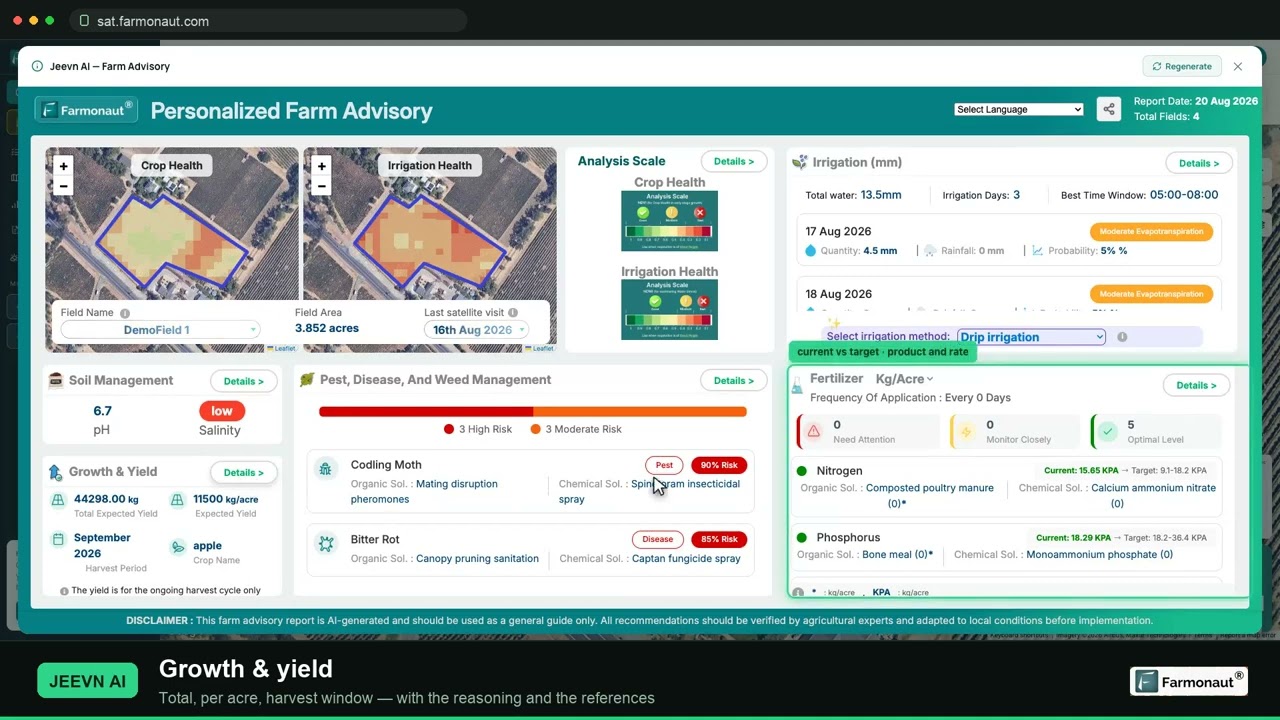
▶ A walkthrough of satellite crop monitoring: reading NDVI maps to see which parts of a field differ. · 19:36
If this topic matters to you, read Drift Irrigation System & Cost: 7 Powerful Upgrades for Optimal Efficiency next.
FAQ
What type of pump is best for a boom sprayer?
For low-pressure herbicide work, K-State lists centrifugal and roller pumps as the usual types. Centrifugal suits large booms and wettable powders; roller suits smaller, budget rigs with clean mixes.
Is a diaphragm or roller pump better?
A diaphragm pump handles corrosive and abrasive mixes better, reaches higher pressure and can run dry. A roller pump costs less and is easy to repair, but its rollers wear with grit and powders.
When do I need a piston pump?
When you need high pressure at low flow, such as handgun spraying, or exact ground-driven metering of liquid fertilizer.
How big should my sprayer pump be?
Add boom flow, agitation flow (about 5% of tank capacity) and a 10 to 20% reserve, per K-State. Then check the maker’s chart at your highest pressure plus 10 to 15 psi.
Why does my centrifugal pump lose pressure?
Common causes are a clogged suction strainer, a collapsed suction hose, air in the pump or a worn impeller. K-State warns that inlet restriction causes loss of pressure control.
Farmonaut crop monitoring
See your own fields from space
Draw your fields once and Farmonaut shows satellite vegetation maps for them through the season, on web, Android or iOS.




Keep reading



Sources
- Kansas State University, Pumps for Applying Crop Protection Products, MF2895 (2019): bookstore.ksre.ksu.edu
- University of Florida IFAS, Florida Citrus Production Guide: Pesticide Application Technology, CG024: edis.ifas.ufl.edu
- University of Maine Extension, Bulletin 2097 Boom Sprayer Calibration: extension.umaine.edu
- University of Kentucky, AGR-239 sprayer calibration: publications.ca.uky.edu
- South Dakota State University Extension, P-00241 sprayer calibration: extension.sdstate.edu
- Cornell Cooperative Extension, ENYCH newsletter sprayer calibration: rvpadmin.cce.cornell.edu
- US EPA, Introduction to Pesticide Labels: epa.gov
- UK Health and Safety Executive, Pesticide use, storage and disposal: hse.gov.uk
- Ohio State University, FABE-538 Advancements in Spray Technology for Orchards and Vineyards: ohiograpeweb.cfaes.ohio-state.edu
- Ohio State University, FABE-540 drone spraying factsheet: pested.osu.edu
Discussion
Questions, corrections or field experience? Share them below. First-time comments are reviewed before they appear, and your email is never published.
No comments yet. Be the first to add a question or your experience.

 Agroes
 Etech Consulting Madagascar
 Vestlandsforsking
 Elders
 Agritein
 Delicio
 WB Dev
 Sama Premium
 Prochecker
 Tres Valles
 LACOS Geoinformation
 Magrifly
 LatConnect 60
 WebsEdge
 Blickwinkel
 Agricultural Credit Policy Council
 Marei Nursery
 eKGIS
 Mostas Tech
 Andex

 Exploration consultancy · South Africa · Gold
 Licence holder · Niger · Gold
 Licence holder · Nigeria · Gold + lithium










