

DJI Sprayer Drone: Cost, Coverage & Precision Ag Fit
Reviewed August 2026 against the American Spray Drone Coalition’s 2025 Impact Survey, FAA Part 137 registry data, and Ohio State University’s Agronomic Crops Network.
Try it: Run your own numbers →
A DJI Agras spray drone treats roughly 35–50 acres per hour and costs about $5–$9 per acre to operate once you include chemical, labor, and equipment amortization, according to industry pricing compiled by Talos Drones and the Spray Drone Directory. A ready-to-fly unit runs close to $18,499 at current US retail pricing — up sharply from the pre-tariff base price of $16,400 for the same DJI Agras T50 kit, because of a 170% cumulative tariff on Chinese-made agricultural drones that took effect in April 2025. That tariff, more than any spec sheet, is now the deciding factor for US buyers weighing a drone sprayer purchase against a service contract.
This page covers what a buyer actually needs before signing a purchase order or a service agreement: current US adoption numbers, real per-acre costs, how DJI spray drones compare to ground and boom-rig spraying, and where to verify certification and pricing before you commit money.
Table of Contents
- US Drone Spraying Adoption: The Numbers
- Where Drone Spraying Fits in Precision Ag Solutions
- DJI Agras Pricing, Tariffs, and What You Actually Pay
- Coverage & Cost Comparison Table
- Drone Sprayer vs. Ground Rig vs. Manual Crew
- FAA Part 137 Certification: What It Means for You
- Drone Spraying Cost Calculator
- Best Agricultural Spraying Drones: How to Actually Evaluate One
- DJI, Protected Farmland, and Airspace Rules
- Pairing Drone Spraying With Satellite Monitoring
- Farmonaut Platform: Quick Access Links
- How to Verify These Numbers Yourself
- FAQ
- Try it: Run your own numbers
US Drone Spraying Adoption: The Numbers
US farmers treated 16.4 million acres of cropland with spray drones in 2025, according to the American Spray Drone Coalition’s 2025 Impact Survey, cited via the Spray Drone Directory’s 2026 statistics guide. That’s a 58.7% increase over 2024 acreage — one of the fastest adoption curves in US precision agriculture equipment. The same survey counted 1,710 FAA Part 137 certificated drone application operators nationwide as of 2025, the credential required to legally apply pesticides or fertilizer by drone in US airspace.
For scale: the USDA does not yet publish an official percentage of total US cropland treated by drone. USDA NASS began collecting drone-adoption data through optional survey modules starting in 2024, but a government-verified adoption rate as a share of the roughly 900 million acres of US farmland has not been released as of this writing. The 16.4-million-acre figure comes from an industry coalition survey, not USDA statisticians — treat it as directionally reliable, not a census number, until NASS publishes its own breakdown.
Regional adoption isn’t evenly spread. Ohio State University’s Agronomic Crops Network reported Ohio ranking second nationally in drone-spraying adoption, and documented one operator who scaled from roughly 1,000 acres to 200,000 acres treated annually within a few growing seasons — a case study in how fast a single custom-application business can grow once the economics work. Full detail is in the Ohio State Agronomic Crops Network newsletter.
Where Drone Spraying Fits in Precision Ag Solutions
“Precision ag solutions” is a broad category — variable-rate seeding, yield mapping, soil sampling grids, satellite NDVI monitoring, and spray drones all fall under it. Spray drones occupy a specific niche: they’re the application layer that acts on data other precision-ag tools generate. A satellite or multispectral pass identifies which zones of a field are stressed, under-fertilized, or pest-affected; the drone sprayer then applies chemical or nutrient only to those zones instead of blanket-treating the whole field.
That combination — sensing plus targeted application — is where the return shows up. Labor-cost savings from drone spraying versus a manual ground crew run 40–60%, based on agronomic research compiled by Ohio State’s Agronomic Crops Network. Those savings come primarily from reduced crew size and faster turnaround on time-sensitive applications (fungicide windows, pre-emergent herbicide timing), not from the chemical itself costing less.
DJI Agras Pricing, Tariffs, and What You Actually Pay
The DJI Agras T50 — DJI’s current flagship agricultural spray drone — carried a base kit price of $16,400 from authorized dealers before the tariff change, per pricing tracked by Talos Drones, a DJI authorized agricultural retailer. As of 2026, the average retail price for a ready-to-fly agricultural spray drone from authorized DJI channels is $18,499 — a roughly $2,000 increase driven largely by the 170% cumulative tariff rate the US imposed on Chinese agricultural drones starting in April 2025, per trade data cited in the Spray Drone Directory’s statistics guide.
That tariff is the single biggest line-item change in this market since 2024, and it’s worth checking before you budget a purchase: tariff schedules on Chinese-manufactured agricultural equipment are subject to further revision, and a rate set in April 2025 is not guaranteed to hold. Confirm the current landed cost with your dealer at time of purchase rather than budgeting off any figure — including this one — that’s more than a few months old.
At $16,400–$18,499 per unit, plus the FAA Part 137 certification process, most operators recover the hardware cost within one to two seasons if they’re running it across 500+ acres — the OSU case study operator scaled to 200,000 acres precisely because the per-acre economics improve sharply with utilization. Below a few hundred acres, a custom-hire drone applicator is usually cheaper than owning the hardware yourself.
Coverage & Cost Comparison Table
| Metric | DJI Agras T50 Spray Drone | Manual Crew / Backpack Sprayer | Source & Date |
|---|---|---|---|
| Coverage rate | 35–50 acres/hour | A fraction of that per hour per worker; not separately quantified in sourced data | Talos Drones / DJI Agriculture operator reports, 2026 |
| Cost per acre (AI-integrated model) | $5–$9/acre | Not itemized in sourced data | Spray Drone Directory pricing guide, 2026 |
| Labor cost vs. manual crew | 40–60% lower | Baseline | OSU Agronomic Crops Network, 2024–2025 |
| Unit price, ready-to-fly | $18,499 average (2026) | N/A | Talos Drones dealer data, 2026 |
| Pre-tariff unit price | $16,400 (base kit) | N/A | DJI authorized dealers, pre-April 2025 |
Drone Sprayer vs. Ground Rig vs. Manual Crew
The comparison that actually matters for a purchase decision isn’t drone-vs-drone spec sheets — it’s drone-vs-your-current-method. Here’s what the sourced data supports:
- Speed: A DJI Agras T50 covers 35–50 acres per hour. That’s the figure to check against your own acreage and application windows — a 500-acre field treated in one pass takes roughly 10–14 flight-hours of drone time, not counting refill and battery-swap downtime.
- Labor: Drone spraying cuts labor cost 40–60% versus a manual crew, per OSU’s Agronomic Crops Network. That saving comes from needing one or two operators instead of a full ground crew, not from reduced chemical volume.
- Direct cost: $5–$9 per acre for AI-integrated drone spraying models, per the Spray Drone Directory. Compare this against your current per-acre custom-application or owned-equipment cost before assuming the drone is cheaper — on very large acreages, a well-utilized ground rig or fixed-wing aircraft can still undercut drone per-acre pricing.
- Capital outlay: $16,400–$18,499 per unit as of 2026, plus FAA Part 137 certification. A backpack sprayer or towed boom rig has a far lower entry cost but scales worse on labor.
None of the sourced data includes a brand-specific yield comparison — there is no published peer-reviewed study comparing DJI Agras models against competitors like Yamaha’s SA-1 or XAG’s V100 on yield outcomes. Most published research treats “drone spraying” as a category rather than a brand comparison, so treat any brand-specific yield claim you encounter elsewhere with skepticism unless it cites a named study.
FAA Part 137 Certification: What It Means for You
Any commercial application of pesticide, herbicide, or fertilizer by drone in US airspace requires FAA Part 137 certification — the same rule that historically governed crop-dusting aircraft, extended to cover unmanned aerial application. As of 2025, 1,710 operators held this certification nationwide, per FAA data cited by the American Spray Drone Coalition. That’s the number to track if you’re deciding whether to hire a custom applicator or get certified yourself: more certificated operators in your region means more competitive custom-hire pricing; fewer means you may need to certify in-house or travel further for service.
The FAA maintains a searchable Part 137 database at faa.gov where you can query certificated operators by state or region — useful both for finding a local custom applicator and for tracking how operator density in your area has changed since 2025.
Drone Spraying Cost Calculator
Estimate your own per-season cost and payback using the coverage and cost ranges sourced above — plug in your own acreage and rates rather than trusting a generic average.
Run your own numbers
Assumptions: uses the $5–$9/acre AI-integrated drone spraying cost range and 35–50 acres/hour coverage range sourced above. Excludes financing costs, insurance, battery/tank consumables, FAA Part 137 certification fees, and chemical cost differences between methods. Payback estimate assumes consistent per-season savings and does not account for tariff changes after 2026.
Best Agricultural Spraying Drones: How to Actually Evaluate One
There's no independent, brand-by-brand market-share breakdown for US agricultural drones as of 2026 — sales data for DJI versus competitors like Yamaha or XAG is proprietary or buried in regional distributor reports, not publicly published. So instead of ranking brands on unverifiable share numbers, evaluate any "best agricultural spraying drone" candidate against four sourced, checkable criteria:
- Coverage rate: Ask the dealer for acres-per-hour under your specific field conditions (row width, terrain, wind exposure) — the 35–50 acres/hour figure for the Agras T50 is a manufacturer/operator-reported range, not a guarantee for your field.
- Landed cost including tariffs: Get the out-the-door price, not the base kit price. The gap between the $16,400 pre-tariff base and the $18,499 average 2026 retail price is almost entirely the 170% tariff — confirm the current rate applies before you sign.
- Certification support: Does the dealer or manufacturer help you or your operator through FAA Part 137 certification? This is a real cost and time barrier, and support quality varies by dealer.
- Local service network: With 1,710 certificated operators nationwide as of 2025, density varies heavily by state — check the FAA's Part 137 database for operators near you before assuming service availability.
DJI, Protected Farmland, and Airspace Rules
Drone operators asking about "protected farmland area" rules are usually looking for airspace and land-use restrictions that limit where a spray drone can legally fly — not a DJI-specific designation. In the US, the relevant restrictions come from three separate sources that don't move in sync: FAA airspace classifications (controlled airspace near airports, temporary flight restrictions), state-level agricultural aviation rules, and any buffer-zone requirements tied to protected or environmentally sensitive land near the field you're treating. There is no single unified "protected farmland" registry — a US operator needs to check FAA airspace maps for their specific coordinates and confirm with their state department of agriculture whether local buffer rules apply, since these vary by state and are updated independently of any drone manufacturer's release cycle.
Pairing Drone Spraying With Satellite Monitoring
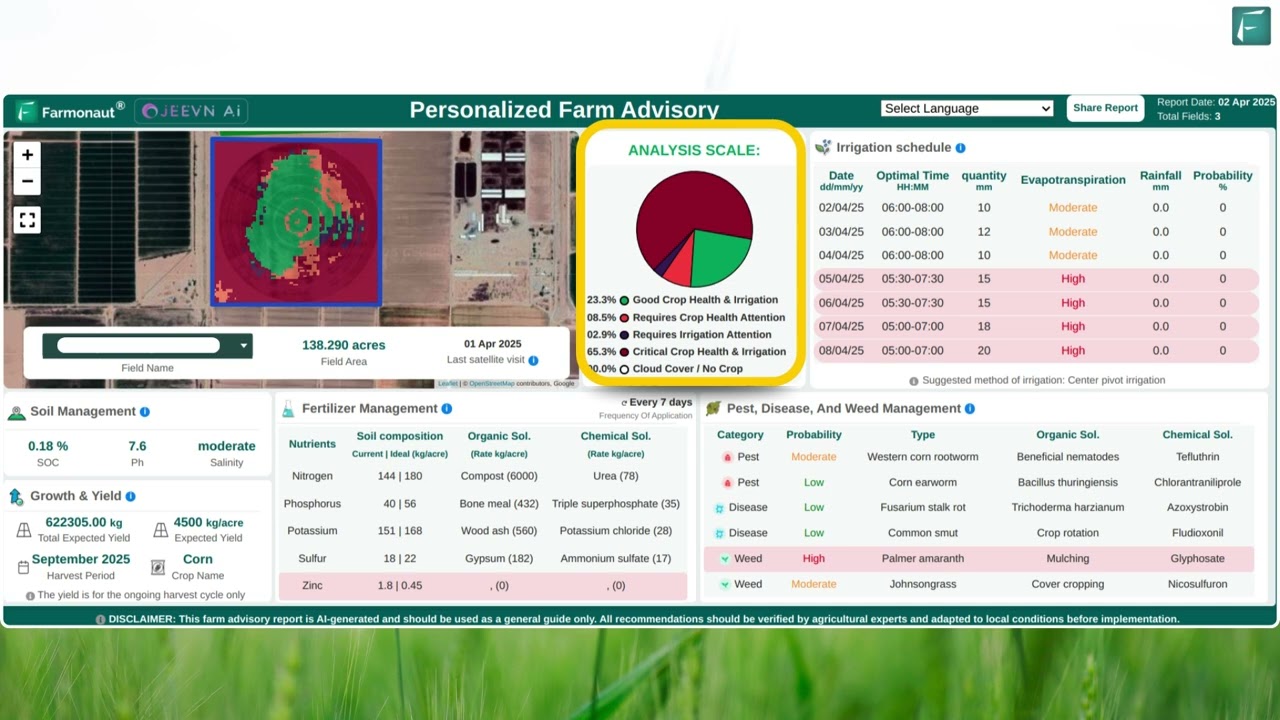
A spray drone is an application tool — it puts chemical or nutrient exactly where directed, but it doesn't tell you where treatment is needed. That's the gap satellite monitoring fills: NDVI and crop-health data identify stressed zones before symptoms are visible to the eye, so the drone's variable-rate application actually targets the right acres instead of blanket-treating a field.
- ✔ Real-Time Satellite Monitoring: NDVI, crop health, and soil moisture data to plan where drone spraying is actually needed.
- ✔ AI-Based Advisory: Farmonaut's Jeevn AI layers historical and weather-derived insights on top of field data to time applications.
- ✔ Blockchain Traceability: Record every drone intervention for quality assurance, from product traceability to crop loan and insurance documentation.
- ✔ Fleet & Resource Management: Track drone and farm equipment usage, maintenance, and operational health for fleet management ROI.
- ✔ Environmental Impact Tracking: Monitor carbon and water use for compliance reporting through the agro admin app.
- ✔ Carbon Footprinting: Satellite-based carbon footprinting tracks the emissions impact of reduced chemical and fuel use from targeted spraying.






Developers and agri-businesses can integrate satellite and drone-application data into custom platforms via the Farmonaut API.
Explore developer documentation: API Developer Docs

Farmonaut Platform: Quick Access Links
Access precision agri-intelligence for remote monitoring, traceability, resource optimization, or custom integration on scalable subscription plans.

How to Verify These Numbers Yourself
Every figure in this article carries a vintage and a source, not a permanent value — drone pricing, tariffs, and adoption rates are all moving targets. Here's where to check for a current number before you act on any of them:
- Acreage, operator counts, tariff impact: The American Spray Drone Coalition publishes an annual impact survey each January. Check agdronedirectory.com for the latest published edition, or contact the coalition directly for data not yet posted online.
- State-level adoption: USDA NASS added optional drone-adoption questions to its farm survey modules starting in 2024. Query USDA NASS QuickStats (nass.usda.gov) for state-level breakdowns — these typically update annually, a few months after each crop year's harvest closes.
- Certificated operators near you: The FAA's Part 137 database at faa.gov is searchable by state and region in real time, so you can check current operator density rather than relying on a national count that ages quickly.
- Current DJI Agras pricing: Contact an authorized dealer such as Talos Drones directly — tariff rates and dealer pricing both move independently of any published guide.
FAQ
Q1: How much does a DJI sprayer drone cost in the US?
Average retail price for a ready-to-fly agricultural spray drone from authorized DJI dealers is $18,499 as of 2026, per pricing compiled by Talos Drones. That's up from a pre-tariff base kit price of $16,400 for the DJI Agras T50, driven by a 170% cumulative tariff on Chinese agricultural drones imposed in April 2025. Confirm current landed cost with a dealer before purchasing, since tariff rates are subject to further change.
Q2: How many acres can a DJI drone sprayer cover per hour?
The DJI Agras T50 covers approximately 35–50 acres per hour, per DJI Agriculture and operator reports compiled by Talos Drones. Actual coverage depends on field shape, terrain, wind, and refill/battery-swap logistics, so treat this as a planning range rather than a guarantee.
Q3: Do I need a certification to fly a spray drone commercially in the US?
Yes. FAA Part 137 certification is required for any commercial aerial application of pesticide, herbicide, or fertilizer, including by drone. As of 2025, 1,710 operators held this certification nationwide. Search the FAA's Part 137 database at faa.gov to find certificated operators in your state or to start your own certification process.
Q4: Is drone spraying actually cheaper than a manual crew or ground rig?
Drone spraying cuts labor costs 40–60% versus a manual crew, per Ohio State University's Agronomic Crops Network, and runs $5–$9 per acre for AI-integrated models per the Spray Drone Directory. Whether it beats your current method depends on your acreage, current per-acre cost, and utilization — use the calculator above with your own numbers rather than a generic average.
Q5: What counts as "protected farmland" for drone flight restrictions?
There's no single unified US registry called "protected farmland" for drone purposes. Restrictions come separately from FAA airspace classifications (check faa.gov for controlled airspace near your coordinates), state agricultural aviation rules, and any local buffer-zone requirements — verify all three for your specific field rather than assuming one source covers it.
Q6: How does drone spraying pair with satellite crop monitoring?
Satellite NDVI and crop-health data identify which zones of a field need treatment before visible symptoms appear; the drone then applies chemical or nutrient only to those zones via variable-rate spraying. Platforms like Farmonaut combine both layers so drone applications target actual field conditions rather than treating uniformly.
The Bottom Line on DJI Sprayer Drones
The case for a DJI spray drone in 2026 rests on three checkable numbers: $18,499 average unit cost, $5–$9 per acre operating cost, and 35–50 acres per hour of coverage. Weigh those against your own acreage, current per-acre application cost, and the FAA Part 137 certification requirement before buying — and re-check pricing and tariff status with a dealer directly, since the 170% tariff that pushed prices up in 2025 is a policy decision, not a fixed cost of the hardware.
Pairing drone application with satellite crop monitoring — so the drone treats only the zones that actually need it — is what separates a spray-everything approach from genuine precision agriculture. That combination, not the drone alone, is where the labor and chemical savings compound.
Ready to pair drone spraying with satellite-driven field intelligence?
Explore the Farmonaut Platform or connect via our Farmonaut API today.

 FarmSetu
 Progenseed
 SkyHarvest
 Polaris Digitech
 Teledarbas
 Wild Oak Farm
 SFX
SFX BACF Africa
 Doodlakine
 Exurbia Geospatial
 FieldZero
 Indico Company
 Kubota
 FFBS
FFBS
