

Irrigation · cost guide
80 Acre Center Pivot Irrigation Cost: Price Guide
A pivot on a square 80 acre field waters about 62 to 63 acres. Extension budgets put the machine at $650 to $750 per acre or more before the well, pump and power. Here are the cost items, running costs, cost-share rates and a payback calculator.
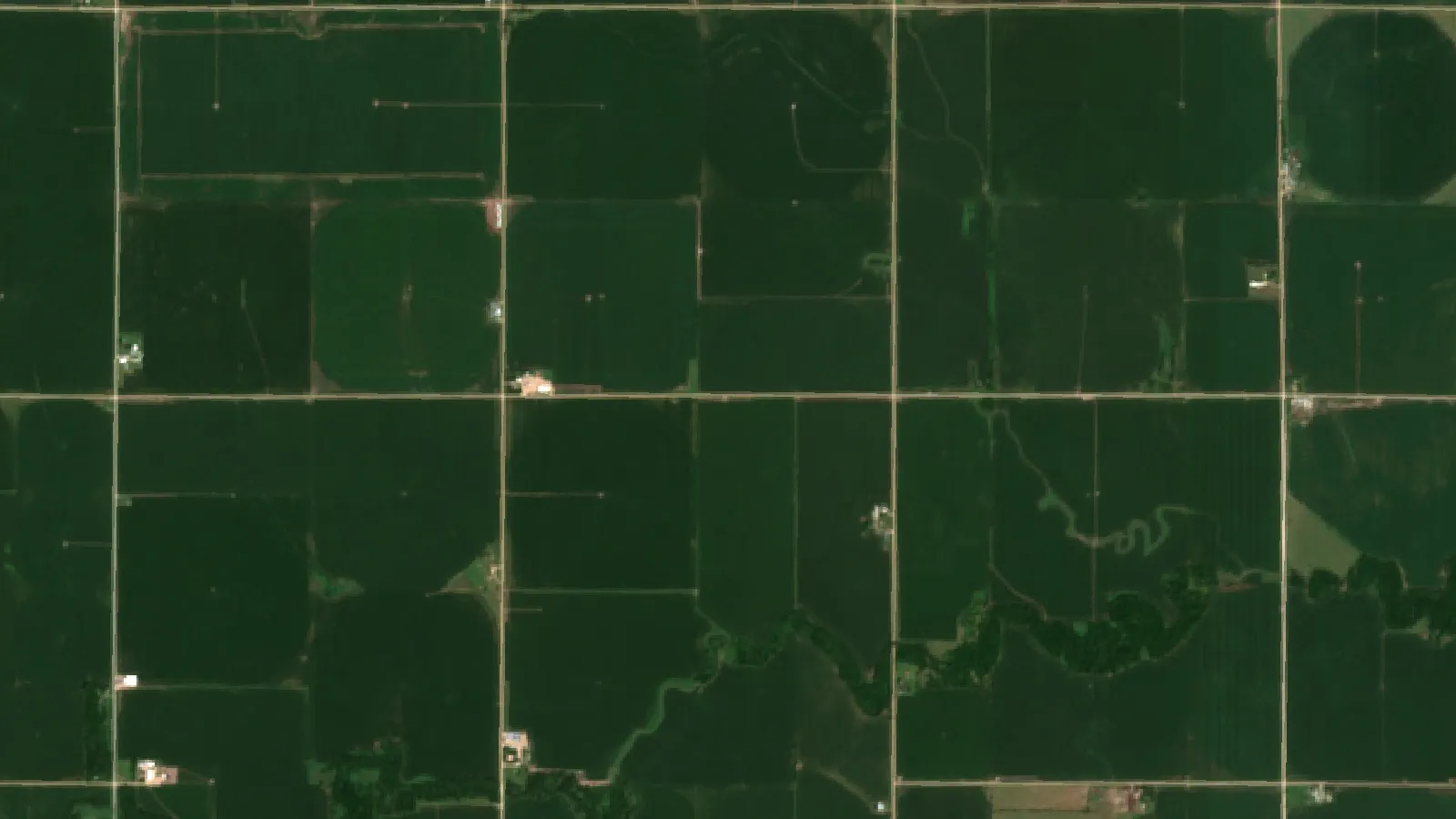
Key takeaways
- Texas A&M AgriLife Extension estimates a quarter-mile pivot (about 120 acres) at $650 to $750 per acre and a half-mile pivot at $500 to $550 per acre, excluding shipping, installation, power and water.
- A full-circle pivot on a square 80 acre field waters about 62 to 63 acres; short pivots cost more per acre than long ones.
- Pennsylvania’s FY 2026 EQIP schedule pays $9,375.45 per center pivot plus $64.04 per linear foot; rates differ by state.
- Nebraska irrigated cropland averaged $9,200 per acre and $283 cash rent in 2026, against $5,650 and $168 for dryland (USDA NASS).
- UGA budgets default to 16 acre-inches for corn on a calendar schedule and 10 with soil moisture sensors or an app.
In this article
- 80 acre center pivot irrigation cost at a glance
- How many acres does a pivot cover on an 80 acre field?
- What a center pivot costs per acre
- Extra costs beyond the pivot machine
- Cost-share for center pivots through EQIP
- Yearly cost to own and run a center pivot
- Calculator: does a pivot pay on your field?
- Center pivot yields and land values
- Types of center pivot systems
- Advantages and limits of center pivots
- Buying a used or new irrigation pivot for sale
- How the market for pivots has changed
- Smart pivot technology and scheduling
- Water, soil and long-term planning
A center pivot for an 80 acre field usually waters about 60 to 65 acres, because a circle cannot reach the corners of a square. Texas A&M AgriLife Extension puts a standard quarter-mile pivot at $650 to $750 per acre for the machine alone, before shipping, installation, power and water. Short pivots cost more per acre than long ones, so the machine for an 80 acre field often lands in the region of $45,000 to $60,000 as a planning figure. A new well, pump, pipe and power line can add as much again. This guide shows where those numbers come from, what drives them up or down, and how to test the payback on your own field with the calculator below.
All prices here are planning estimates from university extension budgets and a public cost-share schedule. They are not dealer quotes. Prices for steel, freight and power hookups change from year to year, so ask two or three local dealers for a written quote before you decide.
80 acre center pivot irrigation cost at a glance
The table sums up the main cost items for one pivot on an 80 acre field. The ranges are examples built from the sources named in each row, not quotes.
| Cost item | What it covers | Planning range for one 80 acre pivot | Where the figure comes from |
|---|---|---|---|
| Pivot machine | Center tower, spans, towers, sprinklers, control panel | About $650 to $750 per irrigated acre for a quarter-mile system; short systems cost more per acre | Texas A&M AgriLife guide by Guy Fipps |
| Freight and set-up | Delivery, concrete pad, assembly | Not in the per-acre price; quoted by the dealer | Texas A&M AgriLife guide |
| Water supply | Well, pump, pipe from well to pivot | Depends on depth and flow; often the largest extra item | UGA Extension irrigation budgets |
| Power | Electric line and panel, or a diesel engine and gearhead | Depends on distance to the nearest line | UGA Extension irrigation budgets |
| Yearly running costs | Energy, repairs, labor, management | Changes with acre-inches pumped, lift and pressure | UGA and Nebraska Extension worksheets |
How many acres does a pivot cover on an 80 acre field?
An 80 acre field can be a square of about 1,867 feet on each side, or a half-mile strip of 1,320 by 2,640 feet. On a square 80, a pivot with a radius of about 930 feet waters a full circle of roughly 62 to 63 acres. That leaves about 17 acres of dry corners. An end gun can add a few acres, and a swing arm or corner system can reach more of the corners at extra cost.
Nebraska Extension gives a useful example. In its Nebraska Extension answer on sharing irrigation costs, a quarter section is split into two 80 acre parcels, and a pivot set near the boundary waters a half circle of about 62.5 acres on one side. If the neighbor pays a fair share to run the full circle, the owner’s cost per acre falls, because most ownership costs stay the same whether the pivot runs a half circle or a full circle.
The common quarter-mile pivot is built for a 160 acre square. The University of Arkansas guide to irrigation methods says it covers about 130 acres of a 160 acre field, and that the biggest challenge with center pivots is the initial cost. The same page notes that pivots can be towed between two fields, which is one way to spread one machine over two small fields.
So when you compare prices, always ask the dealer for the number of irrigated acres, not just the field size. Two quotes for “an 80 acre pivot” can cover very different areas.
What a center pivot costs per acre
Texas A&M AgriLife Extension uses the quarter-mile system, about 1,300 feet long and watering about 120 acres, as its pricing benchmark. Its Texas A&M center pivot guide estimates that machine at $650 to $750 per acre, or $1,600 to $1,850 per hectare. That excludes shipping, installation and the cost of bringing power and water to the pivot. A half-mile system of about 2,600 feet waters about 500 acres for $500 to $550 per acre. The guide also notes that pivot prices have moved a lot in recent years with the cost of materials, energy and transport, and that pivots can last 25 years or more.
The economies of size work in reverse for small fields. Many of the costs are fixed for each machine: the center tower, the control panel, the pad and the hookups. On 60 acres those fixed costs are shared by fewer acres. That is why a short pivot for an 80 acre field usually costs more per acre than the Texas benchmark, even if the total bill is smaller.
A rough way to plan the machine price for an 80 acre field is:
- Take the irrigated acres, for example 62.
- Multiply by a per-acre price at or above the quarter-mile range, for example $750 to $950.
- This gives about $46,500 to $59,000 for the machine alone.
Treat this as a starting point for dealer talks. Options such as stainless or poly-lined pipe for poor water, high-profile towers for tall crops, flotation tires, remote control panels and variable rate irrigation all change the final price.
The chart compares the published per-acre ranges for the two benchmark sizes.
Chart
Published center pivot machine price per acre
US$ per irrigated acre, low and high estimate, machine only
Extra costs beyond the pivot machine
The machine is only part of the bill. The UGA Extension irrigation budgets for south Georgia split the investment into pipe and fittings, the pivot system, the power unit or gearhead, the well and the pump. They assume a 12 inch, 500 foot open-hole well, one well for each pivot, and a pivot that is not sitting on top of the well, so pipe is needed to carry water to it. Soil moisture sensors and a base station are added if the grower picks sensor-based scheduling.
Here is what to price on top of the machine:
- Well and pump. Cost rises with depth and flow. The 2023 national survey found an average well depth of 241 feet.
- Pipe from the water source. Every foot of buried pipe adds cost, so the pivot point location matters.
- Power. An electric line from the road, a transformer and a panel, or a diesel engine with a generator or gearhead drive.
- Pad and site work. Concrete for the center tower, track repair and crossings for ditches.
- Water rights and permits. Rules vary by state and district. Check with your local water authority before you drill.
- Scheduling tools. Soil moisture probes, a weather station or a phone app.
If you already have a well and power at the field edge, an 80 acre pivot is a much smaller project. If you need both, the supply side can cost as much as the machine. Ask for each item as a separate line on the quote.
Cost-share for center pivots through EQIP
The USDA Natural Resources Conservation Service can share part of the cost of a new or upgraded pivot through the Environmental Quality Incentives Program (EQIP). Payment rates are set by state each year. As one example, the Pennsylvania NRCS payment schedule for fiscal year 2026 lists a center pivot sprinkler system at a base of $9,375.45 per pivot plus $64.04 per linear foot, with higher rates for historically underserved producers. The same list has rates for VRI retrofits and for renovating an existing sprinkler system.
These are payment rates, not prices. They show how NRCS values the practice in one state for one year. Your state’s list will differ, funds are limited, and a contract must be signed before you buy. Talk to your local USDA Service Center early, and get professional advice on tax treatment of any payment.
Yearly cost to own and run a center pivot
Once the pivot is in the field, the yearly cost has two parts. Ownership costs are depreciation, interest on the money tied up, taxes and insurance. Operating costs are energy, repairs, labor and management.
The UGA budgets give simple rules that you can copy:
- Depreciation equals investment minus salvage value, divided by useful life.
- Interest equals investment plus salvage value, divided by two, times the interest rate. UGA uses 8% as a default.
- Taxes and insurance use the same average value times 2.5%.
- Labor is set at 0.28 hours per acre-inch of water.
Energy depends on how many acre-inches you pump, the pumping lift and the pressure the sprinklers need. The Nebraska Extension worksheet linked from the cost-sharing answer compares diesel, natural gas, propane and electric pivots on the same field. For an 80 acre pivot, energy is often the cost you can manage most, by pumping only what the crop needs.
Across the country the totals are large. The 2023 Irrigation and Water Management Survey release reports that farmers spent $3 billion on irrigation equipment, facilities, land improvements and computer technology in 2023, and $3.3 billion on energy to pump water.
Calculator: does a pivot pay on your field?
Use the calculator to test the yearly cost per irrigated acre against the extra income you expect from irrigation. Every number is an example. Replace them with your own quotes, your own yields and today’s crop prices. A result near zero means the pivot roughly pays for itself at those inputs.
Try the numbers for your own farm below.
Calculator
80 acre pivot: yearly cost vs extra income
Enter your own quotes, acres and expected gain from irrigation.
- Total investment: 115,000 US$
- Ownership cost per acre per year: 169 US$/ac
- Total cost per acre per year: 259 US$/ac
- Net for the whole pivot per year: 72 US$
Example values only, set near break-even; they are not quotes or a forecast. Price inputs are examples, use today’s price from your dealer. Ownership cost follows the UGA Extension method: depreciation with zero salvage, interest on half the investment, and 2.5% taxes and insurance on half the investment. Operating cost covers energy, repairs and labor. Get professional advice before borrowing.
Center pivot yields and land values
Irrigation pays when it lifts or protects yield more than it costs. In dry years the gain can be large. In wet years it can be small, or even negative if water is badly timed. Nebraska Extension’s review of disappointing corn yields in 2025 found that some growers saw higher or equal non-irrigated yields in corn and soybean compared to irrigated fields, and that this was nearly always due to too much irrigation and poor timing, often just before heavy rain. Statewide, the Nebraska 2025 annual crop production summary shows corn for grain averaged 194 bushels per acre on 10.5 million harvested acres, up 6 bushels from 2024.
Land values show how buyers price the gain. In the USDA farm real estate figures for Nebraska in 2026, irrigated cropland averaged $9,200 per acre against $5,650 for dryland. Cash rent for irrigated cropland averaged $283 per acre, compared with $168 for dryland. That rent gap of about $115 per acre is one market signal of what irrigation is worth in that state.
A separate survey of land professionals by the University of Nebraska-Lincoln found that center pivot irrigated cropland averaged 2% lower in 2026. The same survey notes that low crop prices reduce the incentive to develop irrigation on land. The two surveys use different methods, so use each for its own trend.
Chart
Nebraska farmland value by land type
US$ per acre, USDA farm real estate survey, 2026
Types of center pivot systems
Pivots differ in length, height, drive and how the water leaves the pipe. The main choices are:
- Standard center pivot. One span line turning around a fixed point. Best for square or round fields with no trees, poles or buildings in the path.
- Towable pivot. Can be moved between two set-ups. Lower cost per acre, more labor.
- Corner or swing-arm pivot. Adds an arm that swings out into the corners. More irrigated acres, higher price.
- Linear or lateral move. Runs in a straight line for rectangular fields. The Texas A&M guide notes these cost more than pivots because of their control and water supply systems.
- Electric or hydraulic drive. Most new pivots use electric motors at each tower.
How water is applied changes efficiency. A Texas A&M AgriLife study of five systems, the Texas A&M irrigation system comparison, assumed application efficiency of 60% for furrow, 78% for mid-elevation spray (MESA), 88% for low elevation spray (LESA), 95% for low energy precision application (LEPA) and 97% for subsurface drip. Higher efficiency means fewer acre-inches pumped for the same effective water.
Chart
Assumed application efficiency by irrigation system
Percent of applied water used by the crop, study assumptions
Advantages and limits of center pivots
Pivots are the most common way to irrigate in large parts of the United States. Nebraska alone has over 80,000 center pivot systems, and more than 57% of U.S. irrigated land is equipped with center pivots, according to the Nebraska CropWatch article on sensors on the pivot, which cites USDA data for the 57% figure.
Main advantages:
- Even water on sloping or uneven land where furrow irrigation is hard.
- Low labor once installed. Many panels can be started and stopped by phone.
- Can apply fertilizer and some crop protection products through the water. Always follow the product label and local rules for chemigation.
- Long life. Spread over 15 to 25 years or more, the yearly cost falls.
Main limits:
- High upfront cost, especially when a well and power are needed.
- Dry corners on square fields.
- Needs a field clear of trees, power poles, fences and deep ditches.
- Water rights and pumping limits can cap how much you may apply.
Buying a used or new irrigation pivot for sale
Used pivots can cut the machine price, but check them carefully. Look at the span pipe for rust and pinholes, the gearboxes and tower motors, the tires, the collector ring and the control panel. Ask for the original sprinkler chart, because a used machine often needs a new sprinkler package to match your well, pressure and field length. Moving, shortening or lengthening a pivot also costs money.
For a new pivot, compare at least two dealers on the same specification:
- Irrigated acres and length, with and without an end gun or corner arm.
- Sprinkler package and pressure at the pivot point.
- Pipe material, tower height and tire size.
- Control panel and remote monitoring options.
- Freight, installation, pad and electrical work as separate lines.
- Warranty terms and service distance.
Prices in this guide are extension estimates and a cost-share schedule, not auction results or dealer asks. Always get a written quote with a date.
How the market for pivots has changed
Irrigation in the United States is large but not growing much. The USDA Economic Research Service irrigation overview reports 54.9 million acres of irrigated crop and pastureland in the 2022 Census of Agriculture, and notes that farms with irrigation account for more than half of the value of U.S. crop sales while irrigated land is less than 17% of harvested cropland. Nebraska irrigated land grew from 7 to 8 million acres between 1997 and 2022.
The 2023 survey found 212,714 farms irrigating 53.1 million acres, down from 55.9 million acres in 2018, and 12.6 million more irrigated acres under sprinkler systems than under gravity irrigation. Sprinkler systems now cover more U.S. irrigated acres than gravity systems.
Smart pivot technology and scheduling
Newer pivots carry more electronics. Variable rate irrigation (VRI) changes the amount of water along the pivot to match soil zones. Remote panels let you stop a pivot from your phone. Nebraska research has tested canopy temperature sensors mounted on the pivot, and notes that high-speed pivots can circle a field in about four hours, compared with more than eight hours for most pivots.
Scheduling may matter more than hardware. In the UGA budgets, default water for corn is 16 acre-inches with a calendar checkbook method, against 10 acre-inches with soil moisture sensors or a scheduling app. On an 80 acre pivot that difference cuts energy, labor and repairs every year.
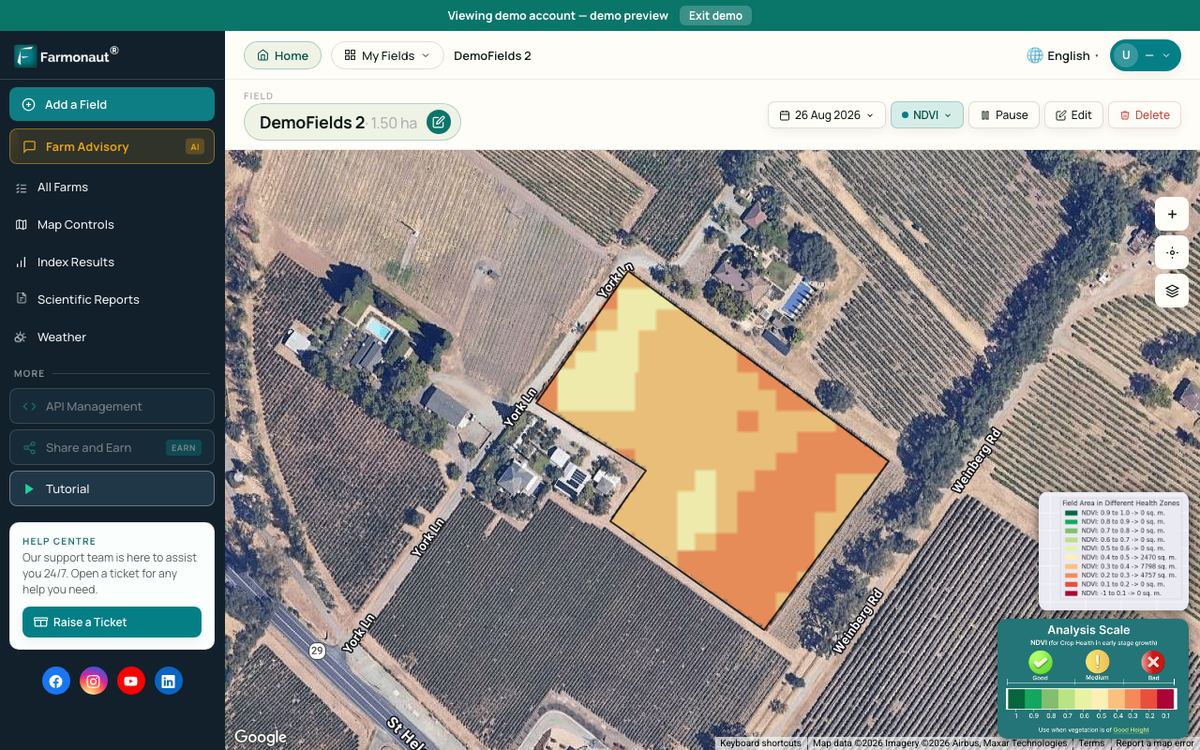
Satellite crop maps add a field-wide view. Farmonaut Satellite + AI Farm Monitoring System shows vegetation and moisture maps of each pivot circle through the season, which helps spot dry arcs, clogged nozzles or a stuck tower before yield is lost. It works alongside probes and a dealer’s control panel, not instead of them.
Chart
Default seasonal water for corn by scheduling method
Acre-inches per season, UGA irrigation budget defaults

▶ Six plain steps to start precision farming, including seeing your fields from space. · 4:18
Water, soil and long-term planning
Agriculture is the largest water user in the country. The ERS overview notes that irrigation accounted for 47% of national freshwater withdrawals between 2010 and 2020. The 2023 USDA irrigation survey found that groundwater from on-farm wells supplied 54% of water applied to acres in the open. Where aquifers are falling, districts may cap pumping. Before you buy, check how many acre-inches your permit allows, because a pivot that can only run half the season pays back slowly.
Good habits that protect both water and soil:
- Check the sprinkler package against the actual flow and pressure each spring.
- Use soil moisture readings or a scheduling app before each run.
- Avoid running just before forecast rain.
- Walk or scan the circle for wet spots, runoff and tower ruts.
- Keep records of acre-inches applied for each field and season.

▶ How to monitor crop health on each field with satellite maps in the Farmonaut web app. · 8:43
How we checked the numbers
We used university extension guides from Texas A&M, the University of Arkansas, the University of Georgia and the University of Nebraska-Lincoln for system costs, coverage and running costs. National irrigation figures come from USDA NASS and the USDA Economic Research Service. Land values and rents are USDA and UNL survey figures for Nebraska in 2026. The EQIP figures are one state’s payment schedule for fiscal year 2026. All dollar figures are labelled as estimates, payment rates or survey averages, and none are dealer prices.
Related pages on our site: farm management software · large farm management · crop and plantation advisory · satellite and weather API docs · satellite data API · farm fleet management · product traceability · carbon footprinting · crop loans and insurance
FAQ
How much does an 80 acre center pivot cost?
The machine for an 80 acre field, watering about 60 to 65 acres, often comes to roughly $45,000 to $60,000 as a planning figure, based on the Texas A&M estimate of $650 to $750 per acre for a quarter-mile pivot and higher per-acre prices for short pivots. A well, pump, pipe and power can add as much again. Get dealer quotes.
How many acres does a pivot water on an 80 acre square?
About 62 to 63 acres with a full circle. An end gun or corner arm adds more. Nebraska Extension uses an example of a half circle of 62.5 acres on one 80 acre parcel.
How long does a center pivot last?
Texas A&M AgriLife says pivots have long life spans of 25 years or more. The University of Arkansas spreads the cost over a service life of at least 15 years.
Can I get help paying for a pivot?
Possibly. NRCS EQIP offers cost-share for sprinkler systems at rates set by each state every year. Apply through your local USDA Service Center before you buy, and get professional advice on tax and contract terms.
Is a center pivot cheaper per acre than drip?
Usually yes for field crops. In Texas A&M’s comparison, subsurface drip had the highest investment per acre, but also the highest assumed efficiency at 97%, against 88% for LESA pivots.
Does irrigation always raise yields?
No. In Nebraska’s 2025 season some irrigated corn yielded the same or less than dryland, mostly due to too much water or poor timing before rain. Scheduling by soil moisture or crop needs matters.
Farmonaut crop monitoring
Watch every pivot circle from space
Draw your pivot fields once and Farmonaut shows satellite vegetation and moisture maps for them through the season, on web, Android or iOS.



Sources
- Nebraska Extension (T. Dorn), Q & A: Sharing Irrigation Costs Among Landowners, CropWatch, May 2009: cropwatch.unl.edu
- University of Arkansas Cooperative Extension Service, Irrigation Methods for Arkansas producers: uaex.uada.edu
- G. Fipps, Center Pivot Irrigation (dual units), Texas A&M AgriLife Extension: gfipps.tamu.edu
- UGA Cooperative Extension Circular 1235, Cost of Irrigation Ownership and Operating Costs through Irrigation Budgets for South Georgia: fieldreport.caes.uga.edu
- USDA NRCS Pennsylvania, Published Cost List and Payment Caps for FY 2026 EQIP and CSP (Bulletin 440-26-06): nrcs-prod.azureedge.us
- USDA NASS via Nebraska CropWatch, 2023 Irrigation and Water Management Data Now Available, 22 November 2024: cropwatch.unl.edu
- Nebraska Extension, Disappointing Corn Yields in 2025, CropWatch, December 2025: cropwatch.unl.edu
- USDA NASS via Nebraska CropWatch, Nebraska 2025 Annual Crop Production Summary: cropwatch.unl.edu
- USDA NASS via Nebraska CropWatch, Nebraska 2026 Farm Real Estate Value and Cash Rent, September 2026: cropwatch.unl.edu
- University of Nebraska-Lincoln Agricultural Economics, 2026 Nebraska Farmland Values and Cash Rental Rates: agecon.unl.edu
- Texas A&M AgriLife Extension, B-6113, Irrigation system comparison for the Texas High Plains: agecoext.tamu.edu
- Nebraska Extension, Sensors on the Pivot for Automated Irrigation Scheduling in the Great Plains, CropWatch, June 2022: cropwatch.unl.edu
- USDA Economic Research Service, Irrigation & Water Use: ers.usda.gov
Discussion
Questions, corrections or field experience? Share them below. First-time comments are reviewed before they appear, and your email is never published.
No comments yet. Be the first to add a question or your experience.

 CGIAR
 Hayleys Agriculture
 Linx Agritech
 Adinet
 Save Your Soils
 GalaxEye Space
 Grandstream Algérie
 XOS Realty
 Geospatial Lab Africa
 Agro La Gándara
 HIPSAC
 ZOL Zimbabwe
 Juligerm
 AdBio
 MISE Maroc
 NWNS
 Red August Group
 Farm Inc
 WeMe Global

 Licence holder · Niger · Gold
 Client · Somalia · Gold
 Client & affiliate partner · Ghana · Gold










