

Telluric iron and gold tellurides · Reference guide
Telluric Iron: Where It Is Found, Plus Gold Telluride Ore
Telluric iron is native iron formed on Earth, found mainly on Greenland’s west coast. Gold telluride ore is a separate subject: gold bound to tellurium, as in calaverite, which is about 43.6% gold in its ideal formula.
Key takeaways
- Telluric iron is native metallic iron of Earth origin; the large occurrences are on Greenland’s west coast, and native iron masses of up to 25 tons are reported (Handbook of Mineralogy).
- A Greenland analysis shows 93.16% iron, 2.34% carbon and 2.01% nickel; the iron is not pure and it is not an iron-tellurium compound (Handbook of Mineralogy).
- Calaverite (AuTe2) is 43.59% gold by weight in its ideal formula; krennerite and sylvanite carry silver as well (Handbook of Mineralogy).
- In the Kalgoorlie Gold Field about 25% of the gold sits in tellurides, 30% is native gold and 45% is in pyrite (Vielreicher et al., Geoscience Frontiers).
- More than 90% of tellurium comes from copper refinery anode slimes; gold telluride ores are only a potential source (USGS Mineral Commodity Summaries 2026).
In this article
- What is telluric iron?
- Where is telluric iron found?
- Is telluric iron the same as meteoritic iron?
- Does telluric iron point to gold telluride ore?
- What is gold telluride ore?
- Where is gold telluride ore mined?
- Why is gold telluride ore hard to process?
- Tellurium: the by-product behind the name
- Tellurium as a pathfinder in exploration
- How much gold and tellurium sit in a calaverite ore?
- Related reading on farmonaut.com
- Frequently asked questions
Telluric iron is native metallic iron that formed inside the Earth, as opposed to iron from a meteorite or iron locked in an oxide ore. The large occurrences are on the west coast of Greenland, on and near Disko Island, and the Handbook of Mineralogy notes native iron masses of up to 25 tons (Handbook of Mineralogy, iron). Gold telluride ore is a different thing: gold bound to tellurium in minerals such as calaverite, which holds about 43.6% gold by weight in its ideal formula (Handbook of Mineralogy, calaverite).
The two share a name root and little else. This guide separates them, shows where each is found, and explains why telluride gold ore is hard to process. It is written for consultants and project owners who need the facts straight before they brief a geologist or a metallurgist.
What is telluric iron?
Telluric iron is also called native iron. It is a cubic iron mineral with a Mohs hardness of about 4, a measured density of 7.3 to 7.87 g/cm3, a steel-gray to iron-black colour and a magnetic response (Handbook of Mineralogy). The word telluric comes from the Latin tellus, “Earth”, and is used to mark iron of terrestrial origin.
Chart
What Greenland telluric iron is made of
Percent by weight of minor elements in one analysis from Blaafjeld (iron is 93.16% of the rest)
It is not made of iron plus tellurium. The element tellurium has the same Latin root: the Royal Society of Chemistry notes that its name comes from tellus, and that it was first found in 1783 by Franz-Joseph Müller von Reichenstein in a gold telluride ore from Transylvania (RSC, tellurium). Many readers land on pages that mix the two; they are separate subjects.
What is in it: the Blaafjeld analysis
Telluric iron is not pure iron. The Handbook of Mineralogy lists an analysis of Greenland material from Blaafjeld: 93.16% iron, 2.34% carbon, 2.01% nickel, 0.80% cobalt, 0.41% sulfur, 0.32% phosphorus and 0.12% copper. A second sample from Cameron, Missouri, was 99.16% iron with only 0.065% carbon. The cobalt and nickel are real, but they are a few percent, not the main part of the metal.
Type 1 and type 2
Greenland iron is usually split in two groups by carbon content. Type 1 is a hard, brittle nickel cast iron with roughly 1.7 to 4% carbon, found as large boulders. Type 2 is a soft, malleable nickel iron with less than about 0.7% carbon, found as small grains of 1 to 5 mm in basalt (Wikipedia summary of Buchwald’s Greenland work). The same summary says the Inuit of the region hammered type 2 grains into knife blades, and that type 1 may have served as hammer and anvil stones. These type details come from that secondary summary, not from a primary paper.
Where is telluric iron found?
Native iron is reported from a short list of places. The Handbook of Mineralogy names Fortune Bay, Mellemfjord, Asuk, Uivfaq and Kitdlit on the west coast of Greenland, plus single localities in Scotland, Germany, Poland, Russia (including the Tolbachik volcano in Kamchatka), the United States (Cameron, Missouri, and near New Brunswick, New Jersey) and Canada (Ontario). It says the iron is rare in igneous rocks, especially basalts, and also occurs in carbonaceous sediments and volcanic fumaroles.
| Locality | Host | What was reported |
|---|---|---|
| Uivfaq and Kitdlit, Disko Island, Greenland | Dikes cutting basalt and gneiss | Large boulders and grains; a geological and magnetic survey tied the iron to a dike, not a lava flow |
| Blaafjeld, Greenland | Not stated in the Handbook | 93.16% Fe, 2.34% C, 2.01% Ni in the Handbook analysis |
| Cameron, Missouri, USA | Carbonaceous sediments | 99.16% Fe, 0.065% C in the Handbook analysis |
| Bühl, Hesse, Germany | Not stated in the Handbook | Listed as a locality |
| Tolbachik, Kamchatka, Russia | Volcanic fissure | Listed as a locality |
How it forms: still debated
The leading idea is that basalt magma swallowed carbon-rich sediment,. A study of the Uivfaq locality by Erling Fundal found the iron sits in a dike with graphite-bearing xenoliths. A second dike at Kitdlit also holds native iron but cuts gneiss, which the author says suggests the sediment-assimilation idea may not hold everywhere (Fundal, Meddelelser om Grønland). Treat the origin as an open research question.
Is telluric iron the same as meteoritic iron?
No, but the two were confused for years. Both carry nickel and can show Widmanstätten patterns (the criss-cross crystal texture seen in etched iron meteorites). According to that summary, Nordenskiöld found boulders at Uivfaq in 1870 and took them for meteorites, and later field work noted basalt crusts and sharp corners unlike meteorites (Wikipedia, telluric iron). It adds that telluric iron usually has about 3% nickel or less, which is lower than most meteorites, but that is a single secondary claim and a poor field test. For a field sample, only a laboratory can settle it.
Does telluric iron point to gold telluride ore?
Some guides suggest that mapping telluric iron leads to tellurides and base metals. Mineralogical references do not make that link. Telluric iron is a rare curiosity of basalt dikes, and the best-known gold telluride districts (below) are hydrothermal vein and breccia systems where the sources cited here report no native iron. If you are exploring for tellurides, the useful guides are geochemical, as the next sections show, not iron.
What is gold telluride ore?
In gold telluride ore, part or all of the gold is bound to tellurium instead of occurring as native gold. Three minerals do most of the work. Mineral formulas and gold contents below come from the Handbook of Mineralogy; the gold values are measured analyses from named mines, not guarantees for any deposit.
Chart
Gold content of telluride minerals in mine analyses
Percent gold by weight, selected analyses named in the Handbook of Mineralogy
| Mineral | Formula | Crystal system | Gold by weight in analyses | Density (g/cm3) |
|---|---|---|---|---|
| Calaverite | AuTe2 | Monoclinic | 41.66% (Cripple Creek), 42.15% (Kalgoorlie) | 9.31 calculated |
| Krennerite | (Au,Ag)Te2 | Orthorhombic | 43.86% (Cripple Creek), 34.77% (Săcărîmb, Romania) | 8.62 measured |
| Sylvanite | (Au,Ag)2Te4 | Monoclinic | 25.45% (Cripple Creek), 29.85% (Kalgoorlie) | 8.16 measured |
Calaverite and krennerite share one family: the Handbook calls them dimorphous, meaning the same chemistry in two crystal structures. Krennerite carries silver in its formula, while pure AuTe2 is calaverite. These minerals are soft (hardness 1.5 to 3), heavy and brittle, and the Handbook describes calaverite and sylvanite as typically occurring in hydrothermal veins.
Where is gold telluride ore mined?
Gold tellurides are reported at many deposits, but only a few districts have treated them at scale. A review in the International Journal of Minerals, Metallurgy and Materials lists Kalgoorlie (Western Australia), Vatukoula (Fiji), Cripple Creek (Colorado) and Kirkland Lake (Ontario) as places where gold tellurides have been commercially treated, and dates the first modern treatment to Cripple Creek in 1891 (Zhang et al., 2010).
Chart
Where the gold sits in the Kalgoorlie Gold Field
Approximate share of gold by form (gold deportment) for the whole field, including the Golden Mile and Mt Charlotte
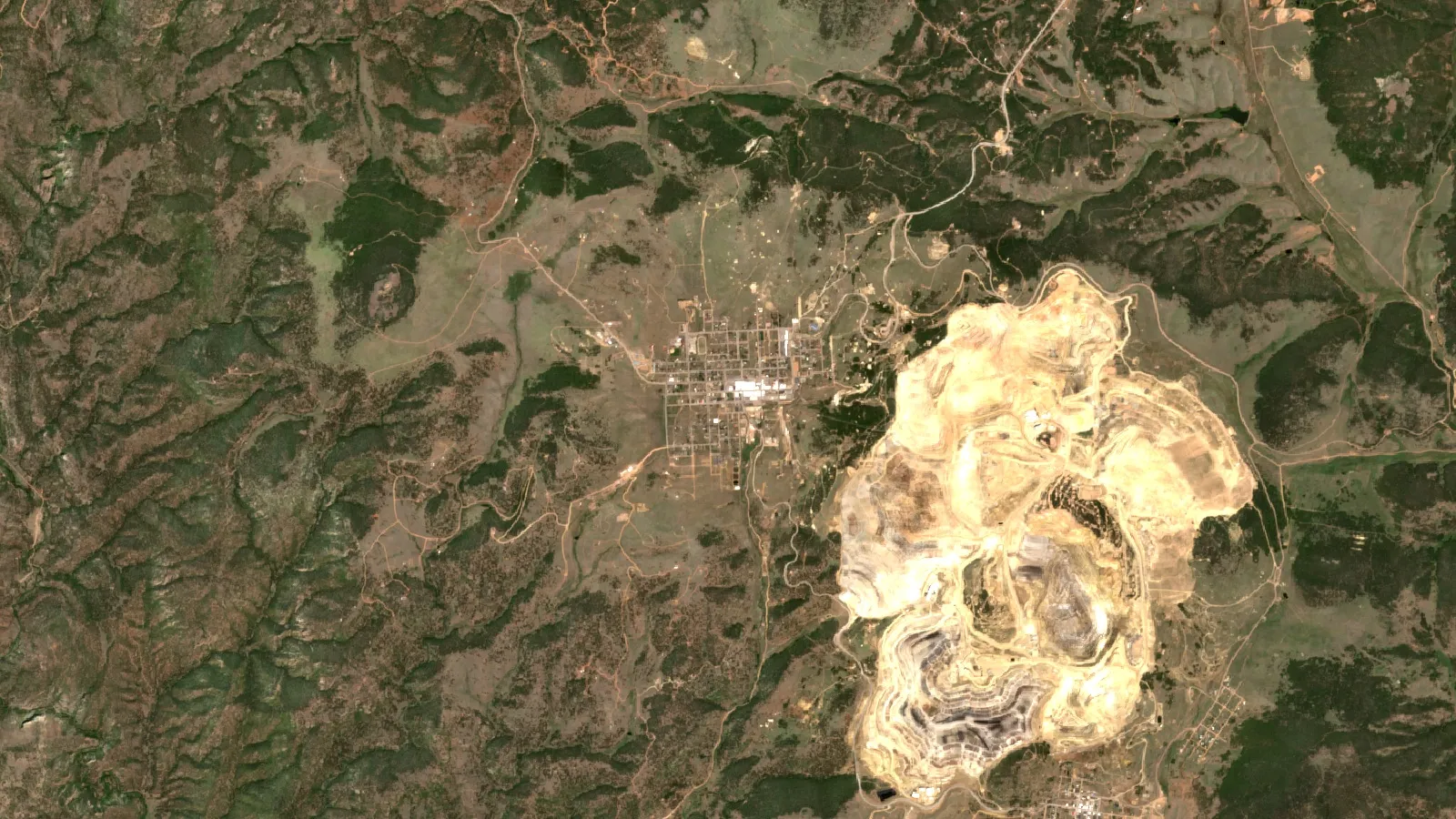
Cripple Creek, Colorado
The U.S. Geological Survey reported that the district had produced about 21 million ounces of gold since its discovery in 1891, and that most unoxidised ore held its gold as tellurides (USGS Circular 543, 1967). Today the Cripple Creek & Victor mine belongs to SSR Mining, which completed its purchase on 28 February 2025. SSR reports proven and probable reserves of 2.7 million ounces at 0.38 g/t as of 31 December 2025, all oxide ore on leach pads, and an average of 141,000 ounces a year planned for the three years to 2028 (SSR Mining). That modern reserve is leach-pad oxide ore, so it is a different material from the telluride ore that earlier mills roasted.
Kalgoorlie Golden Mile, Western Australia
Northern Star describes the Golden Mile as one of the richest gold deposits in the world, with more than 65 million ounces mined over 130 years, and lists 468,000 ounces of gold production for its KCGM operations in its 2026 financial year (Northern Star, KCGM). A geological review of the Kalgoorlie Gold Field (which includes the Golden Mile and Mt Charlotte) gives the gold deportment (where the gold sits in the rock) as roughly 30% native gold, 25% telluride gold, 35% as inclusions in pyrite and 10% invisible gold in pyrite (Vielreicher et al., Geoscience Frontiers). Telluride gold is therefore about a quarter of the gold in the field, not the whole of it.
Fiji and Canada
The Handbook of Mineralogy lists the Emperor mine at Vatukoula and the Tuvatu deposit on Viti Levu, Fiji, as localities for calaverite, sylvanite and krennerite. It also lists several mines in the Kirkland Lake area and the Hemlo deposit in Ontario for calaverite. A locality listing shows the mineral is present; it does not give the share of production. Check each company’s latest technical report for current status and grades.
Why is gold telluride ore hard to process?
Gold telluride ores are classed as refractory, meaning plain cyanide leaching recovers too little gold. The Zhang review explains that conventional cyanide leaching needs an oxidation step first to reach high recovery. The same paper reports that flotation works more easily on tellurides than on other refractory gold ores. Fine grinding, longer leach times and extra lime have also been used to lift recovery.
| Method | How it works | Point to know |
|---|---|---|
| Roasting | Heat oxidises tellurides and pyrite, releasing fine gold for cyanide | Simple but not environmentally friendly; pyrite gives off sulfur dioxide (Zhang et al.) |
| Flotation then oxidation | Float the telluride minerals, then oxidise the concentrate | Used at the Emperor mine, Fiji, where flotation, alkaline calcium hypochlorite oxidation and cyanidation were combined |
| Bio-oxidation | Microbes break down sulfides in a flotation concentrate | One study cited by Zhang et al. reached 98% of gold amenable to cyanide on a pyritic concentrate with some calaverite |
| Direct cyanide leach | Cyanide on finely ground ore | Needs fine grinding, long leach time and extra lime; less reliable alone |
The review says modern plants can reach recovery of up to 98% with the latest concentration and smelting methods, but it does not promise that for every ore. Recovery depends on the ore, and only test work on your own samples answers it.
▶ A claymation walk-through of how gold is found, crushed, dissolved, caught on carbon and refined. · 5:27
Tellurium: the by-product behind the name
Tellurium is mainly a by-product of copper, not gold. The U.S. Geological Survey states that more than 90% of tellurium has been produced from anode slimes at primary electrolytic copper refineries, and that gold telluride ores are only a potential additional source (USGS Mineral Commodity Summaries 2026, tellurium). World refinery production was about 1,000 tonnes in 2025 (estimate, excluding the United States, whose figure is withheld), of which China made about 800 tonnes. It is used mostly for cadmium telluride thin-film solar cells and bismuth telluride thermoelectric devices.
Chart
Tellurium price, United States and Europe
US$ per kilogram, annual average (2025 is a USGS estimate)
The USGS annual average price in the United States rose from US$74.77 per kilogram in 2024 to an estimated US$120 in 2025, and in Europe from US$81.54 to US$150. For a sense of scale, the calculator below shows how much tellurium is bound in the calaverite of an ore you define.
Tellurium as a pathfinder in exploration
Tellurium is more useful to explorers than telluric iron. At Cripple Creek, USGS geochemists measured the gold anomaly in surface rocks and found average concentrations of 2.5 ppm gold and 10.7 ppm tellurium, against 0.002 ppm tellurium in the average crust, an enrichment of about 5,350 times for tellurium and 1,000 times for gold. The authors suggested that mobile elements such as tellurium and mercury form a halo above gold deposits and can guide sampling (USGS Circular 543). That is a geochemical result from rock samples, measured in a laboratory.
Chart
Cripple Creek gold anomaly: enrichment over the average crust
Times the average crustal concentration, surface rocks inside the anomaly
What can satellites add? They do not detect individual telluride minerals. They can map surface alteration, iron staining, clay minerals and fault trends over large ground, which help decide where to take rock and soil samples for tellurium and gold assays. Farmonaut turns a boundary file into satellite-based exploration targets that sit ahead of any sampling or resource estimate. Related reading: our guide to telluride minerals and gold telluride ore, and the wider satellite-based mineral detection service.
▶ What satellites can and cannot see when exploring for gold: the rock around it, not the metal. · 4:25
How much gold and tellurium sit in a calaverite ore?
Because calaverite has a fixed formula, you can convert a gold grade into the mass of mineral and tellurium that carries it. Pure AuTe2 is about 43.6% gold and 56.4% tellurium by weight (Handbook of Mineralogy). The calculator below uses that ratio. Enter your own tonnes, grade and the share of gold you think is held in calaverite; the result is a screening estimate, not a resource figure.
Calculator
How much calaverite and tellurium does your ore hold?
Enter your own tonnes, gold grade and the share of gold held in calaverite.
- Gold recovered (oz): 5,466
- Value of recovered gold (US$): $21,862,491
- Calaverite in the ore (kg): 184
- Tellurium bound in that calaverite (kg): 104
Example values only, not a benchmark. Pure calaverite (AuTe2) is 43.59% gold and 56.41% tellurium by weight (Handbook of Mineralogy). The gold price is an input: example, use today’s price. Real ores mix calaverite with other tellurides and native gold, and tellurium in the ore is rarely recovered.
Related reading on farmonaut.com
For where telluride-bearing gold sits in the wider picture, see our list of active gold mines in the USA, the ranking of gold producing countries, and the guide to the rarest minerals. To scope a project of your own, use the mining quote form.
Frequently asked questions
What is telluric iron?
Telluric iron is native metallic iron of Earth origin, found in rocks such as basalt rather than in an iron ore or a meteorite. It usually contains a few percent carbon and nickel (Handbook of Mineralogy).
Where is telluric iron found?
The large occurrences are on the west coast of Greenland, around Disko Island. Smaller occurrences are listed in Scotland, Germany, Poland, Russia, the United States and Canada.
Is telluric iron the same as meteoric iron?
No. Meteoritic iron falls from space. Telluric iron forms in the Earth, has been reported mainly in basalt dikes with graphite-bearing rock, and usually carries less nickel than meteorites. Early explorers confused them because both can show Widmanstätten patterns.
Is telluric iron magnetic?
Yes. The Handbook of Mineralogy lists native iron as magnetic.
Does telluric iron contain tellurium?
No. The word comes from the Latin for Earth. Tellurium is a separate element that shares the root.
What is gold telluride ore?
It is ore in which some or all of the gold is bound with tellurium, mainly in calaverite, krennerite and sylvanite.
Which minerals are gold tellurides?
Calaverite (AuTe2), krennerite ((Au,Ag)Te2) and sylvanite ((Au,Ag)2Te4) are the main ones. Calaverite is about 43.6% gold in its ideal formula.
Why is gold telluride ore hard to process?
Plain cyanide leaching recovers too little gold, so the ore usually needs flotation, roasting, chemical oxidation or bio-oxidation first (Zhang et al., 2010).
Where is gold telluride ore mined?
Districts with commercial treatment include Cripple Creek in Colorado, the Golden Mile at Kalgoorlie, Vatukoula in Fiji and the Kirkland Lake area in Ontario.
Is tellurium recovered from gold telluride ore?
Rarely. USGS says more than 90% of tellurium comes from copper refinery anode slimes, with gold telluride ores only a potential source.
Can satellites find gold telluride deposits?
Not directly. Satellite data map alteration and structure that help target ground sampling; tellurium and gold assays from rock samples confirm the ore.
This page is for information only. It is not investment advice.
Farmonaut mining
Map your mining site from space
Send a boundary and get satellite-based exploration targets, ahead of any sampling or resource estimate.

Mining Pro sample view, synthetic data
Keep reading
Sources
- Handbook of Mineralogy, Iron: handbookofmineralogy.org
- Handbook of Mineralogy, Calaverite: handbookofmineralogy.org
- Handbook of Mineralogy, Krennerite: handbookofmineralogy.org
- Handbook of Mineralogy, Sylvanite: handbookofmineralogy.org
- Fundal, The Uivfaq Dike and Related Hybrid Dikes, Meddelelser om Grønland: tidsskrift.dk
- Wikipedia, Telluric iron: en.wikipedia.org
- Royal Society of Chemistry, Tellurium: periodic-table.rsc.org
- Zhang et al., Processing technologies for gold-telluride ores (2010): 911metallurgist.com
- USGS Circular 543, Distribution of Gold, Tellurium, Silver and Mercury, Cripple Creek (1967): pubs.usgs.gov
- USGS Mineral Commodity Summaries 2026, Tellurium: pubs.usgs.gov
- SSR Mining, Cripple Creek & Victor: ssrmining.com
- Northern Star, KCGM Operations: nsrltd.com
- Vielreicher et al., The giant Kalgoorlie Gold Field revisited (2016): geosciencefrontiers.com
Discussion
Questions, corrections or field experience? Share them below. First-time comments are reviewed before they appear, and your email is never published.
No comments yet. Be the first to add a question or your experience.

 Timestream Mining
 Lithspo Minerals Limited
 Tintina Mining Group
 Dalgety Minerals Pty Ltd
 Vortex Minerals Pty Ltd
 Faith At Work (Pty) Ltd
 Geotech Mining Solutions plc
 Vulcan International Limited
 Kidepo Associates
 GKY Mining
 Alkimy SARL
 Double A Trading
 GemSprout Metals Limited
 Qader Group
 Ileys General Trading
 SG Gold Mining LLC
 VRV Global Pte Ltd
 Omsri International FZE
 G.I.T.T.
 Jaunita Erss Ltd
 Almosi SARL
 SRK Consulting
 Berks Gold Limited
 Mwerezi Minerals Company Limited

 Exploration consultancy · South Africa · Gold










