

Company comparison · Buyer guide
Sustainable Mining Companies: 7 Compared on Real Data
BHP reported a 33% cut in operated emissions against FY20 and Anglo American 32% against 2016, while Rio Tinto is 14% down against a 50% goal for 2030. This page compares seven sustainable mining companies on filings, with best-for lines, pros and cons.
Key takeaways
- BHP’s operational emissions were 9.4 MtCO2-e in FY26, 33% below its FY20 baseline against a target of at least 30% by FY30 (BHP results presentation, August 2026).
- Rio Tinto’s gross Scope 1 and 2 emissions were 31.5 Mt CO2e in 2025, 14% below 2018 (17% net of offsets), against a 50% goal for 2030 (Rio Tinto, 2025 report).
- Anglo American cut Scope 1 and 2 to 6.3 Mt CO2e in 2025 (excluding platinum) and has IRMA 75 results at four mines (Anglo American, February 2026).
- Agnico Eagle’s 2025 emissions of 1.36 Mt CO2e are about 3% below its 2021 level, against a 30% goal for 2030 (company report; percentage calculated by Farmonaut).
- Non-coal mining was about 0.54% of global greenhouse gas emissions in 2024; metal production was about 8% (ICMM and Wood Mackenzie, March 2026).
In this article
- How we chose these seven sustainable mining companies
- Sustainable mining companies compared at a glance
- Rio Tinto: the largest emitter on this list, with a 50% goal
- BHP: past its first target, but coal methane pushed emissions up
- Anglo American: IRMA audits at the most mines
- Fortescue: a zero-emissions target for one region
- Agnico Eagle: low emissions per ounce, a long way to its goal
- Boliden: Nordic base metals with a validated science-based target
- Newmont: the lesson in how targets get restated
- What counts as sustainable mining: five checks you can verify
- How big is mining's carbon footprint?
- How to read a company's climate claim
- Water, land and mine closure: what the reports show
- Communities and independent audits
No miner leads on every measure, but seven large companies publish enough climate, water and standards data to compare side by side: Rio Tinto, BHP, Anglo American, Fortescue, Agnico Eagle, Boliden and Newmont. On their latest reports, BHP’s operated emissions were 33% below its FY20 baseline in the year to June 2026, Anglo American’s were 32% below its 2016 baseline in 2025, and Rio Tinto’s were 14% below 2018 against a goal of 50% by 2030. Each company has a best-for line, facts, pros and cons below.
Terms used on this page: Scope 1 emissions come from fuel a company burns itself, such as diesel in haul trucks. Scope 2 emissions come from the electricity it buys. Scope 3 emissions come from everything else in the value chain, including customers. Mt CO2e means million tonnes of carbon dioxide equivalent. FY means financial year. The companies are listed from the largest reported Scope 1 and 2 emissions to the smallest, which is a size order and not a sustainability ranking.
How we chose these seven sustainable mining companies
This page is written for mining business owners, suppliers and consultants who want to know what the big producers actually report, before they set up a supplier policy, a joint venture or an audit of their own site. We used five rules.
Chart
Latest reported Scope 1 and 2 emissions
Mt CO2e; different years and boundaries (see caption)
- Producing, publicly listed miners. Every company runs mines and files public reports, so the figures can be checked.
- Scope 1-2 reported with a dated target. A company without a stated baseline year and target year cannot be compared. Newmont is the one exception: it is included to show how a baseline is recalculated.
- Checkable filings. Figures come from stock-exchange filings, annual reports or sustainability reports, and we note any outside standard or audit a company discloses, such as IRMA, TSM or a science-based target validation.
- Different metals and regions. The list covers iron ore, copper, coal, gold and base metals across Australia, Canada, Chile, South Africa, Sweden and the United States.
- Company reports and standards bodies only. We did not use paid ESG scores, because the scoring models are proprietary and cannot be checked.
The limits matter. All emission figures are the companies’ own, on different baselines and different boundaries (equity share, operated assets or a single region). Missing names, such as Glencore, Barrick or Freeport, are not a verdict on them; they did not fit one of the five rules in this round. Nothing here is an endorsement or a recommendation to buy shares.
Sustainable mining companies compared at a glance
The table gives the latest Scope 1 and 2 figure each company reports, its main climate goal, one outside standard it discloses and one thing to watch. Read the rows on their own terms: a 33% cut against FY20 and a 14% cut against 2018 are different starting points.
Chart
Emission cut achieved against the company target
Per cent below each company’s own baseline year; baselines differ
| Company | Main products | Latest Scope 1+2 (Mt CO2e) | Climate goal | Outside check we found | Watch-out |
|---|---|---|---|---|---|
| Rio Tinto | Iron ore, copper, aluminium | 31.5 (2025, equity basis) | 50% cut by 2030 vs 2018 | Not covered in the pages we reviewed | Offsets and certificates count in the net figure |
| BHP | Iron ore, copper, coal | 9.4 (FY26, operated) | At least 30% cut by FY30 vs FY20 | Not covered in the presentation we reviewed | Emissions rose 1% in FY26 on coal methane |
| Anglo American | Copper, iron ore, steelmaking coal | 6.3 (2025, excludes platinum) | 30% cut by 2030 vs 2016 | IRMA 75 at four mines; IRMA audits at Los Bronces and Quellaveco | Teck merger announced Sept 2025; not closed as of Sept 2026 |
| Fortescue | Iron ore (Pilbara) | 2.72 (FY26, Real Zero scope) | Eliminate Scope 1-2 in the Pilbara by end of 2030 | No outside standard found; first climate statement under AASB S2 (a legal reporting rule) | Emissions rose from 2.60 in FY25 |
| Agnico Eagle | Gold | 1.36 (2025) | 30% cut by 2030 vs 2021 | TSM Leadership Awards at seven operations | About 3% below 2021, far from 30% |
| Boliden | Zinc, copper, lead, gold, silver | 0.95 (2025) | 42% cut by 2030 vs 2021 | Targets validated by the Science Based Targets initiative | Scope 3 up 15% since 2021 |
| Newmont | Gold, copper | Not stated in its 10-K | 32% cut by 2030 (baseline being recalculated) | Working to bring all tailings facilities to GISTM | Company says targets are under review |
Rio Tinto: the largest emitter on this list, with a 50% goal
Best for: readers who want to see how a very large iron ore, copper and aluminium group is trying to cut emissions at scale.
Rio Tinto’s gross Scope 1 and 2 emissions were 31.5 Mt CO2e in 2025 on an adjusted equity basis, 0.2 Mt lower than in 2024. That is 14% below 2018 levels, or 17% below after high-integrity offsets. The company says the cut since 2018 came mainly from renewable energy contracts, including unbundled renewable energy certificates. The small fall from 2024 to 2025 came from renewable diesel at its Kennecott copper operation in Utah, offset by higher production. Its goal is a 50% cut by 2030, with an estimated US$5 to 6 billion of decarbonisation spending, mostly in the second half of the decade. The earlier goal was a 15% cut by 2025, so the 14% gross result sits just under it, while the 17% net figure is above it.
- Pros: detailed public figures, a clear 2030 goal, and a gross and net number shown separately.
- Cons: emissions barely moved from 2024 to 2025, and its figures are on an adjusted equity basis, so check how the 2018 baseline was adjusted.
BHP: past its first target, but coal methane pushed emissions up
Best for: readers who want a diversified miner with a dated target it has already passed.
BHP reported operational (Scope 1-2) emissions of 9.4 MtCO2-e in FY26, which is 33% below the FY20 baseline and about 1% higher than FY25 on the same adjusted basis. Its target is a cut of at least 30% by FY30. About 80% of electricity across operated assets was renewable, as shown by the surrender of renewable energy certificates, and the company says its Queensland steelmaking coal business (BMA) reached 100% renewable electricity on 1 July 2026. Emissions rose at BMA and at its New South Wales energy coal mine because of higher production and more methane-intensive mining areas.
- Pros: ahead of the medium-term target, high renewable electricity share, trials of battery-electric haul trucks.
- Cons: BHP changed how it counts Australian electricity in FY26, which moved the FY25 result from a 36% cut to 34%. Coal methane is hard to abate.
Anglo American: IRMA audits at the most mines
Best for: readers who care most about independent, mine-level audits.
Anglo American’s Scope 1 and 2 emissions were 6.3 Mt CO2e in 2025, 14% lower than in 2024 and 32% below the 2016 baseline behind its 2030 goal of a 30% cut. These figures exclude its platinum business, which was demerged in May 2025; with five months of platinum included, the total is 7.9 Mt. The company says its managed operations in South America have used 100% renewable electricity since 2023. On water, fresh water withdrawals fell 17% on 2024 and 47% against a 2015 baseline, excluding platinum.
It completed IRMA audits at Los Bronces and Quellaveco in December 2025. Minas-Rio and Barro Alto in Brazil, and Kolomela and Sishen in South Africa, reached the IRMA 75 level. IRMA is the Initiative for Responsible Mining Assurance, an independent audit scheme; the levels are explained in the section on checks below.
- Pros: the widest list of audited mines here, published water and emissions targets with assured figures.
- Cons: methane from Australian steelmaking coal is still its largest Scope 1 source (2.5 Mt CO2e in 2025). The company reported two work-related deaths in 2025, one at Minas-Rio and one at Unki in its former platinum business. Anglo American and Teck announced their merger in September 2025 and shareholders approved it in December 2025. As of October 2026 it had not closed: Teck’s 1 September 2026 release still called it a proposed merger with conditions left to meet, so check the companies’ latest news before relying on it. The group’s name, assets and targets may change; check the latest announcements.
Fortescue: a zero-emissions target for one region
Best for: readers who want a single-region, zero-emission target with a stated date.
Fortescue says its Scope 1-2 emissions within the Real Zero scope rose from 2.60 MtCO2-e in FY25 to 2.72 MtCO2-e in FY26, because of more iron ore shipped, more gas used as the Iron Bridge mine ramped up and more material moved. The target is to eliminate Scope 1 and 2 emissions from its Australian terrestrial iron ore operations in the Pilbara by the end of 2030; shipping is excluded and has its own target. The company expects emissions to start falling from FY28. FY26 is also its first climate statement prepared under the Australian standard AASB S2.
- Pros: a zero target rather than a percentage, and an honest admission that emissions rise before they fall.
- Cons: the company says the target depends on technical performance, approvals, supply-chain delivery and profitability. The scope covers one region and only the company’s equity share.
Agnico Eagle: low emissions per ounce, a long way to its goal
Best for: readers who want a gold producer with published intensity figures and third-party community and environment assessments.
Chart
Agnico Eagle Scope 1 and 2 emissions
Million tonnes CO2e, 2021 to 2025, as shown in the company’s chart
Agnico Eagle’s 2025 Scope 1-2 emissions were 1.36 Mt CO2e, or 0.39 tonnes of CO2e per ounce of gold produced. Its interim target is a 30% cut in absolute Scope 1 and 2 emissions by 2030 from a 2021 baseline, with net zero as a 2050 ambition. The company’s own chart shows 1.40 Mt in 2021 and 1.36 Mt in 2025, so by our arithmetic it is about 3% below the baseline with five years left. Diesel for mobile equipment and on-site power is its largest Scope 1 source. Several operations (including Canadian Malartic, Goldex, LaRonde, Pinos Altos, Kittilä and Meadowbank) received TSM Leadership Awards, which go to sites that reach Level A or higher on every Towards Sustainable Mining indicator.
For site context, our own pages cover its Nunavut projects, Hope Bay and Meliadine and the Malartic district in Quebec. Hope Bay has been on care and maintenance since 2021 and is an advanced exploration site, and the company signed a power purchase agreement for a wind project there.
- Pros: clear intensity metric, long-running TSM assessments, a wind power agreement for Hope Bay in Nunavut.
- Cons: absolute emissions have been flat, as efficiency gains were offset by higher production, and intensity rose in Australia and Mexico on lower output and declining grades. Scope 2 stays high in Mexico and Australia where grids burn fossil fuels.
Boliden: Nordic base metals with a validated science-based target
Best for: readers who want a European zinc, copper and lead producer and smelter operator with a validated target.
Boliden’s Scope 1-2 emissions were 946 kilotonnes in 2025, 15% below 1,107 kilotonnes in 2021 after restating for its purchases of Somincor and Zinkgruvan. Its goals are a 42% cut in Scope 1 and 2 by 2030, a 30% cut in Scope 3 and net zero in Scope 1-2 by 2050. The Science Based Targets initiative validated the targets, which means an outside body checked them against climate science.
- Pros: a validated target, a restated and comparable time series, and the smallest absolute emissions among the six companies that give a total.
- Cons: Scope 3 emissions rose 15% from 3,458 to 3,992 kilotonnes between 2021 and 2025, the opposite direction to its goal. Smelting adds process emissions that a pure mining company does not have.
Newmont: the lesson in how targets get restated
Best for: readers who want to understand how acquisitions change a company’s climate baseline.
In 2020 Newmont set science-based targets of a 32% cut in Scope 1 and 2 and a 30% cut in Scope 3 by 2030, with an ambition of carbon neutrality by 2050. Its latest annual filing with the US Securities and Exchange Commission says the Newcrest acquisition in November 2023 and the sales of assets in 2024 and 2025 forced it to recalculate its baseline years, and that it is still reviewing its targets and roadmap. The filing also says Newmont is working to bring every tailings facility into conformance with the Global Industry Standard on Tailings Management. We could not find a total Scope 1-2 figure in the filing, so none is quoted here. For a production comparison of gold producers, see our top gold producers by ounces.
- Pros: openly states that baselines changed and that conformance work is ongoing; reports against the ICMM Mining Principles, the tailings standard and the World Gold Council principles.
- Cons: the numbers behind the targets are in separate data tables, and the company warns that targets may be amended.
What counts as sustainable mining: five checks you can verify
A company can describe itself as sustainable in a brochure. Five checks turn that into something you can test against a report.
1. Climate: absolute cuts with a baseline year
Look for Scope 1 and 2 in million tonnes, a baseline year and a target year. Intensity figures, such as tonnes per ounce of gold, can fall while total emissions rise. Ask whether the figure is gross or net of offsets and whether certificates were used to cut reported electricity emissions.
2. Water: withdrawals in places short of water
Total withdrawals matter less than withdrawals in water-scarce areas. Anglo American, for example, says more than 70% of its assets outside platinum sit in water-scarce areas, which is why its water target is set for those areas.
3. Tailings: conformance with the global standard
Tailings are the wet waste left after ore is processed, stored behind dams. The 2019 collapse of a tailings facility at Vale’s Córrego de Feijão mine in Brumadinho, Brazil, killed 270 people. The Global Industry Standard on Tailings Management, published in August 2020, was the industry’s response. Members of ICMM, the International Council on Mining and Metals, committed to bring high-consequence facilities into conformance within three years and all other sites within five.
4. Independent audits of the whole mine
IRMA audits a mine against social, environmental, business integrity and legacy requirements. Its levels are IRMA Transparency, IRMA 50, 75 and 100, which reflect a score of at least 50%, 75% or 100% in each of four principle areas, according to the press release on the first IRMA audit of Eramet’s Grande Côte mine in Senegal, which that company says is among 14 mining sites worldwide with an IRMA evaluation. IRMA calls Grande Côte the first IRMA-assured mine in West Africa. The Towards Sustainable Mining standard from the Mining Association of Canada is a second route; participation is mandatory for its members’ Canadian operations.
5. Closure and land: a funded plan before mining ends
A closure plan sets out how land and water will be left when production stops. Ask for the cost estimate and where the money is held. Our guide to mine closure in seven steps covers the stages, and our explainer on what makes a mining company a sustainable company covers the wider definition.
How big is mining’s carbon footprint?
Mining on its own is a small share of world emissions, and metal production is much larger. In 2024, Scope 1-2 emissions from non-coal mining were about 0.54% of global greenhouse gas emissions, according to the ICMM and Wood Mackenzie dataset. Methane released during coal mining added about 2.46%, and metal production about 8%. Together mining and metals were about 11%, the sixth-largest source behind power, transport, agriculture and fuel refining.
Chart
Share of global greenhouse gas emissions, 2024
Per cent of the global total; scope 1 and 2 for mining and metal production, methane for coal mining
Within the sector, steel, coal mining and aluminium make up about 93% of Scope 1 and 2 emissions, and roughly 80% of the total occurs in Asia. The dataset covers around 1,700 facilities across 14 commodities and about 87% of global production. It does not assess any company. For the seven miners above, that means the biggest emission cuts often come from three things: renewable electricity, diesel replacement and methane abatement at coal mines.
How to read a company’s climate claim
Four patterns in the reports above explain why two percentages cannot be compared directly.
- Different baseline years. BHP uses FY20, Anglo American 2016, Rio Tinto 2018 and Agnico Eagle and Boliden 2021. A cut against an older year is often easier to show.
- Gross versus net. Rio Tinto reports 14% gross and 17% net of offsets for 2025.
- Boundary changes. Anglo American’s figures exclude platinum, Boliden restated after two purchases and Newmont is recalculating after Newcrest.
- Method changes. BHP’s switch to a national residual mix factor for Australian electricity moved its FY25 cut from 36% to 34%.
The calculator below lets you test a company’s numbers. Enter the baseline, the latest figure and the target from its report to see the cut achieved so far and the average cut still needed each year.
Calculator
Is a miner on pace for its emissions target?
Enter a company’s baseline, latest figure and target from its report.
- Emissions allowed at the target: 7.00 Mt CO2e
- Further cut still needed: 1.00 Mt CO2e
- Average cut needed per year: 0.25 Mt CO2e
Example values only, not any company’s figures or a forecast. Read the baseline, latest total and target from the company’s own report, and check they cover the same assets and scopes. The calculation is simple arithmetic and ignores production growth.
Water, land and mine closure: what the reports show
Water and land use are where mining affects neighbours most directly. Anglo American reports fresh water withdrawals of 20,955 megalitres in 2025, down from 25,394 in 2024, and is building a desalination project at Los Bronces in Chile that, as of Anglo American’s February 2026 report, was expected to deliver water in 2026, including 25 litres per second for rural communities in Tiltil and Colina, which could benefit about 10,000 people. Agnico Eagle reports a total of 74.8 million cubic metres of water withdrawn in 2025, against 75.3 million in 2024. Both are company figures; compare them with a site’s local water rules before drawing conclusions.
On land, reports from this group describe progressive reclamation, restoration of wetlands and riparian areas, and reforestation. Ask for the hectares disturbed, the hectares reclaimed and the date of the last independent review. ICMM also publishes a report that maps where mining and metals facilities overlap with water stress and drought, which helps investors and neighbours see where risk is highest.

▶ Explains seven environmental impacts of mining in plain words, including land and water, which the reports above try to measure. · 2:31
Communities and independent audits
Community agreements are where audits usually find the biggest gaps. IRMA’s four principle areas include social responsibility and planning for positive legacies, and Agnico Eagle describes its TSM Leadership Awards as covering safety, environmental stewardship and community engagement. Land access is part of the same story: a deposit can be rich and still unmineable if a town, a protected area or an unresolved community claim sits on top of it. Screening for those limits early, before a drill programme, saves money for the licence owner and avoids disputes later.
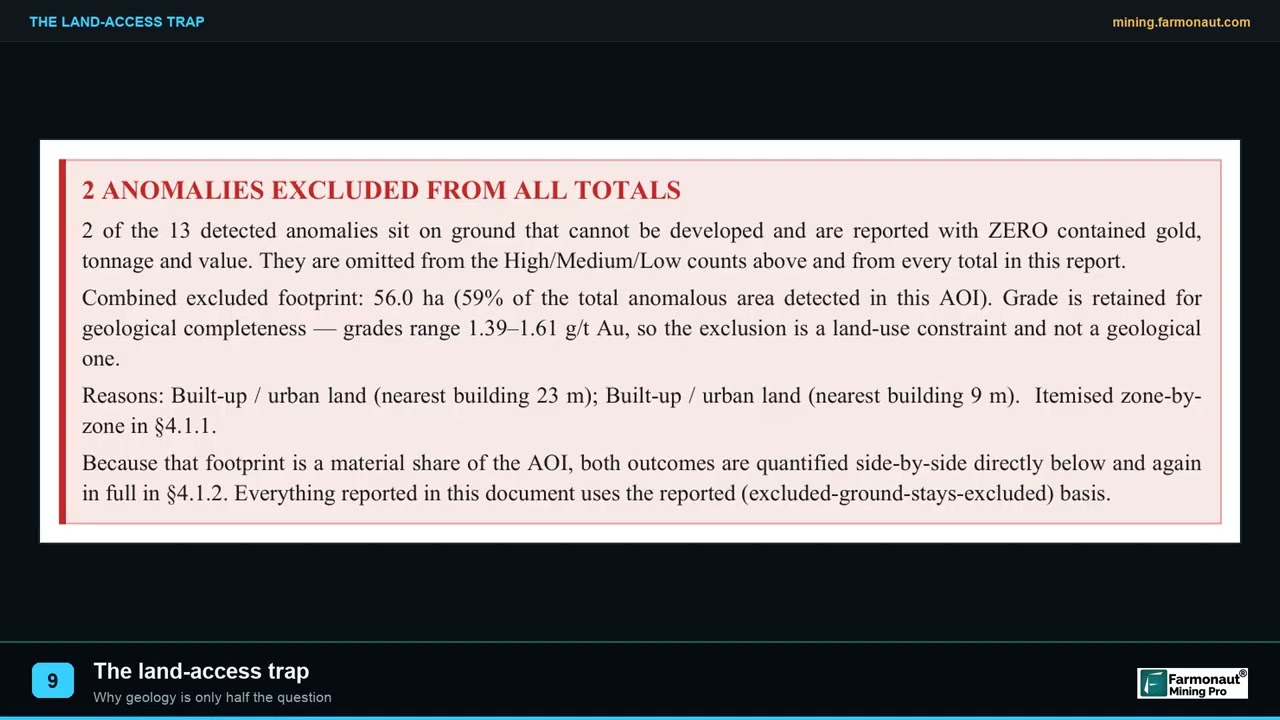
▶ Shows on one sample survey how land access, such as a town on top of anomalous ground, can block an otherwise good target. · 2:05
Where satellite data fits
Satellite data helps with the first step of a sustainable programme: deciding where not to put a drill rig. Farmonaut offers satellite-based mineral detection that screens a licence area from a KML, KMZ or polygon file and returns a report in 5 to 20 business days. The result is an exploration target, which sits ahead of a resource estimate. It is not a resource, an environmental clearance or a social license. Licence owners can request a quote for their own area.
▶ A short, jargon-free explanation of remote sensing for mining, the technique behind satellite screening. · 2:01
Related reading on this site: AI in Mining Examples: 8 Real Deployments Compared.
Frequently asked questions
Which companies are leading in sustainable mining practices?
No single company leads on every measure. On the latest reports, BHP and Anglo American are ahead of their 2030 emission goals, Anglo American has the most IRMA-audited mines listed here, Fortescue has a zero-emissions target for its Pilbara iron ore operations and Boliden has a validated science-based target. Rio Tinto, Agnico Eagle and Boliden report larger gaps to their goals.
What is a sustainable mining company?
It is a miner that publishes measurable results on climate, water, tailings, community and closure, and lets outsiders check them. The five checks above give a practical test: absolute cuts with a baseline, water in scarce areas, tailings conformance, independent mine audits and a funded closure plan.
What do Scope 1, 2 and 3 emissions mean in mining?
Scope 1 is fuel burned on site, such as diesel for trucks and gas for power. Scope 2 is purchased electricity. Scope 3 is everything else in the chain, such as the steel made from iron ore. Companies usually set tighter targets for Scopes 1 and 2 because they control them directly.
Is mining a big source of greenhouse gases?
Non-coal mining was about 0.54% of global emissions in 2024, and coal mining methane about 2.46%. Metal production, such as steel and aluminium, is about 8%. Mining and metals together are about 11%, according to ICMM and Wood Mackenzie.
What is IRMA and what does IRMA 75 mean?
IRMA is the Initiative for Responsible Mining Assurance, which audits individual mines against a standard covering social, environmental, business and legacy topics. IRMA 75 means the mine met all critical requirements and scored at least 75% in each of four principle areas.
What is Towards Sustainable Mining?
It is the standard of the Mining Association of Canada, which assesses operations on topics such as community outreach, tailings management and biodiversity. Participation is mandatory for its members’ Canadian operations, and results are published in annual progress reports.
What is the Global Industry Standard on Tailings Management?
It is a 2020 standard, convened by ICMM, the UN Environment Programme and the Principles for Responsible Investment, that sets requirements for tailings facilities. ICMM members committed to full conformance within three to five years of its launch.
Do renewable energy certificates count as emission cuts?
They lower reported Scope 2 emissions under market-based accounting, and BHP and Rio Tinto both use them. They do not always mean new renewable power was built, so check whether a report gives market-based or location-based figures, and whether the certificates are bundled with a power contract.
How can I check whether a miner’s climate target is credible?
Check the baseline year and whether it was restated, whether the figure is gross or net, what boundary applies (operated assets or equity share) and whether an outside body validated the target. Boliden’s targets, for example, are validated by the Science Based Targets initiative.
Which mines have been audited against IRMA?
Among the mines mentioned here, Anglo American’s Minas-Rio, Barro Alto, Kolomela and Sishen reached IRMA 75, and Los Bronces and Quellaveco were audited in December 2025. Eramet’s Grande Côte in Senegal reached IRMA 50 in February 2026. Check IRMA’s own audit pages for the current list.
How does satellite data support sustainable mining?
Satellite imagery can screen large areas for mineral targets and show land cover before any ground work, so field crews and drill pads go only where the data points. It does not replace an environmental assessment, a resource estimate or community consultation.
This page is for information only. It is not investment advice. It gives no share prices or targets, and the emission figures are the companies’ own, on different baselines. Check each company’s reports before you act.
Farmonaut mining
Screen your licence area from space first
Mining business owners can request a quote to have an area screened by satellite for exploration targets before field work.

Mining Pro sample view, synthetic data
Keep reading
Sources
- BHP, FY26 results presentation, ASX announcement (18 August 2026): announcements.asx.com.au
- Rio Tinto, Key performance indicators, Annual Report 2025: riotinto.com
- Rio Tinto, Climate change: riotinto.com
- Anglo American, Preliminary results for 2025 (RNS, 20 February 2026): data.fca.org.uk
- Fortescue, FY26 Sustainability Report: Climate: fy26sustainability.fortescue.com
- Agnico Eagle Mines, 2025 Sustainability Report: s205.q4cdn.com
- Boliden, Strategy and targets: investors.boliden.com
- Boliden, climate targets validated by the Science Based Targets initiative: investors.boliden.com
- Newmont, Form 10-K for the year ended 31 December 2025 (SEC): sec.gov
- ICMM, Global Mining and Metals Greenhouse Gas Emissions Dataset (10 March 2026): icmm.com
- ICMM, The Global Industry Standard on Tailings Management (12 August 2020): icmm.com
- Eramet, press release on IRMA 50 at Grande Côte (5 February 2026): eramet.com
- IRMA, Senegal’s landmark IRMA-assured mine (10 February 2026): responsiblemining.net
- Mining Association of Canada, Towards Sustainable Mining: mining.ca
- Teck Resources, news release on Anglo American merger closing steps (1 September 2026): teck.com
Discussion
Questions, corrections or field experience? Share them below. First-time comments are reviewed before they appear, and your email is never published.
No comments yet. Be the first to add a question or your experience.

 Ileys General Trading
 SG Gold Mining LLC
 VRV Global Pte Ltd
 Omsri International FZE
 G.I.T.T.
 Jaunita Erss Ltd
 Almosi SARL
 SRK Consulting
 Berks Gold Limited
 Mwerezi Minerals Company Limited
 Mining SARL
 SenGold Invest SAS
 Sean Mining Limited
 NTS Group (Pty) Ltd
 Mine4Africa
 Lithspo Minerals Limited
 Tintina Mining Group

 Licence holder · Nigeria · Gold + lithium










