

Uranium · Company ranking
Top Canadian Uranium Stocks Ranked by Project Stage
Cameco is the only Canadian uranium stock producing in Canada today; Denison and NexGen started building mines in 2026. See tickers, licence status, resources and what the uranium price means for revenue.
Key takeaways
- Cameco’s share of 2025 output was 10.5 Mlb U3O8 from McArthur River/Key Lake and 10.4 Mlb from Cigar Lake; on 30 October 2026 it narrowed 2026 guidance to 19.5-20.5 Mlb (Cameco AIF; Q3 2026 release).
- Denison’s Phoenix ISR project was licensed in February 2026 and targets first production in mid-2028 (World Nuclear Association).
- NexGen’s Rook I received a CNSC construction licence on 4 March 2026; operation needs a separate licence (CNSC).
- Fission Uranium is now part of Paladin Energy (TSX/ASX: PDN); its Patterson Lake South project awaits a CNSC hearing.
- Uranium spot averaged US$91.55/lb and the long-term price US$98.00/lb at the end of October 2026 (Cameco month-end averages). Not investment advice.
In this article
- Top Canadian uranium stocks at a glance
- How we chose and ranked these Canadian uranium stocks
- Cameco: the only producing Canadian uranium stock
- Canada's uranium output by year
- Denison Mines: Phoenix under construction
- NexGen Energy: Rook I and the Arrow deposit
- Paladin Energy: Patterson Lake South after Fission
- IsoEnergy, Uranium Royalty Corp and Uranium Energy Corp
- Uranium resources of the Canadian developers
- Sprott Physical Uranium Trust and other ways to invest in uranium
- Explorers to watch in the Athabasca Basin
- Uranium spot and term prices and what they mean for revenue
- What to check before buying a Canadian uranium stock
- Frequently asked questions
Top Canadian uranium stocks at a glance
The top Canadian uranium stocks by project stage are Cameco (TSX: CCO, NYSE: CCJ), the only one producing in Canada today, followed by Denison Mines (TSX: DML, NYSE American: DNN) and NexGen Energy (TSX: NXE, NYSE: NXE), which both started building Athabasca Basin mines in 2026. Cameco produced 10.5 million pounds of U3O8 as its share of McArthur River/Key Lake and 10.4 million pounds as its share of Cigar Lake in 2025 (Cameco 2025 Annual Information Form). Paladin Energy, IsoEnergy, Uranium Royalty Corp and Uranium Energy Corp complete the list, along with the Sprott Physical Uranium Trust for readers who want the metal rather than a miner.
Canada mined 14,309 tonnes of uranium (tU) in 2024, 24% of world supply and second only to Kazakhstan (World Nuclear Association, updated 23 October 2026). Almost all of it came from two mines in northern Saskatchewan. This page explains who owns what, which projects are licensed, where each company stands on financing, and what the uranium price means for revenue. It gives facts from company filings and regulators, not tips. Not investment advice.
| Company | Tickers | Stage | Main Canadian asset |
|---|---|---|---|
| Cameco | TSX: CCO, NYSE: CCJ | Producer | McArthur River/Key Lake, Cigar Lake |
| Denison Mines | TSX: DML, NYSE American: DNN | Under construction | Phoenix (Wheeler River) |
| NexGen Energy | TSX: NXE, NYSE: NXE | Under construction | Arrow (Rook I) |
| Paladin Energy | TSX: PDN, ASX: PDN | Licensing (Canada); producer in Namibia | Patterson Lake South |
| IsoEnergy | TSX: ISO, NYSE American: ISOU | Exploration and studies | Hurricane (Larocque East) |
| Uranium Royalty Corp | TSX: URC, Nasdaq: UROY | Royalties and physical uranium | Royalties incl. McArthur River and Cigar Lake |
| Uranium Energy Corp | NYSE American: UEC | US producer with Canadian projects | Roughrider and former UEX properties |
| Sprott Physical Uranium Trust | TSX: U.U (US$), U.UN (C$) | Fund holding U3O8 | No mine; stored uranium |
How we chose and ranked these Canadian uranium stocks
We included every company listed on the Toronto Stock Exchange (TSX) that either produces uranium in Canada, holds a Canadian uranium project with a construction licence or a licence application before the Canadian Nuclear Safety Commission (CNSC), or gives direct exposure to Canadian mine output through royalties. We added Uranium Energy Corp, a US-listed company, because its Canadian projects are often searched alongside the TSX names, and the Sprott trust because many readers compare it with the miners.
The ranking metric is project stage: producing, then under construction, then in federal licensing, then exploration and royalty vehicles. Within a stage, companies are ordered by the size of the stated uranium resource. We did not rank by share price or market value, because both move daily. Explorers that do not yet have a licence application, such as F3 Uranium, ATHA Energy and CanAlaska Uranium, are covered in their own section further down.
A few terms used below. U3O8 is uranium oxide concentrate (yellowcake), the form in which uranium is sold; one pound of U3O8 holds about 0.848 pounds of uranium metal. Grade is the share of uranium in the rock, given in percent U3O8. A resource is an estimate of the mineral in the ground; a reserve is the part a study shows can be mined at a profit. For a plain explanation of proven and probable reserves, see our guide to proven and probable reserves.
Cameco: the only producing Canadian uranium stock
Cameco operates McArthur River, the mine, and Key Lake, the mill 80 km to the south. In 2025 the operation produced 15.1 million pounds of U3O8 on a 100% basis, of which Cameco’s share was 10.5 million pounds. Cigar Lake, which Cameco runs with Orano, produced 19.1 million pounds (100% basis), of which Cameco’s share was 10.4 million pounds (Cameco 2025 AIF). Cigar Lake ore is milled at Orano’s McClean Lake mill. The World Nuclear Association lists the two mines as the largest and second-largest uranium mines in the world in 2024, at 7,808 tU and 6,501 tU (WNA).
In its third-quarter results of 30 October 2026, Cameco narrowed its 2026 production outlook to 19.5 to 20.5 million pounds (its share), from 19.5 to 21.5 million pounds, after a longer maintenance outage at Key Lake. Third-quarter output was 3.5 million pounds, against 4.4 million pounds a year earlier. Its average realised uranium price for the quarter was US$65.78 per pound, below the spot price because most of its sales are under long-term contracts signed at earlier prices (Cameco Q3 2026 release, via SEC).
Cameco is more than a miner. It also owns a share of the JV Inkai operation in Kazakhstan, the Port Hope conversion facility in Ontario and, with Brookfield, the reactor services company Westinghouse. Its share of Westinghouse made a net loss of US$24 million in the third quarter of 2026. Readers comparing it with the developers should note that its earnings depend on contract prices, fuel services and Westinghouse, not only on the spot price.
Main things to check: production against guidance each quarter, the realised price compared with spot and term prices, and the Cigar Lake and McArthur River licence terms (to June 2031 and October 2043 respectively, per the AIF).
Canada’s uranium output by year
Canadian mine output fell sharply after 2018, when Cameco suspended McArthur River because of low prices, and fell again in 2020 when the pandemic shut both big mines for months. McArthur River restarted in late 2022. By 2024 Canada was back above 14,000 tU, close to its 2016 level, according to World Nuclear Association data.
Chart
Canadian uranium mine output, 2015 to 2024
Tonnes of uranium (tU) per year
The swing matters for investors because it shows how strongly a single operator’s decisions move national output. When Cameco cut supply, Canada’s share of world production dropped to around 8% in 2020; when it restarted, the country moved back to second place.
Denison Mines: Phoenix under construction
Denison Mines is developing the Phoenix deposit at its Wheeler River project in the eastern Athabasca Basin, using in-situ recovery (ISR). In ISR, a solution is pumped through the ore underground and uranium is recovered from the liquid at surface, instead of digging the rock out. Phoenix will be the first ISR mine in the basin and uses a freeze wall to contain the solution. The CNSC approved a licence for Phoenix in February 2026, Denison made its final investment decision the same month, full-scale construction began in July 2026, and first production is targeted for mid-2028 (WNA, Uranium in Canada).
Wheeler River also hosts Gryphon, a conventional underground deposit about 3 km northwest of Phoenix. Denison’s latest resource update for Phoenix puts 56.3 million pounds of U3O8 in measured and indicated resources in its high-grade Zone A at an average grade of 46.0% U3O8 (Denison Mines, Wheeler River). Denison also owns 22.5% of the McClean Lake joint venture, whose mill processes Cigar Lake ore.
Main things to check: construction cost and schedule updates, freeze-wall commissioning and how much of the planned output is covered by sales contracts.
NexGen Energy: Rook I and the Arrow deposit
NexGen Energy is building Rook I, an underground mine and mill for the Arrow deposit on the Patterson Lake peninsula in the southwestern Athabasca Basin, about 155 km north of La Loche. The CNSC issued a licence on 4 March 2026 that authorises site preparation and construction until 31 March 2036. It does not authorise operation; that needs a further hearing and decision (CNSC, Rook I). The CNSC states that, if operation is authorised, Rook I could produce up to 11.5 million kilograms of uranium a year.
The World Nuclear Association’s Canada table lists Arrow at 80,600 tU (95,000 tonnes U3O8) at 4.35% U3O8, the largest resource in the table for a project not yet in production. NexGen has given a construction capital estimate of C$2.2 billion and in 2026 was reported to be seeking about $1 billion of further funding through project debt, offtake prepayments or strategic deals; company commentary says field construction began on 8 June 2026.
Main things to check: the financing package, the construction schedule and the application for an operating licence.
Paladin Energy: Patterson Lake South after Fission
Fission Uranium, which many older lists of Canadian uranium stocks still name, no longer trades. Australia’s Paladin Energy completed its takeover in early January 2025, after Investment Canada approval in December 2024, and now runs the Patterson Lake South (PLS) project through Paladin Canada. Paladin is listed on both the ASX and TSX under PDN. It already produces uranium at Langer Heinrich in Namibia.
On 20 February 2026 Paladin received Saskatchewan ministerial approval of the PLS environmental impact statement, a prerequisite for the provincial and federal permits needed for construction (Paladin ASX announcement). The CNSC has found the construction licence application sufficient and will consider it at a public hearing; the date had not been set on the CNSC project page (CNSC, Patterson Lake South). Paladin has said its agreed pathway with the CNSC aims to finish the hearing by the end of 2027. The WNA table lists PLS indicated resources at 39,900 tU at 1.85% U3O8.
IsoEnergy, Uranium Royalty Corp and Uranium Energy Corp
IsoEnergy (TSX: ISO, NYSE American: ISOU)
IsoEnergy’s main Canadian asset is the Hurricane deposit on its Larocque East project, about 40 km from the McClean Lake mill. Hurricane has an indicated resource of 48.6 million pounds of U3O8 at 34.5%, one of the highest grades reported anywhere. In August 2026 IsoEnergy put its Utah mines into a new company, DISA Uranium, in which it holds 33%; it reported C$70.9 million in cash at the time (Crux Investor, citing the October 2026 corporate presentation). Hurricane is an exploration-stage deposit with no mining study or licence application yet.
Uranium Royalty Corp (TSX: URC, Nasdaq: UROY)
Uranium Royalty Corp does not mine. It owns royalties and streams on uranium projects, including interests on McArthur River and Cigar Lake, and holds physical uranium. A royalty is a share of a mine’s revenue or output paid to the royalty holder. On 27 July 2026 it completed a transaction with Sweetwater Royalties that added soda ash and land royalties, so it now describes itself as a uranium and land royalty company (Uranium Royalty Corp). For more on how royalty holders earn, see our page on uranium companies and stocks by stage.
Uranium Energy Corp (NYSE American: UEC)
Uranium Energy Corp is a US company with ISR production in Texas and Wyoming. It is on many Canadian lists because it bought UEX Corporation in 2022 and the Roughrider project from Rio Tinto, giving it a portfolio of Athabasca Basin projects. It is not listed on the TSX, so Canadian investors buy it through a US exchange account.
Uranium resources of the Canadian developers
The chart compares the stated uranium resources behind the developers on this list, converted to tonnes of uranium where needed. They come from different estimates and categories, so treat them as an order of size, not a like-for-like comparison. A bigger resource does not mean a cheaper mine: grade, depth, ground conditions and the mining method decide the cost.
Chart
Stated uranium resources of Canadian developers
Thousand tonnes of uranium (ktU); different estimates, categories and dates
Arrow stands out for size, Hurricane and Phoenix for grade. Phoenix and Hurricane are smaller but grade far above the world average, which is one reason ISR at Phoenix was judged feasible.
Sprott Physical Uranium Trust and other ways to invest in uranium
The Sprott Physical Uranium Trust is a closed-end fund that buys and stores U3O8. It trades on the TSX in US dollars (U.U) and Canadian dollars (U.UN). Its value tracks the spot price more closely than a miner’s shares do, but it has no mine, no production and no earnings. Investors who want metal price exposure without project risk often compare it with Cameco; those who want project upside look at the developers. Exchange-traded funds that hold uranium miners are another route.
How to invest in uranium stocks from Canada: open a brokerage account that offers TSX and US exchange access, check whether the account is a TFSA or RRSP (both allow TSX-listed shares), and read each company’s latest annual information form and management discussion on SEDAR+ before buying anything. Many of the companies above are dual-listed, so the same shares trade in Toronto and New York at prices that differ by the exchange rate.
Explorers to watch in the Athabasca Basin
The Athabasca Basin in northern Saskatchewan holds the world’s highest-grade uranium deposits, and the World Nuclear Association notes that more than 40 companies explore for uranium across Canada, mostly in northern Saskatchewan. Explorers are higher risk than producers because they may never build a mine. Names that often appear on TSX and TSX Venture lists include F3 Uranium (near Patterson Lake), ATHA Energy, CanAlaska Uranium (operator of the West McArthur joint venture with Cameco) and Forum Energy Metals. Global Atomic (TSX: GLO) is a Canadian-listed company whose Dasa project is in Niger, not Canada.
For where these deposits sit compared with uranium districts elsewhere, see our map of uranium deposits in the world, our overview of African countries with the largest uranium reserves, and our guide to types of ore deposits, which explains the unconformity-type deposits of the Athabasca Basin.

▶ A short explainer on where uranium occurs in Africa, for comparison with the Athabasca Basin. · 4:27
Uranium spot and term prices and what they mean for revenue
Uranium is not traded on an open exchange like copper. Buyers and sellers agree prices privately, and two price reporters, UxC and TradeTech, publish the spot price (for delivery within a year) and the long-term or term price (for multi-year contracts). Cameco’s month-end averages for 30 October 2026 were US$91.55 per pound spot and US$98.00 per pound long-term (Cameco, uranium price). The term price has risen every few months during 2026, while spot dipped below US$85 in May before recovering.
Chart
Uranium spot and long-term price, month-end 2026
US$ per pound U3O8; industry averages of UxC and TradeTech
Producers sell most of their output under term contracts that may have been signed years earlier, so a company’s realised price lags the market. That is why Cameco realised US$65.78 per pound in the third quarter while spot was close to US$90. Developers such as Denison and NexGen sign offtake contracts before production, and those terms are among the most important numbers in their disclosures.
Calculator
What is a year of uranium output worth?
Enter a producer’s annual output, a realised price and a cost to estimate revenue and cash margin.
- Output in tonnes of uranium (tU): 7,693
- Cash cost for the year (US$ million): $800
- Margin before capital and tax (US$ million): $1,000
- Revenue change per US$1/lb (US$ million): $20
Example values only, not a forecast or a company result. Price is an input: use today’s price or a company’s realised price. Cost is an example all-in cash cost. One pound of U3O8 contains 0.848 lb of uranium; 1 tonne = 2,204.62 lb. Revenue is before royalties, tax and capital spending.
What to check before buying a Canadian uranium stock
- Stage and licence. Confirm on the CNSC website whether the project has a construction licence, an operating licence or only an application.
- Funding. Compare the construction cost with cash on hand and announced financing; look for planned share issues.
- Contracts. Check how much future output is sold, at what price and with which floors or ceilings.
- Resources and reserves. Read the latest NI 43-101 technical report: category, grade, cut-off grade and effective date.
- Partners and processing. Find out who owns the mill and whether the ore depends on another company’s facility, as Cigar Lake depends on McClean Lake.
- Ticker and name. Make sure the company still exists under the same name; Fission Uranium, UEX and others have been acquired.
Investors and consultants who assess exploration ground in the basin sometimes use satellite imagery to map structure and alteration across a licence before field work; Farmonaut offers satellite-based mineral detection for that early screening. Project enquiries can go through the mining query form or the contact page.
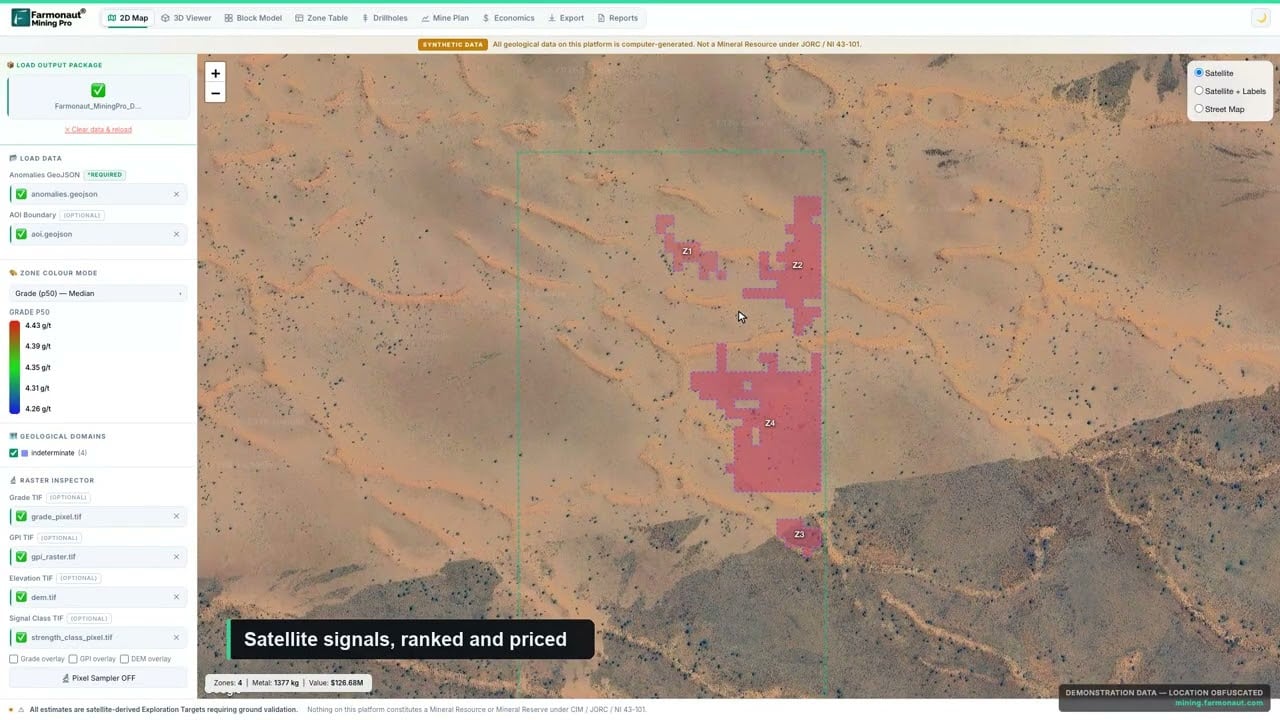
▶ A short look at Farmonaut Mining Pro, which turns a licence boundary into a geological and economic picture. · 4:56
Frequently asked questions
What are the best uranium stocks in Canada?
By project stage, the leading Canadian uranium stocks are Cameco (producer), Denison Mines and NexGen Energy (both building mines), Paladin Energy (Patterson Lake South in licensing), IsoEnergy (Hurricane) and Uranium Royalty Corp. Which suits an investor depends on risk tolerance; this page does not recommend any of them.
Which Canadian uranium companies produce uranium today?
Cameco is the only listed Canadian company producing uranium in Canada, from McArthur River/Key Lake and Cigar Lake. Orano, its partner at Cigar Lake, is French and state-owned.
What is the ticker for Denison Mines?
Denison trades as DML on the Toronto Stock Exchange and DNN on NYSE American.
Is NexGen Energy listed in the US?
Yes. NexGen trades as NXE on both the TSX and the New York Stock Exchange.
What happened to Fission Uranium stock?
Paladin Energy completed its acquisition of Fission Uranium in January 2025. Fission shares were delisted, and holders received Paladin shares, which trade as PDN on the ASX and TSX.
Which uranium stocks trade on the TSX?
Cameco (CCO), Denison (DML), NexGen (NXE), Paladin (PDN), IsoEnergy (ISO), Uranium Royalty Corp (URC) and the Sprott Physical Uranium Trust (U.U and U.UN) all trade on the TSX, along with explorers such as F3 Uranium and Global Atomic.
How do I invest in uranium from Canada?
You can buy shares of uranium miners or royalty companies, units of the Sprott Physical Uranium Trust, or an exchange-traded fund that holds miners, through any brokerage account with TSX access, including a TFSA or RRSP.
Why are Saskatchewan uranium mines so high grade?
The Athabasca Basin hosts unconformity-type deposits, where uranium collected at the boundary between old sandstone and the basement rock beneath it. McArthur River’s reserves averaged 6.48% U3O8 at the end of 2025, many times the grade of most mines elsewhere.
What is the difference between uranium spot and term prices?
Spot is the price for delivery within about a year; term is the price in multi-year contracts. Utilities buy most of their uranium on term contracts, so producers’ realised prices follow the term price more than spot.
When will Denison and NexGen start producing uranium?
Denison targets first production at Phoenix in mid-2028. NexGen holds a construction licence for Rook I and needs a separate CNSC operating licence before it can produce.
This page is for information only. It is not investment advice. It names no security to buy or sell and gives no price targets. Check company filings on SEDAR+ and EDGAR and speak to a licensed adviser.
Farmonaut mining
Screen uranium ground from space
Farmonaut maps structure and alteration across an exploration licence from satellite data, helping investors and explorers rank ground before field work.

Mining Pro sample view, synthetic data
Keep reading
Sources
- Cameco, 2025 Annual Information Form: cameco.com
- Cameco, third quarter 2026 results (30 October 2026), Form 6-K: sec.gov
- Cameco, uranium price (month-end spot and long-term): cameco.com
- Cameco, Cigar Lake: cameco.com
- World Nuclear Association, World Uranium Mining Production (updated 23 October 2026): world-nuclear.org
- World Nuclear Association, Uranium in Canada: world-nuclear.org
- Canadian Nuclear Safety Commission, Rook I: cnsc-ccsn.gc.ca
- Canadian Nuclear Safety Commission, Patterson Lake South project: cnsc-ccsn.gc.ca
- Paladin Energy, EIS approval for Patterson Lake South (20 February 2026): announcements.asx.com.au
- Denison Mines, Wheeler River project: denisonmines.com
- Uranium Royalty Corp, company site: uraniumroyalty.com
- Crux Investor, IsoEnergy cash and DISA Uranium stake (October 2026): cruxinvestor.com
Discussion
Questions, corrections or field experience? Share them below. First-time comments are reviewed before they appear, and your email is never published.
No comments yet. Be the first to add a question or your experience.

 Tintina Mining Group
 Dalgety Minerals Pty Ltd
 Vortex Minerals Pty Ltd
 Faith At Work (Pty) Ltd
 Geotech Mining Solutions plc
 Vulcan International Limited
 Kidepo Associates
 GKY Mining
 Alkimy SARL
 Double A Trading
 GemSprout Metals Limited
 Qader Group
 Ileys General Trading
 SG Gold Mining LLC
 VRV Global Pte Ltd
 Omsri International FZE
 G.I.T.T.
 Jaunita Erss Ltd
 Almosi SARL
 SRK Consulting
 Berks Gold Limited
 Mwerezi Minerals Company Limited

 Exploration consultancy · South Africa · Gold










