

Uranium · Country comparison
US Uranium Production vs Canada: Output and Mines
US plants made about 2.1 million pounds of uranium concentrate in 2025 (EIA). Canada’s two main mines packaged about 34 million pounds (Cameco). Compare mines, grades, plants and world rank, and convert tonnes of uranium to pounds.
Key takeaways
- US plants produced 2.109 million lb of U3O8 concentrate in 2025, up from 657,000 lb in 2024 and the most since 2017 (EIA, 2026).
- Canada’s Cigar Lake and McArthur River/Key Lake packaged 34.2 million lb in 2025 on a 100% basis, about 16 times the US total (Cameco, 2026).
- In 2024 Canada mined 14,309 tU (24% of world supply) and the US 260 tU (WNA, 2026); Cigar Lake reserves grade 15.9% U3O8 against 1.62% at Pinyon Plain.
- Canada was the top source of uranium delivered to US reactors in 2025 at 32%; US-origin uranium was 7% (EIA, 2026).
- US plants made about 2.13 million lb in the first half of 2026 (EIA quarterly), but operating ISR capacity is 13.3 million lb a year.
In this article
- US uranium production vs Canada: the short answer
- How much uranium does the US produce?
- Which US plants and mines produce uranium?
- How much uranium does Canada produce?
- Why Canada's mines produce so much more: grade and method
- Pounds or tonnes? How to compare the two countries
- Where the US and Canada rank in world uranium output
- Where US reactors get their uranium
- What could change output in the US and Canada
- Where satellite images help uranium exploration
- Frequently asked questions
US mines and plants made about 2.1 million pounds of uranium concentrate (U3O8) in 2025, according to the US Energy Information Administration (EIA). Canada’s two big Saskatchewan mines, McArthur River/Key Lake and Cigar Lake, packaged about 34 million pounds in the same year, on a 100% basis, according to their operator Cameco. That is roughly 16 times the American total. This page sets the two countries side by side: how much each makes, where, from what kind of mine, and what could change the picture.
US uranium production vs Canada: the short answer
Canada is the world’s second-largest uranium producer. The World Nuclear Association (WNA) reports that in 2024 Canada mined 14,309 tonnes of uranium (tU), 24% of world mine supply, behind only Kazakhstan at 39%. The same WNA table puts the United States at 260 tU, well under 1% of the world total. American output has risen sharply since then, but it is still a small fraction of Canada’s.
Uranium is quoted in two units, so read figures with care. Americans report pounds of U3O8 (the oxide sold as yellowcake). The WNA and most governments outside the US report tonnes of uranium metal. One tonne of uranium is about 2,600 pounds of U3O8, and the calculator further down converts tonnes of uranium to pounds of U3O8.
| Measure | United States | Canada | Source |
|---|---|---|---|
| Uranium concentrate made, 2025 | 2.109 million lb U3O8 (about 811 tU) | 34.2 million lb U3O8 at McArthur River/Key Lake and Cigar Lake, 100% basis (about 13,200 tU) | EIA; Cameco |
| Mine output, 2024 | 260 tU | 14,309 tU | WNA |
| Share of world mine supply, 2024 | About 0.4% | 24% | WNA (our division) |
| Change from the year before | Concentrate up from 657,000 lb in 2024 to 2.109 million lb in 2025 | Mine output up from 11,001 tU in 2023 to 14,309 tU in 2024 | EIA; WNA |
| Main mining method | In-situ recovery (7 of 9 operating mines and sources in 2025) | High-grade underground mining | EIA; WNA |
| Ore treatment | 5 operating in-situ plants and one conventional mill, White Mesa in Utah | Key Lake and McClean Lake mills in Saskatchewan | EIA; WNA |
The two countries are not on the same basis in this table. The US column counts all domestic concentrate, while the Canadian 2025 figure counts only the two main mines, so it leaves out smaller sources such as Orano’s McClean Lake North and is not the full country total. WNA’s 2024 row is the cleanest like-for-like comparison.
How much uranium does the US produce?
EIA’s annual survey shows a sector that almost disappeared and then restarted. US plants produced 4.9 million pounds of concentrate in 2014, 174,000 pounds in 2019, 21,000 in 2021 and 50,000 in 2023. EIA withheld the 2020 figure to avoid disclosing individual company data. Production then rose to 657,000 pounds in 2024 and 2.109 million pounds in 2025, which EIA describes as more than triple 2024 and the most since 2017.
Chart
US uranium concentrate production
Thousand pounds U3O8 per year; 2020 withheld by EIA, so the line joins 2019 to 2021
EIA publishes two related series, and they differ. Mine production (ore taken from the ground, on a contained basis) was 1,388,000 pounds U3O8 in 2025, up from 677,000 in 2024, from one underground mine and seven in-situ recovery operations plus some other sources such as mine water and well-field restoration. Concentrate production counts what the mills and plants actually packaged. When you quote a US figure, say which series you mean.
The restart is still going. EIA’s quarterly report shows 1,039,075 pounds in the first quarter of 2026 and 1,087,504 pounds in the second, about 2.13 million pounds for the half year, which is already slightly above the whole of 2025. That second-quarter output came from six facilities: four in Wyoming (Ross, Lost Creek, Smith Ranch-Highland and Willow Creek), one in Texas (Alta Mesa) and White Mesa in Utah.
Prices explain part of the slump and the recovery. EIA’s table shows US producers selling 1.19 million pounds in 2025 at a weighted-average US$68.45 per pound, up from US$67.83 in 2024. For the market price and how spot differs from term contracts, see our guide to the uranium spot price.
Which US plants and mines produce uranium?
Nearly all American uranium now comes from in-situ recovery (ISR), also called in-situ leaching. Wells inject a mild leaching solution into a sandstone aquifer that holds the uranium, the solution dissolves it, and pumps bring the uranium-bearing liquid to a plant on the surface. There is no open pit and no ore haul. EIA lists these plants as operating at the end of 2025:
Chart
Operating US in-situ plants by capacity
Thousand pounds U3O8 per year, end of 2025
| Plant | Owner or operator (EIA listing) | Location | Capacity, lb U3O8 per year |
|---|---|---|---|
| Smith Ranch-Highland | Power Resources Inc., doing business as Cameco Resources | Converse County, Wyoming | 5,500,000 |
| Ross Central Processing Plant | Strata Energy Inc. | Crook County, Wyoming | 3,000,000 |
| Lost Creek | Lost Creek ISR LLC (Ur-Energy) | Sweetwater County, Wyoming | 2,000,000 |
| Alta Mesa | enCore Alta Mesa LLC (enCore Energy) | Brooks County, Texas | 1,500,000 |
| Willow Creek (Christensen Ranch and Irigaray) | Uranium Energy Corp | Campbell and Johnson counties, Wyoming | 1,300,000 |
Together these five plants had 13.3 million pounds a year of capacity, slightly down from 14.1 million in 2024. Five more plants with 8.8 million pounds of capacity were on standby, and seven planned plants in South Dakota, Texas and Wyoming would add 10.5 million pounds. Against 13.3 million pounds of operating capacity, the 2.1 million pounds actually produced is about 16%, so plant size is not what holds output back. The company reports below point to wellfield development and permits. The WNA profile says the Ross plant belongs to the Lance project of Australian company Peninsula Energy, run through its subsidiary Strata Energy.
The only conventional mill still working is Energy Fuels’ White Mesa Mill in Utah, which treats ore from underground mines such as Pinyon Plain in Arizona. The WNA reports that Pinyon Plain’s 2025 ore averaged 1.62% U3O8. Our guide to uranium mining in Utah covers the mills, and our list of US uranium mining companies goes through the operators one by one.
Company reports show how uneven the restart is. Ur-Energy drummed 140,873 pounds of U3O8 in the second quarter of 2026, its most in a quarter since the Lost Creek ramp-up began in 2022, at a cash cost of US$40.20 per pound sold, and said it received final state authorisation for full operations at Shirley Basin in late June 2026. enCore reported 131,274 pounds extracted in the first half of 2026, down from 317,613 pounds a year earlier. The company said Wellfield 7 is due to stop recovery in the third quarter of 2026 as it runs out, and that it expects permits for the next wellfields in the fourth quarter of 2026 and the first quarter of 2027.
How much uranium does Canada produce?
Canada’s output swings with the status of two mines. WNA data show it fell from 13,325 tU in 2015 to 3,885 tU in 2020, then climbed back to 14,309 tU in 2024. The fall came when McArthur River was put into care and maintenance in January 2018 and Cigar Lake was paused in 2020. McArthur River restarted in November 2022.
Both mines lie in the Athabasca Basin of northern Saskatchewan, and Cameco operates both. In 2025, Cameco reported 19.1 million pounds at Cigar Lake and 15.1 million pounds at McArthur River/Key Lake (100% basis), and 21.0 million pounds as its own share across its uranium business. For 2026 it expects 19.5 to 21.5 million pounds as its share. It left that guidance unchanged after short disruptions at Key Lake and McArthur River in the second quarter and at Cigar Lake just after it. In that quarter the two operations packaged 3.3 million and 2.9 million pounds on a 100% basis.
A few details that older articles got wrong or left out:
- Key Lake is a mill, not a mine. It treats McArthur River ore. Cigar Lake ore slurry goes to Orano’s McClean Lake mill, about 70 km away.
- Rabbit Lake has been in care and maintenance since 2016, according to the WNA’s Canada profile. It is not an operating asset.
- Orano is the other Canadian producer. Its McClean Lake North deposit began mining again in June 2025 using a borehole method called SABRE, in which a high-pressure water jet cuts the ore from a drill hole at the surface.
Our overview of uranium mining in Saskatchewan goes deeper into the province, and our explainer on where the Athabasca Basin is shows the geology. Company-by-company facts for Canadian-listed uranium firms are in our overview of Canadian uranium stocks; that page is for information, not a recommendation.
Why Canada’s mines produce so much more: grade and method
Grade is the main difference. Grade is the share of the rock that is uranium, usually written as % U3O8. A richer ore means less rock to move and treat for each pound. The WNA lists the proven and probable reserves of the two Canadian mines at very high grades, while American ore is far leaner.
| Deposit | Country | Grade | What the figure is |
|---|---|---|---|
| Cigar Lake | Canada | 15.9% U3O8 | Proven and probable reserves (WNA) |
| McArthur River | Canada | 9.6% U3O8 | Proven and probable reserves (WNA) |
| Pinyon Plain | United States (Arizona) | 1.62% U3O8 | Average of ore produced in 2025 (WNA) |
| Dewey-Burdock | United States (South Dakota) | 0.11% U | Average grade of measured resource, an ISR project (WNA) |
Even Pinyon Plain, which the WNA calls one of the highest-grade US mines, grades about a tenth of Cigar Lake. American ISR resources are lower still: the WNA profile quotes 0.04% U for the Lance project in Wyoming (2017 resource) and 0.11% U at Dewey-Burdock. ISR can work on such ground because the rock stays in place and no ore is hauled or milled. Ur-Energy’s cash cost of US$40.20 per pound sold, noted above, is one example of what a Wyoming operation reports.
Method matters too. Cigar Lake sits in soft, water-bearing sandstone, so it freezes the ground and cuts ore with remote-controlled water jets. That is slow to build and costly, but each tonne of ore carries a lot of metal. Worldwide, in-situ leaching supplied 55% of mine production in 2024, underground and open-pit mines 40% and by-product recovery 5%. The US is almost entirely in the first group, and Canada in the second.
The calculator below works out the cash margin on a pound from an ISR operation, using your own price and cost.
Calculator
What is the cash margin on a pound of ISR uranium?
Enter your own output, selling price and cash cost.
- Revenue per year: $40,000,000
- Cash margin per year: $20,000,000
- Cash margin as a share of price: 50.0 %
Example values only, not benchmarks. Ur-Energy reported a cash cost of US$40.20 per pound sold in the second quarter of 2026 (company results, 10 August 2026), but costs differ by site. Price is an input: use today’s price. Ur-Energy’s cash cost includes ad valorem and severance taxes but excludes non-cash costs and capital; other companies define cash cost differently. Money in US$.
Pounds or tonnes? How to compare the two countries
To compare an EIA figure in pounds with a WNA figure in tonnes, you need a conversion. Uranium oxide (U3O8) is about 84.8% uranium by weight. The WNA’s 2024 world total of 60,213 tU equals 71,006 tonnes of U3O8, a ratio of 1.179, so one tonne of uranium is about 1.179 tonnes of U3O8 or 2,599.8 pounds. For example, EIA’s 1,388,000 pounds of 2025 mine production is 534 tU, the same figure WNN quotes.
Enter any tonnage below to see it in pounds, the value at a price you choose, and its share of what US reactor owners bought in 2025.
Calculator
How many pounds of U3O8 is your tonnage of uranium?
Enter tonnes of uranium and a price of your own. Results update as you type.
- Tonnes of U3O8: 1,179 t
- Value at your price: $207,984,000
- Share of US reactor purchases: 5.5 %
Example values only, not benchmarks. The price is an input: use today’s price. The 2,599.8 lb of U3O8 per tonne of uranium follows from World Nuclear Association’s 2024 world total (60,213 tU = 71,006 t U3O8). The 46.9 million lb is what US reactor owners bought in 2025 (EIA). Money in US$.
Where the US and Canada rank in world uranium output
Kazakhstan led with 23,270 tU, Canada was second and Namibia third at 7,333 tU. Australia (4,598 tU), Uzbekistan (an estimate of 4,000 tU), Russia (2,738 tU) and China (an estimate of 1,600 tU) followed, all from the WNA table. The US figure of 260 tU was also below Niger’s 962 tU and Ukraine’s estimate of 288 tU.
Chart
Uranium mined in 2024, selected countries
Tonnes of uranium (tU), selected countries from WNA’s table; Uzbekistan and China are estimates
By company, the same WNA source lists Kazatomprom at 12,463 tU (21% of world supply), Cameco at 10,193 tU (17%) and Orano at 6,815 tU (11%) for 2024. BHP, whose Olympic Dam mine in South Australia recovers uranium as a by-product, produced 2,693 tU; our page on BHP’s uranium production covers that output and its costs. For deposit size rather than annual output, see the largest uranium deposits by country.

▶ A short explainer on uranium in Africa and whether Zimbabwe has any, to put the African producers in context. · 4:27
Where US reactors get their uranium
US output meets only a small part of domestic demand. EIA’s Uranium Marketing Annual Report data show that US reactor owners bought 46.9 million pounds of U3O8 equivalent in 2025, down from 55.9 million in 2024, at a weighted-average price of US$58.46 per pound, compared with US$52.71 in 2024. Of the material delivered, Canada supplied 32%, Kazakhstan 28% and Australia 15%, and US-origin uranium was 7%.
Chart
Origin of uranium delivered to US reactors
Share of U3O8 deliveries in 2025, percent; selected origins
That means Canada, not any domestic mine, is the largest single source for American reactors. Policy also bears on this mix. The WNA notes that the Prohibiting Russian Uranium Imports Act, signed in May 2024, bans imports of Russian-origin natural uranium and low-enriched uranium from August 2024, with limited waivers available until January 2028. Russia answered with its own export restrictions in November 2024.
What could change output in the US and Canada
On the US side, drilling shows where producers are heading. EIA counted 1,824 exploration holes in 2025 against 1,324 in 2024, and 3,708 development holes against 2,462. It said drilling was the highest in years, with spending on land, exploration, drilling, production and reclamation of US$234.7 million, up from US$160.0 million, and 711 full-time person-years of employment, up from 506. Exploration drilling finds new ground. Development drilling measures known deposits and sets up wellfields.
Chart
US uranium drilling holes, 2024 and 2025
Number of holes drilled
The planned ISR plants (10.5 million pounds a year of capacity in South Dakota, Texas and Wyoming) depend on permits. Dewey-Burdock in South Dakota is an example: the WNA says its Nuclear Regulatory Commission licence became final in 2023 and its EPA underground injection permits were upheld on appeal in 2025. enCore’s Rosita and Alta Mesa wellfields in Texas are waiting on final permits, which the company expects in late 2026 and early 2027.
In Canada, the next new source is Denison’s Phoenix project in Saskatchewan, to be mined by in-situ leaching with a freeze wall around the leach zone. The WNA reports that the Canadian Nuclear Safety Commission approved the licence in February 2026, Denison took a final investment decision the same month, and first production is planned by mid-2028. Cameco’s own 2026 guidance, quoted above, is the best near-term guide to the main mines.
For both countries the biggest swing factors are the same: permits, the contract price utilities will pay, and whether a single mine goes offline. Canada’s output fell from 13,116 tU in 2017 to 3,885 tU in 2020, which shows how two mines can move a whole country’s total.
Where satellite images help uranium exploration
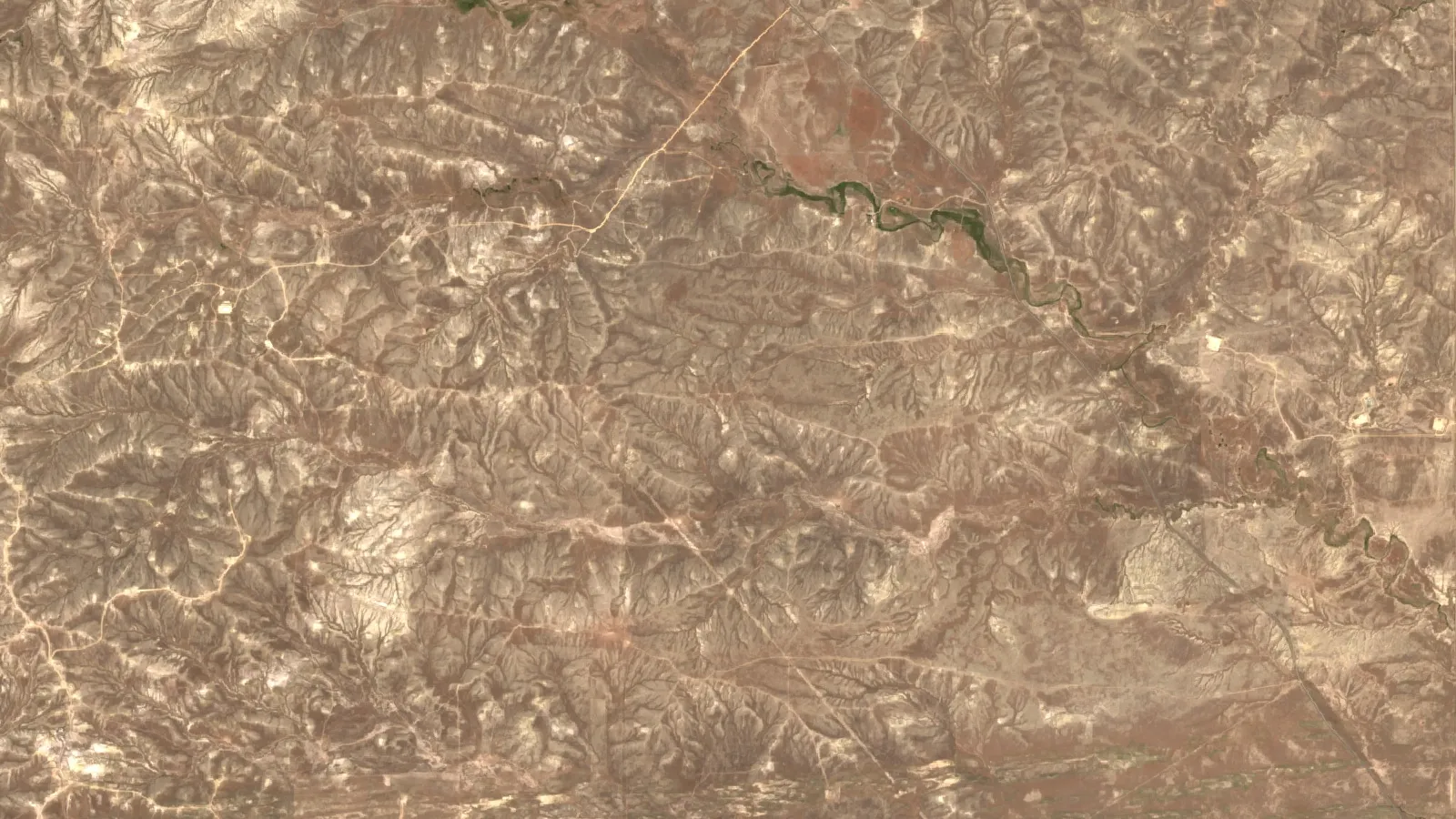
Satellite data do not measure uranium at depth. They map the surface: clay and iron-oxide alteration, faults, drainage patterns and bleached or reduced zones in sandstone that often go with uranium systems. A team uses those maps to choose where to send geologists, take samples and drill. The result is a ranked set of exploration targets, which comes before any resource estimate and is not one.
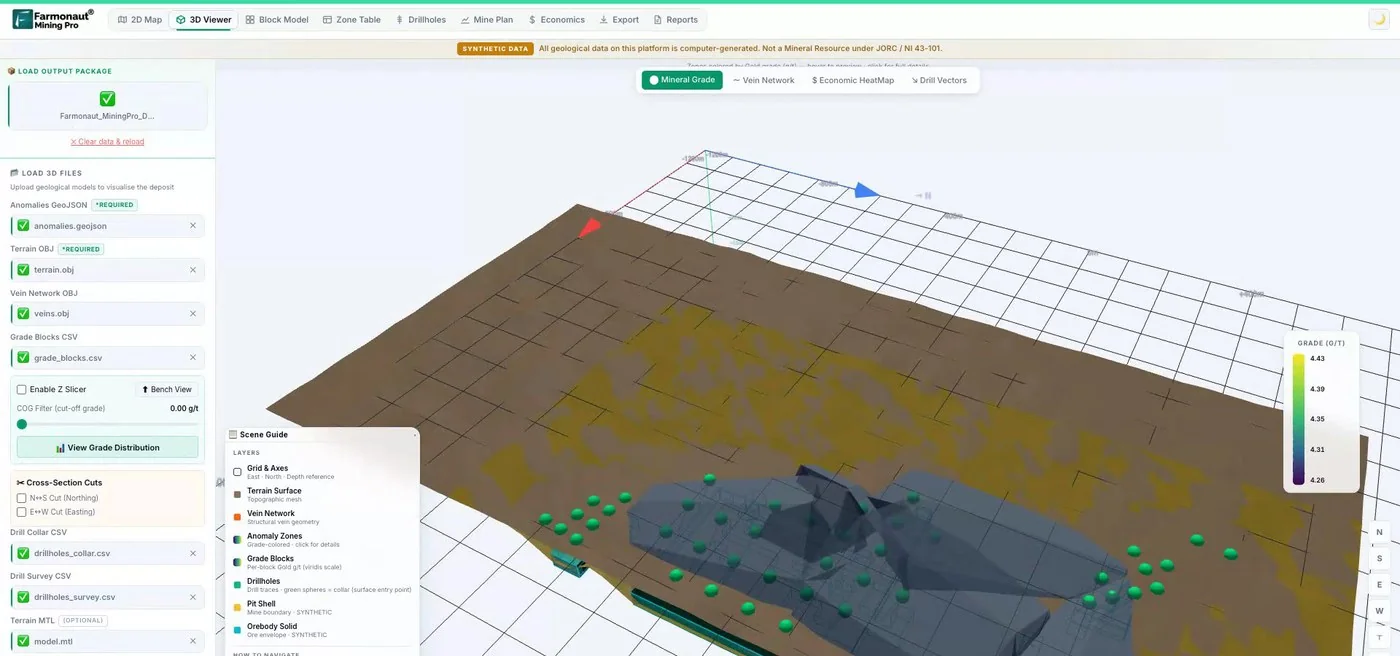
Farmonaut’s satellite-based mineral detection service accepts a KML, KMZ or polygon boundary and screens it for target zones across more than 20 mineral types, including uranium. If you hold ground in Wyoming, Texas, Utah or Saskatchewan and want it screened before a field programme, you can send the boundary through the mining query form or contact the team.
▶ What remote sensing for mining means and why agreement between instruments matters. · 2:01
If this topic matters to you, read Uranium in Niger: Mines, Output and France Supply next.
Frequently asked questions
How much uranium does the US produce each year?
EIA reports 2.109 million pounds of U3O8 concentrate for 2025, up from 657,000 pounds in 2024. In the first half of 2026 US plants made about 2.13 million pounds (1,039,075 pounds in the first quarter and 1,087,504 in the second).
How much uranium does Canada produce each year?
The WNA reports 14,309 tonnes of uranium in 2024, about 37 million pounds of U3O8. In 2025, Cameco’s two main mines packaged 34.2 million pounds on a 100% basis (Cigar Lake 19.1 million, McArthur River/Key Lake 15.1 million).
Which country produces more uranium, the US or Canada?
Canada, by a wide margin. The WNA’s 2024 table has Canada at 14,309 tU (24% of world supply) and the US at 260 tU. On EIA and Cameco’s 2025 figures, the Canadian main mines made about 16 times the American total.
Where is uranium mined in the US?
In the second quarter of 2026, EIA recorded production at four plants in Wyoming, one in Texas and one in Utah. Nebraska’s Crow Butte plant was in restoration, not production, at the end of 2025.
What is in-situ recovery and why does the US use it?
In-situ recovery dissolves uranium in place with a leaching solution pumped through wells, then brings the solution up to a plant. It suits permeable sandstone deposits with a low grade, which is what Wyoming and Texas have. It needs no open pit and moves very little rock.
Why did US uranium production fall so low and then recover?
Output dropped from 4.9 million pounds in 2014 to 21,000 pounds in 2021 (EIA), after years of weak prices and surplus world supply that led many producers to curtail operations (WNN). It has recovered since 2024 as plants restarted and wellfields were drilled. Imports of Russian uranium have also been restricted since August 2024 (WNA).
What are the biggest uranium mines in Canada?
Cigar Lake and McArthur River, both in the Athabasca Basin and both operated by Cameco. In 2025 they produced 19.1 and 15.1 million pounds on a 100% basis. Their ore is treated at the McClean Lake and Key Lake mills.
How many pounds of U3O8 are in a tonne of uranium?
About 2,600. A tonne of uranium metal equals roughly 1.179 tonnes of U3O8, which is 2,599.8 pounds. Use the calculator above for other amounts.
How much of the uranium US reactors use is made in the US?
EIA says US-origin uranium was 7% of deliveries to US plants in 2025. Canada supplied 32%, Kazakhstan 28% and Australia 15%.
Does the US buy uranium from Canada?
Yes. In EIA’s 2025 data, Canada was the top source of uranium delivered to US nuclear plants, at 32% of the total.
Is Canadian uranium higher grade than American uranium?
Yes. The WNA gives Cigar Lake reserves a grade of 15.9% U3O8 and McArthur River 9.6%, compared with 1.62% at Pinyon Plain, one of the richest US mines, and 0.04% to 0.11% U for ISR resources such as Lance and Dewey-Burdock.
Where can I find the latest US production figures?
EIA publishes a quarterly Domestic Uranium Production Report and an annual one. The next quarterly release was listed for November 2026.
This page is for information only. It is not investment advice. Production figures are from the cited reports and are revised from time to time; confirm the latest release before you rely on a number.
Farmonaut mining
Map your mining site from space
Send a KML, KMZ or polygon and Farmonaut screens the ground for exploration targets before crews go in.
Mining Pro sample view, synthetic data
Keep reading
Sources
- EIA, 2025 Domestic Uranium Production Report (June 2026): eia.gov
- EIA, Domestic Uranium Production Report, Quarterly (second quarter 2026): eia.gov
- EIA, Today in Energy: U.S. uranium production more than tripled in 2025 (28 August 2026): eia.gov
- World Nuclear Association, World Uranium Mining Production (updated 9 October 2026): world-nuclear.org
- World Nuclear Association, Uranium in Canada: world-nuclear.org
- World Nuclear Association, US Uranium Mining and Exploration: world-nuclear.org
- Cameco, Quarterly Report, fourth quarter 2025: cameco.com
- Cameco, Quarterly Report, second quarter 2026: cameco.com
- World Nuclear News, US uranium production up again (26 June 2026): world-nuclear-news.org
- Ur-Energy, Second Quarter 2026 Results (10 August 2026): ur-energy.com
- enCore Energy, Q2 2026 Financial Results (13 August 2026): investingnews.com
Discussion
Questions, corrections or field experience? Share them below. First-time comments are reviewed before they appear, and your email is never published.
No comments yet. Be the first to add a question or your experience.

 Klusetic Mining Investments
 Mine4Africa
 Lithspo Minerals Limited
 Tintina Mining Group
 Dalgety Minerals Pty Ltd
 Vortex Minerals Pty Ltd
 Faith At Work (Pty) Ltd
 Geotech Mining Solutions plc
 Vulcan International Limited
 Kidepo Associates
 GKY Mining
 Alkimy SARL
 Double A Trading
 GemSprout Metals Limited
 Qader Group
 Ileys General Trading
 SG Gold Mining LLC
 VRV Global Pte Ltd
 Omsri International FZE
 G.I.T.T.
 Jaunita Erss Ltd
 Almosi SARL
 SRK Consulting
 Berks Gold Limited
 Mwerezi Minerals Company Limited










