

Reviewed September 2026 against USDA Farm Service Agency, AgDirect, Statistics Canada, and UK Defra sources.
Try it: Run your own numbers →
Farm equipment loans in the US, Canada, and UK run on three very different systems, and confusing them is the fastest way to apply to the wrong lender. US producers borrow through USDA Farm Service Agency direct loans or private lenders like AgDirect; Canadian farmers work with Farm Credit Canada and the Canadian Agricultural Loans Act; UK farmers combine commercial agricultural mortgages with Defra’s Farming Equipment and Technology Fund grants. Below is what each actually costs right now, with the direct sources so you can check for a fresher number before you sign anything.
US Farm Equipment Loans: USDA and Private Lenders
US producers looking for farm equipment loans have two broad paths: government-backed USDA Farm Service Agency lending, and private agricultural equipment finance companies such as AgDirect. The two serve different needs — USDA rates are lower but come with eligibility and paperwork requirements; private lenders move faster and finance a wider range of used and new machinery.
As of the USDA Farm Service Agency’s July 2025 lending-rate announcement, Farm Operating Loans carried a direct rate of 4.75% (set in the December 2024 announcement and confirmed unchanged through mid-2025), Farm Ownership Loans stood at 5.25%, and Farm Storage Facility Loans — used for grain bins, cold storage and related structures — ranged 3.875% to 4.625% depending on the 3-year to 12-year term selected (USDA Farm Service Agency, July 2025). FSA republishes these rates on the first business day of most months, so check the FSA news room directly before budgeting a loan.
The average USDA farm loan obligated per borrower was $243,000 in fiscal year 2025, per the same FSA release. Separately, USDA has directed $2.5 billion in Inflation Reduction Act assistance to distressed direct and guaranteed borrowers since August 2022, a program still running as of this review — check the FSA news page for updated disbursement totals.
For farm equipment financing outside the USDA system, AgDirect publishes fixed rates of 6.95% to 8.50% depending on loan size and term, and a variable rate of 6.25%, as of its September 2026 rate sheet (AgDirect, September 2026). AgDirect amortizes most farm equipment loans over 3 to 7 years, extending to 10 years for irrigation pivot equipment. AgDirect updates its posted rates quarterly by financed-amount tier and term length, so the numbers above are a starting point for a quote, not a locked-in rate — check the “rates effective” date on the page before you apply.
If you’re searching for “farm equipment finance companies” or “agricultural equipment finance” beyond AgDirect, ask any lender you’re considering for three things up front: whether the rate is fixed or variable, whether early payoff carries a penalty, and whether the loan is secured solely against the equipment or also against land. Those three answers tell you more about total cost than the headline rate does.
Agriculture Equipment Canada: FCC and CALA Rates
In Canada, agricultural equipment finance mostly runs through Farm Credit Canada (FCC) and, for smaller operating loans, the federal Canadian Agricultural Loans Act (CALA) program. FCC equipment loan rates ranged 5.5% to 7.0% through 2024–2025 (Farm Credit Canada rate data via Spera Credit). CALA caps its interest rate at prime plus 1% — with prime at 4.45% as of this review, that puts the CALA ceiling at 5.45% (Iron Finance guide to Canadian farm equipment financing). CALA and prime rates move with the Bank of Canada’s overnight rate decisions, so confirm the current prime rate with your bank before using 5.45% as a firm number.
Equipment costs in Canada explain why these rates matter: Statistics Canada’s farm capital and equipment survey data puts the median asking price for a tractor at $240,000 CAD and a combine harvester at $522,000 CAD as of 2024 figures, with average farm equipment investment running about $900 CAD per acre (Statistics Canada, farm capital and equipment investment survey). At those prices, even a one-point rate difference between FCC and a private lender compounds into tens of thousands of dollars over a 7-year term.
Leasing is a genuine alternative to ownership in Canada: the machinery and equipment rental/leasing industry reported $17.5 billion CAD in operating revenue in 2023, up 8.5% year-over-year from 2022, per Statistics Canada’s industry survey. That growth rate suggests more Canadian producers are choosing lease-to-own or short-term rental over outright financing — worth comparing against a straight loan before committing to either.
UK Farm Finance: Mortgages, Bridging Loans and FETF Grants
UK farm equipment finance splits into commercial lending and a government grant scheme. On the lending side, UK agricultural mortgage rates ran 6% to 8% through 2024–2025 across multiple specialist agricultural lenders (R&BS Rural Mortgages, Farm Finance Outlook 2025). For short-term needs — bridging a gap between selling old equipment and completing a purchase, for example — UK bridging loan rates for farm finance start from 0.75% per month across the lenders surveyed (Finbri, UK farm finance guide). A 0.75% monthly rate compounds to roughly 9% annualized before fees, so bridging finance is built for weeks or months, not as a substitute for a term loan.
On the grant side, Defra’s Farming Equipment and Technology Fund (FETF) 2026 round allocated £50 million in total, with individual grants ranging £1,000 to £25,000 per applicant and covering 40% to 50% of the eligible cost of qualifying equipment (Defra, FETF 2026 official guidance). That means a £10,000 piece of qualifying equipment could carry a £4,000–£5,000 grant, with the remainder financed conventionally or paid in cash. FETF rounds open and close on a schedule Defra sets per funding year, so check the gov.uk page directly for the current application window before assuming this round is still open.
Because FETF is a grant, not a loan, it stacks with financing: a UK farmer can take a commercial agricultural loan for the unfunded balance of a piece of equipment and still claim the FETF grant against the eligible portion, provided the equipment and applicant meet Defra’s published criteria.
Comparison Table: Farm Equipment Finance Companies and Rates by Market
| Market / Lender Type | Typical Rate (as reviewed) | Term Length | Notes | Source |
|---|---|---|---|---|
| USDA Farm Operating Loans (US) | 4.75% | Varies by purpose | Direct government loan; eligibility rules apply | FSA, Dec 2024 |
| USDA Farm Ownership Loans (US) | 5.25% | Long-term | For land and permanent improvements, not just equipment | FSA, Dec 2024 |
| USDA Farm Storage Facility Loans (US) | 3.875%–4.625% | 3–12 years | Storage-specific, not general equipment | FSA, Jul 2025 |
| AgDirect fixed (US) | 6.95%–8.50% | 3–7 years (10 for pivots) | Private lender; rate varies by loan size | AgDirect, Sep 2026 |
| AgDirect variable (US) | 6.25% | 3–7 years | Floats with market conditions | AgDirect, Sep 2026 |
| Farm Credit Canada equipment loans | 5.5%–7.0% | Flexible | Canada’s largest agricultural lender | FCC via Spera Credit, 2024–2025 |
| CALA program (Canada) | Capped at prime + 1% (5.45% reviewed) | Varies | Federal program; cap moves with Bank of Canada prime | Iron Finance, Sep 2026 |
| UK agricultural mortgages | 6%–8% | Long-term | Commercial lenders; land or equipment-secured | R&BS Rural Mortgages, 2024–2025 |
| UK bridging loans (farm finance) | From 0.75%/month | Weeks to months | Short-term gap finance, not a term loan substitute | Finbri, 2024–2025 |
| UK FETF grants | 40%–50% of eligible cost | One-time grant, £1,000–£25,000 | Not a loan; stacks with financing | Defra, FETF 2026 |
Rates above are as published by each source at the review date in this article’s header. Loan products, especially variable and private-lender rates, change without notice — use the source links to pull the live figure before you apply.
How Farm Equipment Financing Works
Whether you’re looking at USDA loans, AgDirect, Farm Credit Canada, or a UK agricultural mortgage, farm equipment financing is asset-based lending at its core. The machinery itself — its make, model, hours, and condition — usually serves as collateral, which is why lenders ask for equipment specifics up front rather than relying solely on farm revenue history.
- Asset-based collateral: New and used equipment both qualify, but older or highly specialized machinery may face a lower loan-to-value ratio or a shorter repayment term.
- Seasonal repayment structures: US, Canadian, and UK lenders commonly offer annual or semi-annual payment schedules timed to harvest income rather than level monthly payments, reducing off-season cash strain.
- Government vs. private terms: USDA and CALA programs trade lower rates for stricter eligibility (farm size, operator history, purpose of the loan); private lenders like AgDirect or a UK commercial mortgage lender trade a higher rate for faster approval and fewer restrictions.
- Grants are not loans: The UK’s FETF is a direct cost-offset, not a repayment product — it reduces the amount you need to finance rather than reducing your interest rate.
Before comparing headline rates across USDA, AgDirect, FCC, CALA, or a UK lender, confirm whether each figure is the loan’s APR (including fees) or a bare interest rate — the two are not the same number, and lenders don’t always label them consistently.

Equipment Loan Payment Calculator
Enter a loan amount, an annual rate from the table above, and a term to estimate your payment before you request a formal quote.
Run your own numbers

Online Agriculture Degree (UK): Where It Fits Into Farm Finance
Farm managers and new entrants researching an online agriculture degree in the UK are often doing so with equipment and farm-business finance decisions in mind — a farm business management module is standard in UK agriculture degree programmes, covering lending, cash flow, and capital budgeting for machinery alongside agronomy. If you're evaluating providers, the practical filter is whether the programme is validated by a recognised UK university and whether it's structured for distance learning alongside active farm work, since most people searching for this qualification are already running a holding rather than studying full-time.
That business-management grounding connects directly to the equipment-finance decisions covered above: understanding loan-to-value ratios, amortization schedules, and the difference between a grant (like FETF) and a loan is exactly the kind of applied finance content a farm business module teaches, and it's worth more to a working farmer than the agronomy content alone.
Satellite Data and Equipment Loan Approvals
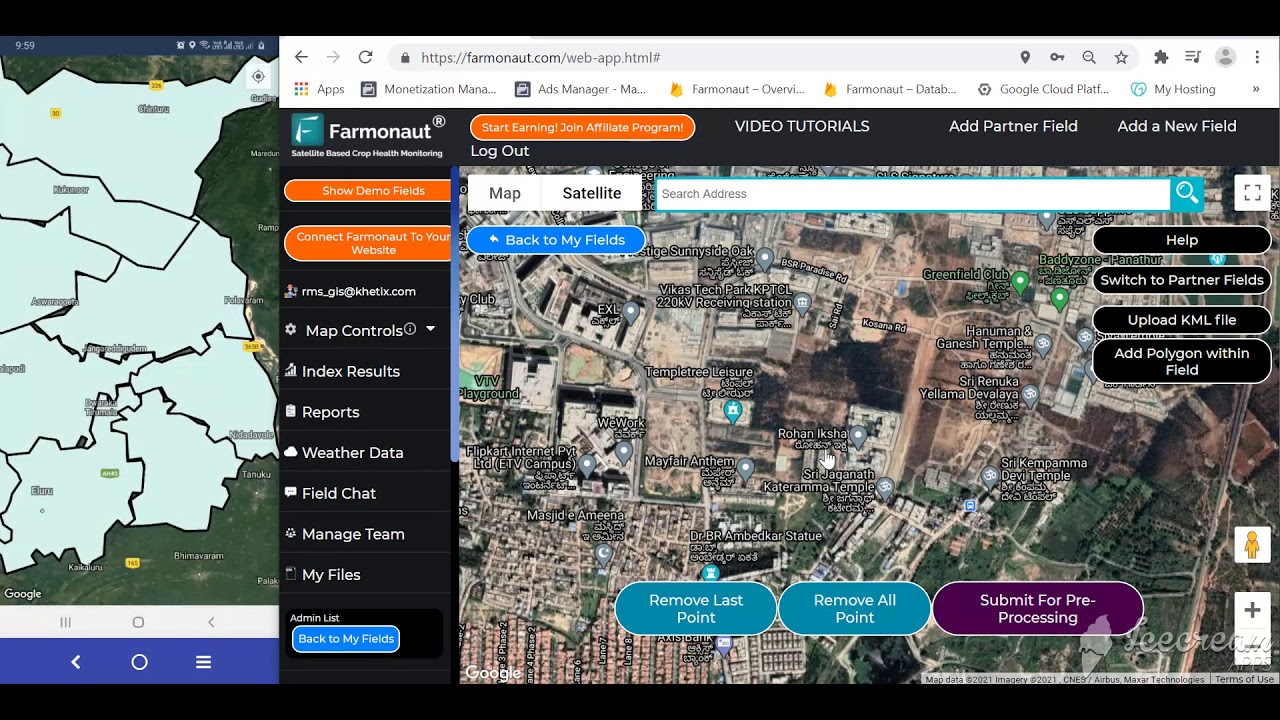
Lenders assessing farm equipment loan applications increasingly ask for verification beyond the borrower's own numbers — proof of land use, crop condition, and operational history. This is where satellite monitoring platforms like Farmonaut fit into the financing conversation, whether you're applying through USDA, FCC, or a UK agricultural mortgage lender.
- Satellite-verified crop and land reporting: NDVI and crop growth analytics give lenders independent, third-party confirmation of farm activity, which can speed up application review regardless of country.
- Asset traceability: Tracking equipment history and maintenance records can support resale value assessments lenders use to set loan-to-value ratios — see Product Traceability.
- Sustainability documentation: Some lenders and grant programs, including schemes structured like the UK's FETF, favor sustainable or precision equipment upgrades — track your footprint with Carbon Footprinting.
- Fleet and equipment monitoring: Remote tracking of financed machinery's usage and location supports both lender reporting and your own maintenance planning — see Fleet Management.
- Loan and insurance verification: Satellite data can confirm land status for lenders and insurers assessing risk on financed equipment and operations — see Crop Loan & Insurance.
Our large-scale farm management tools let producers and their lenders work from the same verified data set when assessing an equipment loan application.

Choosing the Right Agricultural Equipment Finance Partner
- Match the loan type to your country's system: USDA and CALA are government-backed with eligibility rules; AgDirect and FCC are private/quasi-private with faster approval; UK farmers should check FETF grant eligibility before financing the full cost commercially.
- Compare APR, not just the headline rate: Fees and insurance bundled into a loan change the real cost — ask each lender for the APR figure directly.
- Check the rate's effective date: USDA rates update monthly, AgDirect quarterly, and Bank of Canada prime (which sets the CALA cap) on its own schedule — a rate quoted from a search result may already be stale.
- Confirm term length against equipment life: A 10-year term (available for US pivot irrigation equipment) only makes sense for durable, slow-depreciating assets.
- Ask about seasonal repayment options: Confirm whether payments can be timed to harvest income before signing, especially for row-crop or livestock operations with concentrated cash flow.
- Stack grants before financing, not after: UK applicants should confirm FETF eligibility and apply within Defra's current window before taking out a commercial loan for the full equipment cost.
The cheapest headline rate is not always the cheapest loan once fees, term length, and grant eligibility are factored in — build the comparison against your own numbers using the calculator above before choosing.


Tools, Apps and API Links
- For API integrations on financing and insurance workflows: Farmonaut API.
- Developer documentation: API Developer Docs for crop and asset verification.
- Blockchain traceability for financed equipment: Product Traceability Module.
- Carbon footprint tracking for grant and lender requirements: Carbon Footprinting.
- Large-scale farm and fleet management: Agro Admin App.

Farmonaut Subscription Pricing
Explore subscription plans covering satellite crop imagery, AI insights, carbon footprint tracking, and fleet management — useful documentation whether you're applying for equipment finance or a grant:
What to Verify Before You Apply
- Rate effective date: confirm against the lender's own page, not a cached quote.
- APR vs. bare rate: ask for the figure that includes fees.
- Collateral scope: equipment-only or equipment-plus-land.
- Grant stacking: UK applicants confirm FETF eligibility before financing the full amount.
- Seasonal payment option: ask explicitly — it's rarely offered by default.
Risks to Watch For
- Rate drift: variable rates move with prime/base rates between your quote and closing.
- Depreciation mismatch: a 10-year loan on fast-depreciating equipment risks negative equity.
- Grant windows close: FETF rounds have fixed application periods; missing one means waiting for the next.
- Bridging-loan cost: a 0.75%-per-month bridging rate is expensive if it runs longer than planned.
- Early payoff penalties: confirm this before signing, not after.
FAQ: Farm Equipment Loans and Financing
- What is the current USDA rate for a farm equipment loan?
- USDA Farm Operating Loans carried a direct rate of 4.75% per the December 2024 FSA announcement. FSA updates lending rates on the first business day of most months — check the FSA news room for the current figure.
- How do farm equipment loans work in Calgary or elsewhere in Canada?
- Canadian farm equipment loans, including for operators based in Calgary and across Alberta, run mainly through Farm Credit Canada (5.5%–7.0% as of 2024–2025 data) or the federal CALA program, capped at prime plus 1%. Rates and availability don't differ by city — they're set nationally by the lender or program, though your local FCC office handles the application.
- Is a FETF grant the same as a UK farm equipment loan?
- No. FETF is a one-time grant covering 40%–50% of an eligible item's cost, up to £25,000, per Defra's 2026 guidance. It reduces the amount you need to finance; it does not replace a loan for the remaining balance.
- Should I lease or buy farm machinery?
-
- Lease if you upgrade equipment frequently, want lower periodic payments, or want to avoid resale — Canada's leasing industry alone reported $17.5 billion CAD in 2023 revenue, up 8.5% year-over-year.
- Buy if you need long-term control, plan significant modifications, or expect to use the asset past a typical lease term.
- Does an online agriculture degree help with equipment financing decisions?
- UK agriculture degree programmes typically include a farm business management module covering capital budgeting and lending, which applies directly to equipment finance decisions even though the degree itself isn't a finance qualification.
- Can satellite data speed up my equipment loan application?
- Yes — independent crop and land verification through platforms like Farmonaut can support a lender's review process. Learn more about fleet and equipment monitoring here.
Conclusion
Farm equipment financing isn't one market — a US producer choosing between USDA's 4.75% operating-loan rate and AgDirect's 6.25%–8.50% private rates faces a different decision than a Canadian farmer weighing Farm Credit Canada against the CALA program's prime-plus-1% cap, or a UK farmer stacking a Defra FETF grant against a 6%–8% agricultural mortgage. What holds across all three: confirm the rate's effective date directly from the source before applying, ask for APR rather than a bare headline rate, and match the loan term to how fast the equipment actually depreciates.
Whichever market you're financing in, verified farm data — crop condition, land use, equipment history — increasingly speeds up the lender's side of the process. Explore our web app, API, and analytics tools to put that documentation together before you apply.

 Farmer Amigo
 Cresol
 Atur Kuliner
 MDCV UK
 Zerella Group
 Etech Consulting Madagascar
 Vestlandsforsking
 Agritein
 Delicio
 WB Dev
 Sama Premium
 Prochecker
 Tres Valles
 LACOS Geoinformation
 Magrifly
 LatConnect 60
 Blickwinkel
 Agricultural Credit Policy Council
 Marei Nursery
 eKGIS
eKGIS
