

Farm equipment · Buyer guide
Essential Farm Tools and Equipment: 25 Ranked by Use
From spades and hoes to tractors, planters and combines: 25 farm tools ranked by how often a working farm uses them, with dated custom hire rates from US and Canadian surveys, machinery cost data from the University of Illinois and a calculator to test buying against hiring.
Key takeaways
- Central Illinois corn farms saw machinery-related costs rise from $136 per acre in 2021 to $171 in 2024, a 25% rise (farmdoc daily, October 2025).
- Iowa’s 2025 custom rate survey medians: $20 per acre for moldboard plowing, $18.50 for tandem disking and $18 for field cultivating (as reported by Agweek).
- Auto-steer was used on 5.3% of planted US corn acres in 2001 and 58% in 2016 (USDA ERS, EIB-248); smaller farms use precision tools much less.
- Machines used only a few days a year, such as combines, are often cheaper to hire; compare ownership cost per acre with your local custom rate.
- Scammers pose as real equipment dealers online; call dealers on a number you find yourself and never wire money for a machine you have not seen (American Farm Bureau Federation).
In this article
- Essential farm tools and equipment at a glance
- 1–6. Hand tools every farm should own
- 7–9. Tractors and power units
- 10–13. Tillage and soil preparation equipment
- 14–16. Planting and seeding equipment
- 17–19. Crop care: sprayers, spreaders and mowers
- 20–22. Harvest, hay and handling equipment
- 23–25. Fencing, irrigation and storage
- Seven modern tools that are changing farm work
- How to choose essential farm tools and equipment
- What farm equipment costs to own or hire
- How to look after farm tools and machines
- Equipment, data and sustainability
- Five steps to build your farm tool kit
The essential farm tools and equipment for most farms fall into seven groups: hand tools, a tractor, tillage tools, planting gear, sprayers and spreaders, harvest and hay gear, and the fencing, irrigation and storage kit that holds it all together. A small farm can start with good hand tools, a compact tractor and a few implements, then hire custom operators for the jobs it does only once or twice a year.
This guide ranks 25 essential farm tools and equipment by how often a working farm uses them. Each item has a “Best for” line, a short buyer note and, where a public source exists, a dated cost. It also covers modern digital tools such as guidance, sensors and satellite crop maps, and gives you a calculator to test whether buying a machine beats hiring a contractor.
Essential farm tools and equipment at a glance
The table sums up the 25 items by group. The ranking puts first the tools that most farms use every week, then the machines that pay off on bigger acreage, then the digital layer.
| Group | Items in this guide | Who needs it | Buy, rent or hire? |
|---|---|---|---|
| Hand tools | Spade, digging fork, hoe, rake, pruners, wheelbarrow | Every farm and market garden | Buy |
| Power units | Compact or utility tractor, UTV | Farms above a few acres | Buy or lease |
| Tillage | Plow or chisel, disk, field cultivator, tiller | Row crops, vegetables, new ground | Buy small, hire large |
| Planting | Seed drill, row planter, transplanter | Grain, oilseeds, vegetables | Buy or hire |
| Crop care | Sprayer, fertilizer spreader, mower | Most crop and pasture farms | Buy |
| Harvest and hay | Combine, baler, rake, loader | Grain and livestock farms | Hire unless acreage is large |
| Support | Fencing, irrigation, grain storage | Livestock and irrigated farms | Buy |
| Digital | Guidance, sensors, satellite maps | Any farm that wants records | Subscribe |
1–6. Hand tools every farm should own
Hand tools are the cheapest part of a farm kit and the part used most often. They still do the fine work that machines miss: digging around a post, thinning a row, cutting out a diseased branch. Buy fewer, better tools and keep them sharp and clean.
1. Spade and shovel
Best for: digging holes, edging beds, moving soil and compost. A spade has a flat blade for clean cuts; a round-point shovel moves loose material. Look for a forged steel head and a solid ash or fiberglass handle. A long handle saves your back on heavy work.
2. Digging fork and broadfork
Best for: loosening soil without turning it over, lifting potatoes and root crops. A broadfork has two handles and long tines, so you can loosen a vegetable bed to a good depth with less disturbance than a tiller. It suits small no-till and market garden plots.
3. Hoe
Best for: weeding between rows. A stirrup (hula) hoe cuts weeds just under the surface on both the push and pull stroke. A draw hoe is better for hilling potatoes and chopping tougher weeds. Weed early, when weeds are small, and the job goes much faster.
4. Rake
Best for: leveling seedbeds and gathering mulch or straw. A bow rake with steel tines shapes beds; a leaf rake handles light material. A wide bed-prep rake helps when you sow small seed by hand.
5. Pruners, loppers and a pruning saw
Best for: orchards, vines, berries and hedges. Bypass pruners make clean cuts on live wood. Loppers reach thicker branches, and a folding saw handles anything wider. Clean blades between plants when you remove diseased wood.
6. Wheelbarrow or garden cart
Best for: moving compost, feed, tools and harvest. A two-wheel cart is more stable on rough ground. A single-wheel barrow turns in tight spaces. Pick a pneumatic or flat-free tire to suit your ground.
Hand and portable power tools still cause injuries. The OSHA booklet on hand and power tools sets out the basic rules: keep tools in good condition, use the right tool for the job, check for damage before use, and use guards and protective gear.
7–9. Tractors and power units
The tractor is the center of farm equipment. Almost every implement in this guide needs one, so size it to the work, not to the brochure.
7. Compact or utility tractor
Best for: small and mid-size farms, loader work, mowing and light tillage. Compact tractors in the 25 to 60 horsepower range run a loader, a mower, a tiller and a small seeder. Utility tractors above that handle bigger implements and hay work. Check the three-point hitch category and the PTO power your implements need before you buy.
Rental and custom rates give a useful check on value. The Manitoba Agriculture custom and rental guide lists rental rates of about $46 to $51 per hour for a two-wheel-drive tractor and $60 to $129 for a front-wheel-assist tractor, against custom rates (with operator) of $111 to $122 and $128 to $227 per hour. These are Manitoba Agriculture’s 2026/27 guide rates in Canadian dollars, calculated from machine costs; they are not survey results or quotes.
8. Row-crop or four-wheel-drive tractor
Best for: larger grain farms with wide planters, deep tillage and big grain carts. These machines carry the highest price and the highest fixed cost, so most farms that run them spread the cost over many acres. Many come ready for GPS guidance and section control.
9. Utility vehicle (UTV) or ATV
Best for: checking fences, livestock and fields, carrying tools and small spray tanks. A UTV saves time on spread-out farms. Follow the maker’s rules on passengers and slopes; rollovers are a known risk.
A tractor is a large, long-term cost. Think about who will service it. A farmdoc daily article on farm service technician demand notes that machines with more electronics need trained technicians, so check dealer support near you before you choose a brand.
▶ Ten small farm business ideas, from microgreens to renting out a tractor. · 6:03
10–13. Tillage and soil preparation equipment
Tillage breaks up soil, buries residue and makes a seedbed. Many farms now till less to protect soil structure and save fuel, but most still need at least one tool for new ground or problem fields.
Chart
Median custom tillage rates in Iowa
US dollars per acre, 2025 Iowa Farm Custom Rate Survey medians (operator, machine and fuel)
Custom tillage is cheap per acre compared with owning a big implement you use once a year. The 2025 Iowa Farm Custom Rate Survey medians, as reported in an Agweek column on 2025 custom rates, are shown in the chart below.
10. Moldboard plow or chisel plow
Best for: breaking sod and turning under heavy residue. A moldboard plow inverts the soil; a chisel plow loosens it and leaves more residue on the surface, which helps limit erosion. Iowa’s 2025 survey median for moldboard plowing was $20 per acre.
11. Disk harrow
Best for: cutting residue and breaking clods after plowing. A tandem disk is the common choice. The 2025 Iowa median for tandem disking was $18.50 per acre.
12. Field cultivator
Best for: final seedbed work before planting, mixing in herbicide or fertilizer and killing small weeds. The 2025 Iowa median was $18 per acre.
13. Rotary tiller
Best for: vegetable beds and small plots. A PTO tiller on a compact tractor makes a fine seedbed in one pass. Use it with care: frequent tilling breaks down soil structure. Strip tillage, which works only the planting row, is a middle path on row crops; Iowa’s 2025 median was $22 per acre.
14–16. Planting and seeding equipment
Good seed placement sets the yield ceiling. The right planting tool puts seed at an even depth and spacing, with good soil contact.
14. Seed drill
Best for: small grains, soybeans, cover crops and pasture. A no-till drill can seed straight into residue, which saves a tillage pass. Check the row spacing, the seed box size and whether it can handle small seed such as clover.
15. Row-crop planter
Best for: corn, soybeans, cotton and sunflowers. Modern planters meter single seeds and can switch off row sections to avoid overlap. The University of Wisconsin custom rate report for 2025 gave an average of $25.41 per acre to plant corn with fertilizer, conventional method. Texas A&M’s 2026 survey put the statewide average for row-crop planting at $25.42 per acre.
16. Transplanter and seeder for vegetables
Best for: vegetable and market garden farms. A push seeder such as a Jang-type or Earthway seeder sows small seed in rows by hand. A water-wheel or mechanical transplanter puts out seedlings in large numbers with a small crew.
17–19. Crop care: sprayers, spreaders and mowers
Crop care equipment protects the yield you planted. The main jobs are weed, pest and disease control, fertilizer and lime, and keeping pasture and field edges in check.
17. Sprayer
Best for: herbicide, fungicide, insecticide and liquid fertilizer. Options run from a backpack sprayer to a three-point boom sprayer to a self-propelled machine. Calibrate before each season and check nozzles for wear. Always read and follow the pesticide label and your local rules on storage, buffer zones and record keeping, and get professional advice if you are unsure.
18. Fertilizer and lime spreader
Best for: granular fertilizer, lime and seed. A broadcast (spinner) spreader covers wide strips fast; a drop spreader gives a sharp edge. Spread pattern checks matter, because uneven spreading shows up later as striped crops. Variable-rate controllers can change the rate across a field if you have a zone map.
19. Mower
Best for: pasture, hay, orchard alleys and field edges. A rotary cutter (brush hog) handles rough grass and brush. A disc mower or sickle-bar mower cuts hay cleanly. A flail mower suits orchards and roadsides. Keep guards in place and stop the PTO before you clear a blockage.
20–22. Harvest, hay and handling equipment
Harvest machines are the most expensive items on most farms, and many are used for only a few weeks a year. That makes them the first place to compare buying with hiring.
20. Combine harvester
Best for: grain and oilseed farms. A combine cuts, threshes and cleans grain in one pass. Costs are high: in farmdoc daily’s October 2025 analysis of machinery costs, the list price of the combine used in the University of Illinois cost estimates rose from $587,000 in 2021 to $741,000 in 2023, and the cost of combining corn on a 3,600-acre farm rose from $31.10 to $40.90 per acre. Smaller farms often hire a custom harvester instead.
21. Baler and hay rake
Best for: livestock farms that make their own hay or straw. Round balers suit most beef farms. Small square bales are easier to sell to horse owners. A wheel rake or rotary rake turns and gathers the crop into windrows.
22. Front-end loader and pallet forks
Best for: moving bales, feed, manure, gravel and pallets. A loader is one of the most used tractor attachments. Add bale spears and pallet forks to widen what it can do, and keep loads low when moving.
23–25. Fencing, irrigation and storage
These items rarely get attention, but they keep crops watered, animals in and grain in good condition.
23. Fencing tools
Best for: livestock farms. A post driver, fence pliers, a wire stretcher and an electric fence tester cover most jobs. A tractor-mounted post pounder saves days of work when you build new fence lines.
24. Irrigation equipment
Best for: vegetables, orchards and dry-region field crops. Drip lines put water at the root zone and cut losses to evaporation and runoff. Center pivots and linear moves cover large fields. Soil moisture sensors and simple timers help match water to crop need instead of the calendar.
25. Grain and produce storage
Best for: grain farms and growers who sell later in the season. Bins with aeration fans, moisture meters and temperature cables protect stored grain. Produce growers need clean wash and pack areas and cool storage. Australia’s Safe Horticulture guide from Food Standards Australia New Zealand includes a section on premises and equipment for growers who need to keep produce safe.
Seven modern tools that are changing farm work
Beyond the core 25, a newer set of tools adds data to the work you already do. These are seven common modern tools, with the limits of each.
▶ Six plain steps to start precision farming without buying a robot. · 4:18
- GPS guidance and auto-steer. Keeps passes straight and cuts overlap. Adoption is high on large row-crop farms (see the chart below).
- Section control and variable-rate controllers. Turn sprayer or planter sections off where you have already applied, and change rates by zone.
- Yield monitors. Record yield as the combine moves, so you can see which parts of a field pay.
- Soil and weather sensors. Track soil moisture and local rain to time irrigation and fieldwork.
- Drones. Take close-up photos of crop problems and, where rules allow, spray small areas. Check local aviation rules before you fly.
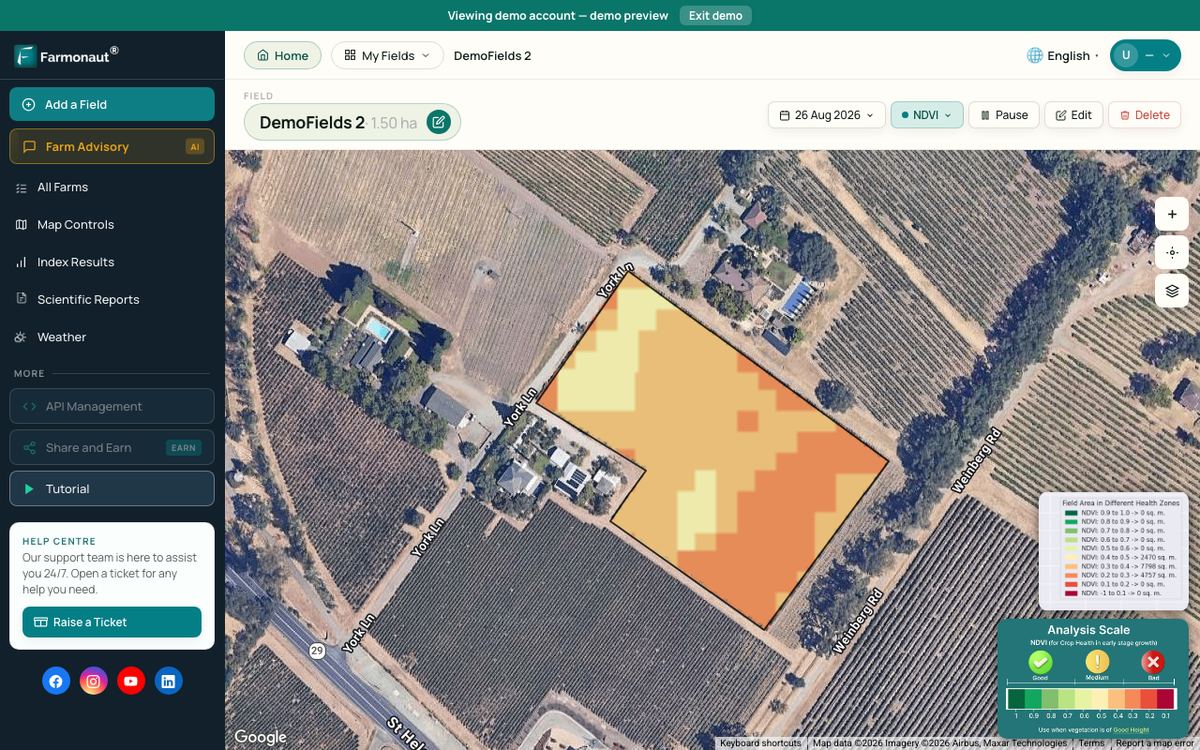
- Satellite crop maps. Show plant health, water stress and changes across every field each time a satellite passes, without walking every acre.
- Farm management apps. Keep records of inputs, field work and costs in one place, which helps with planning and with lenders.
The USDA Economic Research Service report Precision Agriculture in the Digital Era (EIB-248) found that auto-steer and guidance systems were used on 5.3% of planted corn acres in 2001 and 58% in 2016. It also found that yield maps, soil maps and variable-rate technology were used on only 5 to 25% of planted acres for winter wheat, cotton, sorghum and rice, and that less than 25% of the smallest farms (except cotton) used any of these four technologies.
The Farmonaut Satellite + AI Farm Monitoring System shows crop health, water and nutrient maps for your own field boundaries on web, Android and iOS. Teams that need data inside their own software can use the Farmonaut satellite data API.
Chart
Auto-steer and guidance use on US crops
Percent of planted acres; corn 2016, sorghum and cotton 2019 (latest years in the report)
How to choose essential farm tools and equipment
Most mistakes in buying equipment come from buying too big, too early, or from a seller you have not checked. Use these steps.
- List the jobs, then the tools. Write down each job by month and how many hours or acres it takes. Tools you use weekly are worth owning. Tools you use for two days a year are often worth hiring.
- Size the tractor to the biggest regular job. Match horsepower, hitch and PTO to the implements you will use most, not the one you might buy later.
- Run the numbers. Compare yearly ownership cost per acre with your local custom rate. Use the calculator below with your own figures.
- Check dealer support. Parts and a trained technician within a reasonable drive matter more than a small price gap.
- Look at used machines carefully. Check hours, service records and wear on pins, bushings, tires and hydraulics. Bring someone who knows the model.
- Avoid fake sellers. The American Farm Bureau Federation warns in a Farm Bureau News piece on equipment scams that scammers pose as real dealers online, send a purchase agreement and invoice, and ask for large payments up front. Call the dealer on a number you find yourself, and never wire money for a machine you have not seen.
- Plan for safety and storage. Shelter extends machine life. Guards, rollover protection and seat belts protect people.
Financing is part of the choice. If you borrow to buy equipment or to fund a season, get advice from your lender or a farm business adviser before you sign.
What farm equipment costs to own or hire
Machinery is one of the largest costs on a crop farm, and it has risen fast. On central Illinois corn farms in the Illinois Farm Business Farm Management records, machinery-related costs rose from $136 per acre in 2021 to $171 per acre in 2024, a 25% rise, according to the same farmdoc daily analysis. Depreciation, fuel, repairs and machine hire all went up.
Chart
Machinery cost per acre on central Illinois corn farms
US dollars per acre, Illinois Farm Business Farm Management records, high-productivity farmland
Custom rates are the main alternative to owning. They are survey results that show what farmers report paying or charging, not fixed prices. Rates vary by region, field size and fuel cost, so treat them as a starting point when you talk with a local operator. Useful surveys include the Iowa and Wisconsin custom rate reports, the Texas A&M AgriLife 2026 custom rates survey, the Manitoba farm machinery custom and rental guide and the Mississippi State University custom rates publication.
The ownership side has four parts: depreciation (the value the machine loses each year), interest on the money tied up in it, repairs, and insurance and housing. Spread those over the acres you cover each year and you get a cost per acre you can set against the custom rate. More acres lower the cost per acre; fewer acres raise it. Timing also matters. A contractor may not reach your field on the best day, and a late planting or harvest can cost yield. Put a value on that when you decide.
Try the numbers for your own farm below.
Calculator
Should you buy a machine or hire a contractor?
Enter the machine price, its life, your acres and your local custom rate.
- Depreciation per year: 4,200 $
- Interest per year: 2,340 $
- Ownership cost per acre: $20.10 $/acre
- Break-even acres at this custom rate: 402 acres
Example values only, set near break-even; they are not a benchmark or a quote. Use your dealer’s price, your lender’s rate and a custom rate from your local survey or contractor. Interest is charged on the average value of the machine over its life. Timeliness, labor and tax effects are not included. Get advice from a farm business adviser before a large purchase.
How to look after farm tools and machines
Care adds years to every tool and lowers repair bills, which made up $39 per acre of central Illinois machinery costs in 2024 in the farmdoc figures.
- Clean after use. Remove soil and plant matter, which hold moisture and spread disease and weed seed between fields.
- Sharpen edges. Hoes, spades, pruners and mower blades all work faster and with less effort when sharp.
- Grease and oil on schedule. Follow the operator’s manual for grease points, oil changes and filters.
- Check tires, belts and hoses before each season, and replace worn parts before they fail in the field.
- Store under cover. Sun and rain shorten the life of hoses, tires, wooden handles and electronics.
- Keep records. A simple log of hours, repairs and parts helps you plan replacements and raises resale value.
Equipment, data and sustainability
Good equipment can cut waste. Section control and guidance reduce overlap, so you use less seed, fuel and chemical. Drip irrigation and moisture sensors save water. Reduced tillage protects soil and cuts fuel use. Not every claim holds on every farm, so test changes on part of a field first and compare results.
Some buyers and programs now ask for records of how crops were grown. If that applies to you, keep field maps, input records and notes in one place so you can answer those requests.
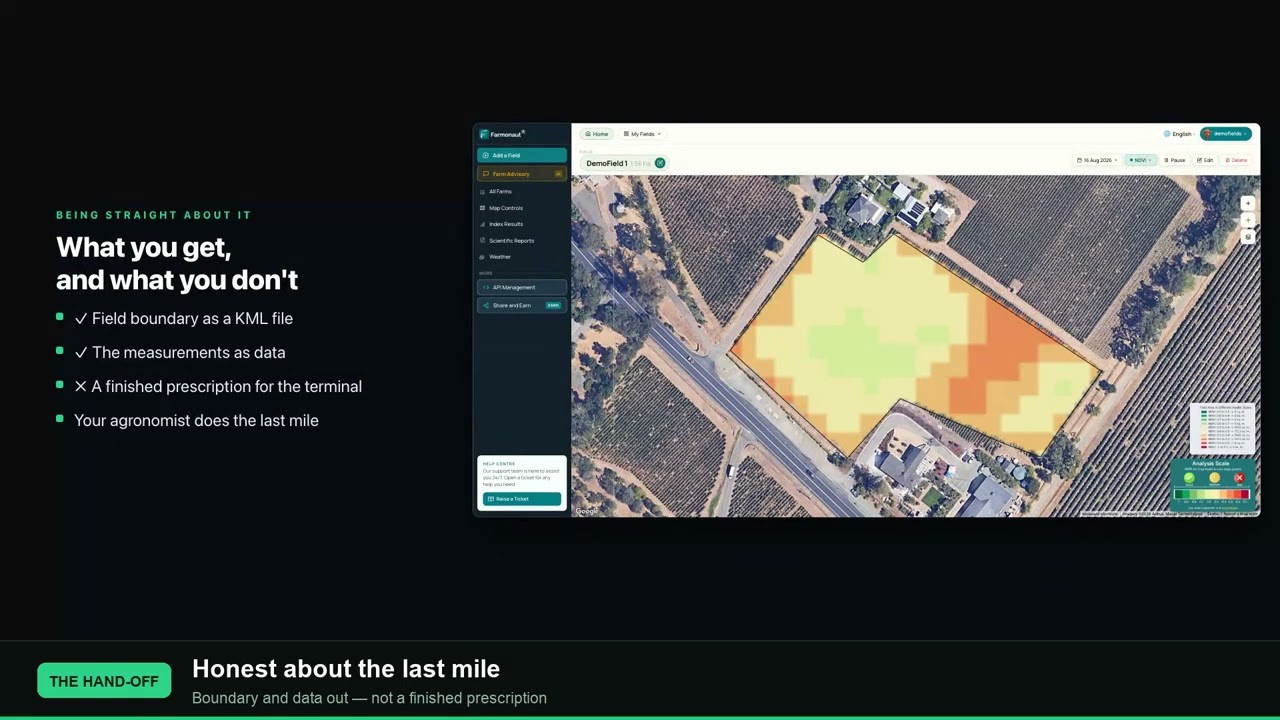
▶ How satellite crop maps produce the zones that variable-rate equipment acts on. · 2:12
Five steps to build your farm tool kit
- Start with a good set of hand tools: spade, fork, hoe, rake, pruners and a cart.
- Add a tractor sized to your biggest regular job, with a loader.
- Buy the two or three implements you use every season; hire the rest.
- Add simple data tools: field boundaries, satellite maps and a record of work done.
- Review every winter: what did you hire, what sat idle, and what would have saved time?
FAQ
What are the most essential farm tools and equipment for a small farm?
A spade, digging fork, hoe, rake, pruners and a cart or wheelbarrow cover most hand work. Add a compact tractor with a loader, a mower and a small tiller or seeder once you farm more than a few acres. Hire larger jobs such as combining or deep tillage.
Is it better to buy or hire farm equipment?
It depends on how many acres you cover each year. Work out the yearly ownership cost (depreciation, interest, repairs and insurance) per acre and compare it with your local custom rate. Machines used for only a few days a year are often cheaper to hire. Use the calculator above with your own numbers.
What are the main types of agricultural tools?
The main types are hand tools, power units (tractors and UTVs), tillage tools, planting tools, crop care tools (sprayers, spreaders, mowers), harvest and hay tools, and support kit such as fencing, irrigation and storage. Digital tools such as guidance, sensors and satellite crop maps sit on top of these.
What modern tools are used in agriculture today?
Common modern tools include GPS guidance and auto-steer, section control, variable-rate controllers, yield monitors, soil moisture sensors, drones, satellite crop maps and farm record apps. USDA ERS data show guidance is widely used on large row-crop farms, while smaller farms use these tools much less.
How can I keep farm tools in good condition?
Clean them after use, keep edges sharp, grease and oil on schedule, store them under cover and keep a log of hours and repairs. Check tires, belts and hoses before each season.
Related pages on our site: this guide’s earlier edition, agro admin app, fleet management, product traceability, crop loans and insurance, carbon footprinting, web and mobile apps.
Farmonaut crop monitoring
See your own fields from space
Draw your fields once and Farmonaut shows satellite crop health, water and nutrient maps for them through the season, on web, Android or iOS.



Keep reading
Sources
- USDA Economic Research Service, Precision Agriculture in the Digital Era: Recent Adoption on U.S. Farms (EIB-248): ers.usda.gov
- farmdoc daily, University of Illinois, Large Increase in Machinery Costs Suggests Need to Reconsider Machinery Purchase Decisions (October 2025): farmdocdaily.illinois.edu
- farmdoc daily, The People Behind the Machines: Precision Agriculture and Farm Service Technician Demand (January 2026): farmdocdaily.illinois.edu
- OSHA, Hand and Power Tools (OSHA 3080): osha.gov
- Agweek, Farm custom rates show slight increase for 2025 (Iowa Farm Custom Rate Survey): agweek.com
- University of Wisconsin-Madison Extension, Custom Rates for 2025 Wisconsin Farm Operations: farms.extension.wisc.edu
- Texas A&M AgriLife Extension, 2026 Texas Agricultural Custom Rates: agecoext.tamu.edu
- Manitoba Agriculture, Farm Machinery Custom and Rental Rate Guide: manitoba.ca
- Mississippi State University Extension, Custom Rates for Mississippi Agricultural Practices: extension.msstate.edu
- American Farm Bureau Federation, Scammers are Impersonating Farm Equipment Businesses: fb.org
- Food Standards Australia New Zealand, Safe Horticulture Australia (2024): foodstandards.gov.au
Discussion
Questions, corrections or field experience? Share them below. First-time comments are reviewed before they appear, and your email is never published.
No comments yet. Be the first to add a question or your experience.

 MISE Maroc
 Drift-Sense
 NWNS
NWNS Hydenmet
 Dirks Bros Farms
 Red August Group
 Farm Inc
 WeMe Global
 Agrotoken
 Blue BearX
 Insignito
 Croptimum
 DnCubed
 Field Capacity
 Indosistim Teknologi
 Liquify Digital
 CU Foods
 BeyondTech Global
 Licence holder · Niger · Gold
 Licence holder · Nigeria · Gold + lithium










