

Gold exploration · Newfoundland and Labrador
Gold deposits in Newfoundland: the Valentine mine, the belts behind it, and what a claim costs to hold
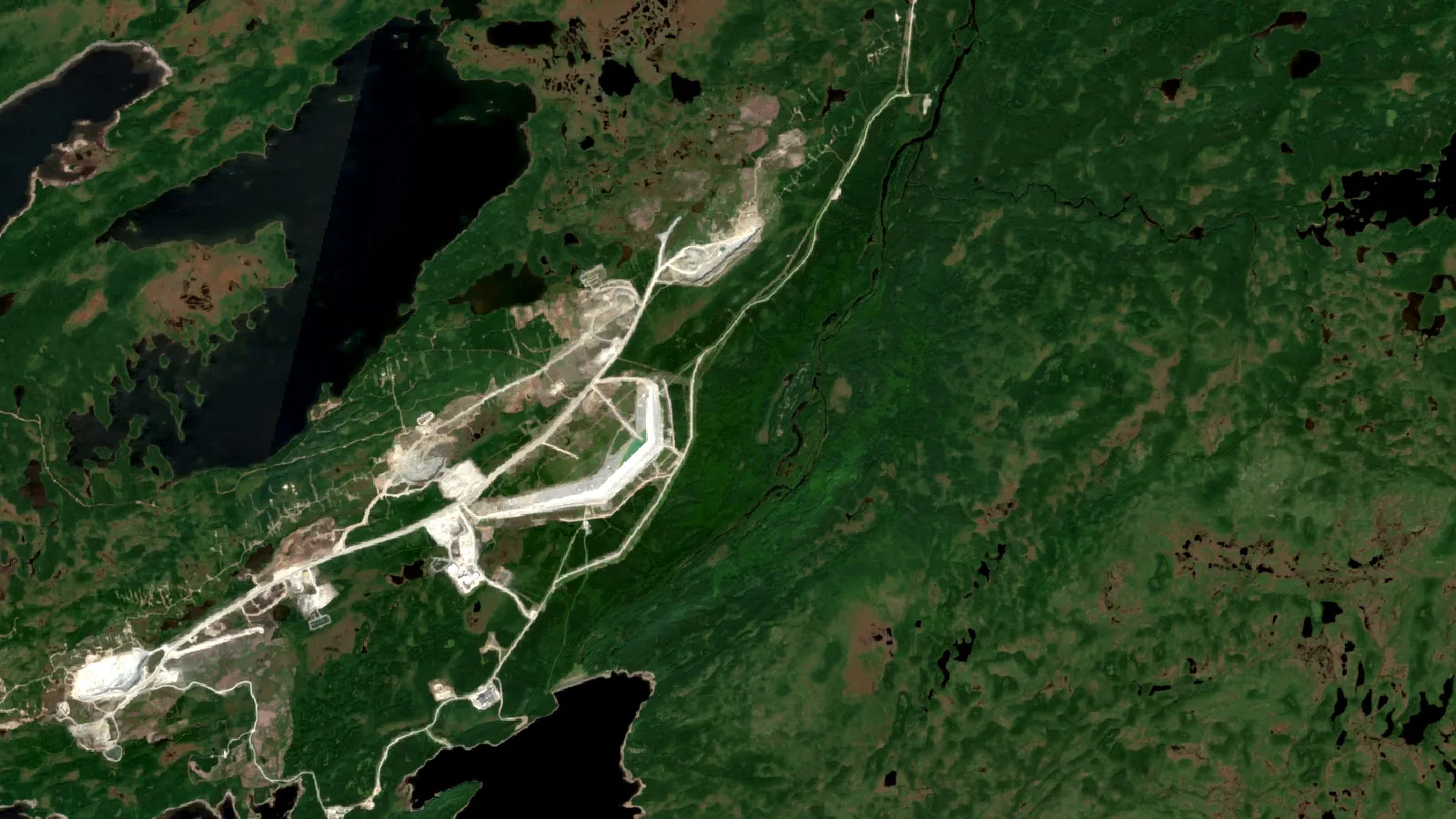
Key takeaways
- Where: the best-known gold deposits in Newfoundland follow fault corridors in the Exploits Subzone (Valentine Lake) and the Gander area (Queensway), plus the Baie Verte district in the north.
- Who mines it: Equinox Gold runs Valentine; New Found Gold runs Hammerdown and is developing Queensway.
- How you get ground: online map staking through MinLAP, 25-hectare claims, up to 256 claims in one licence.
- What it costs: C$65 per claim to stake, then assessment work rising from C$200 per claim in year one to C$400 in year five.
- What satellites do here: trace faults, ice-flow features and outcrop windows; they do not see through till or rate grade.
In this article
- Where the gold deposits in Newfoundland sit
- The Valentine gold mine in Newfoundland and the other producers
- How to stake and hold a gold claim in Newfoundland and Labrador
- Consultation and land you cannot stake
- What satellites can and cannot see over gold deposits in Newfoundland
- Public data for gold deposits in Newfoundland, and where Farmonaut fits
- Frequently asked questions about gold deposits in Newfoundland
Most gold deposits in Newfoundland sit along crustal-scale fault zones in the central Dunnage and Gander zones, where Equinox Gold’s Valentine mine has produced since 2025, and you hold ground there through online map-staked licences of 25-hectare claims at $65 per claim plus yearly assessment work.
For decades the gold deposits in Newfoundland were a prospector’s story told in occurrences and small past producers. That changed in September 2025, when the Valentine mine in central Newfoundland poured its first gold, and again in August 2026, when Hammerdown on the Baie Verte side declared commercial production. If you hold or plan to hold mineral licences in the province, the questions are now practical ones: which belts carry the gold, what a licence costs to keep for five or ten years, how consultation works, and how much a satellite screen can tell you before you cut a line or book a drill.
This page goes deeper on one province. For how Newfoundland’s system compares with Ontario, Quebec, the Yukon and British Columbia, start with our guide to gold exploration and claims across Canada, and for a national ranking of producing regions see Canada gold deposits by province.
Newfoundland and Labrador reported 102 kg of gold for 2024. Valentine poured 23,816 ounces, about 741 kg, in its first months.
Where the gold deposits in Newfoundland sit
Geologists divide the island into belts based on rocks older than the Silurian. A 2019 Geological Survey of Newfoundland and Labrador open file sets them out: the Humber Zone in the west (the old Laurentian margin), the Dunnage Zone across the centre, and the Gander and Avalon zones in the east, which are fragments of the ancient continent of Gondwana. The Dunnage Zone splits along a major fault, the Red Indian Line, into the Notre Dame Subzone to the west and the Exploits Subzone to the east. Most of the known gold deposits in Newfoundland sit in and around the Exploits Subzone.
The same report describes crustal-scale fault zones in central Newfoundland as “emerging as significant gold-mineralized structures”. Its focus is the northeast-trending Rogerson Lake Conglomerate structural corridor, which hosts orogenic, vein-hosted gold near Valentine Lake and at Wilding Lake. High-grade gold there comes with siderite, ankerite and sericite alteration of the host rocks, quartz veins with pyrite and chalcopyrite, and later oxidation. Those alteration minerals matter for screening, because carbonate and sericite have spectral signatures where rock is exposed.

▶ how satellite and soil data are combined to rank copper and gold ground in another glaciated Canadian province. · 3:11
Exploits Subzone and the Gander side: Valentine and Queensway
Valentine Lake sits on that Rogerson Lake corridor in south-central Newfoundland. Equinox Gold describes a 32 km mineralized trend on the property with several deposits. Further northeast, New Found Gold’s Queensway project lies on the Trans-Canada Highway near Appleton, 15 km west of Gander. The company describes Queensway as fault-hosted gold in the Ordovician Davidsville Group, a sequence of shales, siltstones and sandstones, controlled by the Appleton Fault Zone and the Joe Batt’s Pond fault zone along the Dog Bay Line, with more than 110 km of strike. Visible gold in quartz-carbonate veins is common there.
Baie Verte: the older gold district
The north coast holds the oldest-known gold deposits in Newfoundland. The province’s own prospecting article on gold in Newfoundland notes that a 1983 geological map of the Baie Verte area showed only two or three gold occurrences, including the Goldenville deposit near Ming’s Bight, and that at least 100 are now known. It records that Nugget Pond near Snook’s Arm produced gold from 1997 to 1999 and Hammerdown near King’s Point from 2001 to 2004. Hammerdown is back in production, which is covered below. The same article says only two significant gold showings have been found in Labrador to date, the Aucoin showing and the VBE-2 showing south of the Voisey’s Bay mine, so this page concentrates on the island.
| District or belt | Setting (as published) | Named gold deposits or mines | Status as of October 2026 |
|---|---|---|---|
| Rogerson Lake corridor, Exploits Subzone | Orogenic veins on crustal-scale faults; siderite, ankerite, sericite alteration | Valentine (Equinox Gold); Wilding Lake | Valentine operating since 2025 |
| Appleton and Joe Batt’s Pond faults, near Gander | Fault-hosted gold in Davidsville Group turbidites | Queensway (New Found Gold) | Development; first gold targeted second half of 2027 |
| Baie Verte district | Quartz-vein gold, often with sulphides | Hammerdown (New Found Gold); past producer Nugget Pond; Goldenville occurrence | Hammerdown in commercial production from 19 August 2026 |
| Labrador | Mostly Canadian Shield; gold poorly tested | Aucoin and VBE-2 showings | Showings only |
Gold deposits in Newfoundland and Labrador by district. Sources: GSNL Open File 012A/1811, the province’s prospecting article, Equinox Gold and New Found Gold project pages.
The Valentine gold mine in Newfoundland and the other producers
The Valentine gold mine is owned 100% by Equinox Gold. A 2019 government report still names Marathon Gold as the explorer at Valentine Lake; the province’s Mining in Newfoundland and Labrador, Fall 2025 overview records that Equinox completed its merger with Calibre Mining on 17 June 2025 and that Valentine began processing ore through a 2.5-million-tonne-per-year plant on 28 August 2025, with first gold poured on 14 September. The province calls it Atlantic Canada’s largest gold mine, which makes it the biggest of the gold deposits in Newfoundland now in production. Equinox reports commercial production in November 2025 and 23,816 ounces produced in 2025.
For 2026, Equinox’s Valentine page gives guidance of 140,000 to 150,000 ounces at all-in sustaining costs of US$2,000 to US$2,200 per ounce, as updated on 5 August 2026. The 2022 feasibility study, as summarised by the province, projected an average of 195,000 ounces a year over the first 12 years of a 14-year mine life, from a three-pit plan whose federal approvals were completed with the Berry Pit expansion in August 2024. The first full year is running below that average, so always check the guidance date.
Chart
One mine changed the province’s gold output
Troy ounces of gold; 102 kg converted at 31.1035 g per ounce; Valentine 2026 guidance shown as its low and high ends
Valentine’s reserves and resources, kept apart
Equinox’s Valentine page lists Mineral Reserves of 2,748,000 ounces at 1.66 g/t gold. It separately lists Measured and Indicated Mineral Resources of 1,169,000 ounces at 1.24 g/t, and states that those resources are exclusive of reserves. The two figures should not be added together as if they were the same kind of ounce, because only reserves have been shown to be economic under a mine plan. The page also describes a Phase 2 expansion from 2.5 to about 5.0 million tonnes a year, the Frank Zone along trend as a possible fourth open pit, and the Minotaur Zone discovery about 8 km north of the mill.

▶ the open-pit and carbon-in-leach steps that a mill like Valentine's uses, from blasted rock to doré. · 10:34
Hammerdown and Queensway: two more gold deposits in Newfoundland
New Found Gold completed its acquisition of Maritime Resources in November 2025, adding the Hammerdown gold mine about 5 km southwest of King’s Point and the Pine Cove Mill. The company’s Hammerdown page states that the open-pit mine reached commercial production as of 19 August 2026. At Queensway, a January 2026 company release repeats the initial resource: Indicated, 18.0 million tonnes at 2.40 g/t for 1.39 million ounces; Inferred, 10.7 million tonnes at 1.77 g/t for 0.61 million ounces. The company targets first gold from Queensway Phase I in the second half of 2027, subject to permits, and reports a land package of 230,225 hectares.
Chart
Grade by category, never combined
Grams of gold per tonne as published by each company; contained ounces in the caption
Tonnes times grade gives grams of gold, and dividing by 31.1035 gives troy ounces: 18.0 million tonnes at 2.40 g/t is 43.2 tonnes, about 1.39 million ounces, matching the company’s figure. The calculator below repeats that for any inputs.
Calculator
How many ounces are in a deposit, and what is the metal worth in the ground?
Enter a tonnage and grade, your recovery and a gold price. Money results are in US dollars because gold is priced in US$.
- Contained gold: 43.2 tonnes
- Ounces at your recovery: 1.39 million oz
- In-situ gross value at your price, US$: $5.76 billion
Assumptions: defaults are New Found Gold’s published Queensway Indicated resource (18.0 Mt at 2.40 g/t, release of 7 January 2026). Contained ounces = tonnes x g/t / 31.1035. The default price of US$4,150 per ounce is an example near the Kitco bid of about US$4,153 seen on 15 October 2026; check today’s price. Value results are US dollars (US$), not Canadian dollars. Recovery is your own input, capped at 100%; 100% shows contained metal only. In-situ value is not revenue, profit or a valuation, and resources are not reserves. Arithmetic only, not investment advice.
Gold production in Newfoundland and Labrador, in numbers
Official data show how little the gold deposits in Newfoundland produced before Valentine. In Statistics Canada’s tables published by Natural Resources Canada, the province produced 725 kg of gold in 2018 and 662 kg in 2019; the figures for 2020 to 2022 are suppressed for confidentiality; the 2024 table shows 102 kg, worth $8.9 million in shipments, against 185,555 kg for Canada. The same table puts the province’s total metal shipments at $4.17 billion, so gold was a rounding error next to iron ore and nickel.
Chart
Provincial gold output before Valentine
Kilograms of gold produced; Statistics Canada suppressed 2020, 2021 and 2022, so those years are not shown
The province’s Fall 2025 overview puts the estimated value of all mineral shipments for 2025 at $5.3 billion, with iron ore at 74.7%, and says the federal government projected $258.1 million of exploration spending in the province for 2025, more than $30 million above 2024. It also reports that mineral rights for the Glover Island Exempt Mineral Land were awarded in mid-2025 after a competitive call, a reminder that some gold deposits in Newfoundland are released by tender rather than by staking.

▶ a documentary on why gold exploration budgets have risen worldwide, the backdrop to the new gold mine in Newfoundland. · 10:44
How to stake and hold a gold claim in Newfoundland and Labrador
Claims are not staked with posts here. The province’s claims brochure (Mineral Rights Section, January 2024) states that mineral rights are acquired by online map staking in the Mineral Lands Administration Portal, MinLAP. Individuals aged 19 or older and corporations registered in the province can hold mineral licences, which grant the exclusive right to explore over the licence area. You need a MinLAP account first, and activation typically takes up to ten business days.
The basic unit is the claim: a 25-hectare square, 500 m by 500 m, one quarter of a 1,000 m UTM grid square on the 1:50,000 National Topographic System maps (NAD 27). One application can cover up to 256 claims, about 6,400 hectares or 15,800 acres, and the claims must share at least part of a boundary. Shape is not restricted. Each claim costs $65 at staking: a $15 recording fee that is not refunded and a $50 security deposit returned once the first-year work report is accepted. A holder with Genuine Prospector designation can stake up to 30 claims in no more than five licences per calendar year without the deposit.
Infographic
The path from an account to a mining lease
- 1MinLAP accountAge 19 or older, or a company registered in NL; approval takes about 10 business days.
- 2Check the mapUse the Mineral Rights Inquiry, new lands openings and exempt or reserved land layers.
- 3Map-stake25 ha claims, up to 256 per licence, C$65 a claim of which C$50 is refundable.
- 4Exploration approvalGet an approval or letter of acceptance before any field programme starts.
- 5Assessment workC$200 to C$400 per claim in years 1 to 5; report it within 60 days.
- 6Renew or leaseRenew at years 5, 10 and 15; a mining lease needs a QP-confirmed resource.
A licence runs for five years and can be renewed if the required yearly assessment work is done and reported and the renewal fees are paid. The work rises with the licence’s age: $200 per claim in year one, $250 in year two, $300 in year three, $350 in year four and $400 in year five, then $600 a year for years six to ten, $900 for years eleven to fifteen, $1,200 for years sixteen to twenty, $2,000 for years twenty-one to twenty-five, $2,500 for twenty-six to thirty and $3,000 from year thirty-one. Renewal fees are $25 per claim at year five, $50 at year ten, $100 at year fifteen and $200 per claim per year from year twenty. Licences extended past year twenty are capped at 100 claims.
Chart
The longer you hold, the more work each claim needs
Minimum assessment work, Canadian dollars (C$) per claim per year, by licence year
Extra spending in one year is credited and can be carried forward: up to nine years for work done in years one to twenty, though nothing carries past year twenty. A Condition 2 extension gives 12 more months to finish a year’s work against a deposit equal to the shortfall; reports are due within 60 days of the anniversary, and a Condition 3 extension adds 60 days for a partial report. Cancelled or expired licences can sometimes be reinstated within 30 days for at least $100 per claim or $1,000, whichever is greater. Partial surrender is free at any time and cuts the work requirement.
Staking a 25-hectare claim costs $65. Keeping it for five years takes $1,500 of assessment work.
Calculator
What does it cost to hold a Newfoundland licence?
Enter your claims, years and how much ground you drop after year 1. All money results are Canadian dollars (C$).
- Licence area: 1,000 ha
- Licence area in acres: 2,471 acres
- Recording fees at staking, C$: $600
- Security deposit at staking (refundable), C$: $2,000
- Assessment work, all claims kept, C$: $60,000
- Renewal fees, all claims kept, C$: $0
- Claims kept after surrender: 30
- Cost to hold after surrender, C$: $47,600
- Saving from surrender, C$: $13,000
All amounts are Canadian dollars (C$). Assumptions from the province’s January 2024 claims brochure: claim 25 ha (1 ha = 2.471 acres); C$15 recording fee and C$50 refundable security deposit per claim (waived for a Genuine Prospector with 30 claims or fewer); minimum assessment work C$200, C$250, C$300, C$350 and C$400 per claim in years 1 to 5, C$600 in years 6 to 10, C$900 in 11 to 15 and C$1,200 in 16 to 20; renewal fees of C$25, C$50 and C$100 per claim counted when the hold runs past year 5, 10 or 15. Claims up to 256, years up to 20, surrender up to 90%. Surrendered claims are dropped from year 2. Excludes exploration-approval costs, carry-forward credits, extensions and HST. Defaults are examples; confirm with the Mineral Lands Division before budgeting. General information, not legal advice.
At the defaults, 40 claims cover 1,000 hectares. Staking costs $600 in recording fees plus a $2,000 deposit you get back after the first report. Five years of work on all 40 claims is $60,000. Surrender a quarter after year one and keep 30, and the five-year work bill falls to $47,000, a saving of $13,000. That is the arithmetic behind screening ground early: in this province almost all of the holding cost is work, not fees, so trimming weak claims early is where explorers chasing gold deposits in Newfoundland save money.
Exploration approval, leases and transfers
Any licence holder who plans an exploration programme needs an exploration approval or letter of acceptance from the department before the work starts. Options and agreements on mineral rights must be registered with the Mineral Claims Recorder, or the transaction has no effect in law. Once the equivalent of three years of work has been done and reported, a holder can apply for a mining lease over the minimum area needed for an identified mineral resource, confirmed by a qualified person with at least five years of relevant experience and a legal survey. Mining leases carry an annual rental of $120 per hectare, and a separate surface lease is needed to operate a mine.
Consultation and land you cannot stake
The province’s Aboriginal Consultation Policy on Land and Resource Development Decisions (April 2013) commits the government to consult Indigenous organizations before decisions that could adversely affect asserted Aboriginal or treaty rights. Its consultation duties to the Inuit of Labrador are set by the Labrador Inuit Land Claims Agreement rather than by the policy. The Innu Nation’s land claim has been accepted for negotiation, and the policy names the NunatuKavut Community Council, the Naskapi Nation of Kawawachikamach and several Quebec Innu communities as organizations it applies to in Labrador. Under the policy’s model, proponents bear the cost of their projects, including reasonable capacity funding for the consultation.
On Labrador Inuit Lands, a separate regime applies. A 2007 provincial notice announced standards for mineral exploration negotiated with the Nunatsiavut Government, applying only to the Labrador Inuit Lands part of the Labrador Inuit Settlement Area; elsewhere the general provincial rules apply. Rules here change, and Indigenous governments and organizations on the island also have interests in central Newfoundland, so confirm with the department and with the relevant Indigenous government before planning field work on gold deposits in Newfoundland or Labrador.
Not all ground can be map-staked. The MinLAP portal publishes a Mineral Rights Inquiry, a list of new lands opening for staking and recent staking. Exempt mineral lands, such as Glover Island before its 2025 tender, are released by government process. Check status before you spend time on targeting.
What satellites can and cannot see over gold deposits in Newfoundland
Newfoundland is glaciated ground, and the government’s own till surveys say so plainly. A till geochemistry report for the Gander Lake and Gambo areas describes extensive inland till that conceals much of the bedrock, with thin till and prominent outcrop toward the coast. It mapped two regional ice-flow events and found gold, arsenic and other anomalies throughout, especially in till over the Jonathans Pond Formation. That is the country around Queensway, one of the larger gold deposits in Newfoundland. A 2021 Current Research paper on the Cormack and Silver Mountain areas says exploration there is hindered by glacial cover from the Late Wisconsinan glaciation and records three ice-flow directions.
Where satellite data helps on gold ground in Newfoundland
- ✔ Fault corridors. The Rogerson Lake corridor, the Appleton Fault Zone and the Joe Batt’s Pond fault zone are long linear structures. Elevation models and imagery pick up lineaments, aligned ponds and offset streams along such faults.
- ✔ Outcrop windows. Coastal exposure, river cuts, quarries, roadcuts and burned or logged ground show bedrock where spectral data can flag carbonate and sericite alteration.
- ✔ Ice-flow direction. Elongated landforms visible on elevation data help you trace a till anomaly up-ice to its likely source, the same logic the government surveys apply.
- 📊 Access and wet ground. Bogs, ponds, roads and trails are mappable and decide what a programme costs.

▶ satellite screening in another northern, forested and glaciated gold region with short field seasons. · 11:35
Where it cannot
- ⚠ Under till and bog. Optical sensors see vegetation, peat and the top of the till, not the bedrock that hosts the veins.
- ⚠ Snow and cloud. Optical scenes are lost to snow for much of the year and to cloud on many summer days, so the useful archive is narrower than it looks.
- ⚠ Grade and depth. No orbital sensor measures how many grams of gold a vein carries at depth. That needs sampling and drilling.
Our view is that a satellite screen on the island is a structural and terrain filter first, with true alteration mapping only in exposed windows. Applied to gold deposits in Newfoundland, that means ranking which claims sit on the right structure and in the right glacial position, then sending soil, till and geophysical crews to those first.
Public data for gold deposits in Newfoundland, and where Farmonaut fits
The province publishes more free data than most. The GeoScience OnLine portal gives access to the Geoscience Atlas, claim staking, GeoFiles assessment-report search and mineral occurrence search. The Mineral Occurrence Data System (MODS) holds about 6,000 mineral occurrences. GeoFiles serves non-confidential assessment reports, which is where past work on any licence usually turns up. The Hyperspectral Scanning Unit, led by College of the North Atlantic, scans archival drill core to give mineralogy a geologist cannot see by eye.
Our work sits between the public data and the field crew. Our satellite-based mineral detection takes your licence boundary as KML, KMZ, coordinates or a polygon, plus the target mineral, and analyses multispectral and hyperspectral imagery for target zones, alteration halos and faults. The report gives prospectivity heatmaps, high-potential zones with estimated location and depth ranges, and georeferenced GIS files, usually in 5 to 20 business days. The Premium+ report adds TargetMax drilling intelligence and 3D subsurface models. We have scanned 100,000+ hectares for 20+ minerals in 25+ countries, and early screening can lower early-exploration cost by up to 80 to 85% and cut timelines from months to days.
On gold deposits in Newfoundland we would rank structure, glacial setting and outcrop windows, and say plainly where till hides the rock. The results are exploration targets, ahead of any resource estimate; they are not resources, reserves or a guarantee of a find. Draw your licence at mining.farmonaut.com, Map Your Mining Site, request a quote, or see a sample deliverable in the satellite-driven 3D mineral prospectivity mapping overview. For staking systems in other countries, the mining cadastre portal guide lists them.
Frequently asked questions about gold deposits in Newfoundland
Where are the gold deposits in Newfoundland?
Mainly along crustal-scale faults in the central island: the Rogerson Lake corridor in the Exploits Subzone (Valentine Lake), the Appleton and Joe Batt’s Pond faults near Gander (Queensway), and the Baie Verte district in the north (Hammerdown, Nugget Pond).
Is there a gold mine in Newfoundland?
Yes, two. Equinox Gold’s Valentine mine poured first gold on 14 September 2025 and reached commercial production in November 2025. New Found Gold’s Hammerdown mine reached commercial production as of 19 August 2026, processing ore at the Pine Cove Mill.
Who owns the Valentine gold mine in Newfoundland?
Equinox Gold owns 100% of Valentine. Equinox completed its merger with Calibre Mining on 17 June 2025, according to the provincial government’s Fall 2025 mining overview. Its 2026 guidance for the mine is 140,000 to 150,000 ounces.
Where is Valentine Lake in Newfoundland?
In central Newfoundland, on the Rogerson Lake Conglomerate structural corridor of the Exploits Subzone. A 2019 Geological Survey open file describes orogenic, vein-hosted gold there and at nearby Wilding Lake.
How do you stake a gold claim in Newfoundland?
Open a MinLAP account, check open ground, then map-stake 25-hectare claims online, up to 256 per licence, at $65 per claim ($15 recording plus a $50 refundable deposit). You need an exploration approval before field work. Confirm current rules with the Mineral Lands Division.
How much assessment work does a Newfoundland mineral licence need?
Per claim: $200 in year one, rising by $50 a year to $400 in year five, then $600 a year for years six to ten and $900 for eleven to fifteen, according to the January 2024 claims brochure. Renewal fees of $25, $50 and $100 per claim apply at years five, ten and fifteen.
Are new gold deposits in Newfoundland still being found?
The government projected $258.1 million of exploration spending in the province for 2025, and the initial Queensway resource covers only part of its strike. Known gold occurrences in Baie Verte rose from two or three on a 1983 map to at least 100. None of that guarantees a deposit on any given licence.
Is there gold in Labrador?
Little has been found so far. The province’s prospecting article says only two significant gold showings are known in Labrador, the Aucoin showing and the VBE-2 showing south of Voisey’s Bay. Exploration on Labrador Inuit Lands follows standards negotiated with the Nunatsiavut Government.
How much gold does Newfoundland and Labrador produce?
Statistics Canada’s table for 2024 shows 102 kg, before Valentine started. Valentine alone produced 23,816 ounces (about 741 kg) in 2025, and its 2026 guidance is 140,000 to 150,000 ounces.
Can satellites find gold deposits in Newfoundland?
Not directly. They map fault corridors, ice-flow features, wet ground and alteration in exposed rock, which helps rank licences before till sampling, geophysics and drilling. Till and bog hide most bedrock inland.
Authored by: Farmonaut Research & Content Team · Reviewed by: Farmonaut Mining & Mineral Exploration Team · Updated October 2026
Farmonaut mineral detection
Map your mining site from space
Send your claim or licence boundary as KML, KMZ or a polygon. Farmonaut returns ranked satellite exploration targets for it, usually in 5 to 20 business days.

Keep reading
Sources
- Government of Newfoundland and Labrador, Mineral Rights Section, Acquiring and Managing Your Mineral Exploration Licences (2024): gov.nl.ca
- Government of Newfoundland and Labrador, Mining in Newfoundland and Labrador, Fall 2025 (2025): gov.nl.ca
- Natural Resources Canada / Statistics Canada, Mineral production of Canada by province, Table G01 (2024): sead.nrcan-rncan.gc.ca
- Natural Resources Canada / Statistics Canada, Mineral production of Canada by province, Table G01 (2023): sead.nrcan-rncan.gc.ca
- Natural Resources Canada / Statistics Canada, Mineral production of Canada by province, Table G01 (2019): sead.nrcan-rncan.gc.ca
- Natural Resources Canada / Statistics Canada, Mineral production of Canada by province, Table G01 (2018): sead.nrcan-rncan.gc.ca
- Geological Survey of Newfoundland and Labrador, Open File 012A/1811 (2019): gov.nl.ca
- Equinox Gold, Valentine Gold Mine project page (2026): equinoxgold.com
- New Found Gold, Hammerdown project page (2026): newfoundgold.ca
- New Found Gold, Queensway project page (2026): newfoundgold.ca
- New Found Gold via Newsfile, release with initial Queensway mineral resource (2026): newsfilecorp.com
- Government of Newfoundland and Labrador, Aboriginal Consultation Policy (2013): gov.nl.ca
- Government of Newfoundland and Labrador, Mineral exploration standards on Labrador Inuit Lands (2007): gov.nl.ca
- Government of Newfoundland and Labrador, Prospecting for Gold in Newfoundland and Labrador (2026): gov.nl.ca
- Geological Survey of Newfoundland and Labrador, Mineral Occurrence Data System (MODS) (2026): gov.nl.ca
- Geological Survey of Newfoundland and Labrador, GeoScience OnLine portal (2026): gov.nl.ca
- Government of Newfoundland and Labrador, MinLAP Mineral Rights Inquiry (2026): minlap-portal.gov.nl.ca
- Geological Survey of Newfoundland and Labrador, GeoFiles assessment reports (2026): gis.geosurv.gov.nl.ca
- Geological Survey of Newfoundland and Labrador, Till geochemistry of the Gander Lake and Gambo areas, Open File NFLD/3134 (2011): gov.nl.ca
- Geological Survey of Newfoundland and Labrador, Current Research Report 21-1, Hashmi (2021): gov.nl.ca
- Government of Newfoundland and Labrador, Hyperspectral Scanning Unit (2026): gov.nl.ca
- Kitco, Gold price chart, viewed 15 October 2026 (2026): kitco.com
Discussion
Questions, corrections or field experience? Share them below. First-time comments are reviewed before they appear, and your email is never published.
No comments yet. Be the first to add a question or your experience.

 Ileys General Trading
 SG Gold Mining LLC
 VRV Global Pte Ltd
 Omsri International FZE
 G.I.T.T.
 Jaunita Erss Ltd
 Almosi SARL
 SRK Consulting
 Berks Gold Limited
 Mwerezi Minerals Company Limited
 Mining SARL
 SenGold Invest SAS
 Sean Mining Limited
 NTS Group (Pty) Ltd
 Mine4Africa
 Lithspo Minerals Limited
 Tintina Mining Group
