

Gold exploration · Yukon
Yukon gold mining: record placer seasons, the Eagle Gold mine in receivership, and how claims are still staked with posts
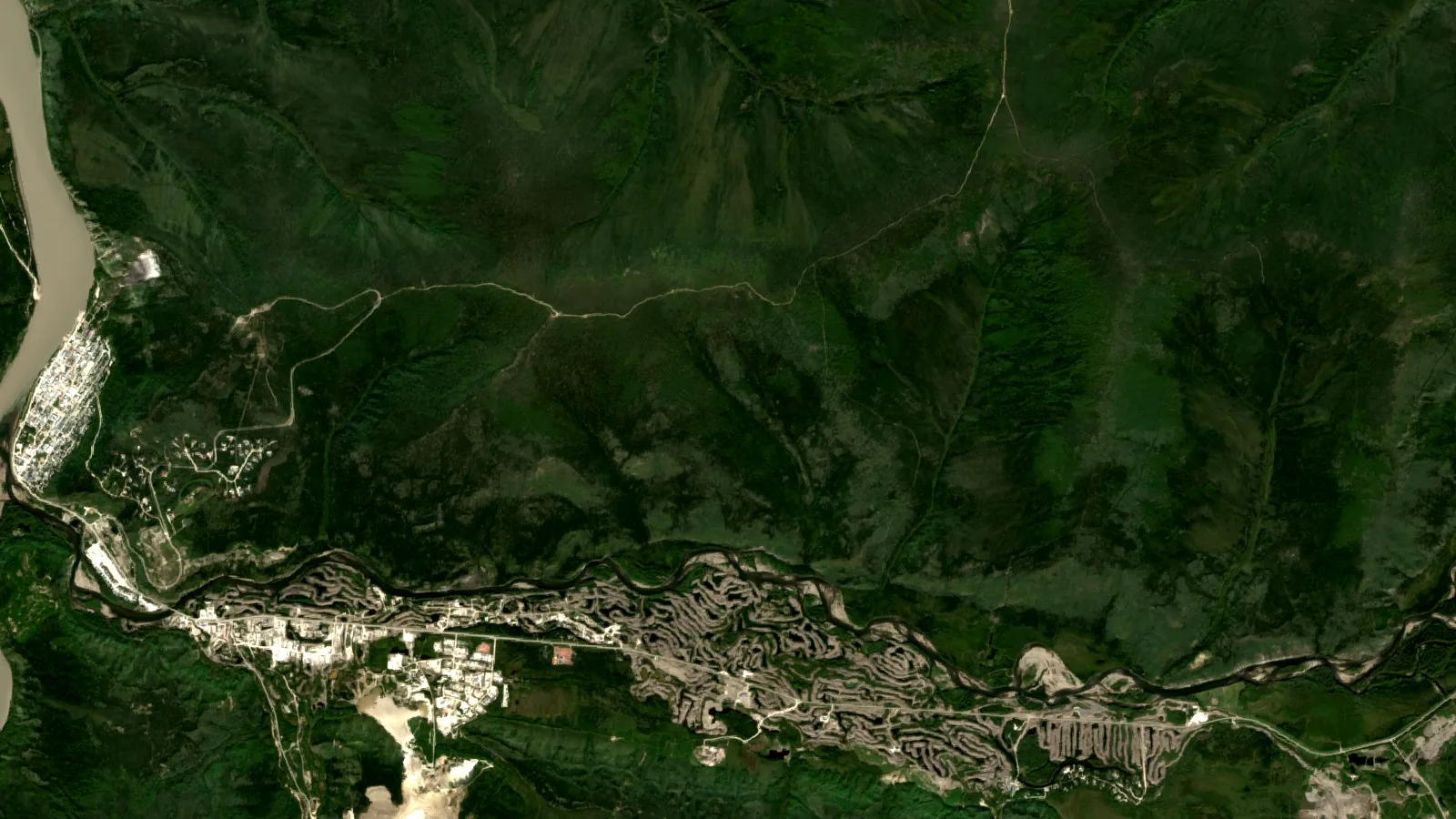
Key takeaways
- The Yukon produced 6.0 tonnes of gold in 2024 (preliminary), about 3% of Canada’s total.
- Placer miners reported 85,799 crude ounces in 2024, the highest placer revenue since 1886.
- The Eagle Gold mine is run by a court-appointed receiver; a buyer was in exclusive talks in 2026 but no sale had closed when we checked.
- Quartz claims are about 1,500 by 1,500 feet, staked with posts, recorded within 30 days and kept with C$100 of work a year; placer claims need C$200 of work a year and cannot be staked on Category A Settlement Land.
- Satellites flag alteration, structure and gravel features. They do not see gold under moss, forest or snow.
In this article
- Yukon gold mining today: output, placer records and royalties
- The Eagle Gold mine in Yukon: failure, receivership and sale
- Where gold is found: the geology behind Yukon gold mining
- Gold claims in Yukon: quartz versus placer, staking and recording
- Permits, YESAB and First Nations: Yukon gold mining from claim to drill rig
- Satellites and Yukon gold mining: what they can and cannot see
- How Farmonaut screens ground for Yukon gold mining targets
- Frequently asked questions about Yukon gold mining
Yukon gold mining today rests on Klondike-area placer operations, which set a revenue record in 2024, while the Eagle Gold mine sits in receivership after its 2024 heap leach failure and Coffee and Valley are the projects working toward new mines.
If you hold claims, run a junior or advise investors, Yukon gold mining asks you to think in two systems at once: placer gold in creek gravels, worked by small family and mid-sized operations, and hard-rock gold in large, low-grade intrusion-related deposits that need big capital. The rules, the costs and the risks differ for each. Our overview of gold exploration across Canada compares the provincial and territorial claim systems side by side. This page stays in the Yukon and goes claim by claim and project by project.
The Yukon’s 2024 placer season earned C$230 million, the highest placer revenue recorded since 1886.
Yukon gold mining today: output, placer records and royalties
How much gold does the Yukon produce? Natural Resources Canada’s gold facts page puts preliminary 2024 output at 6.0 tonnes, about 3% of Canada’s 200 tonnes, and a 3% rise on 2023. The final 2024 mineral production table, built from Statistics Canada data and dated February 2026, marks the Yukon’s gold figure with an “x”, the agency’s symbol for a number suppressed for confidentiality. With few producers, publishing it could reveal one company’s results.
That 6 tonnes is a small share of the national total, but the territory punches above its weight in two ways. It has one of the richest placer histories in the world, and its hard-rock projects are among the larger undeveloped gold deposits in Canada. For anyone tracking Yukon gold mining, the two halves need separate scorecards.
The placer side of Yukon gold mining: a record season
The Yukon Geological Survey’s 2024 placer overview reports 85,799 crude ounces of placer gold from 1 April to 1 November 2024, worth C$230 million, which it calls the highest revenue in the territory’s placer history since 1886. A total of 156 placer operations were active, up from 147 in 2023. “Crude ounces” means raw placer gold before refining, so the fine-gold content is lower than the figure suggests.
Where do those operations work? The same overview says the Dawson Mining District held 70% of active operations, with the Mayo and Whitehorse districts at 21% and 9%. In other words, most Yukon gold mining on the placer side still happens in and around the Klondike, the same ground that started the rush in 1896.
Chart
Where Yukon placer miners worked in 2024
Share of 156 active placer operations, by mining district, 2024 season
High prices have changed which ground pays. A CBC report from September 2025 quotes a Yukon Geological Survey geologist saying miners once needed about one ounce per 100 cubic yards of sluiced ground to break even, and that half an ounce per 100 loose cubic yards is now workable. Small side drainages that nobody wanted are being staked. The same report notes that the territory’s placer royalty is fixed at just over 37 cents per ounce, a rate set in law in 1906.

▶ a documentary on the modern global gold rush, useful context for why marginal Yukon creeks are being staked again. · 10:44
The Eagle Gold mine in Yukon: failure, receivership and sale
The most searched name in Yukon gold mining is Eagle, and its story changed in one afternoon. According to the Government of Yukon’s Eagle mine page, a failure occurred at the heap leach facility of the Eagle Gold Mine, operated by Victoria Gold Corporation, on 24 June 2024. A heap leach pad is a lined stack of crushed ore that is irrigated with a dilute cyanide solution to dissolve gold. MINING.COM reported that the slide released millions of tonnes of ore and at least 280,000 cubic metres of cyanide-bearing solution beyond containment, and that a court placed Victoria Gold into receivership two months later.
Since then the mine has not been run by a mining company. The government page says PricewaterhouseCoopers, as court-appointed receiver, manages the site, including heap stabilization and water monitoring. In April 2025 the court approved the Government of Yukon lending up to C$220 million to the receiver, secured by a super-priority charge. By September 2025 the receiver had intercepted more than 350,000 cubic metres of groundwater and treated and discharged over 800,000 cubic metres of water. An Independent Review Board found that a layer of ore that was not draining properly let the layer above it saturate, which led to the slide.
Who owns the Eagle mine now?
As of October 2026, Victoria Gold remains in receivership, and the Eagle Gold mine is being sold by its receiver rather than owned by a new operator. The government reported in March 2026 that the receiver was selling assets, largely net smelter return royalties, to Franco-Nevada for C$55 million to help fund site work. In April 2026 the receiver signed an exclusivity agreement with Singapore-based Boroo, which MINING.COM described as running to 22 July 2026, with Boroo the only party negotiating. A government update in July 2026 reported a further 90-day extension.
We found no completed sale. Any deal needs court approval and regulatory sign-off, and agreements with the Yukon government and the First Nation of Na-Cho Nyäk Dun.
Infographic
Eagle Gold mine: from failure to sale talks
- 1Jun 2024: heap leach failureThe heap leach pad failed at the Eagle mine.
- 2Aug 2024: receivershipA court-appointed receiver took over the mine.
- 3Apr 2025: C$220M loan approvedThe court approved a Yukon government loan of up to C$220 million.
- 4Feb 2026: C$55M royalty saleThe receiver reported a C$55 million royalty sale.
- 5Apr to Jul 2026: Boroo exclusivityBoroo entered exclusive sale talks; the initial term ended in July 2026.
Why does Eagle matter to everyone else holding ground in the Yukon? Because regulators, First Nations and lenders now read every heap leach proposal through it. The Independent Review Board report includes lessons and recommendations for overseeing heap leach facilities, and the Coffee project discussed below is itself a heap leach design. Expect closer scrutiny of water balance, drainage and monitoring in any new Yukon gold mining proposal.

▶ how gold is extracted from ore, including the heap leaching step at the centre of the Eagle story in Yukon gold mining. · 10:34
Where gold is found: the geology behind Yukon gold mining
Gold in the Yukon comes in three settings worth knowing by name. For a province-by-province comparison of belts and camps across the country, see our guide to Canada’s gold deposits by province. Here we stay in the territory.
The Klondike and Dawson City placers
According to The Canadian Encyclopedia, gold was discovered in mid-August 1896 by George Carmack, Keish (Skookum Jim Mason) and Káa Goox (Dawson Charlie) on Rabbit Creek, a tributary of the Klondike River soon renamed Bonanza Creek. The stampede ran from 1897 to 1899, Dawson City was founded in 1896 and the Yukon Territory was created in 1898. Parks Canada estimates some 50,000 gold seekers headed north, and notes that Dawson sits in Tr’ondëk Hwëch’in Traditional Territory.
Gold mining in Dawson City, Yukon, is still mostly placer work: stripping frozen overburden, sluicing gravel and reclaiming cuts each season. Because placer gold is valued by the yard of gravel rather than the tonne of rock, a placer claim’s worth turns on gravel volume, depth to bedrock and grade per cubic yard. That is very different from the hard-rock deposits further east, and it is why Yukon gold mining needs two sets of valuation rules.
The Tombstone belt and the Tintina Gold Province
The U.S. Geological Survey describes the Tintina gold province as an arc-shaped, 2,000-kilometre metallogenic province running from northern British Columbia through the Yukon and into southwestern Alaska, hosting deposits such as Pogo, Fort Knox-True North and Donlin Creek, and studied as an “intrusion-related gold system”. In plain terms, gold sits in and around granite-type intrusions, often as sheeted quartz veins, spread through large volumes of rock at modest grades. For hard-rock Yukon gold mining, that means big tonnages and low grades, as the Valley figures below show.
Snowline Gold’s Valley deposit on its Rogue project is the newest large example. In its May 2025 NI 43-101 resource update, the company reported Measured Resources of 69.7 million tonnes at 1.41 g/t gold (3.15 million ounces), Indicated Resources of 134.3 million tonnes at 1.11 g/t (4.79 million ounces) and Inferred Resources of 44.5 million tonnes at 0.62 g/t (0.89 million ounces), at a 0.3 g/t cut-off. Rogue is 100% owned and covers 1,110 square kilometres. In May 2026 Snowline said its prefeasibility study is targeted for early 2027.
White Gold district and the Coffee project
West of Dawson, the White Gold district was opened up by prospector Shawn Ryan, whose work led to the Coffee discovery, according to a February 2026 MINING.COM report. Newmont sold Coffee to Fuerte Metals in October 2025, and in June 2026 Fuerte changed its name to Talamore Mining Corp. Coffee is therefore now a Talamore project. The company’s project page places it about 130 km south of Dawson City and notes that the lack of glaciation in this part of the Yukon preserved extensive oxide deposits.
Talamore’s resource, prepared under NI 43-101 with an effective date of 21 August 2025, lists Measured Resources of 1.2 million tonnes at 1.80 g/t (69,000 ounces), Indicated Resources of 78.8 million tonnes at 1.14 g/t (2.89 million ounces) and Inferred Resources of 21.2 million tonnes at 1.17 g/t (0.8 million ounces). In July 2026 the company announced a financing package of up to about C$620 million in available capital and said it aims for a formal construction decision in early 2027.
| Mine or project | District | Owner (October 2026) | Status | Latest public figure |
|---|---|---|---|---|
| Eagle Gold mine | Mayo area, central Yukon | Victoria Gold, in receivership (PwC as receiver) | Not operating; stabilization and sale process | Boroo in exclusive talks from April 2026; no sale closed |
| Coffee | White Gold, south of Dawson City | Talamore Mining Corp. (formerly Fuerte Metals) | Development; early works, construction decision targeted early 2027 | M+I 2.96 Moz at 1.15 g/t; Inferred 0.8 Moz (Aug 2025) |
| Valley (Rogue project) | East-central Yukon | Snowline Gold (100%) | Prefeasibility study, targeted early 2027 | M+I 7.94 Moz at 1.21 g/t; Inferred 0.89 Moz (May 2025) |
| Klondike placers | Dawson district | Many independent operators | Operating seasonally | Part of 85,799 crude oz Yukon placer total (2024) |
Yukon gold mining projects: owners and statuses checked against government, company and trade sources in October 2026. Resource figures are company NI 43-101 estimates; none of these figures are reserves.
Put the two resource estimates side by side and the scale of the hard-rock opportunity is clear. Keep the categories apart: Measured, Indicated and Inferred carry different levels of confidence, and neither project has published Proven or Probable reserves in the sources above, so none of these ounces should be added to a reserve figure. Resources are where Yukon gold mining starts, not proof that a mine will be built.
Chart
Two Yukon gold resources, by category
Million troy ounces contained; categories shown separately, not added
To test what a resource means in ounces, the calculator below applies the standard conversion: tonnes multiplied by grade in grams per tonne, divided by 31.1035 grams per troy ounce. It defaults to Valley’s Measured category, and the price is an example. Kitco quoted gold at a bid of about US$4,152 per ounce early on 15 October 2026; check today’s price before you use it.
Calculator
How much gold does a Yukon resource category contain?
Enter the tonnes and grade of one resource category and an example gold price.
- Contained gold in tonnes: 98.3 t
- In-situ gross value, US$ billion: 13.11 US$ bn
Contained ounces = tonnes x grade / 31.1035 (grams per troy ounce, a fixed constant). Defaults are the Measured category of Snowline Gold’s May 2025 NI 43-101 estimate for Valley (69.7 Mt at 1.41 g/t). The gold price and the value are in US dollars (US$), not C$; the default price of US$4,150/oz is an example near Kitco’s bid on 15 October 2026. Use one resource category at a time and never add resources to reserves. In-situ gross value is before recovery, dilution, mining, processing, royalty and tax. Not a valuation and not investment advice.
Snowline’s Valley deposit holds 7.94 million Measured and Indicated ounces, from 52,736 metres of drilling.

▶ satellites and gold exploration in Alaska, the western end of the same Tintina gold province. · 11:35
Gold claims in Yukon: quartz versus placer, staking and recording
Gold claims in Yukon come in two kinds, and choosing the wrong one is an expensive mistake. The government’s quartz claim page explains that a quartz claim gives you the minerals in bedrock, while gold above bedrock, in gravels, needs a placer claim. Anyone 18 or older can stake, for themselves, a corporation or another person, with no Canadian citizenship or Yukon residency requirement. Corporations must be registered with Yukon Corporate Affairs. Every Yukon gold mining project, from a single creek to Valley, began with claims like these.
How do you stake a quartz claim in the Yukon?
You stake on the ground, in person. The Yukon government states that you must put a series of posts in the ground and cannot stake a claim on a map. Its quartz staking guidelines, last updated in 2025, describe a two-post system on a location line, with a typical claim of 1,500 by 1,500 feet. That works out to about 457 metres square, or roughly 20.9 hectares (51.7 acres). A claim cannot be larger, but it can be smaller, and partial fractions under 25 acres need only half the usual work.
After staking, you have 30 days to record the claim at the district Mining Recorder’s Office, regardless of distance, with a notarized application, a sketch and a fee of C$10 per claim. The office waits until that travel time has passed before approving the claim, so a competing staker has the same window. Staking is not permitted on existing claims, on First Nation Category A Settlement Land, in a house yard, on cultivated farmland, on land valuable for water power, in cemeteries, or on land withdrawn by Order in Council, such as parks, special management areas and historic sites. Staking on Category B Settlement Land requires financial security.
Keeping a quartz claim: C$100 a year, or pay in lieu
The quartz renewal page says a claim expires one year after it is recorded, and you keep it by doing C$100 of representation work on it. Work beyond that can be carried forward, letting you renew for up to five years. You file with a C$5 certificate fee per claim per year, within a two-week grace period. Miss that and you can still renew within six months, with late fees. If you did no work, you can pay C$100 in lieu plus the C$5 fee, C$105 per claim, but only before expiry, with no grace period.
Chart
What late filing costs on a Yukon quartz claim
Fee per claim when filing representation work (C$)
Placer claims: gravel rights with a higher work bar
The placer claim page sets out the same age and residency rules and the same rule that staking is done with posts on the ground. Placer staking is also barred inside municipal boundaries, and a claim cannot cross into another creek’s basin. Travel time is at least 10 days, plus a day for every 10 miles (16.1 km) from the recorder’s office in a straight line. On the placer renewal page, the annual work requirement is C$200 per claim, with excess credit capped at C$800 per claim per year, and a C$10 per claim per year renewal fee.
| Rule | Quartz claim (bedrock) | Placer claim (gravels) |
|---|---|---|
| How you stake | Posts on the ground; no map staking | Posts on the ground; no map or online staking |
| Typical size | 1,500 × 1,500 ft, about 20.9 ha (51.7 acres) | Varies by claim type; see placer guidelines |
| Time to record | 30 days from staking | At least 10 days, plus 1 day per 10 miles |
| Recording fee | C$10 per claim | Confirm with the Mining Recorder |
| Annual work to renew | C$100 per claim, plus C$5 certificate fee | C$200 per claim, plus C$10 renewal fee |
| Pay instead of work | C$105 per claim, before expiry only | Not listed on the renewal page |
| Where staking is barred | Category A Settlement Land, OIC withdrawals, parks, house yards | Same, plus municipal boundaries |
Summary of Yukon government quartz and placer claim pages (dated December 2024 to March 2025). Confirm with the district Mining Recorder before staking.

▶ satellite screening for copper and gold in British Columbia, the Cordilleran neighbour of Yukon gold mining country. · 3:11
What gold claims in Yukon cost to hold: a calculator
Because the work requirement repeats every year, holding cost in Yukon gold mining grows with the size of your block and how long you keep it. The calculator uses the published per-claim figures above and shows what dropping weaker claims after a screen saves.
Calculator
What does it cost to hold Yukon claims?
Enter your number of claims, renewal years and the share you would drop after screening.
- Quartz recording fees (C$10 a claim), C$: $1,000
- Quartz cost per renewal year (C$105 a claim), C$: $10,500
- Quartz ground at full claim size: 2,090 ha
- Quartz cost if you renew only the kept claims, C$: $40,375
- Quartz saving from dropping claims, C$: $13,125
- Placer renewals instead (C$210 a claim a year), C$: $105,000
- Placer renewals for kept claims only, C$: $78,750
All amounts are Canadian dollars (C$). Quartz: recording fee C$10 per claim, renewal by C$100 of work or payment in lieu plus a C$5 certificate fee per claim per year (C$105); full claim 1,500 x 1,500 ft (about 20.9 ha). Placer: renewal C$200 of work plus a C$10 fee per claim per year (C$210); placer recording fees and claim areas are not included. Kept claims are rounded to the nearest whole claim; the drop share is limited to 0 to 90%. Late fees, grouping certificates, staking labour, permits and land-use security are excluded. Fees as published by the Government of Yukon (pages dated December 2024 to October 2025). Defaults are examples; confirm with the Mining Recorder.
Permits, YESAB and First Nations: Yukon gold mining from claim to drill rig
A claim is a mineral right, not a permit to work. The Yukon’s quartz staking guidelines explain that the Quartz Mining Land Use Regulation sorts exploration programs into Classes 1 to 4, each with more potential for environmental effects than the last. Any activity above Class 1 triggers an assessment under the Yukon Environmental and Socio-economic Assessment Act. Work within Class 1 needs an approved notification, and since 1 April 2020 that requirement has applied Yukon-wide.
On the Class 1 notification page, the government says it reviews each notice and consults all affected First Nations on the proposed program, a process that usually takes about 25 days. Notices can be filed online and are posted on a public mining land use registry. Proposed activity in the Peel River watershed is also checked against the 2019 Peel Watershed Regional Land Use Plan.
Larger programs go to the Yukon Environmental and Socio-economic Assessment Board, which was set up under Chapter 12 of the Umbrella Final Agreement. YESAB assesses projects and makes recommendations; it does not approve projects or issue permits. Its levels of assessment page lists three tiers. Most projects, including quartz exploration and placer projects, are assessed by one of six Designated Offices, in Dawson City, Haines Junction, Mayo, Teslin, Watson Lake and Whitehorse. Larger projects go to Executive Committee screening, and the most significant to a Panel Review.
Infographic
Yukon quartz claim: from open ground to the drill
- 1Check the mapUse the mining map viewer and the Mining Recorder to confirm the ground is open.
- 2Stake postsStake on the ground with posts; map staking is not allowed.
- 3Record within 30 daysRecord the claim within 30 days at C$10 a claim.
- 4Class 1 noticeFile a Class 1 notice; First Nations are consulted, usually in about 25 days.
- 5Renew yearlyDo C$100 of work or pay C$105 in lieu per claim each year.
- 6Above Class 1Larger work needs a YESAB assessment, then a land use approval.
The mining laws are being rewritten
The Quartz Mining Act and the Placer Mining Act date back to the gold rush. CBC reported that the laws have been under review since 2021 and that a draft framework prepared before the 2025 election did not win agreement. In June 2026, according to Yukon News, the government and First Nations agreed a process, with an Oversight Group and a Collaborative Development Group, to draft new legislation covering prospecting through closure. The minister said it was too early to say when a draft will be public. For anyone in Yukon gold mining, expect staking, royalties and consent rules to change, and watch for transition rules.
Satellites and Yukon gold mining: what they can and cannot see
Is satellite screening worth it for Yukon gold mining? It depends on which half of the industry you are in, and what is covering the rock. The Yukon is not one terrain.
Where satellite data helps on Yukon ground
- ✔ Unglaciated, deeply weathered ground in west-central Yukon, where Talamore notes that the lack of glaciation preserved oxide deposits such as Coffee. Iron-oxide and clay alteration at surface is the kind of signal multispectral and hyperspectral data are built to map.
- 📊 Structure and lineaments. Faults and fracture corridors that host veins show up in elevation models and radar even where forest hides the rock.
- Above-treeline exposure on ridges and cirques in the mountain ranges, where rock and talus are visible in summer imagery.
- Placer geomorphology: terraces, old channels, benches and the footprint of past workings, which help rank gravel ground before a test pit.
- Access and logistics: roads, trails, river crossings and old cuts that decide what a season of fieldwork will cost.
Where it cannot
- ⚠ Moss, boreal forest and permafrost hide bedrock across much of the territory. Spectral alteration mapping weakens where vegetation covers the ground.
- Snow and a short season. Useful optical scenes come from a narrow summer window, and steep north-facing slopes add shadow.
- Placer grade. No satellite measures gold per cubic yard of gravel or depth to bedrock. That needs drilling, test pits and sluicing.
- Glaciated valleys in other parts of the territory, where till and outwash bury the source rock.
Public Yukon gold mining data to load before any field season
Start with the territory’s online mining map viewer to see which ground is open, then confirm with the district Mining Recorder, because the government itself says the online map can lag. The Yukon Geological Survey publishes placer and exploration overviews each year, and YESAB’s online registry shows every project under assessment, which is a free way to see who is working near you. Licensing questions in other countries are covered in our mining cadastre portal guide.
How Farmonaut screens ground for Yukon gold mining targets
We are a satellite data company. Our satellite-based mineral detection service analyses reflected light in multispectral and, where it fits, hyperspectral bands, where alteration minerals have distinct spectral signatures, and combines that with structural interpretation to flag zones worth fieldwork. We have screened more than 100,000 hectares for over 20 mineral types in more than 25 countries. The aim is to move early exploration from months to days and to lower early-exploration cost by up to 80 to 85%, with no ground disturbance at the screening stage.
The workflow is simple. You send coordinates, a KML or KMZ file, or a polygon of your claim block, plus the target mineral. We choose the data source, run the analysis and deliver in 5 to 20 business days, depending on area and complexity. The premium report covers high-potential zones, prospectivity heatmaps, estimated location and depth ranges, indicative quantity and geological interpretation, as a PDF with georeferenced GIS files. Premium+ adds TargetMax™ drilling intelligence: suggested drill angles and 3D prospectivity models of vein structures.
Be clear about what the output is. Our results are exploration targets that sit ahead of any resource estimate. They carry no NI 43-101 status, they do not replace a Qualified Person’s work, and they do not guarantee a discovery. We are not a licensing agent, land-title adviser, broker or investment adviser. For a Yukon holder, the practical use is ranking claims before you spend C$100 or C$200 a claim keeping them, and placing a smaller Class 1 program on the best ground. To see your ground first, open Map Your Mining Site, or get a quote for a specific block.
Investors weighing companies in Yukon gold mining should read the risk the same way a claim holder does. The three large projects named here are at very different stages: a receivership sale, a heap leach build heading to a construction decision, and a prefeasibility study. Each depends on First Nations agreements and YESAB outcomes as much as on grade. General information only; not investment advice.
Frequently asked questions about Yukon gold mining
Is there still gold in the Yukon?
Yes. Natural Resources Canada puts 2024 output at 6.0 tonnes (preliminary), and placer miners reported 85,799 crude ounces in 2024, the highest placer revenue since 1886. Large hard-rock resources such as Valley and Coffee are still being studied, so Yukon gold mining has both a working present and a pipeline.
Where is gold found in the Yukon?
Placer gold is concentrated in the Dawson district, including the Klondike, with further operations in the Mayo and Whitehorse districts. Hard-rock gold occurs in intrusion-related systems of the Tintina gold province, such as Eagle and Valley, and in the White Gold district, home to Coffee.
What happened to the Eagle Gold mine in Yukon?
Its heap leach facility failed on 24 June 2024. Owner Victoria Gold went into receivership two months later, and PwC, as receiver, runs the site. In April 2026 Boroo entered exclusive talks to buy it; we found no completed sale as of October 2026.
Who owns the Eagle mine in Yukon now?
Victoria Gold still holds it, under court-supervised receivership. Any sale to Boroo or another buyer needs court approval, regulatory authorizations and agreements with the Yukon government and the First Nation of Na-Cho Nyäk Dun.
How do you stake a gold claim in the Yukon?
Check the mining map viewer and the district Mining Recorder, travel to the ground, and mark the claim with posts, since map staking is not allowed. Record a quartz claim within 30 days at C$10 a claim; placer travel time is at least 10 days plus a day per 10 miles.
How much does it cost to keep gold claims in Yukon?
A quartz claim needs C$100 of work a year plus a C$5 certificate fee, or C$105 paid in lieu before expiry. A placer claim needs C$200 of work and a C$10 renewal fee a year. Confirm current figures with the Mining Recorder.
What is the difference between a quartz claim and a placer claim?
A quartz claim covers minerals in bedrock; a placer claim covers gold in gravels above bedrock. They have different recording windows, work requirements and staking rules, so pick the claim type that matches the gold you are after.
Is Yukon gold mining profitable at today’s prices?
For placer operators, high prices have lowered the break-even grade. A Yukon Geological Survey geologist told CBC that half an ounce per 100 loose cubic yards is now workable, against about one ounce per 100 yards in the past. Profit still depends on gravel volume, stripping, fuel and permits. Not investment advice.
What is the biggest gold mine in the Yukon?
The Eagle Gold mine, a heap leach operation, has not produced since its 2024 failure and is in receivership. By published resources, Snowline’s Valley deposit reported 7.94 million Measured and Indicated ounces in May 2025, and Talamore’s Coffee project 2.96 million Measured and Indicated ounces.
Can foreigners stake gold claims in the Yukon?
Yes. The Yukon government says anyone 18 or older can stake a claim and there is no Canadian citizenship or Yukon residency requirement. Corporations holding claims must be registered with Yukon Corporate Affairs.
Do I need a permit to explore my Yukon claim?
Usually. Work within Class 1 limits needs an approved Class 1 notification, which includes First Nations consultation and usually takes about 25 days. Anything above Class 1 is assessed by YESAB before a land use approval can be issued.
Authored by: Farmonaut Research & Content Team · Reviewed by: Farmonaut Mining & Mineral Exploration Team · Updated October 2026
General information about Yukon gold mining only, not legal or investment advice. Fees, work values and assessment rules change, and the territory’s mining laws are being rewritten; confirm with the Government of Yukon Mining Recorder. Farmonaut targets are exploration targets ahead of any resource estimate and carry no NI 43-101 status.
Farmonaut mineral detection
Map your mining site from space
Send your claim or licence boundary as KML, KMZ or a polygon. Farmonaut returns ranked satellite exploration targets for it, usually in 5 to 20 business days.

Keep reading
Sources
- Natural Resources Canada, Gold facts (2025): natural-resources.canada.ca
- Natural Resources Canada, Mineral production of Canada by province and territory, Table G01 (2026): sead.nrcan-rncan.gc.ca
- Yukon Geological Survey, Yukon placer mining 2024: development and exploration overview (2025): open.yukon.ca
- Yahoo News Canada, Gold prices drive Yukon placer mining production to new heights (2025): ca.news.yahoo.com
- Government of Yukon, Victoria Gold Corporation's Eagle mine heap leach failure (2026): yukon.ca
- MINING.COM, Boroo's bid to buy former Eagle Gold site raises questions among miners (2026): mining.com
- The Canadian Encyclopedia, Klondike Gold Rush: thecanadianencyclopedia.ca
- Parks Canada, Klondike National Historic Sites: parks.canada.ca
- U.S. Geological Survey, Fact Sheet 2007-3061 on the Tintina gold province (2007): pubs.usgs.gov
- Snowline Gold, Updated mineral resource estimate for the Valley gold deposit (2025): snowlinegold.com
- Snowline Gold, Fully funded 2026 project development and exploration programs (2026): snowlinegold.com
- MINING.COM, Yukon's Coffee gold project gets new push with quick payback (2025): mining.com
- Talamore Mining, Fuerte announces name change to Talamore Mining Corp. (2026): talamoremining.com
- Talamore Mining, Coffee project page and NI 43-101 resource (2025): talamoremining.com
- Talamore Mining, Construction financing package for the Coffee project (2026): talamoremining.com
- Government of Yukon, Apply for a quartz claim (2025): yukon.ca
- Government of Yukon, Renew your quartz claim (2024): yukon.ca
- Government of Yukon, Apply for a placer claim (2025): yukon.ca
- Government of Yukon, Renew your placer claim (2024): yukon.ca
- Government of Yukon, Guidelines for quartz claim staking in Yukon (2025): yukon.ca
- Government of Yukon, Quartz grouping guidelines under the Quartz Mining Act: yukon.ca
- Government of Yukon, Submit a Class 1 exploration notice (2025): yukon.ca
- Yukon Environmental and Socio-economic Assessment Board, About YESAB: yesab.ca
- Yukon Environmental and Socio-economic Assessment Board, Levels of assessment: yesab.ca
- CBC News, Yukon minerals legislation and First Nations consultation (2026): cbc.ca
- Yukon News, Yukon government sets new process with First Nations to update minerals laws (2026): yukon-news.com
- Kitco, Live gold price chart (accessed 15 October 2026): kitco.com
Discussion
Questions, corrections or field experience? Share them below. First-time comments are reviewed before they appear, and your email is never published.
No comments yet. Be the first to add a question or your experience.

 Jaunita Erss Ltd
 Almosi SARL
 SRK Consulting
 Berks Gold Limited
 Mwerezi Minerals Company Limited
 Mining SARL
 SenGold Invest SAS
 Sean Mining Limited
 NTS Group (Pty) Ltd
 Mine4Africa
 Lithspo Minerals Limited
 Tintina Mining Group
 Dalgety Minerals Pty Ltd
 Vortex Minerals Pty Ltd
 Faith At Work (Pty) Ltd
