

Chromite · Deposit model guide
Podiform Chromite Deposits: Size, Grade, Exploration
Podiform chromite deposits are small chromite pods in ophiolite dunite and peridotite. The USGS major model has a median of 11,000 t at 45% Cr2O3; finding them is hard, and this guide shows how.
Key takeaways
- Podiform chromite forms pods and lenses in ophiolite ultramafic rock; stratiform chromite forms continuous seams in layered intrusions such as the Bushveld (USGS, 2010 and 2012).
- USGS major model: median 11,000 t at 45% Cr2O3; about one deposit in ten holds more than 540,000 t (USGS SIR 2012-5157, 1,124 deposits compiled).
- Metallurgical ore needs about 45% Cr2O3 or more and a Cr:Fe ratio near 3:1; refractory and chemical ores accept lower grades (USGS).
- Pods look randomly placed: map dunite near the Moho transition zone, then test gravity or magnetics locally. Only 10 of 106 gravity highs in Cuba’s Camaguey district were chromite.
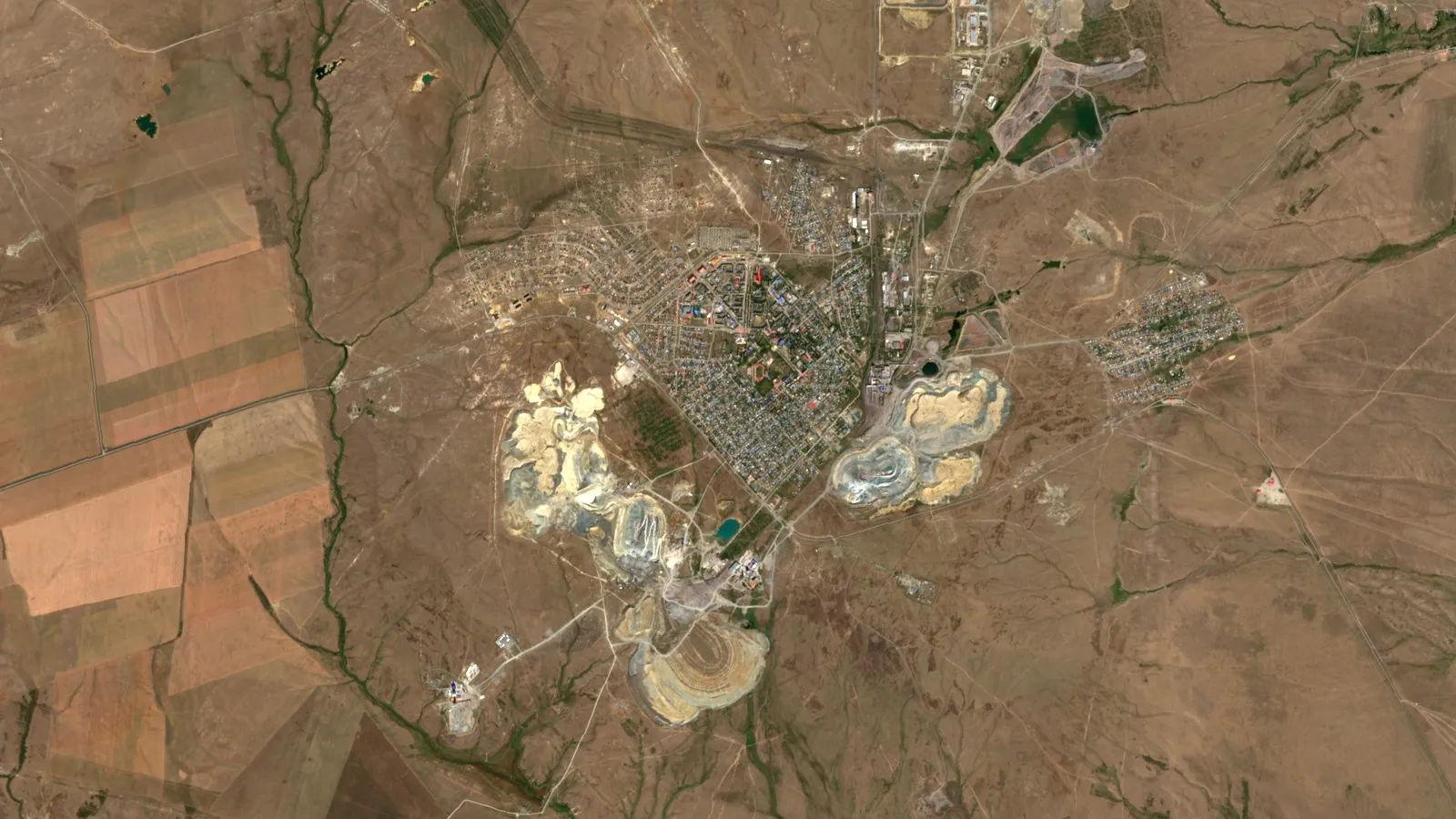
- Kazakhstan’s Donskoy complex produced 4.8 Mt of chromite ore in 2022 (USGS Minerals Yearbook); Kazakhstan reserves are 230 Mt of ore (USGS, 2026).
In this article
- What are podiform chromite deposits?
- Podiform vs stratiform chromite: the key differences
- How ophiolite chromite pods form
- Podiform chromite size and grade: what the USGS models show
- Chromite ore grades: metallurgical, refractory and chemical
- Check a pod: Cr:Fe ratio, contained chromium and pod count
- Where podiform chromite is mined: main districts
- Chromite exploration: how geologists find pods
- Mapping ophiolites from space
- Placer chromite, float and old workings
- What to check before you back a chromite target
- Frequently asked questions
What are podiform chromite deposits?
Podiform chromite deposits are small, lens-shaped bodies of chromite (the only ore of chromium) that sit inside the ultramafic rocks of an ophiolite, a slice of ocean crust and upper mantle pushed onto land. The U.S. Geological Survey (USGS) describes them as small magmatic chromite bodies formed in the ultramafic section of an ophiolite, found mostly in dunite or peridotite near the contact between the cumulate and tectonite zones. The median pod in the main USGS model holds 11,000 tonnes of ore at about 45% Cr2O3, so these are targets for small to mid-size operators, with a few giants such as the chromite deposit worked by Donskoy GOK in north-west Kazakhstan.
This guide is for geologists, licence holders and investors who need the working picture: how pods differ from layered (stratiform) chromite, how big and how rich they are, which districts matter, and how explorers actually find them. Terms are explained as they appear. Nothing here is a resource estimate for any property.
Podiform vs stratiform chromite: the key differences
Chromite concentrates in two ways. Stratiform chromite forms thin, continuous seams inside huge layered intrusions on old continental crust, such as the Bushveld Complex in South Africa. Podiform chromite forms irregular pods in ophiolites. The USGS notes that both types are tied to ultramafic igneous rocks, yet they behave very differently for an explorer. A seam can be followed for kilometres; a pod can vanish within a few metres.
| Feature | Podiform (ophiolite) | Stratiform (layered intrusion) |
|---|---|---|
| Tectonic setting | Oceanic crust and upper mantle, emplaced onto continental margins | Continental crust, layered mafic-ultramafic intrusions |
| Shape | Lenses, pods, tabular or irregular bodies; pea-size nodules to bodies hundreds of metres long | Thin seams, continuous over large areas |
| Extent | Pods usually under 800 m long; banded zones in ophiolites also under 800 m | Seams followed for kilometres; Bushveld covers about 65,000 km2 |
| Typical Cr2O3 in ore | 40-60% in massive ore; 10-30% in disseminated bands | About 40-50% in the Bushveld; 21-57% across intrusions |
| Texture clue | Nodular, orbicular and net textures | Regular layering |
| Exploration difficulty | High: pods look randomly placed | Lower: seams can be mapped and drilled in sequence |
| Examples | Khromtau area (Kazakhstan), Bulqiza (Albania), Oman, Turkey | Bushveld, Great Dyke, Stillwater |
Sources for the table: USGS Scientific Investigations Report 2012-5157 for podiform features and USGS Open-File Report 2010-1232 for the stratiform model. Nodular texture is, in the USGS words, a critical feature that separates the two types.
The split matters for supply. Layered intrusions hold most of the world’s chromium reserves, and the USGS Mineral Commodity Summaries put 95% of world chromium resources in Kazakhstan and southern Africa. Podiform mines have still been important: a USGS compilation cites podiform mines as 57.4% of all chromite produced historically, and about 25% of output in 2010. For how chromite fits among other ore families, see our guide to types of ore deposits.
How ophiolite chromite pods form
An ophiolite is a section of oceanic lithosphere that tectonic forces have thrust onto continental rock. From bottom to top it has a tectonite zone (deformed mantle peridotite, mostly harzburgite), a transition zone rich in dunite, and a cumulate zone of layered gabbro, pyroxenite and more dunite. The base of the cumulate section is the Moho, the boundary between crust and mantle. Dunite is a rock made almost entirely of olivine; harzburgite is olivine plus orthopyroxene.
Most pods sit in dunite, which is often serpentinised (altered to serpentine minerals) in outcrop. The USGS report says the deposits tend to occur at or near, within about 1 km of, the Moho transition zone, and that this transition zone can be as much as 3 km thick. Pods often cluster, and a massive pod may be flanked by a zone of disseminated chromite traceable for hundreds of metres.
How the pods form is still debated. The USGS lists several models: partial melting and remobilisation at depth, multiple magma injections, magma-conduit filling inside residual mantle, and melt-rock or melt-melt interaction. What most researchers accept is that the pods grew in oceanic mantle and were later sheared, folded and broken during emplacement. That deformation is why so many pods are lens-shaped, dislocated or pulled apart, and why their size has no link to the size of the surrounding ultramafic body.
Ore textures help geologists in the field. Massive ore is nearly solid chromite. Nodular ore carries rounded clusters of chromite that seldom exceed 3 cm across. Orbicular, net and banded textures also occur. Chromite crystals themselves are small, usually under 1 mm up to about 10 mm.
Podiform chromite size and grade: what the USGS models show
Pods are small by mining standards. The USGS built grade and tonnage models from a database of 1,124 deposits, using 619 with reliable figures. In that work, any pods within 100 m of each other count as one deposit. The authors split the data into three models: major, minor and banded podiform. The table below gives the median (50th percentile) and the 10th and 90th percentiles. A 10th percentile figure is a size that only about one deposit in ten exceeds.
Chart
Median ore tonnage by USGS podiform model
Tonnes of ore at the 50th percentile of deposits
| Model | Deposits used | Tonnage, 90th / 50th / 10th percentile (t) | Cr2O3, 90th / 50th / 10th percentile (%) |
|---|---|---|---|
| Major podiform | 246 | 400 / 11,000 / 540,000 | 34 / 45 / 51 |
| Minor podiform | 283 | 10 / 100 / 2,000 | 34 / 43 / 51 |
| Banded podiform | 90 | 20 / 650 / 46,000 | 34 / 42 / 52 |
Source: USGS SIR 2012-5157, table 3. The report converts tonnage in millions of tonnes; figures above are restated in tonnes. Grades below 30% Cr2O3 were excluded as uneconomic.
Three points follow. First, most pods are tiny: half of the major-model deposits hold 11,000 t or less. Second, the size distribution has a long tail, so a district can be carried by a handful of large bodies. Third, grades are fairly uniform. The USGS adds that massive ore is typically 40-60% chromic oxide and disseminated bands 10-30%, and an older field rule treated about 10% as the leanest mineable ore.
Platinum-group elements (PGE) are a minor bonus. Ophiolite chromitite is usually enriched in osmium, iridium and ruthenium, though the median grades in the USGS models are near zero, so PGE should be treated as an upside to test, not a basis for value.
Chromite ore grades: metallurgical, refractory and chemical
Two numbers decide what a buyer will pay for: the chromic oxide (Cr2O3) content and the Cr:Fe ratio (the weight ratio of chromium to iron). Podiform ore is the main source of both high-chromium, low-aluminium ore for ferrochrome and high-aluminium ore for refractories, according to the USGS. High-carbon ferrochrome goes mostly into stainless steel; the USGS notes that most stainless steel contains about 18% chromium.
Chart
Cr2O3 range by ore use
Lower and upper Cr2O3 limits, percent (grade A, above 64%, not shown)
| Use | Cr2O3 (%) | Cr:Fe | Other specification |
|---|---|---|---|
| Metallurgical, grade A | Over 64 | Over 2.5 | Lump ore, low alumina |
| Metallurgical, grade B | 56-64 | 1.8-2.5 | Lump ore, low alumina |
| Metallurgical, grade C | 46-55 | Under 1.8 | Lump ore, low alumina |
| Chemical | 40-46 | 1.5-2.0 | Fine-grained, friable ore preferred |
| Refractory | 30-40 | 2.0-2.5 | Al2O3 22-34%; hard, dense lump |
Source: USGS SIR 2012-5157, table 1, compiled from older industry specifications. Individual buyers set their own limits.
The USGS adds that for metallurgical ore, grades under 45% chromic oxide are usually rejected at the mill and a Cr:Fe ratio of 3:1 is preferred. For refractory ore the test is the combined chromium and aluminium oxide, which must reach at least 57%. Chemical ore can be low in Cr2O3 if the chromite is fine enough. For prices of lump and concentrate, see our chromite ore price per ton page, and for the industry in general, chromite ore, steel and defence demand.
Check a pod: Cr:Fe ratio, contained chromium and pod count
Assay sheets often give Cr2O3 and total iron, so the quick conversion below turns them into the Cr:Fe ratio buyers quote. Chromium makes up 68.4% of the weight of Cr2O3 (atomic weights Cr 52.0, O 16.0). The tool also counts how many pods of your size it takes to match one year of output at Kazakhstan’s Donskoy mining complex, as a sense of scale.
Calculator
What is your chromite pod worth in ratio and metal?
Enter your own assay and tonnage; the page converts Cr2O3 to chromium and Cr:Fe.
- Contained Cr2O3 (tonnes): 4,950
- Contained chromium (tonnes): 3,387
- Pods this size to match 4.8 Mt of ore: 436
Example values only, not a benchmark. Chromium is 68.4% of Cr2O3 by weight (atomic weights Cr 52.0, O 16.0). The 4.8 Mt comparison is Donskoy GOK chromite ore output in 2022 (USGS Minerals Yearbook, Kazakhstan). Results are an arithmetic check, not a resource estimate.
Where podiform chromite is mined: main districts
The USGS compilation lists producing countries, in decreasing order of importance, beginning with Kazakhstan and Turkey, followed by Albania, New Caledonia and Cuba among others, with smaller output from Greece, Cyprus, Canada and the United States. In the USGS 2025 estimates Turkey and Kazakhstan rank second and third among world producers, behind South Africa, whose output comes from the layered Bushveld Complex.
Chart
World chromite ore output, 2025 estimate
Thousand tonnes of ore. Turkey and Kazakhstan are mainly podiform; South Africa, Zimbabwe and Finland mine layered intrusions
Kazakhstan: Khromtau area. Kazakhstan’s chromite mines are centred on Khromtau in Aqtobe Province, north-west Kazakhstan. SRK Consulting, which writes competent person’s reports for the operator Donskoy GOK, calls the deposit its two underground mines work a world class podiform chromite deposit. Kazchrome’s Donskoy mining and beneficiation complex, based at Khromtau, produced 4.8 million tonnes of chromite ore in 2022, a 7.0% drop from 2021, per the USGS Minerals Yearbook. SRK reports that the DNK mine uses gravity caving at 2.4 Mtpa, that its largest resources lie below the cave at depth, and that a study found potential to lift rates from 6.0 to 7.2 Mtpa. Kazakhstan’s reserves in the USGS summary are 230 million tonnes of ore with 100 million tonnes of contained Cr2O3.
Turkey. Turkish ophiolites in the Tethyan belt have produced chromite for decades. The USGS 2025 estimate is 9 million tonnes of ore, and reserves are 27 million tonnes of ore with 5.7 million tonnes of Cr2O3. The USGS Minerals Yearbook lists Turkish chromite output in a 34% to 43% Cr2O3 ore class. USGS case studies in the pod report mention magnetic surveys at the Guleman and Mugla deposits that flagged outcropping ore.
Albania. The Bulqiza mine, about 40 km north-east of Tirana, is the main operation. The USGS lists Albania’s marketable chromite at about 1.29 million tonnes in 2019. A USGS-cited study of Albanian exploration reports that combined geological, gravity, magnetic and electrical surveys at 1:2,000 scale led to large discoveries.
Oman. The Semail ophiolite in northern Oman hosts chromitite pods in its mantle section, and the U.S. International Trade Administration notes that Oman’s mountains host intact and exposed ophiolites and that the country was the first GCC producer and exporter of ferrochrome. The USGS reported 608,000 tonnes of chromite ore produced in 2019, down from 885,000 tonnes in 2018. Satellite studies have mapped chromite-bearing serpentinised harzburgite here, described below.
Cuba, New Caledonia and North America. The USGS database includes the Camaguey district in Cuba and deposits in New Caledonia. In North America, the USGS notes podiform deposits along the Pacific coast from Alaska’s Kenai Peninsula to southern California and along the Appalachians from northern Vermont to Georgia. Those deposits are mostly small: the USGS says many pods mined during the world wars with government subsidies are uneconomic by current standards, and the USGS describes US chromite resources as small, with the Stillwater Complex of Montana holding layered chromite. US mine output of chromite is nil in the latest summary and the country imports about 79% of what it uses.
For a wider view of ophiolite belts and other deposit types on a map, see our world mineral deposits map guide.
Chromite exploration: how geologists find pods
The USGS is blunt about this: exploration for pods has been a challenge because of their unpredictable occurrence. In most places they appear randomly distributed within the ultramafic rocks. Not all dunite bodies contain pods, and the dunite bodies themselves look random in the peridotite. The USGS adds that in regions explored thoroughly, most near-surface pods have already been found, because chromite resists weathering and can stand proud of softer host rock. The practical programme therefore has layers.
Infographic
Finding podiform chromite in six steps
- 1Pick the ophioliteChoose a belt with a preserved Moho zone and a large mantle section.
- 2Map duniteTrace dunite lenses and shear zones within about 1 km of the Moho.
- 3Check float and placersLoose chromite and heavy-mineral streams point upslope.
- 4Test geophysicsRun gravity or magnetics over a known pod first.
- 5Rank targetsWeigh structure, outcrop and PGE ratios.
- 6Drill with structureAim down-plunge at dunite-shear intersections.
- Pick the right ophiolite. Choose a belt with a preserved Moho transition zone and a large mantle section. The USGS says its major and minor models can be used for any ophiolite, whatever its tectonic setting.
- Map the dunite and the Moho zone. Pods tend to lie within about 1 km of the contact between cumulate and tectonite rocks. Mapping dunite lenses, shear zones and the contact narrows the target. Mapping is harder in tectonic mélange, where the zones are unclear.
- Walk the outcrop and the streams. Float (loose chromite pieces), old pits and heavy-mineral placers in streams or beach sands point to pods upslope.
- Use geophysics with caution. Gravity and electromagnetic surveys have had mixed results because pods are small and many other rocks are dense. In Cuba’s Camaguey district, only 10 of 106 positive gravity anomalies were caused by chromite. Magnetic surveys flagged outcropping ore at Guleman and Mugla in Turkey, with anomalies above 1,000 and 2,000 nanoteslas, though magnetic work proved of little value in another range. Treat each method as a district-specific test, then use integrated surveys where they work, as in Albania.
- Do not rely on soil geochemistry. The USGS says blind chromite bodies have no useful geochemical halo. PGE ratios can still help rank targets: high Pd/Ir ratios suggest more evolved magmas and weaker chromite potential.
- Drill with structure in mind. Pods cluster, so ground near known pods is better than empty ground, though the USGS says there are no proven guidelines for finding associated ore bodies. Drilling down-plunge of the regional lineation at a dunite-mylonite intersection found blind bodies, and tracing particular shear zones has paid off elsewhere.
The USGS also notes that pods are quickly mined out and drilling around them has had limited success. In California it was historically not economical to drill below 90 m, so deeper extensions of known pods may be untested. The practical point stands: budget for a lot of ground coverage for a small number of hits. Our comparison of satellite, geochemistry and geophysics methods shows where each helps.
Mapping ophiolites from space
Satellites do not see chromite pods, which are metres across, but they map the rocks that host them. Ultramafic rocks and serpentinised harzburgite have a different spectral signature from gabbro, basalt and cover. A peer-reviewed review reports that chromite-bearing zones were detected with ASTER visible and shortwave infrared bands in the Semail Ophiolite massifs of northern Oman, using band ratios and principal component analysis, and that ASTER band ratios have also been used to separate serpentinite, metagabbro and metabasalt in ophiolites. For a licence holder this means a cheap first pass: outline the ultramafic belt, find shear zones and dunite lenses, and rank ground before walking it. Satellites map surface and near-surface signatures; sampling and drilling confirm. High-resolution terrain models can add outcrop and fault detail, as described in our lidar for geology guide.
Farmonaut satellite mineral reports screen a licence area for surface mineral signatures before field work; for ophiolite ground, that starts with mapping the host rocks.

▶ How satellites help exploration: they map the rock, minerals and cracks around a target rather than the target itself. · 4:25
Placer chromite, float and old workings
Because chromite is dense and resistant, eroded pods shed grains into drainage and beach sands. The USGS notes that highly eroded deposits may be accompanied by placer chromite in nearby streams or coastal sands that may be of economic interest. Mapping downslope from float and tracing old trenches is cheap and has historically been the main way pods were found. Check old workings on public records before you apply: many pits from the war years in North America and elsewhere are small and unstable. Always take a trained geologist, tell someone your route and do not enter old workings.
What to check before you back a chromite target
These questions separate a credible target from a hopeful one.
- Is it an ophiolite? Ultramafic rock alone is not enough. Look for the Moho transition, dunite and nodular chromite float.
- Which model fits? Pods in the major model have a median of 11,000 t. A claim built on one pod is a small mine; a claim with a cluster of pods or a banded zone is a different case.
- Which end market? Metallurgical ore needs chromic oxide above about 45% and a good Cr:Fe ratio. Low-grade, high-alumina ore may fit refractory or chemical use only.
- How deep and how continuous? Pods pinch and swell, are often sheared and can be displaced by faults, so a surface outcrop may say little about depth.
- What does the survey show? Gravity or magnetic anomalies need a field check, as most Cuban gravity highs were not chromite.
- Access, infrastructure and market. Ore is shipped as lump or concentrate; check haulage, ports and smelter demand. Check the licence terms with the ministry before you apply.
- Is the language honest? A model tonnage or satellite target is an exploration target, not a JORC, NI 43-101 or SAMREC resource.
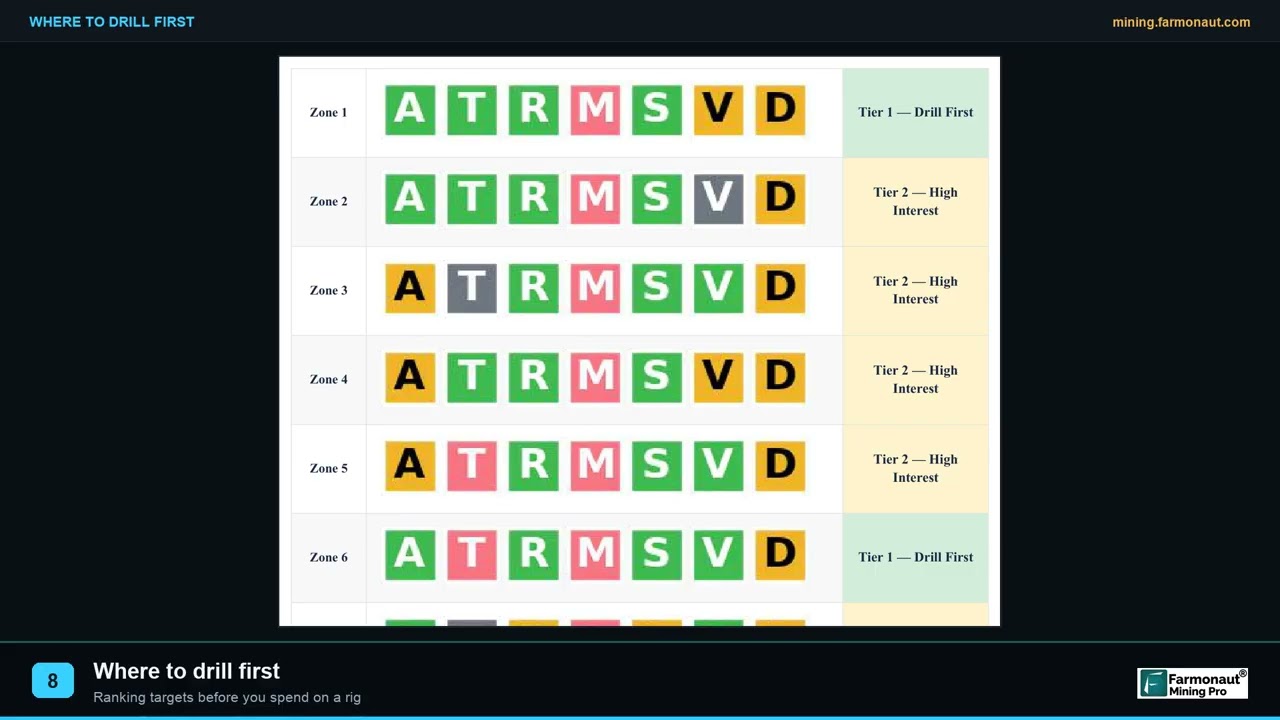
▶ Exploration targeting: how targets are ranked into a drill order you can defend. · 2:19
Frequently asked questions
What is podiform chromite?
It is chromite that forms pods, lenses and tabular bodies in the ultramafic part of an ophiolite. The USGS describes them as small magmatic bodies in oceanic crust and mantle rock, usually in dunite or peridotite.
What is the difference between podiform and stratiform chromite?
Stratiform chromite forms continuous seams in large layered intrusions on continental crust, such as the Bushveld. Podiform chromite forms irregular pods in ophiolites. Podiform ore often shows nodular texture, while stratiform ore shows regular layering.
Where are podiform chromite deposits found?
In ophiolite belts: Kazakhstan, Turkey, Albania, Oman, Cuba and New Caledonia, plus the US Pacific coast and Appalachians, where deposits are small. The USGS database holds 1,124 deposits.
How big is a typical podiform chromite deposit?
The USGS major model has a median of 11,000 tonnes; the minor model about 100 tonnes; the banded model about 650 tonnes. About one in ten major deposits is above 540,000 tonnes.
What grade of chromite is considered high?
Metallurgical grade A is above 64% chromic oxide with a Cr:Fe ratio above 2.5, per the USGS table. High-chromium ore is a main product of podiform deposits, and mills usually reject metallurgical ore under 45% chromic oxide.
What is chromitite?
Chromitite is a rock made mostly of chromite, often with olivine or serpentine. A pod or layer of chromitite is the ore body. The USGS notes massive chromitite is typically 40-60% chromic oxide.
What is the Cr:Fe ratio and why does it matter?
It is the weight ratio of chromium to iron in the ore. A higher ratio makes better ferrochrome for stainless steel. The USGS says a ratio of 3:1 is preferred for metallurgical ore.
Why is chromite exploration so hard?
Pods are small, look randomly placed inside the ultramafic rocks, and have no geochemical halo. Gravity and magnetic surveys give mixed results, and not every dunite body holds a pod.
Which geophysical method finds podiform chromite?
No single method works everywhere. Magnetics worked at Guleman and Mugla in Turkey, gravity in parts of Cuba (though most anomalies there were false), and integrated surveys in Albania. Test the method on a known pod first.
Can satellites find chromite?
They map the host rocks, not the pods. A peer-reviewed review reports that ASTER data detected chromite-bearing serpentinised harzburgite in Oman’s Semail ophiolite, so imagery can narrow the ground before field work.
Does the United States produce chromite?
No. The USGS lists US mine production as nil and estimates net import reliance at 79%. US podiform deposits are small and scattered along the Pacific coast and the Appalachians.
Is every ophiolite chromite-bearing?
No. The USGS stresses that not every dunite body holds pods, and there is no proven rule for predicting which will. That is why district-scale mapping comes before drilling.
This page is for information only. It is not investment advice or legal advice. Model tonnages and grades describe deposit populations, not any property, and satellite results are exploration targets, not resource estimates under JORC, NI 43-101 or SAMREC. Confirm licence rules with the regulator before field work, and follow site safety rules: take a trained geologist, tell someone your route, and do not enter old workings or unstable ground.
Farmonaut mining
Screen your ophiolite licence from space
Send your licence boundary to see which host-rock and alteration signals sit inside it before you plan field work.

Mining Pro sample view, synthetic data
Sources
- USGS, Podiform Chromite Deposits: Database and Grade and Tonnage Models, SIR 2012-5157 (2012): pubs.usgs.gov
- USGS, SIR 2012-5157 full text (tables 1 and 3): pubs.usgs.gov
- USGS, Stratiform Chromite Deposit Model, OFR 2010-1232 (2010): pubs.usgs.gov
- USGS, Chromium: Makes Stainless Steel Stainless, Fact Sheet 2010-3089 (2010): pubs.usgs.gov
- USGS, Mineral Commodity Summaries 2026: chromium: pubs.usgs.gov
- USGS, Minerals Yearbook 2022: Kazakhstan: pubs.usgs.gov
- USGS, Minerals Yearbook 2019: Turkey: pubs.usgs.gov
- USGS, Minerals Yearbook 2019: Albania: pubs.usgs.gov
- USGS, Minerals Yearbook 2019: Oman: pubs.usgs.gov
- SRK Consulting, DNK Mine competent person’s report and technical study (Donskoy GOK, Kazakhstan): srk.com
- PMC, ASTER, ALI and Hyperion data for lithological mapping and ore minerals exploration (review): pmc.ncbi.nlm.nih.gov
- U.S. International Trade Administration, Oman Country Commercial Guide: Mining and Minerals: trade.gov
Discussion
Questions, corrections or field experience? Share them below. First-time comments are reviewed before they appear, and your email is never published.
No comments yet. Be the first to add a question or your experience.

 CIMISCO SARL
 Mining SARL
 SenGold Invest SAS
 Sania Corporation
 Sean Mining Limited
 NTS Group (Pty) Ltd
 Mine4Africa
 Lithspo Minerals Limited
 Tintina Mining Group
 Dalgety Minerals Pty Ltd
 Faith At Work (Pty) Ltd
 Geotech Mining Solutions plc
 Vulcan International Limited
 Kidepo Associates
 GKY Mining
 Alkimy SARL
 Double A Trading
 GemSprout Metals Limited
 Qader Group
 Ileys General Trading
 SG Gold Mining LLC
 VRV Global Pte Ltd
 Omsri International FZE
 G.I.T.T.

 Client · Tanzania · Gold
 Client & affiliate partner · Ghana · Gold










