

Reviewed September 2026 against the Crop Protection Network, Corteva Agriscience, USDA Agricultural Research Service, and Mordor Intelligence.
Try it: Run your own numbers →
Table of Contents
- The Best Fungicide for Anthracnose: A Direct Answer
- Understanding Anthracnose Disease and What It Costs
- Fungicides for Anthracnose: Active Ingredients and Modes of Action
- Spray Cost & Coverage Calculator
- Fungicide Application Strategies & Timing
- Anthracnose Resistance Management
- Comparative Fungicide Table
- Integrated Anthracnose Management: Best Practices
- How Farmonaut Supports Anthracnose Management
- Farmonaut Subscription and Resources
- FAQs: Anthracnose Fungicides & Control
- Conclusion
Best Fungicide for Anthracnose: What Actually Works
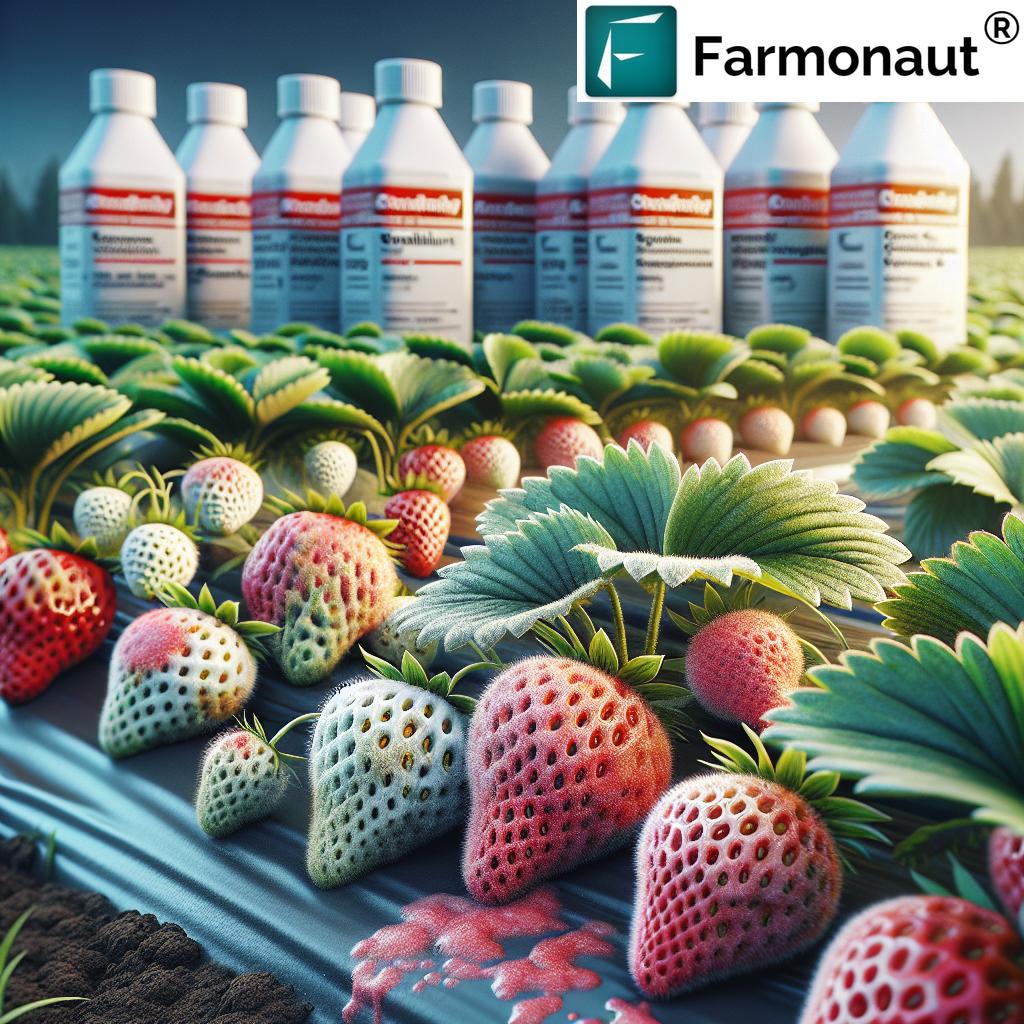
There is no single “best” fungicide for anthracnose — the right choice depends on the crop, the Colletotrichum species involved, and how much resistance risk you’re willing to carry. But across published efficacy data, strobilurins (azoxystrobin, pyraclostrobin, trifloxystrobin) and QoI/SDHI combination products are widely used, but Colletotrichum resistance to QoIs is common in some crops, including Florida strawberries, according to Plant Disease. In a USDA Agricultural Research Service sorghum anthracnose trial, azoxystrobin, mancozeb, copper oxychloride, and chlorothalonil all cut lesion severity by more than 80% when applied before inoculation — the timing mattered as much as the active ingredient (USDA ARS).
That single fact — preventive beats curative — is the spine of this article. Product names and prices will change; the timing principle won’t. Below you’ll find the fungicide classes that work, how to time and rotate them so resistance doesn’t wreck a good program, and a calculator that turns your own acreage and product cost into a per-application budget.
Understanding Anthracnose Disease and What It Costs
Anthracnose is caused by Colletotrichum species — most commonly C. gloeosporioides, C. acutatum, and C. graminicola — and it shows up as dark, sunken lesions on fruit, stems, leaves, and stalks. It spreads through infected plant debris, splashing water, and contaminated equipment, and it thrives in warm, humid conditions. That’s the textbook description. Here’s what it actually costs US growers.
In corn, anthracnose stalk rot and top dieback ranked 4th among the leading disease causes of yield loss nationally in the Crop Protection Network’s 2025 loss estimate report for the US and Ontario, Canada, accounting for an estimated 89.2 million bushels lost (Crop Protection Network, 2025). Corteva Agriscience’s current grower guidance puts the ceiling higher at the field level: severe anthracnose infection can cut corn yield by up to 40% and raise stalk lodging risk to as much as 80% in badly affected fields, since weakened stalks fall before harvest (Corteva Agriscience).
It isn’t just row crops. California’s almond industry has estimated that without fungicide-based disease control, anthracnose and related diseases could cut production by 15–30%, against a typical-year baseline loss of 10–15% (California Department of Pesticide Regulation figures cited via NC State Extension’s cucurbit anthracnose bulletin). In Georgia, pecan anthracnose was estimated to have cost the industry $3.4 million in 2009 — a single-state, single-year figure that shows how fast losses concentrate in a bad disease year for a high-value tree crop.
Almond growers can find crop-specific options in a closer look at anthracnose control in almonds.
- Crops affected in the US: corn, strawberries, almonds, pecans, turfgrass, cucurbits, tomatoes, peppers, and beans.
- Primary pathogen: Colletotrichum species, with the specific species and even the specific active ingredients that work varying by crop.
- Spread mechanism: infected debris, rain and irrigation splash, contaminated tools, and in some crops insect vectors.
- Key symptoms: sunken fruit lesions, leaf necrosis, stalk/stem cankers, premature fruit drop, and in corn, top dieback and lodging.
- Try it: Run your own numbers
These figures carry their own expiration dates. Crop Protection Network typically republishes its national corn disease loss estimates in spring following the harvest year — check the link above directly for the next cycle before citing this year’s number as current. USDA NASS’s QuickStats database (quickstats.nass.usda.gov) is the place to pull regional anthracnose incidence by state and crop when a specific survey is published; there isn’t a standing national anthracnose prevalence dataset broken out by state at present, so that’s a gap you’ll need to fill locally through your county extension office or state land-grant plant pathology lab.
Why Anthracnose Management Requires an Integrated Approach
Because Colletotrichum adapts to single-mode chemical pressure, no single product carries a program on its own. A working plan combines:
- Fungicides matched to the specific crop and disease pressure
- Application timing, rate, and rotation discipline
- Cultural practices and resistant cultivars where they exist
- Ongoing monitoring so the plan adjusts to what’s actually happening in the field
Fungicides for Anthracnose: Active Ingredients and Modes of Action
Every fungicide for anthracnose falls into one of a handful of chemical classes, and the class determines both how it kills the fungus and how fast resistance can build against it. Here’s what’s actually in the market and how each one works.
Growers tempted by a home remedy should first read whether baking soda controls fungus before relying on it as an alternative.
1. Strobilurin (QoI) Fungicides
- Azoxystrobin — systemic, broad-spectrum; blocks mitochondrial respiration in fungal cells. In the USDA ARS sorghum trial cited above, azoxystrobin reduced lesion severity by more than 80% when applied before inoculation (USDA ARS). Widely used in turfgrass, strawberries, and cereals.
- Trifloxystrobin — same mode of action family; frequently tank-mixed for mangoes and turfgrass.
- Pyraclostrobin — strong performance in strawberries and a range of fruit and vegetable crops.
2. Triazole (DMI) Fungicides
- Propiconazole — disrupts fungal cell membrane (ergosterol) synthesis. Standard in almonds, cereals, and turfgrass.
- Tebuconazole and difenoconazole — same DMI mechanism, used as rotation partners.
3. SDHI Fungicides
- Fluopyram — succinate dehydrogenase inhibitor, usually paired with a second active for almond and other fruit crop anthracnose programs.
- Fluxapyroxad — SDHI commonly combined with strobilurins, effective in strawberries and vegetables.
4. Contact & Multi-Site Fungicides
The same USDA ARS sorghum study found that mancozeb, copper oxychloride, and chlorothalonil — none of them single-site systemic products — also reduced lesion severity by more than 80% when applied preventively, ahead of inoculation (USDA ARS). Multi-site contact fungicides carry a lower resistance-development risk than single-site systemics precisely because they attack the fungus at several points at once, which is why they’re valuable rotation partners even when a systemic product gives faster knockdown.
5. Natural & Botanical Fungicides
- Timorex Gold — derived from Melaleuca alternifolia (tea tree); used in banana, mango, and vegetable programs, typically in rotation with synthetic products rather than as a standalone.

The US Fungicide Market, For Context
The US fungicide market — covering anthracnose products alongside every other fungal target — was valued at $1.07 billion in 2026 and is projected by Mordor Intelligence to grow at a 4.01% compound annual rate through 2031, reaching roughly $1.3 billion by then (Mordor Intelligence, US Fungicide Market). That growth is a market-wide figure, not an anthracnose-specific one — Mordor Intelligence updates its forecasts quarterly, so check the report page directly if you need a projection beyond 2031.
What isn’t published anywhere at a national level: EPA-approved product labels specific to anthracnose with current US shelf prices, adoption share by active ingredient, or peer-reviewed ROI studies tying a specific fungicide program to a dollar yield response under current US field conditions. If you need current pricing, your state’s cooperative extension pesticide database or a regional ag retailer quote will get you a real number faster than any published market report — those change too often for any article to keep current for you.
Spray Cost & Coverage Calculator
Use your own product price and field size to see what a preventive anthracnose spray program costs per acre and per pass, based on the rotation-driven application counts discussed below.
Run your own numbers
Assumptions: figures are whatever you enter — this tool does not look up current product prices. It excludes adjuvants, water/carrier costs, and any yield-loss-avoided value; it's a straight spray-budget estimate, not an ROI model. Get your own per-acre product price from a current label quote or your ag retailer before budgeting a season.
Fungicide Application Strategies & Timing for Anthracnose Disease Control
Timing is the single biggest lever in anthracnose control, and the USDA ARS sorghum data makes the case numerically: every active ingredient tested — azoxystrobin, mancozeb, copper oxychloride, chlorothalonil — cut lesion severity by more than 80% when applied before inoculation. Applied after infection is visible, the same products are working against established tissue damage, not preventing it.
Optimal Fungicide Application Timing
- Preventive applications: most effective before symptoms appear or at first sign of disease pressure — for example, as soil temperatures climb past 65°F in turfgrass in spring.
- Scheduled applications : in strawberries, multi-site fungicides such as captan have no curative effect, so they are applied regularly through the season when weather favours disease, according to the Southern Region Small Fruit Consortium.
- Recommended rates: always follow the current label — for example, propiconazole at 8.0 oz per acre in almonds, capped at two consecutive and four total applications per season under typical label guidance. Confirm against the current label before spraying, since label rates are amended periodically.
- Rotation: repeating one mode of action invites resistance — rotate classes and use tank mixes.
Real-World Example: Anthracnose in Strawberries
Strawberry programs in the southeastern US lean on captan and Switch (cyprodinil + fludioxonil), with QoIs such as pyraclostrobin used only where isolates are still sensitive, per the Southern Region Small Fruit Consortium.
Key Application Considerations
- Respect pre-harvest intervals and the maximum number of applications on the label.
- Ensure uniform coverage on the plant parts most exposed — fruit, leaves, stems.
- Pair spray timing with cultural controls: avoid over-irrigation and excess humidity in greenhouse or high tunnel settings.
- Monitor disease pressure continuously to decide when the next pass is actually needed, rather than spraying on a fixed calendar regardless of conditions.
Anthracnose Resistance Management in Fungicides
Colletotrichum species adapt quickly to repeated single-mode pressure, which is why resistance management isn't optional in a serious anthracnose program:
- Rotate fungicide groups — different modes of action — every application or every block of 2–3 sprays.
- Use combination products: strobilurin-SDHI, DMI-strobilurin, or a biological paired with a synthetic.
- Combine with non-chemical tactics: resistant cultivars and field sanitation.
- Monitor regularly and change the plan if control starts to break down — that's the earliest signal of resistance.
- Stay inside labeled rates and maximum applications per season.
Helpful tip: follow the current Integrated Pest Management (IPM) guidelines for your specific crop and region — these are updated more frequently than any static article can track.
Comparative Fungicide & Management Strategies Table
| Fungicide Name | Active Ingredient Class | Lesion Severity Reduction (Preventive Use) | Recommended Application Method & Timing | Resistance Risk | Supplementary Control Practices |
|---|---|---|---|---|---|
| Azoxystrobin | Strobilurin (QoI) | >80% (USDA ARS, pre-inoculation) | Preventive; begin at early symptom onset; repeat per label interval | High (if overused) | Rotate with DMI/SDHI fungicides; pair with proper irrigation and mowing in turfgrass. |
| Propiconazole | DMI (Triazole) | Not separately tested in the ARS trial above; label-recommended for almonds | Curative & preventive; 8.0 oz/acre in almonds per label; max 2 sequential, 4 total per season (confirm current label) | Medium | Use with sanitation and crop rotation; monitor for resistance and tank-mix where possible. |
| Trifloxystrobin | Strobilurin (QoI) | Same QoI mode as azoxystrobin; class-level >80% pre-inoculation efficacy documented | Preventive; tank-mix with other classes for mango, vegetables | High | Use resistant cultivars; rotate classes; improve air circulation. |
| Pyraclostrobin | Strobilurin (QoI) | Same QoI mode as azoxystrobin; class-level >80% pre-inoculation efficacy documented | Strawberry: preventive, ahead of expected outbreaks; rotate with SDHI/DMI | High | Remove infected debris; drip irrigation over overhead. |
| Mancozeb | Multi-site contact (dithiocarbamate) | >80% (USDA ARS, pre-inoculation) | Preventive; before visible infection; strong rotation partner | Low (multi-site mode) | Pair with resistant cultivars; good coverage is critical since it's contact-only. |
| Chlorothalonil | Multi-site contact | >80% (USDA ARS, pre-inoculation) | Preventive; reapply after wash-off from rain/irrigation | Low (multi-site mode) | Rotate with systemic classes; check pre-harvest interval by crop. |
| Copper Oxychloride | Multi-site contact (copper) | >80% (USDA ARS, pre-inoculation) | Preventive; common in organic-adjacent programs | Low (multi-site mode) | Watch for phytotoxicity on sensitive crops/varieties. |
| Fluopyram | SDHI | Not separately tested in the ARS trial above; used in combination almond programs | Preventive & early curative; apply with a compatible partner in almonds/other fruit crops | Medium | Rotate modes; avoid back-to-back SDHI use. |
| Fluxapyroxad | SDHI | Not separately tested in the ARS trial above; used in combination strawberry programs | Part of rotation in strawberries and vegetables; use in mix, monitor resistance | Medium | Integrate with field hygiene; regular scouting. |
| Timorex Gold | Botanical (Melaleuca alternifolia) | Not tested in the ARS trial above; documented efficacy in banana/mango/tomato field use | Preventive/corrective; start at first sign; rotate with synthetic fungicides | Low | Pair with resistant varieties; minimize field humidity. |
The >80% efficacy figures above trace to a single USDA ARS sorghum anthracnose trial measuring lesion severity reduction when fungicide was applied before inoculation (source). They describe pre-infection application, on one crop, under trial conditions — treat them as a directional benchmark for preventive timing, not a guaranteed field result for every crop and region. Confirm efficacy for your specific crop and pathogen strain with your state extension plant pathologist.
Integrated Anthracnose Management: Best Practices
Fungicides alone don't sustain control season after season. The combination of chemical, cultural, and genetic tools is what holds up:
- Choose resistant cultivars where available — breeders offer anthracnose-tolerant varieties for a growing list of crops.
- Practice field sanitation — remove and destroy infected plant material to cut inoculum pressure for the next cycle.
- Optimize irrigation and canopy management — dense, wet canopies and splashing water are the disease's main spread mechanism.
- Rotate and sequence fungicides based on current label guidance and local extension recommendations.
- Monitor fields with satellite-based tools, such as Farmonaut's crop health monitoring, to catch stress signals before symptoms are visible on the ground and guide in-field scouting.
- Use blockchain-based traceability to verify and document disease-free produce through the supply chain. Farmonaut's traceability solutions support this tracking.
- Use AI advisory tools like Farmonaut's Jeevn AI for real-time, location-specific crop protection guidance.
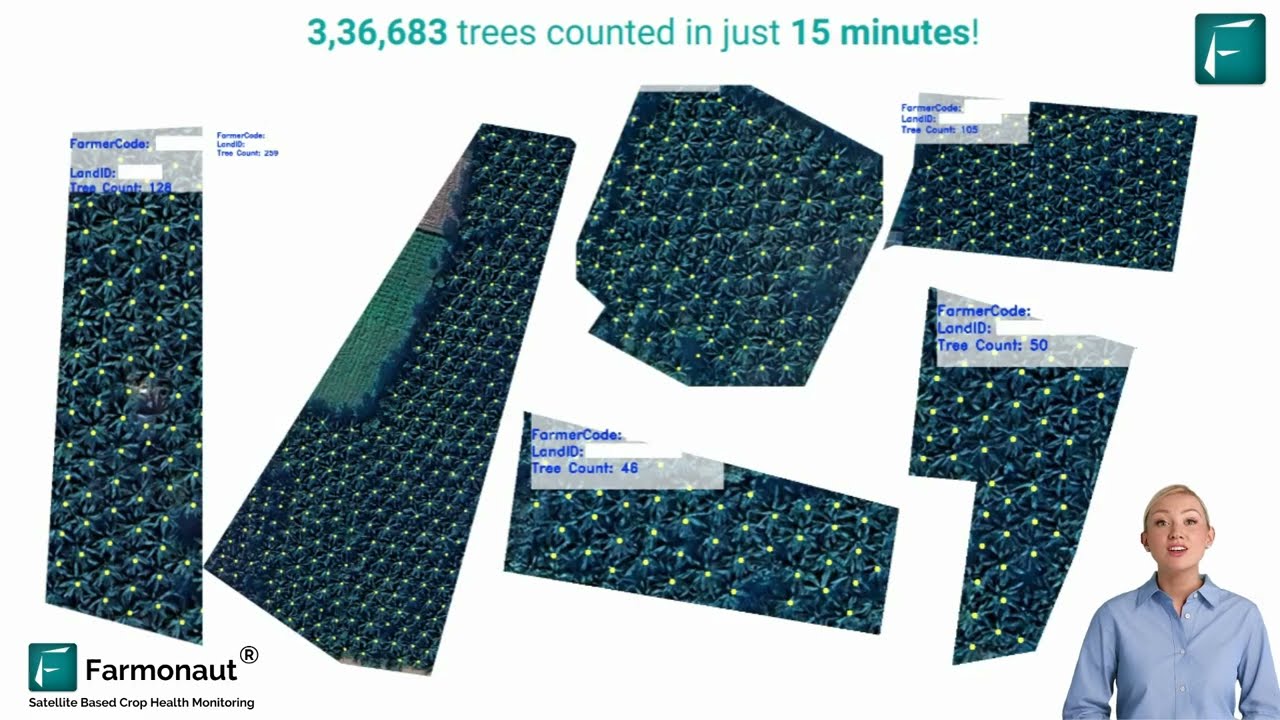
For large farms or plantations, real-time monitoring and area estimation matter at scale. Farmonaut's large-scale farm management tools help optimize inputs and act on disease pressure before it spreads.



How Farmonaut Supports Anthracnose Management
A good fungicide program still needs eyes on the field between sprays. Farmonaut adds three layers:
- Satellite-based crop health monitoring tracks vegetation stress signals and helps locate hotspots before visible symptoms worsen.
- Jeevn AI advisory delivers location-specific guidance on fungicide selection, resistance rotation, irrigation, and fertilizer optimization.
-
Blockchain traceability documents disease-free produce batches for supply chain verification.
Learn more about product traceability. - Fleet management tools coordinate spray timing and machinery for large operations. See fleet tracking for large farm operations.
-
Carbon footprint monitoring keeps disease control programs environmentally accountable.
Read about Farmonaut's carbon footprinting.
Agribusinesses and larger operations can access Farmonaut via Web, Android, or iOS, or integrate satellite and weather data directly through the API and API documentation.
Farmonaut Subscription and Resources
Whether you're managing a few acres or thousands, Farmonaut offers scalable subscription plans across Web, Android, and iOS platforms.
For crop loan and insurance needs, satellite-based verification streamlines claims and approvals. Explore satellite-verified crop insurance solutions.
Start with the farm management app or explore the Plantation, Crop & Forest advisory.
Best fungicide for anthracnose, by crop
The answer changes by crop because Colletotrichum populations differ, and resistance to some classes is already common.
| Crop | Common first choices | Watch out for |
|---|---|---|
| Strawberry (fruit rot) | Captan (multi-site); Switch (cyprodinil + fludioxonil, FRAC 9 + 12); thiram | QoI resistance in C. acutatum, first reported in Florida fields in 2013 |
| Turfgrass (golf greens) | Chlorothalonil and fluazinam (contacts); azoxystrobin; propiconazole + chlorothalonil | QoI and benzimidazole resistance documented in California and North Carolina |
| Sorghum (trial data) | Azoxystrobin, mancozeb, copper oxychloride, chlorothalonil applied before infection | Results from one USDA ARS trial; confirm locally |
Strawberry guidance is from the Southern Region Small Fruit Consortium and QoI resistance research in Plant Disease. Multi-site products such as captan have no curative action, so they are sprayed on a regular schedule during wet, warm periods. Turf recommendations are from UC IPM and NC State Extension. Where QoI resistance is confirmed, a strobilurin alone can fail even when applied on time, so test isolates or rely on multi-site partners.
For fruit trees, vegetables and ornamentals, check your state extension spray guide. Label approvals differ by crop, and a product that works on turf may not be labeled for food crops.
FAQs: Anthracnose Fungicides & Control
What is the best fungicide for anthracnose?
What is the best fungicide for anthracnose in strawberries?
Is there a cure for anthracnose once it's established?
How can I prevent fungicide resistance in my crops?
What non-fungicide methods control anthracnose?
How does Farmonaut help with anthracnose monitoring?
Conclusion
Anthracnose control comes down to three decisions repeated correctly, season after season: pick fungicides from more than one mode of action, apply before infection is visible rather than after, and rotate so no single class carries the whole program. The USDA ARS data showing more than 80% lesion severity reduction from pre-inoculation application — across azoxystrobin, mancozeb, copper oxychloride, and chlorothalonil alike — is the clearest evidence that timing outweighs brand loyalty to any one product.
Whether you're protecting corn, strawberries, almonds, pecans, or turfgrass, the strategy holds: match the active ingredient to your crop and label, rotate to manage resistance, and use field monitoring to catch pressure early enough that preventive timing is still possible. That's the difference between a program that works this season and one that's still working five seasons from now.

 SkyHarvest
 Sarvome
 Polaris Digitech
 Teledarbas
 Wild Oak Farm
 SFX
SFX BACF Africa
 Doodlakine
 Exurbia Geospatial
 FieldZero
 Indico Company
 Kubota
 FFBS
FFBS Jontra
