

Forests · Africa evidence guide
Solutions to Deforestation in Africa: 7 Options and Data
Africa lost a net 2.96 million hectares of forest a year in 2015 to 2025 (FAO, 2025); FAO’s satellite survey found farmland expansion is the main cause. Seven solutions, most with African evidence: higher yields, trees on farms, community rights, payments for verified results, clean supply chains, satellite alerts and restoration.
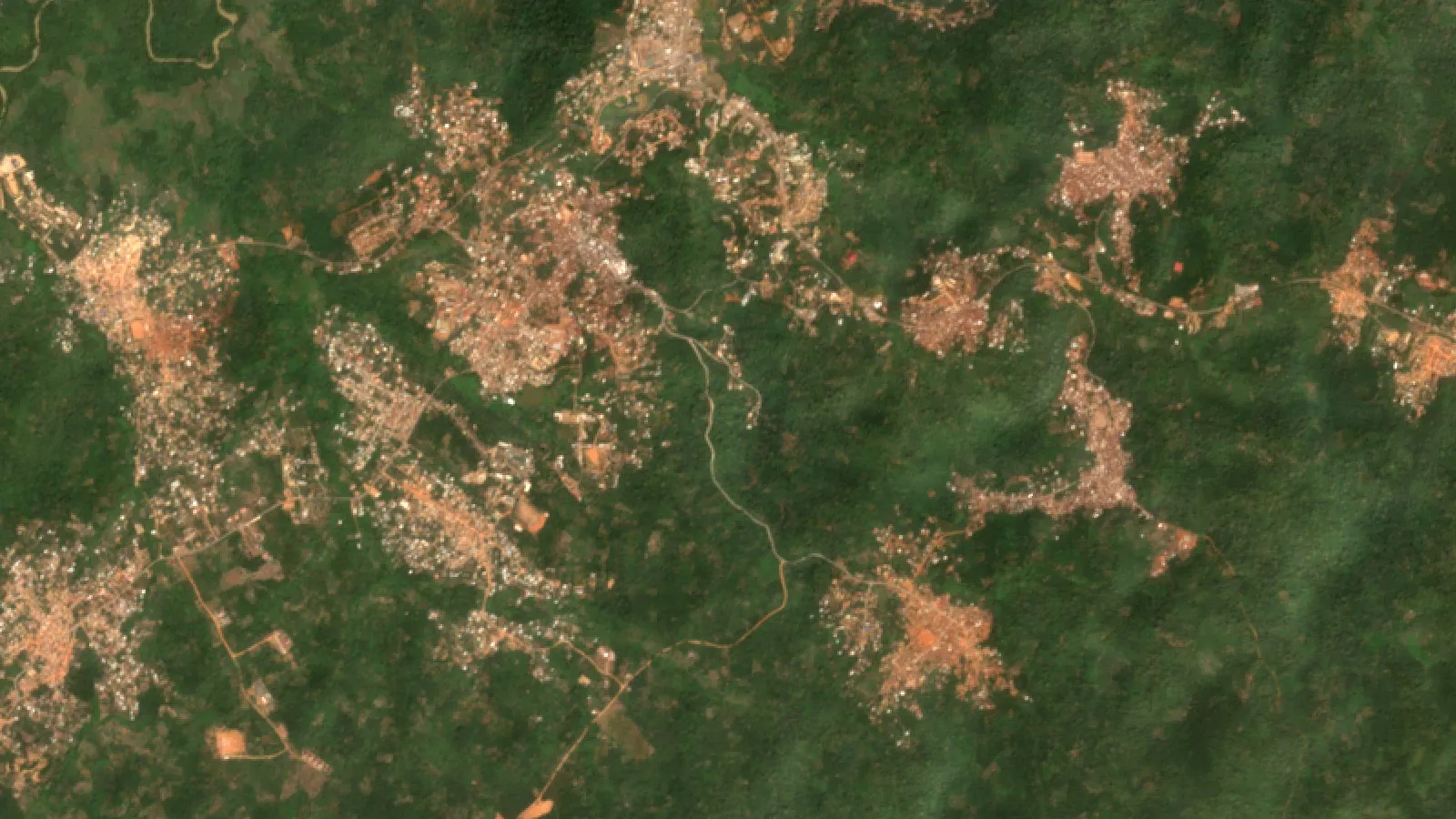
Key takeaways
- Africa had 662.6 million ha of forest in 2025, about 117 million ha less than in 1990. Net loss was 2.96 million ha a year in 2015 to 2025 (FAO, 2025).
- Farmland is the main driver: in Africa and Asia, more than 75% of forest lost in 2000-2018 became cropland (FAO, 2021). In the DRC, shifting cultivation caused 86% of primary forest loss since 2002 (WRI, 2026).
- The DRC lost about 559,000 ha of primary forest in 2025, the third-largest loss in the tropics; Cameroon set a record (Global Forest Watch data, 2026).
- Evidence from Africa: farmer-managed regrowth on about 5 million ha in Niger, 18% less forest loss where groups subscribed to satellite alerts, and World Bank results payments to four countries at about $5 a ton.
- Higher yields spare forest only with land plans and enforcement. Use the calculator to test your own numbers.
In this article
- Solutions to deforestation in Africa at a glance
- How much forest is Africa losing?
- What drives deforestation in Africa
- 1. Grow more food on land already farmed
- 2. Keep and regrow trees on farms
- 3. Give communities rights and a role in forest care
- 4. Pay for verified results
- 5. Make supply chains deforestation-free
- 6. Watch forests by satellite and act on alerts
- 7. Restore degraded land at scale
- How to choose the right mix
- What farmers and landowners can do
- Country snapshots
- Mistakes that make solutions fail
Africa lost a net 2.96 million hectares of forest a year between 2015 and 2025, the second-largest net loss of any region after South America, according to the FAO Global Forest Resources Assessment 2025. The solutions to deforestation in Africa that have real evidence behind them all deal with the main cause, which is the spread of farmland into forest. This guide lists seven of them, ordered by the driver they target, shows the dated numbers, and gives farmers and landowners a calculator to test how much land higher yields could spare.
Below you will find the forest data for Africa from FAO and Global Forest Watch, the main drivers, the seven solutions with an African example for each, a guide to choosing the right mix, and answers to common questions.
Solutions to deforestation in Africa at a glance
The table sums up the seven approaches. Each one is explained in its own section further down, with the source behind it.
| Solution | Driver it tackles | African example or data | Who acts |
|---|---|---|---|
| 1. Higher yields | Cropland expansion | Cereal yields in sub-Saharan Africa average 1.57 t/ha (World Bank, 2023) | Farmers, extension services |
| 2. Trees on farms | Cropland expansion, fuelwood demand | Farmer-managed regrowth on about 5 million ha in southern Niger (Reij et al., 2009) | Farmers, villages |
| 3. Community rights | Open access, unclear tenure | Ethiopian forest user groups: forest area up 1.5% in two years vs down 3.3% without (JICA, 2011) | Governments, communities |
| 4. Pay for results | Low value of standing forest | World Bank payments to Mozambique, Ghana, Madagascar and Côte d’Ivoire (2021 to 2024) | Governments, funders |
| 5. Clean supply chains | Cocoa, coffee, timber, cattle | EU rules apply from 30 December 2026 for large and medium firms | Buyers, exporters |
| 6. Satellite alerts | Clearing that goes unseen | 18% less forest loss where African groups subscribed to alerts (2021 study) | Agencies, rangers, NGOs |
| 7. Restoration | Degraded land | 34 countries, 129.5 million ha committed under AFR100 | Governments, investors |
How much forest is Africa losing?
Africa had 662.6 million hectares of forest in 2025, about 16% of the world’s forest area. That is roughly 117 million hectares less than in 1990, based on FAO’s regional table. Net loss was 3.28 million hectares a year in 1990 to 2000, 3.63 million in 2000 to 2015 and 2.96 million in 2015 to 2025.
Chart
Forest area in Africa
Million hectares, FAO reporting years (gaps between years are uneven)
FAO separates two measures. Net change is forest lost minus forest gained through planting and natural regrowth. Deforestation is the gross conversion of forest to other uses. Gross deforestation in Africa fell from 4.08 million hectares a year in 2000 to 2015 to 3.45 million in 2015 to 2025. FAO credits most of the recent slowdown in net loss to the Democratic Republic of the Congo (DRC), where reported net loss fell by about 0.5 million hectares a year.
Satellite data from Global Forest Watch tell a less hopeful story for the DRC. Global Forest Watch, which its operators have renamed Global Nature Watch, publishes yearly tree cover loss data from the University of Maryland. In 2025 the DRC had the third-largest loss of tropical primary forest in the world, after Brazil and Bolivia, according to the WRI Global Forest Review (April 2026). Cameroon had its highest primary forest loss on record. The two sources measure different things: FAO uses country reports of net forest area, while the satellite series counts gross loss of old-growth forest only.
Chart
Gross deforestation in Africa slowed after 2015
Million hectares of forest converted to other uses per year, by African subregion (gross, not net)
What drives deforestation in Africa
Farming is the main driver. A 2021 FAO satellite survey found that agricultural expansion drives almost 90 percent of global deforestation. In Africa and Asia, more than 75 percent of the forest area lost between 2000 and 2018 was turned into cropland.
- Small-scale shifting cultivation. In the DRC, it caused 86% of primary forest loss from 2002 to 2025, according to the WRI analysis of the 2025 data.
- Cash crops. The same analysis links rising loss in Cameroon partly to cocoa, and reports that the DRC’s cocoa area grew more than five-fold from 2015 to 2024. The World Bank names cocoa farming as a main pressure on Ghana’s forests.
- Food and fuelwood needs. In parts of the Congo Basin and Madagascar, WRI links loss to local needs for food and fuelwood, poverty, population growth and weak governance.
- Conflict and fire. Armed conflict displaced communities in Cameroon, and rebel conflict has fuelled land clearing in the DRC. Fire caused 45% of the 2024 primary forest loss in the Republic of Congo, according to WRI’s report on the 2024 data.
- Small-scale mining. The World Bank lists it, with cocoa and unsustainable harvesting, among the pressures on Ghana’s forest belt.
Because farming is the main driver, the first three solutions below work on farms and village land. The other four change the money, the rules and the information around them.
Chart
DR Congo: primary forest loss and the part caused by fire
Thousand hectares per year, humid tropical primary forest, 2018 to 2025
1. Grow more food on land already farmed
Best for: farming areas at the forest edge where yields are low and families clear new plots to grow more.
Chart
Cereal yield: sub-Saharan Africa and selected comparisons
Tonnes per hectare, 2023 (regions and selected countries)
When yields are low, more food means more land. World Bank cereal yield data show sub-Saharan Africa averaged 1,570 kg per hectare in 2023, against a world average of 4,229 kg. South Africa reached 5,703 kg, so higher yields are possible on the continent.
Better seed, fertilizer at the right time and soil conservation practices can lift yields on fields already open. For practical methods, see our guide to soil conservation methods.
Higher yields do not protect forests on their own. A study of 58 countries from 1961 to 2014 found that most low-input, mainly developing countries still increased their cropped area as yields rose. The authors conclude that expecting intensive farming to protect wild land on its own is inadequate (PNAS, 2018). Yield gains help most when they come with land-use plans and enforcement, which are covered in solutions 3 and 6.
Try the numbers for your own farm below.
Calculator
How much land could a higher yield spare?
Enter your own harvest goal, current yield and target yield.
- Land needed at current yield: 6.67 ha
- Land needed at target yield: 4.00 ha
- Land spared: 2.67 ha
- Land spared as share of current need: 40.0%
Example values only, not a benchmark or a forecast. No fixed constants are used: every number is your input. The default current yield of 1.5 t/ha is a round example close to the 2023 sub-Saharan cereal average of 1.57 t/ha (World Bank). Land is spared only if it is not cleared for something else; a PNAS study (2018) found most low-input countries kept expanding cropland as yields rose.
2. Keep and regrow trees on farms
Best for: dry and semi-dry farmland, and cocoa and coffee areas where shade trees fit the crop.
Agroforestry means growing trees together with crops or livestock. Trees on farmland can supply firewood, fodder, fruit and timber close to home. The best-known African case is farmer-managed natural regeneration in Niger. Farmers protect and prune shoots that regrow from living stumps and roots instead of clearing them.
Researchers estimated that this spread over about 5 million hectares in southern Niger. It reduced wind erosion and raised the output and sales of crops, fodder, firewood and fruit, according to an IFPRI paper by Reij, Tappan and Smale (2009). In Burkina Faso, traditional soil and water conservation brought at least 200,000 hectares of degraded land back into use. Women benefited from better supplies of water, fuelwood and other tree products.
The trend is not automatic. Among the 67 countries that reported agroforestry trends to FAO, the area of agroforestry in Africa decreased between 1990 and 2025, while it rose in Asia, Europe and South America.
▶ Satellite and AI tree detection that counts and maps individual trees across a plantation · 4:05
3. Give communities rights and a role in forest care
Best for: forests used by nearby villages where nobody has clear rights, so the first person to clear the land gains.
When a community holds legal rights to a forest and its products, it has a reason to guard it. Ethiopia has used participatory forest management, in which local forest user associations take part in managing a forest.
A remote-sensing study by Takahashi and Todo found that forest area rose by 1.5% in the first two years where an association existed, and fell by 3.3% where none existed (JICA Research Institute, 2011). There was a warning sign: forest loss was higher in the year an association was set up, which the authors read as possible last-minute logging before the rules started. Tenure reform therefore needs clear maps and early monitoring.
4. Pay for verified results
Best for: provinces and countries with a forest monitoring system and a plan to share benefits with the people who do the work.
Infographic
How a results-based forest payment works, in 5 steps
- 1Sign an agreementCountry and fund agree terms, for example up to $50 million for 10 million tons.
- 2Act on the groundForest protection, rehabilitation and agroforestry in the programme area.
- 3MonitorThe country reports emission cuts for a set period.
- 4VerifyAn independent third party checks the report.
- 5Pay and shareThe fund pays and the country shares money under a benefit-sharing plan.
Clearing forest for crops brings income at once, while a standing forest may bring its users little cash. Results-based payments under REDD+ (Reducing Emissions from Deforestation and Forest Degradation) change that by paying for emission cuts after they are measured and verified.
Four African countries have received payments from the World Bank’s Forest Carbon Partnership Facility. Mozambique was first, with $6.4 million in 2021 for 1.28 million tons of emission cuts in Zambézia Province. Ghana received $4.86 million in 2023 for its cocoa-forest landscape. Madagascar received $8.8 million in December 2023. Côte d’Ivoire received $35 million in June 2024 for 7 million tons, under a programme that covers forest conservation, rehabilitation and agroforestry in the cocoa belt. The Mozambique, Madagascar and Côte d’Ivoire releases say the cuts were confirmed by independent third-party verification.
The amounts are small next to the size of the forests. Each agreement allows up to about $50 million for 10 million tons, which is $5 a ton. See also carbon footprinting for farms.
Chart
World Bank results payments to African countries
US$ million, one announced payment per country, year of announcement in brackets
5. Make supply chains deforestation-free
Best for: export crops such as cocoa, coffee, rubber and timber, where a few large buyers can set rules for many farms.
The EU Deforestation Regulation covers cattle, wood, cocoa, soy, palm oil, coffee and rubber, and products made from them. It applies from 30 December 2026 for large and medium operators and from 30 June 2027 for most micro and small operators (30 December 2026 for those already covered by the EU Timber Regulation), according to the European Commission (checked October 2026). Firms selling into the EU must be able to show that the goods do not come from recently deforested land. Doing that means tracing goods back toward the farms that grew them.
For a cocoa or coffee grower in Ghana, Côte d’Ivoire, Cameroon or Ethiopia who sells to EU-bound exporters, clear farm records can help that tracing. See product traceability for field mapping and records.
6. Watch forests by satellite and act on alerts
Best for: large or remote forests where patrols cannot see clearing until it is too late.
Alert systems such as GLAD, built on NASA Landsat images processed at the University of Maryland, email subscribers when they detect forest clearing. They help only when someone receives them and acts. A study in Nature Climate Change compared the five years before and the first two years after the GLAD alert system started. In Africa, forest loss in areas where organisations subscribed to the alerts was 18% lower in the first two years than in the five years before (Oregon State University, 2021). The study found no substantial change in Asia or South America.
Programmes that manage many farms can view them on one map with a multi-farm dashboard, and developers can pull satellite layers through a satellite data API. Background on monitoring agriculture by satellite is in our French-language guide. Satellites show where vegetation changed. They do not show who cleared the land or why, so field checks are still needed.
▶ How the NDVI vegetation index turns satellite images into a measure of green cover, from bare ground to dense vegetation. · 14:37
7. Restore degraded land at scale
Best for: worn-out farmland, overgrazed hills and old mining or logging sites near forest.
Restoring land that is already degraded gives people timber, firewood and grazing without cutting into standing forest. Under the AFR100 initiative, 34 African countries have committed 129.5 million hectares toward a goal of 100 million hectares in restoration by 2030. The AFR100 site does not report how much land has been restored so far, so treat the pledges as targets.
Niger’s case shows that restoration can rely on trees regrowing from roots and stumps already in the soil, not only on new planting. Where planting is needed, it should use species that fit the site, and young trees need protection from grazing and fire.
How to choose the right mix
No single solution works everywhere. Ask four questions about the landscape:
- What is replacing the forest? Small food plots point to solutions 1 and 2. Cocoa or coffee farms point to 2 and 5. Fire scars point to 6.
- Who owns the land? If nobody holds clear rights, start with solution 3. Payments and supply-chain rules need a known owner.
- Can anyone see the clearing? Without monitoring, rules and payments cannot be checked. Solution 6 supports all the others.
- Who pays? Export buyers can fund supply-chain work. Results-based funds pay governments. Yield gains pay farmers directly.
In practice, the African examples above combine several approaches. Ghana’s and Côte d’Ivoire’s World Bank programmes pair payments with agroforestry in cocoa landscapes, and Niger’s regrowth was managed by farmers themselves.
What farmers and landowners can do
Farmers are not only the cause of forest loss. They also make many of the daily decisions that can stop it. Steps that fit a farm at the forest edge:
- Map your field boundaries and keep the map with your sales records, in case a buyer needs to trace where a crop was grown. For how field maps are used in lending, see satellite data for crop loans and insurance.
- Raise yields on your current plots before you open new land. Ask your local extension office about seed, fertilizer timing and soil cover.
- Protect useful trees and regrowing stumps on your land rather than clearing them.
- Join or form a forest user group if your area allows community forest management.
- Ask your cooperative or buyer whether a results-based payment or certification scheme covers your area.
- Check your fields and nearby forest on satellite images each season to spot change early.
People far from Africa can help too: buy cocoa, coffee and timber from sources that can show where they were grown, and support community forest groups and restoration projects with a track record. For a general list of solutions not tied to Africa, see our guide to deforestation prevention methods.
For satellite views of your own fields, Farmonaut shows vegetation change on fields you draw.
Country snapshots
The same solutions look different from country to country. This table pairs each country’s main forest problem with an approach under way there or, where none is cited, the wider context, using only the sources cited in this guide.
Chart
Largest tropical primary forest loss, 2025
Thousand hectares, the eight largest countries by area lost
| Country | Forest problem | Approach or context | Source |
|---|---|---|---|
| DR Congo | About 559,000 ha of primary forest lost in 2025; shifting cultivation caused 86% of loss since 2002 | FAO reports net loss fell by about 0.5 million ha a year, though satellite loss stayed near record levels | FAO 2025; WRI 2026 |
| Cameroon | Record primary forest loss in 2025, about 105,000 ha, partly from cocoa and conflict | EU buyer rules (solution 5) will apply to its cocoa exports | WRI 2026; European Commission |
| Madagascar | About 91,000 ha of primary forest lost in 2025 | $8.8 million results payment for its eastern humid forests | WRI 2026; World Bank 2023 |
| Ghana | Cocoa farming, unsustainable harvesting and small-scale mining | $4.86 million results payment in a 6-million-ha cocoa-forest area | World Bank 2023 |
| Côte d’Ivoire | Forest loss in the cocoa belt | $35 million results payment; conservation, rehabilitation and agroforestry | World Bank 2024 |
| Mozambique | Forest loss in Zambézia Province | First country paid by the World Bank FCPF: $6.4 million | World Bank 2021 |
| Niger | Bare, wind-eroded farmland | Farmer-managed regrowth on about 5 million ha | Reij et al. 2009 |
| Ethiopia | Village forests with open access | Forest user associations | JICA 2011 |
Two points stand out. First, each carbon payment covered emission cuts in a defined area over a set monitoring period, and was made only after the cuts were reported. Second, the farm-level cases, Niger and Ethiopia, began with local people gaining a stake in the trees.
Mistakes that make solutions fail
- Reading net change as deforestation. Net figures subtract forest gained through planting and natural regrowth, so they can hide how much forest was cleared. FAO reports both, and gross deforestation in Africa (3.45 million ha a year) is higher than net loss (2.96 million).
- Announcing rules before mapping. In the Ethiopian study, forest loss rose in the year user associations were set up.
- Raising yields with no land plan. In the PNAS study, most low-input countries kept expanding cropland as yields rose.
- Buying alerts that nobody reads. The fall in forest loss was measured where organisations subscribed to the alerts.
- Counting pledges as results. AFR100 lists 129.5 million ha committed but does not report how much has been restored.
How we checked the numbers
Forest area and loss figures come from the FAO Global Forest Resources Assessment 2025 regional tables. Primary forest loss by country comes from Global Forest Watch data (University of Maryland) as published in the WRI Global Forest Review in April 2026. Yields come from the World Bank’s World Development Indicators (2023 values). Payments come from World Bank press releases, and rule dates from the European Commission. We list a figure only where we opened the source and it states that figure. The order of the seven solutions follows the driver they tackle, starting with farmland, not a measured ranking of impact.
FAQ
What is the main cause of deforestation in Africa?
Turning forest into farmland. FAO’s 2021 survey found that more than 75 percent of the forest area lost in Africa and Asia between 2000 and 2018 became cropland. In the DRC, small-scale shifting cultivation caused 86% of primary forest loss from 2002 to 2025, according to WRI.
Is deforestation in Africa getting better or worse?
Both, depending on the measure. FAO reports that Africa’s net loss slowed from 3.63 million hectares a year (2000 to 2015) to 2.96 million (2015 to 2025). Satellite data show the DRC’s primary forest loss reached a record in 2024 and fell only 5% in 2025, while Cameroon set a new record in 2025.
Which African country loses the most forest?
The DRC. It had the third-largest tropical primary forest loss in the world in 2025, about 559,000 hectares, according to Global Forest Watch data in the WRI Global Forest Review.
How can I help combat deforestation in Africa from abroad?
Buy cocoa, coffee and wood products whose origin can be traced, and support community forest groups and restoration projects that publish their results. From 30 December 2026, EU rules require large and medium firms to show that these goods are not linked to deforestation.
What are the solutions to deforestation in points?
In short: raise yields on existing farms; keep and regrow trees on farms; give communities forest rights; pay for verified results; make supply chains deforestation-free; monitor forests by satellite and act on alerts; and restore degraded land.
What is REDD+?
REDD+ stands for Reducing Emissions from Deforestation and Forest Degradation. Under it, countries or provinces are paid for emission cuts that are measured and checked by an outside body. Mozambique, Ghana, Madagascar and Côte d’Ivoire have received such payments from the World Bank’s Forest Carbon Partnership Facility.
Does planting trees solve deforestation?
Planting helps on degraded land, but it does not replace an old forest that is cut. Protecting standing forest comes first. On farmland, letting trees regrow from existing roots, as farmers did in Niger, is another option.
Can satellites stop illegal clearing?
Satellites can only flag clearing. In a 2021 study, forest loss in African areas where organisations subscribed to alerts was 18% lower in the first two years than in the five years before, and there was no substantial change in Asia or South America. Someone still has to check the site and enforce the rules.
Farmonaut crop monitoring
See your own fields from space
Draw your field once and Farmonaut shows satellite vegetation maps for it each season, so you can spot change early on web, Android or iOS.



Keep reading
Sources
- FAO, Global Forest Resources Assessment 2025: Forest extent and change (2025): openknowledge.fao.org
- FAO, Global Forest Resources Assessment 2025, main report (2025): doi.org
- FAO, COP26: Agricultural expansion drives almost 90 percent of global deforestation (2021): fao.org
- WRI Global Forest Review, Latest analysis of deforestation trends (Global Forest Watch data, April 2026): gfr.wri.org
- WRI Africa, Tropical rainforest loss slowed in 2025, but fire is a growing threat (April 2026): africa.wri.org
- WRI, Global forest loss shatters records in 2024, fueled by massive fires (May 2025): wri.org
- Global Nature Watch (formerly Global Forest Watch): globalnaturewatch.org
- World Bank, World Development Indicators: Cereal yield (kg per hectare), 2023 data: data.worldbank.org
- Pellegrini and Fernández, Crop intensification, land use, and on-farm energy-use efficiency, PNAS (2018): pmc.ncbi.nlm.nih.gov
- Reij, Tappan and Smale, Agroenvironmental transformation in the Sahel, IFPRI Discussion Paper 00914 (2009), USGS record: pubs.usgs.gov
- Takahashi and Todo, Impact of community management on forest protection: evidence from Ethiopia, JICA Research Institute Working Paper 31 (2011): jica.go.jp
- World Bank, Mozambique becomes first country to receive emission reductions payments from the FCPF (October 2021): worldbank.org
- World Bank, Ghana begins receiving payments for reducing carbon emissions in forest landscapes (January 2023): worldbank.org
- World Bank, Madagascar receives $8.8 million for forest carbon credits (December 2023): worldbank.org
- World Bank, Côte d’Ivoire receives $35 million payment for verified reduction of carbon emissions (June 2024): worldbank.org
- European Commission, Regulation on deforestation-free products (checked October 2026): environment.ec.europa.eu
- Oregon State University, Alert system shows potential for reducing deforestation (January 2021, on Moffette et al., Nature Climate Change): news.oregonstate.edu
- AFR100, African Forest Landscape Restoration Initiative (checked October 2026): afr100.org
Discussion
Questions, corrections or field experience? Share them below. First-time comments are reviewed before they appear, and your email is never published.
No comments yet. Be the first to add a question or your experience.

 Origo Commodities
 Polaris Digitech
 Teledarbas
 Wild Oak Farm
 SFX
SFX BACF Africa
 Doodlakine
 Exurbia Geospatial
 FieldZero
 Indico Company
 Kubota
 FFBS
FFBS Jontra
 Tucor
Tucor
 Licence holder · Niger · Gold










