

Forests and farming · Ranked guide
Solutions to Deforestation: 8 Ranked by Evidence
Farming drove almost 90% of global deforestation in 2000-2018 (FAO). The best-supported solutions are satellite alerts tied to enforcement, deforestation-free supply chains, higher yields on existing farmland, agroforestry, land rights, forest payments, fire control and restoration.
Key takeaways
- FAO’s Global Forest Resources Assessment 2025 puts deforestation at 10.9 million ha a year in 2015-2025, down from 17.6 million ha a year in 1990-2000.
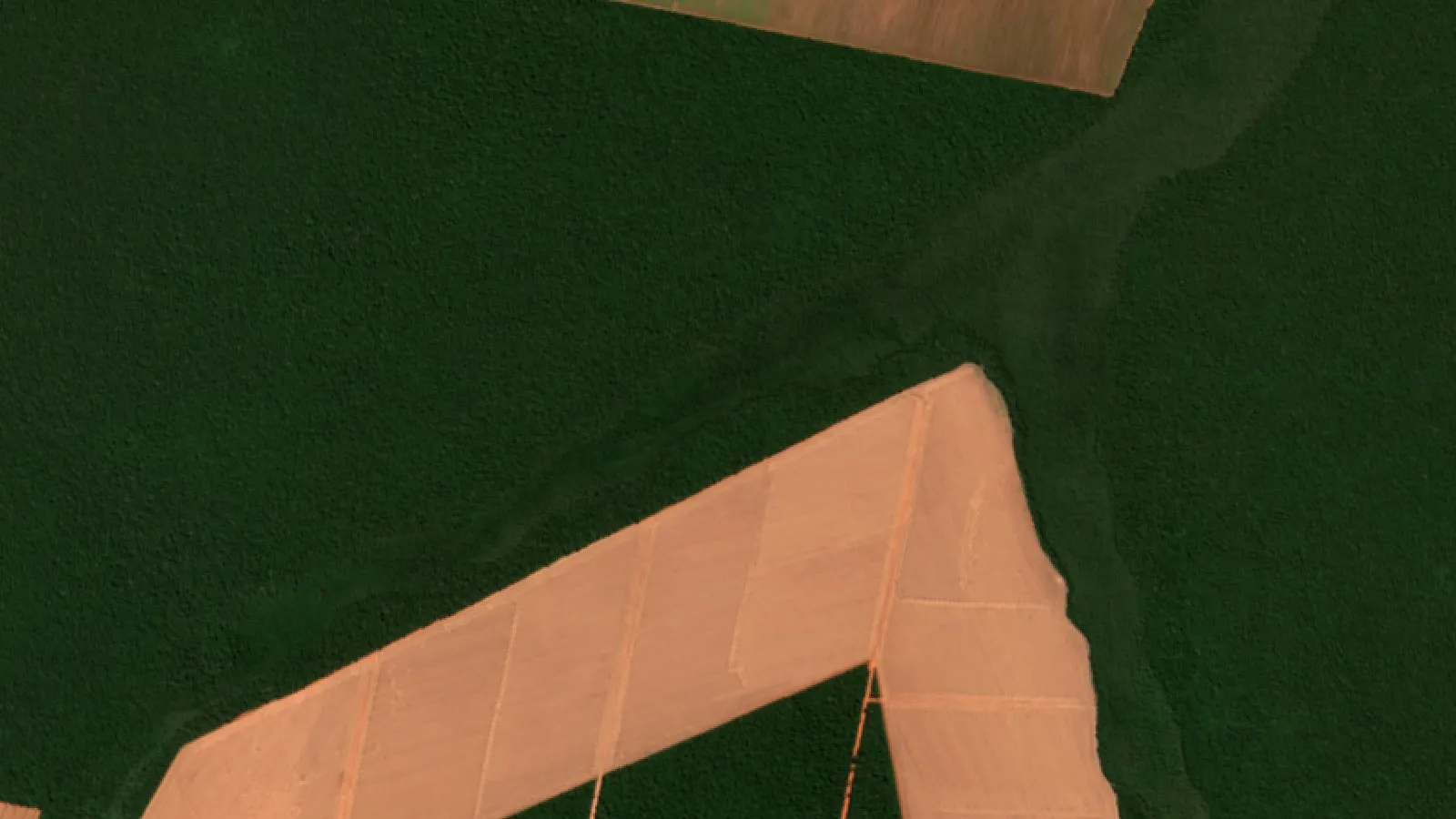
- Agricultural expansion drove almost 90% of deforestation in 2000-2018: cropland almost 50% and livestock grazing 38.5% (FAO Remote Sensing Survey).
- Measured results: 18% less forest loss where African groups used GLAD satellite alerts, and the share of new Amazon soy planted on cleared forest fell from 30% to about 1% after the soy moratorium.
- The EU Deforestation Regulation applies from 30 December 2026 (large and medium operators) and 30 June 2027 (micro and small), with a 31 December 2020 cut-off date.
- Forest payments are small per hectare: USD 5 per tonne of CO2 in the GCF REDD+ pilot, and up to USD 4 per hectare a year planned under the TFFF.
In this article
- Solutions to deforestation at a glance
- How much forest is still being lost
- What drives deforestation: farming comes first
- How we ranked the solutions
- 1. Satellite alerts tied to action on the ground
- 2. Deforestation-free supply chains and buyer rules
- 3. Grow more on land already farmed
- 4. Agroforestry and trees on farms
- 5. Secure land rights for Indigenous peoples and local communities
- 6. Pay to keep forests standing: REDD+ and the TFFF
- 7. Fire prevention and drought response
- 8. Restore forest that has been lost
- Is keeping forest worth more than clearing it?
- What farmers can do on their own land
Farming drove almost 90% of the world’s deforestation in 2000-2018, according to the FAO Remote Sensing Survey, so the solutions to deforestation that matter most change how land is farmed and how farm products are bought. The world still converted about 10.9 million hectares of forest a year to other uses between 2015 and 2025, according to the FAO Global Forest Resources Assessment 2025.
This guide ranks eight deforestation solutions by the evidence behind them. Each has a “Best for” line, the numbers we could check, and what it costs or pays where a figure exists. It also covers the EU deforestation rules that start to apply on 30 December 2026, and it has a calculator that compares a carbon payment for keeping forest with the farm income from clearing it.
Solutions to deforestation at a glance
The table sums up the eight solutions in rank order. Each has its own section below.
| Solution | Best for | Evidence we found | Money involved |
|---|---|---|---|
| 1. Satellite alerts | Agencies, buyers, large farms | 18% less forest loss in African areas that used GLAD alerts (Nature Climate Change, 2021) | Alert data open to all on Global Forest Watch |
| 2. Clean supply chains | Traders, food brands, exporters | The share of new Amazon soy planted on cleared forest fell from 30% to about 1% after the soy moratorium (Science, 2015) | EU rules apply from 30 Dec 2026 |
| 3. More output per hectare | Crop and cattle farms near forest | Cropland and grazing caused about 88% of deforestation, 2000-2018 (FAO) | Paid by the farm; returns vary |
| 4. Agroforestry | Mixed farms, coffee, cocoa, cattle | 43% of farmland had at least 10% tree cover in 2010 (Zomer et al., 2016) | Tree income plus crop or grazing income |
| 5. Land rights | Indigenous and local communities | About 75% less clearing at the edge of titled Indigenous lands (PNAS, 2020) | At least 20% of TFFF payments go to communities |
| 6. Pay for standing forest | Forest countries, regions | GCF paid USD 5 per tonne of CO2 in its REDD+ pilot | TFFF aims for up to USD 4 per hectare a year |
| 7. Fire prevention | Dry-season farms and ranches | Fires caused nearly half of tropical primary forest loss in 2024 (WRI) | Firebreaks and crews are local costs |
| 8. Restoration | Degraded land, riverbanks | Forest gain slowed in 2015-2025, so net loss rose to 4.12 million ha a year (FAO) | No cost figure we could verify |
How much forest is still being lost
The world had about 4.14 billion hectares of forest in 2025, or 32% of all land, according to the FAO Global Forest Resources Assessment 2025. FAO estimates that 489 million hectares were lost to deforestation between 1990 and 2025. The yearly rate has slowed: 17.6 million hectares a year in 1990-2000, 13.6 million in 2000-2015 and 10.9 million in 2015-2025.
Chart
Global deforestation per year has slowed
Million hectares of forest converted to other land uses per year, average for each period
Deforestation is not the same as net change. FAO counts deforestation as forest turned into farmland, roads or other uses. Net change also adds new forest from planting and natural regrowth. Net loss fell from 10.7 million hectares a year in 1990-2000 to 3.68 million in 2000-2015, then rose to 4.12 million in 2015-2025. The rise came because forest gain slowed, for example in China and Canada, not because clearing grew.
Satellite data from the University of Maryland give a mixed picture for the tropics. The world lost 4.3 million hectares of tropical primary forest in 2025, 36% less than the record of 2024, according to the WRI Global Forest Review. That is still 46% higher than a decade earlier. WRI notes that 94% of deforestation happens in the tropics.
The regional picture is uneven. South America had the highest net loss in 2015-2025, at 4.10 million hectares a year, and Brazil reported 2.94 million hectares a year. Indonesia moved from a net loss of 2.44 million hectares a year in the 1990s to a small net gain. Australia also reported a net gain of 105,000 hectares a year in 2015-2025, after losses in earlier decades.
Chart
Net forest loss per year, then and now
Million hectares per year, net change (loss minus new forest), selected areas
What drives deforestation: farming comes first
Any useful list of deforestation solutions has to start with farming. The FAO release on its Remote Sensing Survey found that agricultural expansion drove almost 90% of global deforestation between 2000 and 2018. The FAO results page breaks this down: cropland expansion caused almost 50% and livestock grazing 38.5%. Oil palm alone accounted for 7%. FAO’s own slide deck gives 88.1% for all farm drivers together.
Chart
What forest was cleared for, 2000-2018
Share of global deforestation by driver, percent
The mix differs by region. In South America, almost three quarters of deforestation came from grazing. In Africa and Asia, more than 75% of the forest lost was turned into cropland. Europe is the exception, where towns and infrastructure had the larger impact.
The EU names the same commodities. Its rules cover cattle, wood, cocoa, soy, palm oil, coffee and rubber, and products made from them such as leather, chocolate, tyres and furniture.
FAO’s Director-General said in 2021 that raising farm output and halting deforestation need not conflict, and that more than 20 developing countries have shown both are possible.
How we ranked the solutions
We ranked each solution on three questions. First, is there a measured effect on forest loss, ideally from a peer-reviewed study or official monitoring data? Second, can it work across large areas, or only on a single project? Third, how fast does it act once it starts?
Solutions with a measured effect at scale rank highest. Solutions where we found strong logic but only adoption or funding figures rank lower. The ranking is our judgement from the sources named in each section. It is not a ranking published by FAO, WRI or any other body. We left out cost and impact figures that we could not trace to a source.
1. Satellite alerts tied to action on the ground
Best for: forest agencies, commodity buyers and large farms that need to see new clearing within days.
Satellites now flag new clearing soon after it happens. Global Forest Watch combines GLAD-L alerts from Landsat, GLAD-S2 alerts from Sentinel-2 at 10-metre resolution, RADD radar alerts from Sentinel-1, which see through cloud, and, since January 2026, DIST-ALERT, which covers all vegetation. The GFW integrated alerts explainer describes how these layers are merged into one signal.
Alerts work when someone acts on them. A study in Nature Climate Change, summarised by Oregon State University, found 18% less forest loss in African countries where groups subscribed to GLAD alerts, in the first two years. The researchers valued the carbon benefit at USD 149 million to 696 million. They did not find a clear effect in Asia or South America over the same period.
Brazil shows what enforcement can add. Brazil’s primary forest loss fell 42% in 2025, and its environmental agency, IBAMA, issued 81% more violation notices and 63% more fines in 2023-2025 than in 2020-2022, according to WRI. WRI links the fall to policy changes, stronger law enforcement and company action. Alerts help only when someone acts on them.
For a farm, the same data can show tree cover on your own land over time. Farmonaut Satellite + AI Farm Monitoring System is one way to keep a dated satellite record of fields and forest edges, which can help when a buyer asks about land use. For dates before you start, such as the 31 December 2020 cut-off, check which archive imagery your buyer accepts.
▶ How satellite NDVI maps show changes in plant cover on a farm, the same kind of data used to spot new clearing. · 4:09
2. Deforestation-free supply chains and buyer rules
Best for: traders, food and drink brands, and farmers who export to Europe.
When the buyers of a crop refuse product from new clearing, farmers have less reason to clear. The clearest test came from the Amazon soy moratorium. A UW-Madison summary of the Science study reports that 30% of soy expansion in the Amazon came through deforestation before the 2006 moratorium, and about 1% after it.
Voluntary deals can end. In January 2026, Mongabay reported that the main soy traders’ association planned to leave the moratorium, as a Mato Grosso law removing tax breaks for its signatories took effect on 1 January 2026. It is not yet clear whether every company will leave. Rules written into law are harder to reverse.
The main legal rule for exports to Europe is the EU Deforestation Regulation (EUDR). Under the European Commission’s EUDR page, it applies to large and medium operators from 30 December 2026 and to micro and small operators from 30 June 2027 (30 December 2026 for those already covered by the EU Timber Regulation). Products newly added to the list, such as soluble coffee, follow from 30 December 2027. Products must come from land not deforested after 31 December 2020, the cut-off date set in the Regulation and explained in the Commission’s 2026 EUDR guidance. The rules were amended in December 2024 and December 2025, so check the official page before you plan around a date.
For farmers, the key task is location data. The Commission’s EUDR FAQ says plots over 4 hectares used for crops other than cattle need a polygon of the field boundary, with points to six decimal places. Smaller plots can use a single point. Cattle farms give a point for each place where the animals were kept.
Other countries are moving too. WRI reports that Colombia passed a law requiring cattle traceability, and that a stronger Malaysian palm oil standard likely helped keep forest loss low in 2025. This is legal and trade content: check the current rules with your buyer, your trade body or a lawyer.
3. Grow more on land already farmed
Best for: crop and cattle farms at the forest edge where yields are below what the land can give.
If cropland and grazing cause about 88% of deforestation, then higher output per hectare on existing farmland reduces the pressure to clear more. This is often called sustainable intensification. It covers better pasture and grazing plans, soil testing, the right seed for the area, fertiliser placed where the crop needs it, and fixing drainage on wet fields.
Cover crops add organic matter and protect soil from erosion. Reduced tillage slows the loss of soil carbon. Compost returns nutrients. Managed drainage keeps water tables stable. Each helps the same field produce for longer, so there is less need to open new land when old fields wear out.
This solution ranks below satellite alerts and buyer rules because it works best when paired with them: higher yields only spare forest where land rules and buyer checks stop new clearing.
▶ Seven simple sustainable farming practices, from cover crops to better soil care, that keep existing fields productive. · 4:34
4. Agroforestry and trees on farms
Best for: mixed farms, coffee and cocoa growers, and cattle ranches that want shade, shelter and a second income.
Agroforestry means growing trees with crops or livestock on the same land. Common forms are alley cropping (crops between tree rows), silvopasture (trees in grazed pasture), windbreaks, riverside forest buffers and forest farming under a tree canopy. Shade-grown coffee and cocoa are agroforestry too.
Trees on farms are already common. A study of global tree cover on agricultural land found that 43% of all farmland had at least 10% tree cover in 2010, up 2% over ten years. Those trees store carbon that national carbon accounts often miss, according to the same study.
Agroforestry helps forests in two ways. It gives farmers wood, fruit and fodder from their own land, so they take less from nearby forest. And forest buffers along rivers and steep slopes slow runoff, hold soil and link patches of forest for wildlife. Planting native species gives the most benefit to local wildlife. Certification schemes such as FSC (timber), RSPO (palm oil) and RTRS (soy) set their own forest rules; ask your buyer which ones it accepts.
Agroforestry ranks fourth because we found strong evidence on tree cover and carbon, but less direct evidence on how much forest clearing it prevents nearby.
5. Secure land rights for Indigenous peoples and local communities
Best for: governments and funders working in forests where land ownership is unclear.
Without full legal title, communities have weaker legal tools to defend a forest from outside clearing. Formal titles change that. A study in PNAS found that full property rights for Indigenous territories in Brazil cut deforestation by about 75% right at the territory border, compared with land just outside.
Other countries are taking similar steps. WRI reports that Colombia recognised Indigenous territorial entities that can govern parts of its Amazon, and created forest concessions for rural communities. Community-run forest management, payments for ecosystem services and fair benefit sharing are other options, best set up with local people.
6. Pay to keep forests standing: REDD+ and the TFFF
Best for: tropical forest countries and regions, and farm groups that can join a national or regional programme.
REDD+ is the UN framework that pays countries for lower emissions from deforestation and forest degradation. The best-known test was the Green Climate Fund’s REDD+ pilot. Its board set the value of results at USD 5 per tonne of CO2 and set aside up to USD 500 million. The money was used up by the end of 2020. Payments were for national results, not for individual farms.
The newest scheme is the Tropical Forest Forever Facility (TFFF), launched by Brazil at COP30 in Belém. The TFFF FAQ of June 2026 says it aims to pay up to USD 4 per hectare of forest a year. Under the current proposed method, each hectare cleared would cut the payment by the value of 100 hectares where the national deforestation rate is up to 0.3%, or 200 hectares between 0.3% and the 0.5% limit. At least 20% of payments must go to Indigenous peoples and local communities. The fund targets USD 125 billion and had pledges of about USD 6.7 billion at its launch.
These payments are small per hectare. They work at country level by rewarding low national clearing rates, not by matching the profit from one farm. Use the calculator below to see how a carbon price compares with farm income on your own numbers.

▶ An explainer on carbon farming: how storing carbon in soil and trees can earn farmers money. · 5:30
7. Fire prevention and drought response
Best for: farms and ranches that use fire, or that border forest in a long dry season.
Fire is now a major cause of forest loss. In 2024, fires caused nearly half of all tropical primary forest loss, against an average of about 20% in earlier years, according to the WRI release on the 2024 data. WRI says that for the past three years fires have burned more than twice as much tree cover as two decades ago. Many fires are set to clear land and then escape into standing forest in drought.
Practical steps include firebreaks along forest edges, no burning in high-risk weeks, local fire crews and alerts from satellite hotspot data. Keep a buffer strip between fields and forest, and check whether your area has burning rules or permits before you light any fire. Follow local fire rules and get advice from your fire service.
8. Restore forest that has been lost
Best for: degraded pasture, riverbanks and land that has stopped paying its way as farmland.
Restoration includes planting native trees, letting forest regrow naturally, and replanting buffers along rivers and wetlands. Mixing several native species can spread the risk from drought, fire and pests. FAO data show why restoration matters: the world’s net forest loss rose in 2015-2025 mainly because new forest growth slowed.
Restoration ranks last for one reason. Avoiding deforestation is worth far more than replanting later. One of the authors of the GLAD alert study said that, in some cases, avoiding deforestation is almost 10 times better than reforestation. Old forest holds carbon and wildlife that new trees take decades to replace. Restoration is a second step, not a substitute for stopping clearing.
Is keeping forest worth more than clearing it?
This calculator compares two incomes from the same forest land over a period you choose. One is a carbon payment for the emissions avoided by not clearing. The other is the net farm margin you could earn if the land were cleared and farmed. Enter your own numbers. The defaults are round example values set so the two sides are equal; they are not benchmarks.
The default carbon price is the USD 5 per tonne of CO2 used in the Green Climate Fund’s REDD+ pilot. Real carbon payments depend on the programme, and many go to governments rather than to farms. This is a rough comparison, not financial advice: talk to an adviser before you sign any carbon or land contract.
Try the numbers for your own farm below.
Calculator
Does a carbon payment beat the farm margin from clearing?
Enter your own forest area, carbon estimate, price and farm margin.
- One-off carbon payment for the area: $20,000
- Farm margin over the period: $20,000
- Carbon price that would match farming: 5.00 $/t CO2
- Value at USD 4 per ha a year (TFFF rate): $800
Example values only, set so both sides are equal; they are not benchmarks or forecasts. The default USD 5 per tonne of CO2 is the value the Green Climate Fund used in its REDD+ pilot (GCF decision B.18/07, 2017). The CO2 per hectare default is a round example: use an estimate for your forest type from your local forest service or carbon programme. The last line uses a fixed USD 4 per hectare per year, the TFFF’s indicative payment objective (TFFF FAQ, June 2026); TFFF pays countries, not farms. Margins ignore clearing costs, legal limits and land-value changes. Not financial or legal advice.
What farmers can do on their own land
Most of the eight solutions are set by governments and buyers. Farmers still have choices that cut clearing and make it easier to sell to strict buyers.
- Map every field. Draw a boundary polygon for each plot, especially plots over 4 hectares if you sell into the EU.
- Keep dated records. Keep satellite images or maps that show your land use before and after 31 December 2020.
- Protect forest edges and rivers. Leave or replant buffer strips along streams, wetlands and forest margins.
- Raise output first. Before you open new land, check soil, pasture and drainage on fields you already farm.
- Plant trees where they pay. Windbreaks, shade trees and silvopasture can earn income and protect soil.
- Manage fire. Keep firebreaks and avoid burning in dry, windy weeks.
- Ask your buyer. Find out which certification or due-diligence data they need, and when.
Governments can tie alerts to enforcement and title community lands. Buyers can trace supply chains to the field. Local groups can report illegal clearing early.
Limits and open risks
Each solution has weak points. Voluntary buyer deals can end: in early 2026 the main soy traders’ association began to leave the Amazon soy moratorium. Satellite alerts did not show a clear effect outside Africa in the GLAD study. Carbon payments per hectare can be low compared with farm income. Clearing can move to a new area when one area is protected, which is why national monitoring matters more than single projects.
Climate change adds pressure, as heat and drought make forests easier to burn. Combining several solutions in one landscape gives the best chance of lasting results.
How we checked the numbers
We used the FAO Global Forest Resources Assessment 2025 for forest area, deforestation and net change. These figures are mostly reported by countries, with FAO estimates where data are missing. The farm-driver shares come from the FAO Remote Sensing Survey, which used satellite samples for 2000-2018; its yearly deforestation estimates differ from the country-reported FRA figures, so we do not mix the two in one chart. Tropical primary forest loss comes from University of Maryland data published by WRI. EUDR dates and rules come from European Commission pages, checked in October 2026. Payment figures come from the Green Climate Fund and the TFFF’s own FAQ.
Related pages on our site: solutions to Amazon deforestation in Brazil, deforestation solutions for Africa, deforestation in Australia, large-scale farm management, carbon footprinting, product traceability, crop loan and insurance verification, fleet management, satellite and weather API docs and the Farmonaut app.
FAQ
What are the main solutions to deforestation?
The solutions with the strongest evidence are satellite alerts tied to enforcement, deforestation-free supply chains, higher output on land already farmed, agroforestry, secure land rights for Indigenous peoples and communities, payments for standing forest, fire control and restoration. They work best together.
What causes most deforestation?
Farming. FAO found that agricultural expansion drove almost 90% of global deforestation from 2000 to 2018, with cropland expansion at almost 50% and livestock grazing at 38.5%.
When does the EU Deforestation Regulation apply?
According to the European Commission, it applies from 30 December 2026 for large and medium operators and from 30 June 2027 for micro and small operators. Products must come from land not deforested after 31 December 2020. Check the official page, as the dates have changed before.
Do satellite alerts really reduce deforestation?
They can. A study in Nature Climate Change found 18% less forest loss in African areas that used GLAD alerts in their first two years. It found no clear effect in Asia or South America; the researchers say there are several possible reasons.
How much does REDD+ pay for keeping forest?
It depends on the programme. The Green Climate Fund’s REDD+ pilot valued results at USD 5 per tonne of CO2. The new TFFF aims to pay up to USD 4 per hectare of forest a year to countries, with at least 20% going to Indigenous peoples and local communities.
Farmonaut farm monitoring
Keep a satellite record of your own land
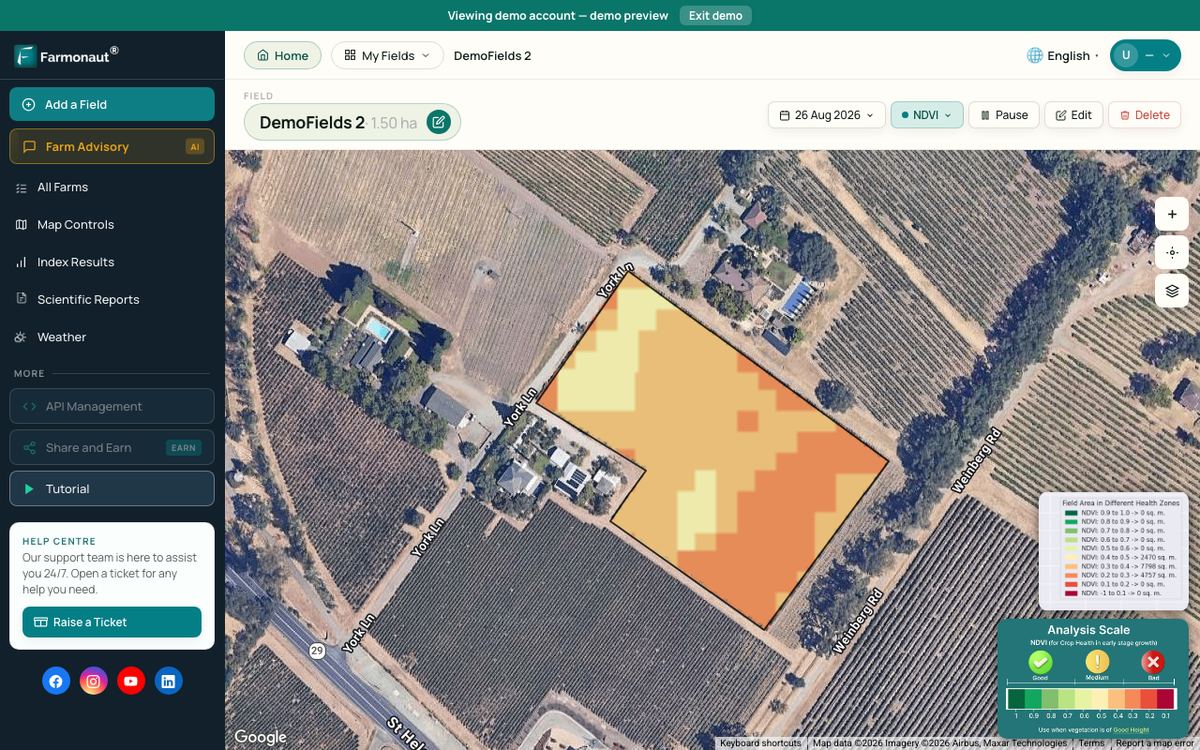
Draw your fields once and Farmonaut shows satellite vegetation maps for them through the season, on web, Android or iOS.



Keep reading
Sources
- FAO, Global Forest Resources Assessment 2025, chapter 2: Forest extent and change (2025): openknowledge.fao.org
- FAO, FRA 2020 Remote Sensing Survey, results page (2022): fao.org
- FAO, COP26: Agricultural expansion drives almost 90 percent of global deforestation (November 2021): fao.org
- FAO, Global sample-based assessment of agricultural deforestation drivers, GFOI plenary slides (May 2023): openknowledge.fao.org
- WRI Global Forest Review, Tropical rainforest loss slowed in 2025, but fire is a growing threat (April 2026): gfr.wri.org
- WRI, Global forest loss shatters records in 2024, fueled by massive fires (May 2025): wri.org
- Global Forest Watch, Integrated deforestation alerts explainer: globalforestwatch.org
- Oregon State University, Alert system shows potential for reducing deforestation (on Moffette et al., Nature Climate Change, January 2021): news.oregonstate.edu
- University of Wisconsin-Madison, Study shows Brazil’s Soy Moratorium still needed to preserve Amazon (on Gibbs et al., Science, 2015): news.wisc.edu
- Mongabay, Soy giants drop Amazon no-deforestation pledge as subsidies come under threat (9 January 2026): news.mongabay.com
- European Commission, Regulation on Deforestation-free products (EUDR) page, checked October 2026: environment.ec.europa.eu
- European Commission, Guidance document for the Regulation on Deforestation-Free Products, C(2026) 4972 (July 2026): green-forum.ec.europa.eu
- European Commission, Frequently asked questions on the implementation of the EUDR, 5th iteration: environment.ec.europa.eu
- Baragwanath and Bayi, Collective property rights reduce deforestation in the Brazilian Amazon, PNAS (2020): pmc.ncbi.nlm.nih.gov
- Zomer et al., Global tree cover and biomass carbon on agricultural land, Scientific Reports (2016): pmc.ncbi.nlm.nih.gov
- Green Climate Fund, REDD+ results-based payments pilot: greenclimate.fund
- Green Climate Fund, Decision B.18/07 on REDD-plus results-based payments (2017): greenclimate.fund
- Tropical Forest Forever Facility, Frequently asked questions (23 June 2026): tfff.earth
Discussion
Questions, corrections or field experience? Share them below. First-time comments are reviewed before they appear, and your email is never published.
No comments yet. Be the first to add a question or your experience.

 Farmo
Farmo Kubota
 FFBS
FFBS Jontra
 Kalustyan
 Tucor
Tucor Geno
Geno Hayleys Agriculture
 Linx Agritech
 Adinet
 Save Your Soils
 Grandstream Algérie
 XOS Realty
 Geospatial Lab Africa
 Agro La Gándara
 HIPSAC
 Licence holder · Niger · Gold










