

Forestry · Quiz answer and landowner guide
Logging: Not a Critical Sustainable Forestry Technique
Of logging, forest management, reforestation and agroforestry, logging is the one that is not a sustainability technique on its own. It removes timber; the other three build or protect forest value. Here is why, with harvest, planting and carbon data from FAO, Canada and the USDA.
Key takeaways
- Logging is the answer: it extracts timber, while forest management, reforestation and agroforestry build or protect forest value.
- FAO estimates deforestation fell from 17.6 million ha a year in 1990-2000 to 10.9 million ha a year in 2015-2025 (FRA 2025).
- Canada harvested nearly 670,000 ha in 2023 and planted 407,820 ha; planting or seeding covered 50-60% of harvested area over 20 years, the rest was left to regrow naturally.
- Private US forests hold about 22 t of carbon per acre above ground and offset about 2 t CO2 per acre a year on average (Penn State Extension, USDA FIA data).
- A harvest counts as sustainable only with a regeneration plan, cutting matched to growth, and follow-up checks.
In this article
- Which of the following is not a critical technique for sustainable forestry?
- The four practices compared
- Forest management: the plan behind every stand
- Reforestation: putting trees back
- Agroforestry: trees on working farms
- Logging: when a harvest becomes sustainable
- What sustainable forestry looks like in numbers
- Calculator: planting cost versus carbon value
- How to plan a reforestation project step by step
- Monitoring: how to know the plan is working
- Other techniques people mean by sustainable forestry
- Common mistakes on the sustainable forestry question
- FAQ
Logging is the answer. When a quiz asks which of the following is not a critical technique for sustainable forestry (logging, forest management, reforestation or agroforestry), logging is the odd one out. Forest management, reforestation and agroforestry exist to keep or rebuild forest value, while logging is the act of cutting and removing trees, and it only counts as sustainable when a management plan controls it and new trees follow.
The numbers show why the line matters. FAO estimates the world lost 10.9 million hectares of forest a year to deforestation in 2015–2025, down from 17.6 million in the 1990s (FAO Global Forest Resources Assessment 2025). This guide explains each of the four practices, shows harvest and replanting data from Canada, gives landowners a carbon and planting cost calculator, and sets out the checks that turn a harvest into sustainable forestry.
Which of the following is not a critical technique for sustainable forestry?
The four answer options are not the same kind of thing. Three are techniques with a goal. One is an activity.
- Forest management: the plan that decides what is cut, what is kept, what is planted and how the forest is protected from fire, pests and erosion.
- Reforestation: putting trees back on land that lost them, by planting, seeding or helping natural regrowth.
- Agroforestry: growing trees on farms together with crops or livestock, so the land keeps tree cover while still producing food.
- Logging: cutting and removing timber. It earns money and supplies wood, but it does not build forest on its own.
So the correct answer is logging. A teacher or exam board may phrase it as “logging is an extraction activity, not a conservation technique”. That is the short version. The longer version is more useful for anyone who owns or manages trees: logging can be part of sustainable forestry, but only as one step inside a plan that also covers regrowth, soil, water and wildlife.
Why the other three count as critical
FAO describes sustainable forest management as a concept that aims to maintain and enhance the economic, social and environmental values of all types of forests for present and future generations. Each of the three techniques serves that aim in a different way. Management sets the rules. Reforestation replaces what was lost. Agroforestry adds trees where people farm. None of them makes sense as a one-off event; each runs for decades.
Why logging is the odd one out
Logging removes value from a stand. If the trees come back and the soil stays in place, the forest recovers and the harvest can repeat. If not, the land drifts toward scrub, pasture or bare ground. The USDA Forest Service paper on strategies for sustainable forest management notes that sustainable forestry is widely desired but its standards are often defined vaguely. That is why the test below focuses on plain, checkable facts rather than labels.
How to answer it in an exam
If the question gives four options and asks for the one that is not a critical technique, look for the option that takes something out of the forest without a built-in plan to put it back. Forest management plans, reforestation replaces and agroforestry adds. Logging only takes. Write “logging” and, if the format allows a reason, add one sentence: “Logging is an extraction activity; it supports sustainability only when a management plan controls the harvest and ensures regeneration.”
The same logic works for related questions. “Which practice restores forests on cleared land?” is reforestation. “Which practice combines trees with crops or livestock?” is agroforestry. “Which practice sets the rules for harvest and protection?” is forest management.
Chart
World deforestation rate by period
Million hectares of forest converted to other land uses per year
The four practices compared
The table sets the four answer options side by side. It uses plain criteria a landowner or student can check.
| Practice | Main purpose | Builds forest value? | Time frame | Common failure |
|---|---|---|---|---|
| Forest management | Plan harvest, regrowth and protection | Yes, sets the rules | Decades, reviewed every few years | Plan written but never followed |
| Reforestation | Return trees to cleared or burned land | Yes, adds trees | Survival checks in years 1–3; carbon over decades | Seedlings lost to browse, weeds or drought |
| Agroforestry | Trees with crops or livestock | Yes, on farmland | Crop income yearly; trees mature over 5–20 years | Too much shade cuts crop or forage yield |
| Logging | Cut and sell timber | No, removes value | One harvest event | No replanting; soil and stream damage |
Forest management: the plan behind every stand
Forest management covers inventory, harvest planning, road layout, fire and pest risk, water protection and the choice between letting a stand regrow naturally or planting it. In practice, a written plan answers five questions: what trees are there, how fast are they growing, what will be cut and when, how will the site regrow, and how will you check that it did.
Many private woodlands have no such plan. Penn State Extension cites a National Woodland Owners Association survey that found only 11% of family forest owners have a forest management plan. Penn State also notes that most family forests are managed passively, either because of cost or because owners believe the forest will take care of itself. That gap is the main reason a timber sale on private land can turn into plain logging rather than sustainable forestry.
What a basic management plan contains
- Goals. Timber income, wildlife, water, recreation, carbon, or a mix. Rank them, because they compete.
- Inventory. Species, size classes, stocking and growth, stand by stand.
- Harvest schedule. How much will be cut, where, and with what method (clearcut, shelterwood, selection or thinning).
- Regeneration plan. Natural regrowth, planting or seeding, and who pays for it.
- Protection. Stream buffers, erosion control on skid trails, fire breaks, invasive weeds and deer browse.
- Monitoring. Survival counts after planting, regrowth checks after harvest, and a date to revise the plan.
In the US, state forestry agencies and extension services help landowners write these plans, and some cost-share programmes require one. Rules and incentives differ by state and province, so check with your local forestry office before you sign a timber contract.
Reforestation: putting trees back
Reforestation means re-establishing forest on land that lost it to harvest, fire, insects, mining or clearing. It can be done by planting seedlings, direct seeding or managing natural regrowth from stumps and seed trees. It is the technique that most directly answers the losses that logging and disturbance cause.
The scale in North America is large. The USDA Forest Service nursery report for fiscal year 2020 counted more than 1.27 billion tree seedlings grown for the 2020 planting season, enough to plant more than 2.4 million acres (977,542 ha). About 84% of that production and planting happened in the southern states, and only about 3% of seedlings were hardwoods.
In Canada, the State of Canada’s Forests report states that in 2023, 563 million seedlings were planted on 400,000 hectares of provincial and territorial lands, and a further 7,000 ha were regenerated by direct seeding. The same report says successful regeneration is required after harvesting on public lands, and that planting or seeding has been applied to 50% to 60% of the harvested area over the past 20 years; the rest is left to regrow naturally.
Why young plantings fail
Planting is the easy part. Keeping seedlings alive is harder. A USDA Forest Service study of red oak in northwestern Pennsylvania tested tree shelters, fences and herbicide under a shelterwood cut. Survival in shelters was 82% when herbicide was used and 40% without herbicide, and unprotected seedlings did poorly, likely because deer browsed them. Only 16% of acorns planted inside shelters produced seedlings, as small mammals ate most of them.
The lesson carries well beyond oak. Browse, weed competition and drought decide whether a planting becomes a forest. Plan for protection and weed control in the first two or three years, budget for replanting gaps, and count survival each year until the trees are above browse height.
Reforestation on damaged land
Some reforestation happens on land that was never meant to grow trees again. The Appalachian Regional Reforestation Initiative, run with the US Office of Surface Mining Reclamation and Enforcement, promotes the Forestry Reclamation Approach to plant high-value native trees on former coal mine lands and to raise survival and growth rates. It shows that site preparation (loose, uncompacted soil) can matter as much as the trees chosen.
Chart
Red oak seedling survival by protection
Percent of planted seedlings alive after two years under a shelterwood cut, northwestern Pennsylvania
Agroforestry: trees on working farms
Agroforestry joins trees with crops or livestock on the same land. FAO says agroforestry systems can improve livelihood resilience and food security, support soil health and water management, and help with climate change mitigation and adaptation. FAO’s 2025 assessment reports that 91 countries and areas declared 55.4 million ha of land under agroforestry in 2025.
The USDA National Agroforestry Survey, run by NASS with the USDA National Agroforestry Center, tracks five practices on US farms:
- Windbreaks, shelterbelts and hedgerows: rows of trees and shrubs that slow wind, manage snow, shade livestock and protect soil.
- Silvopasture: trees, forage and grazing animals managed together on the same land.
- Riparian forest buffers: strips of trees and shrubs along streams that filter runoff and hold banks in place.
- Alley cropping: crops or forage grown between rows of trees or shrubs.
- Forest farming and multi-story cropping: shade-tolerant crops grown under a tree canopy.
Silvopasture: shade without losing the grass
University of Wisconsin-Madison Extension’s introduction to silvopasture explains that trees give livestock shade in heat and shelter from cold wind, and planted trees can provide forage in drought. The same guide warns that forage grows more slowly in shade. It advises aiming for 25 to 40% shade cover, because once the canopy covers more than 50% of the site, forage growth declines. Fast-growing trees can reach useful size in 4 or 5 years, while oaks may take 10 years or more.
That balance is why agroforestry counts as a technique: someone decides tree spacing, species and canopy cover in advance, and adjusts it as the trees grow. Research in Scientific Reports on global tree cover and biomass carbon on agricultural land found that trees on farms make an important contribution to carbon storage but are not systematically counted in national carbon budgets.
Windbreaks and riparian buffers on cropland
On open farmland, the most common tree practice is the windbreak. NASS describes windbreaks, shelterbelts and hedgerows as rows of trees and shrubs that create a better environment for soils, crops, livestock, wildlife and people, and lists uses from slowing wind and managing snow to shading livestock and supporting pollination. Riparian forest buffers do a similar job along streams. Both need the same care as a forest: replace dead trees, control weeds in the first years and renovate old rows before they fail.
A farm windbreak is a small forest with a job. Treat it like one. Note the planting year and species, check for gaps after hard winters or drought, and plan replacement rows before the oldest trees die out. Rows planted in the same year tend to age together, so a gradual replacement plan avoids losing the whole row at once.
Where each technique fits on a farm or woodlot
| Situation | Best-fit technique | First step |
|---|---|---|
| Mature woodlot | Forest management | Inventory and written plan |
| Harvested stand | Reforestation | Check natural regrowth, plant gaps |
| Burned area | Reforestation | Assess seed sources and erosion |
| Grazed pasture | Silvopasture | Choose spacing for 25-40% shade |
| Wind-exposed field | Windbreak | Lay out rows across main wind |
| Stream edge | Riparian buffer | Fence livestock out, plant natives |

▶ Six plain steps to start using field data on a working farm, from mapping to acting on what you see. · 4:18
Logging: when a harvest becomes sustainable
Logging is not the villain in this story. Penn State Extension notes that up to 80% of US domestic timber supply comes from private lands, and that in parts of the southern US the growth-to-drain ratio for pine is above 2, meaning two trees grow for each one harvested. Wood products also hold carbon for years in buildings and furniture.
The question is what surrounds the harvest. A harvest is part of sustainable forestry when it passes three checks:
- A written regeneration plan. Who will replant or how natural regrowth will be secured, and by when.
- Harvest tied to growth. The volume cut over time does not exceed what the forest grows, measured by inventory, not guessed.
- Follow-up after the trucks leave. Regrowth surveys, erosion repair on roads and skid trails, and replanting where natural regrowth fails.
If any of the three is missing, the operation is extraction, whatever the sales brochure calls it. Third-party certification schemes such as FSC and PEFC audit these points, and certified area in Canada alone was 161.6 million hectares in 2024, according to the State of Canada’s Forests report.
Harvest and replanting in Canada
Canada is a useful case because it publishes both sides of the ledger. In 2023, total harvested area was nearly 670,000 hectares, a decrease of less than 1% compared with 2022 (State of Canada’s Forests 2025). The report links the dip partly to the record fire season of 2023 and lower housing demand.
Planted area in 2023 was 407,820 ha and seeded area 7,058 ha. The gap between harvested and planted area does not mean the rest stays bare: much of it regrows naturally from seed and roots, which is why the planting share has run at 50% to 60% of harvested area over two decades. The point for a student is simple. In a managed system, every hectare cut is matched by a plan for regrowth, by planting or by natural means.
Chart
Forest area harvested in Canada
Thousand hectares a year, provincial and territorial Crown land plus private land
What sustainable forestry looks like in numbers
Carbon is the figure landowners ask about most. Penn State Extension, using USDA Forest Inventory and Analysis data, reports that private forests in the US hold about 22 metric tons of carbon per acre in above-ground live biomass on average. Its table puts the average yearly CO2 offset from forest growth at about 2 metric tons of CO2 per acre, and says delaying harvest on one acre for a year in parts of the southeastern US can avoid up to 4.78 metric tons of CO2.
Money is smaller than many expect. On the voluntary carbon market, Penn State puts the average value of delaying harvest on private forest land for one year at US$16 per acre, using a price of US$8 per metric ton of CO2; sales for forest carbon offset projects in 2022 ranged from US$5 to US$20 per metric ton. Penn State adds that what a landowner receives can be lower, because developers and registries take a commission, and that carbon revenues are generally below what timber or farming earn per acre.
These are estimates, not offers. Contract length, verification costs and the project type all change the payment. Get independent financial and legal advice before you sign a carbon or timber contract.
Public money also shapes the decision. Penn State notes that in 2021 more than US$3 billion in federal funds went to the USDA to start climate-smart commodity production, and that later federal actions direct money to state programmes for climate-smart forestry on private land. Cost-share rates, eligible practices and deadlines change, so ask your state forestry agency or extension office what is open before you plan around a grant.
Carbon also has a social value that is higher than market prices. Penn State, using the US$51 per metric ton social cost of carbon set in 2022, puts the average social value of preventing forest loss on one acre of private US land at US$4,158, ranging from US$885 to US$7,305 by state. That figure is used for public policy decisions; it is not a payment a landowner can collect. It does show why governments fund replanting and why keeping existing forest is worth more than replacing it later.
Calculator: planting cost versus carbon value
Use this to test whether carbon income could cover the cost of replanting a cleared or burned area. The defaults are examples set close to break-even. Replace them with your own planting quote, cost-share rate and today’s carbon price.
Try the numbers for your own farm below.
Calculator
Can carbon income cover your replanting cost?
Enter your area, planting quote, cost share and carbon price.
- Your share of planting cost: $2,000
- Carbon value over the period: $2,560
- Tonnes of CO2 over the period: 320 t
Example values only, set near break-even; not a forecast or an offer. The 2 t CO2 per acre per year default is the US private-forest average from Penn State Extension (USDA FIA data); young plantings grow more slowly at first. The carbon price default is the US$8 per t voluntary-market figure Penn State used; check today’s price. Developer and registry fees, verification costs and contract terms reduce what you receive. Get professional financial and legal advice.
How to plan a reforestation project step by step
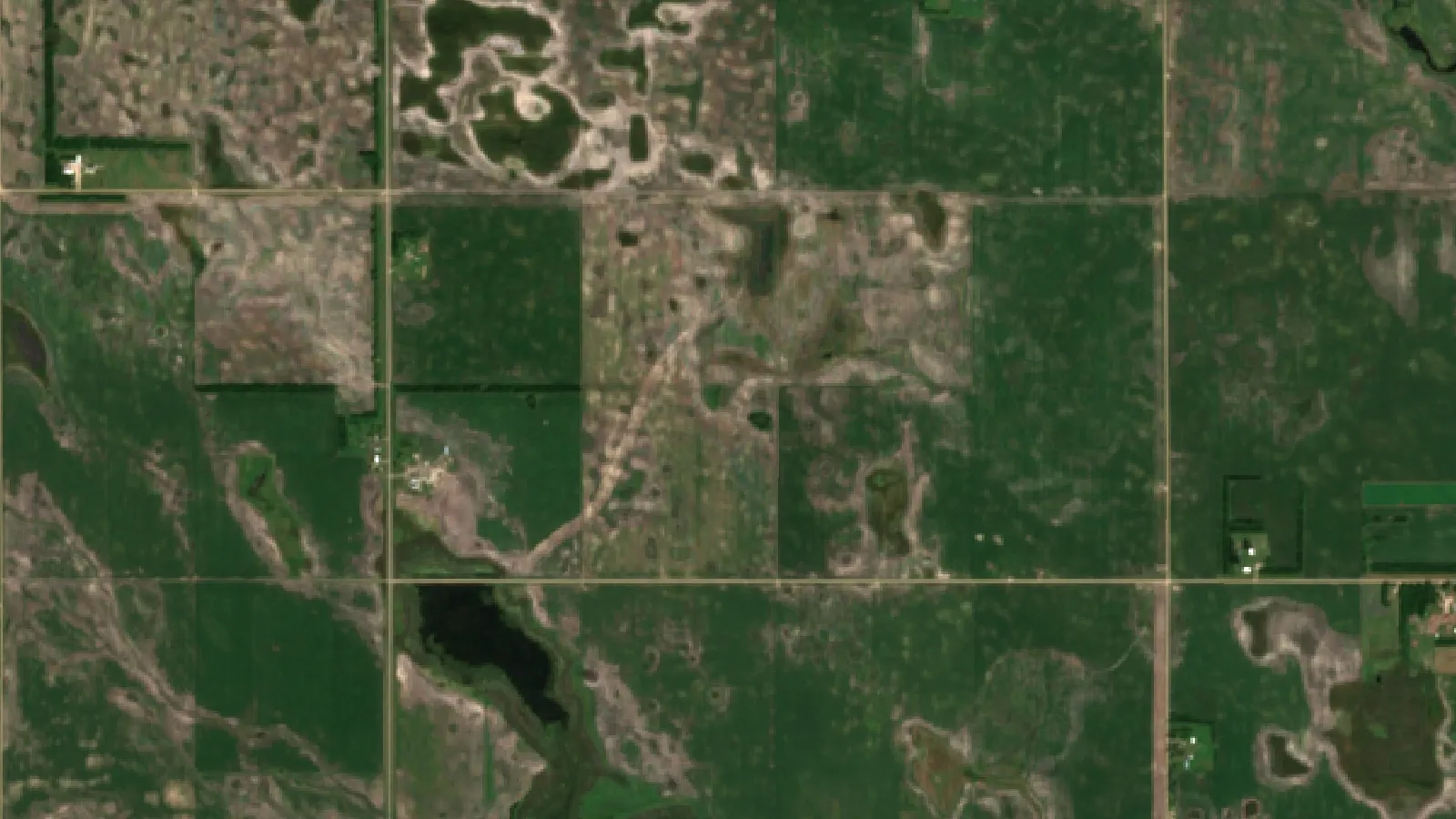
- Map the site. Mark the area to plant, streams, roads and slopes. Satellite images from several years show where trees died, where water collects and where weeds took over.
- Test soil and drainage. Compacted soil, as on old mine or skid-trail sites, often needs ripping before planting.
- Choose species for the site. Native species matched to soil, climate and future conditions. Mixed plantings spread pest and drought risk.
- Order seedlings early. Nurseries grow to order, and popular species sell out a season ahead.
- Plan protection. Tree shelters, fencing, or deer management where browse pressure is high; weed control for two to three seasons.
- Plant in the right window. Usually late winter to spring, or autumn in mild regions, when soil is moist.
- Count survival. Check plots at the end of the first and third growing seasons and replant gaps.
- Write it into the management plan. Record what was planted, where and when, so the next harvest decision starts from facts.

▶ A walkthrough of drawing a field and reading satellite vegetation maps in the Farmonaut web app. · 8:43
Monitoring: how to know the plan is working
Ground surveys remain the standard for counting seedlings and measuring trees. They are slow and costly on large or remote areas. Satellite images help fill the gaps between visits. Vegetation indexes such as NDVI rise as canopy closes and drop where trees die from drought, fire or insects, so a change on the map tells you which corner of a planting to walk first.
Lidar and aerial photos add tree height and canopy detail where they are available. For farm windbreaks, silvopasture paddocks and woodlots next to cropland, the Farmonaut Satellite + AI Farm Monitoring System shows vegetation maps for each field you draw, through the season, on web or phone. It does not replace a forester’s plot count, but it makes the count better targeted.
A simple monitoring routine
- Before planting: save a baseline image of the site.
- Every growing season: compare the vegetation map with the baseline and note patches that stay bare.
- Years 1 and 3: walk survival plots in the weakest and strongest patches.
- After any fire, storm or insect outbreak: check the map, then the ground.
- Every 5 to 10 years: update the inventory and revise the management plan.

▶ How satellite NDVI maps show plant stress across a large area before it is visible on the ground. · 4:09
Other techniques people mean by sustainable forestry
Beyond the four quiz options, several methods appear in forestry courses and certification standards. They all sit inside forest management:
- Selective and reduced-impact harvesting: taking single trees or small groups, with planned skid trails to limit soil damage.
- Shelterwood cuts: removing the overstory in stages so young trees establish under partial shade, as in the Pennsylvania oak study.
- Continuous cover forestry: keeping permanent tree cover with small-group felling instead of large clearcuts.
- Riparian buffers: leaving or planting trees along streams to protect water quality.
- Fire and fuel management: thinning and prescribed burning where local rules allow, to cut wildfire risk.
- Nursery and greenhouse propagation: raising seedlings, often in containers, for later field planting.
A note on global trends
Forest loss is slowing in some regions and rising in others. The World Resources Institute’s Global Forest Review reports that loss of tropical primary forest fell by 36% from 2024 to 2025, after a record year driven by extreme fires. FAO’s assessment shows the United States moving from a net forest gain of about 430,000 ha a year in 2000–2015 to a net loss of 120,000 ha a year in 2015–2025, while Canada’s net gain slowed to 82,500 ha a year. Fire now shapes the forestry agenda as much as harvesting does, which is one more reason forest management sits at the top of the list.
Common mistakes on the sustainable forestry question
- Picking reforestation. Some readers think planting is “just tree planting” and not a technique. It is one of the core techniques, because it replaces what harvest or disturbance removed.
- Picking agroforestry. It happens on farms, so some assume it is not forestry. FAO and USDA both treat it as a forestry practice on agricultural land.
- Calling all logging bad. Planned harvest with regrowth is part of sustainable forestry. The quiz asks which option is not a technique on its own, and that is logging.
- Treating management as paperwork. A plan only counts if it is used: harvest, regrowth and monitoring follow it.
Related pages on our site: carbon accounting for land, supply chain traceability, large-area land management, satellite data API documentation and web app access.
FAQ
Which of the following is not a critical technique for sustainable forestry: logging, forest management, reforestation or agroforestry?
Logging. Forest management, reforestation and agroforestry all build or protect forest value over time. Logging removes timber, and it only becomes part of sustainable forestry when a management plan controls how much is cut and makes sure the forest regrows.
Can logging ever be sustainable?
Yes, inside a plan. The harvest must be matched to growth, followed by planting or secured natural regrowth, and checked afterwards. Certification schemes such as FSC and PEFC audit these points.
How much carbon does a US forest acre store?
Penn State Extension, using USDA inventory data, puts the average for private US forests at about 22 metric tons of carbon per acre in above-ground live biomass, with yearly growth offsetting about 2 metric tons of CO2 per acre on average.
How many tree seedlings are planted each year?
US nurseries grew more than 1.27 billion seedlings for the 2020 planting season (USDA Forest Service). In Canada, 563 million seedlings were planted in 2023 on 400,000 hectares of provincial and territorial lands.
Is agroforestry the same as reforestation?
No. Reforestation returns land to forest. Agroforestry keeps land in farming and adds trees through windbreaks, silvopasture, riparian buffers, alley cropping or forest farming.
How do I check if a reforestation project is working?
Count seedling survival in plots at the end of years 1 and 3, and replant gaps. Between visits, compare satellite vegetation maps with a baseline image to see which areas are filling in and which stay bare.
Farmonaut farm monitoring
Watch your fields and tree rows from space
Draw your fields, windbreaks or woodlots once and Farmonaut shows satellite vegetation maps for them through the season, on web, Android or iOS.




Sources
- FAO, Global Forest Resources Assessment 2025, chapter 2: Forest extent and change: openknowledge.fao.org
- FAO, Sustainable forest management: fao.org
- FAO, Agroforestry: fao.org
- USDA Forest Service, Strategies for sustainable forest management (TreeSearch 40221): research.fs.usda.gov
- Haase et al., Forest Nursery Seedling Production in the United States, Fiscal Year 2020, Tree Planters’ Notes 64(2), USDA Forest Service: research.fs.usda.gov
- Walters, Protecting Red Oak Seedlings with Tree Shelters in Northwestern Pennsylvania, USDA Forest Service Research Paper NE-679: research.fs.usda.gov
- Penn State Extension, The Economic Value of Private Forests and Climate Change Mitigation: extension.psu.edu
- Natural Resources Canada, The State of Canada’s Forests: Annual Report 2025: natural-resources.canada.ca
- USDA NASS, National Agroforestry Survey: nass.usda.gov
- University of Wisconsin-Madison Extension, Introduction to Silvopasture (2025): cropsandsoils.extension.wisc.edu
- US Office of Surface Mining Reclamation and Enforcement, Appalachian Regional Reforestation Initiative: osmre.gov
- Zomer et al., Global Tree Cover and Biomass Carbon on Agricultural Land, Scientific Reports (2016): pmc.ncbi.nlm.nih.gov
- World Resources Institute, Global Forest Review: Tropical rainforest loss slowed in 2025: gfr.wri.org
Discussion
Questions, corrections or field experience? Share them below. First-time comments are reviewed before they appear, and your email is never published.
No comments yet. Be the first to add a question or your experience.

 Cazlv
 HIPSAC
 ZOL Zimbabwe
 Juligerm
 AdBio
 MISE Maroc
 Drift-Sense
 NWNS
 Red August Group
 Farm Inc
 WeMe Global
 Agrotoken
 Blue BearX
 Insignito
 Croptimum
 DnCubed
 Field Capacity
 Indosistim Teknologi

 Licence holder · Niger · Gold
 Licence holder · Nigeria · Gold + lithium
 Client · Somalia · Gold
 Client & affiliate partner · Ghana · Gold










