

Agriculture Climate Control: Top 7 Systems in India 2025
“By 2025, over 60% of Indian greenhouses are projected to use automated climate control systems.”
“Advanced climate control can increase crop yields in India by up to 30% compared to traditional methods.”
Table of Contents
- Introduction: Agriculture Climate Control in India
- Why Climate Control is Crucial in Indian Agriculture
- Emerging Technologies Shaping Agriculture Climate Control (2025 & Beyond)
- Top 7 Climate Control Systems in India 2025
- Comparison Table of Advanced Climate Control Systems
- Farmonaut: Satellite-Driven Solutions for Climate Controlled Farming
- Key Challenges and Solutions in Adoption
- Adoption, Government Initiatives & Subsidies
- The Future of Agriculture Climate Control in India: 2025 and Beyond
- FAQ: Agriculture Climate Control in India
- Conclusion: A Climate-Resilient Indian Agriculture
Introduction: Agriculture Climate Control in India
In recent years, agriculture climate control has emerged as a pivotal innovation shaping the future of farming, especially in countries like India, where agriculture remains the economy’s backbone. As climate change intensifies and the weather becomes less predictable, Indian farmers face unprecedented challenges—from extreme temperatures to water scarcity and pest outbreaks. These factors increasingly threaten crop yields, livestock health, and ultimately, the nation’s food security.
Climate control system for agriculture offers a promising solution by enabling farmers to stabilize growing conditions, enhance productivity, and ensure sustainable food production. In 2025 and beyond, advanced technologies—like IoT, smart sensors, and artificial intelligence—are transforming these systems into efficient, accessible, and affordable tools for small to large-scale agriculture players across India.
Why Climate Control is Crucial in Indian Agriculture
With over 50% of Indians relying on farming for their livelihood, climate controlled farming has become a non-negotiable requirement. India climate agriculture is characterized by erratic weather patterns, frequent droughts, floods, and rising temperatures, which together compromise farmer productivity and income.
- Unpredictable weather and climate fluctuations have led to increased crop failure rates and a reduction in water availability.
- Extreme heat and humidity negatively impact livestock (especially dairy and poultry sectors), reducing their fertility and health.
- Pest outbreaks and new diseases are proliferating due to the changing climate, often leading to higher chemical pesticide usage, compromising both sustainability and food safety.
Climate control in agriculture directly addresses these challenges by enabling the deliberate management of environmental factors such as temperature, humidity, ventilation, and light within agricultural settings—drastically improving resilience and yields.

Emerging Technologies Shaping Agriculture Climate Control (2025 & Beyond)
The approach to agriculture climate control in India has evolved in the last decade. From basic greenhouses to sophisticated, sensor-driven and automated systems, today’s leading solutions offer unparalleled control of environmental conditions. Here’s how it’s evolving:
- Internet of Things (IoT): Modern systems use a network of sensors to monitor temperature, humidity, light, soil moisture, and automatically adjust ventilation, misting, and shading for optimal crop or animal welfare.
- Artificial Intelligence (AI): AI algorithms analyze data from sensors, historical yield records, and weather forecasts to make real-time, predictive decisions—minimizing waste and maximizing yield.
- Automated and Remote Management: With mobile and cloud connectivity, farmers can control their agricultural settings from anywhere—boosting flexibility and operational efficiency.
- Energy-Efficient Designs: Solar-powered climate systems and eco-friendly materials make climate control systems more sustainable and cost-effective.
- Integrated Water Management: Cutting-edge drip irrigation and fertigation are synchronized with climate control for minimal water use and precision nutrition delivery.
-
Blockchain Traceability: Ensures transparency of the food supply chain by tracking resource use and verifying strict environmental controls for higher consumer trust.
Learn more about blockchain-based product traceability here.

Top 7 Climate Control Systems in India 2025
Let us discover the top seven agricultural climate control systems that are set to revolutionize India climate agriculture in 2025. Each system brings unique technological and practical advantages, tailored to both crops and livestock production.
-
1. IoT-Enabled Automated Greenhouses
Automated greenhouses are now enhanced by IoT (Internet of Things) sensors to create precisely monitored environments for producing vegetables, fruits, and flowers year-round.
Through real-time analyses, these greenhouses control temperature, humidity, and light—adapting instantly to weather fluctuations. Automated ventilation, misting, irrigation, and fertilization systems ensure optimal growth and reduce resource waste.- Primary Application: High-value crops like capsicum, tomatoes, cucumbers, floriculture.
- Estimated Yield Increase: Up to 30%.
- Energy Efficiency: High, with solar integration options.

-
2. Automated Polyhouses with Climate Control Panels
Polyhouses deliver robust protection against external weather conditions. In 2025, they’re increasingly fitted with climate control panels (sensors and controllers) to automate shade nets, cooling pads, foggers, and exhaust fans. This creates microclimates ideal for sensitive crops and nursery production.
- Primary Application: Vegetable, flower nurseries, seedlings, lettuce, herbs.
- Estimated Yield Increase: 25%–30%.
- Adoption Rate in India: Rapidly rising, especially in Maharashtra, Karnataka, and Tamil Nadu.
-
3. Precision Drip Irrigation Integrated with Climate Sensors
Drip irrigation remains the backbone of water conservation in semi-arid regions. Now, it gets a big boost when integrated with climate sensors. Automated weather-driven irrigation scheduling reduces water use, maximizes photosynthesis and limits nutrient leaching—especially critical in Rajasthan and Gujarat.
- Primary Application: Open-field and protected-area horticulture, orchards, and vineyards.
- Potential Yield Increase: 15%–25%.
- Key Benefit: Up to 60% water saving and reduced labor costs.
-
4. Smart Shade Net Houses with Dynamic Light and Temperature Adjustment
Shade nets—combined with automation—enable precise control of light and temperature for shade-loving crops and sensitive nursery plants. Advanced net houses dynamically vary shade percentages and activate misting, responding to solar intensity and external temperature fluctuations, thus ensuring consistent growth conditions.
- Primary Application: Leafy greens, ornamental plants, herbs, spices.
- Estimated Yield Increase: 10%–20%.
- Energy Efficiency: Moderate to high.
-
5. Climate Control Livestock Farming Systems
Livestock farmers are adopting climate control solutions to tackle heat stress and erratic seasons. Featuring ventilation fans, evaporative cooling pads, misting systems, and insulated shelters, these maintain thermal comfort for animals—directly impacting health, fertility, and productivity for dairy and poultry sectors.
- Primary Application: Dairy, poultry, piggery, and goat farming.
- Yield Impact: Milk yields in dairy cattle can increase by 15%; egg production in poultry flocks can rise by up to 10%.
- Additional Benefit: Reduced animal mortality and improved growth rates.
-
6. Automated Hydroponic and Vertical Farming Modules
Hydroponic and vertical farms use closed-loop systems to regulate humidity, temperature, CO2 levels, light, and water. Advanced automation ensures year-round, pesticide-free, and locally sourced premium crop production—even expanding into peri-urban areas to combat land scarcity.
- Primary Application: Leafy greens, herbs, strawberries, microgreens.
- Possible Yield Increase: Up to 50% over conventional farming.
- Sustainability: Significantly reduced land and water usage.

-
7. Real-Time Satellite-Based Farm Monitoring & AI Advisory
In 2025, satellite-driven climate control systems are set to transform Indian agriculture. Platforms employ real-time data—on soil health, vegetation, moisture, and weather—to provide actionable advisories and automate environmental control settings. This technology extends to crop insurance, resource management, and blockchain traceability as well.
- Primary Application: Large-scale open-field and protected farming, contract agriculture.
- Competitive Advantage: Early detection of crop stress, reduced loss, and improved decision-making.
- Sustainability Impact: Supports carbon footprint minimization and resource optimization.
Discover Farmonaut’s Agro Admin App for large-scale satellite-based farm management and monitoring.

Comparison Table of Advanced Climate Control Systems
| Climate Control System Name | Technology Type | Primary Application | Estimated Cost Range (INR/Unit) | Potential Yield Increase (%) | Energy Efficiency Rating | Adoption Rate in India (%) | Key Benefits |
|---|---|---|---|---|---|---|---|
| IoT-Enabled Automated Greenhouses | IoT, Sensor Networks, Automated Panels | Crops (vegetables, floriculture) | ₹8-25 lakh | 30 | High | 15 (metro & peri-urban) | Year-round production, minimizes pests, boosts output |
| Automated Polyhouses with Climate Control | Polymer Claddings, Automated Panels | Nurseries, vegetables | ₹5-15 lakh | 25-30 | Moderate | 8-12 | Reduces crop losses, protection from external elements |
| Precision Drip Irrigation w/ Sensors | Drip Systems, Soil/Weather Sensors | Open-field crops, horticulture | ₹50k-3.5 lakh | 15-25 | Very High | 35+ | Water saving, greater crop uniformity |
| Smart Shade Net Houses | Net Structures, Auto Light/Humidity Control | Leafy greens, nurseries | ₹2-6 lakh | 10-20 | Moderate | 18 | Temperature stress protection |
| Climate Control Livestock Systems | Fans, Cooling Pads, Insulated Materials | Dairy, poultry | ₹2-12 lakh (per shed) | 10–15 | Moderate to High | 10 | Reduces mortality, improves animal health |
| Automated Hydroponic/Vertical Farming | Closed-Loop Hydroponics, Automated Lighting | Urban, peri-urban crops | ₹8–20 lakh | 40–50 | Very High | 3 | Maximizes output, water&land saving |
| Satellite-Based Climate & AI Advisory | Satellite Imaging, AI Analytics | Large-scale crops, mixed farms | ₹3,000-20,000/season/service | 10–20 | Very High | 6-10 | Boosts data-driven farming, reduces risks |



API Access?
Farmonaut API |
API Developer Docs
For those interested in crop loans and insurance, see Farmonaut’s real-time satellite-based verification platform to streamline agricultural financing.
If you need regular, expert-backed crop plantation or forest advisory, get started with Farmonaut’s advisory platform here.
“By 2025, over 60% of Indian greenhouses are projected to use automated climate control systems.”
“Advanced climate control can increase crop yields in India by up to 30% compared to traditional methods.”
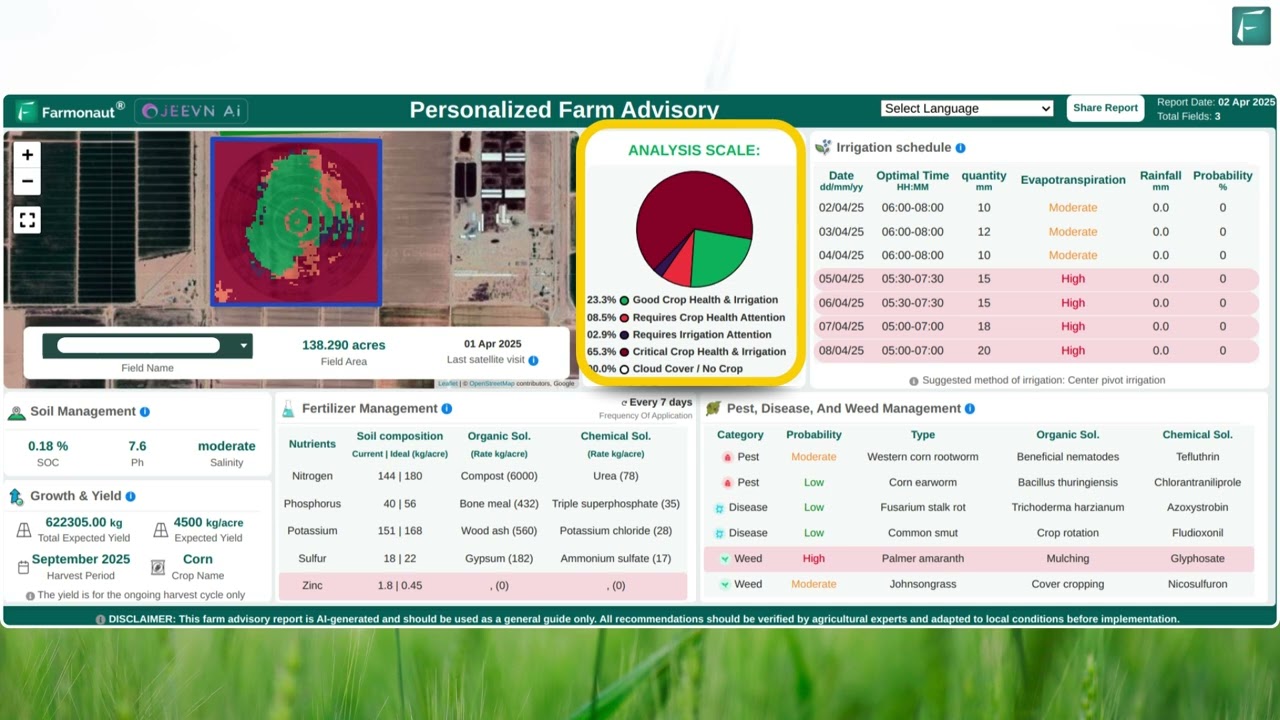
Farmonaut: Satellite-Driven Solutions for Climate Controlled Farming
We at Farmonaut are committed to democratizing climate control farming by providing affordable and accessible satellite-driven insights for every Indian farmer, enterprise, or government body.
- Satellite-Based Monitoring: We use high-resolution multispectral images to assess soil health, NDVI, irrigation needs, and early pest/disease risks, making agricultural climate management data-driven and reliable.
- Jeevn AI Advisory System: The AI system provides real-time weather forecasts and tailored advisory for optimal climate, irrigation, and input scheduling—improving both yield and sustainability.
- Blockchain Traceability & Carbon Monitoring: Our platform offers full supply chain transparency and helps comply with emission reporting mandates.
Read more about Farmonaut’s satellite-based carbon footprinting services - Fleet Management & Automation: Track and optimize agricultural machinery, water usage, chemical applications, and logistics—making resource allocation smarter and cost-effective.
- Access Across Platforms: Farmonaut is available on web, Android, iOS, and via API—making advanced climate control insights available to all.
Value Proposition:
- Affordable, subscription-based satellite insights—no costly hardware required.
- Real-time, field-specific monitoring for all farmers—from individuals to government.
- Promotes sustainability by enabling precise resource management and ecological balance.

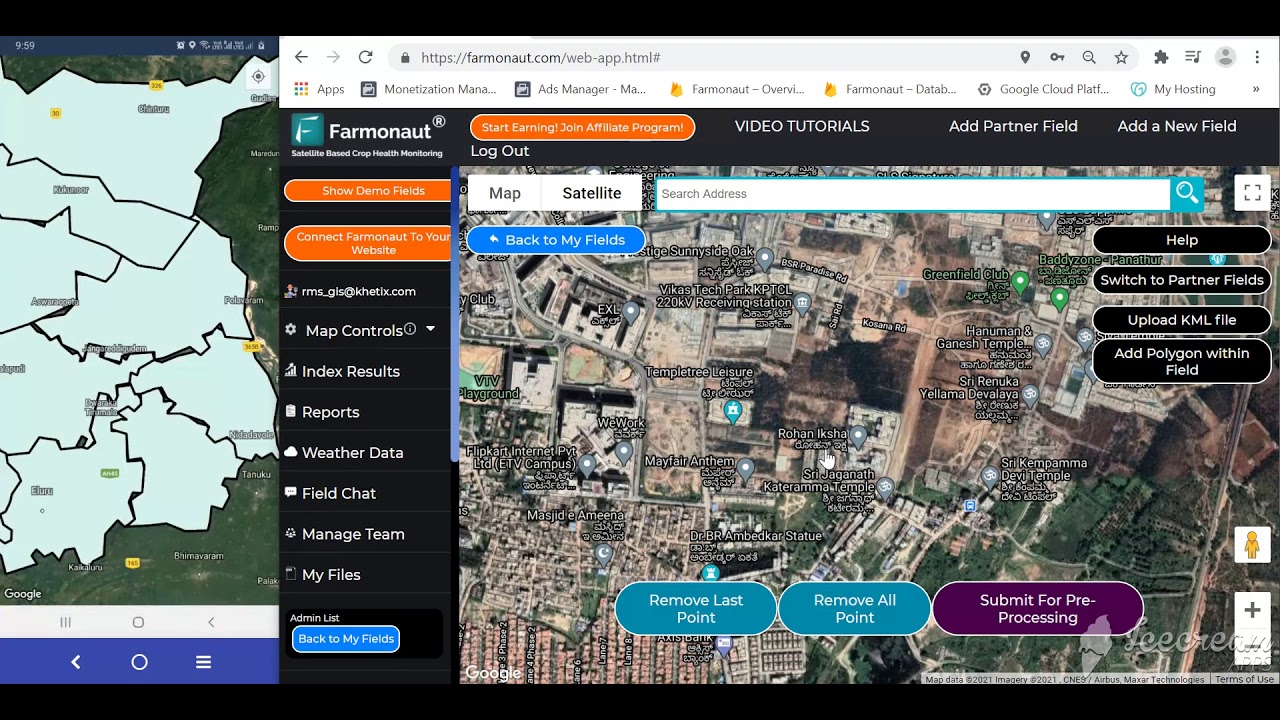
Subscription Details:
Choose the right Farmonaut plan according to your monitoring needs:
Key Challenges and Solutions in Adoption of Climate Control Systems
While the promise of climate control in agriculture is immense, several barriers remain for widespread adoption—especially among small and marginal farmers in India:
- High Initial Investment: The upfront cost for automated greenhouses, sensors, and environmental management hardware can be prohibitive.
- Lack of Technical Know-how: Many farmers are unfamiliar with apps, dashboards, or IoT hardware, especially in non-urban regions.
- Infrastructural Gaps: Power outages, internet connectivity, and logistics can disrupt automation, particularly in rural India.
- Fragmented Land Holdings: Small fields often present scale and ROI challenges for investment in sophisticated systems.
Emerging Solutions:
- Government Subsidies & Start-up Innovations: Schemes now support low-cost polyhouse kits, micro-climate modules, and subsidized financing.
- Affordable SaaS and API Platforms: Solutions like Farmonaut API empower farmers to get real-time advisory without heavy investments in hardware.
- Capacity Building: Agriculture extension programs and mobile apps in local languages expand accessibility.
- Modular Systems and Solar Integration: Solar and modular solutions reduce dependence on grid power and make climate control affordable for remote regions.
Adoption, Government Initiatives & Subsidies
With climate risks threatening food security, the Indian government and several states have rolled out major adoption and incentivization plans for climate control agriculture.
- Mission for Integrated Development of Horticulture (MIDH): Subsidies for polyhouses, greenhouses, shade nets, and micro-irrigation installation.
- PM-KUSUM and Solar Schemes: Financial incentives for solar-powered pumps, sensors, and automated irrigation.
- Crop Insurance Linked to Climate Monitoring: Integration of satellite-based weather and crop monitoring for better insurance payouts.
- Capacity Building Workshops: Field demonstrations, user training, and technical support to bridge the digital divide in rural farming.
As a result, climate control farming is not just an innovation for commercial agribusinesses, but is set to become the mainstream across all geographies in India—including water-scarce and extreme weather-affected regions.
The Future of Agriculture Climate Control in India: 2025 and Beyond
Looking ahead to 2025 and beyond, the role of climate control systems in agriculture will only deepen. Here’s what the future holds:
- Wider Scale and Affordable Access: As costs go down and modular solutions grow, even smallholders will automate their climate management.
- Data-Driven Farming: AI, big data, and weather analytics will be tightly integrated with on-farm automation for precision crop growing and livestock comfort.
- Urban and Peri-Urban Food Farms: Vertical farms, hydroponics, and rooftop units will help secure city food supply, reduce carbon footprints, and minimize food miles.
- Sustainability and Compliance: More farmers will document, monitor, and reduce their carbon and water footprint to meet both domestic and international market standards.
- Resilience Against Climate Extremes: Automated advance alerts and adaptive systems will shield Indian agriculture from the harshest and most unpredictable weather patterns.
- Food Security for a Growing Population: With rising productivity and minimal resource wastage, food security will become more achievable than ever before.
-
Easier Access to Loans and Insurance: Real-time, satellite-verified crop monitoring will enable secure, swift disbursement of agricultural finance.
Get real-time, satellite-based verification for secure crop loans and insurance on the Farmonaut platform.
FAQ: Agriculture Climate Control in India
What is a climate control system for agriculture?
It refers to any technology or setup (greenhouse, polyhouse, livestock barn, sensor network) that monitors and regulates environmental factors—temperature, humidity, light, water, and ventilation—within agricultural settings to optimize crop or livestock productivity.
Why is climate control important for Indian farmers?
India faces extreme temperatures, unpredictable weather patterns, water scarcity, and increased pest/disease pressure. Climate control stabilizes internal growing conditions, reduces risks, boosts yields, and supports food security.
Are these climate control systems affordable for marginal and small farmers?
Modern innovations (modular, solar-powered units, SaaS advisory like Farmonaut) and government subsidies have made basic and mid-level systems more affordable and accessible. Full-scale automation is still costlier but falling rapidly in price. SaaS solutions allow technology adoption without large capital investment.
Can climate control be used for livestock farming in India?
Yes! Climate control livestock farming is vital—particularly for dairy/poultry where heat stress can cut output by up to 20%. Systems with cooling, misting, ventilation, and insulation are increasingly common in Indian dairy farms and poultry sheds.
What government schemes support agriculture climate control systems in India?
The Mission for Integrated Development of Horticulture (MIDH), PM-KUSUM, and multiple state subsidies support installation of greenhouses, polyhouses, microclimate modules, and climate-resilient irrigation systems across states like Maharashtra, Karnataka, Punjab, and Haryana.
Is real-time monitoring possible for climate-controlled farming?
Yes. Using IoT sensors, satellite imaging, and cloud-connected apps (like those from Farmonaut), farmers can monitor and adjust their climatic settings in real time, from any location.
What role do advanced analytics and AI play in modern Indian farm climate control?
AI and analytics predict crop needs, automate environmental adjustments, pre-empt disease/pest outbreaks, and optimize input usage—dramatically boosting efficiency, sustainability, and yield.
Conclusion: A Climate-Resilient Indian Agriculture
Agriculture climate control stands at the center of India’s food security journey for 2025 and beyond. It transforms unpredictable, risky farming into a resilient, data-driven, and sustainable enterprise—from remotely managed greenhouses in Maharashtra to automated livestock sheds in Punjab and real-time satellite monitoring nationwide.
For India to decisively tackle climate change and continue feeding its 1.4+ billion people, the widespread adoption of climate control systems is imperative. This advancement not only enhances crop yields and livestock health, it ensures sustainable resource use, improved income stability for farmers, and new opportunities for private and public sector growth.
As innovative companies like Farmonaut continue to make satellite, AI, and data-driven climate solutions affordable and accessible, the future of Indian agriculture is brighter, smarter, and far more resilient to whatever climate extremes lie ahead.
Ready to begin your climate controlled farming journey?
Embrace the future. Make climate-controlled, sustainable farming in India your reality for 2025 and beyond.

 Godrej Agrovet
 Hayleys Agriculture
 Linx Agritech
 Adinet
 Save Your Soils
 GalaxEye Space
 Grandstream Algérie
 XOS Realty
 Geospatial Lab Africa
 Agro La Gándara
 HIPSAC
 ZOL Zimbabwe
 Juligerm
 AdBio
AdBio MISE Maroc
 NWNS
NWNS Red August Group
 Farm Inc
 WeMe Global
 Agrotoken
 Blue BearX
 Insignito
 DnCubed
 Indosistim Teknologi
 Liquify Digital
 CU Foods
 BeyondTech Global
 Rouge VC
 AgroRisk
 Oath Inc
 Esri North East Africa
 MDCV UK
 Etech Consulting Madagascar
 Vestlandsforsking
 WB Dev
 Sama Premium
 Tres Valles
 Blickwinkel
 Agricultural Credit Policy Council
 eKGIS
eKGIS Mostas Tech
 Andex
Andex Deluxe Conseil
 WICO
WICO Chimera Innovation
 SkyHarvest
 Teledarbas
 Exurbia Geospatial
 FieldZero
