

Reviewed September 2026 against USDA Economic Research Service data and the Association of Equipment Manufacturers’ precision agriculture benefits study.
Table of Contents
- What High Tech Farming Means Today
- Who Is Actually Using High Tech Farming, and How Much It Returns
- Precision Farming & Remote Sensing: The Digital Backbone
- High Tech Container Farming and Vertical Farms: The Economics
- Comparison Table: Field Precision Ag vs. Vertical/Container Farming
- Pig Farming Technology and Profit: What the Data Does and Doesn’t Show
- Precision Ag Payback Calculator
- Digital Platforms and Farmonaut: Tools for High Tech Farming
- Where This Is Headed: Adoption Trends to Watch
- FAQs
- Conclusion
- Try it: Results
What High Tech Farming Means Today
High tech farming is the use of satellites, sensors, automated equipment, and controlled-environment structures to make input decisions — water, fertilizer, feed, climate control — with field-level or plant-level precision instead of averages across a whole operation. In the United States, 27% of farms and ranches reported using at least one precision agriculture practice in 2023, and that share jumps to 68% among large crop farms earning over $1 million in annual income, according to USDA Economic Research Service data. High technology farming now spans two distinct tracks: precision management layered onto conventional field crops, and fully controlled indoor systems — vertical farms and high tech container farming — that remove field variables entirely.
This guide covers both tracks with the numbers USDA, the Association of Equipment Manufacturers (AEM), and current market research firms have actually published, plus a calculator so you can size the payback for your own acreage. Where a figure doesn’t exist in published US data — pig farming profitability is one of them — we say so plainly rather than filling the gap with a number that sounds right.

Who Is Actually Using High Tech Farming, and How Much It Returns
Adoption in the United States is uneven by farm size, and the return on precision technology is measurable but modest per acre — the value comes from scale. USDA’s 2023 data puts overall adoption at 27% of US farms and ranches, but that number roughly hides a size split: 68% of large crop farms (over $1 million in annual income) use precision agriculture technology, compared with a much smaller share of small and mid-size operations, per the same USDA Economic Research Service chart.
On return: AEM’s 2025 whitepaper on the benefits of precision agriculture in the US found that adoption boosts average annual crop production by 5%, while USDA research specifically attributes a 1.8% net return improvement to soil mapping and yield mapping technologies alone. AEM’s economic modeling translates this into roughly $118,000 in annual economic value generated per 1,000 acres of precision-managed row crops — a figure drawn from their 2024 analysis of US row-crop operations. That works out to about $118 per acre per year in aggregate value, which includes yield gains, input savings, and labor efficiency combined, not a single line item.
Those two figures — 27% overall and 68% for large operations — are the clearest evidence that high tech farming in the US is not yet a smallholder story; it’s concentrated where fixed technology costs spread across the most acres. If you want the current-year figure rather than the 2023 snapshot above, USDA’s Census of Agriculture refreshes on a five-year cycle (next full release covers 2024 data), and the Economic Research Service posts interim survey updates through its Charts of Note series year-round — check the ERS chart page directly for whatever is newest when you’re reading this.
Precision Farming & Remote Sensing: The Digital Backbone
Precision farming and remote sensing are the technologies driving that 68% large-farm adoption rate. Satellites, drones, ground sensors, and AI-driven analytics work together to monitor soil moisture, nutrient status, crop stress, and microclimate conditions at a resolution no human scouting crew can match economically:
- 📡 Satellite Imagery – Delivers frequent, low-cost crop health data across large acreage using NDVI, EVI, and soil moisture indices, refreshed every few days depending on satellite revisit schedules and cloud cover.
- 🚁 Drones – Enable targeted pest scouting, variable-rate spraying, and plant vigor mapping at plant-row resolution, useful for fields with irregular terrain or mixed cropping.
- 🌱 Ground Sensors – Provide continuous, hyperlocal readings of soil moisture, temperature, and nutrient levels that satellites can’t resolve at depth.
- 🧠 AI Data Analytics – Convert raw sensor and imagery feeds into fertilization schedules, irrigation timing, and pest-risk alerts, which is where USDA’s 1.8% net-return figure for soil and yield mapping actually gets realized.
- 🌦️ Weather & Microclimate Forecasts – Inform sowing dates, harvest windows, and crop selection to manage weather risk across a growing season.

The broader precision agriculture market growth trends page covers the technology stack and market trajectory in more depth if you’re evaluating which layer to adopt first. For crop varieties bred to work better with precision inputs — drought tolerance, nutrient-use efficiency — see our coverage of biotech innovations in agriculture.


High Tech Container Farming and Vertical Farms: The Economics
High tech container farming — growing crops in stacked, climate-controlled shipping containers or purpose-built modules — is the fastest-growing segment of controlled environment agriculture (CEA) in the US, and it comes with a very different cost and yield profile than field precision ag. The US vertical farming market was valued at $3.56 billion in 2024, based on analysis compiled by Arizton, MarketsandMarkets, and Mordor Intelligence.
USDA’s Census of Agriculture counted 2,994 controlled environment agriculture operations in the United States as of 2019, producing 7.86 million hundredweight (cwt) annually — a 56% production increase over the 2009–2019 decade, according to the USDA Economic Research Service. That’s the most recent Census-verified baseline; the next full Census update (covering 2024 data) will refresh these counts, with interim figures available quarterly through USDA NASS QuickStats.
The yield case for vertical and container farming is strong on a per-square-foot basis: leafy greens grown in vertical systems achieve a 95% harvestable yield rate, compared with 75–80% in field production, and vertical systems produce 50 to 100 times more yield per square foot than conventional field agriculture, according to industry analysis compiled by Arizton and AgeyeTech. But the capital and operating costs are what determine whether that yield advantage turns into profit:
- Construction and equipment costs: $150–250 per square foot for a commercial-scale vertical farm, per 2024 vertical farming economic data.
- Annual operating costs: $10–30 per square foot, covering energy (LED lighting is the dominant cost), labor, and nutrients.
- Microgreens revenue: $25–50 per square foot annually in vertical farming operations — one of the higher-margin crop categories in CEA.
Run the math on a 1,000 sq ft container module at the low end of construction cost ($150,000) and mid-range operating cost ($20,000/year): at $35/sq ft in microgreens revenue ($35,000/year), gross margin before financing is roughly $15,000 in year one, against a five- to ten-year payback horizon on the build-out depending on financing terms and crop mix. Leafy greens at lower per-square-foot revenue than microgreens will stretch that payback further. These are the published cost bands — your actual numbers depend on local energy rates, labor costs, and which crop you grow, which is exactly what the calculator below is for.

Comparison Table: Field Precision Ag vs. Vertical/Container Farming
| Metric | Field Precision Agriculture | Vertical / High Tech Container Farming |
|---|---|---|
| US adoption / scale (year) | 27% of all farms; 68% of large crop farms (2023) | 2,994 CEA operations (2019 Census) |
| Yield effect | +5% average crop production boost from precision tech adoption | 95% harvestable yield (leafy greens) vs. 75–80% field; 50–100x yield per sq ft |
| Documented net return | +1.8% net return from soil/yield mapping specifically | $25–50/sq ft annual revenue (microgreens) |
| Capital cost | Sensor/drone/software stack, typically a fraction of per-acre land value | $150–250/sq ft construction and equipment |
| Operating cost | Reduced via targeted input use (AEM: ~$118,000/1,000 acres annual value) | $10–30/sq ft/year, dominated by energy for lighting/climate control |
| Primary data source | USDA ERS, AEM whitepaper | USDA Census of Agriculture, Arizton/MarketsandMarkets/Mordor market research |
Figures as cited above: USDA ERS (2023, 2019), AEM (2024–2025), Arizton and industry market research (2024). Field precision ag and CEA serve different crop categories and are not directly interchangeable investments — the table compares published unit economics, not a recommendation for one over the other.

Pig Farming Technology and Profit: What the Data Does and Doesn’t Show
Searches for pig farming profitability and technology adoption often expect a headline productivity or profit figure. For US swine operations specifically, no USDA or NASS dataset in our research base breaks out adoption rates or ROI for high-tech systems — automated feeding, precision environmental controls, IoT health monitoring — the way ERS does for row-crop precision agriculture. That is a genuine gap in publicly available US data, not a number we’re willing to invent.
What US producers evaluating this technology can actually do is pull the comparable figures from adjacent, well-documented categories and apply the same framework:
- Start from the general precision-ag return benchmarks: USDA’s 1.8% net-return figure for sensor-based monitoring and AEM’s 5% production boost were both measured on crop operations, but the underlying mechanism — replacing scheduled/manual inputs with sensor-triggered ones — applies to livestock environmental control and feeding systems too. Treat these as an outside reference point, not a swine-specific promise.
- Check USDA NASS QuickStats directly at quickstats.nass.usda.gov for the most current hog and pig inventory, production, and price series — NASS publishes these on a rolling schedule and it’s the authoritative source for any swine economics you’d build a business case on.
- Watch the next Census of Agriculture release for a livestock technology-adoption breakout comparable to what ERS already publishes for crops — USDA’s five-year Census cycle is the mechanism that would eventually produce this data if and when it’s collected.
If your operation is US-based and you’re modeling automated feeding or sensor-based health monitoring for swine, treat vendor-supplied productivity claims with the same scrutiny you’d apply to any unverified figure: ask for the underlying study, the sample size, and the time period, and cross-check against USDA NASS price and production series before committing capital.
Precision Ag Payback Calculator
Use your own acreage and cost assumptions against AEM’s published per-acre value figures to estimate a payback period for a precision agriculture technology package.
Results:
Assumptions and exclusions: The default $118,000-per-1,000-acres figure and 5% production boost are AEM's and USDA's published US benchmarks, not guarantees for your farm — adjust the "adoption effectiveness" field down if your soil types, crop mix, or existing equipment differ from the study population. This calculator excludes financing costs, maintenance and subscription fees after year one, and any yield risk from weather. It's a starting estimate for comparing technology packages, not a substitute for a vendor quote or an extension-office consultation.
Digital Platforms and Farmonaut: Tools for High Tech Farming
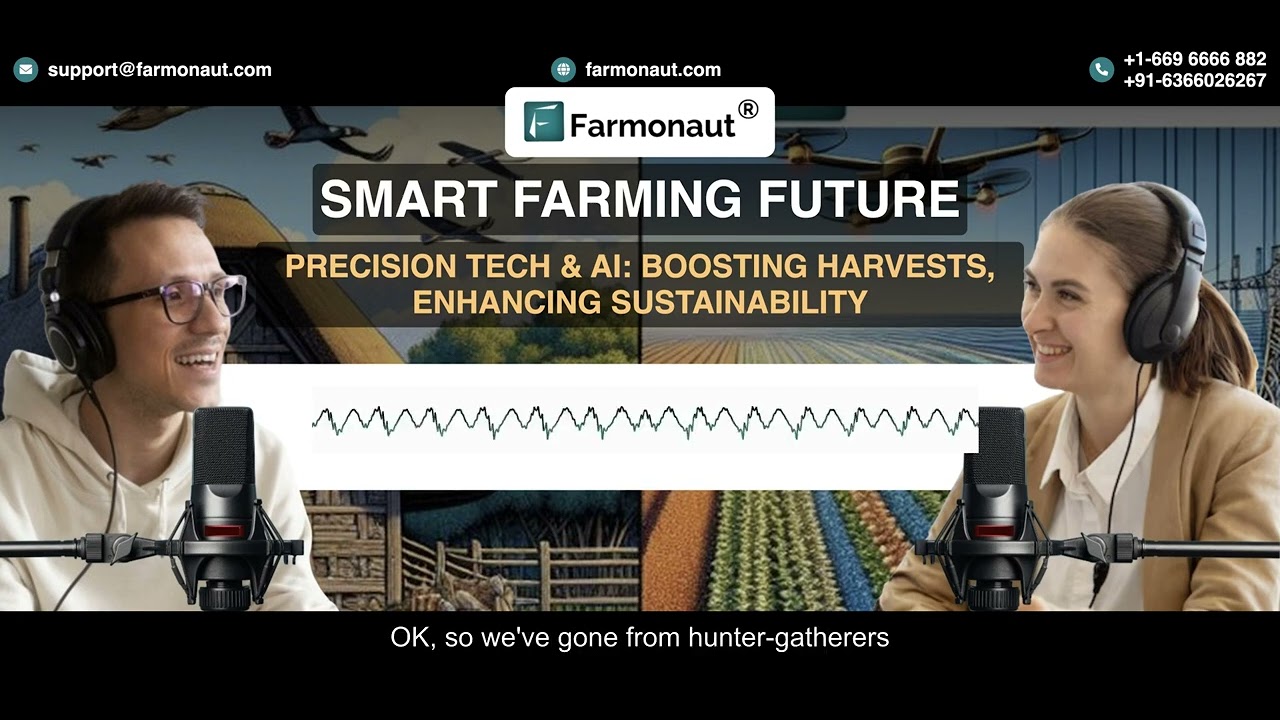
Digital platforms are what turn the raw satellite, sensor, and weather data described above into decisions a farm manager can act on the same day. At Farmonaut, we build satellite-driven monitoring and advisory tools aimed at exactly the adoption gap USDA's data shows — moving mid-size and smaller operations toward the technology stack that large crop farms already use at a 68% rate.
- 📱 Satellite Monitoring & AI-Based Advisories – Crop health analysis (NDVI), soil and water monitoring, and operational insights via Android, iOS, and web apps.
- ⛓ Blockchain-Based Traceability – Full transparency and compliance in agricultural supply chains, reducing fraud risk and building buyer trust.
- 🌦 Environmental Impact Monitoring – Real-time carbon footprinting and environmental compliance tracking.
- 🌾 Large-Scale Farm Management – Modular tools for monitoring, reporting, and input management across thousands of acres via the agro admin app.
- 🚛 Fleet & Resource Tracking – Fleet management tools for equipment and logistics optimization.
- 💳 Financing Support – Verified farm records that support crop loan and insurance applications.
- 🔗 APIs and Custom Integration – Full developer documentation for integrating satellite and weather data into third-party systems.



Farmonaut Subscriptions & Pricing
Explore subscription plans for satellite-based monitoring, AI advisories, and blockchain traceability:
Where This Is Headed: Adoption Trends to Watch
Three verifiable trend lines are worth tracking rather than a snapshot forecast, since each has a defined refresh schedule you can check yourself:
- Precision ag adoption by farm size — USDA's 27%/68% split (2023) is likely to shift as equipment costs fall and software-only tools (satellite monitoring, cloud advisories) lower the entry cost for mid-size farms. Track it via USDA ERS Charts of Note, updated as new survey data is released.
- CEA operation counts and production volume — the 2019 Census figures (2,994 operations, 7.86 million cwt) are due a full refresh with 2024 Census data; interim quarterly figures are available at USDA NASS QuickStats in the meantime.
- Vertical farming market sizing — the $3.56 billion 2024 US figure comes from Arizton, MarketsandMarkets, and Mordor Intelligence, all of which publish updated market reports annually, typically in the first quarter of each year.
Whichever figure you're checking, treat the vintage attached to it as load-bearing: a 2019 Census count and a 2024 market-research estimate are answering different questions on different timelines, and conflating them is the fastest way to misjudge where the market actually is.
Learn more about crop, plantation, and forest advisory here.
Frequently Asked Questions
Q1. What percentage of US farms use high tech farming or precision agriculture?
27% of US farms and ranches reported using at least one precision agriculture practice in 2023, rising to 68% among large crop farms with annual income over $1 million, per USDA's Economic Research Service. Check the ERS Charts of Note page for the most recent survey update.
Q2. How much does high tech farming actually increase yield or income?
AEM's 2025 whitepaper found a 5% average annual crop production boost from precision agriculture adoption, with USDA attributing 1.8% of net return specifically to soil and yield mapping. AEM also estimates roughly $118,000 in annual economic value per 1,000 acres of precision-managed row crops.
Q3. What is high tech container farming and is it profitable?
High tech container farming grows crops in stacked, climate-controlled modules, achieving up to 95% harvestable yield for leafy greens (vs. 75–80% in field production) and 50–100x yield per square foot versus conventional field agriculture. Profitability depends on crop choice: microgreens can generate $25–50/sq ft annually against $150–250/sq ft construction costs and $10–30/sq ft annual operating costs — leafy greens at lower per-square-foot revenue require a longer payback horizon.
Q4. Is there US data on pig farming profitability with high-tech systems?
No USDA or NASS dataset we found breaks out adoption rates or ROI for high-tech swine systems (automated feeding, sensor-based health monitoring) the way it does for row-crop precision agriculture. The most reliable path for US producers is to check current hog and pig production and price series directly at USDA NASS QuickStats and apply the general precision-ag return benchmarks above as a reference point, not a swine-specific promise.
Q5. How big is the US vertical farming market?
The US vertical farming market was valued at $3.56 billion in 2024, based on analysis from Arizton, MarketsandMarkets, and Mordor Intelligence. These firms typically publish updated market sizing each year, usually in the first quarter.
Conclusion
High tech farming in the United States is best understood as two separate adoption curves. Field precision agriculture is already mainstream among large operations — 68% of farms over $1 million in income use it — and returns a documented but modest 1.8–5% boost to production and net return. Controlled environment and high tech container farming sit earlier in their adoption curve (2,994 operations counted in the 2019 Census) but post far larger per-square-foot yield multiples, at a correspondingly larger capital cost of $150–250/sq ft.
Neither track is a guess: USDA's Economic Research Service and Census of Agriculture, plus AEM's whitepaper and current vertical farming market research, are all checkable on the cycles described above. Use the calculator on this page to translate the field-ag benchmarks to your own acreage, and revisit the USDA and NASS links each season — that's the durable habit this article is built around, not any single number in it.
Farmonaut's satellite monitoring and advisory tools are built to help operations of any size close the gap between the 27% national adoption rate and the 68% large-farm rate, without requiring large-farm capital to start.

 Godrej Agrovet
 Hayleys Agriculture
 Linx Agritech
 Adinet
 Save Your Soils
 GalaxEye Space
 Grandstream Algérie
 XOS Realty
 Geospatial Lab Africa
 Agro La Gándara
 HIPSAC
 ZOL Zimbabwe
 Juligerm
 AdBio
AdBio MISE Maroc
 NWNS
NWNS Red August Group
 Farm Inc
 WeMe Global
 Agrotoken
 Blue BearX
 Insignito
 DnCubed
 Indosistim Teknologi
 Liquify Digital
 CU Foods
 BeyondTech Global
 Rouge VC
 AgroRisk
 Oath Inc
 Esri North East Africa
 MDCV UK
 Etech Consulting Madagascar
 Vestlandsforsking
 WB Dev
 Sama Premium
 Tres Valles
 Blickwinkel
 Agricultural Credit Policy Council
 eKGIS
eKGIS Mostas Tech
 Andex
Andex Deluxe Conseil
 WICO
WICO Chimera Innovation
 SkyHarvest
 Teledarbas
 Exurbia Geospatial
 FieldZero
