

Precision Agriculture Market Growth 2025: Trends & Drivers
“The precision agriculture market is projected to surpass $12 billion globally by 2025, driven by smart technology adoption.”
Table of Contents
- The Precision Agriculture Market Growth Outlook for 2025: Trends and Insights
- Introduction: Why Precision Agriculture in 2025?
- Precision Agriculture Market Growth 2025: Market Size, CAGR & Global Expansion
- Key Growth Drivers for the Precision Agriculture Market 2025
- Top Precision Agriculture Market Trends 2025: Technologies & Innovations
- Regional Market Dynamics: North America, Asia-Pacific, and Beyond
- Role of Farmonaut in Precision Agriculture Market Growth
- Challenges and Opportunities in Precision Agriculture Adoption
- Precision Agriculture Market Trends & Growth Drivers (2023–2025)
- Future Outlook: What Lies Ahead for Precision Agriculture 2025 and Beyond?
- Frequently Asked Questions (FAQ)
- Farmonaut Precision Agriculture Subscriptions
The Precision Agriculture Market Growth Outlook for 2025: Trends and Insights
As the global population surpasses 8 billion and demand for food continues to soar, precision agriculture market growth 2025 becomes more than just a trend—it’s an imperative. The sector is experiencing robust expansion through the convergence of advanced technologies, evolving farming practices, and dynamic policy support across leading and emerging markets. In this comprehensive guide, we explore the drivers, trends, and key players—including Farmonaut—in the precision agriculture market 2025, offering actionable insights for farmers, agribusiness leaders, innovators, and policy makers.
Introduction: Why Precision Agriculture in 2025?
Precision agriculture has emerged as a transformative solution for global agriculture and forestry sectors. By 2025, the focus is sharper than ever, as we face increasing urbanization, climate change, and mounting pressures on natural resources. Our world needs smarter, more efficient, and sustainable methods to increase productivity while reducing environmental impact and costs.
Through the integration of advanced technologies—including AI, the Internet of Things (IoT), drones, big data analytics, and satellite sensing—precision agriculture delivers real value for farmers, agribusinesses, and governments worldwide. These tools enable data-driven decisions, optimize inputs, and help promote sustainable practices while securing better yields and improved profitability.
“By 2025, over 60% of large farms are expected to implement advanced precision agriculture solutions for increased productivity.”
Precision Agriculture Market Growth 2025: Market Size, CAGR & Global Expansion
The precision agriculture market 2025 is set to experience explosive growth. Multiple research reports estimate a compound annual growth rate (CAGR) of about 12-15% during the forecast period (2023–2025). The global precision agriculture market size is projected to exceed $12 billion by 2025, reflecting widespread adoption and rapid expansion across regions.
- North America: Currently the global leader due to high technology penetration, mature infrastructure, and strong government backing.
- Asia-Pacific: Expected to see the fastest rate of adoption, with particular growth in countries like China and India through government-led digital agriculture initiatives.
- Latin America & Africa: Poised for significant expansion, driven by modernization efforts, rising food demand, and increasing affordability of precision agriculture tools.
Key factors fueling this expansion include:
- Growing global food demand amid a rising population, necessitating higher yields achieved through precision methods.
- Intensifying environmental concerns—including water scarcity and soil degradation—leading to a preference for sustainable practices.
- Continuous technological innovation and the steadily decreasing costs of adopting precision tools.
- Increasing institutional and private investments targeting agriculture modernization.
This positive market outlook for 2025 is underpinned by robust demand and a clear shift towards data-driven, resource-efficient agricultural management.

Key Growth Drivers for the Precision Agriculture Market 2025
1. Rising Food Demand and Population Growth
By 2025, the world’s population is projected to exceed 8 billion. This brings mounting pressure on our agriculture and forestry sectors to enhance crop yields and increase efficiency.
- Precision agriculture offers targeted methods—including variable rate fertilization and smart irrigation—to help meet food demand more sustainably.
- Site-specific crop health monitoring and resource management enable farmers to optimize every input, maximizing yield per acre while minimizing waste.
2. Technological Advancements: AI, IoT, Big Data & Robotics
Continuous advancements in AI, machine learning, IoT sensors, and drones are driving increased adoption rates among farmers, agribusinesses, and even governments:
- AI-powered decision tools provide real-time insights by analyzing massive, multi-sensor data streams.
- Affordable IoT sensors and drones now deliver detailed soil and crop data faster and more accurately than ever before.
- Robotics—such as autonomous tractors and weeders—improve operational efficiency and address skilled labor shortages.
3. Sustainability and Environmental Concerns
Both governments and international organizations are escalating their push for climate-resilient agriculture.
- Precision farming practices help reduce overuse of water, fertilizers, and pesticides—addressing pollution, soil degradation, and greenhouse gas emissions.
- Carbon footprinting tools help organizations monitor and reduce their environmental impact, aiding compliance and eco-labeling efforts.
Discover how Farmonaut is empowering sustainable farming with advanced carbon footprint tracking →
4. Investments: Government Incentives and Private Funding
Across North America, Asia-Pacific, and Europe, supportive government policies—such as subsidies, tax breaks, and grants—are accelerating the modernization of agriculture. Venture capital and corporate investment flow into agri-tech startups are at an all-time high.
- Innovation grants help reduce upfront costs for farmers and businesses when adopting precision technologies.
- Digital solutions are now within reach of even small- and medium-sized farms, rapidly expanding the overall market.

Top Precision Agriculture Market Trends 2025: Technologies & Innovations
Integration of AI, IoT & Big Data Analytics
- AI-driven platforms process data from multiple field sensors, weather stations, and satellites to generate actionable, site-specific recommendations for pesticide and fertilizer application, irrigation, and harvest schedules.
- IoT sensors monitor real-time field data (moisture, temperature, nutrient levels), enhancing decision-making and resource management.
- Big data analytics support predictive modeling, assist with risk management, and help optimize farm operations for maximum efficiency and productivity.
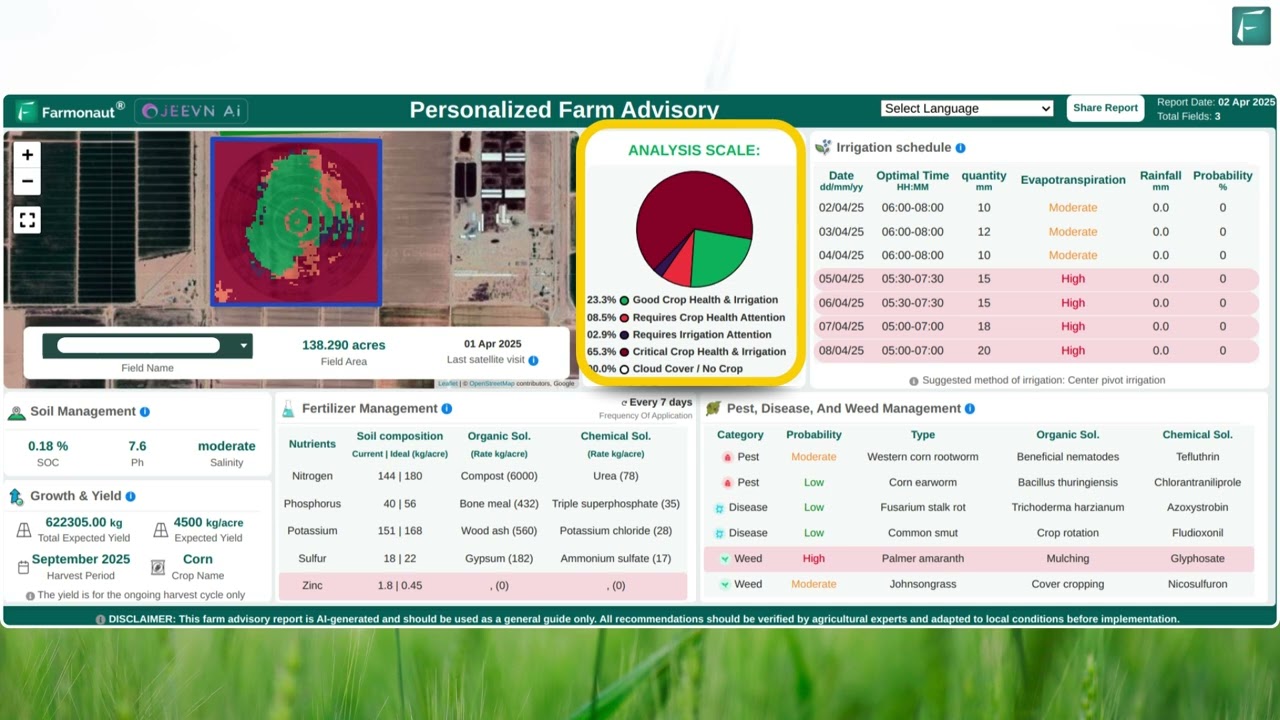
Farmonaut, for example, utilizes AI, blockchain, and satellite sensing to deliver farm health monitoring and actionable insights through its platform, making these advancements accessible through mobile, web, or API integrations worldwide.
Drones, Satellite Imagery & Remote Sensing
Market demand for drones and remote sensing is surging. These technologies deliver high-resolution, multispectral, and real-time imagery, enabling:
- Early detection of crop stress, pests, diseases, and nutrient deficiencies
- Accurate mapping for variable rate application of chemicals
- Smart scouting—targeting field inspections only where risk is detected
- Enhanced forestry management by assessing tree health and growth rates

Smart Machinery, Robotics, and Automation
- Autonomous tractors, robotic weeders, and harvesters are improving labor efficiency and reducing costs, particularly on large farms across North America and Europe.
- Telematics and fleet management tools, like those offered on the Farmonaut platform, optimize the use of agricultural machinery and lower operational risk.
Traceability and Supply Chain Transparency
The precision agriculture market 2025 is increasingly focused on blockchain-based traceability to ensure transparency in food and fiber supply chains. Farmonaut’s traceability solution enables:
- Verification of product origin from field to consumer
- Reduction in supply chain fraud and increased consumer trust
- Data-driven compliance with stringent market and environmental certifications

Digital Platforms and Mobile-First Approaches
- Mobile and web apps, like those developed by Farmonaut, democratize access to advanced agronomy advice, weather data, and resource optimization tools for farmers worldwide.
-
Get started with Farmonaut:




Precision Forestry and Resource Management
Precision technologies are moving beyond conventional farming. In forestry, satellite analytics and smart sensors are used for:
- Monitoring tree health and assessing risk of infestations or disease
- Planning optimal harvesting schedules based on growth data
- Promoting biodiversity and tracking environmental sustainability

Regional Market Dynamics: North America, Asia-Pacific, Latin America, and More
Precision agriculture adoption rates and the pace of market growth vary greatly by region. Below, we highlight the evolution and prospects for each major market:
North America
- Leads the global market, especially the U.S. and Canada
- Highest levels of smart technology adoption (IoT, drones, analytics, robotics)
- Favorable policy framework and long-standing research infrastructure
- Trends: Smart irrigation, variable-rate technology, and precision crop insurance are booming.
Asia-Pacific
- Fastest-growing market: India, China, Japan, and Australia lead precision agriculture initiatives
- Government-backed digital agriculture, smart village programs, and increased use of mobile apps
- Focus: Empowering smallholder farmers, improving yield security, and reducing input costs
Latin America & Africa
- Growth driven by agri-tech investments, export-oriented commodity production, and climate adaptation needs
- Brazil and Argentina: emerging leaders in digital crop management, remote sensing, and smart tractors
- Challenges: Infrastructure gaps, but growing investment and collaborations driving adoption
Europe
- Market driven by sustainability directives (EU Green Deal), traceability regulations, and environmental incentives
- Precision ag adoption through subsidies, climate-smart programs, and low-carbon farming support

Role of Farmonaut in Precision Agriculture Market Growth
At Farmonaut, our mission is to make precision agriculture affordable and accessible for farmers worldwide. We empower farmers, agribusinesses, and government agencies with data-driven solutions that directly address the key challenges outlined in global market trends.
Our Technologies and Value Proposition
- Satellite-based crop and soil health monitoring: Multispectral imagery helps farmers track crop vigor, soil moisture, and disease risk, optimizing every intervention for higher yields and lower resource wastage.
- AI-powered decision support (Jeevn AI): Delivers personalized, real-time recommendations—incorporating weather forecasting, pest risks, and input management—for increased farm productivity and efficiency.
- Blockchain-based traceability: Gives agribusinesses and supply chains the tools to authenticate crops and guarantee product origin, enhancing consumer trust and compliance.
- Fleet and resource management: Our IoT and analytics solutions help streamline logistics, reduce operational costs, and enable efficient machine and worker deployment.
- Carbon footprinting: Provides real-time emissions tracking for environmental compliance and sustainable agriculture programs. Learn more here.
Business Model & Access
We offer scalable, subscription-based services through mobile apps, web portal, and APIs—allowing users to select packages that match their needs, field scale, and data frequency. Our platform is designed for accessibility, with affordable pricing for individual farmers, emerging-market users, large agribusinesses, and institutions.
- API Access: Expand the functionality of your digital agriculture platform by integrating with Farmonaut. Get API Access and access detailed satellite & weather data, or view the Developer Docs for integration guidelines.
- Large-scale management: Our large-scale agro admin solution allows organizations to monitor multiple farms efficiently via a single dashboard.
Target Audience
- Individual farmers seeking affordable, real-time field intelligence
- Agribusinesses and plantation managers in need of scalable, smart monitoring
- Government agencies and NGOs rolling out digital agriculture projects
- Financial institutions needing smart verification for crop loans and insurance (Read about Farmonaut’s crop loan solutions)
- Corporate buyers invested in end-to-end supply chain transparency
Benefits at a Glance
- Cost-Effective Precision: Reduces capital outlay—no need for expensive equipment—leveraging remote sensing instead.
- Boosted Productivity: Data-backed decisions and timely interventions minimize losses and increase output per hectare.
- Sustainability: Supports responsible stewardship of soil, water, and carbon through continuous, actionable insights.
- Scalability: Helps smallholder farmers and massive agribusinesses manage risk and maximize returns.
- Transparency & Trust: Blockchain-traceable supply chains drive resilience in a changing global marketplace.
Challenges and Opportunities in Precision Agriculture Adoption
While the precision agriculture market 2025 boasts robust growth prospects, several persistent challenges could affect adoption rates among farmers and agribusinesses:
- High upfront costs: For sophisticated hardware (drones, robotics), the initial investment remains a barrier for smaller farms.
Solution: Satellite and API-driven tools (like Farmonaut) lower barriers, and government incentives are easing the funding gap. - Lack of technical expertise among farmers: Effective use of data and analytics tools requires skills that some smallholders are still developing.
Solution: Integrate user-friendly interfaces and dedicated support channels; continued training and digital literacy initiatives are key. - Data privacy, security, and ownership: As big data analytics become core to agriculture market growth, concerns over data misuse, privacy risks, and unclear ownership are rising.
Solution: Implement robust data governance, clear consent policies, and transparency standards. - Rural connectivity gaps: In emerging markets or remote forestry zones, limited internet can hinder adoption of cloud-based analytics and precision guidance.
Solution: Mobile/offline-first solutions and leveraging local infrastructure improvements support broader adoption.
Despite these obstacles, opportunities abound, especially as pricing drops, awareness rises, and policies continue to encourage digital transformation in agriculture. Precision agriculture is not only about technology—it’s about empowering a new generation of sustainable, productive, and resilient food systems.
Precision Agriculture Market Trends & Growth Drivers (2023–2025)
| Year | Estimated Global Market Size (USD Billion) | Major Technology Adoption Rate (%) | Notable Innovations | Main Growth Driver |
|---|---|---|---|---|
| 2023 | 7.8 | 34 | Satellite imagery, IoT field sensors, early drone mapping | Yield optimization, variable input savings |
| 2024 | 9.9 | 47 | AI-driven scouting, mobile-based farm management, blockchain traceability pilot projects | Climate adaptation, regulatory compliance, digital platform adoption |
| 2025 | 12.3 | 61 | AI-guided drones, autonomous tractors, predictive analytics, large-scale blockchain-based supply chains | Sustainability demand, productivity increase, cost reduction |
Future Outlook: What Lies Ahead for Precision Agriculture 2025 and Beyond?
- By 2025, the combination of AI, IoT, drone technology, and mobile-first platforms will be foundational to everyday agricultural management—from planting optimization to post-harvest traceability.
- Regenerative agriculture will move from niche to mainstream, driven by financial incentives, carbon offset programs, and growing consumer interest in environmentally responsible products.
- Data integration across platforms, supply chains, and entire regions will power predictive analytics—detecting trends, risks, and opportunities before they reach the field.
- Precision forestry, livestock management, and even aquaculture will deploy advanced monitoring and automation tools to optimize productivity while protecting biodiversity and promoting sustainability.
The outlook is clear: The precision agriculture market trends 2025 represent both a powerful growth opportunity and a vital path towards sustainable global food systems. Through systematic innovation, ongoing democratization of technology, and collaborative change, the future of food, fiber, and forest production looks smarter—and greener—than ever.
Frequently Asked Questions (FAQ)
What is driving the precision agriculture market growth 2025?
Key drivers include rising global food demand, population growth, the need for sustainable practices, increased availability and affordability of advanced technologies (such as AI, IoT, drones, and big data analytics), and supportive government policies worldwide.
Which technologies are transforming the precision agriculture market 2025?
Essential technologies include artificial intelligence, machine learning, IoT field sensors, autonomous machinery, advanced drones, satellite imagery, big data analytics, and blockchain for traceability. These enable smarter input use, soil monitoring, predictive insights, and transparent supply chains.
How accessible is precision agriculture for smallholder farmers?
Precision agriculture is increasingly accessible thanks to mobile/web platforms (like Farmonaut), affordable subscription models, and remote-sensing solutions that eliminate the need for expensive machinery. User-friendly digital tools are helping smallholders worldwide optimize yields.
What are the main challenges to adoption in precision agriculture 2025?
Top barriers include initial investment costs for hardware, lack of technical know-how, rural connectivity issues, and concerns over data privacy. These are being addressed with financial incentives, capacity building, cloud/mobile innovations, and robust data governance standards.
What is Farmonaut’s role in the precision agriculture market growth 2025?
Farmonaut provides affordable, data-driven solutions (such as satellite-based crop monitoring, AI-powered advisories, blockchain traceability, and resource management tools) via app and API, making advanced precision farming accessible and actionable for farmers and agribusinesses globally.
Where can I access Farmonaut’s services or API?
You can access our subscriptions on mobile (Android and iOS), web, and via API integration.
For developers, our in-depth API documentation provides easy start-up and scaling guidance.
What are the benefits of blockchain-based traceability in agriculture?
Blockchain ensures data transparency, secure product authentication, supply chain trust, and compliance with quality standards—protecting consumers and opening market opportunities for producers.
Explore more about Farmonaut’s traceability solutions here.
Farmonaut: Precision Agriculture Subscription Plans

 Zerella Group
 Agroes
 Etech Consulting Madagascar
 Vestlandsforsking
 Agritein
 Delicio
 WB Dev
 Sama Premium
 Prochecker
 Tres Valles
 LACOS Geoinformation
 Magrifly
 LatConnect 60
 WebsEdge
 Blickwinkel
 Agricultural Credit Policy Council
 Marei Nursery
 eKGIS
eKGIS Mostas Tech
 Andex
Andex
