

Farming in Japan · Evidence guide
Japanese Farming Methods: 7 Techniques With Data
The average Japanese farm is 3.8 hectares and the core farm workforce averages 67.7 years. Seven methods with MAFF and USDA data show how Japan keeps farming on small plots.
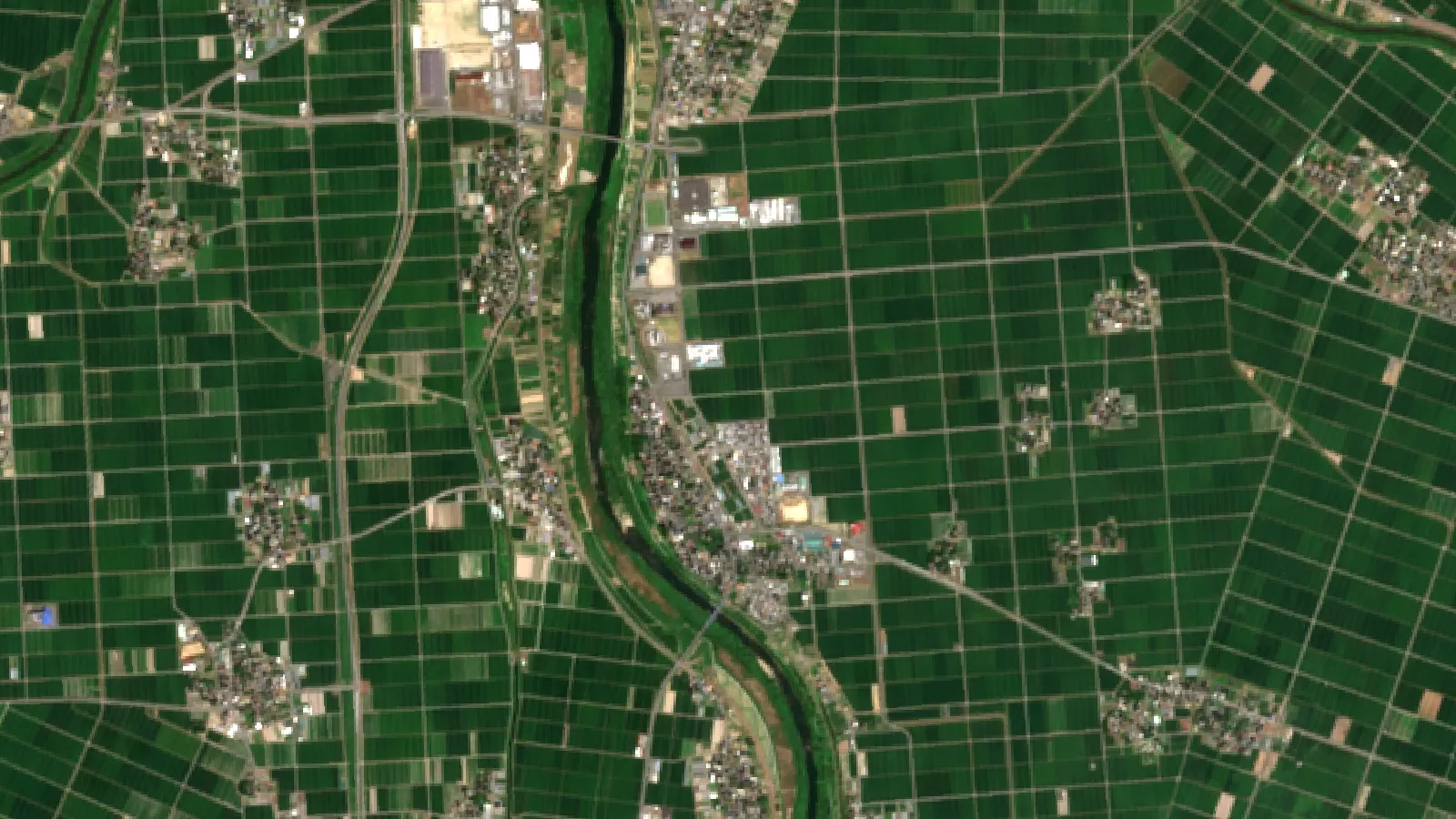
Key takeaways
- Japan’s average farm is 3.8 hectares, 34.6 in Hokkaido and 2.7 elsewhere; core farm workers number 986,600 with an average age of 67.7 (MAFF survey 2026, via Nippon.com).
- Farmland fell from 6.09 million hectares in 1961 to 4.27 million in 2024, and calorie self-sufficiency is about 38% (MAFF).
- On MAFF demonstration sites, drone spraying cut hours by 61% on average, automatic water control by 80% and assisted rice planters by 18%.
- Greenhouse vegetables earned about 2.9 times the income of open-field vegetables per 10 ares in 2014 (MAFF).
- Targets for 2050: pesticide risk down 50%, fertilizer use down 30%, organic farming on 1 million hectares (MAFF).
In this article
- Japanese farming methods at a glance
- Why farms in Japan are built this way
- Satoyama and terraces: the older systems
- Rice: area, crop and prices
- 1. Robot tractors and assisted planters
- 2. Drone spraying
- 3. Automatic water management in paddies
- 4. Greenhouses and protected horticulture
- 5. Integrated pest management and fewer chemicals
- 6. Rotation and paddy-field conversion
- 7. Shared data and satellite monitoring
- Livestock: a dairy feed example
- What farmers outside Japan can copy
- Will a smart machine pay on your farm?
Japanese farming methods are built around small, scattered plots and too few farmers. The average Japanese farm works 3.8 hectares, and the core farming workforce is 986,600 people with an average age of 67.7 (Nippon.com summary of the 2026 MAFF survey, July 2026). To keep producing, farms use paddy-field water control, greenhouses, drones, robot tractors and shared data, on top of older systems such as satoyama and terraced paddies.
This guide covers seven techniques, each with official numbers from Japan’s Ministry of Agriculture, Forestry and Fisheries (MAFF) or the US Department of Agriculture. It also charts how much farmland Japan has lost since 1961 and how food self-sufficiency fell, and gives a calculator to test whether a labour-saving machine would pay on your own farm. For another angle on the same country, see our overview of smart farming technology in Japan.
Japanese farming methods at a glance
The table sums up the seven techniques. Each has its own section below with the source behind the figure. Results come from MAFF demonstration sites or MAFF statistics, so treat them as examples from Japan, not promises for another country or crop.
| Technique | Problem it tackles | Result reported by MAFF | Used for |
|---|---|---|---|
| 1. Robot machines | Too few operators | Assisted rice planters cut work hours 18% on average | Paddy rice, field crops |
| 2. Drone spraying | Heavy spraying work | Spraying hours down 61% on average | Rice, orchards, vegetables |
| 3. Water control | Daily paddy checks | Water work hours down 80% on average | Paddy rice |
| 4. Greenhouses | Small land, short seasons | Income per 10 a about 2.9 times open-field vegetables (2014) | Tomato, strawberry, cucumber |
| 5. Less chemical use | Input cost, environment | Target: risk-weighted pesticide use down 50% by 2050 | All crops |
| 6. Rotation and paddy conversion | Rice demand falling | Area payments move paddies to feed rice, wheat, soy | Paddy fields |
| 7. Shared data | Many small plots | WAGRI platform feeds private farm services | All farms |
Why farms in Japan are built this way
Japan’s farm sector is small, old and shrinking. MAFF’s FY2025 annual report summary shows farmland fell from 6.09 million hectares in 1961 to 4.27 million hectares in 2024. Farm households fell from 6.06 million in 1960 to 1.75 million in 2020 (MAFF, FY2025 Summary of the Annual Report).
Chart
Japan’s farmland area, 1961 to 2024
Million hectares, selected years
The 2026 MAFF farm survey (MAFF, Survey on Agricultural Structure Trends, 2026, in Japanese), as reported by Nippon.com, counted 799,700 farm operations. Of these, 759,000 were run by individuals and 40,700 by groups, of which 34,600 were incorporated. The average farm used 3.8 hectares: 34.6 hectares in Hokkaido and 2.7 hectares in the rest of Japan. People aged 70 or over made up 56.5% of core farm workers, and those under 30 made up 1.2% (Nippon.com, July 2026).
Rice farms are small too. Among Japanese farms selling rice, 58.7% grew it on less than one hectare (Nippon.com, July 2026). A machine’s cost is spread over very little land on these farms.
Farmland consolidation is one response. MAFF set up Farmland Banks in 2014 to pass land to main operators. Its review of regional plans found that about 30% of the farmland area covered had no future operator named (MAFF, FY2025 summary).
Food supply and rice demand
Japan’s calorie-based food self-sufficiency was 73% in fiscal 1965 and about 38% in 2024. The Basic Plan target is 45% by fiscal 2030 on the same calorie supply basis (MAFF, Basic Plan reference, May 2025). Rice eating fell too, from 117.4 kg per person a year in 1961 to about 53.4 kg in 2024 (MAFF, FY2025 summary). Less rice demand is the main reason for the paddy conversion in technique 6.
Chart
Japan’s calorie-based food self-sufficiency
Percent, calorie supply basis, selected years (1965 is the first year; 2024 is approximate)
Satoyama and terraces: the older systems
Two older systems still shape Japanese farmland. Satoyama is the mosaic of paddies, dry fields, managed woodland, ponds and villages at the foot of the mountains. Farmers use the nearby woods and water for fuel, compost and irrigation. The International Partnership for the Satoyama Initiative was set up on 19 October 2010 at the biodiversity conference in Nagoya, with 51 founding member organisations (IPSI).
Tanada are terraced rice paddies cut into steep slopes. Water moves from the top terrace down through each field below, so one source can irrigate a whole hillside. Terraces take a lot of hand work. MAFF added terraced paddies and hilly and mountainous areas to its smart farming demonstrations in 2020.
Rice: area, crop and prices
Rice is still the centre of Japanese farming. USDA FAS Tokyo estimates the 2025/26 crop (market year starting November 2025) at 7.48 million tonnes milled, grown on 1.47 million harvested hectares, up from 7.29 million tonnes on 1.46 million hectares a year earlier (USDA FAS Tokyo, Grain and Feed Annual, 2026). The unmilled (rough) crop was 10.28 million tonnes for 2025/26. The same table lists a rough-rice yield of 6.99 tonnes per hectare for 2025/26.
The area rose in 2025/26 because high prices pulled farmers back to table rice. USDA expects it to fall again to 1.46 million hectares in 2026/27, as older farmers leave and some paddies move to wheat, barley and corn. The lesson for any rice region is that area and price move together, and a policy that pays for other crops changes what gets planted.
1. Robot tractors and assisted planters
MAFF has run its Smart Agriculture Demonstration Project since 2019. It put robots, AI and sensors on working farms in 217 districts, and an Act on the Promotion of Smart Agricultural Technology Utilization came into force in 2024 (MAFF, Promotion of Smart Agriculture, October 2025).
Rice planters with steering assist, which keep a straight line, cut operation hours by 18% on average across the demonstration sites. The range was wide: at one listed site the machine took more time than the manual method, and at others it saved up to 40%.
One example is a farming corporation in Gifu Prefecture working 196 hectares of rice and wheat. After it bought robot tractors and assisted planters, women with no earlier field experience became operators. The area under management grew from 164 to 196 hectares, and exported rice rose from 70 to 194 tonnes. A burdock and carrot farm in Miyazaki grew its planted area 1.4 times, from 16.7 to 23.9 hectares, after buying robot tractors and radio-controlled mowers (MAFF, October 2025).
Field size decides the gain. A 2025 review of the demonstration results by a Ritsumeikan University researcher found that the time saved by autonomous tractors on ploughing was larger in large fields, and that combine harvesters were less effective in narrow plots (FFTC Agricultural Policy Platform, December 2025). A review of smart farming in Asia describes a Hokkaido University floating robot (an unmanned surface vehicle) for paddy fields, tested with lateral errors of 250 and 380 mm, and calls it a less costly and more flexible tool than a ground tractor for paddy work (Smart agriculture in Asia, PMC).
Best for: farms with a labour shortage and fields big enough to give a robot long, straight passes. Watch out for: machine cost and the need for someone trained to run it.
2. Drone spraying
Pesticide spraying with drones cut operation hours by 61% on average in MAFF’s demonstration sites, and the saving ranged from 32% to 89% across the sites listed. MAFF reports that drone spraying gave the same control effect as pump-and-engine spray combinations, and workers no longer had to drag a hose through the field (MAFF, October 2025).
Chart
Work hours saved by smart farming, three tasks
Average cut in operation hours on MAFF demonstration sites (7 drone, 4 water-management and 10 planter sites)
In its sustainable food strategy, MAFF also shows pinpoint pesticide application by drone, where the drone images the whole field so that spraying can target the spots that need it (MAFF, Strategy MIDORI, April 2023). Always follow the product label and your local spraying and drone rules; they differ by country and region.
Best for: rice and orchards on steep or wet ground where walking with a sprayer is slow. Watch out for: drift, licensing and the label’s rules on rate and re-entry. The FFTC review adds that drone spraying needs permission and reporting for legal and safety reasons.
3. Automatic water management in paddies
Paddy rice needs water levels checked often. In MAFF’s demonstrations, automated water-management systems cut the hours of that work by 80% on average (MAFF, October 2025). One site also used deep-water management as a cold-weather measure, and the sterility rate stayed at 2.8% with no damaged grain.
The sensors are cheap compared with a tractor. The FFTC review lists water-management systems at up to JPY 0.75 million (about US$4,800), and notes they reduce patrol time but need attention to monthly fees and signal conditions. Prices are as listed in that paper; check current quotes.
The same material notes that changing the water intake hours can help against heat damage. This matters in a country where the summer of 2025 was the hottest since records began in 1898 (USDA FAS Tokyo, Grain and Feed Annual, 2026).
The same report says quality held up in 2025 despite that heat: about 76% of the crop graded first class. In the 2023 crop year only 61% did, because heat damage reduced milling yields.
4. Greenhouses and protected horticulture
MAFF says vegetables, fruit and flowers make up about 40% of Japan’s farm output by value, and that 85% of new farmers choose these crops. Greenhouses hold a large share of some crops: in 2014, greenhouses covered 6,971 hectares of tomatoes (74% of tomato production), 3,970 hectares of strawberries (88%) and 3,525 hectares of cucumbers (61%) (MAFF, Situation of Greenhouse Horticulture, February 2018).
Chart
Income per 10 ares by farming type, 2014
Thousand yen per 10 ares (0.1 ha), income after costs
Money explains it. MAFF’s 2014 figures give an income of about 462,000 yen per 10 ares (0.1 hectare) for greenhouse vegetables, against 158,000 yen for open-field vegetables. The greenhouse crops also took more labour: 338 hours per 10 ares against 191.
The same document points out a gap. Tomato yield per 10 ares in the Netherlands rose sharply after computer-based climate control spread, while Japan’s yield stalled at a lower level. Better environmental control is where MAFF saw room to grow. The figures are from 2014, so check current numbers for your own market.
Best for: high-value vegetables and fruit on small plots. Watch out for: fuel cost, build cost and the extra labour.
5. Integrated pest management and fewer chemicals
Japan’s national strategy sets a target for 2050: cut risk-weighted use of chemical pesticides by 50% through integrated pest management (IPM) and new alternatives. It also aims to cut chemical fertilizer use by 30% and raise organic farming to 1 million hectares, equal to 25% of farmland (MAFF, Strategy MIDORI, April 2023).
These are targets, not results. In IPM, farmers scout fields, use traps and natural enemies first, and spray only when a pest passes a set threshold. Sensors and drone images can help find the spots to treat. The sooner a stressed patch is found, the smaller the area that needs treatment. Satellite images show a change in plant vigour; they do not name the pest, so a field visit still decides what to do. Follow the label and local rules for any product you use.

▶ Why optical satellite pictures fail under cloud and how radar imagery still sees the field. · 2:37
6. Rotation and paddy-field conversion
With less rice eaten, MAFF pays farmers to use paddies for other things. Its “Direct Payment for Rice Paddy Utilization” program pays by area to move paddies from table rice to processing rice, feed rice, soybeans or wheat, and corn in Japan is mainly grown in paddy fields as a substitute crop for rice (USDA FAS Tokyo, 2026). MAFF’s Basic Plan says the paddy policy will be fundamentally reviewed from FY2027, with the direct payment converted to support for productivity gains for each crop (MAFF, Basic Plan reference, May 2025).
Farmers respond to price. When table rice prices jumped in 2025, feed rice plantings halved as growers switched back to table rice. USDA expects some area to move back to feed rice as prices ease, and total rice area to fall as some paddies shift to wheat, barley and corn. Rice prices in Japan rose 67.5% in 2025, the largest rise since 1971, and private rice imports hit a record in the 2024/25 market year (USDA FAS Tokyo, 2026).
Alternating paddy and dry crops also changes the field’s water cycle and can break pest and disease cycles. Local advisers know which rotation suits your soil.
7. Shared data and satellite monitoring
MAFF built an agricultural data platform, WAGRI, to share and link farm data. Private companies use it to build services for farmers (MAFF, October 2025). MAFF says the aim is to let farmers use shared data to improve productivity and management.
Satellites fit Japan’s pattern of many small plots, because one image covers a whole district. Farmonaut Satellite + AI Farm Monitoring System shows vegetation maps for fields you draw, and its satellite data API lets developers pull the same data into their own apps; see also the API developer docs. Farm users can also open the web and mobile apps.

▶ Six plain steps to start precision farming without buying a robot, from field maps to satellite monitoring. · 4:18
Livestock: a dairy feed example
MAFF’s smart farming demonstrations include livestock. One example is a feed centre in Nakashibetsu, Hokkaido, which makes mixed feed (TMR) for dairy farms. It uses smart technology across pasture grass, forage corn and raw milk production, aiming to cut feed-making hours by more than 10% and raise milk quality by improving feed quality (MAFF, October 2025).
The idea is to link the steps: forage growing, silage, ration design and milk records. A farm that records these in one place can see which fields feed its herd best.

▶ The benefits of mixing crops and livestock on one farm, explained step by step. · 2:55
What farmers outside Japan can copy
Japan’s examples are for small plots and few workers, which many farms in the US, Canada, Europe and Australia and New Zealand also face on part of their land. Five steps follow from the evidence above.
- Find the job that eats the most hours. MAFF’s gains were largest for water checks and spraying, not for every task.
- Run a small trial first. The range of results across MAFF sites was wide, from a loss on one site to large savings on others.
- Match the machine to field size. The FFTC review found robot tractors gain more in large fields.
- Cut input use by looking before you spray or spread. Map the field, scout the weak patches and treat those. Follow the label and local rules.
- Keep records in one place. Japan’s WAGRI platform links weather, farmland map, soil and other data so private services can use it (MAFF, October 2025).
Equipment dealers, your extension service and your lender can help you cost out each step. Rules on drones, chemicals and subsidies differ by country, so get professional advice before you buy.
Will a smart machine pay on your farm?
Use the calculator to test one labour-saving machine. Enter your area, the hours the job takes now, the share of time you expect to save, your labour cost and the extra yearly cost of the machine. MAFF’s demonstrations show average savings from 18% to 80% depending on the task, so the share you enter should come from a trial on your own farm, not from a headline average.
Try the numbers for your own farm below.
Calculator
Would a labour-saving machine pay for itself on your farm?
Enter your own area, hours, wage and machine cost.
- Hours saved per year: 90 h
- Labour cost saved per year: $1,800
- Break-even share of hours saved: 33.3 %
Example values only, not a benchmark or a forecast. Set the time saved from a trial on your own farm: MAFF demonstration sites averaged 18% for assisted rice planters, 61% for drone spraying and 80% for automatic water management, with wide site-to-site ranges (MAFF, October 2025). Wage and machine cost are examples; use a current quote and your own wage. The result ignores fuel, repairs, subsidies, tax and resale value.
How we checked the numbers
Farm structure, farmland and rice figures come from MAFF documents and a USDA FAS Tokyo report; the 2026 workforce figures come from Nippon.com’s summary of the MAFF survey. We kept each year and each unit. Smart farming results are averages from MAFF demonstration sites, not nationwide measurements. Greenhouse income figures are for 2014. Targets for 2050 are labelled as targets. Every source is listed at the end of the article.
FAQ
What makes farming in Japan different from other countries?
Plots are small and farmers are few and old. The average farm is 3.8 hectares, and the average core farm worker is 67.7 years old (Nippon.com, July 2026). Rice grown in flooded paddies is the main crop, and greenhouses, drones and robots help fill the labour gap.
How much farmland does Japan have?
About 4.27 million hectares in 2024, down from 6.09 million in 1961 (MAFF, FY2025 summary).
What is the main crop in Japanese agriculture?
Rice, by number of farms: 55.7% of farm operations earn most of their sales from rice (MAFF, 2026 survey). By output value, MAFF’s 2016 statistics put livestock (34.4%) and vegetables (27.8%) ahead of rice (18.0%) (MAFF, Situation of Greenhouse Horticulture, 2018). USDA estimates the 2025/26 rice crop at 7.48 million tonnes milled from 1.47 million harvested hectares (USDA FAS Tokyo, 2026).
Does Japan grow enough food for itself?
No. On a calorie basis Japan’s food self-sufficiency was about 38% in 2024, against 73% in fiscal 1965. The Basic Plan target is 45% by fiscal 2030 (MAFF, Basic Plan reference, May 2025).
What is satoyama?
A mosaic of paddies, dry fields, woods, ponds and villages at the foot of hills, where farmers use the surrounding land for compost, fuel and water. An international partnership for such landscapes was founded in Nagoya in 2010.
Can small farms use these methods?
Some can. Japan’s average farm is 3.8 hectares, but the MAFF examples above include larger operations (24 to 196 hectares), so results on very small plots may differ. The calculator above shows when the numbers add up. Machines cost money, so test with your own hours and labour cost first, and get professional advice before buying.
Related pages on our site: smart agriculture in Japan, Japan farm size and trade data, AI in agriculture, farm management apps, machinery management, field advisory, carbon footprint tracking and product traceability.
Farmonaut satellite data API
Build farm monitoring into your own app
Farmonaut offers a satellite data API for developers who want field vegetation maps inside their own farm software.




Keep reading
Sources
- MAFF, FY2025 Summary of the Annual Report on Food, Agriculture and Rural Areas in Japan (information to March 2026): maff.go.jp
- MAFF, Promotion of Smart Agriculture (October 2025): maff.go.jp
- Nippon.com, Japan’s Agricultural Workforce Drops Below 1 Million (29 July 2026), on the 2026 MAFF survey: nippon.com
- USDA FAS Tokyo, Grain and Feed Annual, JA2026-0011 (2026): apps.fas.usda.gov
- MAFF, Situation of Greenhouse Horticulture (February 2018): maff.go.jp
- MAFF, Strategy MIDORI and Climate-Smart Agriculture (April 2023): maff.go.jp
- International Partnership for the Satoyama Initiative, About IPSI: satoyama-initiative.org
- FFTC Agricultural Policy Platform, Smart Agriculture and AI Applications: Cases of the Demonstration Project in Japan (December 2025): ap.fftc.org.tw
- PMC, Smart agriculture in Asia: pmc.ncbi.nlm.nih.gov
- MAFF, First Basic Plan for Food, Agriculture and Rural Areas under the revised Basic Act, reference (May 2025): maff.go.jp
- MAFF, Results of the 2026 Survey on Agricultural Structure Trends (Japanese-language PDF): maff.go.jp
Discussion
Questions, corrections or field experience? Share them below. First-time comments are reviewed before they appear, and your email is never published.
No comments yet. Be the first to add a question or your experience.

 AdBio
 MISE Maroc
 Drift-Sense
 NWNS
 Hydenmet
 Red August Group
 Farm Inc
 WeMe Global
 Agrotoken
 Blue BearX
 Insignito
 Croptimum
 DnCubed
 Field Capacity
 Indosistim Teknologi
 Liquify Digital
 CU Foods
 BeyondTech Global

 Licence holder · Niger · Gold
 Licence holder · Nigeria · Gold + lithium










