

Farm education · Australia course guide
Online Agriculture Courses in Australia: 6 With Fees
TAFE Queensland’s online Diploma of Agriculture costs A$4,400 to A$8,150 in total for 2026, and the University of Queensland’s online Master of Agribusiness about A$9,835 a year. Six options compared by delivery, length and published fee.
Key takeaways
- TAFE Queensland lists its online self-paced Diploma of Agriculture at A$4,400 (concession), A$5,260 (subsidised) or A$8,150 (full fee), planned over 2 years part time.
- South West TAFE runs the same diploma with a weekly two-hour virtual class plus eight workshop days; Victorian Skills First subsidies cover much of the tuition for eligible students.
- UQ Skills lists a course cap of A$19,290 for its blended Diploma of Agriculture at Gatton (2026 fee schedule).
- The University of Queensland’s Master of Agribusiness can be completed online in 1.5 to 2 years, at an indicative A$9,835 a year.
- A short UWA course on Coursera takes about 2 weeks at 10 hours a week and suits a first look at farm economics.
In this article
- Agriculture courses in Australia at a glance
- How we chose these courses
- The six online agriculture courses compared
- What agriculture courses cost in Australia
- How to choose an online agriculture course
- Online agriculture courses and farm technology
- Courses on carbon, sustainability and traceability
- Careers after agriculture courses
- Agriculture courses for readers outside Australia
- Is an online agriculture course worth it?
- FAQ
- Conclusion
The online agriculture courses in Australia worth a first look cover three levels. A nationally recognised Diploma of Agriculture from a TAFE costs from about A$4,400 to A$8,150 in total at TAFE Queensland, depending on whether you get a subsidised place. Online postgraduate agribusiness study runs at about A$9,835 a year at the University of Queensland. Short university courses on platforms such as Coursera take about 20 hours.
This guide compares six options we checked on the providers’ own pages in November 2026: what each one teaches, how it is delivered, how long it takes and what it costs. It also has a calculator to work out the cost per study hour and how long a course takes to pay back, with example numbers you can replace with your own.
Agriculture courses in Australia at a glance
The table sums up the six options. Fees are the published amounts for 2026 study unless the row says otherwise. They are list fees from the provider, not what every student pays: subsidies, concessions and loans change the real cost.
| Course | Provider | Level | Delivery | Length | Published fee |
|---|---|---|---|---|---|
| Diploma of Agriculture | TAFE Queensland | Diploma (AQF 5) | Online, self-paced | 2 years part time | A$4,400 to A$8,150 total |
| Diploma of Agriculture | South West TAFE (Victoria) | Diploma (AQF 5) | Weekly virtual class plus 8 workshop days | 2 years | Subsidised places for eligible students |
| Diploma of Agriculture | UQ Skills, Gatton | Diploma (AQF 5) | Blended | Units across terms | Course cap A$19,290 |
| Master of Agribusiness | University of Queensland | Master’s (AQF 9) | Can be completed online | 1.5 to 2 years full time | About A$9,835 a year |
| Graduate Certificate or Master of Agribusiness | Marcus Oldham College | Postgraduate | 100% online, 2 optional blended units | Part time or full time | See college fee list |
| Agriculture, Economics and Nature | University of Western Australia on Coursera | Short course | Online, self-paced | About 2 weeks at 10 hours a week | Paid certificate; trial and financial aid offered |
Chart
Published total fees for selected courses
A$, list fees for 2026 study; selected courses that publish a total
How we chose these courses
We looked for agriculture courses that a farmer, farm worker or career changer in Australia can study mainly from home. Each option had to meet four tests.
- Real online delivery. Most or all of the learning happens online. Where a course needs workshop days or a residential week, we say so.
- A published fee or a clear fee rule. We used the fee the provider shows on its own page or fee schedule, and we give the date.
- A recognised outcome. A nationally recognised qualification, a university award, or a university-made short course with a certificate.
- Relevance to farm work. Crop and livestock production, farm business, or the economics of land use.
We did not rank by price alone. A cheap course that does not lead where you want to go is poor value. Instead, each option has a “Best for” line. The list is not complete. Many other TAFEs, agricultural colleges and universities run agriculture courses with online parts, and their fees and modes change each year.
The six online agriculture courses compared
1. Diploma of Agriculture, TAFE Queensland
TAFE Queensland offers the national Diploma of Agriculture (AHC50122) as online self-directed study. You work through the material at your own pace through its learning system, and courses start soon after you enrol. The course page plans for 2 years of part-time study at up to 10 hours a week for an existing farm worker.
The TAFE Queensland course page lists three total fees: A$4,400 for a concession student, A$5,260 for a subsidised student and A$8,150 as the full fee. The qualification needs all core units plus 8 electives. Units cover farm planning, natural resources, budgets and production planning. If you already work on a farm, Recognition of Prior Learning (RPL) can give credit for skills you have.
Best for: farm workers and managers in Queensland who want a full diploma at their own pace with no set class times.
2. Diploma of Agriculture, South West TAFE
South West TAFE in Victoria runs the same national diploma over two years with a mix of online and in-person study. The South West TAFE course page describes one two-hour virtual class a week, eight full-day workshops at its Glenormiston training site during school holidays, and self-paced online study. You need 10 units: 2 core and 8 electives.
Tuition is charged as an hourly rate. A large part is subsidised by the Victorian Government for eligible students under Skills First, so the price you pay depends on your age, past study and residency. The page lists four tuition rates; only one applies to you.
Best for: students in south-west Victoria who want a live weekly class and some hands-on days, not study alone.
3. Diploma of Agriculture or Agribusiness Management, UQ Skills
UQ Skills is the vocational arm of the University of Queensland, based at the Gatton campus. Its February 2026 tuition fee schedule lists the Diploma of Agriculture (AHC50122) in blended mode with a course cap of A$19,290. Each unit has three prices. Most units shown cost A$1,899 at the full fee, A$1,549 at the subsidised rate and A$1,456 at the subsidised concession rate.
The July 2026 fee schedule lists the Diploma of Agribusiness Management (AHC51422) in the same way, with the same A$19,290 cap. Units include “Select and use agricultural technology”, “Manage integrated crop and pasture production” and “Prepare and monitor budgets and financial reports”.
Best for: students who can reach Gatton for blended sessions and want a diploma tied to a university campus.
4. Master of Agribusiness, University of Queensland
The University of Queensland program page lists the Master of Agribusiness (program 5562) as available externally, and says the program can be completed online. It takes 1.5 or 2 years full time (or part-time equivalent), depending on your past study. Starts are in Semester 1 (23 February 2026) and Semester 2 (27 July 2026). The indicative annual fee is A$9,835 for 16 units.
The same degree is listed through Open Universities Australia, which gives an indicative total fee of A$19,670 for an Australian citizen studying full time. It notes that some subjects or assessments may need you to attend a campus or an exam centre. An optional placement of up to 160 hours is available.
Best for: graduates who want to move into management, supply chain or policy roles in agribusiness.
5. Graduate Certificate or Master of Agribusiness, Marcus Oldham College
Marcus Oldham College in Geelong is a private agricultural college. Its postgraduate studies page says the units are delivered 100% online through the D2L learning system. You can mix part-time and full-time study and choose the order of units. Two units, Leadership and Independent Reading Study, can be taken in blended mode with a residential week on campus.
The Graduate Certificate is for people returning to study or already in an agribusiness role. Its units are also core units of the Master, so you can step up later. The college says the Master focuses on business development, management and leadership more than practical farm skills. New students take the compulsory core units early, and intakes follow the college trimesters.
Best for: people already working in agribusiness who want a part-time, fully online postgraduate path.
6. Agriculture, Economics and Nature, University of Western Australia on Coursera
This short course is taught by Professor David Pannell of the University of Western Australia. The Coursera course page lists it as beginner level with 7 modules, about 2 weeks at 10 hours a week. Topics include the history of farm production and prices, water and phosphorus limits, herbicide resistance, input use, land conservation, benefit-cost analysis and farm policy. The page showed 57,972 people enrolled and a 4.7 rating from 563 reviews when we checked in November 2026.
To get the graded assignments and a certificate you pay for the certificate. The page says some learners can start with a trial or apply for financial aid. It is not a formal qualification, but it is a quick way to learn the economics behind farm decisions.
Best for: anyone who wants a short, university-made course before committing to a diploma or degree.
What agriculture courses cost in Australia
The fee you see on a course page is rarely the fee every student pays. Three things change it.
Chart
TAFE Queensland Diploma of Agriculture: total fee by student type
A$, total course fee, online self-directed study, listed November 2026
- Subsidised places. State governments pay part of the tuition for eligible students in many vocational courses. At TAFE Queensland the subsidised diploma fee is A$5,260 against a full fee of A$8,150. In Victoria, South West TAFE says a large part of tuition is covered by Skills First for eligible students.
- Concessions. Holders of some concession cards pay less. TAFE Queensland lists A$4,400 for concession students.
- Student loans. Diplomas may be eligible for VET Student Loans, and university places may be eligible for HECS-HELP or FEE-HELP. Check your eligibility with the provider before you enrol.
Postgraduate fees are higher per year. The University of Queensland gives an indicative A$9,835 a year for its Master of Agribusiness for 16 units of study. Fees are reviewed each year, so treat every figure here as the 2026 list fee.
The fees in this guide are list fees taken from provider pages and schedules in November 2026. They do not include books, travel to workshops or the cost of time away from the farm. For loans, subsidies and tax, get advice from the provider or a qualified adviser.
How to choose an online agriculture course
Start from the job or skill you want, then work back to the course. These steps help.
- Name the goal. Do you want to run a farm, manage staff, move into agribusiness, or learn one topic such as soils or farm economics? A diploma suits farm managers. A master’s suits agribusiness and policy roles. A short course suits one topic.
- Check the level. National diplomas such as AHC50122 sit at AQF level 5. A master’s sits at AQF level 9. Short courses on platforms like Coursera do not give an AQF award.
- Check how “online” it is. Some courses are fully online. Others need workshop days, a residential week, or exams on campus. South West TAFE, for example, has eight workshop days.
- Check the time. TAFE Queensland plans up to 10 hours a week over 2 years. Count the weeks of calving, sowing and harvest when you will have little time.
- Work out the real cost. Ask whether you qualify for a subsidised place, a concession or a loan, and add travel and books.
- Ask about credit. RPL can shorten a diploma if you already do the work. Some graduate certificates count towards a master’s.
- Talk to the provider. Ask for the unit list, the start dates and who teaches the course.

▶ Six plain steps to start precision farming, from field maps to satellite monitoring. · 4:18
Online agriculture courses and farm technology
Many agriculture courses in Australia now include units on farm technology. The UQ Skills agribusiness diploma, for example, includes a unit on selecting and using agricultural technology. The skills that matter most are practical: reading a paddock map, keeping clean records, and judging whether a tool pays for itself.
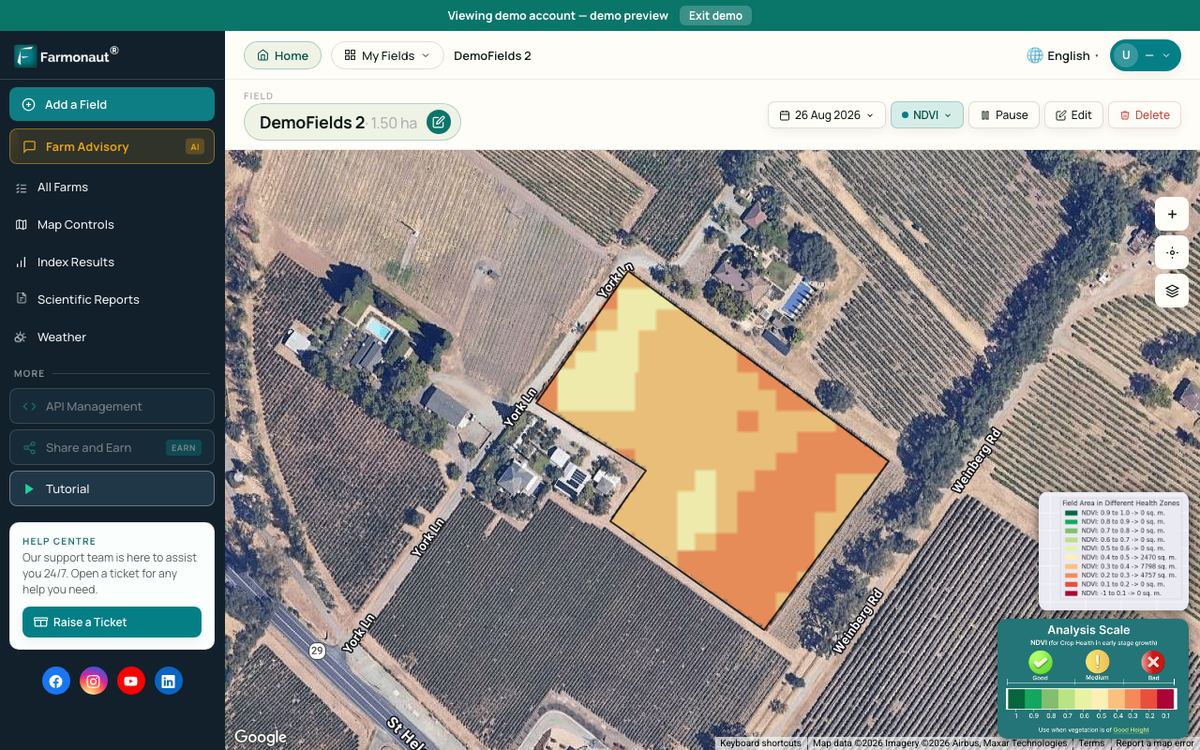
Satellite crop monitoring is one tool you can practise with while you study. Services such as Farmonaut show vegetation maps of your paddocks from satellite images through the season. This helps you see which parts of a paddock grow differently and where to walk first. For records, staff and machinery, see our pages on farm management software and fleet management. Developers and students who want to work with satellite and weather data can read the satellite and weather API documentation.
Courses also teach why farm income swings. The ABS reported that the gross value of wheat in Australia rose 33% to A$13.1 billion in 2021-22, from A$9.9 billion in 2020-21 and A$4.9 billion in 2019-20. A swing that large is why budgeting, risk and farm business units appear in almost every diploma listed here.
Chart
Gross value of Australian wheat
A$ million per financial year
Courses on carbon, sustainability and traceability
Buyers and lenders ask more questions about emissions, soil and where food comes from. Several courses in this guide touch these topics. TAFE Queensland’s diploma includes units on farm planning and natural resources such as water, soil and biodiversity. UWA’s Coursera course covers land conservation and the benefit-cost analysis of environmental projects.
If you want to see how these ideas work on a farm, read about carbon footprinting in agriculture and product traceability. Carbon market rules and reporting rules change, so check the current rules with the regulator before you act on them.

▶ A tutorial on the Farmonaut web app: drawing a field and reading satellite crop health maps. · 8:43
Careers after agriculture courses
Agriculture is a large employer of skilled people. The ABS counted 87,800 agricultural businesses in Australia in 2021-22 in its Agricultural Commodities release, on 369 million hectares of agricultural land. These farms need managers, agronomists, livestock staff, machinery operators and advisers.
A diploma suits farm and station manager roles, supervisors and people taking over a family farm. A master’s in agribusiness suits roles in banking, supply chains, marketing and policy. For job ideas, see our guide to agriculture and farming careers. For a plain list of steps from planning to harvest, read our steps to farm success.
▶ Twenty careers in agriculture, what each job involves day to day and what it pays. · 7:04
Agriculture courses for readers outside Australia
Many readers outside Australia search for the same kind of course. Coursera courses are open worldwide, so the UWA course above works from anywhere. For the United Kingdom, see our guide to online agriculture courses in the UK. For a hands-on example in the United States, see our page on a hydroponics course in Virginia.
Is an online agriculture course worth it?
A course is worth it when the skills lead to a better job, a better-run farm, or a decision you could not make before. The calculator below helps you think it through. Enter the total fee you will pay, the hours you expect to study, and any extra income or savings a year you expect from the new skills. It shows the cost per study hour and how many years the course takes to pay back.
Be careful with the income figure. No source gives a reliable pay rise for one course. Use a number you can explain, such as a role you have been offered, or a cost you know you can cut.
Try the numbers for your own farm below.
Calculator
What does a course cost per study hour, and when does it pay back?
Enter your own fee, study time and the extra income or savings you expect.
- Total cost: $5,500
- Total study hours: 800 hours
- Cost per study hour: $7
Example values only, not a benchmark or a forecast. The default fee is close to TAFE Queensland’s subsidised diploma fee (A$5,260, November 2026). Study hours default to 10 hours a week; the extra income figure is your own estimate, since no source gives a reliable pay rise for one course. Every number is an input.
FAQ
Can I study agriculture fully online in Australia?
Yes. TAFE Queensland offers the Diploma of Agriculture as online self-directed study, and Marcus Oldham College delivers its postgraduate agribusiness units 100% online. Some courses, such as South West TAFE’s diploma, add workshop days, so check the delivery mode first.
How much does a Diploma of Agriculture cost?
It depends on the provider and your eligibility. TAFE Queensland lists A$4,400 for concession students, A$5,260 for subsidised students and A$8,150 as the full fee. UQ Skills lists a course cap of A$19,290. These are 2026 list fees.
Are there no-cost agriculture courses online in Australia?
Some short courses let you start with a trial or apply for financial aid, as the UWA course on Coursera does. Formal qualifications usually have a fee, but state subsidies can cut the cost a lot for eligible students. Ask the provider what applies to you.
How long does an online agriculture diploma take?
TAFE Queensland and South West TAFE both plan about 2 years. TAFE Queensland plans part-time study of up to 10 hours a week. RPL can shorten the time if you already have the skills.
Do I need a degree for a Master of Agribusiness?
Usually yes. The University of Queensland sets entry rules based on your past degree, and the length depends on that study. Marcus Oldham College asks for a CV and transcripts and runs an eligibility check. Check each provider’s entry page.
Conclusion
For a recognised farm qualification, a TAFE Diploma of Agriculture is the main path, and TAFE Queensland’s online version shows the price range from A$4,400 to A$8,150. For agribusiness careers, the online master’s courses from the University of Queensland and Marcus Oldham College are options. For a quick start, a short university course on Coursera takes about 20 hours. Check the fee, the delivery mode and your eligibility for subsidies with each provider before you enrol, and use the calculator to see what the course costs per hour of study.
Ready to see your own paddocks from above? Open the Farmonaut app.
Farmonaut crop monitoring
See your own paddocks from space
Draw your paddocks once and Farmonaut shows satellite vegetation maps for them through the season, on web, Android or iOS.



Sources
- TAFE Queensland, Diploma of Agriculture (AHC50122) course page (accessed November 2026): tafeqld.edu.au
- South West TAFE, Diploma of Agriculture course page (accessed November 2026): swtafe.edu.au
- UQ Skills, Tuition fee schedule, courses commencing 9 February 2026: uqskills.uq.edu.au
- UQ Skills, Tuition fee schedule, courses commencing 27 July 2026: uqskills.uq.edu.au
- University of Queensland, Master of Agribusiness (5562), 2026: study.uq.edu.au
- Open Universities Australia, Master of Agribusiness, University of Queensland (accessed November 2026): open.edu.au
- Marcus Oldham College, Postgraduate studies (accessed November 2026): marcusoldham.vic.edu.au
- University of Western Australia on Coursera, Agriculture, Economics and Nature (accessed November 2026): coursera.org
- Australian Bureau of Statistics, Value of Agricultural Commodities Produced, Australia, 2021-22 (2023): abs.gov.au
- Australian Bureau of Statistics, Agricultural Commodities, Australia, 2021-22 (2023): abs.gov.au
Discussion
Questions, corrections or field experience? Share them below. First-time comments are reviewed before they appear, and your email is never published.
No comments yet. Be the first to add a question or your experience.

 SatSure
 Geno
 Hayleys Agriculture
 Linx Agritech
 Adinet
 Save Your Soils
 Grandstream Algérie
 XOS Realty
 Geospatial Lab Africa
 Agro La Gándara
 HIPSAC
 ZOL Zimbabwe
 Juligerm
 AdBio
 MISE Maroc
 NWNS
 Red August Group

 Licence holder · Niger · Gold
 Client · Somalia · Gold
 Client & affiliate partner · Ghana · Gold










