

Reviewed September 2026 against USDA NASS Farm Labor data and Defra’s Agricultural Workforce in England statistics.
Try it: Run your own numbers →
The fastest route into agriculture training without relocating or quitting a job is a mix of free self-paced modules (FAO e-learning Centre, Open University’s OpenLearn) for foundational topics, and paid university-backed courses (Coursera, edX, FutureLearn) for certification that carries weight with employers. A free 2–4 week module can confirm interest; a paid 8–12 week course with a named institution behind it is what shows up well on a CV. Below is a working comparison of both routes, a calculator to weigh cost against time-to-certificate, and the workforce data explaining why this decision matters more than it did a few years ago.
Introduction: Why Agriculture Training Matters Now
Searches for online agriculture courses, agriculture training, and short agriculture courses online spike for a practical reason: the workforce delivering food production is aging out faster than it is being replaced, and neither government retraining schemes nor university degree programmes fully cover the gap. Online courses fill the space between a full degree (too slow, too expensive for a working farmer) and no formal training at all (too risky given how fast precision-agriculture tools are changing day-to-day operations).
This guide separates the free options from the paid ones, gives you actual duration and cost ranges rather than vague estimates, and explains which online courses for agriculture are worth paying for versus which free modules cover the same ground.

The Workforce Numbers Behind the Demand
In the United States, USDA’s National Agricultural Statistics Service counted 797,000 hired farm workers during the reference week of October 2024, earning an average gross wage of $19.11 per hour across all hired labor and $18.57 per hour for field workers specifically, per the USDA NASS Farm Labor survey. USDA’s Economic Research Service separately puts total US agricultural employment at 1.18 million for 2024, per its Farm Labor topic page. NASS refreshes this data twice a year, in April and October reference weeks — check NASS’s Farm Labor survey guide for the current release.
In England, Defra’s June 2025 agricultural workforce count recorded 279,000 workers total, of whom 167,756 (60%) are farmers, business partners, directors, or their spouses rather than hired staff — a workforce structure that skews toward owner-operators rather than large hired crews. The age profile is the more urgent figure: 40% of England’s agricultural workforce is 65 or older, while only 5% is under 35, according to Defra’s Agricultural Workforce in England at 1 June 2025 release. This snapshot is published annually each June; Defra’s Agricultural Workforce collection holds the current year’s figures once released.
On the training-delivery side, Defra’s Farming and Countryside Programme delivered 137,000 learning hours across England in the 2024–25 programme year, and in Scotland, 525 training courses were badged as eligible for funding as of December 2025, according to the Farming and Countryside Programme Annual Report 2024 to 2025. Separately, industry analyst Technavio forecasts the UK e-learning market to grow at a 17.1% compound annual growth rate from 2026 to 2030, per its UK e-learning market report — a market-wide figure, not agriculture-specific, but relevant context for why more agricultural content is moving online.
Types of Online Agriculture Courses
“Online agriculture courses” is not one category. Three distinct types answer three different searches, and conflating them is why generic listicles rank poorly for specific queries:
- Free, non-credentialed modules: FAO e-learning Centre and OpenLearn. Two to six weeks, self-paced, no cost, often no certificate or a free certificate of participation only.
- Paid, university-branded MOOCs: Coursera, edX, FutureLearn courses built by named universities. Six to twelve weeks, £150–£600 depending on institution and format, with a verified certificate on completion.
- Accredited part-time or micro-credential programmes: Delivered directly by agricultural universities (Harper Adams, Open University in the UK), often blending live sessions with self-paced material, and carrying formal academic credit rather than just a completion certificate.
Someone searching “best online agriculture courses” is usually comparing across all three types without realizing they serve different goals — a free FAO module won’t help a CV the way a university-branded certificate will, but it costs nothing to find out if the subject interests you first.
Comparison Table: Free vs. Paid Online Agriculture Courses
| Course Name | Provider/Institution | Duration | Cost | Key Subjects | Format | Certificate |
|---|---|---|---|---|---|---|
| Agri-Food Tech & Innovation | University of Reading (FutureLearn) | 8 weeks | £150–£250 | Precision Ag, IoT, Data Analytics | Self-paced | Yes |
| Climate Smart Sustainable Agriculture | Harper Adams University | 12 weeks | £350–£600 | Sustainable Practices, Soil Management, Food Security | Live + self-paced | Yes |
| Introduction to Precision Agriculture | University of Edinburgh (Coursera) | 6 weeks | Free to audit / £35 certificate | Precision Techniques, GIS Mapping | Self-paced | Optional |
| Agroforestry in Practice | Open University (OpenLearn) | 4–6 weeks | Free | Agroforestry, Climate adaptation | Self-paced | No |
| Crop Pest & Disease Management | FAO e-learning Centre | 2–4 weeks | Free | Pest Control, Integrated Management | Self-paced | Yes |
| Digital Agribusiness Management | Imperial College London (edX) | 10 weeks | £200–£350 | Farm Business, Risk Analysis | Live/self-paced | Yes |
Costs and durations above are estimated ranges compiled from provider listings and are not published by a government statistical agency; verify current pricing directly on each provider’s site before enrolling, since neither UK, US, nor Australian statistical bodies publish a standardized agriculture course price index.

Short Agriculture Courses: What “Short” Actually Means
For the query “short agriculture courses online,” the honest answer is 2–6 weeks, self-paced, and almost always free or low-cost. The FAO e-learning Centre’s pest and disease modules run 2–4 weeks; OpenLearn’s agroforestry module runs 4–6 weeks; Coursera’s audit-mode precision agriculture course runs 6 weeks. None of these carry academic credit — they are skill-refreshers or interest-testers, not qualifications. If you need a short course that results in a recognized credential rather than just a certificate of completion, expect 8+ weeks minimum, because verification and assessment take time regardless of delivery format.
Agriculture Courses UK Online: Funding and Providers
For readers searching “agriculture courses uk online” specifically: Defra’s Farming and Countryside Programme is the government-funded channel, not a course catalogue itself. It delivered 137,000 learning hours in England in the 2024–25 programme year and, in Scotland, badges third-party courses as eligible for funding — 525 such courses were listed as of December 2025. This means UK farmers should check whether a course they’re considering already qualifies for funding support before paying full price; the Farming and Countryside Programme Annual Report lists the current scope.
Beyond Defra-funded routes, UK-specific online providers include:
- FutureLearn — UK-based, courses in nature and environment / agriculture, several free to audit.
- Harper Adams University and Open University — bespoke digital agriculture education and micro-credentials with UK academic accreditation.
- Coursera and edX — global platforms carrying UK university partners (University of Edinburgh, University of Reading, Imperial College London).
Readers outside the UK comparing regional options should also see our guide to online agriculture courses in Australia, which covers ABARES-relevant programmes and Australian providers separately from this page.

Calculator: Compare Course Cost Against Time-to-Certificate
Enter a course’s fee, its duration, and your available weekly study hours to see the effective cost per certified study-hour — useful for comparing a £600 12-week programme against a £35 6-week one on equal footing.
Run your own numbers
Assumptions: this calculator only weighs fee and time cost against study hours committed — it excludes certification value, career impact, or funding/subsidy offsets (such as Scotland's 525 funded courses) that may reduce your actual out-of-pocket cost. Wage input is optional; leave it at 0 to compare fees alone.
How to Choose: A Verification Checklist
Course catalogues change constantly and prices shift, but this checklist does not expire — apply it to any course, on any platform, at any time:
- Confirm the issuing institution directly. Search the university's own site for the course rather than trusting the aggregator's description — Coursera and edX listings occasionally lag behind institutional catalogue changes.
- Check whether the certificate carries academic credit or is completion-only. A "Certificate of Completion" is not equivalent to a credit-bearing micro-credential; ask the provider directly if unclear.
- Check for funding eligibility before paying. In Scotland, verify against the Farming and Countryside Programme's current list of badged courses; in England, check whether your course qualifies under the live programme year's funded-training list.
- Verify the syllabus date. Precision agriculture, satellite monitoring, and AI-driven tools move fast enough that a syllabus older than 2–3 years may be missing entire technology categories.
- Match duration to your actual capacity. Use the calculator above with your real weekly hours, not an optimistic estimate — course abandonment is highest when the weekly hour estimate was wrong from the start.
Farmonaut: Satellite Tools That Complement Course Learning
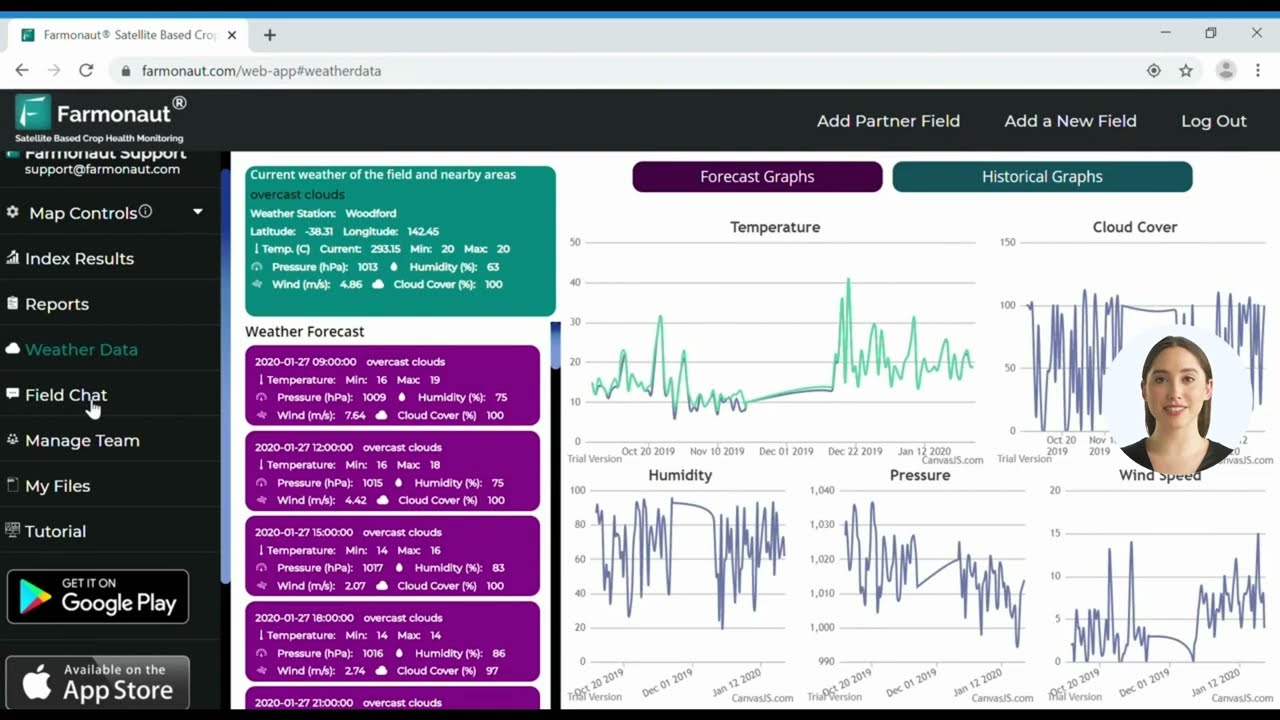
Course-based knowledge on precision agriculture, remote sensing, or supply-chain traceability is easier to retain when you can apply it to a live dataset. Farmonaut provides satellite-driven monitoring and advisory tools that put those concepts into practice:
- Environmental Impact Monitoring – Track carbon emissions from farming operations for compliance and sustainability reporting.
- Traceability Solutions – Blockchain-based tracking for transparent supply chains.
- Fleet Management Tools – Logistics optimization for vehicles and machinery.
- Crop Loan and Insurance Verification – Satellite-based verification for loan and insurance applications.
- Large-scale Farm Management – Digital dashboards and AI-powered analytics for expansive farms.
- Crop, Plantation & Forest Advisory – Real-time monitoring tailored to multiple crop types and forestry.


Download the Farmonaut App:



API for Developers: Integrate satellite and weather insights into your platforms:
API Access | Developer Documentation

Free Online Agriculture Courses in Full
For readers whose only question is "are there free options" — yes, and they cover more ground than a single module suggests:
- Soil health and fertility management — OpenLearn, FAO e-learning Centre.
- Pest and disease control — FAO e-learning Centre's Crop Pest & Disease Management module (2–4 weeks).
- Water management and irrigation — available across OpenLearn's environment catalogue.
- Agroforestry and sustainable agriculture — OpenLearn's Agroforestry in Practice (4–6 weeks, no certificate).
- Food security and rural resilience — FAO e-learning Centre's global development curriculum.
Full catalogues: Open University's OpenLearn, the FAO e-learning Centre, and FutureLearn's agriculture and environment courses (several free to audit, with a paid option for a verified certificate).
Free courses are the right first step if you want to confirm interest before paying, need to update knowledge against a specific policy or compliance change, or are constrained by budget — but they rarely substitute for a paid, institution-branded certificate if the goal is a CV credential rather than personal knowledge.
Frequently Asked Questions
What are the best online agriculture courses available now?
There is no single "best" — it depends on goal. For a free introduction, the FAO e-learning Centre and OpenLearn cover core topics at no cost. For a CV-ready certificate, university-backed courses via FutureLearn, Coursera, or edX (Reading, Edinburgh, Imperial College London, Harper Adams) run £150–£600 depending on duration and format, per the comparison table above.
Are there free online agriculture courses available?
Yes. The FAO e-learning Centre and OpenLearn both offer no-cost modules in soil science, pest control, and crop management, and several FutureLearn courses are free to audit.
What counts as a "short" agriculture course?
2–6 weeks, self-paced. FAO's pest management module runs 2–4 weeks; OpenLearn's agroforestry module runs 4–6 weeks. These are skill-refreshers, not credentials — expect 8+ weeks for anything carrying formal academic weight.
Do online agriculture courses offer certification?
Most paid platforms do; many free ones don't, or offer only a certificate of participation rather than a verified credential. Always check whether the course fee is required specifically for the certificate, separate from course access itself, before assuming a free course includes one.
Are there UK government funding routes for agriculture training?
Yes. Defra's Farming and Countryside Programme delivered 137,000 learning hours in England during the 2024–25 programme year, and in Scotland, 525 courses were badged as funding-eligible as of December 2025. Check the current annual report before assuming a specific course qualifies.
How can Farmonaut's technology support what I learn in these courses?
Farmonaut provides real-time crop and resource monitoring, environmental impact analytics, and blockchain-based traceability tools that let you apply precision-agriculture and remote-sensing concepts from a course to a live dataset. Explore the app suite and API.
What should I check before enrolling in an online agriculture course?
- Confirm the issuing institution directly on its own site, not just the aggregator listing.
- Check whether the certificate is credit-bearing or completion-only.
- Check for funding eligibility (UK: Farming and Countryside Programme) before paying full price.
- Verify the syllabus reflects current tools — precision agriculture content dates quickly.
Further reading:
Conclusion
The workforce data explains the urgency: 40% of England's agricultural workforce is 65 or older against just 5% under 35 (Defra, June 2025), and the US recorded 797,000 hired farm workers in October 2024 at an average $19.11/hour (USDA NASS) against a broader 1.18 million total agricultural employment (USDA ERS). Training capacity is expanding to meet this — 137,000 learning hours delivered in England and 525 funded courses badged in Scotland in the 2024–25 programme year — but the choice of course still comes down to matching free, short, no-credential modules against paid, longer, institution-backed certificates based on what you actually need the course to do for you.
Use the checklist above on any course you're considering, run the numbers through the calculator, and verify funding eligibility and syllabus currency before paying. That process doesn't expire even as the specific course catalogue changes year to year.

 Pixxel
 Sapoznick Farms
 Agrotoken
 Blue BearX
 Insignito
 Croptimum
 DnCubed
 Field Capacity
 Indosistim Teknologi
 Liquify Digital
 CU Foods
 BeyondTech Global
 Rouge VC
 AgroGreen Dynamics
 AgroRisk
 Oath Inc
 Reddane Farming
 Esri North East Africa
