

Fertilizer · NPK grade guide
5-10-5 Fertilizer: Uses, Rates and Blends Compared
A 50 lb bag of 5-10-5 holds 2.5 lb of nitrogen, 5 lb of phosphate and 2.5 lb of potash. Here is what it is for, how much to spread, and how it compares with 5-5-5, 15-5-10, 20-5-10 and potash-heavy blends.
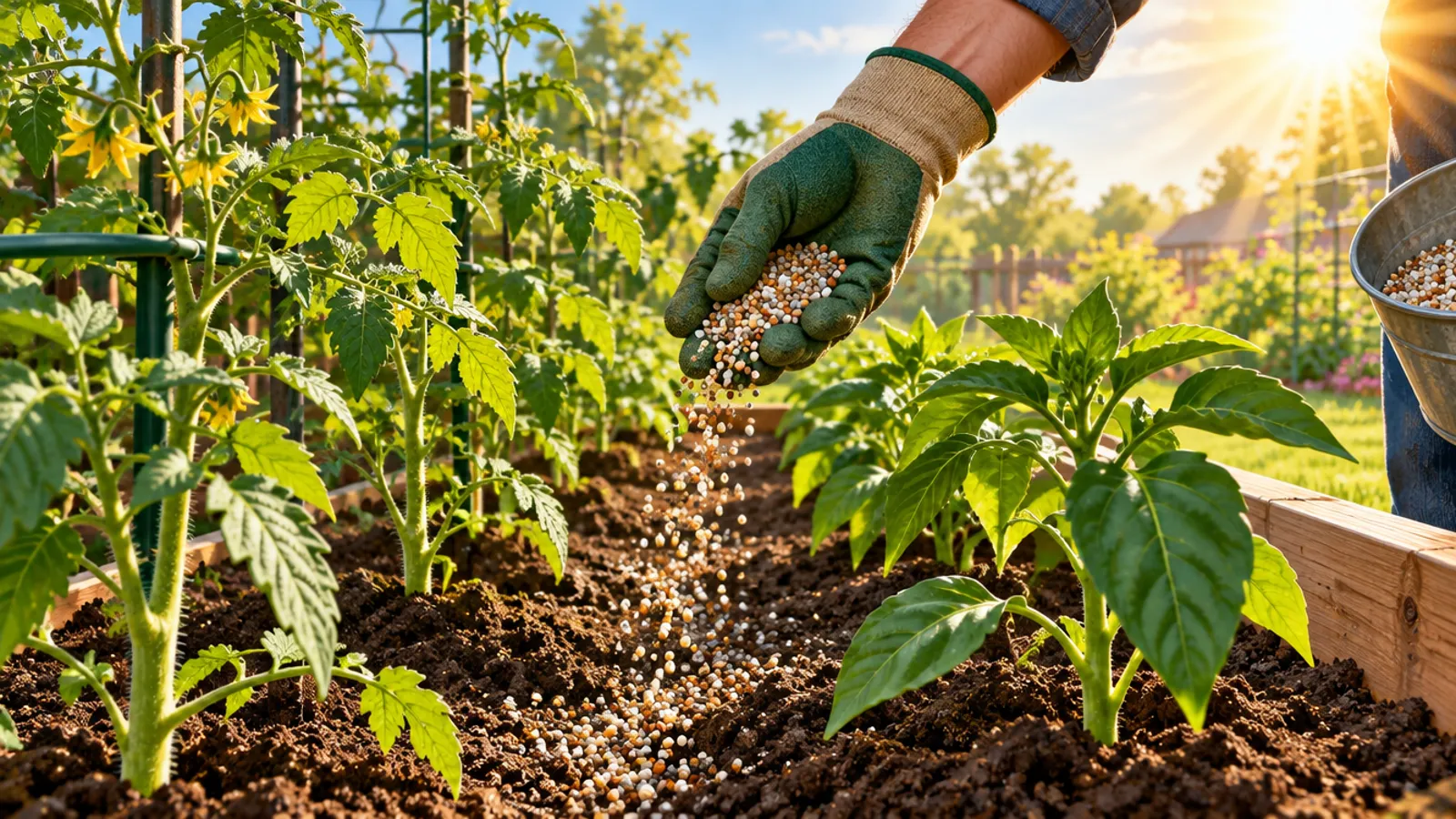
Key takeaways
- The numbers are percent by weight of N, phosphate (P2O5) and potash (K2O); multiply the middle number by 0.44 for phosphorus and the last by 0.83 for potassium (University of Maryland Extension).
- Virginia Tech suggests 2 lb of 5-10-5 per 100 feet of row as a side-dress; Penn State’s no-test garden rate of 1.75 lb of 10-10-10 per 100 sq ft equals 3.5 lb of 5-10-5 for the same nitrogen.
- 15-5-10 and 20-5-10 are nitrogen-led lawn and grass grades; 5-5-15, 5-10-20 and 10-5-15 feed potassium.
- Minnesota limits phosphorus on lawns: a ‘0% phosphate’ product may hold no more than 0.67% phosphate (Minnesota Department of Agriculture).
- DTN average US retail prices, last week of September 2026: DAP $934/ton, potash $499/ton, urea $683/ton.
In this article
- What the three numbers on the bag mean
- What is 5-10-5 fertilizer used for?
- 5-10-5 vs 5-5-5, 15-5-10 and 20-5-10
- Potash-heavy blends: 5-5-15, 5-10-20, 10-5-15 and 15-10-20
- How to pick the right blend in 5 steps
- 5-10-5 fertilizer calculator
- Lawns: phosphorus rules and nitrogen rates
- Farm-scale fertilizer prices
- Using fertilizer well: timing, placement and runoff
- Seeing nutrient problems across a whole field
- How we checked the numbers
- FAQ
5-10-5 fertilizer is a low-nitrogen, phosphate-heavy blend: every 100 pounds holds 5 lb of nitrogen (N), 10 lb of phosphate (P2O5) and 5 lb of potash (K2O), as the University of Maryland Extension explains for any fertilizer grade. Gardeners use it mainly before planting vegetables and flowers, and as a side-dress for fruiting crops, where a soil test shows phosphorus is not already high.
This guide explains what the blend is used for, how much to apply, and how it compares with 5-5-5, 15-5-10, 20-5-10 and other common blends such as 5-5-15, 5-10-20, 10-5-15 and 15-10-20. It includes a nutrient table for each grade, three charts, and a calculator that turns any grade into pounds per bed and cost per bag.
What the three numbers on the bag mean
Every fertilizer bag in the US and Canada carries a guaranteed analysis. The three numbers are always in the same order: nitrogen, phosphate, potash. (Australian labels usually give elemental N-P-K instead, and UK/EU labels may show both, so check which basis your bag uses.) They are percentages by weight.
The University of Georgia Extension circular on fertilizer labels gives a worked example. A 50 lb bag of 16-4-8 holds 8 lb of N, 2 lb of P2O5 and 4 lb of K2O. The rest of the bag is other elements, carrier and filler that help you spread it evenly.
Two points catch many buyers out:
- The middle and last numbers are oxides. Phosphate (P2O5) is not pure phosphorus, and potash (K2O) is not pure potassium. To get elemental phosphorus, multiply the middle number by 0.44. To get elemental potassium, multiply the last number by 0.83 (University of Maryland Extension).
- Grade and ratio are different. The grade is the three numbers. The ratio is the grade divided by its smallest number. 5-10-5 has a 1-2-1 ratio. 10-20-10 has the same ratio but twice the nutrients per pound, so you need half as much.
A “complete” fertilizer contains all three main nutrients. A “balanced” one contains them in equal amounts, such as 10-10-10 (University of Georgia Extension).
Chart
Label phosphate and potash vs actual P and K
lb in a 50 lb bag of 5-10-5 (starter blend) and 15-10-20: oxide on the label vs elemental nutrient
What is 5-10-5 fertilizer used for?
It is a starter and garden blend. Its 1-2-1 ratio gives roots and early growth phosphate without pushing a lot of leafy growth. Typical uses:
- Vegetable beds before planting, mixed into the top few inches of soil.
- Side-dressing leafy crops and sweet corn about a month after planting.
- Fruiting crops such as tomatoes, peppers and eggplant, where too much early nitrogen can mean big plants and few fruit.
- Flower beds and bulbs at planting time.
Virginia Tech’s home garden soil test notes give a clear side-dress rate: apply 1 lb of 10-10-10 or twice that weight of 5-10-5 or 5-10-10 per 100 feet of row, scratched into the top inch of soil. The same Virginia Tech Extension note warns that too much fertilizer early in spring on tomatoes, peppers and lima beans encourages leaves and reduces fruit set. Where soil already tests high in phosphate and potash, it suggests half the rate before planting and half after fruit set.
When not to use it. This blend adds twice as much phosphate as nitrogen. Many garden soils that have had years of manure or compost already test high in phosphorus. Extra phosphate there brings no gain and can wash into streams. Get a soil test first, and check local rules: some US states limit phosphorus on lawns (see the lawn section below).
How much 5-10-5 per 100 square feet?
Without a soil test, Penn State Extension’s general recommendation is 1.75 lb of 10-10-10 per 100 sq ft of vegetable garden for the season. That supplies 0.175 lb of nitrogen. To get the same nitrogen from a 1-2-1 grade at half that strength you need twice the product, 3.5 lb per 100 sq ft, which also adds twice the phosphate of the 10-10-10 rate.
Bagged garden starter blends print their own rate on the label, and it can differ from extension figures. That gap shows why the bag rate is a starting point, not a rule. A soil test report tells you how much nitrogen, phosphate and potash your own bed needs; the calculator below turns that into pounds of any grade.
The Missouri Botanical Garden gives a similar no-test rule of 2 lb of 10-10-10 per 100 sq ft worked in before planting. It adds a handy measure: a one-pound coffee can holds about two pounds of granular fertilizer.
5-10-5 vs 5-5-5, 15-5-10 and 20-5-10
The table shows what a 50 lb bag of each grade holds, and how much product it takes to supply 1 lb of nitrogen, a common single dose for 1,000 sq ft of lawn. Nutrient pounds are simple label maths (bag weight × percentage); the 0.44 and 0.83 factors convert oxides to elements.
| Grade | Ratio | N in 50 lb | P2O5 (P) in 50 lb | K2O (K) in 50 lb | Product for 1 lb N | Typical role |
|---|---|---|---|---|---|---|
| 5-10-5 | 1-2-1 | 2.5 lb | 5 lb (2.2 lb) | 2.5 lb (2.1 lb) | 20 lb | Garden starter, side-dress |
| 5-5-5 | 1-1-1 | 2.5 lb | 2.5 lb (1.1 lb) | 2.5 lb (2.1 lb) | 20 lb | Mild all-purpose |
| 10-10-10 | 1-1-1 | 5 lb | 5 lb (2.2 lb) | 5 lb (4.2 lb) | 10 lb | All-purpose, no soil test |
| 15-5-10 | 3-1-2 | 7.5 lb | 2.5 lb (1.1 lb) | 5 lb (4.2 lb) | 6.7 lb | Leafy growth, lawns, pasture |
| 20-5-10 | 4-1-2 | 10 lb | 2.5 lb (1.1 lb) | 5 lb (4.2 lb) | 5 lb | Lawns, grass crops |
| 15-10-20 | 3-2-4 | 7.5 lb | 5 lb (2.2 lb) | 10 lb (8.3 lb) | 6.7 lb | Fruiting crops, low-K soils |
| 5-5-15 | 1-1-3 | 2.5 lb | 2.5 lb (1.1 lb) | 7.5 lb (6.2 lb) | 20 lb | Potash top-up |
| 5-10-20 | 1-2-4 | 2.5 lb | 5 lb (2.2 lb) | 10 lb (8.3 lb) | 20 lb | Low-P and low-K soils |
| 10-5-15 | 2-1-3 | 5 lb | 2.5 lb (1.1 lb) | 7.5 lb (6.2 lb) | 10 lb | Fruit, potatoes, turf in autumn |
| 5-15-10 | 1-3-2 | 2.5 lb | 7.5 lb (3.3 lb) | 5 lb (4.2 lb) | 20 lb | Transplants, low-P soils |
| 10-52-10 | 1-5.2-1 | 5 lb | 26 lb (11.4 lb) | 5 lb (4.2 lb) | 10 lb | Soluble starter |
| 7-9-5 | 1.4-1.8-1 | 3.5 lb | 4.5 lb (2 lb) | 2.5 lb (2.1 lb) | 14.3 lb | Specialty garden blend |
Read the “Product for 1 lb N” column with care. A low-analysis blend is not weaker in a harmful way; it simply means you spread four times as much product as 20-5-10 for the same nitrogen. That matters for cost per nutrient, bag handling and how easy it is to spread evenly.
5-5-5 fertilizer
5-5-5 is a balanced, low-strength blend with a 1-1-1 ratio. It is popular in organic and “all-purpose” garden products because low numbers are easy to apply without burning plants. Agronomically it does the same job as 10-10-10 at twice the weight. If your soil test shows phosphorus and potassium already high, a balanced blend adds nutrients you do not need; a nitrogen-only source is the better match there. Maryland Extension says to fertilize based on soil test results.
What is 15-5-10 fertilizer used for?
15-5-10 has a 3-1-2 ratio. It feeds leafy, grassy growth: lawns, leafy vegetables, hay and pasture grasses, and cereal crops in their vegetative stage. The moderate potash supports water use and stress tolerance, and the low phosphate suits soils that already test medium to high in P. Mature lawns generally need much more nitrogen than phosphorus or potassium, according to a Virginia Cooperative Extension lawn fertilization guide, and that guide uses 2-1-2 and 4-1-2 ratios as lawn examples.
On sandy soils, split nitrogen-rich blends into smaller doses. Nitrate moves with water, so one heavy dose before a wet spell can be lost below the roots.
20-5-10 fertilizer
20-5-10 is a 4-1-2 blend, the same family as 16-4-8. It is a common lawn and grass grade: it supplies 1 lb of nitrogen in only 5 lb of product. For field crops such as corn and wheat, farmers usually buy straight materials (urea, UAN, DAP, potash) and blend to a soil test, because that is cheaper per pound of nutrient than a bagged blend. Bagged 20-5-10 suits smaller areas such as paddocks, orchard rows and turf.
Chart
Pounds of product needed for 1 lb of nitrogen
lb of each grade that supplies 1 lb N (a common single lawn dose per 1,000 sq ft)
Potash-heavy blends: 5-5-15, 5-10-20, 10-5-15 and 15-10-20
Blends where the last number is largest feed potassium. Potassium controls how leaf pores open and close, helps water use and supports fruit size and quality. These grades fit three cases:
- A soil test shows potassium low or medium.
- Crops that remove a lot of potassium, such as tomatoes, potatoes, fruit trees and hay.
- Late-season lawn feeding in some programmes, where lower nitrogen and higher potash are wanted before winter.
5-10-20 and 15-10-20 add phosphate too, so they suit soils low in both P and K. 5-5-15 and 10-5-15 keep phosphate low. 5-15-10 and 5-10-15 sit in between: phosphate-led, with more potash.
Extra potassium rarely harms plants directly, but it costs money. Like phosphate, it builds up in soil where manure and compost are used often, which is why the soil test, not the crop name, should pick the grade.
How to pick the right blend in 5 steps
- Test the soil. A lab test every three to four years shows pH, phosphorus and potassium. Many state and provincial labs, and UK and Australian labs, give a rate per area with the report. The Maryland guide says lawns, gardens and landscape plants should be fed based on soil test results.
- Fix pH first. Most garden plants grow best between pH 6.0 and 7.0, where nutrients are most available (University of Maryland Extension). Lime or sulfur may matter more than any NPK blend.
- Start from nitrogen. Pick the nitrogen rate for your crop, then choose a grade whose phosphate and potash are close to what the test asks for.
- Convert the rate to product. Pounds of product = pounds of nutrient needed ÷ (percentage ÷ 100). The calculator below does this.
- Compare cost per pound of nutrient, not per bag. A cheap bag of a low-analysis grade can cost more per pound of nitrogen than a dearer, stronger one.
Penn State’s worked example shows step 4 in action: a test asked for 2.5 lb of 5-10-10 plus 1 lb of triple superphosphate (0-46-0) per 100 sq ft. That supplies 0.13 lb N, 0.71 lb phosphate and 0.25 lb potash. The same nitrogen comes from 0.87 lb of 15-15-15.

▶ Six plain steps to start precision farming, from soil tests to field maps. · 4:18
5-10-5 fertilizer calculator
Enter your grade, bed size, the nitrogen rate you want and your bag size and price. The calculator shows how much product to spread and what nutrients and cost that adds up to. The default values are examples only: a 5% nitrogen starter bag and Penn State’s no-test nitrogen rate of 0.175 lb per 100 sq ft.
Try the numbers for your own farm below.
Calculator
How much fertilizer for your bed or lawn?
Enter the three numbers on your bag, the area and the nitrogen rate you want.
- Nitrogen supplied: 0.88 lb N
- Phosphate supplied: 1.75 lb P2O5
- Potash supplied: 0.88 lb K2O
- Bags needed: 0.70 bags
- Cost of product used: 14.00 US$
- Cost per lb of nitrogen: 16.00 US$
Example values only: a 5-10-5 bag and Penn State Extension’s no-test garden rate of 0.175 lb N per 100 sq ft. The bag price is an example, use today’s price. Your soil test report and the product label take priority. Check local rules on phosphorus.
Lawns: phosphorus rules and nitrogen rates
A phosphate-heavy garden blend is rarely the right lawn feed. Established turf needs mostly nitrogen, and phosphorus that runs off lawns feeds algae in lakes. Purdue Turfgrass Science explains that excess phosphorus and nitrogen have been linked to poorer water quality, and it suggests zero-phosphorus fertilizer on established lawns where soil P is adequate.
Several US states set legal limits. Under the Minnesota phosphorus lawn fertilizer law, a lawn product labelled 0% phosphate may hold no more than 0.67% phosphate by weight, and phosphorus lawn fertilizer use is restricted except in set cases such as new lawns or a soil test showing need. Other states, provinces and councils have their own rules, so check before you buy.
For nitrogen, Florida’s UF/IFAS lawn fertilizer guide says to apply up to 1 lb of nitrogen per 1,000 sq ft in each application, and less (0.5 lb) with quick-release sources. A 20-5-10 bag delivers that in 5 lb; a 1-2-1 garden bag at 5% N would need 20 lb and load the lawn with 2 lb of phosphate at the same time.
Farm-scale fertilizer prices
Bagged garden blends have no national price index. For farms, DTN tracks average US retail prices for bulk materials every week. In the last week of September 2026, its averages were DAP $934 per ton, MAP $974, potash $499, urea $683, and 10-34-0 $702, according to the DTN retail fertilizer price report of 7 October 2026. These are average retail bids from dealers, not contract or transaction prices.
On a nitrogen basis, DTN put urea at $0.74 per lb of N. DTN also reported urea 12% higher and anhydrous ammonia 20% higher than a year earlier. Field-scale growers who blend from these materials can match a soil test more closely and more cheaply than with bagged NPK grades.
Chart
US average retail fertilizer prices
US$ per ton, dealer retail averages, last week of September 2026
Using fertilizer well: timing, placement and runoff
Whatever the grade, the same habits cut waste:
- Water it in. Watering after a granular application moves nutrients to the roots and prevents salt burn (University of Maryland Extension).
- Side-dress at the right moment. Fruiting vegetables such as tomato, pepper and eggplant are often side-dressed when first fruits start to form (University of Maryland Extension).
- Keep it off hard surfaces. Sweep granules from paths and drives back onto the lawn or bed.
- Split nitrogen on sandy soil. Two or three smaller doses lose less than one big dose.
- Leave grass clippings. Maryland Extension says leaving clippings on the lawn can cut lawn fertilizer use by 25%.
- Use compost and manure as nutrient sources. They add P and K, so count them before adding more from a bag.
Always read the product label, follow its rate and safety directions, and check local rules on phosphorus and on application near water. For crops grown for sale, get advice from a local agronomist or extension office.
Yellowing lower leaves often point to nitrogen shortage rather than a need for more phosphate. The video below covers how to spot that and organic ways to correct it.
▶ Yellow leaves and nitrogen deficiency: how to spot them and organic ways to correct them. · 12:32
Seeing nutrient problems across a whole field
In a small bed you can see every plant. On a farm, uneven colour and vigour across a field can mean patchy nitrogen, a pH problem or water stress. Satellite vegetation maps (NDVI) show those patterns field by field, so you can soil-sample the weak zones and adjust rates instead of feeding every acre the same.
The Farmonaut Satellite + AI Farm Monitoring System shows these maps for fields you draw once, through the season. Developers can pull the same data through the satellite and weather API documentation.
▶ How satellite NDVI maps show crop stress before you can see it on the ground. · 4:09
How we checked the numbers
Nutrient pounds in the table are label arithmetic from each grade, using the oxide-to-element factors published by the University of Maryland Extension. Garden rates come from Penn State Extension, Virginia Tech Extension and the Missouri Botanical Garden. Lawn rates and phosphorus rules come from UF/IFAS, Purdue, Virginia Cooperative Extension and the Minnesota Department of Agriculture. Prices are DTN average US retail prices for the last week of September 2026. We did not test any branded product.
Related pages on our site: farm carbon footprinting, crop loans and insurance, farm fleet management, product traceability, agribusiness admin tools, web app access.
FAQ
What is 5-10-5 fertilizer good for?
It is a garden starter and side-dress blend with a 1-2-1 ratio. It suits vegetable and flower beds before planting and fruiting crops such as tomatoes and peppers, where soil phosphorus is not already high. Virginia Tech suggests 2 lb per 100 feet of row as a side-dress.
Can I use 10-10-10 instead?
Yes, at about half the weight for the same nitrogen. You will add less phosphate relative to nitrogen, because 10-10-10 has a 1-1-1 ratio rather than 1-2-1. If your soil is low in phosphorus, add a phosphate source; if it is high, 10-10-10 or a nitrogen-only product is the better match.
Is a 1-2-1 starter blend good for tomatoes?
It is a common choice, because heavy early nitrogen can reduce fruit set. Virginia Tech advises splitting the rate on fertile soils: half before planting and half after fruit set. Use a soil test to check potassium too; tomatoes draw a lot of it.
What is 15-5-10 fertilizer used for?
Leafy and grassy growth: lawns, leafy vegetables, pasture and cereals in the vegetative stage. Its 3-1-2 ratio gives plenty of nitrogen with modest phosphate and potash.
Is 5-5-5 the same as 10-10-10?
Same 1-1-1 ratio, half the strength. You need twice the weight of 5-5-5 to supply the same nutrients, so compare the price per pound of nutrient, not per bag.
Can I put a garden starter blend on my lawn?
It is usually a poor fit. Established lawns need mostly nitrogen, and some states, such as Minnesota, restrict phosphorus on lawns unless a soil test or new seeding justifies it. A grade such as 20-5-10 or a zero-phosphate lawn product is more common.
Farmonaut crop monitoring
See your own fields from space
Draw your fields once and Farmonaut shows satellite vegetation maps for them through the season, on web, Android or iOS.




Keep reading
Sources
- University of Maryland Extension, Garden Fertilizer Basics: extension.umd.edu
- University of Georgia Extension, Circular 1058, Understanding fertilizer labels (2025): fieldreport.caes.uga.edu
- Virginia Tech Extension, Soil test note 452-719: home vegetable gardens: pubs.ext.vt.edu
- Penn State Extension, How to tailor fertilizer recommendations to the fertilizers you have: extension.psu.edu
- Missouri Botanical Garden, How do I fertilize my vegetable garden?: missouribotanicalgarden.org
- Virginia Cooperative Extension / Prince William County, Lawn Fertilization (CSES-135): pwcva.gov
- Purdue Turfgrass Science, AY-334-W Facts About Phosphorus and Lawns: extension.purdue.edu
- Minnesota Department of Agriculture, Phosphorus Lawn Fertilizer Law: mda.state.mn.us
- UF/IFAS EDIS, Calculating fertilizer for your lawn: journals.flvc.org
- DTN, UAN32 Leads Fertilizer Prices Higher (7 October 2026): dtnpf.com
- Farmonaut satellite and weather API documentation: farmonaut.com
Discussion
Questions, corrections or field experience? Share them below. First-time comments are reviewed before they appear, and your email is never published.
No comments yet. Be the first to add a question or your experience.

 Unifrutti Gulf
 Deluxe Conseil
 Krishify
 TVS Electronics
 BW Pipelines
 WICO
 Gen Chayat
 Chimera Innovation
 SkyHarvest
 Polaris Digitech
 Teledarbas
 Wild Oak Farm
 SFX
 Doodlakine
 Exurbia Geospatial

 Licence holder · Niger · Gold










